
Articles | Volume 11, issue 1
https://doi.org/10.5194/soil-11-105-2025
© Author(s) 2025. This work is distributed under
the Creative Commons Attribution 4.0 License.
the Creative Commons Attribution 4.0 License.
https://doi.org/10.5194/soil-11-105-2025
© Author(s) 2025. This work is distributed under
the Creative Commons Attribution 4.0 License.
the Creative Commons Attribution 4.0 License.
Original research article
| 
30 Jan 2025
Original research article |
| 30 Jan 2025
| 30 Jan 2025
Soil organic carbon mineralization is controlled by the application dose of exogenous organic matter
Orly Mendoza
CORRESPONDING AUTHOR
Department of Environment, Ghent University, Coupure Links 653, 9000 Ghent, Belgium
Stefaan De Neve
Department of Environment, Ghent University, Coupure Links 653, 9000 Ghent, Belgium
Heleen Deroo
Department of Environment, Ghent University, Coupure Links 653, 9000 Ghent, Belgium
Haichao Li
Department of Environment, Ghent University, Coupure Links 653, 9000 Ghent, Belgium
Astrid Françoys
Department of Environment, Ghent University, Coupure Links 653, 9000 Ghent, Belgium
Isotope Bioscience Laboratory, Department of Green Chemistry and Technology, Ghent University, Coupure Links 653, 9000 Ghent, Belgium
Steven Sleutel
Department of Environment, Ghent University, Coupure Links 653, 9000 Ghent, Belgium
Related authors
Astrid Françoys, Orly Mendoza, Junwei Hu, Pascal Boeckx, Wim Cornelis, Stefaan De Neve, and Steven Sleutel
SOIL, 11, 121–140, https://doi.org/10.5194/soil-11-121-2025, https://doi.org/10.5194/soil-11-121-2025, 2025
Short summary
Short summary
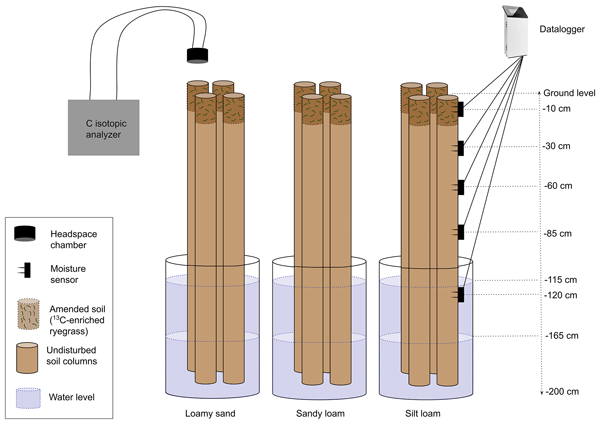
To assess the impact of the groundwater table (GWT) depth on soil moisture and C mineralization, we designed a laboratory setup using 200 cm undisturbed soil columns. Surprisingly, the moisture increase induced by a shallower GWT did not result in enhanced C mineralization. We presume this upward capillary moisture effect was offset by increased C mineralization upon rewetting, particularly noticeable in drier soils when capillary rise affected the topsoil to a lesser extent due to a deeper GWT.
Astrid Françoys, Orly Mendoza, Junwei Hu, Pascal Boeckx, Wim Cornelis, Stefaan De Neve, and Steven Sleutel
SOIL, 11, 121–140, https://doi.org/10.5194/soil-11-121-2025, https://doi.org/10.5194/soil-11-121-2025, 2025
Short summary
Short summary
To assess the impact of the groundwater table (GWT) depth on soil moisture and C mineralization, we designed a laboratory setup using 200 cm undisturbed soil columns. Surprisingly, the moisture increase induced by a shallower GWT did not result in enhanced C mineralization. We presume this upward capillary moisture effect was offset by increased C mineralization upon rewetting, particularly noticeable in drier soils when capillary rise affected the topsoil to a lesser extent due to a deeper GWT.
Sastrika Anindita, Peter Finke, and Steven Sleutel
SOIL, 9, 443–459, https://doi.org/10.5194/soil-9-443-2023, https://doi.org/10.5194/soil-9-443-2023, 2023
Short summary
Short summary
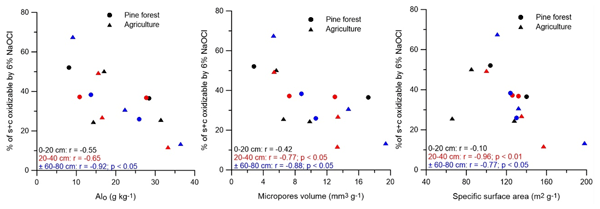
This study investigated how land use, through its impact on soil geochemistry, might indirectly control soil organic carbon (SOC) content in tropical volcanic soils in Indonesia. We analyzed SOC fractions, substrate-specific mineralization, and net priming of SOC. Our results indicated that the enhanced formation of aluminum (hydr)oxides promoted aggregation and physical occlusion of OC, which is consistent with the lesser degradability of SOC in agricultural soils.

Joseph Okello, Marijn Bauters, Hans Verbeeck, Samuel Bodé, John Kasenene, Astrid Françoys, Till Engelhardt, Klaus Butterbach-Bahl, Ralf Kiese, and Pascal Boeckx
Biogeosciences, 20, 719–735, https://doi.org/10.5194/bg-20-719-2023, https://doi.org/10.5194/bg-20-719-2023, 2023
Short summary
Short summary
The increase in global and regional temperatures has the potential to drive accelerated soil organic carbon losses in tropical forests. We simulated climate warming by translocating intact soil cores from higher to lower elevations. The results revealed increasing temperature sensitivity and decreasing losses of soil organic carbon with increasing elevation. Our results suggest that climate warming may trigger enhanced losses of soil organic carbon from tropical montane forests.
Heleen Deroo, Masuda Akter, Samuel Bodé, Orly Mendoza, Haichao Li, Pascal Boeckx, and Steven Sleutel
Biogeosciences, 18, 5035–5051, https://doi.org/10.5194/bg-18-5035-2021, https://doi.org/10.5194/bg-18-5035-2021, 2021
Short summary
Short summary
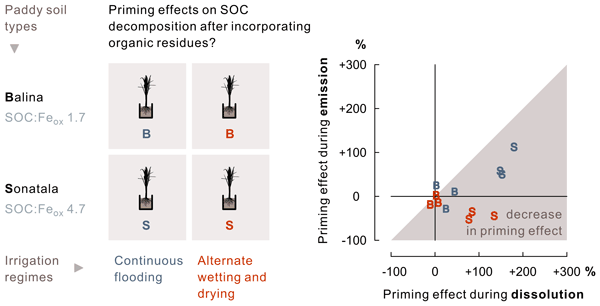
We assessed if and how incorporation of exogenous organic carbon (OC) such as straw could affect decomposition of native soil organic carbon (SOC) under different irrigation regimes. Addition of exogenous OC promoted dissolution of native SOC, partly because of increased Fe reduction, leading to more net release of Fe-bound SOC. Yet, there was no proportionate priming of SOC-derived DOC mineralisation. Water-saving irrigation can retard both priming of SOC dissolution and mineralisation.
Cited articles
Andriulo, A., Mary, B., and Guerif, J.: Modelling soil carbon dynamics with various cropping sequences on the rolling pampas, Agronomie, 19, 365–377, https://doi.org/10.1051/agro:19990504, 1999.
Bingeman, C. W., Varner, J., and Martin, W.: The effect of the addition of organic materials on the decomposition of an organic soil, Soil Sci. Soc. Am. J., 17, 34–38, 1953.
Blagodatskaya, E. V., Blagodatsky, S. A., Anderson, T. H., and Kuzyakov, Y.: Priming effects in Chernozem induced by glucose and N in relation to microbial growth strategies, Appl. Soil Ecol., 37, 95–105, https://doi.org/10.1016/j.apsoil.2007.05.002, 2007.
Carter, M. R. and Gregorich, E. G.: Soil sampling and methods of analysis, 2nd edn., CRC press, Boca Raton (Fla.), https://doi.org/10.1201/9781420005271, 2007.
Craine, J. M., Morrow, C., and Fierer, N.: Microbial nitrogen limitation increases decomposition, Ecology, 88, 2105–2113, https://doi.org/10.1890/06-1847.1, 2007.
De Gryze, S., Six, J., Brits, C., and Merckx, R.: A quantification of short-term macroaggregate dynamics: influences of wheat residue input and texture, Soil Biol. Biochem., 37, 55–66, https://doi.org/10.1016/j.soilbio.2004.07.024, 2005.
De Neve, S., Pannier, J., and Hofman, G.: Temperature effects on C-and N-mineralization from vegetable crop residues, Plant Soil, 181, 25–30, 1996.
Don, A., Rödenbeck, C., and Gleixner, G.: Unexpected control of soil carbon turnover by soil carbon concentration, Environ. Chem. Lett., 11, 407–413, https://doi.org/10.1007/s10311-013-0433-3, 2013.
Dungait, J. A., Hopkins, D. W., Gregory, A. S., and Whitmore, A. P.: Soil organic matter turnover is governed by accessibility not recalcitrance, Glob. Change Biol., 18, 1781–1796, https://doi.org/10.1111/j.1365-2486.2012.02665.x, 2012.
Ekschmitt, K., Liu, M., Vetter, S., Fox, O., and Wolters, V.: Strategies used by soil biota to overcome soil organic matter stability – why is dead organic matter left over in the soil?, Geoderma, 128, 167–176, https://doi.org/10.1016/j.geoderma.2004.12.024, 2005.
Fiedler, S., Vepraskas, M. J., and Richardson, J. L.: Soil Redox Potential: Importance, Field Measurements, and Observations, in: Advances in Agronomy, vol. 94, Elsevier, 1–54, https://doi.org/10.1016/S0065-2113(06)94001-2, 2007.
Garnier, P., Cambier, C., Bousso, M., Masse, D., Chenu, C., and Recous, S.: Modeling the influence of soil-plant residue contact on carbon mineralization: Comparison of a compartmental approach and a 3D spatial approach, Soil Biol. Biochem., 40, 2754–2761, https://doi.org/10.1016/j.soilbio.2008.07.032, 2008.
Guenet, B., Neill, C., Bardoux, G., and Abbadie, L.: Is there a linear relationship between priming effect intensity and the amount of organic matter input?, Appl. Soil Ecol., 46, 436–442, https://doi.org/10.1016/j.apsoil.2010.09.006, 2010.
Husson, O.: Redox potential (Eh) and pH as drivers of soil/plant/microorganism systems: a transdisciplinary overview pointing to integrative opportunities for agronomy, Plant Soil, 362, 389–417, https://doi.org/10.1007/s11104-012-1429-7, 2013.
Jenkinson, D. S., Poulton, P. R., and Bryant, C.: The turnover of organic carbon in subsoils. Part 1. Natural and bomb radiocarbon in soil profiles from the Rothamsted long-term field experiments, Eur. J. Soil Sci., 59, 391–399, https://doi.org/10.1111/j.1365-2389.2008.01025.x, 2008.
Joergensen, R. G.: The fumigation-extraction method to estimate soil microbial biomass: Calibration of the kEC value, Soil Biol. Biochem., 28, 25–31, https://doi.org/10.1016/0038-0717(95)00102-6, 1996.
Kästner, M., Miltner, A., Thiele-Bruhn, S., and Liang, C.: Microbial Necromass in Soils—Linking Microbes to Soil Processes and Carbon Turnover, Front. Environ. Sci., 9, 756378, https://doi.org/10.3389/fenvs.2021.756378, 2021.
Keeling, C. D.: The concentration and isotopic abundances of atmospheric carbon dioxide in rural areas, Geochim. Cosmochim. Ac., 13, 322–334, 1958.
Keiluweit, M., Wanzek, T., Kleber, M., Nico, P., and Fendorf, S.: Anaerobic microsites have an unaccounted role in soil carbon stabilization, Nat. Commun., 8, 1771, https://doi.org/10.1038/s41467-017-01406-6, 2017.
Kögel-Knabner, I., Guggenberger, G., Kleber, M., Kandeler, E., Kalbitz, K., Scheu, S., Eusterhues, K., and Leinweber, P.: Organo-mineral associations in temperate soils: Integrating biology, mineralogy, and organic matter chemistry, J. Plant Nutr. Soil Sci., 171, 61–82, https://doi.org/10.1002/jpln.200700048, 2008.
Kuka, K., Franko, U., and Rühlmann, J.: Modelling the impact of pore space distribution on carbon turnover, Ecol. Model., 208, 295–306, https://doi.org/10.1016/j.ecolmodel.2007.06.002, 2007.
Kutsch, W. L. (Ed.): Soil carbon dynamics: an integrated methodology, Repr. with corr., Cambridge University Press, Cambridge, 288 pp., ISBN 978-0-521-86561-6, 2012.
Kuzyakov, Y. and Domanski, G.: Carbon input by plants into the soil. Review, J. Plant Nutr. Soil Sci., 163, 421–431, https://doi.org/10.1002/1522-2624(200008)163:4<421::AID-JPLN421>3.0.CO;2-R, 2000.
Lehmann, J., Hansel, C. M., Kaiser, C., Kleber, M., Maher, K., Manzoni, S., Nunan, N., Reichstein, M., Schimel, J. P., Torn, M. S., Wieder, W. R., and Kögel-Knabner, I.: Persistence of soil organic carbon caused by functional complexity, Nat. Geosci., 13, 529–534, https://doi.org/10.1038/s41561-020-0612-3, 2020.
Li, C., Frolking, S., Crocker, G. J., Grace, P. R., Klír, J., Körchens, M., and Poulton, P. R.: Simulating trends in soil organic carbon in long-term experiments using the DNDC model, Geoderma, 81, 45–60, 1997.
Liang, C., Amelung, W., Lehmann, J., and Kästner, M.: Quantitative assessment of microbial necromass contribution to soil organic matter, Glob. Change Biol., 25, 3578–3590, https://doi.org/10.1111/gcb.14781, 2019.
Liu, X.-J. A., Sun, J., Mau, R. L., Finley, B. K., Compson, Z. G., Van Gestel, N., Brown, J. R., Schwartz, E., Dijkstra, P., and Hungate, B. A.: Labile carbon input determines the direction and magnitude of the priming effect, Appl. Soil Ecol., 109, 7–13, https://doi.org/10.1016/j.apsoil.2016.10.002, 2017.
Mendoza, O., De Neve, S., Deroo, H., Li, H., and Sleutel, S.: Do interactions between application rate and native soil organic matter content determine the degradation of exogenous organic carbon?, Soil Biol. Biochem., 164, 108473, https://doi.org/10.1016/j.soilbio.2021.108473, 2022a.
Mendoza, O., De Neve, S., Deroo, H., and Sleutel, S.: Mineralisation of ryegrass and soil organic matter as affected by ryegrass application doses and changes in soil structure, Biol. Fertil. Soils, 58, 679–691, https://doi.org/10.1007/s00374-022-01654-9, 2022b.
Paustian, K., Andren, O., Janzen, H., Lal, R., Smith, P., Tian, G., Tiessen, H., Van Noordwijk, M., and Woomer, P.: Agricultural soils as a sink to mitigate CO2 emissions, Soil Use Manage., 13, 230–244, 1997.
Paustian, K., Larson, E., Kent, J., Marx, E., and Swan, A.: Soil C Sequestration as a Biological Negative Emission Strategy, Front. Clim., 1, 8, https://doi.org/10.3389/fclim.2019.00008, 2019.
Powlson, D. S., Smith, P., and Smith, J. U.: Evaluation of soil organic matter models: using existing long-term datasets, Springer Science & Business Media, https://doi.org/10.1007/978-3-642-61094-3, 2013.
Reddy, K. R. and DeLaune, R. D.: Biogeochemistry of wetlands: science and applications, CRC Press, Boca Raton, FL, https://doi.org/10.1201/9780203491454, 2008.
Riggers, C., Poeplau, C., Don, A., Frühauf, C., and Dechow, R.: How much carbon input is required to preserve or increase projected soil organic carbon stocks in German croplands under climate change?, Plant Soil, 460, 417–433, 2021.
Rohe, L., Apelt, B., Vogel, H.-J., Well, R., Wu, G.-M., and Schlüter, S.: Denitrification in soil as a function of oxygen availability at the microscale, Biogeosciences, 18, 1185–1201, https://doi.org/10.5194/bg-18-1185-2021, 2021.
Schjønning, P., Thomsen, I. K., Møberg, J. P., de Jonge, H., Kristensen, K., and Christensen, B. T.: Turnover of organic matter in differently textured soils: I. Physical characteristics of structurally disturbed and intact soils, Geoderma, 89, 177–198, 1999.
Schlüter, S., Leuther, F., Albrecht, L., Hoeschen, C., Kilian, R., Surey, R., Mikutta, R., Kaiser, K., Mueller, C. W., and Vogel, H.-J.: Microscale carbon distribution around pores and particulate organic matter varies with soil moisture regime, Nat. Commun., 13, 1–14, 2022.
Schneckenberger, K., Demin, D., Stahr, K., and Kuzyakov, Y.: Microbial utilization and mineralization of [14C]glucose added in six orders of concentration to soil, Soil Biol. Biochem., 40, 1981–1988, https://doi.org/10.1016/j.soilbio.2008.02.020, 2008.
Shahbaz, M., Kuzyakov, Y., and Heitkamp, F.: Decrease of soil organic matter stabilization with increasing inputs: Mechanisms and controls, Geoderma, 304, 76–82, https://doi.org/10.1016/j.geoderma.2016.05.019, 2017a.
Shahbaz, M., Kuzyakov, Y., Sanaullah, M., Heitkamp, F., Zelenev, V., Kumar, A., and Blagodatskaya, E.: Microbial decomposition of soil organic matter is mediated by quality and quantity of crop residues: mechanisms and thresholds, Biol. Fert. Soils, 53, 287–301, https://doi.org/10.1007/s00374-016-1174-9, 2017b.
Smith, P., Soussana, J., Angers, D., Schipper, L., Chenu, C., Rasse, D. P., Batjes, N. H., Van Egmond, F., McNeill, S., Kuhnert, M., Arias-Navarro, C., Olesen, J. E., Chirinda, N., Fornara, D., Wollenberg, E., Álvaro-Fuentes, J., Sanz-Cobena, A., and Klumpp, K.: How to measure, report and verify soil carbon change to realize the potential of soil carbon sequestration for atmospheric greenhouse gas removal, Glob. Change Biol., 26, 219–241, https://doi.org/10.1111/gcb.14815, 2020.
Vleeshouwers, L. M. and Verhagen, A.: Carbon emission and sequestration by agricultural land use: a model study for Europe, Glob. Change Biol., 8, 519–530, https://doi.org/10.1046/j.1365-2486.2002.00485.x, 2002.
Xiao, C., Guenet, B., Zhou, Y., Su, J., and Janssens, I. A.: Priming of soil organic matter decomposition scales linearly with microbial biomass response to litter input in steppe vegetation, Oikos, 124, 649–657, https://doi.org/10.1111/oik.01728, 2015.
Zomer, R. J., Bossio, D. A., Sommer, R., and Verchot, L. V.: Global Sequestration Potential of Increased Organic Carbon in Cropland Soils, Sci. Rep., 7, 15554, https://doi.org/10.1038/s41598-017-15794-8, 2017.
Short summary
Farmers frequently apply fresh organic matter such as crop residues to soil to boost its carbon content. Yet, one burning question remains: does the quantity of applied organic matter affect its decomposition and that of native soil organic matter? Our experiment suggests that smaller application doses might deplete soil organic matter more rapidly, at least in coarser-textured soil. In contrast, applying intermediate or high doses might be a promising strategy for maintaining it.
Farmers frequently apply fresh organic matter such as crop residues to soil to boost its carbon...


