
Articles | Volume 11, issue 1
https://doi.org/10.5194/soil-11-193-2025
© Author(s) 2025. This work is distributed under
the Creative Commons Attribution 4.0 License.
https://doi.org/10.5194/soil-11-193-2025
© Author(s) 2025. This work is distributed under
the Creative Commons Attribution 4.0 License.
On the risks of good intentions and poor evidence – comment on “Back to the future? Conservative grassland management can preserve soil health in the changing landscapes of Uruguay” by Säumel et al. (2023)

Instituto Nacional de Investigación Agropecuaria, INIA – La Estanzuela, Colonia, Uruguay
Instituto de Ecología y Ciencias Ambientales, Facultad de Ciencias, Universidad de la República, Montevideo, Uruguay
LART-IFEVA and Facultad de Agronomía, Universidad de Buenos Aires, CONICET, Buenos Aires, Argentina
Luis López-Mársico
Instituto de Ecología y Ciencias Ambientales, Facultad de Ciencias, Universidad de la República, Montevideo, Uruguay
Pablo Baldassini
Instituto Nacional de Investigación Agropecuaria, INIA – La Estanzuela, Colonia, Uruguay
LART-IFEVA and Facultad de Agronomía, Universidad de Buenos Aires, CONICET, Buenos Aires, Argentina
Felipe Lezama
Departamento de Sistemas Ambientales, Facultad de Agronomía, Universidad de la República, Montevideo, Uruguay
Bruno Bazzoni
LART-IFEVA and Facultad de Agronomía, Universidad de Buenos Aires, CONICET, Buenos Aires, Argentina
Luciana Staiano
LART-IFEVA and Facultad de Agronomía, Universidad de Buenos Aires, CONICET, Buenos Aires, Argentina
Agustin Nuñez
Instituto Nacional de Investigación Agropecuaria, INIA – La Estanzuela, Colonia, Uruguay
Anaclara Guido
Instituto de Ecología y Ciencias Ambientales, Facultad de Ciencias, Universidad de la República, Montevideo, Uruguay
Cecilia Ríos
Instituto de Ecología y Ciencias Ambientales, Facultad de Ciencias, Universidad de la República, Montevideo, Uruguay
Andrea Tommasino
Instituto de Ecología y Ciencias Ambientales, Facultad de Ciencias, Universidad de la República, Montevideo, Uruguay
Federico Gallego
Instituto de Ecología y Ciencias Ambientales, Facultad de Ciencias, Universidad de la República, Montevideo, Uruguay
Fabiana Pezzani
Departamento de Sistemas Ambientales, Facultad de Agronomía, Universidad de la República, Montevideo, Uruguay
Gonzalo Camba Sans
Instituto de Ecología y Ciencias Ambientales, Facultad de Ciencias, Universidad de la República, Montevideo, Uruguay
Andrés Quincke
Instituto Nacional de Investigación Agropecuaria, INIA – La Estanzuela, Colonia, Uruguay
Santiago Baeza
Departamento de Sistemas Ambientales, Facultad de Agronomía, Universidad de la República, Montevideo, Uruguay
Gervasio Piñeiro
LART-IFEVA and Facultad de Agronomía, Universidad de Buenos Aires, CONICET, Buenos Aires, Argentina
Departamento de Sistemas Ambientales, Facultad de Agronomía, Universidad de la República, Montevideo, Uruguay
Walter Baethgen
International Research Institute for Climate and Society (IRI), Columbia University, Palisades, NY, USA
Note on duplicated preprint: although EGUsphere's policy does not support double preprinting, this preprint has also been posted on OSF Preprints in parallel to the EGUsphere preprint.
Related authors
No articles found.
Maximiliano González-Sosa, Carlos A. Sierra, Juan A. Quincke, Walter E. Baethgen, Susan Trumbore, and M. Virginia Pravia
EGUsphere, https://doi.org/10.5194/egusphere-2025-6451, https://doi.org/10.5194/egusphere-2025-6451, 2026
This preprint is open for discussion and under review for SOIL (SOIL).
Short summary
Short summary
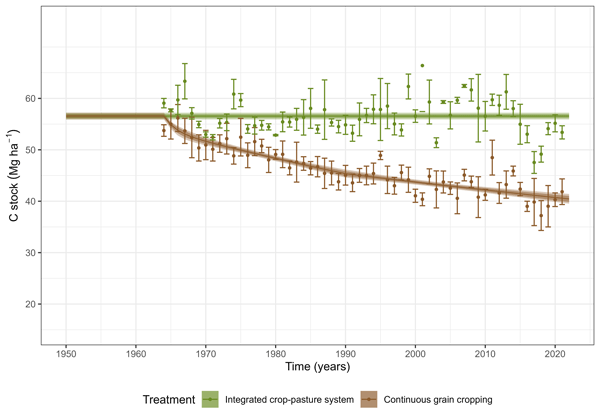
Through the analysis and modeling of SOC and isotope (Δ14C and δ13C) data from contrasting treatments in a 60-year agricultural experiment, we found that mineral-associated SOC is highly isolated from recent atmospheric CO₂ inputs, with isolation increasing with soil depth. Integrated crop-pasture rotational systems have not been able to sequester substantial new carbon along the profile, particularly at depth, but they are relevant to preserve the natural carbon legacy of these soils.
Maximiliano González-Sosa, Carlos A. Sierra, J. Andrés Quincke, Walter E. Baethgen, Susan Trumbore, and M. Virginia Pravia
SOIL, 10, 467–486, https://doi.org/10.5194/soil-10-467-2024, https://doi.org/10.5194/soil-10-467-2024, 2024
Short summary
Short summary
Based on an approach that involved soil organic carbon (SOC) monitoring, radiocarbon measurement in bulk soil, and incubations from a long-term 60-year experiment, it was concluded that the avoidance of old carbon losses in the integrated crop–pasture systems is the main reason that explains their greater carbon storage capacities compared to continuous cropping. A better understanding of these processes is essential for making agronomic decisions to increase the carbon sequestration capacity.
Cited articles
Altesor, A., Gallego, F., Ferrón, M., Pezzani, F., López-Mársico, L., Lezama, F., Baeza, S., Pereira, M., Costa, B., and Paruelo, J. M.: Inductive approach to build state-and-transition models for Uruguayan Grasslands, Rangeland Ecol. Manag., 72, 1005–1016, https://doi.org/10.1016/j.rama.2019.06.004, 2019.
Baeza, S. and Paruelo, J. M.: Land use/land cover change (2000–2014) in the Rio de la Plata grasslands: An analysis based on MODIS NDVI time series, Remote Sensing, 12, 381, https://doi.org/10.3390/rs12030381, 2020.
Baeza, S., Rama, G., and Lezama F.: Cartografía de los pastizales naturales en las regiones geomorfológicas de Uruguay predominantemente ganaderas. Ampliación y actualización, in: Bases ecológicas y tecnológicas para el manejo de pastizales II, edited by: Altesor, A., López-Mársico, L., and Paruelo, J. M., FPTA - INIA, Montevideo, 26–47, ISBN 978-9974-38-412-5, 2019 (in Spanish).
Baeza, S., Vélez-Martin, E., De Abelleyra, D., Banchero, S., Gallego, F., Schirmbeck, J., Veron, S., Vallejos, M., Weber, E., Oyarzabal, M., Barbieri, A., Petek, M., Guerra Lara, M., Sarrailhé, S. S., Baldi, G., Bagnato, C., Bruzzone, L., Ramos, S., and Hasenack, H.: Two decades of land cover mapping in the Río de la Plata grassland region: The MapBiomas Pampa initiative, Remote Sensing Applications: Society and Environment, 28, 100834, https://doi.org/10.1016/j.rsase.2022.100834, 2022.
Baldassini, P., Baethgen, W., Camba-Sans, G. H., Quincke, A., Pravia, M. V., Terra, J., Macedo, I., Piñeiro, G., and Paruelo, J. M.: Carbon stocks and potential sequestration of Uruguayan soils. A road map to a comprehensive characterization of temporal and spatial changes to assess Carbon footprint, Frontiers in Sustainable Food Systems, 7, 1045734, https://doi.org/10.3389/fsufs.2023.1045734, 2023.
Beretta-Blanco, A., Pérez, O., and Carrasco-Letelier, L.: Soil quality decrease over 13 years of agricultural production, Nutr. Cycl. Agroecosys., 114, 45–55, https://doi.org/10.1007/s10705-019-09990-3, 2019.
Céspedes-Payret, C., Piñeiro, G., Gutiérrez, O., and Panario, D.: Land use change in a temperate grassland soil: Afforestation effects on chemical properties and their ecological and mineralogical implication, Sci. Total Environ., 438, 549–557, https://doi.org/10.1016/j.scitotenv.2012.08.075, 2012.
Chung, H., Grove, J. H., and Six, J.: Indications for soil carbon saturation in a temperate agroecosystem, Soil Sci. Soc. Am. J., 72, 1132–1139, https://doi.org/10.2136/sssaj2007.0265, 2008.
Feng, W., Plante, A. F., and Six, J.: Improving estimates of maximal organic carbon stabilization by fine soil particles, Biogeochemistry, 112, 81–93, https://doi.org/10.1007/s10533-011-9679-7, 2013.
Gallego, F., López-Mársico, L., Tommasino, A., Altesor, A., Casás, M., and Rodríguez, C.: Legacy effects after seven years of afforestation with Pinus taeda in a natural grassland, Restor. Ecol., 31, e13865, https://doi.org/10.1111/rec.13865, 2023.
Gifford, R. M. and Roderick, M. L.: Soil carbon stocks and bulk density: spatial or cumulative mass coordinates as a basis of expression?, Glob. Change Biol., 9, 1507–1514, https://doi.org/10.1046/j.1365-2486.2003.00677.x, 2003.
Grahmann, K., Dellepiane, V. R., Terra, J. A., and Quincke, J. A.: Long-term observations in contrasting crop-pasture rotations over half a century: statistical analysis of chemical soil properties and implications for soil sampling frequency, Agr. Ecosyst. Environ., 287, 106710, https://doi.org/10.1016/j.agee.2019.106710, 2020.
Hassink, J.: The capacity of soils to preserve organic C and N by their association with clay and silt particles, Plant Soil, 191, 77–87, https://doi.org/10.1023/A:1004213929699, 1997.
Hernández, J., del Pino, A., Vance, E. D., Califra, Á., Del Giorgio, F., Martínez, L., and González-Barrios, P.: Eucalyptus and Pinus stand density effects on soil carbon sequestration, Forest Ecol. Manag., 368, 28–38, 2016.
Jobbágy, E. G. and Jackson, R. B.: Patterns and mechanisms of soil acidification in the conversion of grasslands to forests, Biogeochemistry, 64, 205–229, https://doi.org/10.1023/A:1024985629259, 2003.
Kehoe, L., dos Reis, T. N., Meyfroidt, P., Bager, S., Seppelt, R., Kuemmerle, T., Berenguer, E., Clark, M., Frankel Davis, K., zu Ermgassen, E. K. H. J., Farrell, K. N., Friis, C., Haberl, H., Kastner, T., Murtough, K. L., Persson, U. M., Romero-Muñoz, A., O’Connell, C., Valeska Schäfer, V., Virah-Sawmy, M., le Polain de Waroux, Y., and Kiesecker, J.: Inclusion, transparency, and enforcement: How the EU-Mercosur trade agreement fails the sustainability test, One Earth, 3, 268–272, 2020.
Krull, E., Baldock, J., and Skjemstad, J.: Soil texture effects on decomposition and soil carbon storage. In Net ecosystem exchange CRC workshop proceedings, 103-110, Citeseer, 2001.
Lezama, F. and Paruelo, J. M.: Regional Assessment of Stocking Rate Effects on Uruguayan Rangelands: A Ranch-Level Study, Rangeland Ecol. Manag., 82, 58–65, https://doi.org/10.1016/j.rama.2022.02.005, 2022.
Lezama, F., Baeza, S., Altesor, A., Cesa, A., Chaneton, E. J., and Paruelo, J. M.: Variation of grazing-induced vegetation changes across a large-scale productivity gradient, J. Veg. Sci., 25, 8–21, https://doi.org/10.1111/jvs.12053, 2014.
Lezama, F., Pereira, M., Altesor, A., and Paruelo, J. M.: Grasslands of Uruguay: classification based on vegetation plots, Phytocoenologia, 49, 211–229, https://doi.org/10.1127/phyto/2019/0215, 2019.
López-Mársico, L., Altesor, A., Oyarzabal, M., Baldassini, P., and Paruelo, J. M.: Grazing increases below-ground biomass and net primary production in a temperate grassland, Plant Soil, 392, 155–162. https://doi.org/10.1007/s11104-015-2452-2, 2015.
López-Mársico, L., Oyarzabal, M., Altesor, A., and Paruelo, J. M.: Grazing exclusion reduces below-ground biomass of temperate subhumid grasslands of South America: A meta-analysis and a database, Austral Ecol., 49, e13304, https://doi.org/10.1111/aec.13304, 2023.
Mayzelle, M. M., Krusor, M. L., Lajtha, K., Bowden, R. D., and Six, J.: Effects of detrital inputs and roots on carbon saturation deficit of a temperate forest soil, Soil Sci. Soc. Am. J., 78, S76–S83, https://doi.org/10.2136/sssaj2013.09.0415nafsc, 2014.
Overbeck, G. E., Vélez-Martin, E., da Silva Menezes, L., Anand, M., Baeza, S., Carlucci, M. B., Dechoum, M. S., Durigan, G., Fidelis, A., Guido, A., Freire Moro, M., Rodrigues Munhoz, C. B., Reginato, M., Schütz Rodrigues, R., Rosenfield, M. F., Sampaio, A. B., Barbosa da Silva, F. H., Silveira, F. A. O., Sosinski, E. E., Staude, I. R., Temperton, V. M., Turchetto, C., Veldman, J. W., Viana, P. L., Zappi, D. C., and Müller, S. C.: Placing Brazil's grasslands and savannas on the map of science and conservation, Perspect. Plant. Ecol., 56, 125687, https://doi.org/10.1016/j.ppees.2022.125687, 2022.
Parton, W. J., Ojima, D. S., Cole, C. V., and Schimel, D. S.: A general model for soil organic matter dynamics: sensitivity to litter chemistry, texture and management, Quantitative Modeling of Soil Forming Processes, 39, 147–167, https://doi.org/10.2136/sssaspecpub39.c9, 1994.
Paruelo, J. M., Oesterheld, M., Altesor, A., Piñeiro, G., Rodríguez, C., Baldassini, P., Irisarri, G., López-Mársico, L., and Pillar, V. D.: Grazers and fires: Their role in shaping the structure and functioning of the Río de la Plata Grasslands, Ecología Austral, 32, 784–805, https://doi.org/10.25260/EA.22.32.2.1.1880, 2022.
Perelman, S. B., Garibald, L. A., and Tognetti, P. M. (Eds.): Experimentación y modelos, Editorial Facultad de Agronomía, Ciudad Autónoma de Buenos Aires, Argentina, 356 pp, ISBN: 978-987-3738-22-7, 2019.
Piñeiro, G., Paruelo, J. M., Jobbágy, E. G., Jackson, R. B., and Oesterheld, M.: Grazing effects on belowground C and N stocks along a network of cattle exclosures in temperate and subtropical grasslands of South America, Global Biogeochem. Cy., 23, GB2003, https://doi.org/10.1029/2007GB003168, 2009.
Piñeiro, G., Paruelo, J. M., Oesterheld, M., and Jobbágy, E. G.: Pathways of grazing effects on soil organic carbon and nitrogen, Rangeland Ecol. Manag., 63, 109–119, https://doi.org/10.2111/08-255.1, 2010.
Pravia, M. V., Kemanian, A. R., Terra, J. A., Shi, Y., Macedo, I., and Goslee, S.: Soil carbon saturation, productivity, and carbon and nitrogen cycling in crop-pasture rotations, Agr. Syst., 171, 13–22, 2019.
Roca, N.: Heavy metal background levels in rural soils: a case study in Pampean soils (Argentina), Ciencia del Suelo, 33, 283– 292, http://www.scielo.org.ar/pdf/cds/v33n2/v33n2a12.pdf (last access: 15 May 2021), 2015.
Rubio, V., Quincke, A., and Ernst, O.: Deep tillage and nitrogen do not remediate cumulative soil deterioration effects of continuous cropping, Agron. J., 113, 5584–5596, 2021.
Säumel, I., Ramírez, L. R., Tietjen, S., Barra, M., and Zagal, E.: Back to the future? Conservative grassland management can preserve soil health in the changing landscapes of Uruguay, SOIL, 9, 425–442, https://doi.org/10.5194/soil-9-425-2023, 2023.
Schimel, D. S., Braswell, B. H., Holland, E. A., McKeown, R., Ojima, D. S., Painter, T. H., Parton, W. J., and Townsend, A. R.: Climatic, edaphic, and biotic controls over storage and turnover of carbon in soils, Global Biogeochem. Cy., 8, 279–293, https://doi.org/10.1029/94GB00993, 1994.
Staiano, L., Sans, G. H. C., Baldassini, P., Gallego, F., Texeira, M. A., and Paruelo, J. M.: Putting the Ecosystem Services idea at work: Applications on impact assessment and territorial planning, Environmental Development, 38, 100570, https://doi.org/10.1016/j.envdev.2020.100570, 2021.
Stewart, C. E., Paustian, K., Conant, R. T., Plante, A. F., and Six, J.: Soil carbon saturation: concept, evidence and evaluation, Biogeochemistry, 86, 19–31, https://doi.org/10.1007/s10533-007-9140-0, 2007.
Veldman, J. W., Overbeck, G. E., Negreiros, D., Mahy, G., Le Stradic, S., Fernandes, G. W., Durigan, G., Buisson, E., Putz, F. E., and Bond, W. J.: Where tree planting and forest expansion are bad for biodiversity and ecosystem services, BioScience, 65, 1011–1018, https://doi.org/10.1093/biosci/biv118, 2015.
Veldman, J. W., Aleman, J. C., Alvarado, S. T., Anderson, T. M., Archibald, S., Bond, W. J., Boutton, T. W., Buchmann, N., Buisson, E., Canadell, J. G., Dechoum, M. d. S., Diaz-Toribio, M. H., Durigan, G., Ewel, J. J., Fernandes, G. W., Fidelis, A., Fleischman, F., Good, S. P., Griffith, D. M., Hermann, J.-M., Hoffmann, W. A., Le Stradic, S., Lehmann, C. E. R., Mahy, G., Nerlekar, A. N., Nippert, J. B., Noss, R. F., Osborne, C. P., Overbeck, G. E., Parr, C. L., Pausas, J. G., Pennington, R. T., Perring, M. P., Putz, F. E., Ratnam, J., Sankaran, M., Schmidt, I. B., Schmitt, C. B., Silveira, F. A. O., Staver, A. C., Stevens, N., Still, C. J., Strömberg, C. A. E., Temperton, V. M., Varner, J. M., and Zaloumis, N. P.: Comment on “The global tree restoration potential”, Science, 366, eaay7976, https://doi.org/10.1126/science.aay7976, 2019.
Download
Please read the editorial note first before accessing the article.
- Article
(351 KB) - Full-text XML
Short summary
In this article, we make comments on some methodological issues and on the general approach of the paper
Back to the future? Conservative grassland management can preserve soil health in the changing landscapes of Uruguay(Säumel et al., 2023; https://doi.org/10.5194/soil-9-425-2023). We identified several design and methodological problems in the aforementioned publication that may induce potential misinterpretations.
In this article, we make comments on some methodological issues and on the general approach of...