
Articles | Volume 3, issue 4
https://doi.org/10.5194/soil-3-177-2017
© Author(s) 2017. This work is distributed under
the Creative Commons Attribution 3.0 License.
the Creative Commons Attribution 3.0 License.
https://doi.org/10.5194/soil-3-177-2017
© Author(s) 2017. This work is distributed under
the Creative Commons Attribution 3.0 License.
the Creative Commons Attribution 3.0 License.
Original research article
| 
23 Oct 2017
Original research article |
| 23 Oct 2017
Quantitative imaging of the 3-D distribution of cation adsorption sites in undisturbed soil
Department of Soil and Environment, Swedish University of Agricultural
Sciences, P.O. Box 7014, 750 07 Uppsala, Sweden
Department of Plant and Environmental Sciences, University of
Copenhagen, Thorvaldsensvej 40, 1871 Frederiksberg C, Denmark
Bjarne W. Strobel
Department of Plant and Environmental Sciences, University of
Copenhagen, Thorvaldsensvej 40, 1871 Frederiksberg C, Denmark
Jon Petter Gustafsson
Department of Soil and Environment, Swedish University of Agricultural
Sciences, P.O. Box 7014, 750 07 Uppsala, Sweden
John Koestel
Department of Soil and Environment, Swedish University of Agricultural
Sciences, P.O. Box 7014, 750 07 Uppsala, Sweden
Related authors
Hannes Keck, Laurence Strubbe, Paul M. Magyar, Adriano Joss, Andreas Froemelt, André Kupferschmid, Klaus-Holger Knorr, and Joachim Mohn
EGUsphere, https://doi.org/10.5194/egusphere-2026-857, https://doi.org/10.5194/egusphere-2026-857, 2026
Short summary
Short summary
We monitored nitrous oxide in a pilot wastewater treatment plant in real time to understand how microbes produce and remove this greenhouse gas. We designed and tested a laser-based analytical setup, with which we were able to show that denitrification is the main source of nitrous oxide emissions and that low oxygen concentrations enhances nitrous oxide removal. Our approach offers a new way to monitor the wastewater treatment processes and to cut climate-relevant nitrous oxide emissions.
Mosisa Tujuba Wakjira, Renske Hijbeek, Joost van Heerwaarden, John Koestel, Sara Bonetti, Johan Six, and Katrien Descheemaeker
EGUsphere, https://doi.org/10.5194/egusphere-2026-2816, https://doi.org/10.5194/egusphere-2026-2816, 2026
This preprint is open for discussion and under review for SOIL (SOIL).
Short summary
Short summary
Nowadays, minimizing agricultural soil tillage is widely promoted but often leads to lower crop yields. This study combines experimental evidence globally to identify soil-related causes of these yield declines. Results show that minimized tillage, especially without leaving crop residues on the field, can cause soil compaction, limiting root growth and the movement of air and water needed by crops. This suggests that conservation agriculture should only be applied where suitable.
Hannes Keck, Laurence Strubbe, Paul M. Magyar, Adriano Joss, Andreas Froemelt, André Kupferschmid, Klaus-Holger Knorr, and Joachim Mohn
EGUsphere, https://doi.org/10.5194/egusphere-2026-857, https://doi.org/10.5194/egusphere-2026-857, 2026
Short summary
Short summary
We monitored nitrous oxide in a pilot wastewater treatment plant in real time to understand how microbes produce and remove this greenhouse gas. We designed and tested a laser-based analytical setup, with which we were able to show that denitrification is the main source of nitrous oxide emissions and that low oxygen concentrations enhances nitrous oxide removal. Our approach offers a new way to monitor the wastewater treatment processes and to cut climate-relevant nitrous oxide emissions.
Tobias Karl David Weber, Lutz Weihermüller, Attila Nemes, Michel Bechtold, Aurore Degré, Efstathios Diamantopoulos, Simone Fatichi, Vilim Filipović, Surya Gupta, Tobias L. Hohenbrink, Daniel R. Hirmas, Conrad Jackisch, Quirijn de Jong van Lier, John Koestel, Peter Lehmann, Toby R. Marthews, Budiman Minasny, Holger Pagel, Martine van der Ploeg, Shahab Aldin Shojaeezadeh, Simon Fiil Svane, Brigitta Szabó, Harry Vereecken, Anne Verhoef, Michael Young, Yijian Zeng, Yonggen Zhang, and Sara Bonetti
Hydrol. Earth Syst. Sci., 28, 3391–3433, https://doi.org/10.5194/hess-28-3391-2024, https://doi.org/10.5194/hess-28-3391-2024, 2024
Short summary
Short summary
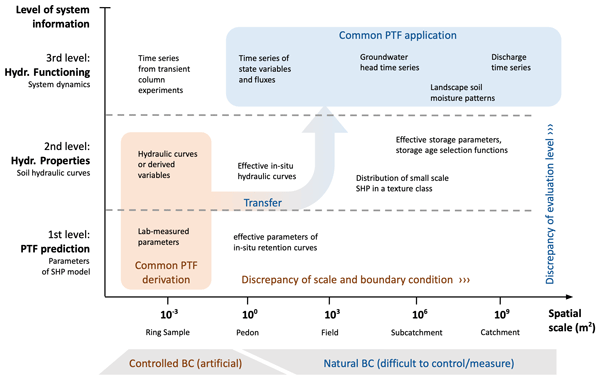
Pedotransfer functions (PTFs) are used to predict parameters of models describing the hydraulic properties of soils. The appropriateness of these predictions critically relies on the nature of the datasets for training the PTFs and the physical comprehensiveness of the models. This roadmap paper is addressed to PTF developers and users and critically reflects the utility and future of PTFs. To this end, we present a manifesto aiming at a paradigm shift in PTF research.
Gina Garland, John Koestel, Alice Johannes, Olivier Heller, Sebastian Doetterl, Dani Or, and Thomas Keller
SOIL, 10, 23–31, https://doi.org/10.5194/soil-10-23-2024, https://doi.org/10.5194/soil-10-23-2024, 2024
Short summary
Short summary
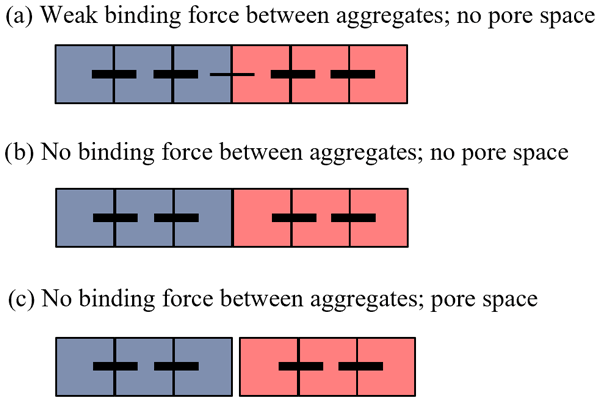
The concept of soil aggregates is hotly debated, leading to confusion about their function or relevancy to soil processes. We propose that the use of conceptual figures showing detached and isolated aggregates can be misleading and has contributed to this skepticism. Here, we conceptually illustrate how aggregates can form and dissipate within the context of undisturbed soils, highlighting the fact that aggregates do not necessarily need to have distinct physical boundaries.
Guillaume Blanchy, Lukas Albrecht, Gilberto Bragato, Sarah Garré, Nicholas Jarvis, and John Koestel
Hydrol. Earth Syst. Sci., 27, 2703–2724, https://doi.org/10.5194/hess-27-2703-2023, https://doi.org/10.5194/hess-27-2703-2023, 2023
Short summary
Short summary
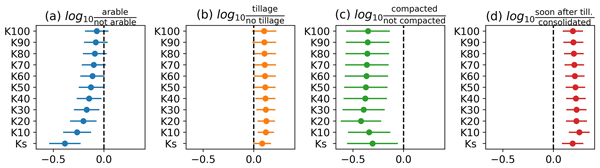
We collated the Open Tension-disk Infiltrometer Meta-database (OTIM). We analysed topsoil hydraulic conductivities at supply tensions between 0 and 100 mm of 466 data entries. We found indications of different flow mechanisms at saturation and at tensions >20 mm. Climate factors were better correlated with near-saturated hydraulic conductivities than soil properties. Land use, tillage system, soil compaction and experimenter bias significantly influenced K to a similar degree to soil properties.
Guillaume Blanchy, Lukas Albrecht, John Koestel, and Sarah Garré
SOIL, 9, 155–168, https://doi.org/10.5194/soil-9-155-2023, https://doi.org/10.5194/soil-9-155-2023, 2023
Short summary
Short summary
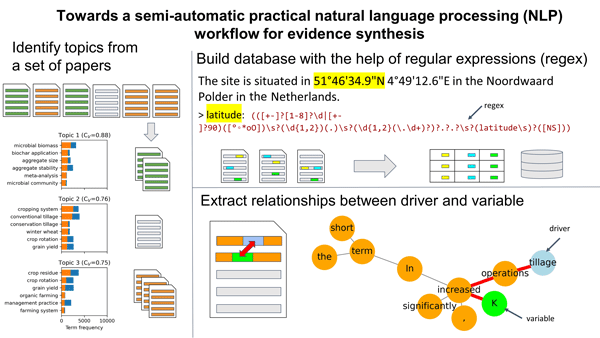
Adapting agricultural practices to future climatic conditions requires us to synthesize the effects of management practices on soil properties with respect to local soil and climate. We showcase different automated text-processing methods to identify topics, extract metadata for building a database and summarize findings from publication abstracts. While human intervention remains essential, these methods show great potential to support evidence synthesis from large numbers of publications.
Cited articles
Ahmed, S., Klassen, T. N., Keyes, S., Daly, M., Jones, D. L., Mavrogordato, M., Sinclair, I., and Roose, T.: Imaging the interaction of roots and phosphate fertiliser granules using 4D X-ray tomography, Plant Soil, 401, 125–134, https://doi.org/10.1007/s11104-015-2425-5, 2016.
Bhattacharyya, K. G. and Gupta, S. S.: Adsorption of a few heavy metals on natural and modified kaolinite and montmorillonite: A review, Adv. Colloid Interface Sci., 140, 114–131, https://doi.org/10.1016/j.cis.2007.12.008, 2008.
Bodek, I., Lyman, W. J., Reehl, W. F., and Rosenblatt, D. H. (Eds.): Environmental inorganic chemistry: properties, processes, and estimation methods, Pergamon Press, New York, 1988.
Bradl, H. B.: Adsorption of heavy metal ions on soils and soils constituents, J. Colloid Interface Sci., 277, 1–18, https://doi.org/10.1016/j.jcis.2004.04.005, 2004.
Bundt, M., Jäggi, M., Blaser, P., Siegwolf, R., and Hagedorn, F.: Carbon and Nitrogen Dynamics in Preferential Flow Paths and Matrix of a Forest Soil, Soil Sci. Soc. Am. J., 65, 1529–1538, https://doi.org/10.2136/sssaj2001.6551529x, 2001a.
Bundt, M., Widmer, F., Pesaro, M., Zeyer, J., and Blaser, P.: Preferential flow paths: biological “hot spots” in soils, Soil Biol. Biochem., 33, 729–738, https://doi.org/10.1016/S0038-0717(00)00218-2, 2001b.
Cardoso, E. J. B. N., Vasconcellos, R. L. F., Bini, D., Miyauchi, M. Y. H., Santos, C. A. dos, Alves, P. R. L., Paula, A. M. de, Nakatani, A. S., Pereira, J. de M., and Nogueira, M. A.: Soil health: looking for suitable indicators. What should be considered to assess the effects of use and management on soil health?, Sci. Agric., 70, 274–289, https://doi.org/10.1590/S0103-90162013000400009, 2013.
Ciesielski, H., Sterckeman, T., Santerne, M., and Willery, J. P.: A comparison between three methods for the determination of cation exchange capacity and exchangeable cations in soils, Agronomie, 17, 9–16, https://doi.org/10.1051/agro:19970102, 1997.
Ellerbrock, R. H. and Gerke, H. H.: Characterizing organic matter of soil aggregate coatings and biopores by Fourier transform infrared spectroscopy, Eur. J. Soil Sci., 55, 219–228, https://doi.org/10.1046/j.1365-2389.2004.00593.x, 2004.
Essington, M. E.: Cation Exchange, in Soil and Water Chemistry: An Integrative Approach, CRC Press LLC, 399–442, 2004a.
Essington, M. E.: Organic Matter in Soil, in Soil and Water Chemistry: An Integrative Approach, CRC Press LLC, 129–180, 2004b.
FAO: Guidelines for soil description, 4th Edn., Food and Agriculture Organization of the United Nations, Rome, 2006.
FAO: World reference base for soil resources 2014 international soil classification system for naming soils and creating legends for soil maps, Food and Agriculture Organization of the United Nations, Rome, 2014.
Figueroa-Diva, R. A., Vasudevan, D., and MacKay, A. A.: Trends in soil sorption coefficients within common antimicrobial families, Chemosphere, 79, 786–793, https://doi.org/10.1016/j.chemosphere.2010.03.017, 2010.
Gevao, B., Semple, K. T., and Jones, K. C.: Bound pesticide residues in soils: a review, Environ. Pollut., 108, 3–14, https://doi.org/10.1016/S0269-7491(99)00197-9, 2000.
Gomes, P. C., Fontes, M. P. F., da Silva, A. G., de S. Mendonça, E., and Netto, A. R.: Selectivity Sequence and Competitive Adsorption of Heavy Metals by Brazilian Soils, Soil Sci. Soc. Am. J., 65, 1115–1121, https://doi.org/10.2136/sssaj2001.6541115x, 2001.
Guo, L. B. and Gifford, R. M.: Soil carbon stocks and land use change: a meta analysis, Glob. Change Biol., 8, 345–360, https://doi.org/10.1046/j.1354-1013.2002.00486.x, 2002.
Hapca, S., Baveye, P. C., Wilson, C., Lark, R. M., and Otten, W.: Three-Dimensional Mapping of Soil Chemical Characteristics at Micrometric Scale by Combining 2D SEM-EDX Data and 3D X-Ray CT Images, PLoS ONE, 10, e0137205, https://doi.org/10.1371/journal.pone.0137205 2015.
Holmqvist, J., Øgaard, A., Öborn, I., Edwards, A., Mattsson, L., and Sverdrup, H.: Application of the PROFILE model to estimate potassium release from mineral weathering in Northern European agricultural soils, Eur. J. Agron., 20, 149–163, https://doi.org/10.1016/S1161-0301(03)00064-9, 2003.
Horn, R.: Die Bedeutung der Aggregierung für die Nährstoffsorption in Böden, J. Plant Nutr. Soil Sci., 150, 13–16, https://doi.org/10.1002/jpln.19871500104, 1987.
International Organization of Standardization (ISO): Determination of Organic and Total Carbon After Dry Combustion (Elementary Analysis) ISO 10694, 1995.
Jaremko, D. and Kalembasa, D.: A Comparison of Methods for the Determination of Cation Exchange Capacity of Soils/Porównanie Metod Oznaczania Pojemności Wymiany Kationów I Sumy Kationów Wymiennych W Glebach, Ecol. Chem. Eng. S, 21, 487–498, https://doi.org/10.2478/eces-2014-0036, 2014.
Jarvis, N. J.: A review of non-equilibrium water flow and solute transport in soil macropores: principles, controlling factors and consequences for water quality, Eur. J. Soil Sci., 58, 523–546, https://doi.org/10.1111/j.1365-2389.2007.00915.x, 2007.
Kabata-Pendias, A.: Trace elements in soils and plants, 4th Edn., CRC Press, Boca Raton, 2010.
Keck, H., Strobel, B. W., Gustafsson, J. P., and Koestel, J.: Data of: Quantitative imaging of the 3-D distribution of cation adsorption sites in undisturbed soil [Data set], Zenodo, http://doi.org/10.5281/zenodo.1020068, 2017.
Kirchmann, H.: Properties and Classification of Soils of the Swedish Long-term Fertility Experiments: I. Sites at Fors and Kungsängen, Acta Agr. Scand., 41, 227–242, https://doi.org/10.1080/00015129109439905, 1991.
Koestel, J.: SoilJ An ImageJ Plugin for the Semiautomatic Processing of Three-Dimensional X-ray Images of Soils, Vadose Zone J., 10.2136/vzj2017.03.0062, 2017.
Koestel, J. and Larsbo, M.: Imaging and quantification of preferential solute transport in soil macropores, Water Resour. Res., 50, 4357–4378, https://doi.org/10.1002/2014WR015351, 2014.
Kögel-Knabner, I., Guggenberger, G., Kleber, M., Kandeler, E., Kalbitz, K., Scheu, S., Eusterhues, K., and Leinweber, P.: Organo-mineral associations in temperate soils: Integrating biology, mineralogy, and organic matter chemistry, J. Plant Nutr. Soil Sci., 171, 61–82, https://doi.org/10.1002/jpln.200700048, 2008.
Larsbo, M., Koestel, J., and Jarvis, N.: Relations between macropore network characteristics and the degree of preferential solute transport, Hydrol. Earth Syst. Sci., 18, 5255–5269, https://doi.org/10.5194/hess-18-5255-2014, 2014.
Lee, S. S., Nagy, K. L., and Fenter, P.: Distribution of barium and fulvic acid at the mica–solution interface using in-situ X-ray reflectivity, Geochim. Cosmochim. Ac., 71, 5763–5781, https://doi.org/10.1016/j.gca.2007.05.031, 2007.
Leue, M., Ellerbrock, R. H., and Gerke, H. H.: DRIFT Mapping of Organic Matter Composition at Intact Soil Aggregate Surfaces, Vadose Zone J., 9, 317–324, https://doi.org/10.2136/vzj2009.0101, 2010.
Limaye, A.: Drishti: a volume exploration and presentation tool, Developments in X-Ray Tomography VIII, 85060X, 2012.
Mairhofer, S., Johnson, J., Sturrock, C. J., Bennett, M. J., Mooney, S. J., and Pridmore, T. P.: Visual tracking for the recovery of multiple interacting plant root systems from X-ray µCT images, Mach. Vis. Appl., 27, 721–734, https://doi.org/10.1007/s00138-015-0733-7, 2016.
Murphy, B. W.: Impact of soil organic matter on soil properties – a review with emphasis on Australian soils, Soil Res., 53, 605, https://doi.org/10.1071/SR14246, 2015.
Naveed, M., Moldrup, P., Schaap, M. G., Tuller, M., Kulkarni, R., Vogel, H.-J., and Wollesen de Jonge, L.: Prediction of biopore- and matrix-dominated flow from X-ray CT-derived macropore network characteristics, Hydrol. Earth Syst. Sci., 20, 4017–4030, https://doi.org/10.5194/hess-20-4017-2016, 2016.
Nielsen, M. H., Petersen, C. T., and Hansen, S.: Identification of efficient transport pathways from the soil surface to field drains by smoke injection: Efficient transport pathways from surface to drains, Eur. J. Soil Sci., 66, 516–524, https://doi.org/10.1111/ejss.12235, 2015.
Pansu, M. and Gautheyrou, J.: Handbook of soil analysis: mineralogical, organic and inorganic methods, Springer, Berlin, Heidelberg, 2006.
Peth, S., Chenu, C., Leblond, N., Mordhorst, A., Garnier, P., Nunan, N., Pot, V., Ogurreck, M., and Beckmann, F.: Localization of soil organic matter in soil aggregates using synchrotron-based X-ray microtomography, Soil Biol. Biochem., 78, 189–194, https://doi.org/10.1016/j.soilbio.2014.07.024, 2014.
Pichtel, J., Kuroiwa, K., and Sawyerr, H. .: Distribution of Pb, Cd and Ba in soils and plants of two contaminated sites, Environ. Pollut., 110, 171–178, https://doi.org/10.1016/S0269-7491(99)00272-9, 2000.
Porfiri, C., Montoya, J. C., Koskinen, W. C., and Azcarate, M. P.: Adsorption and transport of imazapyr through intact soil columns taken from two soils under two tillage systems, Geoderma, 251/252, 1–9, https://doi.org/10.1016/j.geoderma.2015.03.016, 2015.
Preibisch, S., Saalfeld, S., Schindelin, J., and Tomancak, P.: Software for bead-based registration of selective plane illumination microscopy data, Nat. Methods, 7, 418–419, https://doi.org/10.1038/nmeth0610-418, 2010.
R Core Team: A Language and Environment for Statistical Computing, R Foundation for Statistical Computing, Vienna, Austria, available from: https://www.R-project.org/ (last access: 16 March 2017), 2016.
Roscoat, S. R. du, Martins, J. M. F., Séchet, P., Vince, E., Latil, P., and Geindreau, C.: Application of synchrotron X-ray microtomography for visualizing bacterial biofilms 3D microstructure in porous media: µCT of bacterial biofilm in porous media, Biotechnol. Bioeng., 111, 1265–1271, https://doi.org/10.1002/bit.25168, 2014.
Ruamps, L. S., Nunan, N., and Chenu, C.: Microbial biogeography at the soil pore scale, Soil Biol. Biochem., 43, 280–286, https://doi.org/10.1016/j.soilbio.2010.10.010, 2011.
Schindelin, J., Rueden, C. T., Hiner, M. C., and Eliceiri, K. W.: The ImageJ ecosystem: An open platform for biomedical image analysis, Mol. Reprod. Dev., 82, 518–529, https://doi.org/10.1002/mrd.22489, 2015.
Skinner, M. F., Zabowski, D., Harrison, R., Lowe, A., and Xue, D.: Measuring the cation exchange capacity of forest soils, Commun. Soil Sci. Plant Anal., 32, 1751–1764, https://doi.org/10.1081/CSS-120000247, 2001.
Teferi, E., Bewket, W., and Simane, B.: Effects of land use and land cover on selected soil quality indicators in the headwater area of the Blue Nile basin of Ethiopia, Environ. Monit. Assess., 188, 83, https://doi.org/10.1007/s10661-015-5086-1, 2016.
Thieme, J., Schneider, G., and Knöchel, C.: X-ray tomography of a microhabitat of bacteria and other soil colloids with sub-100 nm resolution, Micron, 34, 339–344, https://doi.org/10.1016/S0968-4328(03)00061-1, 2003.
Thomas, G. W.: Exchangeable cations, in: Methods of Soil Analysis, Part 2. Chemical and Microbiological Properties, Madison, USA, 154–157, 1982
Tippkötter, R., Eickhorst, T., Taubner, H., Gredner, B., and Rademaker, G.: Detection of soil water in macropores of undisturbed soil using microfocus X-ray tube computerized tomography (µCT), Soil Tillage Res., 105, 12–20, https://doi.org/10.1016/j.still.2009.05.001, 2009.
Tracy, S. R., Roberts, J. A., Black, C. R., McNeill, A., Davidson, R., and Mooney, S. J.: The X-factor: visualizing undisturbed root architecture in soils using X-ray computed tomography, J. Exp. Bot., 61, 311–313, https://doi.org/10.1093/jxb/erp386, 2010.
Van Loo, D., Bouckaert, L., Leroux, O., Pauwels, E., Dierick, M., Van Hoorebeke, L., Cnudde, V., De Neve, S., and Sleutel, S.: Contrast agents for soil investigation with X-ray computed tomography, Geoderma, 213, 485–491, https://doi.org/10.1016/j.geoderma.2013.08.036, 2014.
Voltolini, M., Taş, N., Wang, S., Brodie, E. L., and Ajo-Franklin, J. B.: Quantitative characterization of soil micro-aggregates: New opportunities from sub-micron resolution synchrotron X-ray microtomography, Geoderma, 305, 382–393, https://doi.org/10.1016/j.geoderma.2017.06.005, 2017
Weller, U., Leuther, F., Schlüter, S., and Vogel, H.-J.: Quantitative analysis of water infiltration in soil cores using x-ray, Vadose Zone J., https://dl.sciencesocieties.org/publications/vzj/first-look (last access: 22 August 2017), 2017.
Wildenschild, D., Hopmans, J. W., Vaz, C. M., Rivers, M. L., Rikard, D., and Christensen, B. S. B.: Using X-ray computed tomography in hydrology: systems, resolutions, and limitations, J. Hydrol., 267, 285–297, https://doi.org/10.1016/S0022-1694(02)00157-9, 2002.
Young, I. M., Crawford, J. W., Nunan, N., Otten, W., and Spiers, A.: Microbial Distribution in Soils: Physics and Scaling, in Advances in Agronomy, edited by: Sparks, D. L., Academic Press, Burlington, available from: http://linkinghub.elsevier.com/retrieve/pii/S0065211308006044 (last access: 23 June 2016), Vol. 100, 81–121, 2008.
Short summary
Several studies have shown that the cation adsorption sites in soils are heterogeneously distributed in space. In many soil system models this knowledge is not included yet. In our study we proposed a new method to map the 3-D distribution of cation adsorption sites in undisturbed soils. The method is based on three-dimensional X-ray scanning with a contrast agent and image analysis. We are convinced that this approach will strongly aid the development of more realistic soil system models.
Several studies have shown that the cation adsorption sites in soils are heterogeneously...


