
Articles | Volume 12, issue 1
https://doi.org/10.5194/soil-12-301-2026
© Author(s) 2026. This work is distributed under
the Creative Commons Attribution 4.0 License.
the Creative Commons Attribution 4.0 License.
Special issue:
https://doi.org/10.5194/soil-12-301-2026
© Author(s) 2026. This work is distributed under
the Creative Commons Attribution 4.0 License.
the Creative Commons Attribution 4.0 License.
Original research article
| 
30 Mar 2026
Original research article |
| 30 Mar 2026
| 30 Mar 2026
A GLUE-based assessment of WaTEM/SEDEM for simulating soil erosion, transport, and deposition in soil conservation optimised agricultural watersheds
Kay D. Seufferheld
Institute of Geography, Water and Soil Resources Research, University of Augsburg, 86159 Augsburg, Germany
Pedro V. G. Batista
Institute of Geography, Water and Soil Resources Research, University of Augsburg, 86159 Augsburg, Germany
Hadi Shokati
Department of Geosciences, Soil Science and Geomorphology, University of Tübingen, 72074 Tübingen, Germany
Thomas Scholten
Department of Geosciences, Soil Science and Geomorphology, University of Tübingen, 72074 Tübingen, Germany
Peter Fiener
CORRESPONDING AUTHOR

Institute of Geography, Water and Soil Resources Research, University of Augsburg, 86159 Augsburg, Germany
Related authors
Hadi Shokati, Kay D. Seufferheld, Peter Fiener, and Thomas Scholten
Hydrol. Earth Syst. Sci., 30, 743–756, https://doi.org/10.5194/hess-30-743-2026, https://doi.org/10.5194/hess-30-743-2026, 2026
Short summary
Short summary
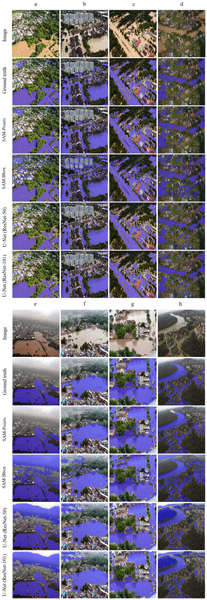
Floods threaten lives and property and require rapid mapping. We compared two artificial intelligence approaches on aerial imagery: a fine‑tuned Segment Anything Model (SAM) guided by point or bounding box prompts, and a U‑Net network with ResNet‑50 and ResNet‑101 backbones. The point‑based SAM was the most accurate with precise boundaries. Faster and more reliable flood maps help rescue teams, insurers, and planners to act quickly.
Rabindra Adhikari, Jan Huber, Amrit Maharjan, Madhavi Parajuli, Corinna Gall, Steffen Seitz, Chandra Kanta Subedi, Niels Schwab, Ram Prasad Chaudhary, Udo Schickhoff, Jürgen Böhner, Yvonne Oelmann, and Thomas Scholten
EGUsphere, https://doi.org/10.5194/egusphere-2026-3815, https://doi.org/10.5194/egusphere-2026-3815, 2026
Short summary
Short summary
Mountain treeline ecosystems are highly sensitive to climate change, yet the role of soil microbes remains poorly understood. We investigated microbial biomass and soil nutrients across a near-natural Himalayan treeline ecotone in Nepal. Our results show that soil horizon development and altitudinal-vegetation zonation are stronger controls on microbial biomass than bulk soil nutrient concentrations, providing new insights into nutrient cycling in mountain soils.
Madhavi Parajuli, Rabindra Adhikari, Xiaoxia Yang, Luisa Brosch, Nadja Fürst, Thomas Scholten, Steffen Seitz, and Corinna Gall
EGUsphere, https://doi.org/10.5194/egusphere-2026-4029, https://doi.org/10.5194/egusphere-2026-4029, 2026
Short summary
Short summary
We studied how moss growing on forest soils influences long-term carbon storage in two temperate forests in Germany. By separating soil into different organic matter components, we found that moss can increase the amount of carbon held in the most stable form, especially in coniferous forests. These findings show that moss plays an important role in helping forests store carbon and should be considered in forest carbon assessments and climate change research.
Alessandro Fabrizi, Peter Fiener, Kristof Van Oost, and Florian Wilken
SOIL, 12, 715–731, https://doi.org/10.5194/soil-12-715-2026, https://doi.org/10.5194/soil-12-715-2026, 2026
Short summary
Short summary
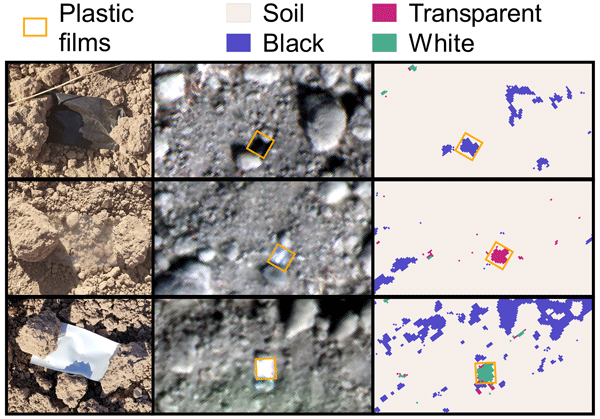
Drones can be used to identify the presence of macroplastic residues after plastic film use, allowing sustainable management practices and assessing the risk of soil plastic contamination. We highlight the potential and the limitations of current technologies, providing practical strategies to overcome them. We demonstrate the possibility of building cameras tailored to plastic detection and point the way towards necessary technological development.
Mathias Bellat, Mjahid Zebari, Benjamin Glissmann, Tobias Rentschler, Paola Sconzo, Nafiseh Kakhani, Ruhollah Taghizadeh-Mehrjardi, Pegah Kohsravani, Bekas Brifkany, Peter Pfälzner, and Thomas Scholten
Earth Syst. Sci. Data, 18, 2507–2548, https://doi.org/10.5194/essd-18-2507-2026, https://doi.org/10.5194/essd-18-2507-2026, 2026
Short summary
Short summary
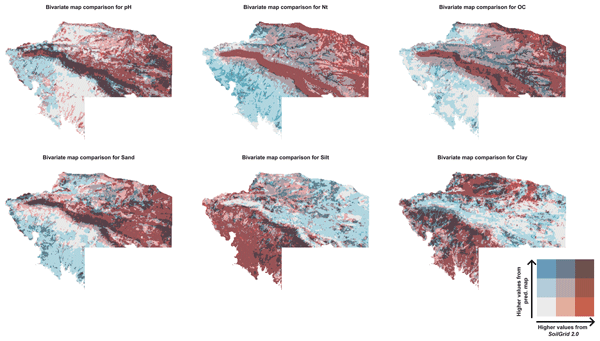
This dataset presents the first soil maps for the region produced using digital mapping techniques. It includes predictions for ten major physical and chemical soil properties at various depths, plus a map of total soil depth. For each property, we selected the most accurate models and key environmental drivers. In Southwestern Asia and many arid or semi-arid regions, detailed soil data are often missing. This dataset fills that gap, supporting agriculture, research, planning, and local policy.
Hadi Shokati, Kay D. Seufferheld, Peter Fiener, and Thomas Scholten
Hydrol. Earth Syst. Sci., 30, 743–756, https://doi.org/10.5194/hess-30-743-2026, https://doi.org/10.5194/hess-30-743-2026, 2026
Short summary
Short summary
Floods threaten lives and property and require rapid mapping. We compared two artificial intelligence approaches on aerial imagery: a fine‑tuned Segment Anything Model (SAM) guided by point or bounding box prompts, and a U‑Net network with ResNet‑50 and ResNet‑101 backbones. The point‑based SAM was the most accurate with precise boundaries. Faster and more reliable flood maps help rescue teams, insurers, and planners to act quickly.
Fedor Scholz, Manuel Traub, Christiane Zarfl, Thomas Scholten, and Martin V. Butz
Hydrol. Earth Syst. Sci., 29, 6257–6283, https://doi.org/10.5194/hess-29-6257-2025, https://doi.org/10.5194/hess-29-6257-2025, 2025
Short summary
Short summary
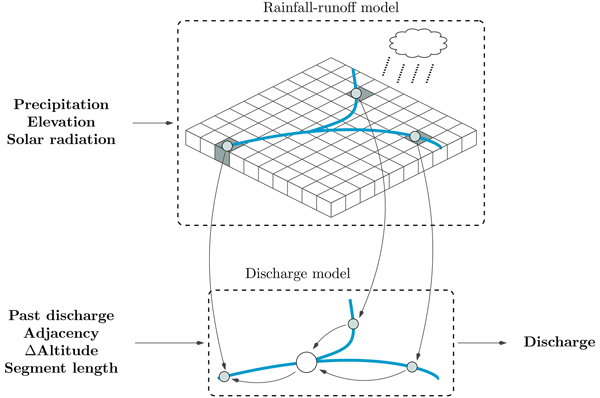
We present a neural network model that estimates river discharge based on gridded elevation, precipitation, and solar radiation. Some instances of our model produce more accurate forecasts than the European Flood Awareness System (EFAS) when simulating discharge with lead times of 50 days on the Neckar river network in Germany. It consists of multiple components that are designed to model distinct sub-processes. We show that this makes the model behave in a more physically realistic way.
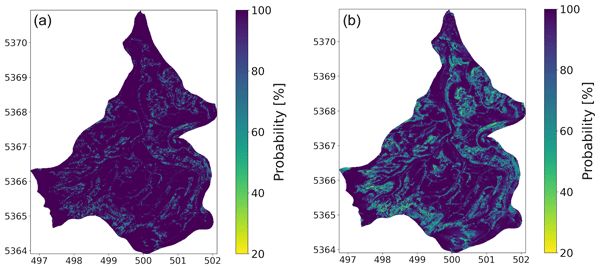
Kerstin Rau, Katharina Eggensperger, Frank Schneider, Michael Blaschek, Philipp Hennig, and Thomas Scholten
SOIL, 11, 833–847, https://doi.org/10.5194/soil-11-833-2025, https://doi.org/10.5194/soil-11-833-2025, 2025
Short summary
Short summary
We developed an uncertainty method to show where machine learning (ML) models predicting soil units are most reliable, especially for transfer tasks. The model was able to correctly predict soil patterns, especially along rivers, in a new but similar region without retraining. It was too confident about common soil types, showing the need for balanced data. This helps improve soil maps and guides better planning for future data collection, saving time and resources while showing uncertainty.
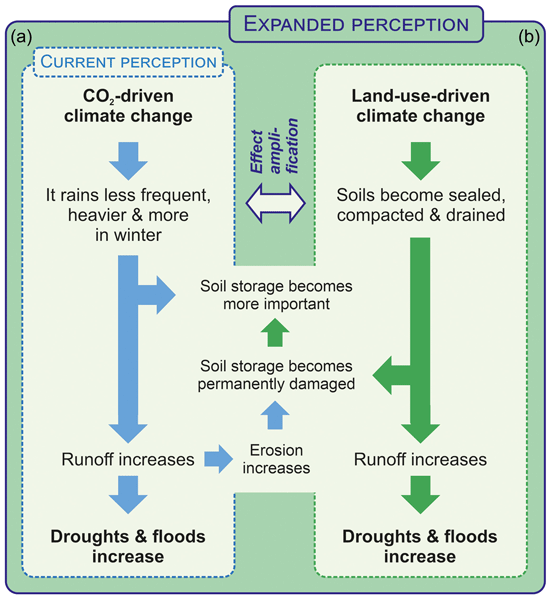
Karl Auerswald, Juergen Geist, John N. Quinton, and Peter Fiener
Hydrol. Earth Syst. Sci., 29, 2185–2200, https://doi.org/10.5194/hess-29-2185-2025, https://doi.org/10.5194/hess-29-2185-2025, 2025
Short summary
Short summary
Floods, droughts, and heatwaves are increasing globally. This is often attributed to CO2-driven climate change. However, at the global scale, CO2-driven climate change neither reduces precipitation nor adequately explains droughts. Land-use change, particularly soil sealing, compaction, and drainage, is likely to be more significant for water losses by runoff leading to flooding and water scarcity and is therefore an important part of the solution to mitigate floods, droughts, and heatwaves.
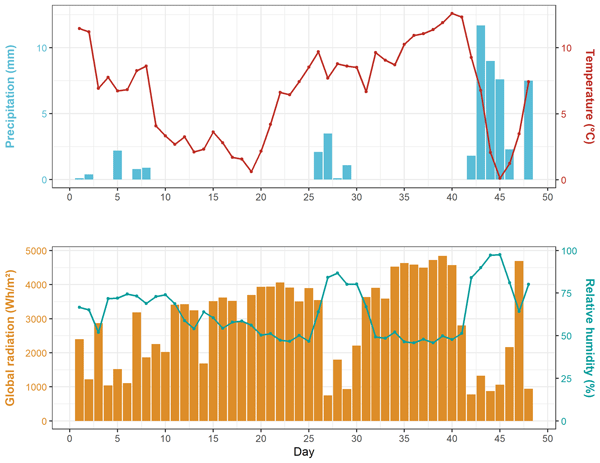
Corinna Gall, Silvana Oldenburg, Martin Nebel, Thomas Scholten, and Steffen Seitz
SOIL, 11, 199–212, https://doi.org/10.5194/soil-11-199-2025, https://doi.org/10.5194/soil-11-199-2025, 2025
Short summary
Short summary
Soil erosion is a major issue in vineyards due to often steep slopes and fallow interlines. While cover crops are typically used for erosion control, moss restoration has not yet been explored. In this study, moss restoration reduced surface runoff by 71.4 % and sediment discharge by 75.8 % compared with bare soil, similar to cover crops. Mosses could serve as ground cover where mowing is impractical, potentially reducing herbicide use in viticulture, although further research is needed.
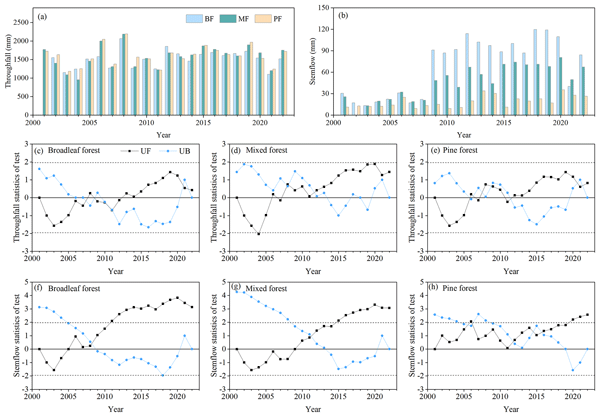
Wanjun Zhang, Thomas Scholten, Steffen Seitz, Qianmei Zhang, Guowei Chu, Linhua Wang, Xin Xiong, and Juxiu Liu
Hydrol. Earth Syst. Sci., 28, 3837–3854, https://doi.org/10.5194/hess-28-3837-2024, https://doi.org/10.5194/hess-28-3837-2024, 2024
Short summary
Short summary
Rainfall input generally controls soil water and plant growth. We focus on rainfall redistribution in succession sequence forests over 22 years. Some changes in rainwater volume and chemistry in the throughfall and stemflow and drivers were investigated. Results show that shifted open rainfall over time and forest factors induced remarkable variability in throughfall and stemflow, which potentially makes forecasting future changes in water resources in the forest ecosystems more difficult.
Lena Katharina Öttl, Florian Wilken, Anna Juřicová, Pedro V. G. Batista, and Peter Fiener
SOIL, 10, 281–305, https://doi.org/10.5194/soil-10-281-2024, https://doi.org/10.5194/soil-10-281-2024, 2024
Short summary
Short summary
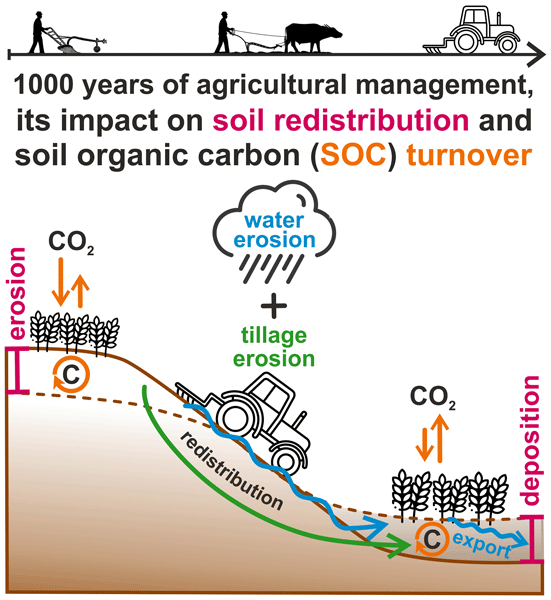
Our long-term modelling study examines the effects of multiple soil redistribution processes on carbon dynamics in a 200 km² catchment converted from natural forest to agriculture about 1000 years ago. The modelling results stress the importance of including tillage erosion processes and long-term land use and land management changes to understand current soil-redistribution-induced carbon fluxes at the landscape scale.
Raphael Rehm and Peter Fiener
SOIL, 10, 211–230, https://doi.org/10.5194/soil-10-211-2024, https://doi.org/10.5194/soil-10-211-2024, 2024
Short summary
Short summary
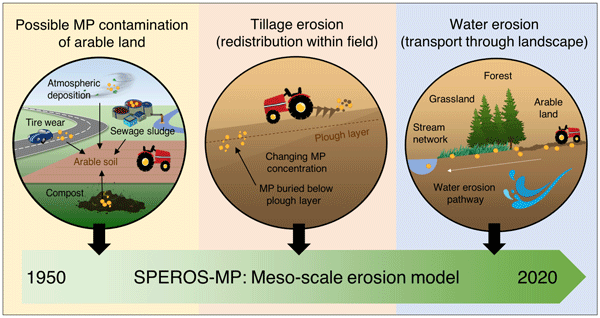
A carbon transport model was adjusted to study the importance of water and tillage erosion processes for particular microplastic (MP) transport across a mesoscale landscape. The MP mass delivered into the stream network represented a serious amount of MP input in the same range as potential MP inputs from wastewater treatment plants. In addition, most of the MP applied to arable soils remains in the topsoil (0–20 cm) for decades. The MP sink function of soil results in a long-term MP source.
Thomas Chalaux-Clergue, Rémi Bizeul, Pedro V. G. Batista, Núria Martínez-Carreras, J. Patrick Laceby, and Olivier Evrard
SOIL, 10, 109–138, https://doi.org/10.5194/soil-10-109-2024, https://doi.org/10.5194/soil-10-109-2024, 2024
Short summary
Short summary
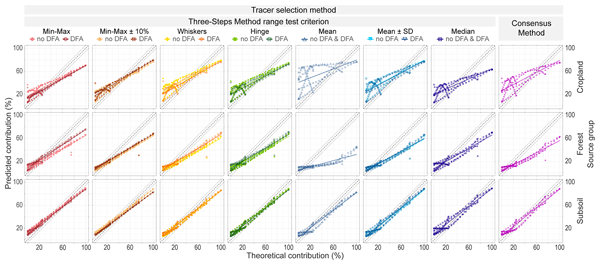
Sediment source fingerprinting is a relevant tool to support soil conservation and watershed management in the context of accelerated soil erosion. To quantify sediment source contribution, it requires the selection of relevant tracers. We compared the three-step method and the consensus method and found very contrasted trends. The divergences between virtual mixtures and sample prediction ranges highlight that virtual mixture statistics are not directly transferable to actual samples.
Thomas O. Hoffmann, Yannik Baulig, Stefan Vollmer, Jan H. Blöthe, Karl Auerswald, and Peter Fiener
Earth Surf. Dynam., 11, 287–303, https://doi.org/10.5194/esurf-11-287-2023, https://doi.org/10.5194/esurf-11-287-2023, 2023
Short summary
Short summary
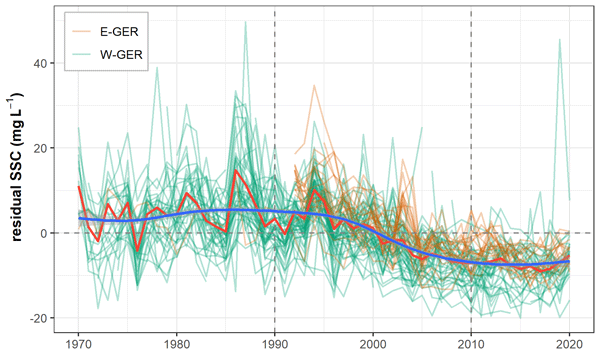
We analyzed more than 440 000 measurements from suspended sediment monitoring to show that suspended sediment concentration (SSC) in large rivers in Germany strongly declined by 50 % between 1990 and 2010. We argue that SSC is approaching the natural base level that was reached during the mid-Holocene. There is no simple explanation for this decline, but increased sediment retention in upstream headwaters is presumably the major reason for declining SSC in the large river channels studied.

Pedro V. G. Batista, Daniel L. Evans, Bernardo M. Cândido, and Peter Fiener
SOIL, 9, 71–88, https://doi.org/10.5194/soil-9-71-2023, https://doi.org/10.5194/soil-9-71-2023, 2023
Short summary
Short summary
Most agricultural soils erode faster than new soil is formed, which leads to soil thinning. Here, we used a model simulation to investigate how soil erosion and soil thinning can alter topsoil properties and change its susceptibility to erosion. We found that soil profiles are sensitive to erosion-induced changes in the soil system, which mostly slow down soil thinning. These findings are likely to impact how we estimate soil lifespans and simulate long-term erosion dynamics.
Nicolás Riveras-Muñoz, Steffen Seitz, Kristina Witzgall, Victoria Rodríguez, Peter Kühn, Carsten W. Mueller, Rómulo Oses, Oscar Seguel, Dirk Wagner, and Thomas Scholten
SOIL, 8, 717–731, https://doi.org/10.5194/soil-8-717-2022, https://doi.org/10.5194/soil-8-717-2022, 2022
Short summary
Short summary
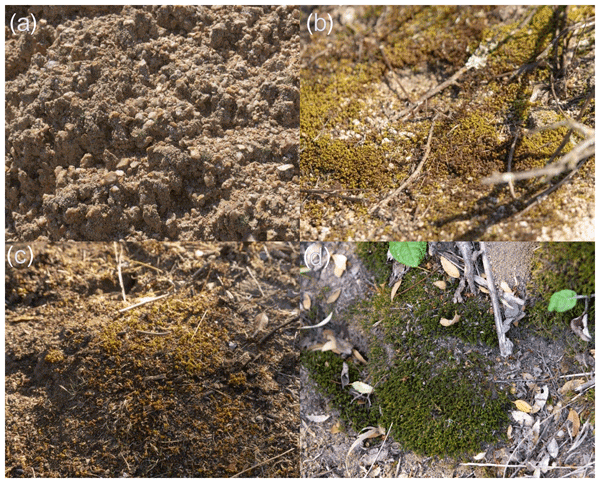
Biological soil crusts (biocrusts) stabilize the soil surface mainly in arid regions but are also present in Mediterranean and humid climates. We studied this stabilizing effect through wet and dry sieving along a large climatic gradient in Chile and found that the stabilization of soil aggregates persists in all climates, but their role is masked and reserved for a limited number of size fractions under humid conditions by higher vegetation and organic matter contents in the topsoil.
Pedro V. G. Batista, Peter Fiener, Simon Scheper, and Christine Alewell
Hydrol. Earth Syst. Sci., 26, 3753–3770, https://doi.org/10.5194/hess-26-3753-2022, https://doi.org/10.5194/hess-26-3753-2022, 2022
Short summary
Short summary
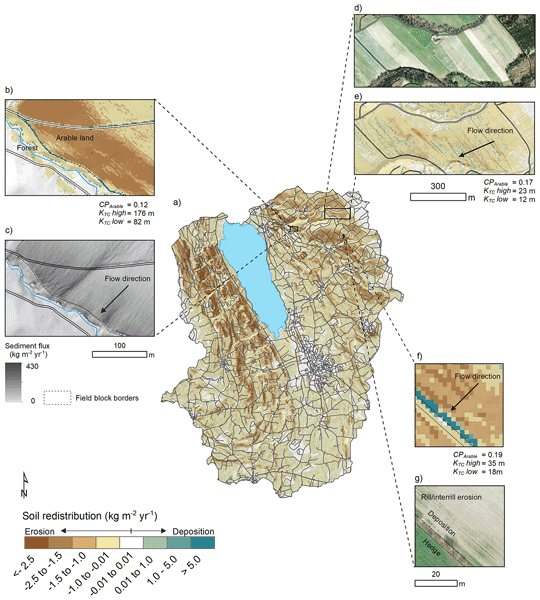
Patchy agricultural landscapes have a large number of small fields, which are separated by linear features such as roads and field borders. When eroded sediments are transported out of the agricultural fields by surface runoff, these features can influence sediment connectivity. By use of measured data and a simulation model, we demonstrate how a dense road network (and its drainage system) facilitates sediment transport from fields to water courses in a patchy Swiss agricultural catchment.
Corinna Gall, Martin Nebel, Dietmar Quandt, Thomas Scholten, and Steffen Seitz
Biogeosciences, 19, 3225–3245, https://doi.org/10.5194/bg-19-3225-2022, https://doi.org/10.5194/bg-19-3225-2022, 2022
Short summary
Short summary
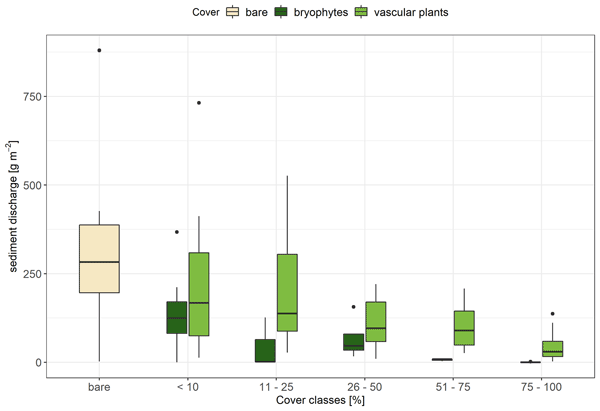
Soil erosion is one of the most serious environmental challenges of our time, which also applies to forests when forest soil is disturbed. Biological soil crusts (biocrusts) can play a key role as erosion control. In this study, we combined soil erosion measurements with vegetation surveys in disturbed forest areas. We found that soil erosion was reduced primarily by pioneer bryophyte-dominated biocrusts and that bryophytes contributed more to soil erosion mitigation than vascular plants.
Cited articles
Aghabeygi, M., Strauss, V., Paul, C., and Helming, K.: Barriers of adopting sustainable soil management practices for organic and conventional farming systems, Discover Soil, 1, 1–11, https://doi.org/10.1007/s44378-024-00008-1, 2024.
Alatorre, L. C., Beguería, S., and García-Ruiz, J. M.: Regional scale modeling of hillslope sediment delivery: A case study in the Barasona Reservoir watershed (Spain) using WATEM/SEDEM, J. Hydrol., 391, 109–123, https://doi.org/10.1016/j.jhydrol.2010.07.010, 2010.
Andersson, J. A. and D'Souza, S.: From adoption claims to understanding farmers and contexts: A literature review of Conservation Agriculture (CA) adoption among smallholder farmers in southern Africa, Agr. Ecosyst. Environ, 187, 116–132, https://doi.org/10.1016/j.agee.2013.08.008, 2014.
Auerswald, K. and Fiener, P.: Soil organic carbon storage following conversion from cropland to grassland on sites differing in soil drainage and erosion history, Sci. Total Environ., 661, 481–491, https://doi.org/10.1016/j.scitotenv.2019.01.200, 2019.
Auerswald, K. and Fiener, P.: Assessing the impact of climate change on soil erosion by water, in: Understanding and preventing soil erosion, Burleigh Dodds Science Publishing Limited, London, 51–76, https://doi.org/10.19103/AS.2023.0131.05, 2024.
Auerswald, K., Kainz, M., Scheinost, A., and Sinowski, W.: The Scheyern Experimental Farm: Research methods, the farming system and definition of the framework of site properties and characteristics, in: Ecosystem Approaches to Landscape Management in Central Europe, Ecological Studies, 147, 183–194, ISBN-13: 978-3642086632, 2001.
Auerswald, K., Fiener, P., and Dikau, R.: Rates of sheet and rill erosion in Germany – A meta-analysis, Geomorphology, 111, 182–193, https://doi.org/10.1016/j.geomorph.2009.04.018, 2009.
Auerswald, K., Fiener, P., Martin, W., and Elhaus, D.: Use and misuse of the K factor equation in soil erosion modeling: An alternative equation for determining USLE nomograph soil erodibility values, CATENA, 118, 220–225, https://doi.org/10.1016/j.catena.2014.01.008, 2014.
Auerswald, K., Wilken, F., and Fiener, P.: Soil properties at the Scheyern experimental farm covering 14 small adjacent watersheds and their surroundings, Research Gate [data set], https://doi.org/10.13140/RG.2.2.14231.83365, 2019a.
Auerswald, K., Fiener, P., Gerl, G., and Wilken, F.: Land use and land management data from the Scheyern experimental farm covering 14 small adjacent watersheds and their surroundings, Research Gate [data set], https://doi.org/10.13140/RG.2.2.26172.49285, 2019b.
Batista, P. V. G., Davies, J., Silva, M. L. N., and Quinton, J. N.: On the evaluation of soil erosion models: Are we doing enough?, Earth-Sci. Rev., 197, 102898, https://doi.org/10.1016/j.earscirev.2019.102898, 2019.
Batista, P. V. G., Fiener, P., Scheper, S., and Alewell, C.: A conceptual-model-based sediment connectivity assessment for patchy agricultural catchments, Hydrol. Earth Syst. Sci., 26, 3753–3770, https://doi.org/10.5194/hess-26-3753-2022, 2022.
Beven, K.: A manifesto for the equifinality thesis, J. Hydrol., 320, 18–36, https://doi.org/10.1016/j.jhydrol.2005.07.007, 2006.
Beven, K.: Towards a methodology for testing models as hypotheses in the inexact sciences, P. Roy. Soc. A-Math. Phy., 475, 20180862, https://doi.org/10.1098/rspa.2018.0862, 2019.
Beven, K. and Binley, A.: The future of distributed models: Model calibration and uncertainty prediction, Hydrol. Process., 6, 279–298, https://doi.org/10.1002/hyp.3360060305, 1992.
Beven, K. and Lane, S.: On (in)validating environmental models. 1. Principles for formulating a Turing-like Test for determining when a model is fit-for purpose, Hydrol. Process., 36, e14704, https://doi.org/10.1002/hyp.14704, 2022.
Borrelli, P., Alewell, C., Alvarez, P., Anache, J. A. A., Baartman, J., Ballabio, C., Bezak, N., Biddoccu, M., Cerdà, A., Chalise, D., Chen, S., Chen, W., De Girolamo, A. M., Gessesse, G. D., Deumlich, D., Diodato, N., Efthimiou, N., Erpul, G., Fiener, P., Freppaz, M., and Panagos, P.: Soil erosion modelling: A global review and statistical analysis, Sci. Total Environ., 780, https://doi.org/10.1016/j.scitotenv.2021.146494, 2021.
Brazier, R. E., Beven, K. J., Freer, J., and Rowan, J. S.: Equifinality and uncertainty in physically based soil erosion models: application of the GLUE methodology to WEPP-the Water Erosion Prediction Project-for sites in the UK and USA, Earth Surf. Processes, 25, 825–845, https://doi.org/10.1002/1096-9837(200008)25:8<825::AID-ESP101>3.0.CO;2-3, 2000.
Brus, D. J. and van den Akker, J. J. H.: How serious a problem is subsoil compaction in the Netherlands? A survey based on probability sampling, SOIL, 4, 37–45, https://doi.org/10.5194/soil-4-37-2018, 2018.
Carter, C. E. and Parsons, D. A.: Field tests on the coshocton-type wheel runoff sampler, T. ASAE, 10, 133–135, https://doi.org/10.13031/2013.39613, 1967.
Choudhury, B. U., Nengzouzam, G., and Islam, A.: Runoff and soil erosion in the integrated farming systems based on micro-watersheds under projected climate change scenarios and adaptation strategies in the eastern Himalayan mountain ecosystem (India), J. Environ. Manage., 309, 114667, https://doi.org/10.1016/j.jenvman.2022.114667, 2022.
de Vente, J. and Poesen, J.: Predicting soil erosion and sediment yield at the basin scale: Scale issues and semi-quantitative models, Earth-Sci. Rev., 71, 95–125, https://doi.org/10.1016/j.earscirev.2005.02.002, 2005.
Dermisis, D., Abaci, O., Papanicolaou, A. N., and Wilson, C. G.: Evaluating grassed waterway efficiency in southeastern Iowa using WEPP, Soil Use Manage., 26, 183–192, https://doi.org/10.1111/j.1475-2743.2010.00257.x, 2010.
Desmet, P. J. J. and Govers, G.: A GIS procedure for automatically calculating the USLE LS factor on topographically complex landscape units, J. Soil Water Conserv., 51, 427–433, https://doi.org/10.1016/j.cageo.2012.09.027, 1996.
DIN-Normenausschuss, W.: Soil quality – Predicting soil erosion by water by means of ABAG, https://doi.org/10.31030/3365455, 2022.
Dymond, J. R., Betts, H. D., and Schierlitz, C. S.: An erosion model for evaluating regional land-use scenarios, Environ. Modell. Softw., 25, 289–298, https://doi.org/10.1016/j.envsoft.2009.09.011, 2010.
Eekhout, J. P. C., Terink, W., and de Vente, J.: Assessing the large-scale impacts of environmental change using a coupled hydrology and soil erosion model, Earth Surf. Dynam., 6, 687–703, https://doi.org/10.5194/esurf-6-687-2018, 2018.
Fiener, P. and Auerswald, K.: Effectiveness of grassed waterways in reducing runoff and sediment delivery from agricultural watersheds, J. Environ. Qual., 32, 927–936, https://doi.org/10.2134/jeq2003.9270, 2003.
Fiener, P. and Auerswald, K.: Measurement and modeling of concentrated runoff in grassed waterways, J. Hydrol., 301, 198–215, https://doi.org/10.1016/j.jhydrol.2004.06.030, 2005.
Fiener, P. and Auerswald, K.: Rotation effects of potato, maize, and winter wheat on soil erosion by water, Soil Sci. Soc. Am. J., 71, 1919–1925, https://doi.org/10.2136/sssaj2006.0355, 2007.
Fiener, P., Auerswald, K., and Weigand, S.: Managing erosion and water quality in agricultural watersheds by small detention ponds, Agr. Ecosyst. Environ, 110, 132–142, https://doi.org/10.1016/j.agee.2005.03.012, 2005.
Fiener, P. and Auerswald, K.: Grassed waterways, in, American Society of Agronomy, Crop Science Society of America, Soil Science Society of America, 131–150, https://doi.org/10.2134/agronmonogr59.c7, 2018.
Fiener, P., Wilken, F., and Auerswald, K.: Filling the gap between plot and landscape scale – eight years of soil erosion monitoring in 14 adjacent watersheds under soil conservation at Scheyern, Southern Germany, Adv. Geosci., 48, 31–48, https://doi.org/10.5194/adgeo-48-31-2019, 2019a.
Fiener, P., Wilken, F., and Auerswald, K.: Runoff and sediment delivery data at the Scheyern experimental farm covering 14 small adjacent watersheds [data set], https://doi.org/10.13140/RG.2.2.30786.22729, 2019b.
Foucher, A., Salvador-Blanes, S., Evrard, O., Simonneau, A., Chapron, E., Courp, T., Cerdan, O., Lefèvre, I., Adriaensen, H., Lecompte, F., and Desmet, M.: Increase in soil erosion after agricultural intensification: Evidence from a lowland basin in France, Anthropocene, 7, https://doi.org/10.1016/j.ancene.2015.02.001, 2014.
Gonzalez-Hidalgo, J. C., Batalla, R. J., Cerda, A., and de Luis, M.: A regional analysis of the effects of largest events on soil erosion, CATENA, 95, 85–90, https://doi.org/10.1016/j.catena.2012.03.006, 2012.
Gumiere, S. J., Le Bissonnais, Y., Raclot, D., and Cheviron, B.: Vegetated filter effects on sedimentological connectivity of agricultural catchments in erosion modelling: a review, Earth Surf. processes, 36, 3–19, https://doi.org/10.1002/esp.2042, 2011.
Hessel, R. and Tenge, A.: A pragmatic approach to modelling soil and water conservation measures with a catchment scale erosion model, CATENA, 74, https://doi.org/10.1016/j.catena.2008.03.018, 2008.
Hlavčová, K., Kohnová, S., Velísková, Y., Studvová, Z., Sočuvka, V., and Ivan, P.: Comparison of two concepts for assessment of sediment transport in small agricultural catchments, J. Hydrol. Hydromech., 66, 404–415, https://doi.org/10.2478/johh-2018-0032, 2018.
Hosseinzadehtalaei, P., Tabari, H., and Willems, P.: Climate change impact on short-duration extreme precipitation and intensity–duration–frequency curves over Europe, J. Hydrol., 590, 125249, https://doi.org/10.1016/j.jhydrol.2020.125249, 2020.
Keller, T., Sandin, M., Colombi, T., Horn, R., and Or, D.: Historical increase in agricultural machinery weights enhanced soil stress levels and adversely affected soil functioning, Soil Till. Res., 194, 104293, https://doi.org/10.1016/j.still.2019.104293, 2019.
Kinnell, P. I. A.: Runoff dependent erosivity and slope length factors suitable for modelling annual erosion using the Universal Soil Loss Equation, Hydrol. Process., 21, 2681–2689, https://doi.org/10.1002/hyp.6493, 2007.
Montanarella, L., Pennock, D. J., McKenzie, N., Badraoui, M., Chude, V., Baptista, I., Mamo, T., Yemefack, M., Singh Aulakh, M., Yagi, K., Young Hong, S., Vijarnsorn, P., Zhang, G.-L., Arrouays, D., Black, H., Krasilnikov, P., Sobocká, J., Alegre, J., Henriquez, C. R., de Lourdes Mendonça-Santos, M., Taboada, M., Espinosa-Victoria, D., AlShankiti, A., AlaviPanah, S. K., Elsheikh, E. A. E. M., Hempel, J., Camps Arbestain, M., Nachtergaele, F., and Vargas, R.: World's soils are under threat, SOIL, 2, 79–82, https://doi.org/10.5194/soil-2-79-2016, 2016.
Myhre, G., Alterskjær, K., Stjern, C. W., Hodnebrog, Ø., Marelle, L., Samset, B. H., Sillmann, J., Schaller, N., Fischer, E., Schulz, M., and Stohl, A.: Frequency of extreme precipitation increases extensively with event rareness under global warming, Sci. Rep.-UK, 9, 16063, https://doi.org/10.1038/s41598-019-52277-4, 2019.
Nearing, M.: Why soil erosion models over-predict small soil losses and under-predict large soil losses, CATENA, 32, 15–22, https://doi.org/10.1016/S0341-8162(97)00052-0, 1998.
Nearing, M.: Evaluating soil erosion models using measured plot data: accounting for variability in the data, Earth Surf. Processes, 25, 1035–1043, https://doi.org/10.1002/1096-9837(200008)25:9<1035::AID-ESP121>3.0.CO;2-B, 2000.
Nearing, M.: Soil erosion and conservation, in: Environmental Modelling, edited by: Wainwright, J. and Mulligan, M., John Wiley & Sons, Chichester, UK, 365–378, https://doi.org/10.1002/9781118351475.ch22, 2013.
Notebaert, B., Vaes, B., Verstraeten, G., and Govers, G.: WaTEM/SEDEM version 2006 Manual, Katholieke Universiteit Leuven, Belgium, https://ees.kuleuven.be/eng/geography/modelling/watemsedem2006/manual_watemsedem_122011.pdf (last access: 26 March 2026), 2006.
Onnen, N., Heckrath, G., Stevens, A., Olsen, P., Greve, M. B., Pullens, J. W. M., Kronvang, B., and Van Oost, K.: Distributed water erosion modelling at fine spatial resolution across Denmark, Geomorphology, 342, 150–162, https://doi.org/10.1016/j.geomorph.2019.06.011, 2019.
Peeters, I., Van Oost, K., Govers, G., Verstraeten, G., Rommens, T., and Poesen, J.: The compatibility of erosion data at different temporal scales, Earth Planet. Sc. Lett., 265, 138–152, https://doi.org/10.1016/j.epsl.2007.09.040, 2008.
Quinn, P., Beven, K., Chevallier, P., and Planchon, O.: The prediction of hillslope flow paths for distributed hydrological modelling using digital terrain models, Hydrol. Process., 5, 59–79, https://doi.org/10.1002/hyp.3360050106, 1991.
Quinton, J. N. and Fiener, P.: Soil erosion on arable land: An unresolved global environmental threat, Prog. Phys. Geog., 48, 136–161, https://doi.org/10.1177/03091333231216595, 2024.
Rehm, R. and Fiener, P.: Model-based analysis of erosion-induced microplastic delivery from arable land to the stream network of a mesoscale catchment, SOIL, 10, 211–230, https://doi.org/10.5194/soil-10-211-2024, 2024.
Renard, K. G.: Predicting soil erosion by water: A guide to conservation planning with the Revised Universal Soil Loss Equation (RUSLE), Agricultural handbook, US Department of Agriculture, Agricultural Research Service, ISBN-13: 978-0160489389, 1997.
Rickson, R. J., Deeks, L. K., Graves, A., Harris, J. A. H., Kibblewhite, M. G., and Sakrabani, R.: Input constraints to food production: the impact of soil degradation, Food Secur., 7, 351–364, https://doi.org/10.1007/s12571-015-0437-x, 2015.
Risse, M., Nearing, M. A., Laflen, J. M., and Nicks, A. D.: Error assessment in the Universal Soil Loss Equation, Soil Sci. Soc. Am. J., 57, 825–833, https://doi.org/10.2136/sssaj1993.03615995005700030032x, 1993.
Schad, P., Anjos, L., Llobet, J. B., Deckers, S., Dondeyne, S., Eberhardt, E., Gerasimova, M., Harms, B., Kabala, C., Mantel, S., Michéli, E., Monger, C., Claret, R. P., Stahr, K., van Huyssteen, C., Buness, V., and Rau, M., IUSS (Ed.): World Reference Base for Soil Resources. International soil classification system for naming soils and creating legends for soil maps, IUSS Working Group WRB, Vienna, Austria, 236, ISBN-13: 979-8-9862451-1-9, 2022.
Schwertmann, U., Vogl, W., and Kainz, M.: Bodenerosion durch Wasser: Vorhersage des Abtrags und Bewertung von Gegenmassnahmen, Ulmer, Stuttgart, 64, ISBN-13: 978-3800130887, 1987.
Seufferheld, K. D., Batista, P., and Fiener, P.: A GLUE-based assessment of WaTEM/SEDEM – Dataset and code, Zenodo [code, data set], https://doi.org/10.5281/zenodo.18714865, 2026.
Smith, H. G., Peñuela, A., Sangster, H., Sellami, H., Boyle, J., Chiverrell, R., Schillereff, D., and Riley, M.: Simulating a century of soil erosion for agricultural catchment management, Earth Surf. Processes, 43, 2089–2105, https://doi.org/10.1002/esp.4375, 2018.
Srikanthan, R. and McMahon, T. A.: Stochastic generation of annual, monthly and daily climate data: A review, Hydrol. Earth Syst. Sci., 5, 653–670, https://doi.org/10.5194/hess-5-653-2001, 2001.
Steegen, A., Govers, G., Nachtergaele, J., Takken, I., Beuselinck, L., and Poesen, J.: Sediment export by water from an agricultural catchment in the Loam Belt of central Belgium, Geomorphology, 33, 25–36, https://doi.org/10.1016/s0169-555x(99)00108-7, 2000.
Van Oost, K., Govers, G., and Desmet, P.: Evaluating the effects of changes in landscape structure on soil erosion by water and tillage, Landscape Ecol., 15, 577–589, https://doi.org/10.1023/A:1008198215674, 2000.
Van Rompaey, A. J. J., Verstraeten, G., Van Oost, K., Govers, G., and Poesen, J.: Modelling mean annual sediment yield using a distributed approach, Earth Surf. Processes, 26, 1221–1236, https://doi.org/10.1002/esp.275, 2001.
Verstraeten, G., Van Oost, K., Van Rompaey, A., Poesen, J., and Govers, G.: Evaluating an integrated approach to catchment management to reduce soil loss and sediment pollution through modelling, Soil Use Manage., 18, 386–394, https://doi.org/10.1111/j.1475-2743.2002.tb00257.x, 2002.
Wang, S., Szeles, B., Krammer, C., Schmaltz, E., Song, K., Li, Y., Zhang, Z., Blöschl, G., and Strauss, P.: Agricultural intensification vs. climate change: what drives long-term changes in sediment load?, Hydrol. Earth Syst. Sci., 26, 3021–3036, https://doi.org/10.5194/hess-26-3021-2022, 2022.
Wendt, R. C., Alberts, E. E., and Hjelmfelt, A. T.: Variability of Runoff and Soil Loss from Fallow Experimental Plots, Soil Sci. Soc. Am. J., 50, https://doi.org/10.2136/sssaj1986.03615995005000030035x, 1986.
Wilken, F., Fiener, P., and Auerswald, K.: Meteorological data at the Scheyern experimental farm covering 14 small adjacent watersheds and their surroundings [data set], https://doi.org/10.13140/RG.2.2.34561.10088, 2019a.
Wilken, F., Fiener, P., and Auerswald, K.: Topography at the Scheyern experimental farm covering 14 small adjacent watersheds and their surroundings [data set], https://doi.org/10.13140/RG.2.2.32044.51845, 2019b.
Wilken, F., Ketterer, M., Koszinski, S., Sommer, M., and Fiener, P.: Understanding the role of water and tillage erosion from 239+240Pu tracer measurements using inverse modelling, SOIL, 6, 549–564, https://doi.org/10.5194/soil-6-549-2020, 2020.
Wischmeier, W. H. and Smith, D. D.: Predicting rainfall erosion losses: A guide to conservation planning, Agriculture Handbook, 537, Department of Agriculture, Science and Education Administration, United States, 65, ISBN-10: 0-16-048938-5, 1978.
Short summary
Soil erosion threatens global food security, yet modeling soil conservation remains challenging. We evaluated WaTEM/SEDEM (Water and Tillage Erosion Model/Sediment Delivery Model) in six highly instrumented micro-scale watersheds optimised for soil conservation using a GLUE (Generalized Likelihood Uncertainty Estimation) framework. The model captured the magnitude of very low sediment yields but showed limited accuracy for annual steps. However, it performed well over eight-year timeframes and larger spatial scales, demonstrating its suitability for strategic, long-term soil conservation planning.
Soil erosion threatens global food security, yet modeling soil conservation remains challenging....


Special issue