
the Creative Commons Attribution 4.0 License.
the Creative Commons Attribution 4.0 License.
 | 11 Sep 2026

Differences in organic carbon fractions and stability explain limited accumulation in loam and sandy loam under greenhouse conditions
Boyuan Tan
Lu Yang
Xun Xiao
Chunji Li
Jing Tan
Ning An
Lingxuan Meng
Yanli Yi
Fengkui Qian
Na Li
Xue Liu
Song Li

Wei Han
Manure is widely applied in greenhouses to enhance soil organic carbon (SOC) and improve fertility. However, how SOC fractions and their chemical stability change under different soil textures and long-term manure inputs remains unclear. We investigated greenhouse soils with 2–50 years of manure application in loam and sandy loam. SOC, easily oxidizable carbon (EOC), microbial biomass carbon (MBC), dissolved organic carbon (DOC), particulate organic carbon (POC), and mineral-associated organic carbon (MAOC) were quantified. The molecular structures of SOC were analyzed via 13C NMR spectroscopy. Results showed that SOC in loam stabilized after about 20 years of manure application, whereas sandy loam reached equilibrium within 2 years. In loam, aromatic C and carbonyl C in SOC increased, raising the aromaticity index (AI); in sandy loam, alkyl C increased, elevating alkyl C to O-alkyl C () and the hydrophobicity index (HI). Loam contained higher SOC, EOC, POC, and MAOC contents than sandy loam, with SOC positively correlated with EOC, POC, and MAOC, whereas in sandy loam SOC was positively correlated only with EOC and MAOC, and negatively with fine POC (fPOC). In loam, the AI and HI of SOC showed significant positive path relationships with EOC, DOC and POC (coarse POC [cPOC] and fPOC), while the accumulation of both cPOC and fPOC contributed to MAOC formation. In sandy loam, HI was mainly positively associated with EOC and cPOC, while MAOC was primarily related to EOC. Overall, in greenhouses, long-term stability of SOC depends on the transformation of labile carbon into stable fractions, with fine-textured soils exhibiting greater sequestration efficiency due to higher structural stability and greater MAOC accumulation.
- Article
(3546 KB) - Full-text XML
-
Supplement
(543 KB) - BibTeX
- EndNote


Soil organic carbon (SOC) is a keystone determinant of soil fertility and sustainable agricultural production; its quantity and composition directly regulate soil fertility and resilience to environmental stress (Oldfield et al., 2019; Beillouin et al., 2023). SOC fractions differ markedly in function. Labile carbon pools (e.g., soil labile organic carbon fractions [SLOCF] and particulate organic carbon [POC]) are highly sensitive to environmental and management perturbations, capturing short-term shifts in soil quality and carbon turnover; whereas stable carbon pools (e.g., mineral-associated organic carbon [MAOC]) reflect the long-term stabilization and preservation of SOC, functioning as the basis for maintaining structural stability and long-term fertility (Lavallee et al., 2020; Witzgall et al., 2021; Zheng et al., 2022; Das et al., 2023a). Therefore, compared with SOC content, SOC composition can reveal soil productivity, nutrient supply, and carbon sequestration potential in greater detail.
Manure application has been widely demonstrated to significantly enhance SOC content, attributable not only to direct carbon inputs but also to its stimulation of microbial activity and the consequent promotion of organic matter decomposition and resynthesis (Denoncourt et al., 2025). A global meta-analysis by Gross and Glaser (2021), covering field experiments with manure application durations grouped into 3–5, 6–10, 11–20, and >20 years, showed that manure application increased SOC stocks by an overall average of about 35.4 %. Although total SOC increases, the effects of manure application on different carbon fractions are not consistent. Manure application preferentially enriches SLOC and POC, and these labile carbon pools are gradually incorporated into stable pools through microbial reorganization and mineral mediation, serving as important precursors for MAOC formation (Zhou et al., 2024; Hao et al., 2025). At the molecular level, 13C Nuclear Magnetic Resonance (NMR) analyses revealed increases in alkyl C, declines in aromatic C, higher alkyl C to O-alkyl C (), and lower aromaticity index (AI) following manure application, suggesting a shift of SOC from aromatic dominance to more hydrophobic and aliphatic structures (Zhao et al., 2023). The efficiency of manure-derived carbon transformation into SOC depends on climatic conditions, soil texture, and agricultural systems. Although long-term manure application can substantially increase SOC stocks, its effectiveness varies with climatic conditions (Gross and Glaser, 2021). In greenhouse systems, the warm and humid environment can enhance organic matter decomposition and accelerate SOC turnover, thereby limiting net SOC accumulation (Zhang et al., 2022). Beyond climatic controls, SOC accumulation and stabilization are also strongly influenced by soil mineralogy and texture (Kleber et al., 2015; Das et al., 2023a). Compared with coarse-textured soils, fine-textured soils (such as loam) possess higher surface area and stronger sorptive capacity, which enable them to more effectively retain organic carbon and promote MAOC formation, thus enhancing long-term SOC storage (Kleber et al., 2015; Islam et al., 2022; Das et al., 2023a).
In contrast to open-field agriculture, greenhouses are maintained under consistently warm and humid environments, with air temperatures typically ranging from 18–35 °C and relative humidity of approximately 65 %–80 % (Yang et al., 2024; Tan et al., 2025). Such stable and relatively high temperature-humidity regimes enhance microbial activity and substrate decomposition, thereby accelerating SOC turnover. Consequently, to improve soil fertility, manure inputs in greenhouses often reach 30–120 Mg ha−1 yr−1; however, SOC accumulation remains considerably lower than anticipated (Zhang et al., 2022; Tan et al., 2025). Zhang et al. (2022) found that continuous annual application of 37.5 Mg ha−1 of chicken manure resulted in a new SOC equilibrium after five years, with SOC content increasing by 1.27-fold, yet only 24 % of the exogenous carbon was retained. This discrepancy may arise from the unique environmental and management conditions of greenhouse systems, including elevated temperature and moisture, frequent irrigation, and intensive tillage, which collectively accelerate organic matter decomposition and carbon mineralization (Zhang et al., 2022; Tan et al., 2025). In addition, the majority of greenhouse studies span only 1–10 years, and although apparent equilibrium in total SOC has been observed, such short-term stabilization does not represent an endpoint, as SOC may continue to accumulate or shift over longer timescales (Das et al., 2023b). Evidence from open-field studies indicates that net SOC accumulation, particularly MAOC, typically requires continuous organic inputs for more than 20–30 years before becoming pronounced (Just et al., 2023; Dietz et al., 2024). To more comprehensively evaluate the effects of manure application on SOC in greenhouses, it is necessary to analyze SOC accumulation dynamics and carbon fraction distribution over much longer timescales. Accordingly, this study examined greenhouse soils with loam and sandy loam spanning 2–50 years of manure application, employing analyses of SOC fractions (SLOCF, POC, MAOC) combined with 13C NMR spectroscopy to systematically compare the composition and molecular structural features of SOC fractions across different manure application durations. The aims of this study were: (1) to compare variations in SOC content, structural features, and molecular composition between loam and sandy loam under different manure application durations in greenhouse; and (2) to determine the relationships between changes in SOC fractions and molecular structural features with long-term SOC accumulation. The findings will provide a scientific basis for formulating greenhouse manure application strategies and sustaining soil fertility over the long term.
2.1 Site description
The sampling sites for this study were located in Wujianfang Town (41°49′12′′ N, 120°43′12′′ E) and Yangshibao Town (41°37′48′′ N, 122°45′36′′ E), which are two key regions for greenhouse agriculture in Liaoning Province, northeast China. Greenhouse agriculture has steadily developed in these two regions since 1970 and 1988, respectively, and has gradually expanded with the advancement of farming techniques and improved economic benefits. To improve production efficiency and support local agriculture, the government organized standardized planting schedules, crop rotation, and water-nutrient management training, thus providing ideal conditions for investigating the composition of SOC fractions and their stabilization characteristics under varying durations of manure application in greenhouses.
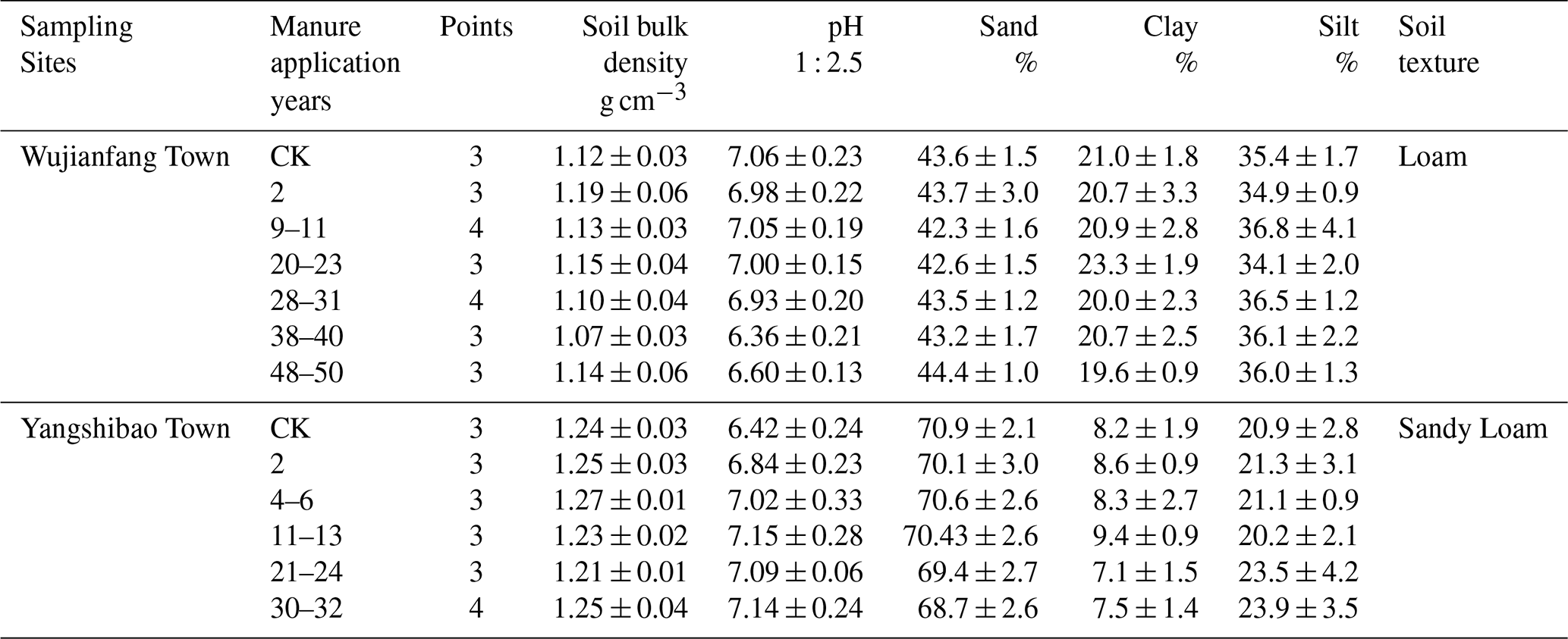
By 2020, the greenhouses in these two regions had planting histories ranging from 2–50 years (Table 1). The soil in Wujianfang Town is classified as Luvisols, while the soil in Yangshibao Town is classified as Cambisols (FAO, 2014). Each greenhouse sample plot was 60 m × 15 m, with daytime temperatures ranging from 22 to 36 °C and nighttime temperatures ranging from 15 to 18 °C. A three-crop rotation system of tomato-bean-tomato was implemented annually. Tomato is the main crop, with a planting density of 82 500 plants ha−1.
Table 1Manure application years and soil mechanical composition at greenhouse sampling sites.
The greenhouses were treated annually with approximately 41.25 Mg ha−1 (dry weight) of mixed cow and pig manure composts, providing a carbon input of 11.58 Mg ha−1 yr−1. The compost contained 28.07 % carbon and 2.24 % nitrogen. Additionally, chemical fertilizers were applied at annual rates of 300–400 kg ha−1 N, 300–400 kg ha−1 P2O5, and 450 kg ha−1 K2O, in combination with a drip irrigation system. To compare the effects of the greenhouse, open-field soils located within 100 m of the sampled greenhouse were selected as controls (CK). These control fields followed the same tomato-soybean-tomato rotation, with similar chemical fertilizer application rates but no manure application.
2.2 Soil sampling and analysis
Soil samples were collected in May 2020. Greenhouse plots with similar manure application durations were grouped into loam (Wujianfang Town) and sandy loam (Yangshibao Town) soils. At Wujianfang, samples included CK and six manure application duration groups (2, 9–11, 20–23, 28–31, 38–40, and 48–50 years), while at Yangshibao, samples included CK and five manure application duration groups (2, 4–6, 11–13, 21–24, and 30–32 years). Each group consisted of 6 to 8 samples, for a total of 90 samples. In each greenhouse plot, soil samples were collected from five points arranged in an X-pattern at a depth of 0–20 cm and combined to form a composite sample. Because the space-for-time substitution (chronosequence) approach requires sites to be comparable in inherent soil properties, all composite samples were first characterized for particle-size distribution and pH. Only plots that (i) fell within the target USDA textural class for each location (loam in Wujianfang Town and sandy loam in Yangshibao Town), and (ii) had near-neutral soil pH (6.0–8.0) were retained for further analysis. This screening step ensured that differences among manure application durations were not confounded by large variations in soil texture or pH. After screening, 42 samples remained. Among these, four samples were collected from greenhouse sandy loam with 30–32 years of continuous manure application, and from loam with 9–11 years and 28–31 years of manure application, while the remaining groups consisted of three samples each (Table 1). The same screening criteria were applied to the adjacent CK plots. Consequently, the results of this study mainly apply to greenhouse soils with comparable loam or sandy loam textures and near-neutral pH conditions.
2.3 SOC and sequestration analysis
The SOC content was determined using the potassium dichromate (K2Cr2O7) oxidation method (Lu, 2000).
SOC stock (SOCstock, Mg C ha−1) was estimated by Eq. (1) (Liu et al., 2015):
Where SOC is the SOC content (g kg−1 soil), is the soil bulk density (g cm−3), and 0.20 is the depth of the plow horizon (m). 104 is the conversion factor for hectare to square meters (m2), and 10−3 is the overall unit conversion factor for adjusting the units to Mg C ha−1.
SOC sequestration rate (%) was estimated using Eq. (2) (Liu et al., 2015; Lu et al., 2009):
Where SOCstock-n and SOCstock-CK represent the carbon stocks (Mg C ha−1) in greenhouse soil with n years of manure application and in the control group, respectively. C-inputn represents the cumulative C input from manure application over n years (Mg C ha−1).
2.4 Fraction of SOC
We quantified (i) complementary physical SOC pools obtained by physical fractionation – POC (coarse particulate organic carbon, cPOC, and fine particulate organic carbon, fPOC) and MAOC – which together represent SOC stored in particulate versus mineral-associated forms, and (ii) labile C indicators – EOC, DOC, and MBC – which reflect short-term bioavailable and microbially mediated C dynamics rather than mutually exclusive SOC pools. These two categories were jointly analyzed to evaluate how long-term manure application influences both SOC accumulation and turnover in greenhouse soils.
KMnO4 oxidation method (Vieira et al., 2007) was used to measure EOC in the samples. The fumigation–extraction method (Vance et al., 1987), using ethanol-free chloroform vapor as the fumigant, was applied to determine DOC and MBC. DOC was measured from extracts of the non-fumigated samples, and MBC was calculated according to Eq. (3):
where OCf and DOC represent the organic carbon (OC) contents of the fumigated and non-fumigated samples, respectively (g kg−1 soil), and 0.45 is a constant value representing the OC extraction efficiency.
The contents of POC and MAOC were measured using a particle size fractionation method. An air-dried soil sample (10 g) was placed in a 50 mL centrifuge tube, and 35 mL of 1.85 g cm−3 NaI solution (85 g NaI dissolved in 100 mL of water) was added. After shaking the tube 10 times, the sample was centrifuged at 4000 rpm for 20 min. The NaI solution was then removed, and the residue on the tube wall was rinsed. The remaining soil was rinsed 2–3 times with deionized water and then treated with 30 mL of 5 g L−1 Na6P6O18 solution, followed by shaking at 200 rpm for 18 h to disperse aggregates. The dispersion was successively sieved through 250 and 53 µm mesh sieves. Different fractions were collected: cPOC > 250 µm, fPOC 250–53 µm, and MAOC < 53 µm. Each fraction was dried at 40 °C to constant weight. The carbon content of each fraction was determined using the K2Cr2O7 oxidation method.
The contributions of each carbon fractions (SLOCF, POC, and MAOC) to SOC (%) was estimated using Eq. (4):
2.5 13C NMR analysis and spectral indicators
The molecular structure of SOC was characterized using cross-polarization magic angle spinning (13C CPMAS) solid-state NMR spectroscopy on a Bruker AVANCE III 400 spectrometer (Switzerland), operating at a 13C resonance frequency of 100 MHz and equipped with a 4 mm CPMAS probe. To remove paramagnetic materials and concentrate organic carbon, soil samples were pretreated with 10 % hydrofluoric acid (HF) solution (Schmidt et al., 2011). The treated samples were dried to constant weight at 40 °C, ground, sieved through a 60-mesh sieve, and stored for NMR analysis.
Spectra were acquired at a magic angle spinning rate of 5 kHz, with a contact time of 1 ms and a recycle delay of 0.8 s. A total of 140 000 scans were accumulated for each sample to ensure an adequate signal-to-noise ratio. The spectra were divided into four chemical shift regions: alkyl C (0–45 ppm), O-alkyl C (45–110 ppm), aromatic C (110–160 ppm), and carbonyl C (160–220 ppm) (Mustafa et al., 2022). The relative contribution of each SOC functional group was calculated by integrating the corresponding spectral regions. Based on these relative intensities, three SOC stability indicators were calculated: the AI (Eq. 5), the hydrophobicity index (HI; Eq. 6) (Mustafa et al., 2022), and the ratio of (Eq. 7) (Kubar et al., 2018).
2.6 Statistical analysis
Statistical analyses were performed using IBM SPSS Statistics 22 software (IBM, Armonk, New York, USA). Significant differences among treatments were analyzed using one-way analysis of variance (ANOVA) with Tukey's HSD post hoc test for multiple comparisons. Data visualization and Pearson correlation analysis were performed using OriginPro 2023 (OriginLab Corp., Northampton, MA, USA). Pearson correlation coefficients (r) and their significance levels (P) were calculated and visualized as a heatmap. The circle size indicates the strength of the correlation, and the color gradient (red for positive and blue for negative correlations) represents the direction. Statistically significant correlations are marked with asterisks (* for P<0.05, for P<0.01, for P<0.001). Solid-state 13C NMR spectra were processed and integrated using MestreNova software (Mestrelab Research, Santiago de Compostela, Spain).
The partial least squares structural equation model (PLS-SEM) was used to explore the pathways by which SOC fractions (SLOCF, POC, and MAOC) and structural stability indices of organic carbon (AI, HI, and ) influence SOC content in greenhouse. Based on our hypotheses, an a priori model was first constructed (Fig. S1 in the Supplement). The model was subsequently modified and simplified according to external model quality (heterotrait–monotrait ratio, composite reliability, Cronbach's alpha, and convergent validity), internal model quality (explained variance, R2), and model fit (standardized root mean square residual, SRMR, and normed fit index, NFI). The model was constructed using the R package “plspm” (Hair et al., 2022).
3.1 SOC content and sequestration in greenhouses
In the greenhouse, SOC content did not continuously increase with the prolonged application of manure, and the SOC stock remained much lower than the carbon input from manure application. In the loam, after 20 years of manure application, SOC content stabilized between 33.1–37.0 g kg−1, with a SOC stock of approximately 77.5 Mg C ha−1, and SOC sequestration rate at 16.1 % (Fig. 1a, b). Although both SOC content and stock stabilized after 20 years, SOC sequestration rate continued to decrease annually with the prolonged application of manure. After 48–50 years of manure application, SOC sequestration rate decreased to 7.2 % (Fig. 1c). In contrast, the effect of manure application on SOC content was relatively weak in the sandy loam. SOC content increased rapidly during the first two years and then remained relatively stable thereafter. After 2 years of manure application, the SOC content and stock in the sandy loam were 13.3 g kg−1 and 33.0 Mg C ha−1 (Fig. 1a, b). Although SOC sequestration rate was higher in the sandy loam (54.9 %) after 2 years of manure application, it markedly decreased as the application years increased. After approximately 30 years, SOC sequestration rate in the sandy loam decreased to 4.0 %, only 49.2 % of that in the loam (Fig. 1c).

Figure 1Changes in (a) soil organic carbon (SOC), (b) manure-derived carbon input and SOC stock, and (c) SOC sequestration rate following manure application over various years in greenhouses. Bars represent the standard errors. Within each soil texture, bars with different lowercase letters indicate significant differences among years of manure application (P<0.05).
3.2 Dynamic changes in SLOCF, POC, and MAOC in greenhouses
The application of manure enhanced SOC content of various fractions in the greenhouse. SLOCF took the shortest time to reach a new equilibrium, followed by POC, with MAOC requiring the longest. Specifically, DOC and MBC contents in both soil textures stabilized after 2 years of manure application in greenhouses. EOC stabilized after 9–11 years in loam (5.77–6.92 g kg−1), whereas sandy loam required 21–24 years to reach equilibrium (3.67–4.60 g kg−1), representing only 32 % of the loam's (Fig. 2c). In loam, cPOC and fPOC contents reached their peak (5.01 and 6.80 g kg−1) after 28–31 and 20–23 years of manure application, respectively, and then slightly decreased (Fig. 2d, f). In sandy loam, cPOC content remained at 1.19–1.62 g kg−1 within 2–32 years; the fPOC content reached its peak (3.08 g kg−1) at 2 years and significantly decreased to 1.81 g kg−1 at 30–32 years (Fig. 2d, f). In loam, MAOC content gradually stabilized after 28 years of manure application, and reached highest (21.83 g kg−1) after 48–50 years (Fig. 2h). In sandy loam, MAOC content tended to stabilize after 4 years of manure application, maintaining at 6.21–7.54 g kg−1 (Fig. 2h). Overall, loam exhibited higher contents of most organic carbon fractions than sandy loam, except for DOC and MBC, which showed comparable levels between the two soil textures (Fig. 2a, b).

Figure 2Content and variations of (a) soil labile organic carbon fractions (SLOCF), (b) particulate organic carbon (POC), and mineral-associated organic carbon (MAOC) with data pooled across all years of manure application in greenhouse (loam and sandy loam); and dynamic changes in (c) easily oxidizable organic carbon (EOC), (e) dissolved organic carbon (DOC), (g) microbial biomass carbon (MBC), (d) coarse particulate organic carbon (cPOC), (f) fine particulate organic carbon (fPOC), and (h) mineral-associated organic carbon (MAOC) across different years of manure application in greenhouse soils. Bars represent the standard errors. Within each soil texture, bars with different lowercase letters indicate significant differences among years of manure application (P<0.05).
In SLOCF, the proportion of DOC and MBC in SOC peaked at 2 years of manure application in both soil textures and then declined to levels similar to those of CK. The proportion of EOC in SOC significantly increased in the greenhouse, with the increase in the sandy loam being significantly higher than that in the loam (Fig. 3a, b). In the loam, the proportion of cPOC and fPOC in SOC reached 14.1 % and 20.0 %, respectively, after 20–23 years of manure application, and then decreased to 12.2 % and 16.3 % after 48–50 years. In contrast, the proportion of MAOC in SOC gradually increased. Notably, when manure application was less than 48 years, the proportion of MAOC remained lower than that in CK (Fig. 3c). In the sandy loam, the proportion of cPOC and fPOC peaked at 12.7 % and 24.5 %, respectively, after 2 years of manure application, and then declined. Over 4–32 years, the proportions of cPOC and fPOC remained consistently at 9 %–10 % and 14 %–15 %, respectively. MAOC reached its maximum value of 52.3 % after 4–6 years of manure application and then stabilized between 47 % and 51 % thereafter (Fig. 3e).

Figure 3Proportions of soil labile organic carbon fractions (SLOCF: easily oxidizable organic carbon [EOC], microbial biomass carbon [MBC], and dissolved organic carbon [DOC]), particulate organic carbon (POC: coarse POC [cPOC] and fine POC [fPOC]), and mineral-associated organic carbon (MAOC) to soil organic carbon (SOC) in greenhouse soils under different manure application years in (a, c) loam and (b, d) sandy loam.
3.3 Correlations among SOC, SLOCF, POC, and MAOC in greenhouses
In greenhouses with loam, SOC was highly positively correlated with EOC, cPOC, fPOC, and MAOC (P<0.001). Among them, MAOC showed the strongest correlation with SOC. Additionally, SOC was significantly positively correlated with cPOC/SOC and fPOC/SOC, and negatively correlated with DOC/SOC and MBC/SOC (P<0.01, Fig. 4a). In contrast, SOC was only highly positively correlated with MAOC in the sandy loam (P<0.001). No significant correlation was found between cPOC and either SOC or MAOC, while fPOC was negatively correlated with both SOC and MAOC (P<0.05). The MAOC/SOC was significantly positively correlated with SOC (P<0.05), while cPOC/SOC and fPOC/SOC were significantly negatively correlated with SOC (P<0.01, Fig. 4b).

Figure 4Pearson correlations among soil organic carbon (SOC) fractions and their relative proportions in greenhouses for (a) loam and (b) sandy loam. Note: SOC fractions represent concentrations (g kg−1), include total SOC, easily oxidizable organic carbon (EOC), dissolved organic carbon (DOC), microbial biomass carbon (MBC), coarse particulate organic carbon (cPOC), fine particulate organic carbon (fPOC), and mineral-associated organic carbon (MAOC). Their relative proportions to SOC include EOC/SOC, DOC/SOC, MBC/SOC, cPOC/SOC, fPOC/SOC, and MAOC/SOC. * Correlation was significant at P≤0.05; Correlation was significant at P≤0.01; Correlation was significant at P≤0.001.
3.4 Chemical composition and stability of SOC based on 13C NMR analysis
The solid-state 13C NMR spectra and the relative contributions of various carbon functional groups in SOC are shown in Fig. 5a and b, and Table 2. The 0–45 ppm region corresponds to the alkyl C group, predominantly consisting of CH2 bonds, which are characteristic of branched aliphatic C functional groups. The 45–110 ppm region corresponds to the O-alkyl C group, typically associated with methoxy -alkyl compounds, mainly derived from lignin derivatives such as guaiacol and vanillin, as well as C-N bonds in amino acids. The aromatic C group is prominent in the 110–160 ppm range and is strongly associated with aromatic C and phenolic C structures. The 160–220 ppm region corresponds to carbonyl C, comprising acyl-C (160–190 ppm), including carbonyl C in amides, carboxylic acids, and esters, and ketone-C (190–220 ppm) (Mustafa et al., 2022).

Figure 5Solid-state CPMAS 13C NMR spectroscopy of greenhouse soils under varying years of manure application in (a) loam and (b) sandy loam. Soil organic carbon (SOC) stability indicators during different manure application years in (c) loam and (d) sandy loam under greenhouse conditions. : the ratio of alkyl C to O-alkyl C; HI: hydrophobicity index; AI: aromaticity index.
Table 2Percentage (%) contributions of C functional groups based on integrated CPMAS 13C NMR spectroscopy of bulk soil in greenhouses.
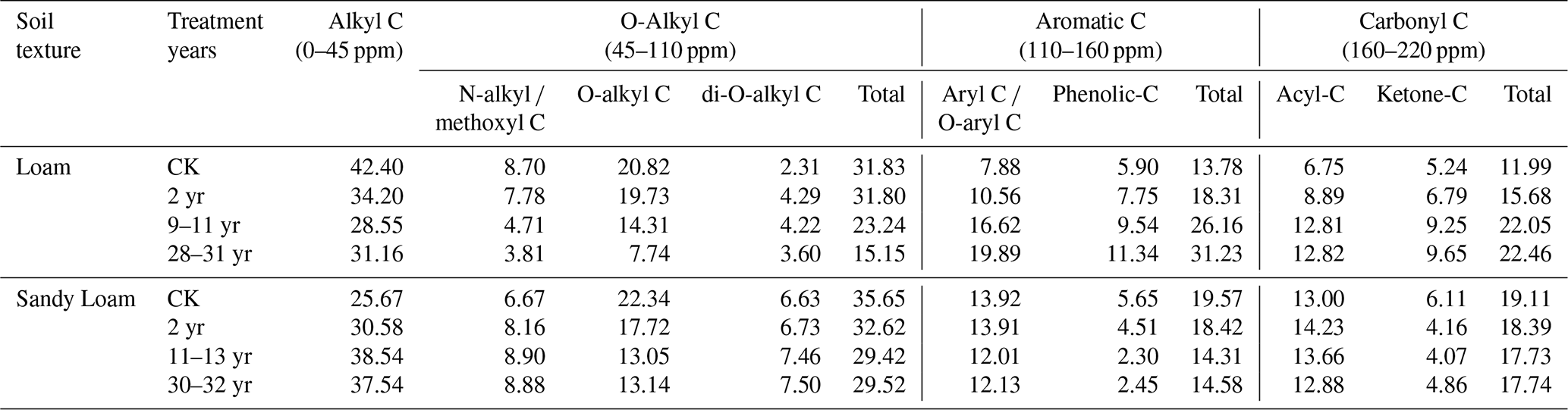
Long-term manure application significantly altered the distribution of OC functional groups in greenhouse soils, with notable variations observed between different soil textures (Fig. 5a, b). Compared to CK, the proportion of alkyl C in the loam decreased by 13.9 % at 9–11 years of manure application, and subsequently increased by 2.6 % at 28–31 years. The proportion of O-Alkyl C exhibited a gradual decline, decreasing by 16.7 % at 28–31 years. In contrast, the proportions of aromatic C and carbonyl C steadily increased, rising by 17.5 % and 10.5 %, respectively, at 28–31 years (Table 2). In the sandy loam, manure application increased the proportion of alkyl C while decreasing the proportions of O-alkyl C and aromatic C. Compared to CK, the proportion of alkyl C increased by 12.9 % at 30–32 years, while the proportions of O-alkyl C and aromatic C decreased by 6.2 % and 5.3 %, respectively. The proportion of carbonyl C remained relatively stable, maintaining at 15.56 %–19.11 % (Table 2).
In the loam, long-term manure application primarily increased AI, followed by HI and . AI increased with the extension of manure application years. HI increased only between 28–31 years, remaining relatively stable at 2 years and 9–11 years. decreased at 2 and 9–11 years. Compared to CK, after 28–31 years of manure application in the greenhouse, AI, HI, and increased by 249.44 %, 29.39 %, and 49.90 %, respectively, with an overall increase of 54.61 % in SOC stability (Fig. 5c). In contrast, the SOC stability indicators in the sandy loam were significantly lower than those in the loam. In the sandy loam, AI decreased with the extended manure application years, while HI and gradually increased. Compared to CK, although the AI of greenhouse soils after 30–32 years of manure application decreased by 0.12, HI and increased by 0.29 and 0.99, respectively (Fig. 5d).
3.5 Correlations between SOC fractions and chemical composition
There were significant differences in the correlation patterns between the two soil textures. In the loam, SOC and all its fractions were significantly negatively correlated with alkyl C and O-alkyl C, but showed highly significant positive correlations with aromatic C and carbonyl C (P<0.001, Fig. 6a). All SOC fractions were significantly positively correlated with AI, but negatively with . HI was significantly positively correlated only with SOC, POC, and MAOC, but not with SLOCF (EOC, DOC, and MBC, Fig. 6a). In contrast, in the sandy loam, POC showed generally weak correlations with functional groups and stability indices; only cPOC was significantly positively correlated with alkyl C and HI, and negatively with O-alkyl C (Fig. 6b). SOC, SLOCF, and MAOC were positively correlated with alkyl C, but generally negatively with O-alkyl C, aromatic C, and carbonyl C. Notably, DOC showed no significant correlation with either aromatic C or carbonyl C. The strongest correlation was observed between carbonyl C and MAOC (P<0.001), but correlations with other SOC fractions were weak. SOC, SLOCF, and MAOC were all significantly positively correlated with HI, but negatively with AI. exhibited significant positive correlations with SOC, EOC, MBC, and MAOC, but was not significantly associated with DOC (Fig. 6b).

Figure 6Pearson correlations between soil organic carbon (SOC) fractions based on their concentrations (g kg−1) and SOC chemical structure and stability indices in greenhouses (a) loam and (b) sandy loam. Note: SOC fractions include total SOC, easily oxidizable organic carbon (EOC), dissolved organic carbon (DOC), microbial biomass carbon (MBC), coarse particulate organic carbon (cPOC), fine particulate organic carbon (fPOC), and mineral-associated organic carbon (MAOC). SOC stability indices include aromaticity index (AI), hydrophobicity index (HI), and the ratio of alkyl C to O-alkyl C (). * Correlation was significant at P≤0.05; Correlation was significant at P≤0.01; Correlation was significant at P≤0.001.
3.6 Pathways of long-term SOC storage in greenhouses
In loam, SOC content was primarily driven by MAOC and EOC. Although no direct path was found from POC to SOC, SOC stability indices (AI and HI) exerted significant positive effects on POC accumulation, and POC indirectly contributed to SOC content through its promotion of MAOC formation. By contrast, the path from MAOC to EOC was not significant (Fig. 7a). In sandy loam, SOC content was jointly influenced by MAOC and POC. SOC stability (HI) significantly enhanced EOC accumulation, which subsequently promoted MAOC formation and ultimately increased SOC content. However, the path between SOC stability (HI) and cPOC showed relatively low significance, and no direct association was detected between cPOC and MAOC (Fig. 7b).

Figure 7Partial least squares structural equation models (PLS-SEM) illustrating the pathways through which soil organic carbon (SOC) chemical stability indices influence SOC fractions and SOC content in greenhouse soils: (a) loam; (b) sandy loam. Numbers on arrows denote path coefficients, while numbers adjacent to arrows represent weight contributions. Solid and dashed lines indicate significant and non-significant relationships, respectively. Note: SOC fractions include easily oxidizable organic carbon (EOC), dissolved organic carbon (DOC), coarse particulate organic carbon (cPOC), fine particulate organic carbon (fPOC), and mineral-associated organic carbon (MAOC). SOC chemical stability indices include aromaticity index (AI) and hydrophobicity index (HI).
4.1 Effects of manure application on SOC fractions in greenhouses
Manure application in greenhouses significantly increased SOC content, playing a key role in enhancing soil fertility. However, with continuous application, SOC in loam stabilized after 20 years, whereas in sandy loam equilibrium was reached within only 2 years (Fig. 1). This stabilization likely reflects a new balance in SOC, where additional carbon inputs are offset by the higher mineralization rates characteristic of greenhouse soils (Stewart et al., 2007). The difference in equilibrium time can be attributed to soil texture: fine-textured soils (e.g., loam) provide more binding sites that enhance SOC stability and slow decomposition, while sandy loam, with limited binding capacity, undergoes faster SOC decomposition and therefore reaches equilibrium more rapidly (Wiesmeier et al., 2019; Mao et al., 2024).
Manure application significantly increased all SOC fractions, with MAOC emerging as the dominant stable pool (Figs. 2, 3), consistent with previous findings highlighting MAOC's central role in long-term carbon sequestration (Mustafa et al., 2022; Zhou et al., 2024). With prolonged manure application, EOC, cPOC, and fPOC and their relative proportions in SOC tended to stabilize (Figs. 2, 3). Under greenhouse conditions, manure-derived EOC and POC exhibit rapid microbial turnover, and with prolonged manure application their inputs and losses approach a dynamic balance, thereby stabilizing both their contents and their relative contributions to SOC (Zheng et al., 2022; Zhou et al., 2024). DOC and MBC accounted for less than 2.5 % of SOC, showing no significant differences across application durations or soil textures, serving primarily as indicators of microbial metabolism rather than major carbon reservoirs (Francioli et al., 2016; Li et al., 2021; Yan et al., 2023). Loam exhibited higher levels of EOC, POC, and MAOC, with the increasing contribution of MAOC under prolonged manure application reflecting a greater availability of mineral binding and protective sites and, consequently, a superior capacity for organic matter accumulation and stabilization (Zhou et al., 2024; Ling et al., 2025). In contrast, sandy loam, with limited mineral protection, retained SOC mainly in particulate forms, resulting in a much lower sequestration potential, thereby explaining the contrasting SOC fraction distributions between the two soils. Compared with open-field soils in the same region, where lower temperature and moisture generally favor gradual MAOC formation, the warmer and more humid greenhouse environment accelerates labile carbon turnover, thereby amplifying the texture-dependent differences in SOC stabilization observed in this study (Zhang et al., 2022; Niu et al., 2024).
4.2 Effects of manure application on SOC chemical composition
Manure application reshaped SOC chemical structures via texture-specific pathways. In the loam, the application of manure decreased the proportion of alkyl C and O-alkyl C in SOC, while increasing the proportions of aromatic C and carbonyl C (Fig. 5a, Table 2). O-alkyl C and alkyl C are more readily biodegraded than aromatic and carbonyl C and can be transformed into more stable carbonyl- and aromatic-enriched structures via microbial oxidation and free-radical reactions (Panettieri et al., 2014; Kubar et al., 2018; Lan et al., 2022). In loam, rapid and extensive depletion of labile O-alkyl and alkyl C during the initial stage of manure application temporarily shifted SOC composition toward less hydrophobic structures; however, as this selective decomposition persisted over successive microbial turnover cycles, the remaining SOC pool became progressively enriched in more hydrophobic and decomposition-resistant carbon (Xu et al., 2020), driving SOC composition toward greater stability and leading to a subsequent recovery of HI and (Fig. 5c). In sandy loam, the proportion of alkyl C gradually increased with prolonged manure application, whereas the proportions of O-alkyl C, aromatic C, and carbonyl C show an overall decreasing trend (Fig. 5b, Table 2). This is likely because of the lower content of clay and silt in the sandy loam, which reduces the physical protection of soil particles on SOC (An et al., 2021; Yao et al., 2022). In sandy loam, manure application significantly increased HI and while decreasing AI (Fig. 5d), indicating that SOC stabilization was mainly associated with an increased contribution of alkyl C and enhanced hydrophobicity, rather than with the accumulation of chemically resistant aromatic C (Almendros and González-Pérez, 2025). These divergences reflected two stabilization mechanisms: mineral protection in loam (clay-silt adsorption promoting recalcitrant structure accumulation) and hydrophobic protection in sandy loam (alkyl C enrichment reducing microbial accessibility) (Yao et al., 2022; Almendros and González-Pérez, 2025). Greenhouse's warm and humid conditions accelerated labile carbon (O-alkyl C, alkyl C) decomposition, further amplifying texture-driven differences in SOC chemical composition.
4.3 Relationships between SOC fractions and stability-related indices
Mineral protection capacity determined the strength and direction of correlations between SOC fractions (Datta et al., 2017; Yan et al., 2023). In loam, MAOC showed significant positive correlations with EOC, cPOC, and fPOC (Fig. 6a). This pattern reflects the higher mineral protection capacity of loam, whereby labile carbon is retained during decomposition and can associate with clay and silt surfaces, ultimately facilitating MAOC formation (Six et al., 2002; Ji et al., 2024; Si et al., 2024). In contrast, the sandy loam, with its low clay and silt contents, exhibited a weaker SOC accumulation capacity, where SOC was positively correlated only with EOC and MAOC, but negatively correlated with fPOC (Fig. 4b). This finding differs from the results of Rocci et al. (2021), who reported that increases in both MAOC and POC directly contributed to SOC pool enhancement. However, in the sandy loam soil under greenhouse conditions, the negative correlation between POC and MAOC indicates that POC accumulation did not contribute to effective carbon stabilization but instead likely promoted MAOC loss through priming effects. This interpretation is consistent with previous studies showing that inputs of labile or low-quality organic carbon, particularly in soils with limited mineral protection or dominated by low-reactivity clays, can offset newly formed MAOC (Angst et al., 2023; Liang et al., 2023; Elias et al., 2024).
This study also found that the correlations between SOC fractions, functional groups, and stability indices differed significantly between loam and sandy loam (Fig. 6). Previous studies have shown that fine-textured soils preferentially retain microbially transformed and chemically restructured SOC (e.g., aromatic and carboxyl groups) within MAOC, whereas coarse-textured soils mainly preserve partially decomposed plant-derived residues with higher proportions of O-alkyl C (Jindaluang et al., 2013; Witzgall et al., 2021; Niu et al., 2024). In this study, EOC, POC, and MAOC in loam showed significant positive correlations with SOC stability indices such as AI and HI (Fig. 6a), indicating that even metabolically active fractions may contribute to long-term SOC stabilization through mineral associations when mineral adsorption sites are abundant. In contrast, the organic carbon fractions in sandy loam were mainly positively correlated with alkyl C, HI, and , while fPOC showed no significant relationships with SOC chemical structures or stability indices (Fig. 6b), indicating that these particulate organic carbons were not effectively adsorbed or protected. This finding aligns with Witzgall et al. (2021), who observed in controlled litter decomposition experiments that fine-textured soils preferentially retained microbially restructured SOC, whereas coarse-textured soils released more CO2 and retained only limited plant-derived fragments.
4.4 Sequestration pathways of SOC in greenhouses
Across the two greenhouse, MAOC was the primary driver of SOC accumulation, but the contribution pathways of SLOC and POC differed markedly (Fig. 7). In loam, although EOC can be partially transformed into residues and incorporated into MAOC through microbial metabolism, its contribution is not significant. This does not imply the absence of such a process; rather, the abundant clay and mineral binding sites in loam make the microbial reprocessing and mineral association of POC the predominant sources of MAOC, thereby masking the effect of EOC incorporation (Zhou et al., 2024; Liu et al., 2025). In contrast, limited clay and sorption sites in sandy loam markedly reduce the conversion of POC into MAOC, leaving POC largely as particulate residues (Christy et al., 2023; Fohrafellner et al., 2024). This explains why there was no significant path detected between POC and MAOC in sandy loam, while POC still directly promoted SOC content through its own accumulation. Under such conditions, the molecular characteristics of EOC, such as small molecules rich in carboxyl and phenolic hydroxyl groups, enable rapid diffusion and preferential occupation of scarce mineral binding sites, making it a key precursor of MAOC (Christy et al., 2023). This is consistent with several studies reporting that in soils with low fine particle content, inputs of labile or soluble organic carbon contribute relatively more to the stable carbon pool (Peng et al., 2025; Simon et al., 2025). In summary, the results of this study indicate that long-term SOC stabilization in greenhouse soil is achieved through a synergistic process in which labile carbon fractions are progressively transformed and incorporated into more stable pools. Nevertheless, the dominant stabilization mechanisms differ between soil textures. In loam, mineral-associated physical protection predominates, whereas in sandy loam with limited mineral binding capacity, chemical recalcitrance plays a relatively greater role.
The results of this study provide guidance for the management of manure application in greenhouse soils with different textures. However, several limitations should be noted. First, the study relied on a chronosequence (space-for-time substitution) approach based on long-term greenhouse plots of different ages. Although samples were collected under unified management conditions, residual differences in initial soil properties and microenvironmental heterogeneity among plots may still influence SOC baselines, making it difficult to fully disentangle fertilization effects from environmental factors. Second, the study did not include structural characterization of submicron-scale mineral–organic complexes (e.g., using X-ray absorption fine structure spectroscopy), preventing us from distinguishing the roles of different clay mineral types (e.g., montmorillonite vs. kaolinite) in the formation and stabilization of MAOC. Third, although the relationships between SOC fractions and stabilization were analyzed, direct evidence on microbial communities and their functional traits was lacking. Future work should integrate metagenomic or functional gene sequencing to identify the key microbial groups driving carbon transformation under different soil textures. Overall, future studies combining long-term field experiments with controlled factor-based additions will be needed to disentangle the coupled effects of manure characteristics, mineral composition, and microbial processes, thereby advancing a multi-scale understanding of SOC stabilization in greenhouse soil.
In greenhouse soil, SOC content gradually stabilized with increasing years of manure application, with loam reaching equilibrium after approximately 20 years, whereas sandy loam attained a new balance within only 2 years. Under equivalent manure inputs, loam contained significantly higher amounts of EOC, POC, and MAOC than sandy loam, with SOC stocks being approximately 2–3 times higher. In loam, SOC showed significant positive correlations with EOC, POC, and MAOC, indicating their synergistic role in long-term SOC stabilization. By contrast, in sandy loam, SOC was positively associated only with EOC and MAOC, but negatively with fPOC, reflecting the limited capacity of sandy loam to incorporate POC into the stable pool under constrained clay and sorption sites. Further analysis revealed that manure application in loam enriched aromatic and carbonyl C, a structural feature conferring greater stability and enhancing the efficiency of EOC and POC transformation into MAOC, thereby facilitating long-term SOC accumulation. Conversely, SOC in sandy loam was dominated by hydrophobic alkyl C, where increases in HI primarily stimulated EOC accumulation, and SOC stabilization largely depended on the continuous replenishment of EOC and its derivatives. Taken together, these findings demonstrate that long-term SOC sequestration rate is not determined solely by the quantity of external inputs, but is strongly governed by the efficiency with which labile fractions are transformed into MAOC. Overall, the response of greenhouse SOC to long-term manure application is essentially regulated by both the distribution of C fractions and the structural stability of their chemical composition.
The data supporting the findings of this study are available from the corresponding author upon reasonable request. The datasets are not publicly available at present because part of the underlying data are associated with ongoing related research projects and are subject to project-level data management and release arrangements.
The supplement related to this article is available online at https://doi.org/10.5194/soil-12-855-2026-supplement.
Conceptualization: Yanli Yi, Song Li, Wei Han; Data curation: Boyuan Tan; Formal analysis: Boyuan Tan, Lu Yang, Xun Xiao, Lingxuan Meng; Funding acquisition: Song Li, Wei Han, Fengkui Qian; Investigation: Boyuan Tan, Lu Yang, Lingxuan Meng, Jing Tan; Methodology: Boyuan Tan; Project administration: Song Li, Wei Han; Resources: Song Li, Wei Han; Software: Boyuan Tan; Supervision: Yanli Yi, Wei Han; Validation: Boyuan Tan; Visualization: Boyuan Tan, Lu Yang; Writing – original draft: Boyuan Tan; Writing – review & editing: Xue Liu, Fengkui Qian, Na Li, Chunji Li, Ning An, Song Li, Wei Han.
The contact author has declared that none of the authors has any competing interests.
Publisher's note: Copernicus Publications remains neutral with regard to jurisdictional claims made in the text, published maps, institutional affiliations, or any other geographical representation in this paper. The authors bear the ultimate responsibility for providing appropriate place names. Views expressed in the text are those of the authors and do not necessarily reflect the views of the publisher.
The authors gratefully acknowledge the College of Land and Environment, Shenyang Agricultural University, for providing research facilities and academic support. We also thank the colleagues and technical staff for their assistance with field sampling, laboratory analyses, and data processing.
This research was financially supported by the National Natural Science Foundation of China (Grant No. U23A2053), the National Key Research and Development Program of China (Grant No. 2023YFD1500303), and the Scientific Research Project of Science and Technology of Liaoning Province (Grant No. 2022-MS-254).
This paper was edited by Luisella Celi Celi and reviewed by two anonymous referees.
Almendros, G. and González-Pérez, J. A.: Soil organic carbon sequestration mechanisms and the chemical nature of soil organic matter – A review, Sustainability, 17, 6689, https://doi.org/10.3390/su17156689, 2025.
An, Z., Bernard, G. M., Ma, Z., Plante, A. F., Michaelis, V. K., Bork, E. W., Carlyle, C. N., Baah-Acheamfour, M., and Chang, S. X.: Forest land-use increases soil organic carbon quality but not its structural or thermal stability in a hedgerow system, Agr. Ecosyst. Environ., 321, 107617, https://doi.org/10.1016/j.agee.2021.107617, 2021.
Angst, G., Mueller, K. E., Castellano, M. J., Vogel, C., Wiesmeier, M., and Mueller, C. W.: Unlocking complex soil systems as carbon sinks: multi-pool management as the key, Nat. Commun., 14, 2967, https://doi.org/10.1038/s41467-023-38700-5, 2023.
Beillouin, D., Corbeels, M., Demenois, J., Berre, D., Boyer, A., Fallot, A., Feder, F., and Cardinael, R.: A global meta-analysis of soil organic carbon in the Anthropocene, Nat. Commun., 14, 3700, https://doi.org/10.1038/s41467-023-39338-z, 2023.
Christy, I., Moore, A., Myrold, D., and Kleber, M.: A mechanistic inquiry into the applicability of permanganate oxidizable carbon as a soil health indicator, Soil Sci. Soc. Am. J., 87, 1083–1095, https://doi.org/10.1002/saj2.20569, 2023.
Das, A., Purakayastha, T. J., Ahmed, N., Das, R., Biswas, S., Shivay, Y. S., Sehgal, V. K., Rani, K., Trivedi, A., Tigga, P., Sahoo, J., Chakraborty, R., and Sen, S.: Influence of clay mineralogy on soil organic carbon stabilization under tropical climate, Indian J. Soil Sci. Plant Nutr., 23, 1003–1018, https://doi.org/10.1007/s42729-022-01099-x, 2023a.
Das, S., Liptzin, D., and Maharjan, B.: Long-term manure application improves soil health and stabilizes carbon in continuous maize production system, Geoderma, 430, 116338, https://doi.org/10.1016/j.geoderma.2023.116338, 2023b.
Datta, R., Kelkar, A., Baraniya, D., Molaei, A., Moulick, A., Meena, R. S., and Formanek, P.: Enzymatic degradation of lignin in soil: A Review, Sustainability, 9, 1163, https://doi.org/10.3390/su9071163, 2017.
Denoncourt, C., Chantigny, M. H., Angers, D. A., Maillard, É., and Halde, C.: Animal manure application promotes nitrogen and organic carbon accumulation in soil organic matter fractions: A global meta-analysis, Sci. Total Environ., 996, 180097, https://doi.org/10.1016/j.scitotenv.2025.180097, 2025.
Dietz, C. L., Jackson, R. D., Ruark, M. D., and Sanford, G. R.: Soil carbon maintained by perennial grasslands over 30 years but lost in field crop systems in a temperate Mollisol, Commun. Earth Environ., 5, 360, https://doi.org/10.1016/j.scitotenv.2025.180097, 2024.
Elias, D. M. O., Mason, K. E., Goodall, T., Taylor, A., Zhao, P., Otero-Fariña, A., Chen, H., Peacock, C. L., Ostle, N. J., Griffiths, R., Chapman, P. J., Holden, J., Banwart, S., McNamara, N. P., and Whitaker, J.: Microbial and mineral interactions decouple litter quality from soil organic matter formation, Nat. Commun., 15, 10063, https://doi.org/10.1038/s41467-024-54446-0, 2024.
FAO (Food and Agriculture Organization of the United Nations): World reference base for soil resources 2014: International soil classification system for naming soils and creating legends for soil maps, World Soil Resources Reports No. 106, FAO, Rome, https://openknowledge.fao.org/handle/20.500.14283/i3794en (last access: 5 September 2026), 2014.
Fohrafellner, J., Keiblinger, K. M., Zechmeister-Boltenstern, S., Murugan, R., Spiegel, H., and Valkama, E.: Cover crops affect pool specific soil organic carbon in cropland – A meta-analysis, Eur. J. Soil Sci., 75, e13472, https://doi.org/10.1111/ejss.13472, 2024.
Francioli, D., Schulz, E., Lentendu, G., Wubet, T., Buscot, F., and Reitz, T.: Mineral vs. organic amendments: Microbial community structure, activity and abundance of agriculturally relevant microbes are driven by long-term fertilization strategies, Front. Microbiol., 7, 1446, https://doi.org/10.3389/fmicb.2016.01446, 2016.
Gross, A. and Glaser, B.: Meta-analysis on how manure application changes soil organic carbon storage, Sci. Rep., 11, 5516, https://doi.org/10.1038/s41598-021-82739-7, 2021.
Hair, J. F., Hult, G. T. M., Ringle, C. M., and Sarstedt, M.: A primer on partial least squares structural equation modeling (PLS-SEM), 3rd edn., Sage Publications, Thousand Oaks, CA, USA, https://us.sagepub.com/en-us/nam/a-primer-on-partial-least-squares-structural-equation-modeling-pls-sem/book270548 (last access: 5 September 2026), 2022.
Hao, X., Ma, X., Sun, L., Liu, S., Ji, J., Zhou, B., Zhao, Y., Zheng, Y., Kuang, E., Liu, Y., and Zhao, S.: High ratio of manure substitution enhanced soil organic carbon storage via increasing particulate organic carbon and nutrient availability, Plants, 14, 2045, https://doi.org/10.3390/plants14132045, 2025.
Islam, M. R., Singh, B., and Dijkstra, F. A.: Stabilisation of soil organic matter: interactions between clay and microbes, Biogeochemistry, 160, 145–158, https://doi.org/10.1007/s10533-022-00956-2, 2022.
Ji, Y., Zhao, Y., Han, X., Chen, X., Yan, J., Lu, X., Zhu, Y., and Zou, W.: Effect of long-term fertilization practices on the stability of soil organic matter in the northeast black soil region in China, Agronomy, 14, 2272, https://doi.org/10.3390/agronomy14102272, 2024.
Jindaluang, W., Kheoruenromne, I., Suddhiprakarn, A., Singh, B. P., and Singh, B.: Influence of soil texture and mineralogy on organic matter content and composition in physically separated fractions soils of Thailand, Geoderma, 195–196, 207–219, https://doi.org/10.1016/j.geoderma.2012.12.003, 2013.
Just, C., Armbruster, M., Barkusky, D., Baumecker, M., Diepolder, M., Döring, T. F., Heigl, L., Honermeier, B., Jate, M., Merbach, I., Rusch, C., Schubert, D., Schulz, F., Schweitzer, K., Seidel, S., Sommer, M., Spiegel, H., Thumm, U., Urbatzka, P., Zimmer, J., Kögel-Knabner, I., and Wiesmeier, M.: Soil organic carbon sequestration in agricultural long-term field experiments as derived from particulate and mineral-associated organic matter, Geoderma, 434, 116472, https://doi.org/10.1016/j.geoderma.2023.116472, 2023.
Kleber, M., Eusterhues, K., Keiluweit, M., Mikutta, C., Mikutta, R., and Nico, P. S.: Chapter one – Mineral–organic associations: formation, properties, and relevance in soil environments, Adv. Agron., 130, 1–140, https://doi.org/10.1016/bs.agron.2014.10.005, 2015.
Kubar, K. A., Huang, L., Lu, J., Li, X., Xue, B., and Yin, Z.: Long-term tillage and straw returning effects on organic C fractions and chemical composition of SOC in rice-rape cropping system, Arch. Agron. Soil Sci., 65, 125–137, https://doi.org/10.1080/03650340.2018.1490726, 2018.
Lan, X., Shan, J., Huang, Y., Liu, X., Lv, Z., Ji, J., Hou, H., Xia, W., and Liu, Y.: Effects of long-term manure substitution regimes on soil organic carbon composition in a red paddy soil of southern China, Soil Till. Res., 221, 105395, https://doi.org/10.1016/j.still.2022.105395, 2022.
Lavallee, J. M., Soong, J. L., and Cotrufo, M. F.: Conceptualizing soil organic matter into particulate and mineral-associated forms to address global change in the 21st century, Glob. Change Biol., 26, 261–273, https://doi.org/10.1111/gcb.14859, 2020.
Li, Y., Li, Z., Cui, S., Liang, G., and Zhang, Q.: Microbial-derived carbon components are critical for enhancing soil organic carbon in no-tillage croplands: A global perspective, Soil Till. Res., 205, 104758, https://doi.org/10.1016/j.still.2020.104758, 2021.
Liang, G., Stark, J., and Waring, B. G.: Mineral reactivity determines root effects on soil organic carbon, Nat. Commun., 14, 4962, https://doi.org/10.1038/s41467-023-40768-y, 2023.
Ling, J., Dungait, J. A. J., Delgado-Baquerizo, M., Cui, Z., Zhou, R., Zhang, W., Gao, Q., Chen, Y., Yue, S., Kuzyakov, Y., Zhang, F., Chen, X., and Tian, J.: Soil organic carbon thresholds control fertilizer effects on carbon accrual in croplands worldwide, Nat. Commun., 16, 3009, https://doi.org/10.1038/s41467-025-57981-6, 2025.
Liu, L., Yang, J., Wang, J., Yu, Q., Wei, C., Jiang, L., Huang, J., Zhang, Y., Jiang, Y., Zhang, H., and Han, X.: Increase in mineral-associated organic carbon does not offset the decrease in particulate organic carbon under long-term nitrogen enrichment in a steppe ecosystem, Soil Biol. Biochem., 202, 109695, https://doi.org/10.1016/j.soilbio.2024.109695, 2025.
Liu, Y., Zhou, Z., Zhang, X., Xu, X., Chen, H., and Xiong, Z.: Net global warming potential and greenhouse gas intensity from the double rice system with integrated soil–crop system management: A three-year field study, Atmos. Environ., 116, 92–101, https://doi.org/10.1016/j.atmosenv.2015.06.018, 2015.
Lu, F., Wang, X., Han, B., Ouyang, Z., Duan, X., Hua, Z., and Miao, H.: Soil carbon sequestrations by nitrogen fertilizer application, straw return and no-tillage in China's cropland, Glob. Change Biol., 15, 281–305, https://doi.org/10.1111/j.1365-2486.2008.01743.x, 2009.
Lu, R. K.: Analysis methods of soil agricultural chemistry, China Agricultural Science and Technology Press, Beijing, ISBN 978-7-80119-925-6, 2000 (in Chinese).
Mao, H. R., Cotrufo, M. F., Hart, S. C., Sullivan, B. W., Zhu, X., Zhang, J., Liang, C., and Zhu, M.: Dual role of silt and clay in the formation and accrual of stabilized soil organic carbon, Soil Biol. Biochem., 192, 109390, https://doi.org/10.1016/j.soilbio.2024.109390, 2024.
Mustafa, A., Frouz, J., Naveed, M., Ping, Z., Nan, S., Minggang, X., and Núñez-Delgado, A.: Stability of soil organic carbon under long-term fertilization: Results from 13C NMR analysis and laboratory incubation, J. Integr. Agr., 205, 112476, https://doi.org/10.1016/j.envres.2021.112476, 2022.
Niu, Y., Li, Y., Lou, M., Cheng, Z., Ma, R., Guo, H., Zhou, J., Jia, H., Fan, L., and Wang, T.: Microbial transformation mechanisms of particulate organic carbon to mineral-associated organic carbon at the chemical molecular level: Highlighting the effects of ambient temperature and soil moisture, Soil Biol. Biochem., 195, 109454, https://doi.org/10.1016/j.soilbio.2024.109454, 2024.
Oldfield, E. E., Bradford, M. A., and Wood, S. A.: Global meta-analysis of the relationship between soil organic matter and crop yields, SOIL, 5, 15–32, https://doi.org/10.5194/soil-5-15-2019, 2019.
Panettieri, M., Knicker, H., Murillo, J. M., Madejón, E., and Hatcher, P. G.: Soil organic matter degradation in an agricultural chronosequence under different tillage regimes evaluated by organic matter pools, enzymatic activities and CPMAS 13C NMR, Soil Biol. Biochem., 78, 170–181, https://doi.org/10.1016/j.soilbio.2014.07.021, 2014.
Peng, Y., Biswas, A., Adamowski, J. F., Zhang, X., Li, Y., Li, L., Peng, Y., and Cao, J.: Sources and stability of particulate organic matter (POM) and mineral-associated organic matter (MAOM) on the Loess Plateau: Implications for soil carbon management, Ecol. Indic., 179, 114162, https://doi.org/10.1016/j.ecolind.2025.114162, 2025.
Rocci, K. S., Lavallee, J. M., Stewart, C. E., and Cotrufo, M. F.: Soil organic carbon response to global environmental change depends on its distribution between mineral-associated and particulate organic matter: A meta-analysis, Sci. Total Environ., 793, 148569, https://doi.org/10.1016/j.scitotenv.2021.148569, 2021.
Schmidt, M. W. I., Torn, M. S., Abiven, S., Dittmar, T., Guggenberger, G., Janssens, I. A., Kleber, M., Kögel-Knabner, I., Lehmann, J., Manning, D. A. C., Nannipieri, P., Rasse, D. P., Weiner, S., and Trumbore, S. E.: Persistence of soil organic matter as an ecosystem property, Nature, 478, 49–56, https://doi.org/10.1038/nature10386, 2011.
Si, Q., Chen, K., Wei, B., Zhang, Y., Sun, X., and Liang, J.: Dissolved carbon flow to particulate organic carbon enhances soil carbon sequestration, SOIL, 10, 441–450, https://doi.org/10.5194/soil-10-441-2024, 2024.
Simon, C., Miltner, A., Mulder, I., Kaiser, K., Lorenz, M., Thiele-Bruhn, S., and Lechtenfeld, O.: Long-term effects of manure addition on soil organic matter molecular composition: Carbon transformation as a major driver of energetic potential, Soil Biol. Biochem., 205, 109755, https://doi.org/10.1016/j.soilbio.2025.109755, 2025.
Six, J., Callewaert, P., Lenders, S., De Gryze, S., Morris, S. J., Gregorich, E. G., Paul, E. A., and Paustian, K.: Measuring and understanding carbon storage in afforested soils by physical fractionation, Soil Sci. Soc. Am. J., 66, 1981–1987, https://doi.org/10.2136/sssaj2002.1981, 2002.
Stewart, C. E., Paustian, K., Conant, R. T., Plante, A. F., and Six, J.: Soil carbon saturation: concept, evidence and evaluation, Biogeochemistry, 86, 19–31, https://doi.org/10.1007/s10533-007-9140-0, 2007.
Tan, B., Xiao, X., Yang, L., Meng, L., Li, S., An, N., Lu, Y., Wang, W., Han, W., and Yi, Y.: Mechanisms of soil structure stability in greenhouse: the balancing role of binding and dispersing agents, J. Soils Sediments, 25, 2371–2386, https://doi.org/10.1007/s11368-025-04079-7, 2025.
Vance, E. D., Brookes, P. C., and Jenkinson, D. S.: An extraction method for measuring soil microbial biomass C, Soil Biol. Biochem., 19, 703–707, https://doi.org/10.1016/0038-0717(87)90052-6, 1987.
Vieira, F. C. B., Bayer, C., Zanatta, J. A., Dieckow, J., Mielniczuk, J., and He, Z. L.: Carbon management index based on physical fractionation of soil organic matter in an Acrisol under long-term no-till cropping systems, Soil Till. Res., 96, 195–204, https://doi.org/10.1016/j.still.2007.06.007, 2007.
Wiesmeier, M., Urbanski, L., Hobley, E., Lang, B., von Lützow, M., Marin-Spiotta, E., van Wesemael, B., Rabot, E., Ließ, M., Garcia-Franco, N., Wollschläger, U., Vogel, H., and Kögel-Knabner, I.: Soil organic carbon storage as a key function of soils – a review of drivers and indicators at various scales, Geoderma, 333, 149–162, https://doi.org/10.1016/j.geoderma.2018.07.026, 2019.
Witzgall, K., Vidal, A., Schubert, D. I., Höschen, C., Schweizer, S. A., Buegger, F., Pouteau, V., Chenu, C., and Mueller, C. W.: Particulate organic matter as a functional soil component for persistent soil organic carbon, Nat. Commun., 12, 4115, https://doi.org/10.1038/s41467-021-24192-8, 2021.
Xu, L., Wang, M., Tian, Y., Shi, X., Shi, Y., Yu, Q., Xu, S., Pan, J., Li, X., and Xie, X.: Relationship between macropores and soil organic carbon fractions under long-term organic manure application, Land Degrad. Dev., 31, 1344–1354, https://doi.org/10.1002/ldr.3525, 2020.
Yan, H., Fan, W., and Wu, J.: Effects of continuous manure application on the microbial community and labile organic carbon fractions, Agriculture, 13, 2096, https://doi.org/10.3390/agriculture13112096, 2023.
Yang, L., Han, W., Tan, B., Wu, Y., Li, S., and Yi, Y.: Effects of nutrient accumulation and microbial community changes on tomato fusarium wilt disease in greenhouse soil, Sustainability, 16, 7756, https://doi.org/10.3390/su16177756, 2024.
Yao, B., Zeng, X., Pang, L., Kong, X., Tian, K., Ji, Y., Sun, S., and Tian, X.: The photodegradation of lignin methoxyl C promotes fungal decomposition of lignin aromatic C measured with 13C-CPMAS NMR, J. Fungi, 8, 900, https://doi.org/10.3390/jof8090900, 2022.
Zhang, Y., Hagedorn, F., Guidi, C., and Yang, L.: Limited soil carbon storage under long-term organic fertilization in solar greenhouses, Soil Use Manage., 38, 1614–1627, https://doi.org/10.1111/sum.12832, 2022.
Zhao, Z., Mao, Y., Gao, S., Lu, C., Pan, C., and Li, X.: Organic carbon accumulation and aggregate formation in soils under organic and inorganic fertilizer management practices in a rice-wheat cropping system, Sci. Rep., 13, 3665, https://doi.org/10.1038/s41598-023-30541-y, 2023.
Zheng, W., Rao, C., Wu, Q., Wang, E., Jiang, X., Xu, Y., Hu, L., Chen, Y., Liang, X., and Yan, W.: Changes in the soil labile organic carbon fractions following bedrock exposure rate in a karst context, Forests, 13, 516, https://doi.org/10.3390/f13040516, 2022.
Zhou, Z., Ren, C., Wang, C., Delgado-Baquerizo, M., Luo, Y., Luo, Z., Du, Z., Zhu, B., Yang, Y., Jiao, S., Zhao, F., Cai, A., Yang, G., and Wei, G.: Global turnover of soil mineral-associated and particulate organic carbon, Nat. Commun., 15, 5329, https://doi.org/10.1038/s41467-024-49743-7, 2024.