
Articles | Volume 12, issue 2
https://doi.org/10.5194/soil-12-733-2026
© Author(s) 2026. This work is distributed under
the Creative Commons Attribution 4.0 License.
the Creative Commons Attribution 4.0 License.
https://doi.org/10.5194/soil-12-733-2026
© Author(s) 2026. This work is distributed under
the Creative Commons Attribution 4.0 License.
the Creative Commons Attribution 4.0 License.
Original research article
| 
03 Jul 2026
Original research article |
| 03 Jul 2026
| 03 Jul 2026
Non-inversion tillage benefits soil N retention during bare soil period coinciding with wet spell
Annelie Holzkämper
CORRESPONDING AUTHOR
Agroscope, Division Agroecology and Environment, Reckenholzstr. 191, 8046 Zurich, Switzerland
Ernst Spiess
Agroscope, Division Agroecology and Environment, Reckenholzstr. 191, 8046 Zurich, Switzerland
Clay Humphrys
Agroscope, Division Agroecology and Environment, Reckenholzstr. 191, 8046 Zurich, Switzerland
Karin Meier-Zimmermann
Agroscope, Division Agroecology and Environment, Reckenholzstr. 191, 8046 Zurich, Switzerland
Olivier Heller
Agroscope, Division Agroecology and Environment, Reckenholzstr. 191, 8046 Zurich, Switzerland
Thomas Keller
Agroscope, Division Agroecology and Environment, Reckenholzstr. 191, 8046 Zurich, Switzerland
Volker Prasuhn
Agroscope, Division Agroecology and Environment, Reckenholzstr. 191, 8046 Zurich, Switzerland
Related authors
Malve Heinz, Annelie Holzkämper, Rohini Kumar, Sélène Ledain, Pascal Horton, and Bettina Schaefli
Hydrol. Earth Syst. Sci., 30, 2879–2911, https://doi.org/10.5194/hess-30-2879-2026, https://doi.org/10.5194/hess-30-2879-2026, 2026
Short summary
Short summary
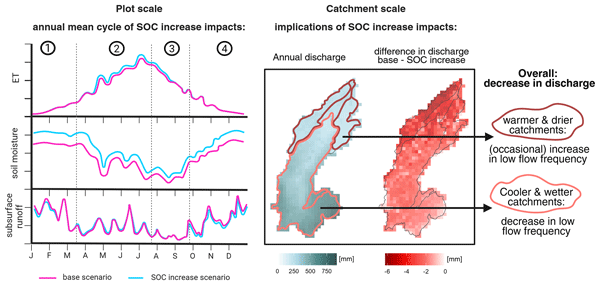
Droughts increasingly threaten agriculture. Improving soils to store more water, for example by increasing soil organic carbon, can help. We simulated this in a Swiss catchment and found that more soil carbon slightly increased soil water storage and evapotranspiration, modestly reduced floods, and shortened periods with very little streamflow. However in warmer, drier areas, these periods with little streamflow could sometimes last longer.
Malve Heinz, Maria Eliza Turek, Bettina Schaefli, Andreas Keiser, and Annelie Holzkämper
Hydrol. Earth Syst. Sci., 29, 1807–1827, https://doi.org/10.5194/hess-29-1807-2025, https://doi.org/10.5194/hess-29-1807-2025, 2025
Short summary
Short summary
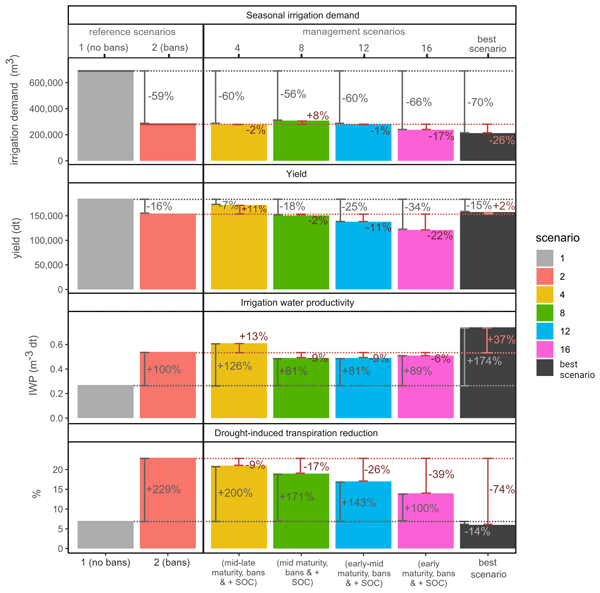
Potato farmers in Switzerland are facing drier conditions and water restrictions. We explored how improving soil health and planting early-maturing potato varieties might help them to adapt. Using a computer model, we simulated potato yields and irrigation water needs under water scarcity. Our results show that earlier-maturing potato varieties reduce the reliance on irrigation but result in lower yields. However, improving soil health can significantly reduce yield losses.
Maria Eliza Turek, Attila Nemes, and Annelie Holzkämper
SOIL, 9, 545–560, https://doi.org/10.5194/soil-9-545-2023, https://doi.org/10.5194/soil-9-545-2023, 2023
Short summary
Short summary
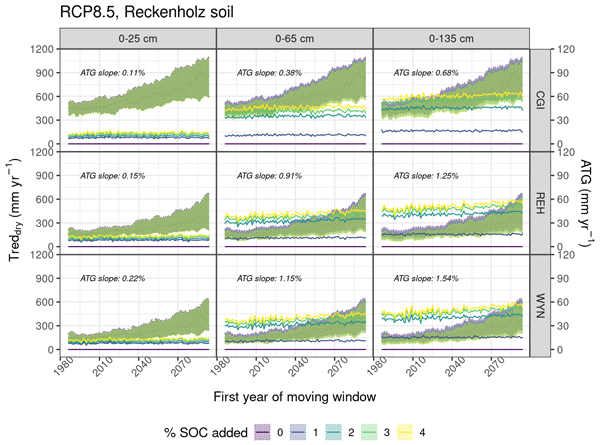
In this study, we systematically evaluated prospective crop transpiration benefits of sequestering soil organic carbon (SOC) under current and future climatic conditions based on the model SWAP. We found that adding at least 2% SOC down to at least 65 cm depth could increase transpiration annually by almost 40 mm, which can play a role in mitigating drought impacts in rain-fed cropping. Beyond this threshold, additional crop transpiration benefits of sequestering SOC are only marginal.
Malve Heinz, Annelie Holzkämper, Rohini Kumar, Sélène Ledain, Pascal Horton, and Bettina Schaefli
Hydrol. Earth Syst. Sci., 30, 2879–2911, https://doi.org/10.5194/hess-30-2879-2026, https://doi.org/10.5194/hess-30-2879-2026, 2026
Short summary
Short summary
Droughts increasingly threaten agriculture. Improving soils to store more water, for example by increasing soil organic carbon, can help. We simulated this in a Swiss catchment and found that more soil carbon slightly increased soil water storage and evapotranspiration, modestly reduced floods, and shortened periods with very little streamflow. However in warmer, drier areas, these periods with little streamflow could sometimes last longer.
Malve Heinz, Maria Eliza Turek, Bettina Schaefli, Andreas Keiser, and Annelie Holzkämper
Hydrol. Earth Syst. Sci., 29, 1807–1827, https://doi.org/10.5194/hess-29-1807-2025, https://doi.org/10.5194/hess-29-1807-2025, 2025
Short summary
Short summary
Potato farmers in Switzerland are facing drier conditions and water restrictions. We explored how improving soil health and planting early-maturing potato varieties might help them to adapt. Using a computer model, we simulated potato yields and irrigation water needs under water scarcity. Our results show that earlier-maturing potato varieties reduce the reliance on irrigation but result in lower yields. However, improving soil health can significantly reduce yield losses.
Hanna Sjulgård, Lukas Valentin Graf, Tino Colombi, Juliane Hirte, Thomas Keller, and Helge Aasen
Biogeosciences, 22, 1341–1354, https://doi.org/10.5194/bg-22-1341-2025, https://doi.org/10.5194/bg-22-1341-2025, 2025
Short summary
Short summary
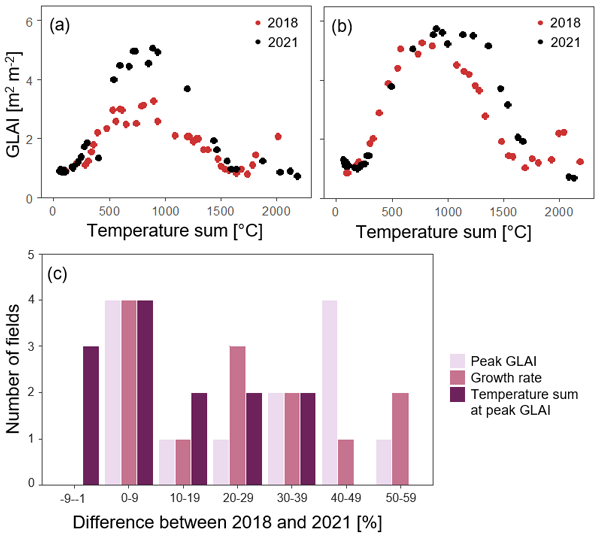
Our study showed that stress-related crop response to changing environmental conditions can be detected by monitoring crops using satellite images at the landscape level. This could be useful for farmers to identify when stresses occur. Our results also suggest that satellite imagery can be used to discover soil impacts on crop development at farm fields. The inclusion of soil properties in satellite image analyses could further improve the accuracy of the prediction of drought stress on crops.
Gina Garland, John Koestel, Alice Johannes, Olivier Heller, Sebastian Doetterl, Dani Or, and Thomas Keller
SOIL, 10, 23–31, https://doi.org/10.5194/soil-10-23-2024, https://doi.org/10.5194/soil-10-23-2024, 2024
Short summary
Short summary
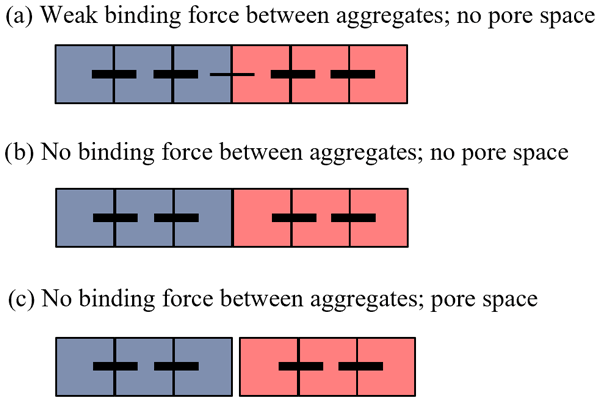
The concept of soil aggregates is hotly debated, leading to confusion about their function or relevancy to soil processes. We propose that the use of conceptual figures showing detached and isolated aggregates can be misleading and has contributed to this skepticism. Here, we conceptually illustrate how aggregates can form and dissipate within the context of undisturbed soils, highlighting the fact that aggregates do not necessarily need to have distinct physical boundaries.
Maria Eliza Turek, Attila Nemes, and Annelie Holzkämper
SOIL, 9, 545–560, https://doi.org/10.5194/soil-9-545-2023, https://doi.org/10.5194/soil-9-545-2023, 2023
Short summary
Short summary
In this study, we systematically evaluated prospective crop transpiration benefits of sequestering soil organic carbon (SOC) under current and future climatic conditions based on the model SWAP. We found that adding at least 2% SOC down to at least 65 cm depth could increase transpiration annually by almost 40 mm, which can play a role in mitigating drought impacts in rain-fed cropping. Beyond this threshold, additional crop transpiration benefits of sequestering SOC are only marginal.
Cited articles
Abdou, H. M. and Flury, M.: Simulation of water flow and solute transport in free-drainage lysimeters and field soils with heterogeneous structures, Eur. J. Soil Sci., 55, 229–241, https://doi.org/10.1046/j.1365-2389.2004.00592.x, 2004.
Agroscope: Bestimmung des Porenvolumens von Bodenproben mit ungestörtem Gefüge mittels Luftdruckpyknometer, Schweizerische Referenzmethoden der Forschungsanstalten Agroscope, Version 1.1, https://link.ira.agroscope.ch/de-CH/publication/46215 (last access: 30 June 2026), 2020a.
Agroscope: pH: pH-Wert in Wassersuspension (1:2.5), in: Schweizerische Referenzmethoden der Forschungsanstalten Agroscope, Agroscope, Zurich, Switzerland, https://link.ira.agroscope.ch/de-CH/publication/45991 (last access: 30 June 2026), 2020b.
Agroscope: Bestimmung des organisch gebundenen Kohlenstoffs (Corg) – Version 1.2, in: Schweizerische Referenzmethoden der Forschungsanstalten Agroscope, Agroscope, Zurich, Switzerland, https://link.ira.agroscope.ch/de-CH/publication/46276 (last access: 30 June 2026), 2020c.
Bates, D., Mächler, M., Bolker, B., and Walker, S.: Fitting Linear Mixed-Effects Models Using lme4, J. Stat. Softw., 67, 1–48, https://doi.org/10.18637/jss.v067.i01, 2015.
Betancur-Corredor, B., Lang, B., and Russell, D. J.: Reducing tillage intensity benefits the soil micro-and mesofauna in a global meta-analysis, Eur. J. Soil Sci., 73, e13321, https://doi.org/10.1111/ejss.13321, 2022.
Behrer, A. P. and Lobell, D.: Higher levels of no-till agriculture associated with lower PM2.5 in the Corn Belt, Environ. Res. Lett., 17, https://doi.org/10.1088/1748-9326/ac816f, 2022.
Bhattacharyya, S. S., Leite, F. F. G. D., France, C. L., Adekoya, A. O., Ros, G. H., de Vries, W., Melchor-Martínez, E. M., Iqbal, H. M. N., and Parra-Saldívar, R.: Soil carbon sequestration, greenhouse gas emissions, and water pollution under different tillage practices, Sci. Total Environ., 826, 154161, https://doi.org/10.1016/j.scitotenv.2022.154161, 2022.
Bjorneberg, D. L., Kanwar, R. S., and Melvin, S. W.: Seasonal changes in flow and NO
Blanco-Canqui, H. and Ruis, S. J.: No-tillage and soil physical environment, Geoderma, 326, 164–200, https://doi.org/10.1016/j.geoderma.2018.03.011, 2018.
Blanco-Canqui, H., Mikha, M. M., Benjamin, J. G., Stone, L. R., Schlegel, A. J., Lyon, D. J., Vigil, M. F., and Stahlman, P. W.: Regional Study of No-Till Impacts on Near-Surface Aggregate Properties that Influence Soil Erodibility, Soil Sci. Soc. Am. J., 73, 1361–1368, https://doi.org/10.2136/sssaj2008.0401, 2009.
Bremner, J. M. and Mulvaney, C. S.: Nitrogen-Total, in: Methods of soil analysis. Part 2. Chemical and microbiological properties, edited by: Page, A. L., Miller, R. H., and Keeney, D. R., American Society of Agronomy, Soil Science Society of America, Madison, Wisconsin, 595–624, ISBN 978-0-89118-072-2, 1982.
Büchi, L., Wendling, M., Amossé, C., Necpalova, M., and Charles, R.: Importance of cover crops in alleviating negative effects of reduced soil tillage and promoting soil fertility in a winter wheat cropping system, Agr. Ecosyst. Environ., 256, 92–104, https://doi.org/10.1016/j.agee.2018.01.005, 2018.
Buczko, U., Bens, O., Hangen, E., Brunotte, J., and Hüttl, R. F.: Infiltration and macroporosity of a silt moam soil under two contrasting tillage systems, Landbauforsch. Volk., 2/3, 181–190, 2003.
Chakraborty, P., Singh, N., Bansal, S., Sekaran, U., Sexton, P., Bly, A., Anderson, S. H., and Kumar, S.: Does the duration of no-till implementation influence depth distribution of soil organic carbon, hydro-physical properties, and computed tomography-derived macropore characteristics?, Soil Till. Res., 222, 105426, https://doi.org/10.1016/j.still.2022.105426, 2022.
Colunga, S. L., Wahab, L., Fierro Cabo, A., and Pereira, E.: Carbon sequestration through conservation tillage in sandy soils of arid and semi-arid climates: A meta-analysis, Soil Till. Res., 245, 106310, https://doi.org/10.1016/j.still.2024.106310, 2025.
Daryanto, S., Wang, L., and Jacinthe, P.-A.: Impacts of no-tillage management on nitrate loss from corn, soybean and wheat cultivation: A meta-analysis, Sci. Rep., 7, 12117, https://doi.org/10.1038/s41598-017-12383-7, 2017.
Deurer, M., Grinev, D., Young, I., Clothier, B. E., and Müller, K.: The impact of soil carbon management on soil macropore structure: a comparison of two apple orchard systems in New Zealand, Eur. J. Soil Sci., 60, 945–955, https://doi.org/10.1111/j.1365-2389.2009.01164.x, 2009.
Dumas, J. B. A.: Procedes de I'analyse organique, Ann. Chim. Phys., 247, 198–213, 1831.
Flisch, R., Sinaj, S., Charles, R., and Richner, W.: GRUDAF 2009. Principles for fertilisation in arable and fodder production, Agrarforschung, 16, 1–100, 2009.
Follett, R. F.: Soil management concepts and carbon sequestration in cropland soils, Soil Till. Res., 61, 77–92, https://doi.org/10.1016/S0167-1987(01)00180-5, 2001.
Frick, H., Bischoff, W.-A., and Liebisch, F.: Massnahmen zur Reduktion der Nitratauswaschung ins Grundwasser: Regionalisierter Massnahmenkatalog für das Nitratprojekt Niederbipp-Gäu-Olten (SO & BE), Agroscope Science, 147, https://doi.org/10.34776/as147g, 2023.
Hansen, E. M., Munkholm, L. J., Melander, B., and Olesen, J. E.: Can non-inversion tillage and straw retainment reduce N leaching in cereal-based crop rotations?, Soil Till. Res., 109, 1–8, https://doi.org/10.1016/j.still.2010.04.001, 2010.
Hess, L. J. T., Hinckley, E.-L. S., Robertson, G. P., and Matson, P. A.: Rainfall intensification increases nitrate leaching from tilled but not no-till cropping systems in the U.S. Midwest, Agr. Ecosyst. Environ., 290, 106747, https://doi.org/10.1016/j.agee.2019.106747, 2020.
Holzkämper, A., Spiess, E., and Prasuhn, V.: Lysimeter data from a tillage experiment at Zurich-Reckenholz, Zenodo [data set], https://doi.org/10.5281/zenodo.20825203, 2026.
Hooker, K. V., Coxon, C. E., Hackett, R., Kirwan, L. E., O'Keeffe, E., and Richards, K. G.: Evaluation of cover crop and reduced cultivation for reducing nitrate leaching in Ireland, J. Environ. Qual., 37, 138–145, https://doi.org/10.2134/jeq2006.0547, 2008.
Huang, M. X., Liang, T., Wang, L. Q., and Zhou, C. H.: No-tillage and fertilization management on crop yields and nitrate leaching in North China Plain, Ecol. Evol., 5, 1143–1155, https://doi.org/10.1002/ece3.1420, 2015.
Huang, Y. W., Ren, W., Lindsey, L. E., Wang, L. X., Hui, D. F., Tao, B., Jacinthe, P. A., and Tian, H. Q.: No-tillage farming enhances widespread nitrate leaching in the US Midwest, Environ. Res. Lett., 19, https://doi.org/10.1088/1748-9326/ad751d, 2024.
Jabro, J. D., Iversen, W. M., Stevens, W. B., Sainju, U. M., and Allen, B. L.: Tillage Effects on Drainage Fluxes and Nitrate Leaching through Unsaturated Zone under Irrigated Corn-Soybean Rotation, Appl. Eng. Agric., 35, 293–300, https://doi.org/10.13031/aea.13127, 2019.
Jossi, W., Zihlmann, U., Anken, T., Dorn, B., and Van der Heijden, M.: Reduzierte Bodenbearbeitung schont die Regenwürmer (Reduced soil management benefits earthworms), Agrarforsch. Schweiz, 2, 432–439, 2011.
Kan, Z., Liu, W., Liu, W., Lal, R., Dang, Y., Zhao, X., and Zhang, H.: Mechanisms of soil organic carbon stability and its response to no-till: A global synthesis and perspective, Glob. Change Biol., 28, 693–710, https://doi.org/10.1111/gcb.15968, 2022.
Kassam, A., Friedrich, T., and Derpsch, R.: Global spread of conservation agriculture, Int. J. Environ. Stud., 76, 29–51, https://doi.org/10.1080/00207233.2018.1494927, 2019.
Kenward, M. G. and Roger, J. H.: Small Sample Inference for Fixed Effects from Restricted Maximum Likelihood, Biometrics, 53, 983–997, 1997.
Kirchmann, H., Johnston, A. E. J., and Bergström, L. F.: Possibilities for Reducing Nitrate Leaching from Agricultural Land, AMBIO, 31, 404–408, https://doi.org/10.1579/0044-7447-31.5.404, 2002.
Klein, T., Holzkämper, A., Calanca, P., and Fuhrer, J.: Adaptation options under climate change for multifunctional agriculture: a simulation study for western Switzerland, Reg. Environ. Change, 14, 167–184, https://doi.org/10.1007/s10113-013-0470-2, 2014.
Klein, T., Holzkämper, A., Calanca, P., Seppelt, R., and Fuhrer, J.: Adapting agricultural land management to climate change: a regional multi-objective optimization approach, Landscape Ecol., 28, 2029–2047, https://doi.org/10.1007/s10980-013-9939-0, 2013.
Koskiaho, J., Kivisaari, S., and Vermeulen, S.: Reduced tillage: Influence on erosion and nutrient losses in a clayey field in southern, Agr. Food Sci., 11, 37–50, https://doi.org/10.23986/afsci.5711, 2002.
Kuznetsova, A., Brockhoff, P. B., and Christensen, R. H. B.: lmerTest Package: Tests in Linear Mixed Effects Models, J. Stat. Softw., 82, 1–26, https://doi.org/10.18637/jss.v082.i13, 2017.
Li, J., Hu, W., Chau, H. W., Beare, M., Cichota, R., Teixeira, E., Moore, T., Di, H., Cameron, K., Guo, J., and Xu, L.: Response of nitrate leaching to no-tillage is dependent on soil, climate, and management factors: A global meta-analysis, Glob. Change Biol., 29, 2172–2187, https://doi.org/10.1111/gcb.16618, 2023.
Liu, J., Tian, Y., Pasut, C., Farrell, M., and Lu, S.: Investigating the influence of soil organic carbon on pore structure within aggregates, Geoderma, 460, 117463, https://doi.org/10.1016/j.geoderma.2025.117463, 2025.
Ma, L., Song, D., Liu, M., Li, Y., and Li, Y.: Effects of earthworm activities on soil nutrients and microbial diversity under different tillage measures, Soil Till. Res., 222, 105441, https://doi.org/10.1016/j.still.2022.105441, 2022.
Maurer-Troxler, C., Chervet, A., Ramseier, L., and Sturny, W. G.: Bodenbiologie nach zehn Jahren Direktsaat und Pflug, Agrarforsch. Schweiz, 12, 460–465, 2005.
Meisinger, J. J., Palmer, R. E., and Timlin, D. J.: Effects of tillage practices on drainage and nitrate leaching from winter wheat in the Northern Atlantic Coastal-Plain USA, Soil Till. Res., 151, 18–27, https://doi.org/10.1016/j.still.2015.02.007, 2015.
Meissner, R., Rupp, H., and Seyfarth, M.: Advanced Technologies in Lysimetry, in: Novel Measurement and Assessment Tools for Monitoring and Management of Land and Water Resources in Agricultural Landscapes of Central Asia, edited by: Mueller, L., Saparov, A., and Lischeid, G., Springer International Publishing, Cham, 159–173, https://doi.org/10.1007/978-3-319-01017-5_8, 2014.
Miranda-Vélez, J. F., Diamantopoulos, E., and Vogeler, I.: Does macropore flow in no-till systems bypass mobile soil nitrogen after harvest?, Soil Till. Res., 221, 105408, https://doi.org/10.1016/j.still.2022.105408, 2022.
Mkhabela, M. S., Madani, A., Gordon, R., Burton, D., Cudmore, D., Elmi, A., and Hart, W.: Gaseous and leaching nitrogen losses from no-tillage and conventional tillage systems following surface application of cattle manure, Soil Till. Res., 98, 187–199, https://doi.org/10.1016/j.still.2007.12.005, 2008.
Montgomery, D. R.: Soil erosion and agricultural sustainability, P. Natl. Acad. Sci. USA, 104, 13268–13272, https://doi.org/10.1073/pnas.0611508104, 2007.
Norberg, L. and Aronsson, H.: Conventional and reduced tillage, and set-aside land – Effects on nitrogen, phosphorus and potassium subsurface leaching from a clay soil during 9 years, Soil Till. Res., 250, 106515, https://doi.org/10.1016/j.still.2025.106515, 2025.
Pires, L. F., Borges, J. A. R., Rosa, J. A., Cooper, M., Heck, R. J., Passoni, S., and Roque, W. L.: Soil structure changes induced by tillage systems, Soil Till. Res., 165, 66–79, https://doi.org/10.1016/j.still.2016.07.010, 2017.
Pisani, O., Strickland, T. C., Hubbard, R. K., Bosch, D. D., Coffin, A. W., Endale, D. M., and Potter, T. L.: Soil nitrogen dynamics and leaching under conservation tillage in the Atlantic Coastal Plain, Georgia, United States, J. Soil Water Conserv., 72, 519–529, https://doi.org/10.2489/jswc.72.5.519, 2017.
Pittelkow, C. M., Linquist, B. A., Lundy, M. E., Liang, X., van Groenigen, K. J., Lee, J., van Gestel, N., Six, J., Venterea, R. T., and van Kessel, C.: When does no-till yield more? A global meta-analysis, Field Crop. Res., 183, 156–168, https://doi.org/10.1016/j.fcr.2015.07.020, 2015.
Porwollik, V., Rolinski, S., Heinke, J., and Müller, C.: Generating a rule-based global gridded tillage dataset, Earth Syst. Sci. Data, 11, 823–843, https://doi.org/10.5194/essd-11-823-2019, 2019.
Prasuhn, V.: On-farm effects of tillage and crops on soil erosion measured over 10 years in Switzerland, Soil Till. Res., 120, 137–146, https://doi.org/10.1016/j.still.2012.01.002, 2012.
Prasuhn, V., Spiess, E., and Seyfarth, M.: The new lysimeter station Zurich-Reckenholz, 13. Gumpensteiner Lysimetertagung, 11–16, https://ira.agroscope.ch/de-CH/publication/23903 (last access: 30 June 2026), 2009.
Radolinski, J., Le, H., Hilaire, S. S., Xia, K., Scott, D., and Stewart, R. D.: A spectrum of preferential flow alters solute mobility in soils, Sci. Rep., 12, 4261, https://doi.org/10.1038/s41598-022-08241-w, 2022.
Randall, G. W. and Iragavarapu, T. K.: Impact of Long-Term Tillage Systems for Continuous Corn on Nitrate Leaching to Tile Drainage, J. Environ. Qual., 24, 360–366, https://doi.org/10.2134/jeq1995.00472425002400020020x, 1995.
Roseberg, R. J. and McCoy, E. L.: Tillage- and Traffic-Induced Changes in Macroporosity and Macropore Continuity: Air Permeability Assessment, Soil Sci. Soc. Am. J., 56, 1261–1267, https://doi.org/10.2136/sssaj1992.03615995005600040042x, 1992.
Seitz, S., Goebes, P., Puerta, V. L., Pereira, E. I. P., Wittwer, R., Six, J., van der Heijden, M. G. A., and Scholten, T.: Conservation tillage and organic farming reduce soil erosion, Agron. Sustain. Dev., 39, https://doi.org/10.1007/s13593-018-0545-z, 2018.
Senigagliesi, C. and Ferrari, M.: Soil and Crop Responses to Alternative Tillage Practices, in: International Crop Science I, ASA, CSSA, and SSSA Books, 27–35, https://doi.org/10.2135/1993.internationalcropscience.c6, 1993.
Shipitalo, M. J., Dick, W. A., and Edwards, W. M.: Conservation tillage and macropore factors that affect water movement and the fate of chemicals, Soil Till. Res., 53, 167–183, https://doi.org/10.1016/S0167-1987(99)00104-X, 2000.
Singh, J.: 3 – Role of Earthworm in Sustainable Agriculture, in: Sustainable Food Systems from Agriculture to Industry, edited by: Galanakis, C. M., Academic Press, 83–122, https://doi.org/10.1016/B978-0-12-811935-8.00003-2, 2018.
Skaalsveen, K., Ingram, J., and Clarke, L. E.: The effect of no-till farming on the soil functions of water purification and retention in north-western Europe: A literature review, Soil Till. Res., 189, 98–109, https://doi.org/10.1016/j.still.2019.01.004, 2019.
Spiess, E., Humphrys, C., Richner, W., Schneider, M. K., Piepho, H.-P., Chervet, A., and Prasuhn, V.: Does no-tillage decrease nitrate leaching compared to ploughing under a long-term crop rotation in Switzerland?, Soil Till. Res., 199, https://doi.org/10.1016/j.still.2020.104590, 2020.
SSS: Swiss soil classification, 3rd edn., Soil Science Society (SSS), https://www.soil.ch/de/publikationen/klassifikation (last access: 30 June 2026), 2010 (in German).
Thomsen, I. K. and Christensen, B. T.: Availability to subsequent crops and leaching of nitrogen in 15N-labelled sugar beet tops and oilseed rape residues, J. Agr. Sci., 126, 191–199, https://doi.org/10.1017/S0021859600073135, 1996.
Weed, D. A. J. and Kanwar, R. S.: Nitrate and Water Present in and Flowing from Root-Zone Soil, J. Environ. Qual., 25, 709–719, https://doi.org/10.2134/jeq1996.00472425002500040010x, 1996.
Zarrineh, N., Abbaspour, K. C., and Holzkämper, A.: Integrated assessment of climate change impacts on multiple ecosystem services in Western Switzerland, Sci. Total Environ., 708, 135212, https://doi.org/10.1016/j.scitotenv.2019.135212, 2020.
Short summary
We studied whether reduced soil disturbance can lower nitrate losses from farmland in Switzerland. In a large lysimeter experiment, we compared chisel ploughing with conventional ploughing.
Reduced tillage lowered nitrate leaching by up to 42 percent in some soils during a very rainy period without crop cover. The results suggest that reduced soil management could help protect water quality under future climate conditions with wetter winter and spring conditions.
We studied whether reduced soil disturbance can lower nitrate losses from farmland in...


