
the Creative Commons Attribution 4.0 License.
the Creative Commons Attribution 4.0 License.
 | 19 Jan 2026

Soil characteristics, land suitability and effect of trachyte and basalt rock powders on maize (Zea mays L.) growth and yield on Fluvisols in Cameroon's Sudano-Sahelian zone (Central Africa)
Bienvenu Sidsi
Claudine Vounba
Simon Djakba Basga
Aubin Nzeugang Nzeukou
Merlin Gountie Dedzo
The Sudano–Sahelian zone of Cameroon, characterized by a low annual rainfall, faces challenges in soil fertility preservation due to agricultural intensification and unsustainable practices. This study aims to evaluate the effect of trachyte and basalt powders inputs on soil and maize yield in Guiring experimental farm in the Far-North Region of Cameroon. Fieldwork involved collecting and describing samples of trachyte, basalt, and soil and setting up the experimental design. In the laboratory, the ground rock samples underwent geochemical analysis, and the soil samples were analysed for their mineralogical and physicochemical properties. The experiment followed a completely randomized block design with six treatments and four replications as follows: T0 (control plot without fertilizer inputs); T1 (trachyte powder applied directly after sowing at 2000 kg ha−1, 2.0 kg per 9.6 m2); T2 (trachyte powder applied directly after sowing (2000 kg ha−1; 2.0 kg per 9.6 m2) + urea (104.2 kg ha−1; 100 g per 9.6 m2) at 06 weeks); T3 (basalt powder applied directly after sowing (2000 kg ha−1; 2.0 kg per 9.6 m2); T4 (basalt powder applied directly after sowing (2000 kg ha−1; 2.0 kg per 9.6 m2) + urea (104.2 kg ha−1; 100 g per 9.6 m2) at 06 weeks); and T5 (NPK fertilizer applied 2 weeks after sowing at 208.3 kg ha−1 combined with urea applied 6 weeks after sowing (208,3 kg ha−1; 200 g per 9.6 m2) + urea (104.2 kg ha−1; 100 g per 9.6 m2) at 06 weeks. Growth and yield parameters of maize, include germination rate, plant height, number of leaves per plant, stem diameter, ear length, ear diameter, ear weight, 100-grain weight, and grain yield (kg ha−1). The soil is sand-dominated with a neutral pH, and its clay fraction is composed of kaolinite, smectites, and sepiolite. It exhibits low levels of organic matter (2.6 %) and nitrogen (0.1 %) but has a moderate-to-high cation exchange capacity (22.1 cmolc kg−1) and an available phosphorus content (19 mg kg−1). This soil is classified as Ochric Dystric Fluvisols according to the WRB. Fertilization trials showed a significant improvement in maize growth and yield. For NPK + urea as 100 % relative yield (T5: 3165 kg ha−1), basalt + urea reached 93 % (T4: 2931 kg ha−1) and trachyte + urea reached 87 % (T2: 2764 kg ha−1) of the maximum yield, whereas the remineralizers alone resulted in relative yields of 81 % and 75 % for basalt (T3: 2559 kg ha−1) and trachyte (T1: 2363 kg ha−1), respectively, with the low performance of 20 % (646 kg ha−1) obtained in the control. Although treatments with conventional fertilizers resulted in comparatively higher yields, rock powders offer significant advantages by facilitating region-specific strategies that deliver environmental benefits, durable effectiveness, and improved affordability.
- Article
(6412 KB) - Full-text XML
- BibTeX
- EndNote


In Sub-Saharan Africa, soil degradation represents a major obstacle to food security and the sustainability of agricultural production systems. Increasing population pressure on arable land, combined with extensive farming practices and low input, leads to the gradual depletion of soil nutrients (Jhariya et al., 2021; Khatri et al., 2024). In most rural areas, agriculture remains predominantly subsistence-based, relying on traditional techniques and limited mineral inputs due to the high cost and restricted accessibility of synthetic fertilizers (Sinha et al., 2022). These conditions result in declining yields, deteriorating soil structure, and loss of organic matter (Nanganoa et al., 2019; Rajwar et al., 2021).
In recent decades, population growth and food insecurity have led to an intensification of extensive farming practices and an increase in soil overexploitation (Pham et al., 2018; Jhariya et al., 2021; Khatri et al., 2024). This situation is further exacerbated in addition to limited access to inputs, by logistical constraints and institutional challenges, causing a continuous decline in soil fertility and crop productivity (Kuria et al., 2019; Nanganoa et al., 2019). As a limited resource, soil takes between 200 to 1000 years to form a layer of 2.5 cm in thickness (Stockmann et al., 2014; Zhang et al., 2024), making its exploitation for agricultural purposes fragile due to the increase in the world population and climate change (Moges and Taye, 2017). Soil degradation thus represents a major environmental and socio-economic challenge, impacting biodiversity, ecosystem services, and food security. Sustainable management requires integrated strategies aimed at restoring or maintaining nutrient balance and enhancing agroecosystem resilience (Nkouathio et al., 2008; Mekuriaw et al., 2017; Hossain et al., 2020; Garai et al., 2021).
Soil provides physical stability, support for agriculture and contributes to the nutrient cycle, water retention capacity, storage, filtering, buffering, and transformation of compounds (Tsozué et al., 2020a; Toor et al., 2021; Sivaram et al., 2023). Soil health is a key factor in sustainable agriculture, influencing ecosystem qualities, such as air and water quality (Are et al., 2018; Tsozué et al., 2020a). Maintaining soil quality is an essential determinant for managing ecosystem services and sustainable soil management (Tsozué et al., 2020a; Wu et al., 2023). Its restoration and assessment require the use of relevant biological, physical, and/or chemical indicators (Tsozué et al., 2020a; Oliveira et al., 2024). It is important to consider current land use and precisely define the type of disturbance that may alter its quality (Peng et al., 2021). In the case of anthropogenic disturbances, land use, including agricultural management systems, strongly influences soil quality, expressed by changes in its physicochemical and biological properties and agricultural yield (Farahani et al., 2019; Tsozué et al., 2020a; Mamabolo et al., 2024).
Also, the intensification of extensive farming practices leads to excessive nutrient depletion from the soil, thereby compromising its fertility on a global scale (Padhiary and Kumar, 2024). While nitrogen (N) and phosphorus (P) are often highlighted, potassium (K) also plays a crucial role, and its depletion is becoming an increasing concern (Khan et al., 2023). To address this issue, the use of rock powders derived from base-rich silicate rocks has emerged as a sustainable alternative to synthetic fertilizers. These natural fertilizers enrich the soil with plant nutrients and enhance its structure, although their performance depends on soil characteristics and climatic conditions (Manning and Theodoro, 2020; Buss et al., 2024; Rodrigues et al., 2024). Numerous studies have explored the use of silicate rock powders for soil fertilization and remineralization. In the Americas, several studies have demonstrated that these mineral powders enhance water retention and soil fertility while contributing to carbon sequestration (Beerling et al., 2018; Theodoro et al., 2021; Lewis et al., 2021; Ramos et al., 2022; Medeiros et al., 2023). In Europe, research has confirmed their positive impact on improving soil fertility and remineralization (Beerling et al., 2018; Vienne et al., 2022). Similarly, in Asia, silicate rocks have shown their ability to increase agricultural productivity (Xiang et al., 2020; Basak et al., 2023; Sniatala et al., 2023). Africa has also embraced this innovation, using rock powders to boost agricultural yields while preserving the environment (Mekuriaw et al., 2017; Muhie, 2022). Multiple studies conducted in Cameroon have demonstrated the effectiveness of these rock powders (Nkouathio et al., 2008; Mein'da et al., 2022; Tetchou et al., 2022). Although crushed rocks offer agronomic and environmental benefits, some limitations remain, including their slow dissolution rate, high logistical costs, and the need for pedological expertise to maximize their effectiveness. Given the growing concerns over soil degradation and nutrient depletion, it becomes crucial to explore sustainable solutions, particularly in regions like the Sudano–Sahelian zone of Cameroon, where challenging climatic conditions contribute to the deterioration of soil fertility.
The Sudano–Sahelian zone of Cameroon, characterized by a low precipitation and a prolonged dry season, faces challenges in preserving soil fertility. Inadequate agricultural practices and pressure on the soil have led to its degradation, resulting in a decline in fertility and agricultural yield (Prasannakumar et al., 2011; Hishe et al., 2017). According to FAO (2013), global food demand is expected to increase by 60 % between 2006 and 2050, making imperative, if not essential, to modify or replace agricultural techniques with more sustainable and environmentally friendly practices to preserve the integrity of various environmental components and ensure long-term agricultural sustainability (Nkouathio et al., 2008; Muhie, 2022). One of these techniques involves effectively regenerating soil fertility using appropriate methods that do not impact the environment, including the use of geological materials (Burbano et al., 2022). The chemical elements released during the weathering of rock minerals become available to plants (Silva et al., 2005; Manning and Theodoro, 2020; Basak et al., 2023). To address the challenges of soil fertility decline and rising fertilizer costs in the Sudano–Sahelian zone, exploring alternative solutions such as local rock powders becomes essential for sustainable and resilient agriculture.
The rising cost of fertilizers represents a major constraint for farmers, especially in the Sudano–Sahelian zone of Cameroon, thereby limiting their access to these essential inputs (Sinha et al., 2022). In this region, synthetic NPK fertilizer is generally used in combination with urea, which has become a standard treatment for most crops. For maize production, this standard fertilization is the guideline recommended by the Center for International Forestry Research and World Agroforestry (CIFOR-ICRAF) in the framework of the Strengthening Innovation Systems in the North of Cameroon (ReSI-NoC) projet 2020–2024 (CIFOR-ICRAF, 2024). This choice is driven both by the severe soil degradation in the area and by local farming practices, which are characterized by the application of relatively high doses to compensate for the low fertility of the land. This situation has raised global concerns about food shortages, forcing countries reliant on fertilizer imports to find mechanisms and new technological pathways to reduce their dependence on the international market (Xiang et al., 2020; Sniatala et al., 2023). The use of local silicate rock powders, or soil remineralizers, appears to be a promising alternative (Dalmora et al., 2020; Swoboda et al., 2022). Trachyte and basalt powders have been specifically selected for their complementary geochemical properties and local availability within the study area. Basalt, a mafic rock, is rich in Ca, Mg, Fe, and trace elements, while trachyte, which is more siliceous, has a relatively higher content of K (Manning, 2010; Anda et al., 2015). These characteristics make them natural amendments capable of gradually releasing essential elements for plant growth, while improving the soil's physico–chemical properties over the long term. This agroecological approach, based on the use of local geological resources, not only reduces reliance on synthetic fertilizers but also sustainably improves soil fertility while being more economical and environmentally friendly (Ramos et al., 2017; Conceição et al., 2022; Swoboda et al., 2022). In light of the challenges posed by increasing fertilizer costs and the need for sustainable agricultural practices, exploring the potential of trachyte and basalt powders to enhance soil fertility and maize production in Cameroon has become a vital research focus.
Maize is one of the most produced and consumed cereals in the world, with approximately 1016 million t cultivated across nearly 184 million ha (Eshetie, 2017). It is primarily used for food, but also plays a key role in the production of biofuels, as well as the extraction of starch, oil, and other industrial substances (Ranum et al., 2014). In the northern regions of Cameroon in particular, maize is a staple food in nearly every household (Chimi et al., 2023). However, the national average maize yield in Cameroon remains relatively low, ranging from 1.7 to 2.5 t ha−1 well below its agronomic potential, which is estimated at 5 to 6 t ha−1 under optimal conditions (Tsafack et al., 2024). This yield gap is largely attributed to poor soil fertility, limited access to agricultural inputs, and inadequate soil management practices. In a context marked by ongoing soil degradation, the environmental impacts of intensive chemical fertilizer use, and rising input costs, it is crucial to explore the extent to which locally available geological materials such as trachyte and basalt powders can improve soil fertility, enhance maize growth and yield, and support a more sustainable and climate-resilient form of agriculture. This issue lies at the core of the research conducted at the experimental farm of the Agricultural Research Institute for Development (IRAD) in Guiring. The objective of this study was to characterize the soils and evaluate the fertilizing effect of trachyte and basalt powders on maize growth and yield in the Far-North Region of Cameroon. Specifically, it was to: (i) characterize the trachyte and basalt based on petrographic and geochemical analyses; (ii) characterize the soils on morphological, mineralogical and physicochemical point of view; (iii) evaluate the suitability of soils for maize growth and (iv) evaluate the fertilizing effect of trachyte and basalt powders on maize growth and yield.
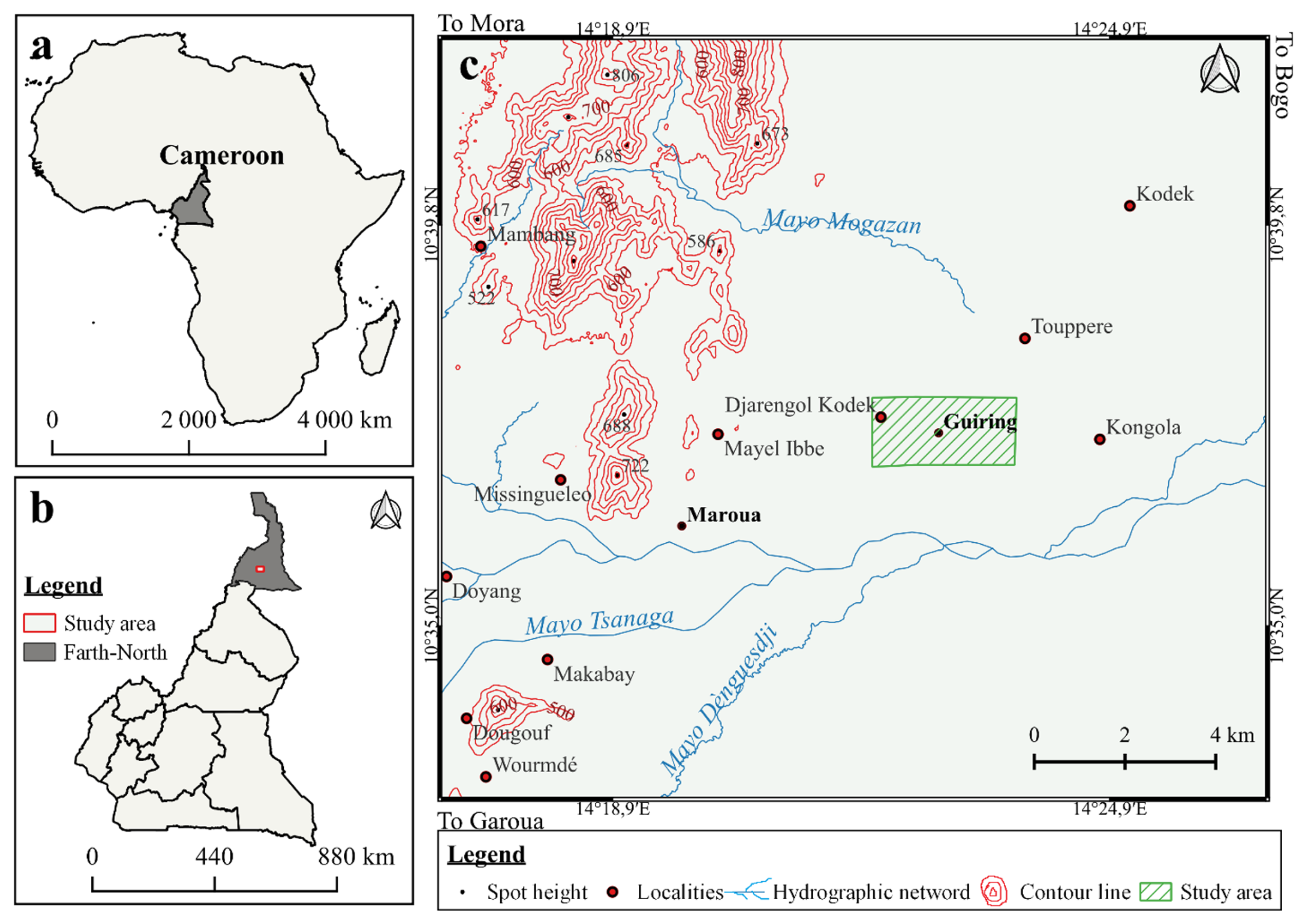
Figure 1(a) Location of Cameroon in Africa, (b) Location of Far-North region of Cameroon, (c) Location of the study area.
Table 1Monthly averages of precipitation, temperature, and relative humidity in Maroua-Salack from 1980 to 2020.

2.1 Study area
This study was conducted in the locality of Guiring, situated in the Diamaré Division (Maroua III Subdivision) in the Far-North Region of Cameroon, located between 10° 32′21.8′′ and 10°41′55.7′′ North latitude and 14°15′33.8′′ and 14°29′42.0′′ East longitude (Fig. 1). The area has a Sudano–Sahelian climate (Suchel, 1987), with a short and irregularly distributed rainy season of four months from June to September (Aridity index > 20), followed by a long dry season of eight months lasting from October to May (Aridity index < 20). The average annual rainfall is approximately 792.25 mm, and the average annual temperature reaches 27.7 °C (Table 1). The highest temperatures are recorded in April, while the lowest occur in January. The terrain is mainly characterized by a relatively flat topography, marked by several ecological zones, including the Sahelo–Sudanian domain, the elevated Sudanian domain, and the periodically flooded Sahelian domain. The substratum consists of alluvial deposits of Quaternary age (Tamen et al., 2015; Gountié et al., 2019). The vegetation consists of scattered trees and shrubs associated with grasses. Among the most representative species are Acacia seyal, Balanites aegyptiaca, Faidherbia albida, and Ziziphus mauritiana (Letouzey, 1985).
2.2 Experimental design, treatments, and plant material
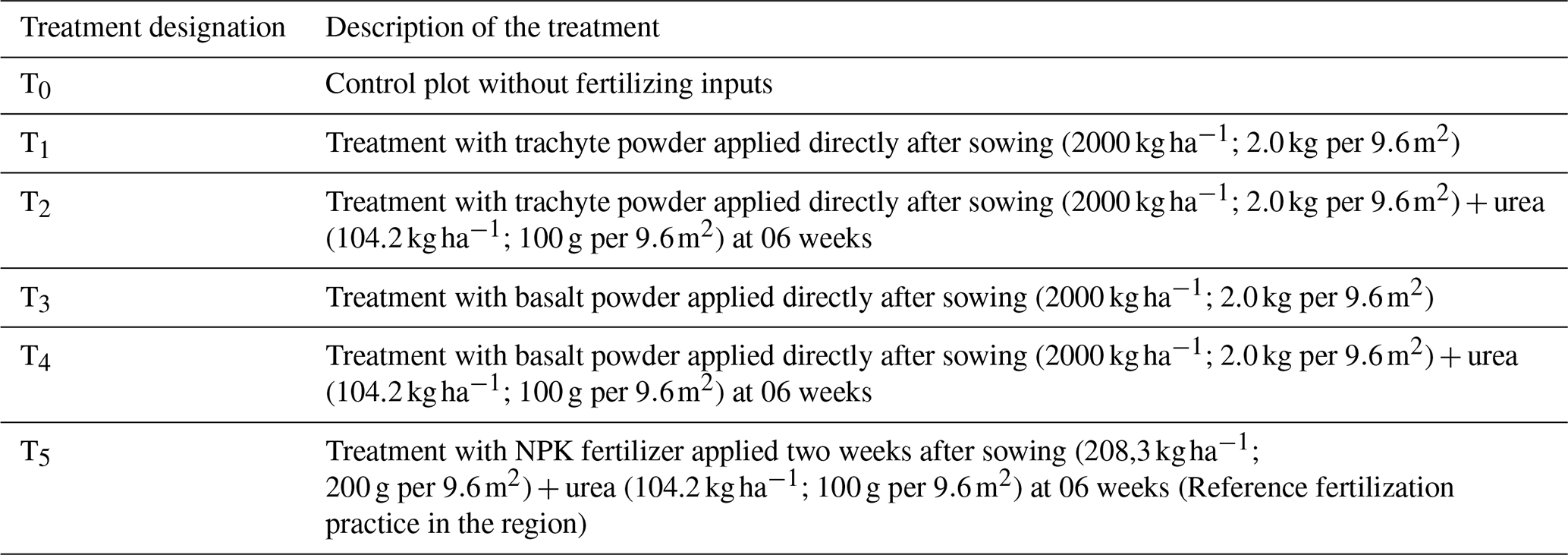
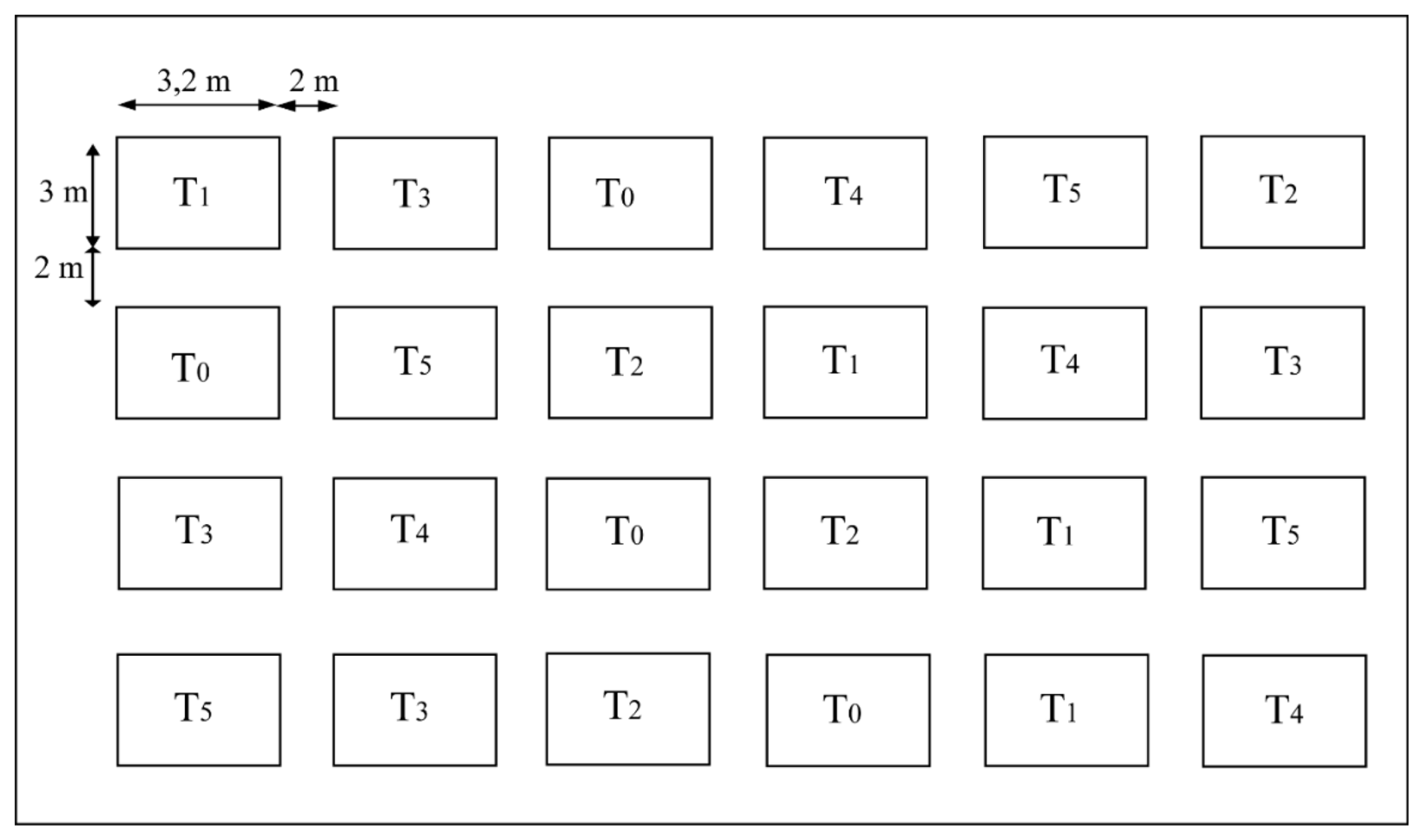
The experimental design is a completely randomized block design with six (06) treatments (T0, T1, T2, T3, T4, T5) as described in Table 2 and four replicates, resulting in twenty-four plots (6 × 4) (Fig. 2). The choice of a completely randomized block design accounts for environmental heterogeneity and variability in the soil's natural fertility by randomly distributing treatments within each block, thereby minimizing the influence of uncontrolled factors. Each experimental unit received one of the recommended treatments, T0, T1, T2, T3, T4, and T5 (Table 2). Treatment T0 corresponds to the plot that received no input. It serves as the initial reference for evaluating the effects of the various treatments. To enable an objective and effective comparison of the treatments, a standard treatment based on synthetic NPK fertilizer combined with urea (T5) was included, also representing a control, a reference fertilization practice in the region recommended by CIFOR-ICRAF (2024). After the experimental setup was established and the seedlings had emerged, the rock powder was applied locally, directly into each planting hole. It was incorporated to a depth of approximately 5 cm to reduce leaching by water and dispersion by wind. This targeted incorporation enhances the availability of nutrients at the root level while minimizing losses. The maize density was 0.8 m × 0.3 m, with 2 to 3 seeds needed per hole. Two weeks after sowing, thinning was performed to leave one plant per cluster. In each experimental unit, a yield square was demarcated by eliminating plants located at the edges. Parameters were measured on the three central lines, and the four best plants from each line were selected, for a total of 12 plants per plot. A total of 288 plants were retained for all replicates. The plant material used is the CMS-9015 variety of maize, developed by IRAD, which is an open-pollinated variety. This variety is specifically adapted to the Sudanese-Sahelian zone of Cameroon. Under normal conditions, it produces grain yields ranging from 4 to 4.5 t ha−1, with a vegetative cycle of 95 d. Manual weeding was carried out throughout the experiment, based on the appearance and development of weeds, to prevent excessive competition with the crops.
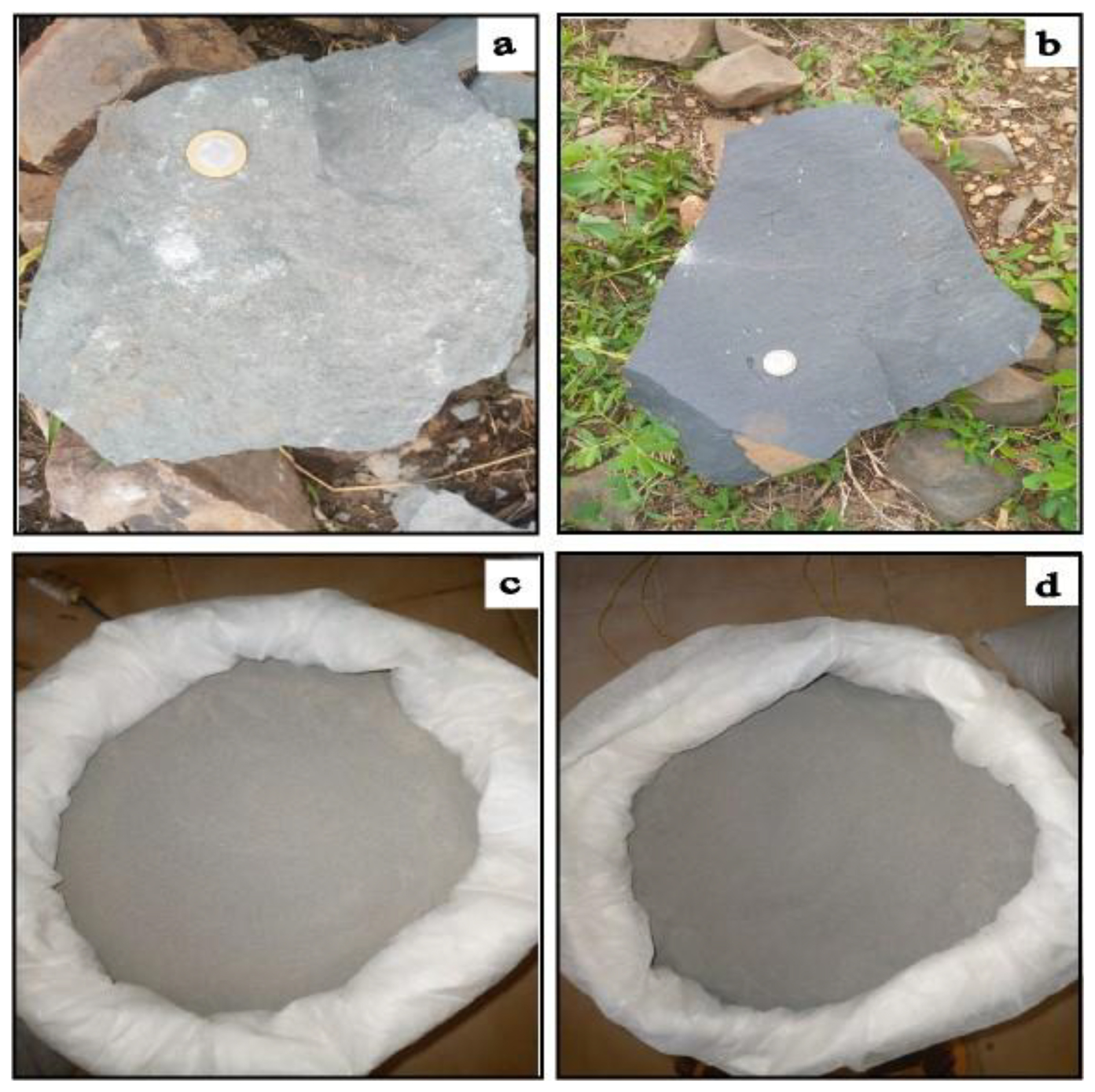
Figure 3Samples and powders of trachyte and basalt: (a) Trachyte sample from Zamai, (b) Basalt sample from Gawar, (c) Trachyte powder obtained after grinding, (d) Basalt powder obtained after grinding.
2.3 Rock sampling and analysis
Samples of trachyte (Fig. 3a) were collected from the localities of Zamai, at 10°38′06′′ north latitude and 13°53′55′′ east longitude and that of basalts (Fig. 3b) from the locality of Gawar, at 10°30′50.7′′ north latitude and 13°50′25.68′′ east longitude. Approximately 500 kg of each type of rock were sampled. These samples were then carefully transported for grinding, thin section preparation, petrographic analyses, and geochemical analyses. In total, 3 samples of trachyte and 3 samples of basalts were subjected to petrographic and geochemical analysis in the laboratory.
The rock sample was fragmented and passed through a ball mill, then sieved using a 2 mm mesh to obtain powder less than 2 mm (Fig. 3c and d). This powder was composed of 49 %, 22 % and 29 % of fractions passing through 0.8, 0.3, and 0.1 mm sieves, respectively. In total, 100 kg of trachyte powder and 100 kg of basalt powder were obtained.
The petrographic analysis was carried out on thin sections prepared at the Tokyo Institute of Technology, Japan. The microscopic description was done in the geology laboratory at the University of Maroua (Cameroon) using an optic microscope to examine the rock samples in detail. This phase allowed for the precise identification of the different minerals present in each sample, based on their optical and textural characteristics. The observations focused on mineralogical assemblages, grain shapes and the relationships between the various minerals.
For the measurements of trace and major elements, all samples were crushed into millimetre-sized fragments using a jaw crusher, and fragments with saw and hammer marks were carefully separated. After each sample, the jaw crusher was systematically cleaned with compressed air and deionized water. The major elements and some trace elements, including scandium (Sc), cobalt (Co), vanadium (V), nickel (Ni), and chromium (Cr), were analysed by X-ray fluorescence (XRF) using a Rigaku RIX2100 (manufactured by Rigaku Corporation, Japan) at Osaka City University, Graduate School of Science in Japan. The trace element concentrations in the samples were determined by ICP-MS (manufactured by Thermo Fisher Scientific, USA) at the Tokyo Institute of Technology, Japan, in accordance with the method described by Yokoyama et al. (1999). Approximately 50 mg of rock powder were digested with nitric acid (HNO3), perchloric acid (HClO4), hydrochloric acid (HCl), and hydrofluoric acid (HF). Before acid digestion, enriched spikes of 113In and 203Tl were added to the sample to serve as internal standards during measurement. The data reported by Makishima and Nakamura (2006) were used to calibrate the trace element concentrations against the basalt and rhyolite standards JB-3 and JR-1, respectively. The typical analytical reproducibility (2σ) was 4 % for niobium (Nb) and lead (Pb), 5 % for yttrium (Y) and tantalum (Ta), and < 3 % for other trace elements.
2.4 Soil sampling and laboratory analysis
The fieldwork was carried out in two phases. The first phase consisted of direct observation and a detailed description of the study site and its surroundings. In the second phase, a representative soil profile (10°33′17′′ north latitude, 14°22′16′′ east longitude, 386 m of altitude) with a thickness of 270 cm was excavated in a flat relief, under highly anthropogenized vegetation, and described in situ following the guidelines for soil profile description according to Baize and Jabiol (2011). The soil description took into account several parameters: colour, porosity, texture, coarse elements, structure, biological activity, thickness, and the boundaries between horizons. The colour was determined in its dry state using the Munsell Soil Colour Charts (2009). A total of six (06) samples, each weighing approximately 0.5 kg, were collected from the different horizons of the profile. The collected samples were placed in polyethylene bags, carefully labelled, and prepared for laboratory analysis.
In the laboratory, the main analyses focused on mineralogical and physicochemical analyses. Particles size distribution was performed using the Robinson pipette method on air-dried, ground, and 2 mm-sieved samples. The pH was measured in a soil-water suspension, then in a normal potassium chloride solution at 1:2.5 ratio using a glass electrode pH meter. Exchangeable bases (calcium: Ca2+, magnesium: Mg2+, potassium: K+, and sodium: Na+) were extracted from the soil using a pH 7 ammonium acetate solution and measured by atomic absorption spectrophotometry. The total exchangeable bases (TEB) was determined by adding the concentrations of Ca2+, Mg2+, K+, and Na+. Cation exchange capacity (CEC) was measured using an ammonium acetate solution at pH 7, following a three-step process: washing the soil with alcohol to remove the ammonium solution saturating the pores, determining NH4+ by Kjeldahl distillation after quantitative desorption with KCl. The CEC of the clay fraction was calculated from the CEC at pH 7, organic carbon content, and clay percentage. Base saturation (BS) was calculated using the formula () × 100. Total nitrogen (N) was determined by the Kjeldahl method. Organic carbon (OC) was measured by wet oxidation according to Walkley and Black (1934) using a sodium dichromate and concentrated H2SO4 mixture. Organic matter (OM) content was calculated by multiplying the OC by 1.724, and the ratio was determined. Available phosphorus was measured using the Bray no. 2 method (Bray and Kurtz, 1945). Soil classification was done according to IUSS Working Group WRB (2022).
Mineralogical analysis was carried out using infrared (IR) spectroscopy, a non-destructive analytical method widely used to identify and characterize the functional groups present in samples. This technique provides detailed information about the chemical bonds and molecular structures of minerals. Diffuse reflectance IR spectra were recorded in the range of 4000 to 400 cm−1 using a Perkin Elmer 2000 FTIR spectrometer (Perkin Elmer, Waltham, MA, USA), equipped with a DTGS (deuterated triglycine sulphate) detector, optimized for high sensitivity and precise resolution. To avoid contamination from atmospheric moisture and ensure the reliability of the results, measurements were carried out under strictly controlled environmental conditions. This method not only allows for the identification of minerals present in the soil but also helps describe their local chemical environments, providing a deeper understanding of the composition and properties of soils.
2.5 Determination of quantities of nitrogen, phosphorus and potassium supplied
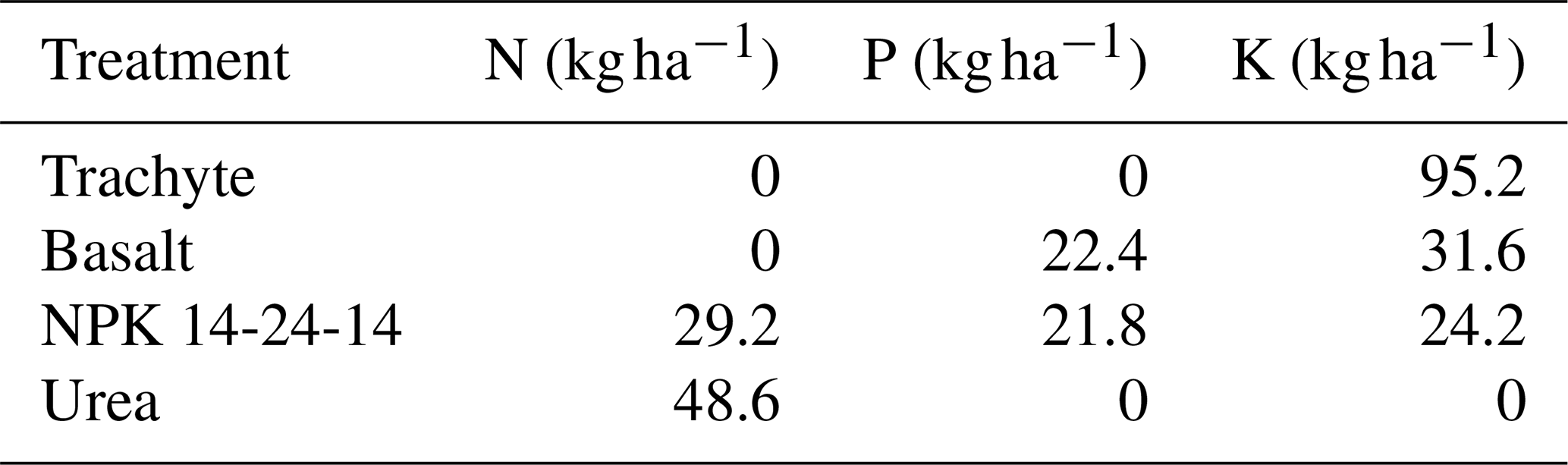
The percentage of nitrogen, potassium and phosphorus in rock powder was calculated using the chemical composition of the rock. To calculate the quantity of each element in the NPK fertilizer, the percentages indicated on the label (14-24-14), the molar masses of these elements and the quantity of fertilizer were used. The percentage of nitrogen in urea was calculated using the amount of nitrogen and the molar mass of urea. The amounts of nitrogen, phosphorus and potassium used are shown in Table 3.
Table 3Quantities of nitrogen, phosphorus and potassium supplied.
2.6 Pedoclimatic Assessment
The pedoclimatic assessment aimed to determine the suitability of the study area for maize cultivation based on climatic data (precipitation, temperature, relative humidity, and insolation) collected at the Maroua-Salak station (Cameroon, 10°27′0′′ north latitude and 14°15′0′′ east longitude) between 1980 and 2020, and the pedological characteristics of soils such as topography, flooding, texture, depth, and cation exchange capacity, base saturation, organic carbon, pH and salinity, in accordance with the climatic conditions and requirements of crops (Sys, 1985; Sys et al., 1993; Issiné et al., 2022). It allows to identify the potential limiting factors for maize cultivation. A climatic index (CI) was calculated using the parametric formula (Sys, 1985):
where Rmin is the smallest value, are the other parametric values. Adjustments are made if the CI falls between 25 and 92.5.
The pedological assessment used a table of soil characteristics to determine a land index, based on similar parametric values using the formula (Sys, 1985):
The calculation of the CI and LI allows for an integrated assessment of agroclimatic and soil quality for agricultural production.
2.7 Collection of maize parameters
The growth and yield parameters of maize, including germination rate, plant height, number of leaves per plant, stem diameter, ear length, ear diameter, ear weight, 100-grain weight, and grain yield (kg ha−1), were measured. To minimize the influence of edge effects on the average value of the response variables of interest, only the plants located at the centre of each experimental plot were considered for measurements. The germination rate was assessed 10 d after sowing by counting the number of germinated seeds in each plot. It was calculated using the following formula (Ellis et al., 1986):
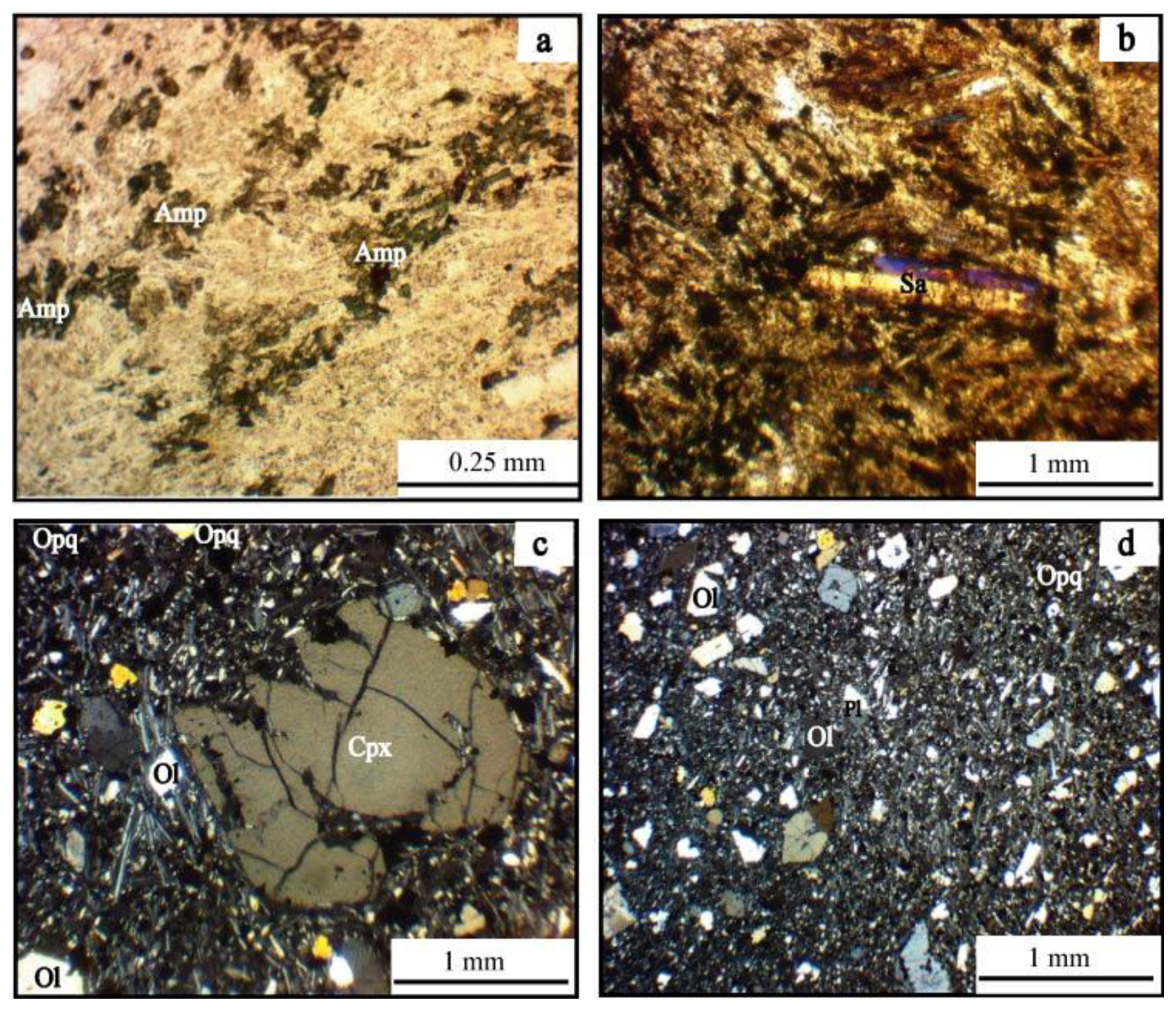
Figure 4Photomicrographs of thin sections of representative samples from the study area. (a) and (b) Aphyric texture of Minawao trachyte showing mineral assemblages. (c) and (d) Porphyritic texture of Gawar basalt showing mineral assemblages. Ol: olivine. CPx: clinopyroxene. Pl: plagioclase. Opq: opaque minerals. Sa: sanidine. Amp: amphibole. Mineral abbreviations from Whitney and Evans (2010).
Plant height was measured using a tape measure, recording the distance from the soil to the top of the stem, with measurements taken every 21 d. These measurements were performed on a representative sample from each plot and an average value was considered (Cox and Andrade, 1988). The number of leaves was counted by tallying the leaves deployed on the main stem, with an average estimation made every 3 weeks (Cox and Andrade, 1988). The stem and ear diameter were measured using a calliper, respectively before and after harvest (Ngoune Tandzi and Mutengwa, 2019). The ear length, measured from base to tip, was recorded with a tape measure when the ears were mature. The weight of the ears was obtained by weighing them with a high-precision electronic scale after harvest (Muthaura et al., 2017). The weight of 100 randomly selected dried maize grains was also measured using a precision electronic scale (Soleymani, 2018). The yield per hectare was estimated by harvesting a representative portion of each plot, weighing the harvest, and then extrapolating the results to the hectare scale using a conversion factor (Soleymani, 2018).
2.8 Data Analysis
Statistical analyses focused on the physicochemical properties of soils as well as the growth and yield parameters of maize. The physicochemical properties of soils were subjected to standard statistical analyses, including mean, maximum-minimum values, standard deviation, and coefficient of variation. The normality of the distribution was assessed using the Anderson–Darling test. Relationships among the various soil parameters were examined using Spearman's correlation test, with a significance threshold set at p < 0.05. Since the data distribution did not follow a normal law, a logarithmic transformation was applied to measured plant parameter values (Daumas, 1982). Subsequently, the data from plants within the same plot were averaged to produce a single value per replicate, thus representing an independent experimental unit. This approach aimed to avoid pseudo-replication in the statistical analysis. A two-factor analysis of variance (two-way ANOVA) was then performed to assess the existence of statistically significant differences (p< 0.05) between treatments. In case of significant differences, a Tukey's HSD post hoc test was conducted to precisely identify the groups showing differences. All statistical analyses were carried out using the R software (R Core Team, version 4.5.0).
3.1 Petrographic and geochemical characteristics of rocks
Petrographically, trachyte outcrops in the form of slabs in the Zamai locality and exhibits an aphyric texture, with rare phenocrysts (≤ 5 %). These scarce phenocrysts are mainly composed of amphibole (Fig. 4a), sanidine (Fig. 4b), sometimes associated with clinopyroxene. Sanidine, characterized by elongated euhedral prisms reaching up to 0.6 mm × 1.8 mm, displays simple Carlsbad twins (Fig. 4b). The trachytes are composed of feldspar microliths, accompanied by a low proportion of clinopyroxene and oxides (Fig. 4a andb). Basalts outcrop as lava flows, exhibiting well-defined columnar joints and a porphyritic texture. Plagioclase, olivine, and clinopyroxene constitute the phenocrysts (Fig. 4c andd). Olivine, present in some samples, is often altered to iddingsite. Peridotite xenoliths are also observed in some samples, containing approximately 65 % olivine and 35 % pyroxene. Plagioclase microliths, associated with clinopyroxene, olivine, and oxides, are the main components of the basalt matrix. Microliths and volcanic glass constitute the groundmass of basalts and trachytes.
Table 4Major (wt. %) and trace (mg kg−1) elements data for the Gawar-Zamay lavas and standard permissible limits in soil.
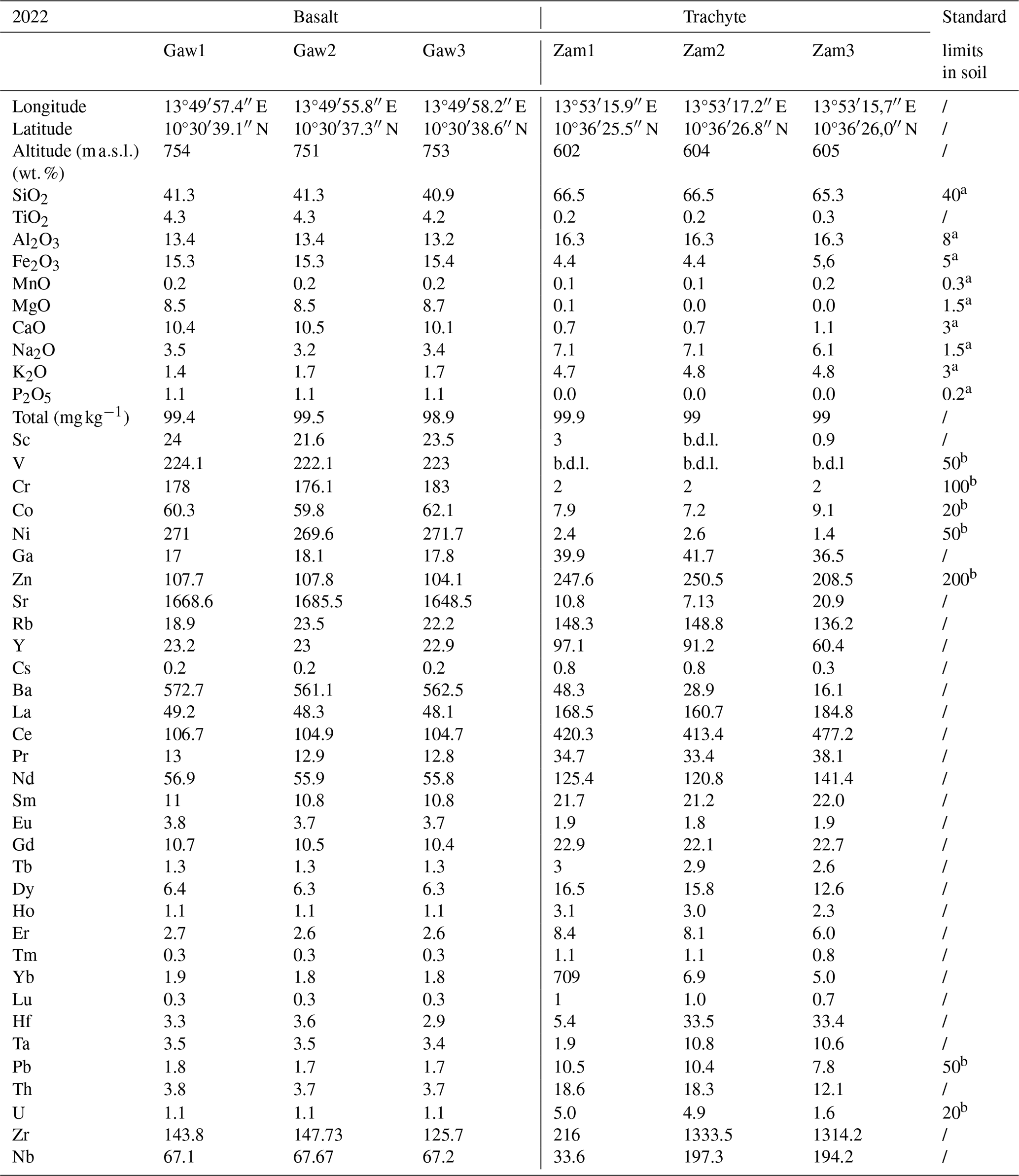
b.d.l: below detection limit; a Standard limits according to Environment protection agency United State (EPA); b Standard limits according to FAO/WHO.
From a geochemical perspective, the concentration of major and trace elements in the studied rocks are summarized in Table 4. Trachyte exhibit variations in major element contents across samples. The SiO2 content ranges between 65.3 % and 66.5 %, meanwhile the TiO2 content varies from 0.2 % to 0.3 %. The Al2O3 content remains constant at 16.3 %, whereas Fe2O3 concentrations fluctuate between 4.4 % and 5.6 %. The contents of CaO and K2O show variations ranging from 0.6 % to 1.1 % and 4.7 % to 4.8 %, respectively. Regarding basalts, notable variations are also observed in the proportions of major elements. The SiO2 content ranges from 40.9 % to 41.3 %, while TiO2 content is between 4.2 % and 4.3 %. Similarly, the percentage of Al2O3 fluctuates between 13.2 % and 13.4 %. Fe2O3 concentrations vary slightly, ranging from 15.3 % to 15.4 %, while CaO content is between 10.1 % and 10.4 %, and K2O ranges from 1.4 % to 1.7 %. These subtle yet significant differences highlight the important geochemical variations between trachyte and basalt samples, underscoring the diversity of their mineralogical composition.
Trace element concentrations in the trachyte show significant fluctuation. The chromium (Cr) content remains relatively constant at 2 ppm, while other elements such as nickel (Ni), strontium (Sr), rubidium (Rb), yttrium (Y), barium (Ba), and niobium (Nb) exhibit more pronounced variations, ranging from 7.2 to 9.1 ppm, 7.3 to 20.9 ppm, 136.2 to 148.8 ppm, 60.4 to 97.1 ppm, 16.2 to 48.9 ppm, and 194.2 to 197.3 ppm, respectively. In contrast, basalts show much higher concentrations of Cr (176.1 to 183 ppm), Ni (269.6 to 277.7 ppm), Sr (1648.5 to 1685.5 ppm), and Ba (561.1 to 572.7 ppm). However, the basalts have relatively low levels of Rb (18.9 to 23.5 ppm) and Y (22.9 to 23.2 ppm) compared to the trachyte (Table 4). These variations indicate substantial differences in trace elements between trachytes and basalts, reflecting distinct geochemical signatures.
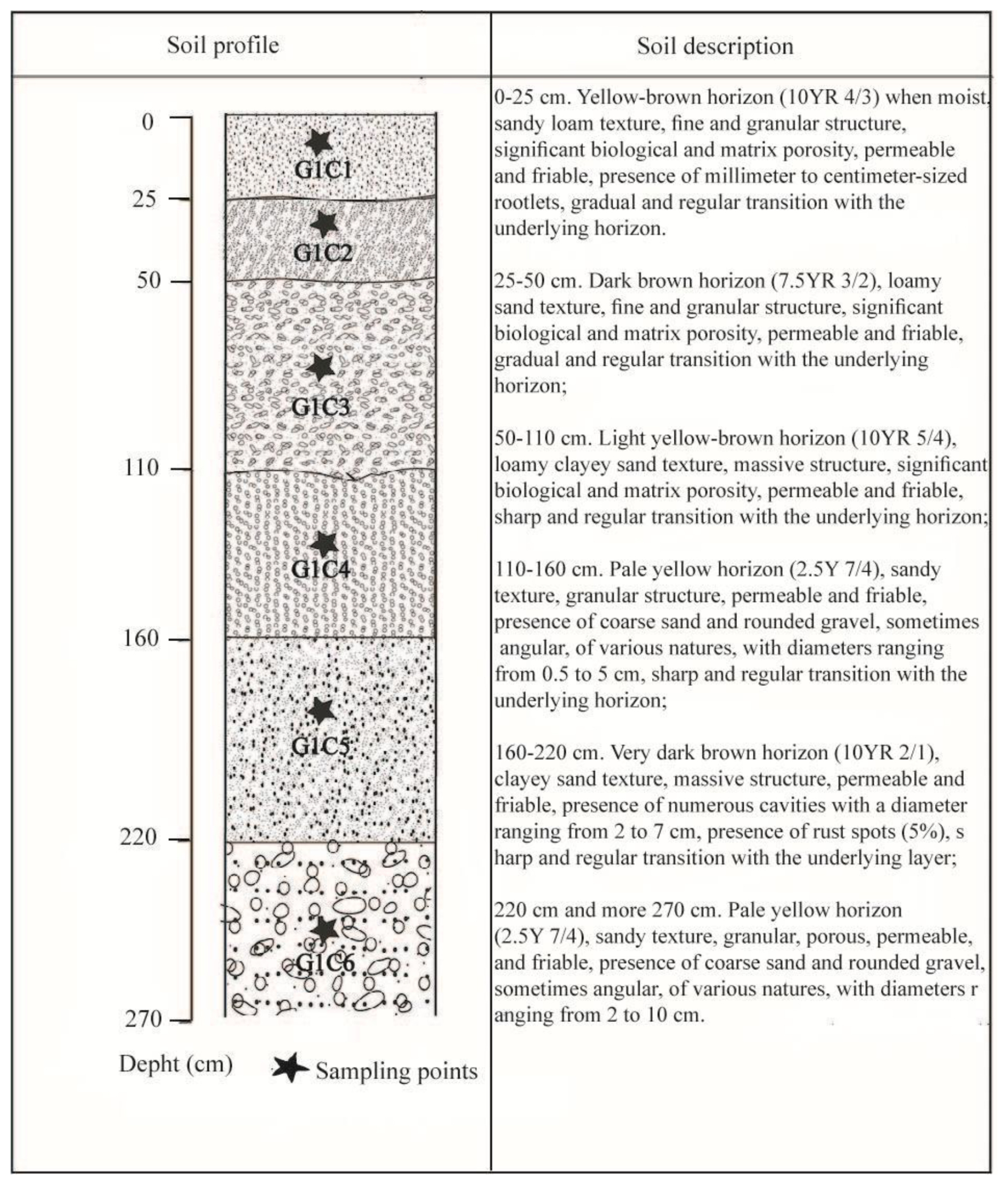
Table 5Morphological and physical characteristics of the soil profile.
3.2 Morphological and mineralogical characteristics of the soil
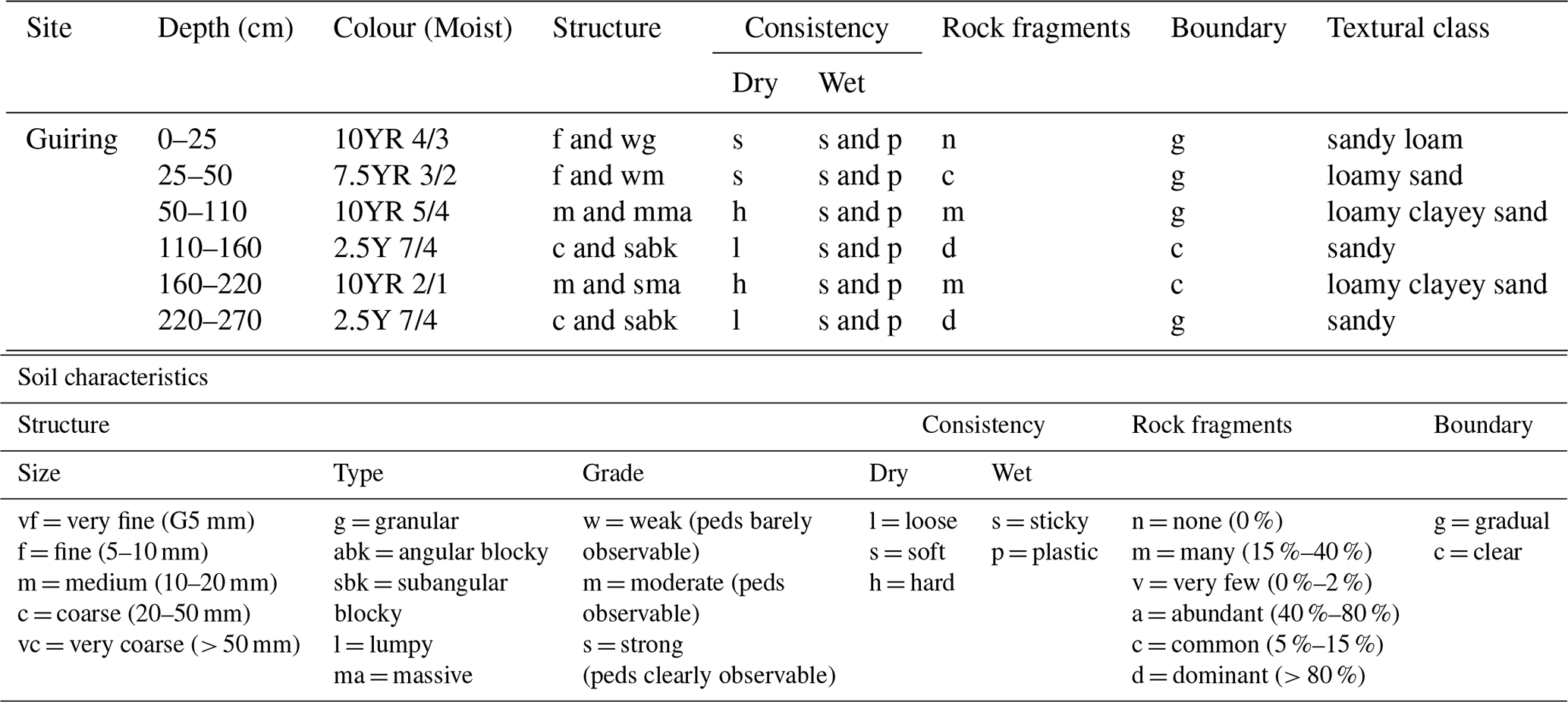
The studied soil profile consists of six horizons (Fig. 5) divided into four distinct textural groups: sandy loam, loamy sand, loamy clayey sand, clayey sand and sandy. The colours range from light yellow-brown (10YR 5/4) to dark brown (7.5YR 3/2), passing through light yellow (10YR 5/4) and up to pale yellow (2.5Y 7/4). Each horizon has a fine, granular structure with significant biological and matrix porosity, promoting good permeability and optimal friability. The transitions between horizons are gradual and regular (Table 5).
Mineralogically, the infrared spectra of the soil, illustrated in Fig. 6, revealed the presence of kaolinite, smectites, sepiolite, and quartz. In the high-frequency region, the hydroxyl groups display two bands at 3774–3622 cm−1, corresponding to the stretching vibrations of the OH− groups characteristic of kaolinite according to Farmer and Russell (1964) and Frost and Johanson (1998). The low intensity absorption band located at 1621 cm−1 is attributed to water molecules, possibly associated with smectites. Sepiolite is primarily distinguished by the band at 531 cm−1. The presence of quartz is manifested by the peaks at 1003, 774, 693, 531, and 459 cm−1, which correspond to Si-O vibrations.
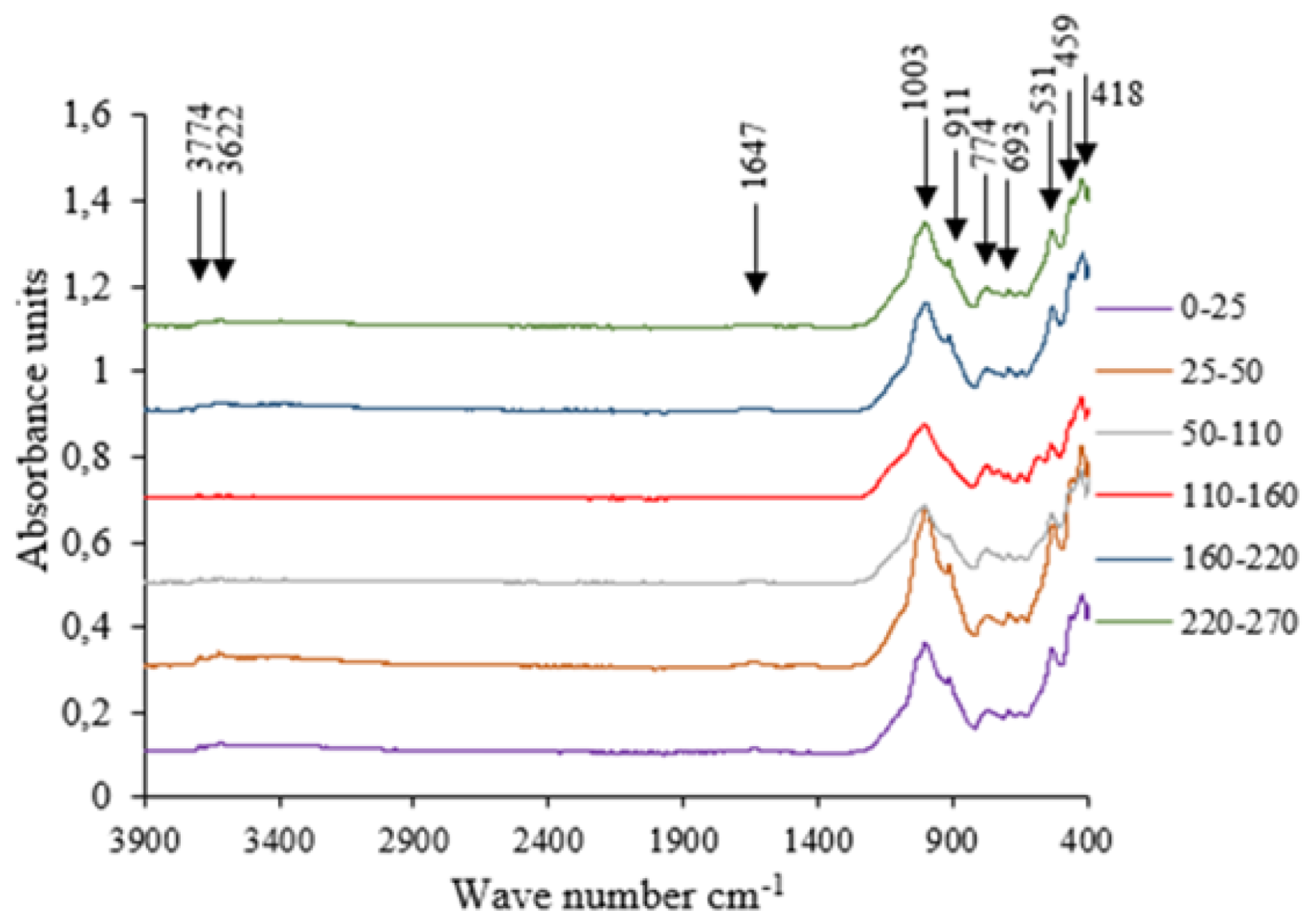
Table 6Physicochemical characteristics and summary statistics of the soil profile.
3.3 Physicochemical characteristics of the soils
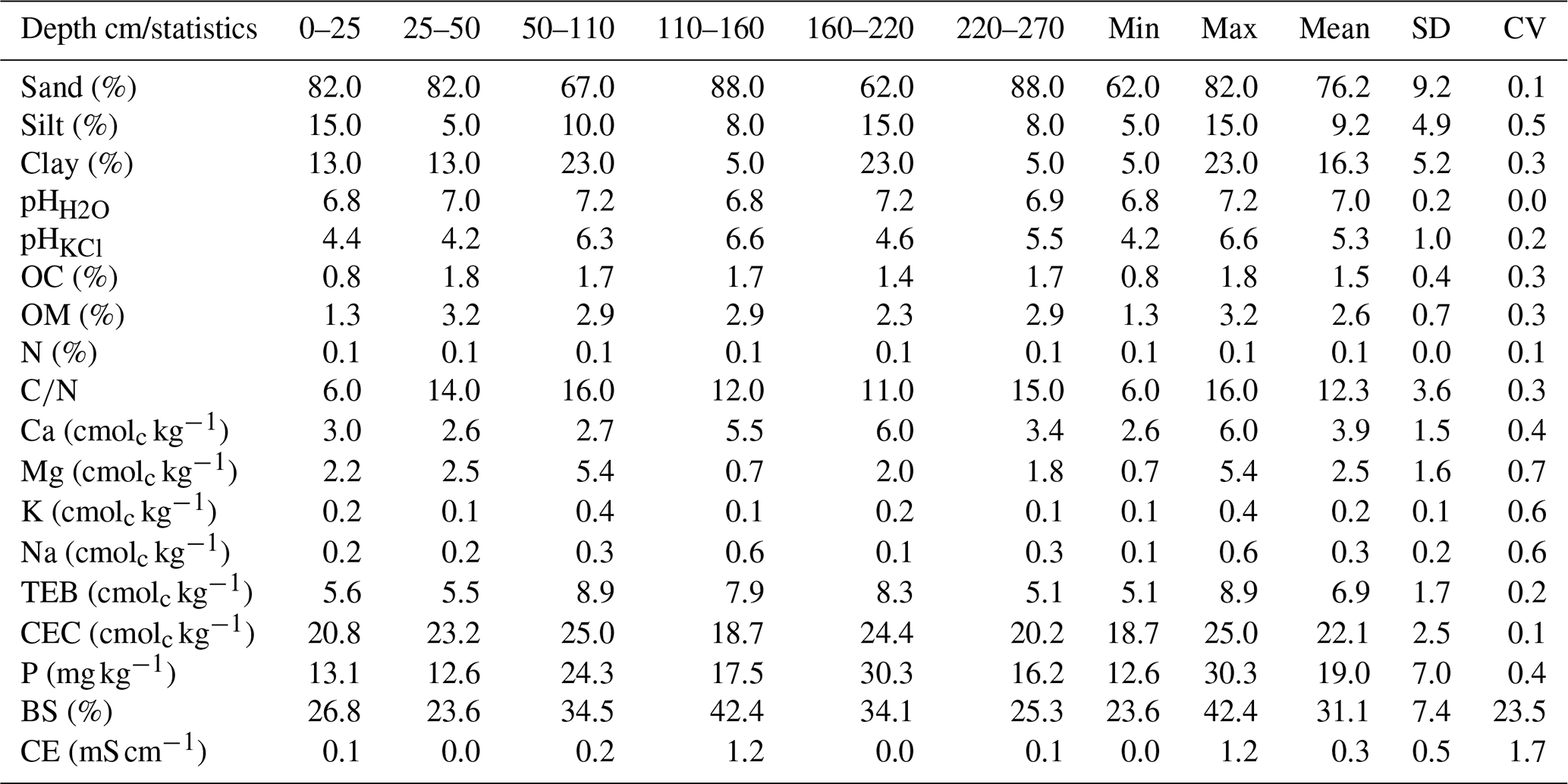
The particle size distribution is dominated by sand fraction with proportions varying from 62 % to 82 %, corresponding to a mean value of 76.2 ± 9.2 % (Table 6). Clay constitutes the second important particle size fraction, with proportions ranging from 13 % to 23 %, with a mean value of 16.3 ± 5.2 %. Silt fraction appears to be the least abundant, with proportions varying from 5 % to 15 %, with an average of 9.2 ± 4.9 %.
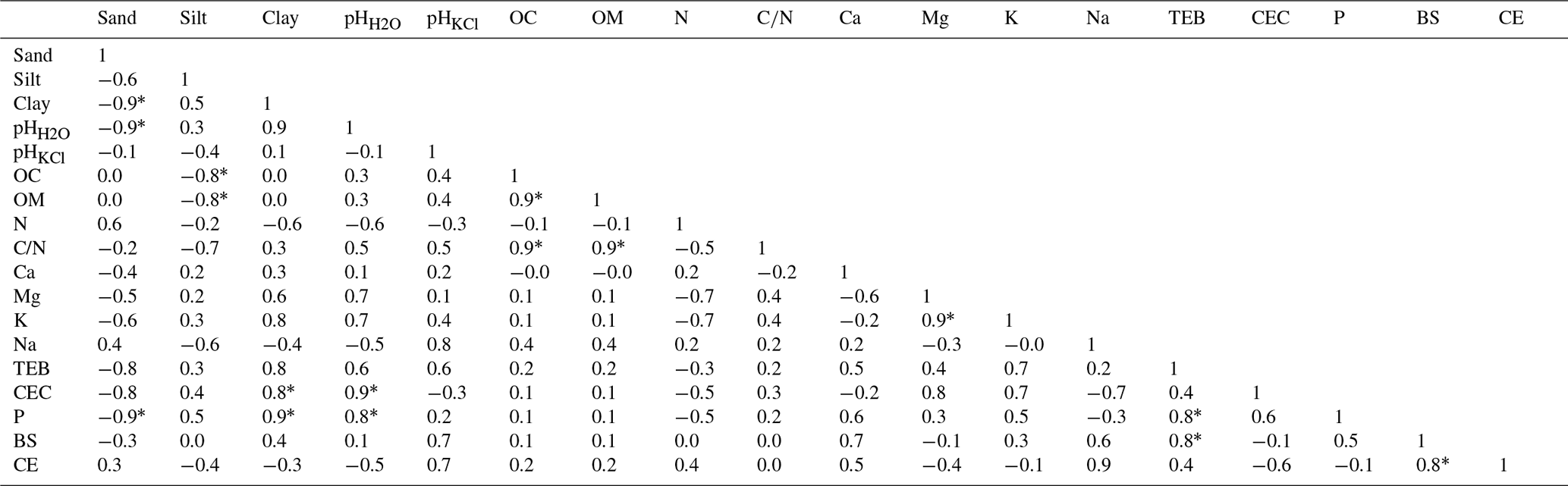
The analysed soils exhibit a pH ranging from acidic to slightly basic (6.8 to 7.2), with an average of 7.0 ± 0.2. Except for clay, which was strongly positively correlated with pH (r = 0.9, p< 0.05), no significant correlations were observed between pH and other soil parameters. The organic matter (OM) and total nitrogen (N) contents are relatively low, with values ranging from 1.3 % to 3.2 %, and 0.1 %, with averages of 2.6 ± 0.7 %, and 1.1 ± 0.0 % (Table 6). The ratio, relatively low, varies from 6 to 16, with an average of 12.3 ± 3.6. Base saturation (BS) varies between 23.6 % and 42.4 %, with an average value of 31.1 ± 7.4 % (Table 6).
Table 7Spearman correlation matrix for linear relationships between soil profile properties.
∗ Significant at p<0.05.
The total exchangeable bases (Ca2+, Mg2+, K+, and Na+) exhibit notable variation across the soil profile. Calcium (Ca2+) and magnesium (Mg2+) concentrations are low to moderate, with values ranging from 2.6 to 6.0 cmolc kg−1 in the case of Ca2+ and 0.7 to 5.4 cmolc kg−1 for Mg2+, with respective averages of 3.9 ± 1.5 and 2.5 ± 1.6 cmolc kg−1 (Table 6). Regarding potassium (K+) and sodium (Na+), their contents are very low to low, oscillating between 0.1 and 0.4 cmolc kg−1 for K+ and between 0.1 and 0.6 cmolc kg−1 for Na+, with respective averages of 0.2 ± 0.1 and 0.3 ± 0.2 cmolc kg−1 (Table 6). Mg2+ shows a positive correlation with clay (r = 0.6, p< 0.05) and pH H2O (r = 0.7, p< 0.05). K+ is strongly correlated with clay (r = 0.8, p< 0.05) and moderately with pH H2O (r = 0.7, p< 0.05). The total of exchangeable bases (TEB) ranges from 5.1 to 8.9 cmol kg−1, with an average value of 6.9 ± 1.7 cmolc kg−1 (Table 6). This TEB shows a moderately positive correlation with clay content (r = 0.8, p< 0.05). The cation exchange capacity (CEC) displays relatively high values, ranging from 18.7 to 25.0 cmolc kg−1, with an average of 22.1 ± 2.5 cmolc kg−1 (Table 6). It shows a strong correlation with the clay fraction (r = 0.8, p< 0.05), as well as with pH H2O (r = 0.8, p< 0.05). It is also moderately correlated with potassium (K+) (r = 0.8, p< 0.05) (Table 7). Phosphorus (P) shows concentrations ranging from low to medium, with values between 12.6 and 30.3 mg kg−1, and an average of 19.0 ± 7.0 mg kg−1 (Table 6). Phosphorus shows a strong correlation with clay content (r = 0.9, p< 0.05) and with CEC (r = 0.8, p< 0.05) (Table 7). Base saturation (BS) presents values ranging from 23.6 % to 42.4 %, with an average of 31.1 ± 7.4 %. Electrical conductivity varies from 0.0 to 1.2 dS m−1, with an average of 0.3 ± 0.5 dS m−1 (Table 6). The latter is strongly correlated with Na, with a coefficient of r = 0.9 (p< 0.05).
Morphologically, the study soil profile is characterized by an alternation of different soil textures which are sandy loam, loamy sand, loamy clayey sand, clayey sand and sandy, in line with the alluvial nature of the parent material. This alternation of soil textures is confirmed by the zigzag evolution of the percentage of different particle size distribution fraction noted in Table 5. These characteristics correspond to those of Fluvisols. Base saturation ratio in all soil horizons is below 50 %, leading to the choice of Dystric as principal qualifier. The light colour of soils and the organic matter content (< 3 %) lead to classify the studied soils as Ochric Dystric Fluvisols according to the IUSS Working Group WRB (2022).
Table 8Climatic suitability evaluation for the production of Maize using simple limitation and parametric methods.
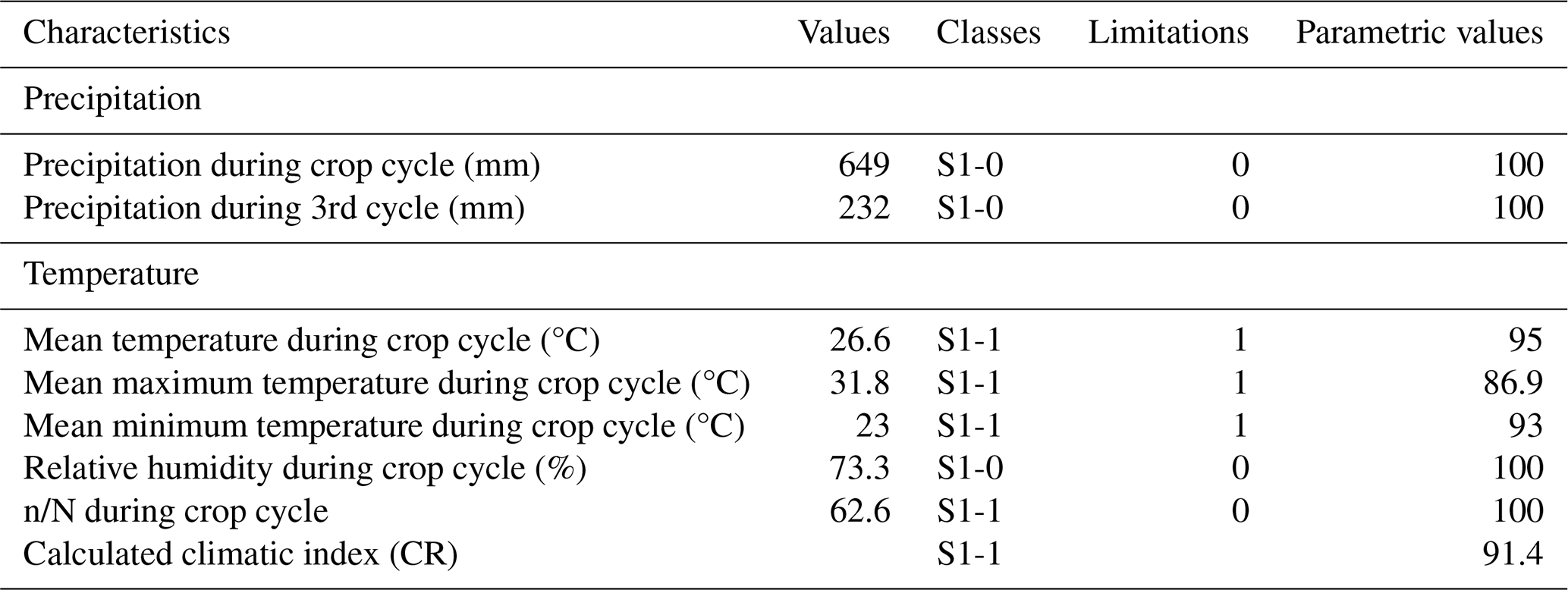
n/N: actual hours of bright sunshine/astronomically possible hours of bright sunshine; S1-0: no limitation; S1-1: slight limitation.
3.4 Suitability of the studied soil for maize cultivation
The study area presents very favourable climatic conditions for the growth and yield of maize. The average temperature of 26.6 °C during the growing cycle presents a slight limitation for the production of maize (S1-1) (Table 8). The precipitation during the growing cycle, approximately 649 mm, has no limitation for the cultivation of maize. The climatic index of 91.4 (S1-0) indicates that there are no major limitations for maize cultivation in this area. This means that climatic conditions are favourable, suggesting the possibility of achieving optimal yields.
Table 9Land suitability evaluation for the maize production using simple limitation and parametric methods.
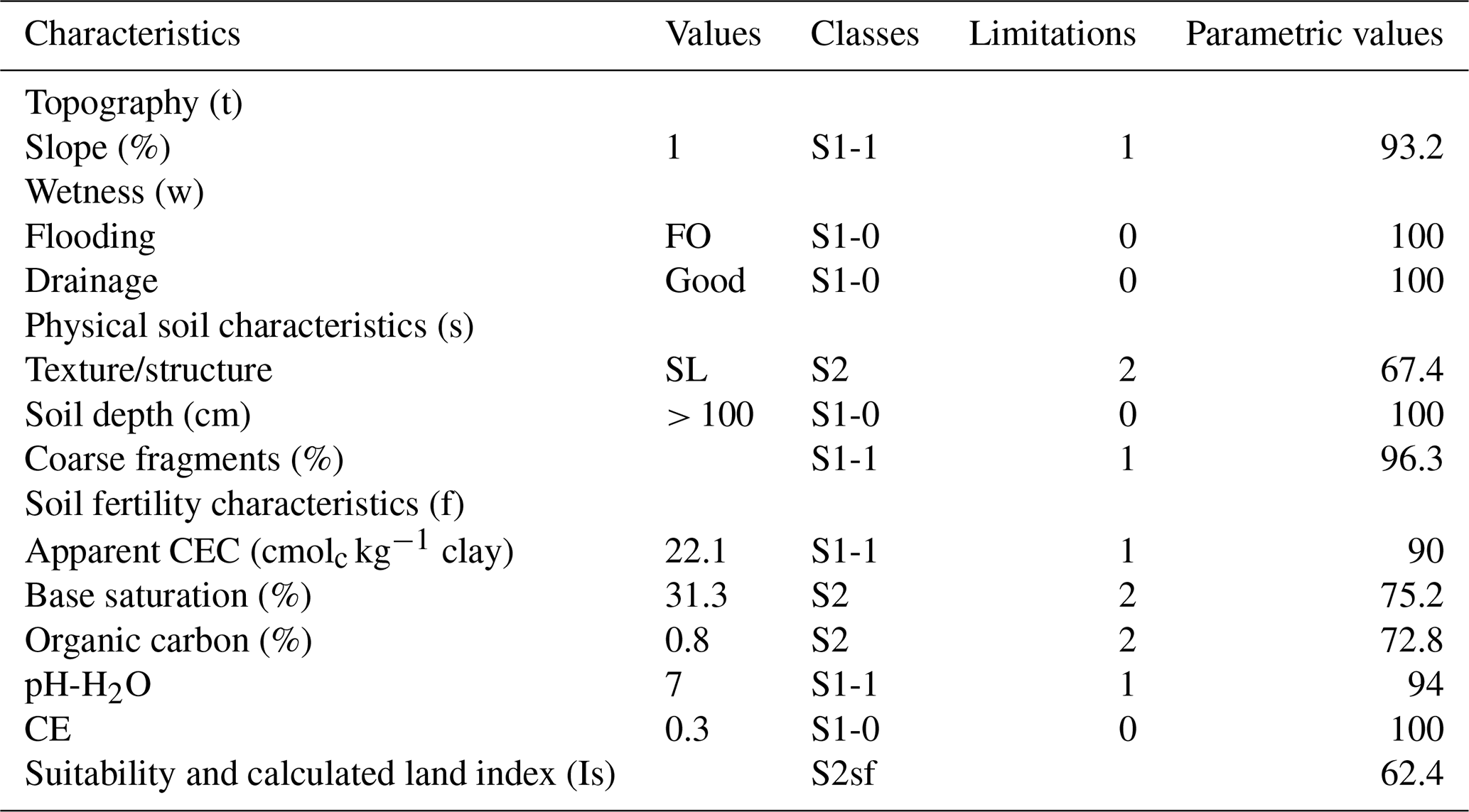
CE: Conductivity; FO: no flood; SL: Sandy loam; S1-0: no limitation; S1-1: slight limitation; S2: moderate limitation.
The low slope (1 %), presents a slight limitation (S1-1). The risk of flooding is non-existent (FO), and drainage is of good quality, indicating that there are no constraints related to soil moisture (S1-0) (Table 9). The soil texture, of the sandy-loamy type (SL), classified as S2, has proven to be a moderate limitation with a parametric value of 67.4. The soil depth, greater than 100 cm, is very suitable (S1-0), which is optimal for root development. Presence of coarse fragments displays a slight limitation (S1.1), with a parametric value of 96.3 for maize production (Table 9). The apparent cation exchange capacity (CEC) of the soil, classified as S1-1, indicates a slight limitation, with a parametric value of 90. Base saturation and organic carbon content, both classified as S2, reveal moderate limitations, with respective parametric values of 75.2 and 72.8. The soil pH (S1-1) and the electrical conductivity is suitable (S1-0) for the production of maize although there is a slight limitation related to pH (Table 9). The overall land suitability index is 62.4, which classifies it as S2sf, indicating moderate suitability for cultivation, primarily due to constraints related to the soil's physical properties and fertility.
3.5 Evaluation of the effect of trachyte and basalt powder on the growth and yield of maize
3.5.1 Effect of trachyte and basalt powder on maize growth parameters
Germination was observed in all plots starting from the 5th day after sowing. After 10 d, the recorded germination rate reached 92.2 %, indicating good uniformity of plant growth across all experimental plots.
Table 10Statistical analysis of the effect of basalt and trachyte powder on the growth and yield of Maize parameters (Mean ± SD∗).
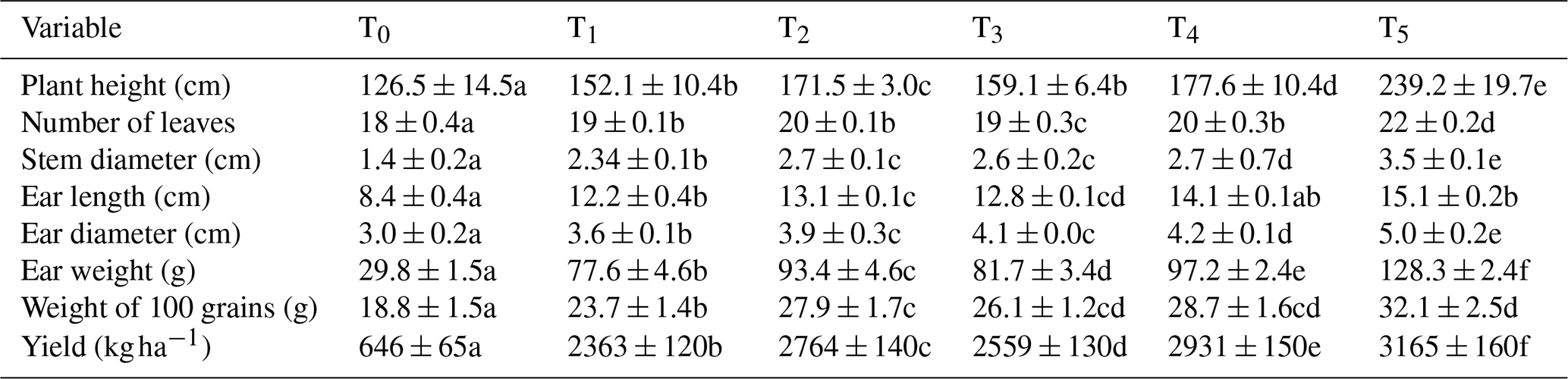
T0: Control plot without treatment; T1: Treatment with trachyte powder (1.96 kg of trachyte powder for 9.6 m2); T2: Treatment with trachyte powder (2.0 kg of trachyte powder for 9.6 m2) + urea (100 g for 9.6 m2) at 06 weeks; T3: Treatment with basalt powder (2.0 kg of basalt powder for 9.6 m2); T4: Treatment with basalt powder (2.0 kg of trachyte powder for 9.6 m2) + urea (100 g for 9.6 m2) at 06 weeks. T5: Treatment with NPK fertilizer (200 g for 9.6 m2) + urea (100 g for 9.6 m2) at 06 weeks. ∗ Standard deviation; Mean value followed by different lower-case letters within the same line have significant differences (p< 0.05).
The plant height ranges from 126.5 ± 14.5 cm for the control plot without treatment (T0) to 239.2 ± 19.7 cm for treatment with NPK fertilizer + urea (T5), with the latter showing the tallest plants, while T0 shows the shortest height. Treatments with trachyte powder (T1: 152.1 ± 10.4 cm), trachyte powder + urea (T2: 171.5 ± 3.0 cm), basalt powder (T3: 159.1 ± 6.4 cm), and basalt powder + urea (T4: 177.6 ± 10.4 cm) show significant differences among them, and all are higher than T0. However, treatment T5, which is a reference fertilization practice in the region (239.2 ± 19.7 cm) is significantly (p< 0.05) taller than all other treatments. A progressive increase in plant height is observed with inputs of trachyte and basalt powders (Table 10).
The evolution of the number of leaves based on treatments shows that treatment T5, with an average of 22 leaves per plant (22 ± 0.2), yields the best results, showing a significant difference (p< 0.05) compared to the other treatments. In contrast, treatment T0, with 18 leaves per plant (18 ± 0.4), recorded the lowest number of leaves. Treatments T1 and T3 produced similar results, with 19 leaves per plant, slightly lower than that of T2 and T4, with an average of 20 leaves per plant each. There is a significant difference (p< 0.05) between T3 and T4, and between T0 and T5 and the other treatments.
The stem diameter shows a significant (p< 0.05) increase depending on the treatments (Table 10). T0 recorded the smallest stem diameter (1.4 ± 0.2 cm), serving as the reference without any treatment influence. T1 and T2 had stem diameters of 2.3 ± 0.1 and 2.7 ± 0.1 cm, respectively, both larger than T0. Similarly, T3 recorded a stem diameter of 2.6 ± 0.2 cm, and T4 reached 2.7 ± 0.1 cm, both showing wider diameters than T0. T5 exhibited the largest diameter at 3.0 ± 0.1 cm. The plots treated with trachyte and basalt powder clearly stand out from the control plots (T0).
The evolution of ear length shows a significant (p< 0.05) increase as the treatments are applied (Table 10). Treatment T0, with an ear length of 8.4 ± 0.4 cm, presents the shortest ears and stands out significantly (p< 0.05) from all other treatments. T1 (12.2 ± 0.4 cm) and T2 (13.1 ± 0.1 cm) display noticeably longer ears than those of T0. For treatments T3 and T4, the ear length increases to 12.8 ± 0.1 and 14.1 ± 0.7 cm, respectively. Under the influence of treatment T5 known as reference fertilization practice in the region, the length reaches its maximum at 15.1 ± 0.2 cm, a value significantly (p< 0.05) higher than the others (Table 10).
The ear diameter shows a statistically significant (p< 0.05) increase with the application of the different treatments (Table 10). Treatment T0, with an average diameter of 3.0 ± 0.2 cm, produces the smallest ears. T1 (3.6 ± 0.1 cm) and T2 (3.9 ± 0.3 cm) show a noticeable increase compared to T0. Treatment T3 (4.1 ± 0.0) and T4, with a diameter of 4.2 ± 0.1 cm, also show significant (p< 0.05) increases, surpassing T0. Under the effect of treatment T5, the diameter reaches its maximum at 5.0 ± 0.2 cm, a value significantly (p< 0.05) higher than those observed for the other treatments.
3.5.2 Effect of trachyte and basalt powder on maize yield parameters
Several parameters help assess the overall productivity of maize, including the weight of the ears, the weight of 100 maize grains, and the total yield in kilograms per hectare (kg ha−1).
The weight of the ears increases significantly (p< 0.05) according to the treatments, indicating a positive response, resulting from the dissolution of the rock powder (Table 10). Treatment T0, with a weight of 29.8 ± 1.5 g, is significantly (p< 0.05) lower than all the others. Under treatment T1, the weight doubles, reaching 77.6 ± 4.6 g, and T2 (93.5 ± 4.6 g) also shows a notable improvement compared to T0. Treatment T3 (81.7 ± 3.4 g) and T4 (97.5 ± 2.4 g), are statistically significant (p< 0.05) compared to T0. Treatment T5, with a weight of 128.3 ± 2.4 g, shows a substantial and significant (p< 0.05) increase compared to all other treatments.
The variation in the weight of 100 grains shows that treatment T0, with a weight of 18.8 ± 1.5 g, is significantly (p< 0.05) lower than all the other treatments. Treatments T1 (23.7 ± 1.4 g) and T2 (27.9 ± 1.7 g) exhibit notable increases compared to T0, Treatments T3 (26.1 ± 1.2 g) and T4 (28.7 ± 1.6) also show significantly (p< 0.05) higher values than T0. Treatment T5, with an average weight of 32.1 ± 2.5 g for 100 grains, significantly (p< 0.05) outperforms all other treatments (Table 10).
The yield in kg ha−1 based on the treatments is presented in Table 10. Treatment T0, with a yield of 646 ± 65 kg ha−1, shows the lowest level among all treatments. In contrast, treatments T1 (2363 ± 120 kg ha−1) and T2 (2764 ± 140 kg ha−1) recorded significantly (p< 0.05) higher yields, demonstrating notable improvement compared to T0 due to the application of trachyte powder. Similarly, treatment T3 (2559 ± 130 kg ha−1) and treatment T4 (2931 ± 150 kg ha−1) reveal significant (p< 0.05) increases, highlighting the positive impact of basalt powder on maize yield. Treatment T5, with a maximum yield of 3165 ± 160 kg ha−1, statistically outperforms all other treatments. Globally, it is noted that application of basalt powder has more positive effect on maize yields than trachyte powder while adding urea to these treatments increases the maize yield.
4.1 Physical and mineralogical characteristics of soils
Particle size analyses revealed that the upper part of the soil profile primarily consists of a sandy-loam horizon, characterized by a high sand content ranging from 67 % to 82 %. The underlying horizons exhibit a succession of sandy and sandy-clay textures, with similar sand proportions. These observations are consistent with those observed in Fluvisols from various arid regions around the world (Romanens et al., 2019). The predominance of sand fractions can negatively affect water and nutrient retention capacities while directly impacting plant root development (Basga et al., 2018; Tsozué et al., 2020a). The limited presence of silt particles may help mitigate these effects by enhancing infiltration and slightly increasing the soil's water and nutrient retention capacity (Lu et al., 2020; Tsozué et al., 2021). The clay fraction, ranging from 13 % to 18 %, plays a significant role in the soil's structural stability and fertility, and can enhance both nutrient availability and water retention in the soil (Kome et al., 2019; Gautam et al., 2022).
From a mineralogical perspective, the studied soils are predominantly composed of quartz, along with clay minerals such as kaolinite, smectites, and sepiolite. Kaolinite, an indicator of advanced weathering processes in tropical environments, results from climatic conditions that promote the leaching of basic cations and the neoformation of secondary minerals (Tsozué et al., 2020b; Lyu and Lu, 2024). In contrast, the presence of smectite suggests moderate pedoclimatic conditions with variable humidity, which enhance cation exchange capacity and water retention. However, due to its swelling and shrinking behaviour, smectite could cause drainage problems and surface water stagnation, limiting agricultural use for certain sensitive crops (Hopmans et al., 2021). Sepiolite, on the other hand, is characteristic of semi-arid environments with low leaching rates (Bannari and Abuelgasim, 2021). According to Easwaran et al. (2024), this mineral is notable for its remarkable ability to retain water and nutrients, making it particularly beneficial for soils in arid areas or regions prone to drought.
4.2 Physicochemical characteristics of the studied soils
From a physicochemical perspective, the pH reveals low acidity, typical of soils under a Sudano–Sahelian climate, consistent with the chemical conditions observed in this region (Tsozué et al., 2020a; Tamto Mamdem et al., 2024). The slight acidification, particularly in the surface layer, can be attributed to the leaching of bases and the use of synthetic fertilizers and pesticides (Pahalvi et al., 2021; Sarkar et al., 2024). The strong correlation between pH and cation exchange capacity highlights the importance of regulating pH to optimize CEC and, consequently, improve the availability of essential nutrients for crops (Tsozué et al., 2021; Poggi et al. 2023; Santos et al., 2023; Thiaw et al., 2024). Organic matter plays a key role in soil fertility; its low proportion could be explained by several factors, including overexploitation of agricultural lands and intensive grazing after harvest, the semi-arid climate characteristic of the study area and the sandy texture of the soils (Abdelhak, 2022; Plaza et al., 2018; de Alencar et al., 2024). Improved management practices, such as adding organic matter, crop rotation, or using cover crops to improve soil fertility and overall health, could be corrective measures (Arif et al., 2021; Choudhury et al., 2024; Yang et al., 2024). The very low ratio indicates rapid mineralization, likely related to high temperatures and the sandy texture of the soils (Chen et al., 2024). The low content of available phosphorus in the soil, although essential for crop growth and yield, could be attributed to its fixation on the clay-humic complex, a phenomenon strongly influenced by the clay content, pH, and calcium levels (Joshi et al., 2021; Lotse Tedontsah et al., 2022). The relatively high CEC is a crucial indicator of soil fertility, illustrating its ability to retain and exchange nutrients, essential for plant growth. According to Obi et al. (2020), this suggests that the soil can sustainably provide nutrients. High concentrations of Ca2+ and Mg2+, especially at depth, indicate a good reserve of nutrients for plants (Hechmi et al., 2023). In contrast, the relatively low K+ content could limit plant growth, as potassium is important for photosynthesis and water regulation (Johnson et al., 2022). The moderate Na+ concentration would be beneficial in preventing salinity issues (Hussain et al., 2021). These exchangeable bases play a vital role in plant health and improving agricultural yields (Verma et al., 2024). Electrical conductivity is a key indicator of soil salinity. Since the measured values are low, this would not favour optimal absorption of water and nutrients by plant roots (Golia, 2023).
4.3 Kinetics of nutrient element release from trachyte and basalt powders
The release of nutrients from trachyte and basalt powders is a key topic in pedology and geochemistry, particularly in bioweathering (Podia et al., 2023). These processes enhance the bioavailability of essential plant nutrients (Medeiros et al., 2023). Mineral hydration from water input causes swelling and disintegration, releasing cations like K, Ca, and Mg (Ramos et al., 2022; Wakeel, 2013). The release of nutrients from trachyte and basalt powders is governed by interdependent physical, chemical, and biological processes (Swoboda et al., 2022). Basalt, rich in plagioclase feldspars, pyroxenes, and olivine, provides Ca, Mg, Fe, and trace elements. Its high reactivity stems from mafic minerals, which are more easily altered (Ghasera and Rashid, 2024). In contrast, trachyte, mainly composed of alkali feldspars, is a major K source but has lower reactivity due to its felsic nature (Meena and Biswas, 2014; Mbissik et al., 2021). Particle size significantly influences mineral dissolution and nutrient release (Duarte et al., 2013; Burbano et al., 2022; Rodrigues et al., 2024). Acidic pH favours silicate dissolution and K, Mg, and Fe release, while reducing conditions increase Fe and Mn mobility (Wakeel, 2013; Vondráčková et al., 2017). Organic matter and microbial activity play key roles in mineral weathering (Yang et al., 2016; Rout et al., 2024). This microbial activity, coupled with mycorrhizal interactions, enhances mineral breakdown and nutrient uptake (Ma and Yamaji, 2006; Meena and Biswas, 2014). These symbioses boost root access to nutrients and activate biological processes that promote silicate dissolution (Yadegari and Etesami, 2024). These combined mechanisms make trachyte and basalt powders particularly effective in nutrient-deficient soils, facilitating the release of K, Ca, and Mg. High humidity promotes mineral alteration and microbial activity, while excessive rainfall can cause nutrient leaching (Basak and Biswas, 2009; Lima et al., 2010; Duarte et al., 2013).
4.4 Suitability of the soils from Guiring to maize production
The climate of the study area offers favourable conditions for maize growth and yield, as evidenced by annual rainfall and the climatic index. Conversely, some edaphic parameters pose moderate limitations, including the sandy-loam texture and low base saturation, which affect water retention and nutrient availability (Verdoodt et al., 2003; Tsozué et al., 2015; Issiné et al., 2022; Scanlan et al., 2022). To address these limitations, adapted management practices are essential. Adding organic matter, such as compost or crop residues, and using cover crops like legumes can improve soil structure and water retention capacity (Obi et al., 2020). Additionally, the application of lime or dolomite could increase calcium and magnesium saturation, while potassium fertilizers can correct low potassium availability (Hechmi et al., 2023). Adding biochar with and without additional compost and manure, identified by Hussain et al. (2021) and Seyedsadr et al. (2022) as an effective solution, enhances water retention and cation exchange capacity, both of which are fundamental properties for the fertility of sandy soils. The use of organic fertilizers is similarly effective in overcoming fertility limitations while promoting sustainable soil management (Van Leeuwen et al., 2015; Das et al., 2024; Robinson, 2024). Trachyte and basalt powders, used as natural amendments, represent a promising alternative for improving soil fertility, especially in semi-arid regions where soils are often degraded by nutrient depletion and poor structure. These powders gradually release essential mineral elements such as calcium, magnesium, and potassium, thereby increasing exchangeable bases and cation saturation (Swoboda et al., 2022; Basak et al., 2023). They enhance nutrient retention, improve soil mineral composition, increase cation exchange capacity, and contribute to sustainable agricultural fertility management (Manning and Theodoro, 2020; Ramos et al., 2022). As slow-release mineral sources, these powders also help restore nutrient balances, improve water retention, and revitalize soil microbial activity (Anda et al., 2015; Ramos et al., 2022; Guo et al., 2023). This is particularly relevant in semi-arid zones, where conventional fertilizers are often ineffective due to rapid nutrient leaching and unfavourable climatic conditions (Ramos et al., 2022; Cardozo et al., 2024).
4.5 Effect of trachyte and basalt powder on maize growth and yield
Trachyte powder, with relatively high concentrations of K2O and Na2O, promotes plant growth, particularly potassium, which is essential for photosynthesis and water regulation. Its low level of Fe and Mg limits its direct nutrient contribution for maize, which primarily requires nitrogen, phosphorus, and potassium for its growth (Reimann et al., 2018; Linhares et al., 2021). In contrast, basalts, characterized by high concentrations of Fe2O3, CaO, TiO2, and P2O5, while exhibiting reduced levels of SiO2 and Al2O3, can serve as a natural nutrient source (Oppon et al., 2023). They are particularly suited to enriching soils' deficient in these elements, thereby improving soil fertility and productivity (Kagou Dongmo et al., 2018; Luchese et al., 2021; Conceição et al., 2022).
The application of rock powders and conventional fertilizers known as reference fertilization practice in the region (T5) led to an increase in essential parameters related to maize growth and yield, compared to the control (T0). Plots treated solely with trachyte and basalt powders exhibited significantly higher growth compared to control plots, confirming their potential as effective amendments for improving maize growth (Ramos et al., 2015, 2017, 2021, 2022; Oliveira et al., 2020; Mein'da et al., 2022; Luchese et al., 2023; Reis et al., 2024). This improvement could influence photosynthesis, biomass production, and even seed quality, contributing to increased productivity and yield (Oliveira et al., 2020; Marinho Viana et al., 2024; Swoboda et al., 2022; Luchese et al., 2023).
There is an overall significant improvement of maize yield, increasing from 646 kg ha−1 in the control to 2764 kg ha−1 in the plot treated with trachyte powder and 2931 kg ha−1 in the plot amended with basalt powder. For NPK + urea as 100 % relative yield, basalt + urea reached 92.6 % and trachyte + urea reached 87.3 % of the maximum yield, whereas the remineralizers alone resulted in relative yields of 80.8 % and 74.7 % for basalt and trachyte, respectively. These results are consistent with the findings of Sánchez-Marañón et al. (2002), who emphasized the need to strengthen fertilization in tropical soils that are inherently poor in nutrients. Although the highest yield was obtained with the application of conventional fertilizers known as reference fertilization practice in the region recommended by CIFOR-ICRAF (2024) (3165 kg ha−1), trachyte and basalt powders could be more advantageous due to their local availability, lower cost, and positive effects on the soil (Tamfuh et al., 2020; Ramos et al., 2021; Mbissik et al., 2021). They release nutrients slowly and sustainably over multiple seasons, unlike conventional fertilizers, which provide nutrients rapidly but for a short duration. They help improve soil fertility without causing pollution or harming biodiversity (Nkouathio et al., 2008; Lopes et al., 2014; Oliveira et al., 2020; Luchese et al., 2023).
Although no comparison was made between NPK fertilizers and rock powder, rock powder naturally contains a variety of micronutrients essential for plant health, which are often absent in NPK fertilizers. Deficiencies of micronutrients are major causes of low maize yields in poorly responsive soils (Njoroge et al., 2018). This phenomenon minimizes the agronomic efficiency of N, P and K fertilizers and consequently results in a dwindling economic benefit associated with their use (Njoroge et al., 2018). It is recognised that basalt powder, for example, improves soil fertility and maize nutrition and can help combat plant diseases by strengthening their natural resistance (Conceição et al., 2022). Rock powder can be used in biological agriculture unlike synthetic NPK fertilizers. Rock powder therefore offers a more sustainable and environmentally friendly approach to soil fertilization, improving long-term fertility and reducing the risk of pollution (Nkouathio et al., 2008). It represents an attractive alternative to NPK fertilizers for those seeking to adopt more environmentally friendly and sustainable agricultural practices.
This study aims to evaluate the effect of using trachyte and basalt powders on maize growth and yield in the Guiring experimental farm in the Far-North Region of Cameroon. Geochemically, the Zamai trachytes are rich in silica and potassium, while the basalts are distinguished by their high content of iron, magnesium, and calcium. The soils in Guiring are dominated by a high sand content (62 %–82 %) and have low clay (13 %–23 %) and silt (5 %–15 %) contents and mineralogically, these soils are composed of kaolinite, smectites, sepiolite, and quartz. The pH values varied between slightly acid and neutral, with values of 6.8 to 7.2. The organic matter (1.3 %–3.2 %) and total nitrogen (0.1 %) contents are low, and a ratio ranges between 6.0 and 16.0. The cation exchange capacity (18.7–25.0 cmolc kg−1) is high, while exchangeable bases (Ca2+, Mg2+, K+, Na+) and phosphorus are low to moderate, with base saturation varying between 23.6 % and 42.4 %. The study area has very favourable climatic conditions for maize growth (suitability index of 91.4), while the land suitability index is 62.4, classifying it as S2sf, indicating moderate suitability for maize cultivation. The control treatment (T0) showed the lowest yield, with 646 kg ha−1. Treatments T1 (2363 kg ha−1) and T2 (2764 kg ha−1) showed notable improvements with trachyte powder application. Treatments T3 (2559 kg ha−1) and T4 (2931 kg ha−1) highlighted the positive effect of basalt powder. Treatment T5 achieved the maximum yield of 3165 kg ha−1. For NPK + urea (T5) as 100 % relative yield, basalt + urea (T4) reached 92.6 % and trachyte + urea (T2) reached 87.3 % of the maximum yield, whereas the remineralizers alone resulted in relative yields of 80.8 % and 74.7 % for basalt (T3) and trachyte (T1), respectively. The control treatment (T0) shows a very relative low performance of 20.4 %. Although synthetic fertilizers provide maximum yields in the short term, trachyte and basalt powders offer a sustainable and cost-effective alternative, improving soils while ensuring competitive yields. Their use is particularly beneficial for resilient and environmentally friendly agriculture. This study will contribute to the development of regional solutions for soil fertility management, contrasting with the dependency on synthetic fertilizers produced in the Northern Hemisphere, to which tropical countries are reliant. In addition to urea, biological nitrogen fixation processes and phosphorous level may play a crucial role in the agronomic response. This role will be elucidated in future studies.
The research data will be freely available on request from the corresponding author.
All the authors substantially contributed to this article. The conceptualization of the study was done by DT and BS, with input from CV, SDB. The data acquisition, investigation, methodology, and visualization for the paper were performed by DT, BS, CV, SDB, with substantial input from ANN and MGD. BS and CV wrote the initial draft, and DT and SDB were involved in the reviewing, editing, and the validation of the paper. All authors read and agreed to the final version of the manuscript.
The contact author has declared that none of the authors has any competing interests.
Publisher's note: Copernicus Publications remains neutral with regard to jurisdictional claims made in the text, published maps, institutional affiliations, or any other geographical representation in this paper. The authors bear the ultimate responsibility for providing appropriate place names. Views expressed in the text are those of the authors and do not necessarily reflect the views of the publisher.
Authors thank the administrative authorities of the Institute of Agricultural Research for Development (IRAD) of Maroua for providing plots for experimentation and support for field campaigns.
This paper was edited by Pedro Batista and reviewed by Diego Tassinari, Eder Martins, and one anonymous referee.
Abdelhak, M.: Soil improvement in arid and semiarid regions for sustainable development, in: Natural resources conservation and advances for sustainability, edited by: Jhariya, M. K., Meena, R. S., Banerjee, A., and Meena, S. N., Elsevier, https://doi.org/10.1016/B978-0-12-822976-7.00026-0, 2022.
Anda, M., Shamshuddin, J., Fauziah, C. I.: Improving chemical properties of a highly weathered soil using finely ground basalt rocks, Catena, 124, 147–161, https://doi.org/10.1016/j.catena.2014.09.012, 2015.
Are, K. S., Oshunsanya, S. O., and Oluwatosin, G. A.: Changes in soil physical health indicators of an eroded land as influenced by integrated use of narrow grass strips and mulch, Soil and Tillage Research, 184, 269–280, https://doi.org/10.1016/j.still.2018.08.009, 2018.
Arif, M., Ikramullah, Jan, T., Riaz, M., Akhtar, K., Ali, S., and Wang, H.: Biochar and leguminous cover crops as an alternative to summer fallowing for soil organic carbon and nutrient management in the wheat-maize-wheat cropping system under semiarid climate, Journal of Soils and Sediments, 21, 1395–1407, https://doi.org/10.1007/s11368-020-02866-y, 2021.
Baize, D. and Jabiol, B.: Guide pour la description des sols, Quae, RD 10, 78026 Versailles CEDEX, France, ISBN 978-2-7592-1035-0, 2011.
Bannari, A. and Abuelgasim, A.: Potential and limits of vegetation indices compared to evaporite mineral indices for soil salinity discrimination and mapping , SOIL Discuss. [preprint], https://doi.org/10.5194/soil-2021-55, 2021.
Basak, B. B. and Biswas, D. R.: Influence of potassium solubilizing microorganism (Bacillus mucilaginosus) and waste mica on potassium uptake dynamics by sudan grass (Sorghum vulgare Pers.) grown under two Alfisols, Plant Soil 317, 235–255, https://doi.org/10.1007/s11104-008-9805-z, 2009.
Basak, B. B., Sarkar, B., Maity, A., Chari, M. S., Banerjee, A., and Biswas, D. R.: Low-grade silicate minerals as value-added natural potash fertilizer in deeply weathered tropical soil, Geoderma, 433, 116433, https://doi.org/10.1016/j.geoderma.2023.116433, 2023.
Basga, S. D., Madi, P. O., Balna, J., Abib, C. F., Tsozué, D., and Njiemoun, A.: Sandy soil fertility restoration and crops yields after conversion of long term Acacia senegal planted fallows in North Cameroon, African Journal of Agricultural Research, 13, 2154–2162, https://doi.org/10.5897/AJAR2018.13283, 2018.
Beerling, D. J., Leake, J. R., and Long, S. P.: Farming with crops and rocks to address global climate, food and soil security, Nature Plants, 4, 138–147, https://doi.org/10.1038/s41477-018-0108-y, 2018.
Bray, R. H. and Kurtz, L. T.: Determination of Total Organic and Available Forms of Phosphorus in Soils, Soil Science, 59, 39–45, https://doi.org/10.1097/00010694-194501000-00006, 1945.
Burbano, D. F. M., Theodoro, S. H., de Carvalho, A. M. X., and Ramos, C. G.: Crushed volcanic rock as soil remineralizer: a strategy to overcome the global fertilizer crisis, Natural Resources Research, 31, 2197–2210, https://doi.org/10.1007/s11053-022-10107-x, 2022.
Buss, W., Hasemer, H., Ferguson, S., and Borevitz, J.: Stabilisation of soil organic matter with rock dust partially counteracted by plants, Global Change Biology, 30, e17052, https://doi.org/10.1111/gcb.17052, 2024.
Cardozo, E., Pinto, V., Nadaleti, W., Thue, P., dos Santos, M., Gomes, C., and Vieira, B.: Sustainable agricultural practices: volcanic rock potential for soil remineralization, Journal of Cleaner Production, 466, 142876, https://doi.org/10.1016/j.jclepro.2024.142876, 2024.
Chen, Z., Zhang, H., Tu, X., Wang, J., Elrys, A. S., Tang, Q., and Cheng, Y.: ratio of high-organic C materials is a poor predictor of microbial nitrate immobilization potential in a nitrate-rich soil: An 15N incubation study, Soil and Tillage Research, 238, 106019, https://doi.org/10.1016/j.still.2024.106019, 2024.
Chimi, P. M., Mala, W. A., Essouma, F. M., Ngamsou, A. K., Matick, J. H., Fobane, J. L., and Bell, J. M.: Family Farming Systems in Northern Central Cameroon: Challenges and Prospects for Food Security, European Scientific Journal, 19, 115, https://doi.org/10.19044/esj.2023.v19n6p115, 2023.
Choudhury, D., Kumar, P., Zhimo, V. Y., and Sahoo, J.: Crop rotation patterns and soil health management, in: Bioremediation of Emerging Contaminants from Soils, edited by: Kumar, P., Srivastav, A. L., Chaudhary, V., van Hullebusch, E. D., and Busquets, R., Elsevier, 565–589, https://doi.org/10.1016/B978-0-443-13993-2.00025-6, 2024.
CIFOR-ICRAF: Technical guidelines for the multiplication of certified seeds: the case of maize, CIFOR-ICRAF, https://www.cifor-icraf.org/publications/pdf/factsheets/Fiche-technique-MAIS.pdf (last access: 7 January 2026), 2024.
Conceição, L. T., Silva, G. N., Holsback, H. M. S., de Figueiredo Oliveira, C., Marcante, N. C., de Souza Martins, E. And Santos, E. F.: 2022. Potential of basalt dust to improve soil fertility and crop nutrition, Journal of Agriculture and Food Research, 10, 100443, https://doi.org/10.1016/j.jafr.2022.100443, 2022.
Cox, W. J. and Andrade, H. F.: Growth, yield, and yield components of maize as influenced by ethephon, Crop Science, 28, 536–542, https://doi.org/10.2135/cropsci1988.0011183X002800030023x, 1988.
Dalmora, A. C., Ramos, C. G., Oliveira, M. L. S., Oliveira, L. F. S., Schneider, I. A. H., and Kautzmann, R. M.: Application of andesite rock as a clean source of fertilizer for eucalyptus crop: Evidence of sustainability, Journal of Cleaner Production, 256, 120432, https://doi.org/10.1016/j.jclepro.2020.120432, 2020.
Das, S., Kim, P. J., Nie, M., and Chabbi, A.: Soil organic matter in the anthropocene: Role in climate change mitigation, carbon sequestration, and food security, Agriculture, Ecosystems and Environment, 375, 109180, https://doi.org/10.1016/j.agee.2024.109180, 2024.
Daumas, F.: Méthodes de normalisation des données, Revue de Statistique Appliquée, 30, 23–38, http://www.numdam.org/item?id=RSA_1982__30_4_23_0 (last access: 13 January 2026), 1982.
de Alencar, G. V., Gomes, L. C., Barros, V. M. D. S., Ortiz Escobar, M. E., de Oliveira, T. S., and Mendonça, E. D. S.: Organic farming improves soil carbon pools and aggregation of sandy soils in the Brazilian semi-arid region, Soil Use and Management, 40, e13097, https://doi.org/10.1111/sum.13097, 2024.
Duarte, I. N., Pereira, H. S., and Korndörfer, G. H.: Lixiviação de potássio proveniente do termopotássio, Pesqui. Agropecu. Trop., 43, 195–200, https://doi.org/10.1590/S1983-40632013000200003, 2013.
Easwaran, C., Moorthy, G., Christopher, S. R., Mohan, P., Marimuthu, R., Koothan, V., and Nallusamy, S.: Nano hybrid fertilizers: A review on the state of the art in sustainable agriculture, Science of The Total Environment, 929, 172533, https://doi.org/10.1016/j.scitotenv.2024.172533, 2024.
Ellis, R. H., Covell, S., Roberts, E. H., and Summerfield, R. J.: The influence of temperature on seed germination rate in grain legumes: II. Intraspecific variation in chickpea (Cicer arietinum L.) at constant temperatures, Journal of Experimental Botany, 37, 1503–1515, https://doi.org/10.1093/jxb/37.10.1503, 1986.
Eshetie, T.: Review of quality protein maize as food and feed: In alleviating protein deficiency in developing countries, American Journal of Food and Nutrition, 5, 99–105, https://doi.org/10.12691/ajfn-5-3-4, 2017.
FAO: The state of food and agriculture, Rome, https://www.fao.org/4/i3300e/i3300e.pdf (last access: 13 January 2026), 2013.
Farahani, E., Mosaddeghi, M. R., Mahboubi, A. A., and Dexter, A. R.: Prediction of soil hard-setting and physical quality using water retention data, Geoderma, 338, 343–354, https://doi.org/10.1016/j.geoderma.2018.12.012, 2019.
Farmer, V. T. and Russell, J. D.: The infra-red spectra of layer silicates, Spectrochimica Acta, 20, 1149–1173, https://doi.org/10.1016/0371-1951(64)80165-X, 1964.
Frost, R. L. and Johansson, U.: Combination bands in the infrared spectroscopy of kaolins – A drift spectroscopic study, Clays and Clay Minerals, 46, 466–477, https://doi.org/10.1346/CCMN.1998.0460411, 1998.
Garai, S., Mondal, M., Nayak, J., Sarkar, S., Banerjee, H., Brahmachari, K., and Hossain, A.: Input Use Efficiency for Improving Soil Fertility and Productivity, in: Input Use Efficiency for Food and Environmental Security, edited by: Bhatt, R., Meena, R. S. and Hossain, A., 305–333, Springer, Singapore, https://doi.org/10.1007/978-981-16-5199-1_10, 2021.
Gautam, A., Guzman, J., Kovacs, P., and Kumar, S.: Manure and inorganic fertilization impacts on soil nutrients, aggregate stability, and organic carbon and nitrogen in different aggregate fractions, Archives of Agronomy and Soil Science, 68, 1261–1273, https://doi.org/10.1080/03650340.2021.1887480, 2022.
Ghasera, K. M. and Rashid, S. A.: Influence of micro-scale factors in weathering and elements mobility: Evidence from a comparative study of granite and basalt weathering profiles across India, Catena, 235, 107680, https://doi.org/10.1016/j.catena.2023.107680, 2024.
Golia, E. E.: The impact of heavy metal contamination on soil quality and plant nutrition. Sustainable management of moderate contaminated agricultural and urban soils, using low cost materials and promoting circular economy, Sustainable Chemistry and Pharmacy, 33, 101046, https://doi.org/10.1016/j.scp.2023.101046, 2023.
Gountié, D. M., Asobo, N. E., Fozing, E. M., Tchamabé, B. C., Zangmo, T. G., Nguihdama, D., Tchokona, S. D., Kamgang, P., Aka, T. F., and Ohbak, T.: Petrology and geochemistry of lavas from Gawar, Minawao and Zamay volcanoes of the northern segment of the Cameroon volcanic line (Central Africa): Constraints on mantle source and geochemical evolution, J. Afr. Earth Sci., 153, 3–41, https://doi.org/10.1016/j.jafrearsci.2019.02.010, 2019.
Guo, F., Wang, Y., Zhu, H., Zhang, C., Sun, H., Fang, Z., and Wu, F.: Crop productivity and soil inorganic carbon change mediated by enhanced rock weathering in farmland: A comparative field analysis of multi-agroclimatic regions in central China, Agricultural Systems, 210. 103691, https://doi.org/10.1016/j.agsy.2023.103691, 2023.
Hechmi, S., Melki, S., Khelil, M. N., Ghrib, R., Gueddari, M., and Jedidi, N.: Potential risk of soil irrigation with treated wastewater over 40 years: a field experiment under semi-arid conditions in northeastern Tunisia, Journal of Arid Land, 15, 407–423, https://doi.org/10.1007/s40333-023-0100-x, 2023.
Hishe, S., Lyimo, J. B., and Bewket, W.: Soil and water conservation effects on soil properties in the Middle Silluh Valley, northern Ethiopia, International Soil and Water Conservation Research, 5, 231–240, https://doi.org/10.1016/j.iswcr.2017.06.005, 2017.
Hopmans, J. W., Qureshi, A. S., Kisekka, I., Munns, R., Grattan, S. R., Rengasamy, P., and Taleisnik, E.: Critical knowledge gaps and research priorities in global soil salinity, Advances in Agronomy, 169, 1–191, https://doi.org/10.1016/bs.agron.2021.03.001, 2021.
Hossain, A., Krupnik, T. J., Timsina, J., Mahboob, M. G., Chaki, A. K., Farooq, M., and Hasanuzzaman, M.: Agricultural land degradation: processes and problems undermining future food security, in: Environment, climate, plant and vegetation growth, edited by: Fahad, S., Hasanuzzaman, M., Alam, M., Ullah, H., Saeed, M., Khan, I. A., and Adnan, M., Springer, 17–61, https://doi.org/10.1007/978-3-030-49732-3_2, 2020.
Hussain, S., Hussain, S., Ali, B., Ren, X., Chen, X., Li, Q., and Ahmad, N.: Recent progress in understanding salinity tolerance in plants: Story of balance and beyond, Plant Physiology and Biochemistry, 160, 239–256, https://doi.org/10.1016/j.plaphy.2021.01.029, 2021.
Issine, A., Tsozué, D., Nzeukou, A. N., Yongue, R. F., and Kagonbé, B. P.: Soil Characteristics and Pedoclimatic Evaluation of Rainfed Sorghum (Sorghum bicolor (L.) Moench) in the Mayo-Lemié Division, South-Western Chad, Applied and Environmental Soil Science, 2022, https://doi.org/10.1155/2022/7394260, 2022.
IUSS Working Group WRB: World Reference Base for Soil Resources. International soil classification system for naming soils and creating legends for soil maps, 4th edition, International Union of Soil Sciences (IUSS), Vienna, Austria, 2022.
Jhariya, M. K., Banerjee, A., Meena, R. S., Kumar, S., and Raj, A.: Sustainable intensification for agroecosystem services and management: an overview, Sustainable Intensification for Agroecosystem Services and Management, 1–35, https://doi.org/10.1007/978-981-16-3207-5_1, 2021.
Johnson, R., Vishwakarma, K., Hossen, M. S., Kumar, V., Shackira, A. M., Puthur, J. T., and Hasanuzzaman, M.: Potassium in plants: Growth regulation, signaling, and environmental stress tolerance, Plant Physiology and Biochemistry, 172, 56–69, https://doi.org/10.1016/j.plaphy.2022.01.001, 2022.
Joshi, S. R., Morris, J. W., Tfaily, M. M., Young, R. P., and Mc Near, D. H.: Low soil phosphorus availability triggers maize growth stage specific rhizosphere processes leading to mineralization of organic P, Plant and Soil, 459, 423–440, https://doi.org/10.1007/s11104-020-04774-z, 2021.
Kagou Dongmo, A., Guedjeo, C. S., Azinwi Tamfuh, P., Wotchoko, P., Chenyi, M. L., and Aziwo, B. T.: Geochemical and Geotechnical Characterization of Soils Developed on Volcanic Rocks on the Bamenda Mountain (Cameroon Volcanic Line), International Journal of Advanced Geosciences, 6, 184–194, https://doi.org/10.14419/ijag.v6i2.13505, 2018.
Khan, F., Siddique, A. B., Shabala, S., Zhou, M., and Zhao, C.: Phosphorus plays key roles in regulating plants' physiological responses to abiotic stresses, Plants, 12, 2861, https://doi.org/10.3390/plants12152861, 2023.
Khatri, P., Kumar, P., Shakya, K. S., Kirlas, M. C., and Tiwari, K. K.: Understanding the intertwined nature of rising multiple risks in modern agriculture and food system, Environment, Development and Sustainability, 26, 24107–24150, https://doi.org/10.1007/s10668-023-03638-7, 2024.
Kome, G. K., Enang, R. K., Tabi, F. O., and Yerima, B. P. K.: Influence of clay minerals on some soil fertility attributes: a review, Open Journal of Soil Science, 9, 155–188, https://doi.org/10.4236/ojss.2019.99010, 2019.
Kuria, A. W., Barrios, E., Pagella, T., Muthuri, C. W., Mukuralinda, A., and Sinclair, F. L.: Connaissance des agriculteurs sur les indicateurs de qualité des sols le long d'un gradient de dégradation des terres au Rwanda, Geoderma Regional, 16, e00199, https://doi.org/10.1016/j.geodrs.2018.e00199, 2019.
Letouzey, R.: Notice explicative de la carte phytogéographique du Cameroun au , Institut de la Carte Internationale de la Végétation, Toulouse, France, 1985.
Lewis, A. L., Sarkar, B., Wade, P., Kemp, S. J., Hodson, M. E., Taylor, L. L., and Beerling, D. J.: Effects of mineralogy, chemistry and physical properties of basalts on carbon capture potential and plant-nutrient element release via enhanced weathering, Applied Geochemistry, 132, 105023, https://doi.org/10.1016/j.apgeochem.2021.105023, 2021.
Lima, C. C., Mendonça, E. D. S., and Roig, A.: Contribution of humic substances from different composts to the synthesis of humin in a tropical soil, Revista Brasileira de Ciência do Solo, 34, 1041–1048, https://doi.org/10.1590/S0100-06832010000400004, 2010.
Linhares, D., Pimentel, A., Garcia, P., and Rodrigues, A.: Deficiency of essential elements in volcanic soils: potential harmful health effects on grazing cattle, Environmental Geochemistry and Health, 43, 3883–3895, https://doi.org/10.1007/s10653-021-00874-6, 2021.
Lopes, O. M. M., Carrilho, E. N. V. M., and Lopes-Assad, M. L. R. C.: Effect of rock powder and vinasse on two types of soils, Revista Brasileira de Ciência do Solo, 38, 1547–1557, https://doi.org/10.1590/S0100-06832014000500020, 2014.
Lotse Tedontsah, V. P., Mbog, M. B., Ngon Ngon, G. F., Edzoa, R. C., Tassongwa, B., Bitom, D., and Etame, J.: Physicochemical properties and fertility assessment of soils in foumban (west Cameroon), Applied and Environmental Soil Science, 2022(1), 7889430, https://doi.org/10.1155/2022/7889430, 2022.
Lu, J., Zhang, Q., Werner, A. D., Li, Y., Jiang, S., and Tan, Z.: Root-induced changes of soil hydraulic properties–A review, Journal of Hydrology, 589, 125203, https://doi.org/10.1155/2022/7889430, 2020.
Luchese, A. V., Pivetta, L. A., Batista, M. A., Steiner, F., Giaretta, A. P. D. S., and Curtis, J. C. D.: Agronomic feasibility of using basalt powder as soil nutrient remineralizer, African Journal of Agricultural Research, 17, 487–497, https://doi.org/10.5897/AJAR2020.15234, 2021.
Luchese, A. V., de Castro Leite, I. J. G., da Silva Giaretta, A. P., Alves, M. L., Pivetta, L. A., and Missio, R.: Use of quarry waste basalt rock powder as a soil remineralizer to grow soybean and maize, Heliyon, 9, https://doi.org/10.1016/j.heliyon.2023.e14050, 2023.
Lyu, H. and Lu, H.: Precipitation is the main control on the global distribution of soil clay minerals, Earth-Science Reviews, 104891, https://doi.org/10.1016/j.earscirev.2024.104891, 2024.
Ma, J. F. and Yamaji, N.: Silicon uptake and accumulation in higher plants, Trends Plant Sci., 11, 392–397, https://doi.org/10.1016/j.tplants.2006.06.007, 2006.
Makishima, A. and Nakamura, E.: Determination of major/minor and trace elements in silicate samples by ICP-QMS and ICP-SFMS applying isotope dilution-internal standardisation (ID-IS) and multi-stage internal standardisation, Geostand. Geoanal. Res., 30, 245–271, https://doi.org/10.1111/j.1751-908X.2006.tb01066.x, 2006.
Mamabolo, E., Gaigher, R., and Pryke, J. S.: Conventional agricultural management negatively affects soil fauna abundance, soil physicochemical quality and multifunctionality, Pedobiologia, 104, 150961, https://doi.org/10.1016/j.pedobi.2024.150961, 2024.
Manning, D. A. C.: Mineral sources of potassium for plant nutrition: a review, Agron. Sustain. Dev., 30, 281–294, https://doi.org/10.1051/agro/2009023, 2010.
Manning, D. A. and Theodoro, S. H.: Enabling food security through use of local rocks and minerals, The Extractive Industries and Society, 7, 480–487, https://doi.org/10.1016/j.exis.2018.11.002, 2020.
Marinho Viana, M., Matheus Araujo Silva, L., Castro Ramos, K. A., Barbosa, W. A., Silva Carvalho, C., Zonta, J. B., Partelli, F. L., de Oliveira Reis, F., Jones, D. L., and Braun, H.: Maize seed inoculated with Azospirillum brasilense as strategy to improve photosynthetic nitrogen use efficiency in the Amazonian periphery, Journal of Plant Nutrition, 47, 4017–4032, https://doi.org/10.1080/01904167.2024.2393432, 2024.
Mbissik, A., Elghali, A., Ouabid, M., Raji, O., Bodinier, J. L., and El Messbahi, H.: Alkali-hydrothermal treatment of K-rich igneous rocks for their direct use as potassic fertilizers, Minerals, 11, 140, https://doi.org/10.3390/min11020140, 2021.
Medeiros, F. D. P., Carvalho, A. M. D., Gindri Ramos, C., Dotto, G. L., Cardoso, I. M., and Theodoro, S. H.: Rock Powder enhances soil nutrition and coffee quality in agroforestry systems, Sustainability, 16, 354, https://doi.org/10.3390/su16010354, 2023.
Meena, M. D. and Biswas, D. R.: Changes in biological properties in soil amended with rock phosphate and waste mica enriched compost using biological amendments and chemical fertilizers under wheat-soybean rotation, J. Plant Nutr., 37, 2050–2073, https://doi.org/10.1080/01904167.2014.920368, 2014.
Mein'da, C. D., Maimouna, A., Tatchum, L. T., Nguetnkam, J. P., and Megueni, C.: Effect of Pyroclastic Powder on the Growth and Seeds Nutritional Values of Common Bean (Phaseolus vulgaris L.) on Ferralitic Soils in Adamawa (Cameroon, Central Africa), International Journal of Plant & Soil Science, 34, 211–225, https://doi.org/10.9734/ijpss/2022/v34i2131257, 2022.
Mekuriaw, A., Heinimann, A., Zeleke, G., Hurni, H., and Hurni, K.: An automated method for mapping physical soil and water conservation structures on cultivated land using GIS and remote sensing techniques, Journal of Geographical Sciences, 27, 79–94, https://doi.org/10.1007/s11442-017-1365-9, 2017.
Moges, D. M. and Taye, A. A.: Determinants of farmers' perception to invest in soil and water conservation technologies in the North-Western Highlands of Ethiopia, International Soil and Water Conservation Research, 5, 56–61, https://doi.org/10.1016/j.iswcr.2017.02.003, 2017.
Muhie, S. H.: Novel approaches and practices to sustainable agriculture, Journal of Agriculture and Food Research, 10, 100446, https://doi.org/10.1016/j.jafr.2022.100446, 2022.
Muthaura, C., Mucheru-Muna, M., Zingore, S., Kihara, J., and Muthamia, J.: Effect of application of different nutrients on growth and yield parameters of maize (Zea mays), case of Kandara Murang'a County, ARPN Journal of Agricultural and Biological Science, 12, 19–33, 2017.
Nanganoa, L. T., Okolle, J. N., Missi, V., Tueche, J. R., Levai, L. D., and Njukeng, J. N.: Impact of Different Land-Use Systems on Soil Physicochemical Properties and Macrofauna Abundance in the Humid Tropics of Cameroon, Applied and Environmental Soil Science, 2019, 5701278, https://doi.org/10.1155/2019/5701278, 2019.
Ngoune Tandzi, L. and Mutengwa, C. S.: Estimation of maize (Zea mays L.) yield per harvest area: Appropriate methods, Agronomy, 10, 29, https://doi.org/10.3390/agronomy10010029, 2019.
Njoroge, R., Otinga, A. N., Okalebo, J. R., Pepela, M., and Merckx, R.: Maize (Zea mays L.) response to secondary and micronutrients for profitable N, P and K fertilizer use in poorly responsive soils, Agronomy, 8, 49, https://doi.org/10.3390/agronomy8040049, 2018.
Nkouathio, D. G., Wandji, P., Bardintzeff, J. M., Tematio, P., Dongmo, A. K., and Tchoua, F.: Utilisation des roches volcaniques pour la remineralisation des sols ferrallitiques des regions tropicales. Cas des pyroclastites basaltiques du graben de Tombel (Ligne volcanique du Cameroun), Bull. Soc. Vaudoise Sci. Nat., 91, 1–14, 2008.
Obi, J. C., Udoh, I. B., and Obi, I. C.: Modelling soil properties from horizon depth functions and terrain attributes: An example with cation exchange capacity, Eurasian Journal of Soil Science, 9, 10–17, https://doi.org/10.18393/ejss.623325, 2020.
Oliveira, A. K. M. Pina, J. C., Pereira, S. R., Bono, J. A. M., Matias, R., Pires, F., and Assis, T. E.: Effect of basalt rock powder associated with different substrates on the initial development of aroeira seedlings (Myracrodruon urundeuva), Research, Society and Development, 9, e5591210790, https://doi.org/10.33448/rsd-v9i12.10790, 2020.
Oliveira, V. H., Díez, S., Dolbeth, M., and Coelho, J. P.: Restoration of degraded estuarine and marine ecosystems: A systematic review of rehabilitation methods in Europe, Journal of Hazardous Materials, 469, 133863, https://doi.org/10.1016/j.jhazmat.2024.133863, 2024.
Oppon, E., Koh, S. L., Eufrasio, R., Nabayiga, H., and Donkor, F.: Towards sustainable food production and climate change mitigation: an attributional life cycle assessment comparing industrial and basalt rock dust fertilizers, The International Journal of Life Cycle Assessment, 29, 2257–2268, https://doi.org/10.1007/s11367-023-02196-4, 2023.
Padhiary, M. and Kumar, R.: Assessing the Environmental Impacts of Agriculture, Industrial Operations, and Mining on Agro-Ecosystems, in: Smart Internet of Things for Environment and Healthcare, Studies in Computational Intelligence, vol 1165, edited by: Azrour, M., Mabrouki, J., Alabdulatif, A., Guezzaz, A., and Amounas, F., Springer, Cham, https://doi.org/10.1007/978-3-031-70102-3_8, 2024.
Pahalvi, H. N., Rafiya, L., Rashid, S., Nisar, B., and Kamili, A. N.: Chemical fertilizers and their impact on soil health, Microbiota and Biofertilizers, 2, 1–20, https://doi.org/10.1007/978-3-030-61010-4_1, 2021.
Peng, K., Jiang, W., Ling, Z., Hou, P., and Deng, Y.: 2021. Evaluating the potential impacts of land use changes on ecosystem service value under multiple scenarios in support of SDG reporting: A case study of the Wuhan urban agglomeration, Journal of Cleaner Production, 307, 127321, https://doi.org/10.1016/j.jclepro.2021.127321, 2021.
Pham, T. G., Degener, J., and Kappas, M.: Integrated universal soil loss equation (USLE) and Geographical Information System (GIS) for soil erosion estimation in A Sap basin: Central Vietnam. International Soil and Water Conservation Research, 6, 99–110, https://doi.org/10.1016/j.iswcr.2018.01.001, 2018.
Plaza, C., Zaccone, C., Sawicka, K., Méndez, A. M., Tarquis, A., Gascó, G., and Maestre, F. T.: Soil resources and element stocks in drylands to face global issues, Scientific Reports, 8, 13788, https://doi.org/10.1038/s41598-018-32229-0, 2018.
Podia, M., Yadav, P., Hooda, S., Diwan, P., and Gupta, R. K.: Microbial Weathering of Rocks in Natural Habitat: Genetic Basis and Omics-Based Exploration, in: Weathering and Erosion Processes in the Natural Environment, edited by: Singh, V. B., Madhav, S., Pant, N. Ch., and Shekhar, R., Wiley, 265–302, https://doi.org/10.1002/9781394157365. ch11, 2023.
Poggi, G. M., Corneti, S., Aloisi, I., and Ventura, F.: Environment-oriented selection criteria to overcome controversies in breeding for drought resistance in wheat, Journal of Plant Physiology, 280, 153895, https://doi.org/10.1016/j.jplph.2022.153895, 2023.
Prasannakumar, V., Vijith, H., Abinod, S., and Geetha, N.: Estimation of soil erosion risk within a small mountainous sub-watershed in Kerala, India, using Revised Universal Soil Loss Equation (RUSLE) and geo-information technology, Geoscience Frontiers, 3, 209–215, https://doi.org/10.1016/j.gsf.2011.11.003, 2011.
Rajwar, J., Joshi, D., Suyal, D. C., and Soni, R.: Factors Affecting Soil Ecosystem and Productivity, in: Microbiological Activity for Soil and Plant Health Management, Soni, R., Suyal, D. C., Bhargava, P., and Goel, R., Springer, Singapore, https://doi.org/10.1007/978-981-16-2922-8_18, 2021.
Ramos, C. G., Querol, X., Oliveira, M. L., Pires, K., Kautzmann, R. M., and Oliveira, L. F.: A preliminary evaluation of volcanic rock powder for application in agriculture as soil a remineralizer, Science of the Total Environment, 512, 371–380, https://doi.org/10.1016/j.scitotenv.2014.12.070, 2015.
Ramos, C. G., Querol, X., Dalmora, A. C., de Jesus Pires, K. C., Schneider, I. A. H., Oliveira, L. F. S., and Kautzmann, R. M.: Evaluation of the potential of volcanic rock waste from southern Brazil as a natural soil fertilizer, Journal of Cleaner Production, 142, 2700–2706, https://doi.org/10.1016/j.jclepro.2016.11.006, 2017.
Ramos, C. G., Dalmora, A. C., Kautzmann, R. M., Hower, J., Dotto, G. L., and Oliveira, L. F. S.: Sustainable release of macronutrients to black oat and maize crops from organically-altered dacite rock powder, Natural Resources Research, 30, 1941–1953, https://doi.org/10.1007/s11053-021-09862-0, 2021.
Ramos, C. G., Hower, J. C., Blanco, E., Oliveira, M. L. S., and Theodoro, S. H.: Possibilities of using silicate rock powder: An overview, Geoscience Frontiers, 13, 101185, https://doi.org/10.1016/j.gsf.2021.101185, 2022.
Ranum, P., Peña-Rosas, J. P., and Garcia-Casal, M. N.: Global maize production, utilization, and consumption, Annals of the New York Academy of Sciences, 1312, 105–112, https://doi.org/10.1111/nyas.12396, 2014.
Reimann, C., Fabian, K., Flem, B., Andersson, M., Filzmoser, P., and Englmaier, P.: Geosphere-biosphere circulation of chemical elements in soil and plant systems from a 100 km transect from southern central Norway, Science of the Total Environment, 639, 129–145, https://doi.org/10.1016/j.scitotenv.2018.05.070, 2018.
Reis, B. R., Vasconcelos, A. L. S., Silva, A. M. M., Andreote, F. D., and Azevedo, A. C.: Changes in soil bacterial community structure in a short-term trial with different silicate rock powders, Chemical and Biological Technologies in Agriculture, 11, 61, https://doi.org/10.1186/s40538-024-00586-w, 2024.
Robinson, G. M.: Global sustainable agriculture and land management systems, Geography and Sustainability, 5, 637–646, https://doi.org/10.1016/j.geosus.2024.09.001, 2024.
Rodrigues, M., da Silva Junges, L. F., Mozorovicz, C., Ziemmer, G. S., Neto, C. K., de Andrade, E. A., and de Melo Teixeira, L.: Paraná Basin Basalt Powder: A Multinutrient Soil Amendment for Enhancing Soil Chemistry and Microbiology, Journal of South American Earth Sciences, 141, 104957, https://doi.org/10.1016/j.jsames.2024.104957, 2024.
Romanens, R., Pellacani, F., Mainga, A., Fynn, R., Vittoz, P., and Verrecchia, E. P.: Soil diversity and major soil processes in the Kalahari basin, Botswana, Geoderma Regional, 19, e00236, https://doi.org/10.1016/j.geodrs.2019.e00236, 2019.
Rout, S., Abhilash, Meshram, P., and Zhang, P.: A comprehensive review on occurrence and processing of phosphate rock based resources-focus on REEs, Mineral Processing and Extractive Metallurgy Review, 45, 368–388, https://doi.org/10.1080/08827508.2022.2161537, 2024.
Sánchez-Marañón, M., Soriano, M., Delgado, G., and Delgado, R.: Soil quality in Mediterranean mountain environments: effects of land use change, Soil Science Society of America Journal, 66, 948–958, https://doi.org/10.2136/sssaj2002.9480, 2002.
Santos, L. Angélica, R., and Paz, S.: Investigation of mineral commodity residues based on alkalinity, solubility and other physicochemical aspects aiming the management of amazonian acidic soils, Journal of Environmental Management, 335, 117558, https://doi.org/10.1016/j.jenvman.2023.117558, 2023.
Sarkar, S., Jaswal, A., and Singh, A.: Sources of inorganic nonmetallic contaminants (synthetic fertilizers, pesticides) in agricultural soil and their impacts on the adjacent ecosystems, in: Bioremediation of Emerging Contaminants from Soils, edited by: Kumar, P., Srivastav, A. L., Chaudhary, V., van Hullebusch, E. D., and Busquets, R., Elsevier, 135–161, https://doi.org/10.1016/B978-0-443-13993-2.00007-4, 2024.
Scanlan, C. A., Holmes, K. W., and Bell, R. W.: Sand and gravel subsoils, in: Subsoil Constraints for Crop Production, edited by: de Oliveira, T. S. and Bell, R. W., Springer, 179–198, https://doi.org/10.1007/978-3-031-00317-2_8, 2022.
Seyedsadr, S., Šípek, V., Jačka, L., Sněhota, M., Beesley, L., Pohořelý, M., Kovář, M., and Trakal, L.: Biochar considerably increases the easily available water and nutrient content in low-organic soils amended with compost and manure, Chemosphere, 293, 133586, https://doi.org/10.1016/j.chemosphere.2022.133586, 2022.
Silva, M. B., Hermo, B. S., García-Rodeja, E., and Freire, N. V.: Reutilization of granite powder as an amendment and fertilizer for acid soils, Chemosphere, 61, 993–1002, https://doi.org/10.1016/j.chemosphere.2005.03.010, 2005.
Sinha, E., Calvin, K. V., Kyle, P. G., Hejazi, M. I., Waldhoff, S. T., Huang, M., and Zhang, X.: Implication of imposing fertilizer limitations on energy, agriculture, and land systems, Journal of Environmental Management, 305, 114391, https://doi.org/10.1016/j.jenvman.2021.114391, 2022.
Sivaram, A. K., Abinandan, S., Chen, C., Venkateswartlu, K., and Megharaj, M.: Microbial inoculant carriers: Soil health improvement and moisture retention in sustainable agriculture, Advances in Agronomy,, 35–91, https://doi.org/10.1016/bs.agron.2023.03.001, 2023.
Sniatala, B., Kurniawan, T. A., Sobotka, D., Makinia, J., and Othman, M. H. D.: Macro-nutrients recovery from liquid waste as a sustainable resource for production of recovered mineral fertilizer: Uncovering alternative options to sustain global food security cost-effectively, Science of The Total Environment, 856, 159283, https://doi.org/10.1016/j.scitotenv.2022.159283, 2023.
Soleymani, A.: Corn (Zea mays L.) yield and yield components as affected by light properties in response to plant parameters and N fertilization, Biocatalysis and Agricultural Biotechnology, 15, 173–180, https://doi.org/10.1016/j.bcab.2018.06.011, 2018.
Stockmann, U., Minasny, B., and McBratney, A. B.: How fast does soil grow?, Geoderma 216, 48–61, https://doi.org/10.1016/j.geoderma.2013.10.007, 2014.
Suchel, J. B.: Les climats du Cameroun, these d'É tat, Université de Bordeaux III, 1186, 1987.
Swoboda, P., Döring, T. F., and Hamer, M.: Remineralizing soils? The agricultural usage of silicate rock powders: A review, Science of The Total Environment, 807, 150976, https://doi.org/10.1016/j.scitotenv.2021.150976, 2022.
Sys, C.: Land Evaluation, International Training Centre for Postgraduate Soil Scientists, University of Ghent, Ghent, Belgium, 1985.
Sys, C., Van Ranst, E., Debaveye, J., and Beernaert, F.: Land Evaluation part III, Crop requirements, Agricultural Publications, vol. 7, G.A.D.C., Brussels, Belguium, http://hdl.handle.net/1854/LU-233235 (last access: 13 January 2026), 1993.
Tamen, J., Nkoumbou, C., Reusser, E., and Tchoua, F.: Petrology and geochemistry of mantle xenoliths from the Kapsiki plateau (Cameroon volcanic line): implications for lithospheric upwelling, J. Afr. Earth Sci., 101, 119–134, https://doi.org/10.1016/j.jafrearsci.2014.09.008, 2015.
Tamfuh, P. A., Wotchoko, P., Chotangui, A. H., Magha, A., Nono, D. G. K., Peghetmo, M. N. M., and Bitom, D.: Effect of Amending Acid Oxisols Using Basalt Dust, Tithonia diversifolia Powder and NPK 20-10-10 on Garlic (Allium sativum) Production in Bafut (Cameroon Volcanic Line), International Journal of Plant & Soil Science, 31, 1–18, IJPSS.53715, 2020.
Tamto Mamdem, E. L., Tsozué, D., Matakon, E., Apiniel Atourakail, M. R., Moudjie Noubissie, N. M., Basga, S. D., and Oyono Bitom, D. L.: Degradation Rate/Vulnerability Potential and Fertility Status of Luvisols in the Mandara Mountains (Far-North Cameroon), The Scientific World Journal, 2024(1), 6565723, https://doi.org/10.1155/2024/6565723, 2024.
Tetchou, A. N. T., Sonmo, J. D., Nguiffo, A., Tchouankoue, J. P., Nguetnkam, J. P., and Theodoro, S. H.: Effect of Micaschist Powder in Sugarcane (Saccharum officinarum) Farming on Ferrallitic Soils of Mbandjock (Cameroon, Central Africa), Asian Journal of Soil Science and Plant Nutrition, 8, 16–33, https://doi.org/10.9734/ajsspn/2022/v8i4165, 2022.
Theodoro, S. H., de Paula Medeiros, F., Ianniruberto, M., and Jacobson, T. K. B.: Soil remineralization and recovery of degraded areas: An experience in the tropical region, Journal of South American Earth Sciences, 107, 103014, https://doi.org/10.1016/j.jsames.2020.103014, 2021.
Thiaw, P., Sow, S. A., Faye, C. A. T., Abou Sy, A., and Sy, B. A.: Analyse de la dégradation physico-chimique des sols dans les Niayes de la Commune de Darou Khoudoss (Région de Thiès, Sénégal), Revue Internationale de la Recherche Scientifique, 2, 1253–1276, https://doi.org/10.5281/zenodo.11660826, 2024.
Toor, G. S., Yang, Y. Y., Das, S., Dorsey, S., and Felton, G.: Soil health in agricultural ecosystems: current status and future perspectives, Advances in Agronomy, 168, 157–201, https://doi.org/10.1016/bs.agron.2021.02.004, 2021.
Tsafack, B. J., Njonko, H. B., Kengni, L., Neba, S. C., and Fongang, B. T.: Evaluation of the productivity of maize (ATP) under different sowing dates in the western highlands of Cameroon, Heliyon, 10, https://doi.org/10.1016/j.heliyon.2024.e35660, 2024.
Tsozué, D., Nghonda, J. P., and Mekem, D. L.: Impact of land management system on crop yields and soil fertility in Cameroon, Solid Earth, 6, 1087–1101, https://doi.org/10.5194/se-6-1087-2015, 2015.
Tsozué, D., Nafissa, B., Basga, S. D., and Balna, J.: Soil change in Arenosols under long term cultivation in the sudano-sahelian zone of Cameroon, Geoderma Regional, 23, e00338, https://doi.org/10.1016/j.geodrs.2020.e00338, 2020a.
Tsozué, D., Basga, S. D., and Nzeukou, A. N.: Spatial variation of soil weathering processes in the tropical high reliefs of Cameroon (Central Africa), Eurasian Journal of Soil Science, 9, 92–104, https://doi.org/10.18393/ejss.659830, 2020b.
Tsozué, D., Noubissie, N. M. M., Mamdem, E. L. T., Basga, S. D., and Oyono, D. L. B.: Effects of environmental factors and soil properties on soil organic carbon stock in a natural dry tropical area of Cameroon, SOIL, 7, 677–691, https://doi.org/10.5194/soil-7-677-2021, 2021.
van Leeuwen, J. P., Lehtinen, T., Lair, G. J., Bloem, J., Hemerik, L., Ragnarsdóttir, K. V., Gísladóttir, G., Newton, J. S., and de Ruiter, P. C.: An ecosystem approach to assess soil quality in organically and conventionally managed farms in Iceland and Austria, SOIL, 1, 83–101, https://doi.org/10.5194/soil-1-83-2015, 2015.
Verdoodt, A., Van Ranst, E., and Van Averbeke, W.: Modelling crop production potentials for yield gap analysis under semiarid conditions in Guquka, South Africa, Soil Use and Management, 19, 372–380, https://doi.org/10.1111/j.1475-2743.2003.tb00328.x, 2003.
Verma, G., Dhaka, A. K., Singh, B., Kumar, A., Choudhary, A. K., Kumar, A., and Kumar, S.: Productivity, soil health, and carbon management index of soybean-wheat cropping system under double zero-tillage and natural-farming based organic nutrient management in north-Indian plains, Science of the Total Environment, 917, 170418, https://doi.org/10.1016/j.scitotenv.2024.170418, 2024.
Vienne, A., Poblador, S., Portillo-Estrada, M., Hartmann, J., Ijiehon, S., Wade, P., and Vicca, S.: Enhanced weathering using basalt rock powder: carbon sequestration, co-benefits and risks in a mesocosm study with Solanum tuberosum, Frontiers in Climate, 4, 869456, https://doi.org/10.3389/fclim.2022.869456, 2022.
Vondráčková, S., Hejcman, M., Tlustoš, P., and Száková, J.: Effect of rock phosphate and superphosphate application on mobility of elements (Cd, Zn, Pb, As, Fe, Mn) in contaminated soils, Environmental Engineering & Management Journal (EEMJ), 16, https://doi.org/10.30638/eemj.2017.299, 2017.
Wakeel, A.: Potassium-sodium interactions in soil and plant under saline-sodic conditions, J. Plant Nutr. Soil. Sci., 176, 344–354, https://doi.org/10.1002/jpln.201200417, 2013.
Walkley, A. J. and Black, I. A.: Estimation of Soil Organic Carbon by the Chromic Acid Titration Method, Soil Science, 37, 29–38, https://doi.org/10.1097/00010694-193401000-00003, 1934.
Whitney, D. L. and Evans, B. W.: Abbreviations for Names of Rock-Forming Minerals, American Mineralogist, 95, 185–187, https://doi.org/10.2138/am.2010.3371, 2010.
Wu, P., Zhao, G., Huang, H., Wu, Q., Bangura, K., Cai, T., and Gao, Z.: Optimizing soil and fertilizer management strategy to facilitate sustainable development of wheat production in a semi-arid area: A 12-year in-situ study on the Loess Plateau, Field Crops Research, 302, 109084, https://doi.org/10.1016/j.fcr.2023.109084, 2023.
Xiang, T., Malik, T. H., and Nielsen, K.: The impact of population pressure on global fertilizer use intensity, 1970–2011: An analysis of policy-induced mediation, Technological Forecasting and Social Change, 152, 119895, https://doi.org/10.1016/j.techfore.2019.119895, 2020.
Yadegari, A. H. and Etesami, H.: The Multifaceted Role of Silicon and Silicon-Solubilizing Bacteria in Sustainable Agriculture, in: Silicon Advances for Sustainable Agriculture and Human Health. Sustainable Plant Nutrition in a Changing World, edited by: de Mello Prado, R., Etesami, H., and Srivastava, A. K., Springer, Cham, https://doi.org/10.1007/978-3-031-69876-7_7, 2024.
Yang, J., Masoudi, A., Li, H., Gu, Y., Wang, C., Wang, M., and Liu, J.: Soil total nitrogen mediated the impact of climatic factors on urban soil organic matter under different land uses, Journal of Soil Science and Plant Nutrition, 1–18, 01921–8, https://doi.org/10.1007/s42729-024-01921-8, 2024.
Yang, X., Li, Y., Lu, A., Wang, H., Zhu, Y., Ding, H., and Wang, X.: Effect of Bacillus mucilaginosus D4B1 on the structure and soil-conservation-related properties of montmorillonite, Applied Clay Science, 119, 141–145, https://doi.org/10.1016/j.clay.2015.08.033, 2016.
Yokoyama, T., Makishima, A., and Nakamura, E.: Separation of thorium and uranium from silicate rock samples using two commercial extraction chromatographic resins, Anal. Chem., 71, 135–141, https://doi.org/10.1021/ac9805807, 1999.
Zhang, Y., Hartemink, A. E., Vanwalleghem, T., Bonfatti, B. R., and Moen, S.: Climate and land use changes explain variation in the A horizon and soil thickness in the United States, Communications Earth & Environment, 5, 129, https://doi.org/10.1038/s43247-024-01299-6, 2024.