
the Creative Commons Attribution 4.0 License.
the Creative Commons Attribution 4.0 License.
 | 01 Oct 2026
Unraveling the plant growth promotion potential of Pseudomonas species isolated from the rhizosphere of Lotus creticus grown in the Mediterranean coastal regions of Morocco
Imane Achkouk

Anass El Yemlahi
Ouiam El Galiou
Amin Laglaoui
Mounir Hassani Zerrouk
Mohammed Bakkali
Abdelhay Arakrak
Rhizosphere-associated bacteria play a key role in enhancing plant performance under saline and nutrient-limited soil conditions, where plant establishment is strongly constrained. In this study, we evaluated the plant growth-promoting potential of rhizobacteria isolated from the rhizosphere of wild-growing Lotus creticus along the Mediterranean coast of Morocco. Of the 30 isolates, five bacterial strains (R125, P79, R8, R150, and R15) were selected based on their plant growth-promoting traits. These strains were identified through 16S rRNA gene sequencing as Pseudomonas protegens, Pseudomonas sesami, Pseudomonas versuta, Pseudomonas helleri, and Pseudomonas trivialis. Phenotypic characteristics, including IAA production, phosphate solubilization capacity, cellulase and protease activities, and tolerance to salinity and temperature, were evaluated. Additionally, a pot experiment was conducted to assess the impact of inoculation on L. creticus growth. Pseudomonas protegens P79 was characterized by strong IAA production, high phosphate solubilization capacity (150.5 mg L−1), and notable cellulase and protease activities. It also demonstrated high tolerance to salinity (up to 13 % NaCl) and temperature (up to 45 °C). Comparatively, Pseudomonas sesami R8 exhibited broad-spectrum antifungal activity, including strong inhibition of the growth of Aspergillus ochraceus. The pot experiment revealed that inoculation with Pseudomonas helleri R125 and Pseudomonas trivialis R150 significantly (P < 0.05) enhanced the aerial dry biomass of L. creticus by 300 %. In contrast, Pseudomonas protegens P79 was more effective in promoting root elongation by 8 % under growth chamber conditions. This study highlights the potential of Pseudomonas strains as promising biostimulants for sustainable agriculture and rehabilitation of coastal marginal soils under combined salinity and nutrient stresses.
- Article
(742 KB) - Full-text XML
- BibTeX
- EndNote


Coastal lands are agroecosystems that support various plant species adapted to saline and nutrient-poor soils. They also serve as valuable habitats for wildlife, providing food and breeding grounds for livestock (Romano et al., 2022; Younsi and Bouziane, 2023). Despite their ecological importance, these coastal ecosystems are increasingly threatened by climate change, overgrazing, and other anthropogenic pressures, leading to habitat degradation, biodiversity loss, and a decline in soil quality (Younsi and Bouziane, 2023). Similar to many regions worldwide, Mediterranean coastal soils are generally sandy or weakly developed, exhibiting elevated salinity, low organic matter and nutrient availability, and poor water-holding capacity, which impose strong constraints on plant establishment and growth (Ferreira et al., 2022; Sun et al., 2026).
Therefore, sustainable management and ecological restoration strategies are required to preserve ecosystem function and support agricultural productivity. Legumes (Fabaceae) are widely recognized as effective biological tools for sustainable revegetation and soil restoration (Ainane et al., 2021). Through their ability to fix atmospheric nitrogen in symbiosis with soil bacteria, these plants contribute to soil fertility, thereby reducing the need for synthetic fertilizers and supporting sustainable agricultural systems (Abd-Alla et al., 2023). Among the diverse legume species found in Mediterranean ecosystems, Lotus creticus L. is a perennial species particularly well adapted to saline and arid coastal environments (Belechheb et al., 2021). Its high tolerance to salinity and its ability to thrive under poor soil conditions make it a promising candidate for soil stabilization and rehabilitation of degraded coastal areas (Navarro-Torre et al., 2023). Like many leguminous plants, L. creticus may harbor beneficial bacteria known as plant growth-promoting rhizobacteria (PGPR) in its rhizosphere. These bacteria have been extensively studied and have demonstrated significant potential to enhance plant growth and stress tolerance under saline and nutrient-limited conditions (Vejan et al., 2016; de Andrade et al., 2023; Nisa et al., 2026). They promote plant performance through multiple mechanisms, including nutrient acquisition, phytohormone production, and stress alleviation (Sharma et al., 2025). For instance, phosphate solubilization improves phosphorus availability in calcareous soils, siderophore production enhances iron uptake under alkaline conditions, and ACC deaminase activity reduces ethylene-induced stress under saline conditions (Pattnaik et al., 2021; Khan et al., 2022; Yang et al., 2026). Additionally, these microorganisms can induce systemic tolerance and improve plant resilience to abiotic stresses such as drought and salinity (Bashan et al., 2014; Mekureyaw et al., 2022; Salwan et al., 2023). Although most investigations have focused on cultivated species such as wheat, rice, and maize, the rhizobacterial communities of wild coastal legumes, particularly Lotus creticus, remain underexplored. Under coastal environmental conditions, rhizosphere processes, particularly microbe-mediated nutrient mobilization, play a key role in plant survival and growth (Adeleke et al., 2024; Chu et al., 2025). These environments also represent environmentally challenging ecosystems that provide a relevant natural model for studying plant-microbe interactions under combined salinity and nutrient limitations (Marien et al., 2023).
In this context, assessing the functional diversity of rhizobacteria associated with wild coastal legumes is important for understanding how soil limitations shape microbially mediated plant adaptation to saline coastal soil. Therefore, this study aimed to isolate and characterize rhizobacteria associated with L. creticus, evaluate their plant growth-promoting traits, and assess their potential as bioinoculants for improving plant performance in Mediterranean coastal environments. These results provide new insights into the role of rhizosphere bacteria in enhancing plant growth and adaptation to saline and nutrient-limited conditions.
2.1 Plant and soil sampling
Plant samples of L. creticus were collected in March 2024 from a natural population of L. creticus growing wild in the coastal region of northwestern Morocco, near Tahadart Beach (35°34′56.0′′ N, 5°59′23.5′′ W). The region is characterized by a Mediterranean climate, with approximately 525 mm of annual precipitation and an average temperature of 19.1 °C. Climatic data for the sampling site, including annual precipitation and seasonal temperatures, were obtained from the National Oceanic and Atmospheric Administration (NOAA) National Centers for Environmental Information (NCEI) database, available at https://www.ncei.noaa.gov (last access: 10 August 2026). Sampling was conducted during the late flowering stage on mobile dunes. Three independent biological replicate plots of 1 m2 were randomly established in the area near the seashore to capture spatial variability. Each replicate corresponded to a composite sample collected from each plot. The samples (stems and leaves) were oven-dried at 60 °C to constant weight prior to analysis. The dried samples were analyzed for crude protein content using the Kjeldahl method (AOAC, 1997) and organic matter by incineration at 550 °C for 12 h (AOAC, 1997).
Plant roots from each plot were carefully excavated, and loosely adhering soil was removed by gentle shaking and collected in sterile bags. Soil tightly attached to the roots was recovered by brushing the roots into the same bags. In addition, rhizosphere soil firmly adhering to the roots was sampled from the 0–20 cm surface layer. Electrical conductivity (EC) was measured using the saturated paste method with an ORION brand conductivity meter, model 162 (USSLS, 1954). The exchangeable sodium percentage (ESP) was calculated as , where CEC represents the cation exchange capacity (FAO, 1970). Total soil nitrogen was measured using the Kjeldahl method (ISO, 1995). Available phosphorus was assessed using the Olsen method (Olsen et al., 1954), and exchangeable potassium was measured using flame photometry, following the method of Bower et al. (1952). Soil organic matter was evaluated using Walkley and Black's method (Walkley and Black, 1934).
2.2 Isolation of rhizobacteria
One gram of rhizosphere soil was mixed with 9 mL of sterile NaCl solution (0.9 % ). The mixture was stirred at 200 rpm for 1 h and subjected to serial dilutions ranging from 10−1 to 10−7. Then, 100 µL of each dilution was plated onto Petri dishes containing King B (KB) medium and incubated at 28 °C for 3 d. After incubation, single colonies were selected and repeatedly streaked onto KB agar medium until pure colonies were obtained. Finally, pure isolates were preserved in 25 % () sterile glycerol at −20 °C until analysis.
2.3 Morphological characterization and Gram staining
The morphological characteristics of each colony, including shape, structure, and pigmentation, were examined after streaking the bacteria onto KB agar plates. Gram staining was performed on fixed smears of bacterial cultures following the method described by Crabtree and Hindshill (1974).
2.4 Molecular characterization
Bacterial genomic DNA was extracted using the phenol-chloroform method described by Chen and Kuo (1993). DNA concentration and purity were determined using a NanoDrop spectrophotometer (Thermo Scientific™ NanoDrop 2000). The nearly full-length 16S rRNA gene was amplified using the universal primers rD1 and fD1, as described by Weisburg et al. (1991). PCR products were verified by horizontal agarose gel electrophoresis (70 V for 1 h) in Tris-acetate-EDTA (TAE) buffer. The amplified fragments were purified and subjected to cycle sequencing using the same primer sets. The obtained sequences (≈1500 bp) were assembled and edited using BioEdit software (version 7.0.5.3) and manually checked for quality. Sequence similarity searches were performed using the BLAST algorithm in the GenBank database. The closest type strains and their corresponding sequence similarities (%) were recorded. The nucleotide sequences generated in this study were deposited in GenBank under accession numbers: OM403655, OM420233, OQ324690, OM317560, and OM403658. For phylogenetic analysis, sequences were aligned with reference sequences retrieved from GenBank using ClustalW implemented in MEGA version 11. A phylogenetic tree was constructed using the neighbor-joining method based on Kimura's two-parameter model. The robustness of the tree topology was evaluated using bootstrap analysis with 1000 replicates.
2.5 Assessment of PGP traits
2.5.1 Phosphate solubilization
Bacterial isolates were tested for their ability to solubilize tricalcium phosphate (TCP), which increases the pool of plant-available phosphorus in the soil. A 10 µL aliquot of fresh bacterial culture was inoculated onto PVK agar medium, which served as the sole phosphorus source, and incubated at 28 °C for seven days (Pikovskaya, 1948). The plates were checked for halo formation, and the solubilization index (SI) was calculated using the formula described by Ed-Premono et al. (1996):
The isolates were further evaluated for their ability to solubilize tricalcium phosphate (TCP) in liquid medium by inoculating 500 µL of bacterial culture into 50 mL PVK liquid medium. Sterile, uninoculated media were used as controls. Both inoculated and control media were incubated for 7 d at 28 °C on an orbital shaker at 180 rpm. After incubation, the cultures were centrifuged at 13 000 rpm for 20 min. The concentration of soluble phosphorus in the supernatant was determined using the colorimetric method described by Ames (1966).
2.5.2 Production of ammonia
Through nitrogen enrichment and biocontrol in the rhizosphere, ammonia production improves nutrient availability and contributes to plant growth under stressful conditions (Yang et al., 2025). Ammonia production was assessed as described by Cappuccino and Sherman (1992). Bacterial cultures were inoculated into 10 mL of peptone water and incubated at 36 ± 2 °C for 48–72 h. Ammonia production was indicated by a color change from yellow to brown after the addition of Nessler's reagent.
2.5.3 Production of hydrogen cyanide (HCN)
The isolates were evaluated for their ability to produce hydrogen cyanide (HCN), a key trait involved in suppressing soil-borne pathogens and maintaining rhizosphere health (Sehrawat et al., 2022). To estimate HCN production, 100 µL of bacterial culture was streaked onto KB agar plates supplemented with 4.4 g of glycine. Filter paper disks (9 cm in diameter), saturated with 2 % sodium carbonate, were then placed inside each Petri plate. The plates were sealed with Parafilm and incubated at 28 °C. A color change from yellow to orange or brown indicates HCN production (Bakker and Schippers, 1987).
2.5.4 Production of siderophores
Siderophore secretion facilitates iron acquisition under limiting conditions by chelating Fe3+ and improving its bioavailability in plants (Timofeeva et al., 2022). The bacterial isolates were spot-inoculated onto KB agar medium to assess siderophore production and incubated for 3 d at 28 °C. Subsequently, a layer of Chrome Azurol S (CAS) medium was overlaid on the surface of the plates, which were then incubated in the dark for 24 h. A color change in the CAS medium from blue to orange indicates siderophore production (Schwyn and Neilands, 1987).
2.5.5 Production of ACC deaminase
ACC (1-aminocyclopropane-1-carboxylate) deaminase activity enables rhizobacteria to mitigate plant stress by lowering ethylene levels through the degradation of its precursors (Orozco-Mosqueda et al., 2020). The isolates were evaluated for their ability to synthesize ACC deaminase, using ACC as the sole nitrogen source, following the procedure described by Jacobson et al. (1994). Bacterial growth was assessed by measuring optical density (OD) at 600 nm. Higher OD values indicated increased ACC deaminase activity. The results were compared to those obtained using a control medium containing an alternative nitrogen source, such as ammonium sulfate ((NH4)2SO4).
2.5.6 Production of IAA
IAA (indole-3-acetic acid) is a phytohormone involved in the regulation of root development and stimulation of cell elongation and division (Etesami and Glick, 2024). To evaluate the ability of the isolated bacteria to synthesize IAA, 0.05 % tryptophan was added to TSA medium. After solidification, a sterile nitrocellulose membrane was carefully placed on the surface of the medium and inoculated with 10 µL of bacterial culture. Following incubation at 28 °C, the membrane containing the colonies was transferred onto Whatman filter paper impregnated with Salkowski reagent (2 % FeCl3 [0.5 M] in 35 % perchloric acid). Bacteria capable of synthesizing IAA were identified by the appearance of red halos surrounding their colonies (Bric et al., 1991).
2.5.7 Production of extracellular enzymes
-
Cellulase production. Cellulase production supports carbon transformation and nutrient recycling in soil environments through the degradation of cellulose-rich compounds (Datta, 2024). The strains were cultured on carboxymethyl cellulose (CMC) agar plates. The pH of the medium was adjusted to 7, and the plates were incubated at 30 °C for 5 d. After incubation, the plates were soaked in an aqueous solution of Congo red (0.1 %) and rinsed with 1 M NaCl solution. The formation of a clear zone around the colonies indicated cellulose degradation (Miller, 1959).
-
Production of amylase. Amylase activity reflects the capacity of microorganisms to hydrolyze starch into assimilable sugars, supporting microbial metabolism and soil biochemical processes (Morbia et al., 2024). To assess amylase production, 10 µL of fresh bacterial culture was inoculated onto starch agar medium (SAM) and incubated at 37 °C for 48 h. The plates were then soaked in 1 % iodine solution for 5 min. The appearance of a clear zone around the bacterial colonies indicated amylase production (Collins et al., 2004).
-
Chitinase production. Chitinase is associated with antifungal activity through the enzymatic degradation of chitin, a major structural component of fungal cell walls (Veliz et al., 2017). To confirm chitinase synthesis by the bacterial isolates, colloidal chitin (C8H13O5N)n was used as a carbon source (Renwick et al., 1991). Petri dishes containing colloidal chitin agar medium were inoculated with freshly prepared bacterial culture. After incubation at 30 °C for 4 d, positive colonies were surrounded by distinct, clear halos, indicating chitin degradation.
-
Protease production. Protease activity contributes to nitrogen cycling by facilitating the degradation of proteinaceous substrates and may also play a role in suppressing pathogenic microorganisms (Adamczyk, 2021). Protease production was assessed using a skim milk agar medium prepared as described by Vijayaraghavan and Vincent (2013). The plates were inoculated with 100 µL of fresh bacterial culture and incubated at 28 °C for 48 h. The appearance of a clear halo around the colonies indicated protein degradation.
-
Urease production. Urease activity catalyzes the hydrolysis of urea into ammonia, contributing to nitrogen transformation in soil (Zhang et al., 2026). Urease production was detected by the alkalinization of Christensen's urea agar medium, which contained urea as the sole nitrogen source and phenol red as a pH indicator. The plates were inoculated with the bacterial strains and incubated at 30 °C for 48 h. After incubation, positive colonies were identified by their pink-purple coloration against a yellow background (Brink, 2010).
-
Catalase production. By converting hydrogen peroxide into water and oxygen, catalase plays a key role in protecting cells from oxidative damage caused by reactive species (Roy et al., 2022). The catalase test was performed by adding a drop of 3 % hydrogen peroxide to a freshly cultured bacterial isolate on a sterile slide using a sterile inoculation loop. The appearance of effervescence indicated catalase activity (Bumunang and Babalola, 2014).
2.6 Antagonism against phytopathogenic fungi
The antagonistic potential of rhizobacteria against phytopathogens is a critical mechanism of biological control, limiting pathogen growth through direct or indirect interactions (Espinosa-Palomeque et al., 2025). The bacteria were assessed for their potential to inhibit the growth of four plant pathogenic fungi, Fusarium oxysporum, Botrytis cinerea, Aspergillus ochraceus, and Aspergillus flavus, chosen for their prevalence and significant impact on various important legumes in the Mediterranean climate, including L. creticus (Maciá-Vicente et al., 2008; Tsitsigiannis et al., 2012; El Aaraj et al., 2015). Antifungal activity was evaluated using potato dextrose agar (PDA) medium, as described by Rabindran and Vidhyasekaran (1996). A 5 mm agar disk from a fresh fungal culture was placed at the center of Petri plates filled with PDA medium. Subsequently, 20 µL of each bacterial culture was inoculated as spots 3 cm away from the fungal strain. Control experiments were conducted without bacteria. The plates were incubated at 25 °C for 7 d and examined for fungal inhibition using the following formula:
where r1 is the diameter of the control culture, and r2 is the diameter of the treated culture.
2.7 Stress effect
2.7.1 Effect of NaCl
The salt tolerance reflects the ability of microorganisms to survive and maintain metabolic activity under high osmotic pressure conditions typical of saline environments (Witzel et al., 2025). Salt tolerance of the selected strains was evaluated by streaking a single colony onto Petri dishes containing King's B (KB) medium supplemented with increasing NaCl concentrations ranging from 0 %–14 % (). The plates were incubated at 28 °C for 48 h in the dark. Bacterial growth was qualitatively assessed based on colony formation and compared with control plates without NaCl. All assays were performed in triplicate (Novitsky and Kushner, 1975).
2.7.2 Effect of Temperature
Temperature tolerance indicates the capacity of bacterial strains to withstand thermal stress and maintain functional stability under a range of environmental conditions (Sharma et al., 2025). The tolerance of the bacterial isolates to heat stress was assessed by streaking them onto King's B (KB) agar plates and incubating at various temperatures (30, 37, 42, 45, and 50 °C) for 24 h in the dark. Growth was evaluated based on colony formation and compared to control plates incubated at 28 °C. All experiments were performed in triplicate.
2.7.3 Effect of pH
The ability to tolerate pH variations determines microbial viability and function by modulating enzyme activity and cellular homeostasis in acidic and alkaline soils (Msimbira and Smith, 2020). Tolerance of the isolates to acidic and alkaline conditions was evaluated by streaking them onto buffered King's B (KB) medium adjusted to pH values of 3, 5, 6, 6.5, 7.5, 8.5, 9, 10, and 11. Bacterial growth reflected tolerance to the tested pH, whereas its absence indicated sensitivity.
2.8 Inoculation of Lotus creticus
The seeds of L. creticus were disinfected by immersion in 95 % ethanol for 1 min, followed by treatment with 1.2 % sodium hypochlorite for 20 min, and then thoroughly rinsed several times with sterile water. The seeds were placed on filter paper disks moistened with 10 mL of sterile water in a Petri dish and incubated at 28 °C. Three germinated seeds were then planted in plastic pots ( cm) filled with 1 kg of sterilized soil obtained from the same location where L. creticus plants were originally collected and directly inoculated with 1 mL per seed of bacterial culture (108 colony-forming units mL−1) grown in TSB. Each treatment consisted of three pots. The uninoculated pots served as controls. All pots were maintained under greenhouse conditions at 25 °C, with a 16:8 h light-dark photoperiod, and irrigated weekly with distilled water. Additionally, the mineral solution described by Broughton and Dilworth (1971), containing 500 µM KH2PO4, 1000 µM CaCl2⋅2H2O, 250 µM MgSO4⋅7H2O, 250 µM K2SO4, 10 µM ferric citrate, 1 µM MnSO4⋅H2O, 2 µM H3BO3, 0.5 µM ZnSO4⋅7H2O, 0.2 µM CuSO4⋅5H2O, 0.1 µM CoSO4⋅7H2O, and 0.1 µM Na2MoO4⋅2H2O and adjusted to pH 6.8, was applied every three months throughout the experiment.
2.9 Statistical analysis
All experiments were performed in three independent replicates and presented as means ± standard deviation (SD). Differences between treatment means were determined using analysis of variance (ANOVA), following verification of normality and homogeneity of variances. Significant differences were assessed using Fisher's Protected Least Significant Difference (LSD) test (P<0.05). Statistical analyses were conducted using STATISTICA 13.3 software.
3.1 Soil analysis and symbiosis evaluation
The results of the soil analysis (Table 1) indicate that L. creticus occurs in a sandy Arenosol, characterized by a high proportion of sand and low levels of clay and silt. The soil was alkaline (pH 8.4), exhibited moderate salinity (EC = 4.2 mS cm−1 ), and had a low exchangeable sodium percentage (ESP = 6.3 %). It was also nutrient-poor, with very low organic matter content (0.48 %) and limited concentrations of available phosphorus (3 ppm), potassium (45.2 ppm), and nitrogen (0.08 %).
Table 1Soil physicochemical properties of the sampling site.

WRB: World Reference Base, C: Clay, FSi: Fine Silt, CSi: Coarse Silt, FS: Fine Sand, CS: Coarse Sand, EC: Electrical conductivity, OM: Organic matter, ESP: exchangeable Sodium Percentage. Values are expressed as the mean ± SD of three replicates.
Additionally, plant examination revealed a strong nodulation capacity in L. creticus, as evidenced by the formation of large, pink nodules (Table 2). The results demonstrated the high productivity of L. creticus, which yielded up to 781.25 kg of dry matter per hectare. The plant exhibited high organic matter (91.32 % DM) and crude protein (12.60 % DM) contents during the flowering stage.
Table 2Nodulation and growth of L. creticus.

DM: dry matter, OM: organic matter, CP: crude protein. *: using the nodule-scoring chart proposed by Howieson and Dilworth (2016). Values are expressed as the mean ± SD of three replicates.
3.2 Isolation and morphological characterization of rhizobacteria
Thirty bacteria were isolated from the rhizosphere of distinct L. creticus plants and cultured in King B medium. Five isolates were selected for further examination based on their growth characteristics. Morphologically, three isolates (R8, R15, and P79) exhibited rod-shaped cells (bacilli), whereas two isolates (R150 and R125) displayed spherical cells (cocci). All isolates were identified as Gram-negative bacteria and formed cream-colored colonies, except for P79, which produced green colonies.
3.3 Molecular characterization
Electrophoretic analysis revealed distinct amplicons of approximately 1500 bp in all bacterial isolates, corresponding to the expected size of the 16S rRNA gene (Fig. 1).

Figure 1Agarose gel electrophoresis analysis of 16S rRNA genes amplified from 5 bacterial isolates.
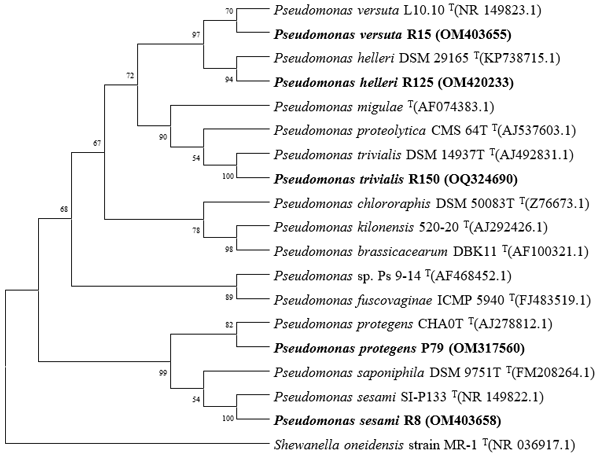
Genetic characterization of the selected strains revealed a close phylogenetic relationship to the Pseudomonas genus based on nearly complete 16S rRNA gene sequences, with similarity values exceeding 98 %. According to the phylogenetic tree (Fig. 2) inferred from the 16S rRNA sequences, the five strains P79, R8, R15, R125, and R150 isolated from the rhizosphere soil of L. creticus were closely related to Pseudomonas protegens, Pseudomonas sesami, Pseudomonas versuta, Pseudomonas helleri, and Pseudomonas trivialis. The 16S rRNA gene sequences of these five Pseudomonas strains were submitted to NCBI GenBank, and their accession numbers are provided in Fig. 2.

Figure 2Phylogenetic tree based on the 16S rRNA gene sequences showing the relationship between the five Pseudomonas strains (highlighted in the tree) and other related species. The tree was reconstructed using the neighbor-joining tree method. Bootstrap values are indicated as percentages derived from 1000 replicates. The tree was rooted with Shewanella oneidensis strain MR-1T.
3.4 Assessment of PGP traits
The plant growth-promoting properties of the five selected bacterial strains are presented in Table 3. The results revealed marked differences in their ability to solubilize phosphate and acidify the culture medium.
Table 3Plant growth-promoting traits of the five selected rhizobacterial strains.

Values are presented as the means of three replicates. S.I: solubilization index; IAA: Indole acetic acid; ACCD: ACC deaminase; P solubilization in mg L−1; +: low activity; ++: moderate activity; +++: strong activity; −: no activity.
Pseudomonas protegens P79 demonstrated the highest phosphate solubilization (150.5 mg L−1) and moderate siderophore production. Pseudomonas sesami R8 was notable for its strong HCN production. However, it displayed the lowest phosphate solubilization capacity (59.70 mg L−1). Pseudomonas helleri R125 and Pseudomonas trivialis R150 exhibited similar profiles, both exhibiting moderate phosphate solubilization (91.25 and 87.05 mg L−1, respectively) and ammonia production. Pseudomonas versuta R15 showed relatively low phosphate solubilization (76.09 mg L−1) and weak HCN production, and could not produce siderophores. All strains exhibited low IAA levels and ACC deaminase activity, except for P79, which exhibited high IAA production.
3.5 Production of extracellular enzymes
Table 4 highlights the ability of the isolates to produce extracellular enzymes, including cellulase, chitinase, amylase, protease, urease, and catalase. All bacterial strains exhibited minimal enzymatic activity, except for Pseudomonas protegens P79, which exhibited high cellulase and protease activities. This strain exhibited moderate chitinase production and low urease and catalase activity.
Table 4Extracellular enzyme production by bacterial isolates.

(+): low activity, (++): moderate activity, (+++): strong activity, (−): no activity. Values are presented as the means of three replicates.
3.6 Antagonism against phytopathogenic fungi
The antagonistic activity of the five rhizobacterial strains against the four fungal pathogens, Fusarium oxysporum, Aspergillus flavus, Aspergillus ochraceus, and Botrytis cinerea, is shown in Fig. 3. Notably, Pseudomonas sesami R8 exhibited a broad-spectrum antifungal activity compared to the other strains, showing potent inhibition of Aspergillus ochraceus (50.37 %). This strain also demonstrated moderate inhibitory effects against Aspergillus flavus (23.90 %), Botrytis cinerea (23.41 %), and Fusarium oxysporum (16.30 %). Additionally, three strains, Pseudomonas versuta R15, Pseudomonas helleri R125, and Pseudomonas trivialis R150, displayed a highly similar inhibition pattern, effectively suppressing Fusarium oxysporum and Aspergillus ochraceus, but showing no inhibitory activity against Aspergillus flavus and Botrytis cinerea. Finally, Pseudomonas protegens P79 exhibited vigorous antifungal activity against Fusarium oxysporum, with an inhibition rate of 55.56 %.
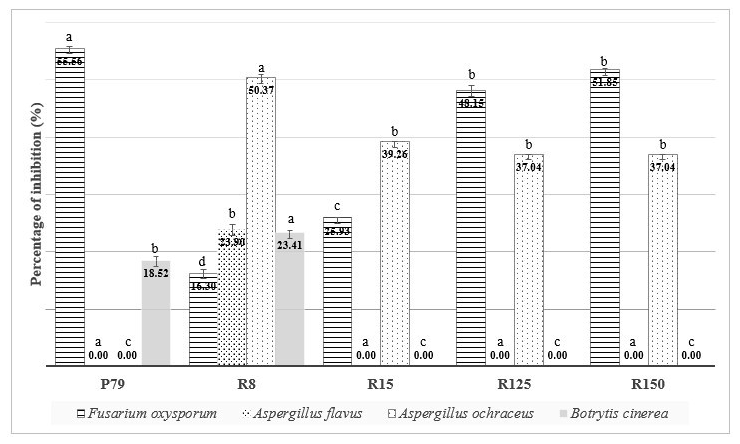
Figure 3Percentage of growth inhibition of phytopathogenic fungi by Pseudomonasstrains. Values are expressed as the mean ± SD. Different letters indicate significant differences (ANOVA, P<0.05).
3.7 Stress effect
The tolerance of the five isolates to salinity, high temperature, and alkaline pH was assessed (Table 5). Among the five PGPR strains, Pseudomonas protegens P79 was the most tolerant, capable of growing at salinity levels up to 13 % NaCl, which correlates with its native soil habitat. This strain also tolerated extreme temperatures of up to 45 °C and an alkaline pH of 11. Pseudomonas helleri R125 and Pseudomonas versuta R15 exhibited moderate resistance, growing in the presence of 12 % and 11 % NaCl, respectively. Both strains also withstood temperatures of 42 °C and a pH of 10. Among the tested strains, Pseudomonas trivialis R150 and Pseudomonas sesami R8 showed the lowest salinity tolerance, with growth observed at 9 % NaCl. Pseudomonas sesami R8 also exhibited a maximum growth temperature of 37 °C (Table 5).
Table 5Bacterial tolerance to stress conditions.

Values are presented as the means of three replicates.
3.8 Inoculation of Lotus creticus
The effects of the five rhizobacterial strains on the growth of L. creticus plants were investigated. The results showed that aerial-part length was highest in plants inoculated with Pseudomonas versuta R15 compared with the other treatments (Fig. 4). In contrast, no significant differences (P>0.05) in root length were observed between the control and most bacterial treatments, except for plants inoculated with R150, which exhibited a lower root length (Fig. 4).
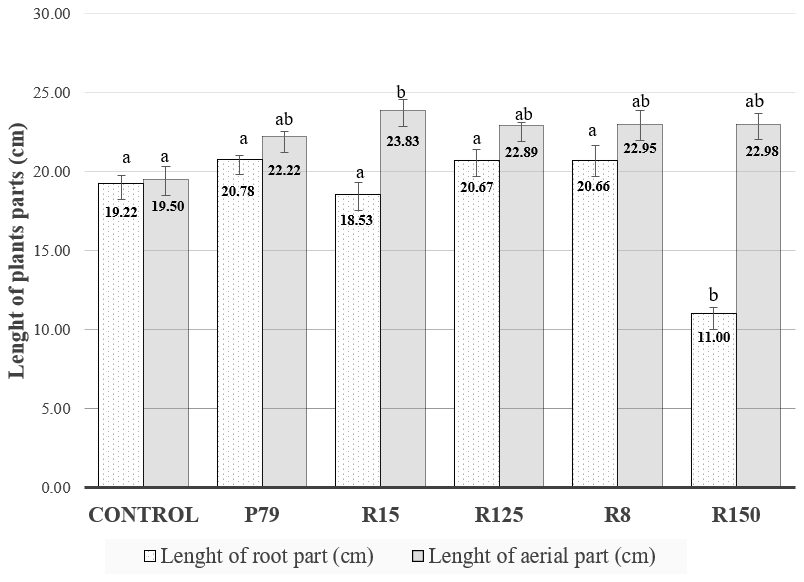
Figure 4Effect of bacterial strains on root and aerial part lengths compared with the control. Values are expressed as the mean ± SD of three independent replicates (n = 3 pots). Different letters indicate significant differences (ANOVA, P<0.05).
Additionally, the impact of the five bacterial strains on the fresh and dry weights of both aerial and root parts of L. creticus is presented in Fig. 5. The highest aerial-part dry weight was observed in plants inoculated with Pseudomonas helleri R125 and Pseudomonas trivialis R150 (P<0.05), whereas the highest root dry weight was recorded in plants inoculated with Pseudomonas protegens P79.
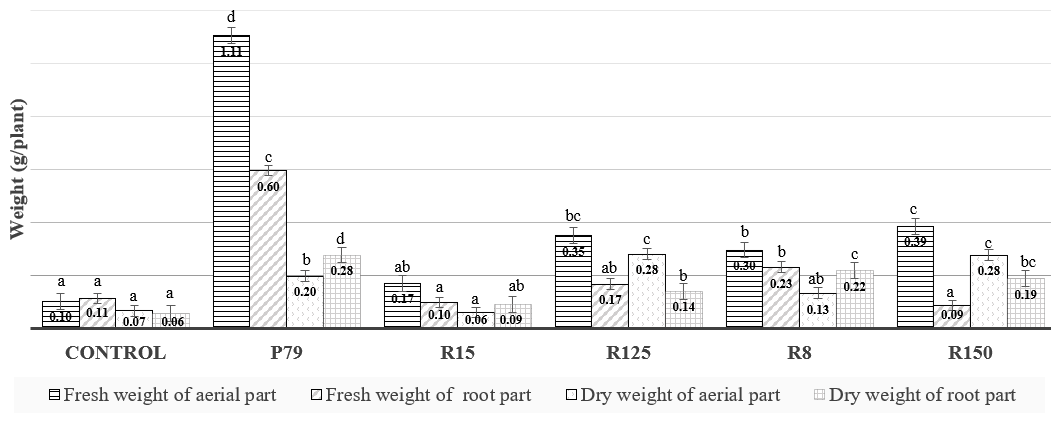
Figure 5Effect of bacterial strains on the fresh and dry weights of aerial and root parts. Values are expressed as the mean ± SD of three independent replicates (n = 3 pots). Different letters indicate significant differences (ANOVA, P<0.05).
In Mediterranean coastal regions, L. creticus is one of the plant species well adapted to saline, nutrient-poor environments. Such adaptation is mainly attributed to the species' ability to make osmotic and transpiration adjustments and to produce bioactive compounds, such as hydroxybenzoic and gallic acid, which are necessary for maintaining photosynthetic activity under stress conditions (Araniti et al., 2014; Barreira et al., 2017). On the other hand, soil microbiota have been extensively reported to play a critical role in enhancing nutrient mobilization and uptake as well as stress tolerance (Howieson et al., 2011; Rima et al., 2018). In this study, the soil where L. creticus was identified was characterized as a sandy Arenosol with an alkaline pH, moderate salinity, and very low levels of organic matter. Such conditions impose multiple constraints on plant growth, including water leaching due to sandy texture, nutrient immobilization and precipitation under alkaline pH conditions, and osmotic stress associated with salinity (Zhu et al., 2024; Sun et al., 2026). In general, legumes are salt-sensitive, and symbiosis is often limited at high salinity (Bruning and Rozema, 2013). However, L. creticus maintained vigorous growth and high nodulation capacity, indicating the functional importance of rhizosphere microorganisms. In this context, five rhizobacterial strains of the genus Pseudomonas were isolated from the rhizosphere of L. creticus growing wild in the coastal region of Morocco. These strains exhibited notable plant growth-promoting traits that support plant development in environments where nutrient availability is often limited by leaching and ionic imbalances (Sun et al., 2026). The relative contribution of these traits varied significantly among strains. At the strain level, distinct functional profiles indicate that the five Pseudomonas isolates may contribute to plant performance through different but complementary mechanisms that collectively support plant establishment and growth in constrained soil environments. Direct effects include plant-level physiological traits, such as IAA production, known to stimulate root system development and improve soil exploration and nutrient uptake (Etesami and Glick, 2024). In addition, ACC deaminase activity plays a key role in alleviating stress-induced ethylene accumulation and mitigating growth inhibition under adverse environmental conditions (Gamalero et al., 2023). In contrast, soil-mediated effects involve processes such as phosphate solubilization and siderophore-based iron chelation. These effects could also include ammonia production, which affects rhizosphere pH and enhances nutrient solubility and availability (Yang et al., 2025).
Remarkably, all five Pseudomonas strains, particularly Pseudomonas protegens P79, could solubilize tricalcium phosphate into soluble forms that can be readily absorbed by plants. Phosphorus is an essential element for plant growth; however, its uptake is often restricted due to its immobilization in soils, particularly sandy soils, where rapid leaching and low organic matter content reduce its uptake by plants (Gerke, 2024). In alkaline, calcareous coastal sandy soils, phosphate tends to precipitate by forming insoluble complexes with calcium ions, thereby decreasing its bioavailability (Johan et al., 2021). Enhanced phosphate solubilization may support plant growth while also increasing microbial biomass P, as microorganisms rapidly assimilate the released phosphate. This microbial pool may function as a temporary reservoir, from which phosphorus could gradually become available to plants and potentially influence phosphorus dynamics at the soil–root interface. Additionally, the increase in dry weight observed with Pseudomonas protegens P79 might be related to its broad enzymatic capacity, which facilitates organic matter decomposition and nutrient release under nutrient-limited conditions, as well as to its ability to synthesize phytohormones such as IAA (Daunoras et al., 2024).
Likewise, the in vitro analysis revealed that all selected strains, except Pseudomonas versuta R15, produced siderophores, which are known to enhance iron uptake (Kong et al., 2014). In sandy soils with low organic matter content, iron is commonly present as insoluble Fe3+ oxides, which limit its uptake by plants (Singh et al., 2022; Yamagata et al., 2022). Iron deficiency can affect various physiological processes (Singh et al., 2022). In response, many siderophore-producing rhizobacteria can chelate these Fe3+ forms and mobilize them into soluble complexes that enhance iron bioavailability (Yamagata et al., 2022). In this regard, the results from the pot trial indicated that Pseudomonas helleri R125 and Pseudomonas trivialis R150 markedly improved the shoot and root dry biomass of L. creticus, suggesting a potential contribution of their nutrient-mobilizing activities, particularly those related to phosphorus and iron. In contrast, Pseudomonas versuta R15 promoted shoot elongation in L. creticus while resulting in comparatively lower dry biomass, suggesting a growth-promoting effect that preferentially favored shoot elongation over biomass accumulation (Kurepa and Smalle, 2026).
Also, Pseudomonas sesami R8 was able to promote the root dry weight of L. creticus, indicating a potential role in nutrient mobilization (Madhaiyan et al., 2017). However, the strain exhibited relatively low tolerance to abiotic stress compared with other Pseudomonas species, suggesting that its plant growth-promoting effects may be primarily associated with functional traits, such as phytohormone production and nutrient solubilization, independently of its stress tolerance (Glick, 2012). Although the strain exhibited limited stress tolerance under in vitro conditions, it could potentially contribute to plant performance in vivo through plant-associated interactions (Compant et al., 2010; Song et al., 2025). Secondary metabolites associated with biocontrol could also contribute to improved rhizosphere competence and root colonization (Lugtenberg and Kamilova, 2009). Notably, Pseudomonas sesami R8 demonstrated strong antifungal activity against all tested fungi. This effect is likely attributable to the strain's ability to produce secondary metabolites, such as ammonia and HCN, which restrict fungal growth, reduce their access to soil nutrients, and enhance rhizosphere health (Sehrawat et al., 2022). These observations may suggest a functional bias of Pseudomonas sesami R8 toward biocontrol rather than abiotic stress tolerance (Sehrawat et al., 2022). In practice, the strain could be applied as a seed coating or soaking treatment to protect L. creticus seeds, suppress fungal colonization, and enhance early plant development. Alternatively, it could be introduced directly into the rhizosphere through soil inoculation (Paravar et al., 2023). For foliar pathogens such as Botrytis cinerea, spraying bacterial suspensions onto leaves may inhibit spore germination and lesion development (Roca-Couso et al., 2021).
These findings demonstrate the functional diversity of rhizosphere-associated Pseudomonas strains and their potential importance in supporting plant establishment and resilience under the combined abiotic stresses of the coastal environment. Most importantly, the ability of strains to grow under high salinity conditions, often associated with arid and semi-arid coastal regions, indicates their capacity to remain metabolically active in saline soils (Wang et al., 2025). However, the plant growth-promoting traits were mainly evaluated in vitro, which may not fully reflect natural soil conditions. Moreover, the underlying mechanisms were inferred from functional assays rather than confirmed by molecular or genomic analyses, and the long-term persistence of the strains was not assessed. Future studies should therefore include field trials across diverse coastal soils, larger sample sizes, and genomic approaches to clarify the mechanisms involved and support the development of effective and sustainable bioinoculant formulations.
This study indicates that five Pseudomonas strains, particularly Pseudomonas protegens P79, originating from Mediterranean coastal soils, can tolerate high salinity and temperature and exhibit important functional traits, such as phosphorus solubilization and siderophore production. Overall, the findings emphasize the important role of diverse PGPR communities in supporting nutrient availability and soil fertility in saline, nutrient-poor soils and in supporting plant adaptation to the physicochemical constraints of coastal ecosystems. Nevertheless, further field-based studies, including single or co-inoculation trials, are required to evaluate their effectiveness in enhancing plant growth, nutrient acquisition, and resilience under natural conditions.
The data used in this study are available from the corresponding author upon reasonable request.
All authors contributed to the study conception and design. Material preparation, data collection, and analysis were performed by Imane Achkouk and Abdelhay Arakrak. The first draft of the manuscript was written by Imane Achkouk. Anass El Yemlahi contributed to the revision and the correction of the manuscript. All authors read and approved the final manuscript.
The contact author has declared that none of the authors has any competing interests.
Publisher's note: Copernicus Publications remains neutral with regard to jurisdictional claims made in the text, published maps, institutional affiliations, or any other geographical representation in this paper. The authors bear the ultimate responsibility for providing appropriate place names. Views expressed in the text are those of the authors and do not necessarily reflect the views of the publisher.
The authors would like to thank the National Center for Scientific and Technical Research (CNRST) for gene sequencing analysis.
This paper was edited by Ping He and reviewed by three anonymous referees.
Abd-Alla, M. H., Al-Amri, S. M., and El-Enany, A.-W. E.: Enhancing rhizobium-legume symbiosis and reducing nitrogen fertilizer use are potential options for mitigating climate change, Agriculture, 13, 2092, https://doi.org/10.3390/agriculture13112092, 2023.
Adamczyk, B.: Root-derived proteases as a plant tool to access soil organic nitrogen; current stage of knowledge and controversies, Plants, 10, 731, https://doi.org/10.3390/plants10040731, 2021.
Adeleke, B. S., Chaudhary, P., Ayilara, M. S., Ojo, F. M., Erinoso, S. M., Upadhayay, V. K., Adeyemo, A. I., and Akinola, S. A.: Rhizosphere microbiomes mediating abiotic stress mitigation for improved plant nutrition, Ecologies, 5, 375–401, https://doi.org/10.3390/ecologies5030024, 2024.
Ainane, A., Abdoul-Latif, F. M., and Ainane, T.: Culture des plantes légumineuses en Afrique: un système agricole durable, Éditions Universitaires Européennes, ISBN-13 978-620-341-419-6, 2021.
Ames, B. N.: Assay of inorganic phosphate, total phosphate and phosphatases, Methods Enzymol., 8, 115–118, https://doi.org/10.1016/0076-6879(66)08014-5, 1966.
AOAC: Official methods of analysis, 16th Edn., Association of Official Analytical Chemists, Gaithersburg, MD, USA, ISBN 978-0-935584-54-7, 1997.
Araniti, F., Sunseri, F., and Abenavoli, M. R.: Phytotoxic activity and phytochemical characterization of Lotus ornithopodioides L., a spontaneous species of the Mediterranean area, Phytochem. Lett., 8, 179–183, 2014.
Bakker, A. W. and Schippers, B.: Microbial cyanide production in the rhizosphere in relation to potato yield reduction and Pseudomonas spp. mediated plant growth stimulation, Soil Biol. Biochem., 19, 451–457, https://doi.org/10.1016/0038-0717(87)90037-X, 1987.
Barreira, J. C., Visnevschi-Necrasov, T., Pereira, G., Nunes, E., and Oliveira, M. B. P.: Phytochemical profiling of underexploited Fabaceae species: insights on ontogenic and phylogenetic effects over isoflavone levels, Food Res. Int., 100, 517–523, https://doi.org/10.1016/j.foodres.2016.07.009, 2017.
Bashan, Y., de-Bashan, L. E., Prabhu, S. R., and Hernandez, J.-P.: Advances in plant growth-promoting bacterial inoculant technology: formulations and practical perspectives (1998–2013), Plant Soil, 378, 1–33, https://doi.org/10.1007/s11104-013-1956-x, 2014.
Belechheb, T., Bouhnik, O., Bakkali, M., Hassani Zerrouk, M., Laglaoui, A., Missbah El Idrissi, M., and Arakrak, A.: Ensifer meliloti sv. lancerottense nodulates Lotus creticus in alkaline soils of Northern Morocco, Rhizosphere, 18, 100339, https://doi.org/10.1016/j.rhisph.2021.100339, 2021.
Bower, C. A., Reitemeier, R. F., and Fireman, M.: Exchangeable cation analysis of saline and alkali soils, Soil Sci., 73, 251–262, https://doi.org/10.1097/00010694-195204000-00001, 1952.
Bric, J. M., Bostock, R. M., and Silverstone, S. E.: Rapid in situ assay for indoleacetic acid production by bacteria immobilized on nitrocellulose membrane, Appl. Environ. Microbiol., 57, 535–538, 1991.
Brink, B.: Urease test protocol, American Society for Microbiology, https://asm.org/protocols/urease-test (last access: 16 February 2026), 2010.
Broughton, W. J. and Dilworth, M. J.: Control of leghaemoglobin synthesis in snake beans, Biochem. J., 125, 1075–1080, https://doi.org/10.1042/bj1251075, 1971.
Bruning, B. and Rozema, J.: Symbiotic nitrogen fixation in legumes: perspectives for saline agriculture, Environ. Exp. Bot., 92, 134–143, https://doi.org/10.1016/j.envexpbot.2012.09.001, 2013.
Bumunang, W. E. and Babalola, O. O.: Characterization of rhizobacteria from field grown genetically modified (GM) and non-GM maizes, Braz. Arch. Biol. Technol., 57, https://doi.org/10.1590/S1516-89132014000100001, 2014.
Cappuccino, J. G. and Sherman, N.: Microbiology: a laboratory manual, 3rd Edn., Benjamin/Cummings, New York, USA, ISBN 978-0-8053-1052-8, 1992.
Chen, W. P. and Kuo, T. T.: A simple and rapid method for the preparation of Gram-negative bacterial genomic DNA, Nucleic Acids Res., 21, 2260, https://doi.org/10.1093/nar/21.9.2260, 1993.
Chu, W., Shen, C., Zhou, L., Zhang, Y., Li, X., Wang, H., Liu, J., and Chen, Q.: Rationalizing microbial strategies for coastal soil restoration: functional complementarity and trade-offs in PGPR-AMF interactions, Land Degrad. Dev., 1–14, https://doi.org/10.1002/ldr.70366, 2025.
Collins, H. C., Lyne, P. M., Grange, J. M., and Falkinham, J. O.: Collins and Lyne’s Microbiological Methods, 8th Edn., Arnold, London, ISBN 978-0-340-80896-2, 2004.
Compant, S., Clément, C., and Sessitsch, A.: Plant growth-promoting bacteria in the rhizo- and endosphere of plants: their role, colonization mechanisms involved and prospects for utilization, Soil Biol. Biochem., 42, 669–678, https://doi.org/10.1016/j.soilbio.2009.11.024, 2010.
Crabtree, K. T. and Hinsdill, R. D.: Fundamental Experiments in Microbiology, W. B. Saunders, Philadelphia, USA, ISBN 978-0-7216-2733-5, 1974.
Datta, R.: Enzymatic degradation of cellulose in soil: a review, Heliyon, 10, e24022, https://doi.org/10.1016/j.heliyon.2024.e24022, 2024.
Daunoras, J., Kačergius, A., and Gudiukait, R.: Role of soil microbiota enzymes in soil health and activity changes depending on climate change and the type of soil ecosystem, Biology, 13, 85, https://doi.org/10.3390/biology13020085, 2024.
de Andrade, L. A., Santos, C. H. B., Frezarin, E. T., Sales, L. R., and Rigobelo, E. C.: Plant growth-promoting rhizobacteria for sustainable agricultural production, Microorganisms, 11, 1088, https://doi.org/10.3390/microorganisms11041088, 2023.
Ed-Premono, M., Moawad, M. A., and Vleck, L. G.: Effect of phosphate-solubilizing Pseudomonas putida on the growth of maize and its survival in the rhizosphere, Indones. J. Crop Sci., 11, 13–23, 1996.
El Aaraj, C., Bakkali, M., Infantino, A., Arakrak, A., and Laglaoui, A.: Mycotoxigenic fungi in cereal grains and coffee from the north of Morocco, Am. J. Res. Commun., 3, 2325–4076, 2015.
Espinosa-Palomeque, B., Jiménez-Pérez, O., Ramírez-Gottfried, R. I., Preciado-Rangel, P., Buendía-García, A., Sifuentes, G. Z., Sariñana-Navarrete, M. A., and Rivas-García, T.: Biocontrol of phytopathogens using plant growth-promoting rhizobacteria: bibliometric analysis and systematic review, Horticulturae, 11, 271, https://doi.org/10.3390/horticulturae11030271, 2025.
Etesami, H. and Glick, B. R.: Bacterial indole-3-acetic acid: a key regulator for plant growth, plant-microbe interactions, and agricultural adaptive resilience, Microbiol. Res., 281, 127602, https://doi.org/10.1016/j.micres.2024.127602, 2024.
FAO: Physical and chemical methods of soil and water analysis, Soils Bulletin, 10, Food and Agriculture Organization of the United Nations, Rome, Italy, https://asm.org/protocols/urease-test (last access: 10 August 2026), 1970.
Ferreira, C. S. S., Seifollahi-Aghmiuni, S., Destouni, G., Ghajarnia, N., and Kalantari, Z.: Soil degradation in the European Mediterranean region: processes, status and consequences, Sci. Total Environ., 805, 150106, https://doi.org/10.1016/j.scitotenv.2021.150106, 2022.
Gamalero, E., Lingua, G., and Glick, B. R.: Ethylene, ACC, and the plant growth-promoting enzyme ACC deaminase, Biology, 12, 1043, https://doi.org/10.3390/biology12081043, 2023.
Gerke, J.: Improving phosphate acquisition from soil via higher plants while approaching peak phosphorus worldwide: a critical review of current concepts and misconceptions, Plants, 13, 3478, https://doi.org/10.3390/plants13243478, 2024.
Glick, B. R.: Plant growth-promoting bacteria: mechanisms and applications, Scientifica, 2012, 963401, https://doi.org/10.6064/2012/963401, 2012.
Howieson, J. G. and Dilworth, M. J.: Working with rhizobia, ACIAR Monograph No. 173, Australian Centre for International Agricultural Research, Canberra, Australia, ISBN 978-1-925436-18-1, 2016.
Howieson, J. G., Ballard, R. A., Yates, R. J., Nandasena, K. G., O'Hara, G. W., Tiwari, R. P., Sezmis, E., and Aitken, M.: Selecting improved Lotus-nodulating rhizobia to expedite the development of new forage species, Plant Soil, 348, 231–243, https://doi.org/10.1007/s11104-011-0921-9, 2011.
ISO (International Organization for Standardization): Soil quality – determination of total nitrogen – modified Kjeldahl method (ISO 11261), ISO, Geneva, Switzerland, https://www.iso.org/standard/19239.html (last access: 10 August 2026), 1995.
Jacobson, C. B., Pasternak, J. J., and Glick, B. R.: Partial purification and characterization of 1-aminocyclopropane-1-carboxylate deaminase from the plant growth-promoting rhizobacterium Pseudomonas putida GR12-2, Can. J. Microbiol., 40, 1019–1025, 1994.
Johan, P. D., Ahmed, O. H., Omar, L., and Hasbullah, N. A.: Phosphorus transformation in soils following co-application of charcoal and wood ash, Agronomy, 11, 2010, https://doi.org/10.3390/agronomy11102010, 2021.
Khan, H., Akbar, W. A., Shah, Z., Rahim, H. U., Taj, A., and Alatalo, J. M.: Coupling phosphate-solubilizing bacteria with inorganic phosphorus fertilizer improves mungbean phosphorus acquisition, nitrogen fixation, and yield in alkaline-calcareous soil, Heliyon, 8, e09081, https://doi.org/10.1016/j.heliyon.2022.e09081, 2022.
Kong, J., Dong, Y., Xu, L., Liu, S., and Bai, X.: Effects of exogenous salicylic acid on alleviating chlorosis induced by iron deficiency in peanut seedlings (Arachis hypogaea L.), J. Plant Growth Regul., 33, 715–729, https://doi.org/10.1007/s00344-014-9417-9, 2014.
Kurepa, J. and Smalle, J. A.: Plant hormone regulation of competitive growth: implications for agriculture and inclusive fitness, Appl. Biosci., 5, 24, https://doi.org/10.3390/applbiosci5020024, 2026.
Lugtenberg, B. and Kamilova, F.: Plant-growth-promoting rhizobacteria, Annu. Rev. Microbiol., 63, 541–556, https://doi.org/10.1146/annurev.micro.62.081307.162918, 2009.
Maciá-Vicente, J. G., Jansson, H.-B., Abdullah, S. K., Descals, E., Salinas, J., and Lopez-Llorca, L. V.: Fungal root endophytes from natural vegetation in Mediterranean environments with special reference to Fusarium spp., FEMS Microbiol. Ecol., 64, 90–105, https://doi.org/10.1111/j.1574-6941.2007.00443.x, 2008.
Madhaiyan, M., Poonguzhali, S., Saravanan, V. S., Lee, J. S., Lee, K. C., and Sundaram, S.: Pseudomonas sesami sp. nov., a plant growth-promoting Gammaproteobacterium isolated from the rhizosphere of Sesamum indicum L., Antonie van Leeuwenhoek, 110, 843–852, https://doi.org/10.1007/s10482-017-0859-x, 2017.
Marien, L., Crabit, A., Dewandel, B., Ladouche, B., Fleury, P., Follain, S., Cavero, J., Berteloot, V., and Colin, F.: Salinity spatial patterns in Mediterranean coastal areas: the legacy of historical water infrastructures, Sci. Total Environ., 895, 165730, https://doi.org/10.1016/j.scitotenv.2023.165730, 2023.
Mekureyaw, M. F., Pandey, C., Hennessy, R. C., Nicolaisen, M. H., Liu, F., Nybroe, O., and Roitsch, T.: The cytokinin-producing plant beneficial bacterium Pseudomonas fluorescens G20-18 primes tomato (Solanum lycopersicum) for enhanced drought stress responses, J. Plant Physiol., 270, 153629, https://doi.org/10.1016/j.jplph.2022.153629, 2022.
Miller, G. L.: Use of dinitrosalicylic acid reagent for determination of reducing sugar, Anal. Chem., 31, 426–428, https://doi.org/10.1021/ac60147a030, 1959.
Morbia, M., Pandey, A., Mahla, P., and Gohil, S.: Isolation of α-amylase producing microorganisms from soil of Kachchh, Gujarat, J. Pure Appl. Microbiol., 18, 1610–1619, https://doi.org/10.22207/JPAM.18.3.10, 2024.
Msimbira, L. A. and Smith, D. L.: The roles of plant growth-promoting microbes in enhancing plant tolerance to acidity and alkalinity stresses, Front. Sustain. Food Syst., 4, 106, https://doi.org/10.3389/fsufs.2020.00106, 2020.
Navarro-Torre, S., Garcia-Caparrós, P., Nogales, A., Abreu, M. M., Santos, E., Cortinhas, A. L., and Caperta, A. D.: Sustainable agricultural management of saline soils in arid and semi-arid Mediterranean regions through halophytes, microbial and soil-based technologies, Environ. Exp. Bot., https://doi.org/10.1016/j.envexpbot.2023.105397, 2023.
Nisa, M. U., Rizvi, Z. F., Hyder, S., Gondal, A. S., Ahmed, I., Riaz, N., Iqra, Montoya Martínez, A. C., de los Santos-Villalobos, S., and Iqbal, M.: Integrated application of plant growth-promoting rhizobacteria and organic amendments enhances growth and nutrient uptake in maize, J. Agric. Food Res., 102742, https://doi.org/10.1016/j.jafr.2026.102742, 2026.
Novitsky, T. J. and Kushner, D. J.: Influence of temperature and salt concentration on the growth of a facultatively halophilic Micrococcus sp., Can. J. Microbiol., 21, 107–110, https://doi.org/10.1139/m75-017, 1975.
Olsen, S. R., Cole, C. V., Watanabe, F. S., and Dean, L. A.: Estimation of available phosphorus in soils by extraction with sodium bicarbonate, USDA Circular 939, U.S. Department of Agriculture, Washington, DC, 19 pp., https://archive.org/details/estimationofavai939olse (last access: 16 February 2026), 1954.
Orozco-Mosqueda, M. del C., Glick, B. R., and Santoyo, G.: ACC deaminase in plant growth-promoting bacteria (PGPB): an efficient mechanism to counter salt stress in crops, Microbiol. Res., 235, 126439, https://doi.org/10.1016/j.micres.2020.126439, 2020.
Paravar, A., Piri, R., Balouchi, H., and Ma, Y.: Microbial seed coating: an attractive tool for sustainable agriculture, Biotechnol. Rep., 37, e00781, https://doi.org/10.1016/j.btre.2023.e00781, 2023.
Pattnaik, S., Mohapatra, B., and Gupta, A.: Plant growth-promoting microbe-mediated uptake of essential nutrients (Fe, P, K) for crop stress management: microbe-soil-plant continuum, Front. Agron., 3, 689972, https://doi.org/10.3389/fagro.2021.689972, 2021.
Pikovskaya, R. I.: Mobilization of phosphorus in soil in connection with the vital activity of some microbial species, Mikrobiologiya, 17, 362–370, 1948.
Rabindran, R. and Vidhyasekaran, P.: Development of a formulation of Pseudomonas fluorescens PfALR2 for management of rice sheath blight, Crop Prot., 15, 715–721, https://doi.org/10.1016/S0261-2194(96)00045-2, 1996.
Renwick, A., Campbell, R., and Coe, S.: Assessment of in vivo screening systems for potential biocontrol agents of Gaeumannomyces graminis, Plant Pathol., 40, 524–532, 1991.
Rima, F. S., Biswas, S., Sarker, P. K., Islam, M. R., and Seraj, Z. I.: Bacteria endemic to the saline coastal belt and their ability to mitigate the effects of salt stress on rice growth and yields, Ann. Microbiol., 68, 525-535, https://doi.org/10.1007/s13213-018-1358-7, 2018.
Roca-Couso, R., Flores-Félix, J. D., and Rivas, R.: Mechanisms of action of microbial biocontrol agents against Botrytis cinerea, J. Fungi, 7, 1045, https://doi.org/10.3390/jof7121045, 2021.
Romano, G., Ricci, G. F., and Leronni, V.: Soil bioengineering techniques for Mediterranean coastal dune restoration using autochthonous vegetation species, J. Coast. Conserv., 26, 71, https://doi.org/10.1007/s11852-022-00912-0, 2022.
Roy, S., Bhowmik, S., Dutta Chowdhury, A., Dhara, B., and Mitra, A. K.: Plant growth-promoting rhizobacteria: an alternative for NPK fertilizers, in: Microbes and Microbial Biotechnology for Green Remediation, edited by: Malik, J. A., Elsevier, 149–167, https://doi.org/10.1016/B978-0-323-90452-0.00007-4, 2022.
Salwan, I., Sharma, M., Sharma, A., and Sharma, V.: Insights into plant beneficial microorganism-triggered induced systemic resistance, Plant Stress, 7, 100140, https://doi.org/10.1016/j.stress.2023.100140, 2023.
Schwyn, B. and Neilands, J. B.: Universal chemical assay for the detection and determination of siderophores, Anal. Biochem., 160, 47-56, https://doi.org/10.1016/0003-2697(87)90612-9, 1987.
Sehrawat, A., Sindhu, S. S., and Glick, B. R.: Hydrogen cyanide production by soil bacteria: biological control of pests and promotion of plant growth in sustainable agriculture, Pedosphere, 32, 15-38, https://doi.org/10.1016/S1002-0160(21)60058-9, 2022.
Sharma, N., Mahawar, L., Mishra, A., and Albrectsen, B. R.: Microbial contributions to plant growth and stress tolerance: mechanisms for sustainable plant production, Plant Stress, 17, 100966, https://doi.org/10.1016/j.stress.2025.100966, 2025.
Singh, P., Chauhan, P. K., Upadhyay, S. K., Singh, R. K., Dwivedi, P., Wang, J., Jain, D., and Jiang, M.: Mechanistic insights and potential use of siderophore producing microbes in rhizosphere for mitigation of stress in plants grown in degraded land, Front. Microbiol., 13, 898979, https://doi.org/10.3389/fmicb.2022.898979, 2022.
Song, Q., Qi, Z., Liang, N., Hou, N., Zhang, C., Pei, C., Zhao, X., and Li, D.: Cross-protection and cross-feeding mediated by signaling molecules enhanced the viability of Pseudomonas fluorescens S01 and Rhodococcus erythropolis S02 under the dual stresses of polycyclic aromatic hydrocarbons and low temperature, J. Hazard. Mater., 494, 138689, https://doi.org/10.1016/j.jhazmat.2025.138689, 2025.
Sun, Q., Chen, C., Yao, Y., Wu, H., Zhang, M., Jin, L., Zhou, H., Meng, T., and Peng, H.: Soil properties of reclaimed coastal saline-alkali farmland in a Chinese province: spatial variability and soil profiles, Agriculture, 16, 638, https://doi.org/10.3390/agriculture16060638, 2026.
Timofeeva, A. M., Galyamova, M. R., and Sedykh, S. E.: Bacterial siderophores: classification, biosynthesis, perspectives of use in agriculture, Plants, 11, 3065, https://doi.org/10.3390/plants11223065, 2022.
Tsitsigiannis, D. I., Dimakopoulou, M., Antoniou, P. P., and Tjamos, S. E.: Biological control strategies of mycotoxigenic fungi and associated mycotoxins in Mediterranean basin crops, Phytopathol. Mediterr., 51, 158–174, https://doi.org/10.14601/Phytopathol_Mediterr-11502, 2012.
USSLS (United States Salinity Laboratory Staff): Diagnosis and improvement of saline and alkali soils, USDA Handbook No. 60, U.S. Department of Agriculture, Washington, DC, USA, https://www.ars.usda.gov/pacific-west-area/riverside-ca/agricultural-water-efficiency-and-salinity-research-unit/docs/publications/handbook-no-60/ (last access: 10 August 2026), 1954.
Vejan, P., Abdullah, R., Khadiran, T., Ismail, S., and Nasrulhaq Boyce, A.: Role of plant growth promoting rhizobacteria in agricultural sustainability: a review, Molecules, 21, 573, https://doi.org/10.3390/molecules21050573, 2016.
Veliz, E. A., Martínez-Hidalgo, P., and Hirsch, A. M.: Chitinase-producing bacteria and their role in biocontrol, AIMS Microbiol., 3, 689–705, https://doi.org/10.3934/microbiol.2017.3.689, 2017.
Vijayaraghavan, R. and Vincent, S. G. P.: A simple method for the detection of protease activity on agar plates using bromocresol green dye, J. Biochem. Technol., 4, 628–630, 2013.
Walkley, A. and Black, I. A.: An examination of the method for determining soil organic matter and a proposed modification of the chromic acid titration method, Soil Sci., 37, 29–38, https://doi.org/10.1097/00010694-193401000-00003, 1934.
Wang, X., Xu, L., Qi, X., Huang, J., Han, M., Wang, C., Li, X., and Jiang, H.: Microbial assembly and stress-tolerance mechanisms in salt-adapted plants along the shore of a salt lake: implications for saline-alkaline soil remediation, Microorganisms, 13, 1942, https://doi.org/10.3390/microorganisms13081942, 2025.
Weisburg, W. G., Barns, S. M., Pelletier, D. A., and Lane, D. J.: 16S ribosomal DNA amplification for phylogenetic study, J. Bacteriol., 173, 697–703, https://doi.org/10.1128/jb.173.2.697-703.1991, 1991.
Witzel, K., Motos, J. R. A., Atay, E., Hirt, H., and Schmülling, T.: Leveraging microorganisms and biostimulants: mitigating salinity stress in crops with agricultural biologicals, Plant Soil, https://doi.org/10.1007/s11104-025-07578-1, 2025.
Yamagata, A., Murata, Y., Namba, K., Terada, T., Fukai, S., and Shirouzu, M.: Uptake mechanism of iron-phytosiderophore from the soil based on the structure of yellow stripe transporter, Nat. Commun., 13, 7180, https://doi.org/10.1038/s41467-022-34930-1, 2022.
Yang, J., Tang, M., and Zhao, H.: Physiological mechanisms of plant growth-promoting rhizobacteria in enhancing abiotic stress tolerance of vegetable crops: a review, Plants, 15, 686, https://doi.org/10.3390/plants15050686, 2026.
Yang, Z., Yan, H., Liu, H., Yang, L., Mi, G., and Wang, P.: Enhancing crop nitrogen efficiency: the role of mixed nitrate and ammonium supply in plant growth and development, Biology, 14, 546, https://doi.org/10.3390/biology14050546, 2025.
Younsi, S. E. and Bouziane, Z.: Plant diversity in Mediterranean coastal dune systems subjected to anthropogenic disturbances, Biodivers. Res. Conserv., 72, 25–38, https://doi.org/10.14746/biorc.2023.72.4, 2023.
Zhang, H., Cui, C., Li, S., Lv, W., Zhang, J., Zhu, X., Xu, C., Wang, Q., Bai, N., and Zhang, H.: Bio-organic fertilizer with Bacillus velezensis promoted plant growth by regulating soil microbial community structure and C/N cycle function, Plants, 15, 382, https://doi.org/10.3390/plants15030382, 2026.
Zhu, W., Gu, S., Jiang, R., Zhang, X., and Hatano, R.: Saline-alkali soil reclamation contributes to soil health improvement in China, Agriculture, 14, 1210, https://doi.org/10.3390/agriculture14081210, 2024.