
Articles | Volume 12, issue 1
https://doi.org/10.5194/soil-12-665-2026
© Author(s) 2026. This work is distributed under
the Creative Commons Attribution 4.0 License.
the Creative Commons Attribution 4.0 License.
https://doi.org/10.5194/soil-12-665-2026
© Author(s) 2026. This work is distributed under
the Creative Commons Attribution 4.0 License.
the Creative Commons Attribution 4.0 License.
Original research article
| 
19 May 2026
Original research article |
| 19 May 2026
| 19 May 2026
Improvement of soil properties maps using an iterative residual correction method

Department of Civil and Environmental Engineering, Duke University, Durham, NC 27705, USA
Elia Scudiero
Department of Environmental Sciences, University of California Riverside, Riverside, CA 92521, USA
United States Department of Agriculture – Agricultural Research Service, George E. Brown Jr. Salinity Laboratory, Agricultural Water Efficiency and Salinity Research Unit, Riverside, CA 92507, USA
Ray Anderson
United States Department of Agriculture – Agricultural Research Service, George E. Brown Jr. Salinity Laboratory, Agricultural Water Efficiency and Salinity Research Unit, Riverside, CA 92507, USA
Department of Environmental Sciences, University of California Riverside, Riverside, CA 92521, USA
Nathaniel Chaney
Department of Civil and Environmental Engineering, Duke University, Durham, NC 27705, USA
Related authors
Daniel Guyumus, Laura Torres-Rojas, Luiz Bacelar, Chengcheng Xu, and Nathaniel Chaney
Geosci. Model Dev., 19, 477–504, https://doi.org/10.5194/gmd-19-477-2026, https://doi.org/10.5194/gmd-19-477-2026, 2026
Short summary
Short summary
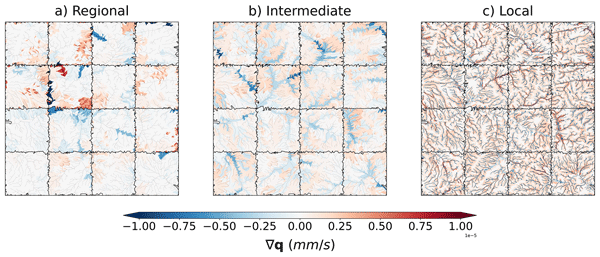
This study explores a new tiling scheme within the HydroBlocks Land Surface Model to represent local, regional and intermediate subsurface flow. Using high-resolution environmental data, the scheme defines parameterized flow units, enabling water and energy flux simulations. Compared against a benchmark simulation, the multiscale scheme demonstrates strong agreement in spatial mean, standard deviation, and temporal variability, showcasing its potential for large-scale hydrological simulation.
Emma-Riikka Kokko, Nathaniel Chaney, Daniel Guyumus, Luiz Bacelar, Laura Torres-Rojas, and Jarkko Okkonen
Hydrol. Earth Syst. Sci., 30, 5049–5065, https://doi.org/10.5194/hess-30-5049-2026, https://doi.org/10.5194/hess-30-5049-2026, 2026
Short summary
Short summary
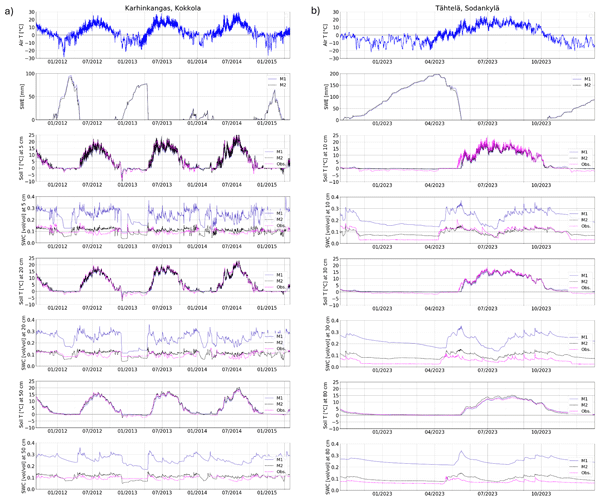
HydroBlocks model, was configured over Finland. Time series of snow water equivalent, soil temperature, soil water content and soil ice content were created. Observational data was used to evaluate the model performance. HydroBlocks can generally predict soil conditions in Finland with some uncertainty. The model performance is improved with using local soil data and local soil hydraulic parameters. In the future, the modelling outputs show potential to be used in environmental applications.
Daniel Guyumus, Laura Torres-Rojas, Luiz Bacelar, Chengcheng Xu, and Nathaniel Chaney
Geosci. Model Dev., 19, 477–504, https://doi.org/10.5194/gmd-19-477-2026, https://doi.org/10.5194/gmd-19-477-2026, 2026
Short summary
Short summary
This study explores a new tiling scheme within the HydroBlocks Land Surface Model to represent local, regional and intermediate subsurface flow. Using high-resolution environmental data, the scheme defines parameterized flow units, enabling water and energy flux simulations. Compared against a benchmark simulation, the multiscale scheme demonstrates strong agreement in spatial mean, standard deviation, and temporal variability, showcasing its potential for large-scale hydrological simulation.
Wouter J. M. Knoben, Cyril Thébault, Kasra Keshavarz, Laura Torres-Rojas, Nathaniel W. Chaney, Alain Pietroniro, and Martyn P. Clark
Hydrol. Earth Syst. Sci., 29, 5791–5833, https://doi.org/10.5194/hess-29-5791-2025, https://doi.org/10.5194/hess-29-5791-2025, 2025
Short summary
Short summary
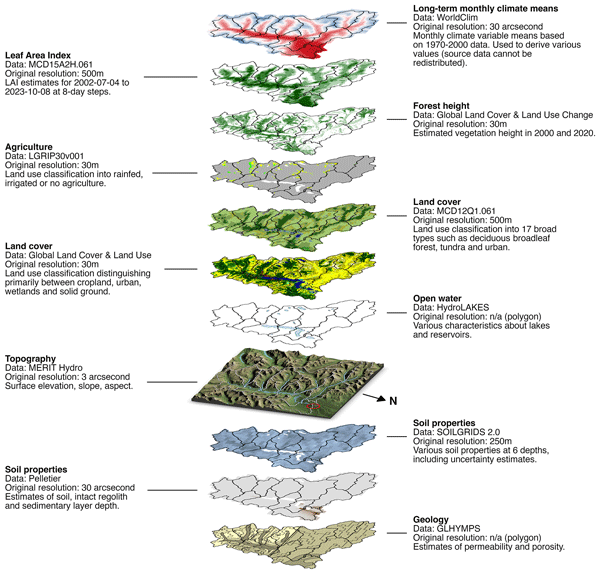
Many existing datasets for hydrologic analysis tend to treat catchments as single spatially homogeneous units focusing on daily data and typically do not support more complex models. This paper introduces a dataset that goes beyond this set-up by (1) providing data at a higher spatial and temporal resolution, (2) specifically considering the data requirements of all common hydrologic model types, and (3) using statistical summaries of the data aimed at quantifying spatial and temporal heterogeneity.
Minki Hong, Nathaniel Chaney, Sergey Malyshev, Enrico Zorzetto, Anthony Preucil, and Elena Shevliakova
Geosci. Model Dev., 18, 2275–2301, https://doi.org/10.5194/gmd-18-2275-2025, https://doi.org/10.5194/gmd-18-2275-2025, 2025
Short summary
Short summary
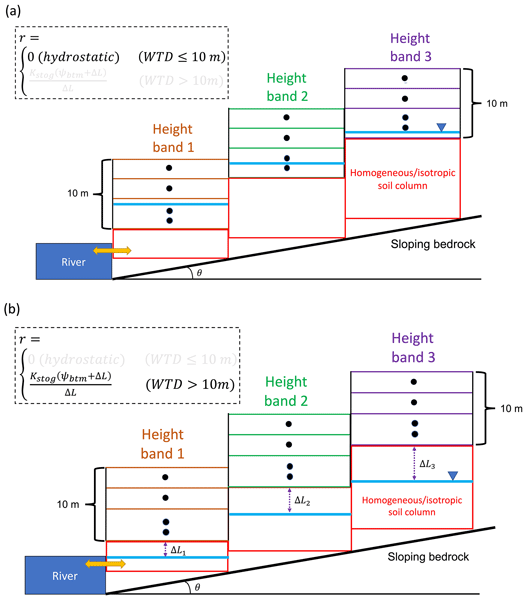
This study shows the significance of groundwater in resolving the coupled terrestrial water–energy cycle. LM4-SHARC (soil–hillslope aquifer–river continuum) describes the hillslope groundwater using its emergent properties, yielding noticeable improvements in soil moisture/temperature and groundwater discharge predictions. The implications of groundwater-mediated hydrologic interactions between hillslopes and streams need further exploration in the Earth system modeling community.
Rachael Lau, Carolina Seguí, Tyler Waterman, Nathaniel Chaney, and Manolis Veveakis
Nat. Hazards Earth Syst. Sci., 24, 3651–3661, https://doi.org/10.5194/nhess-24-3651-2024, https://doi.org/10.5194/nhess-24-3651-2024, 2024
Short summary
Short summary
This work examines the use of interferometric synthetic-aperture radar (InSAR) alongside in situ borehole measurements to assess the stability of deep-seated landslides for the case study of El Forn (Andorra). Comparing InSAR with borehole data suggests a key trade-off between accuracy and precision for various InSAR resolutions. Spatial interpolation with InSAR informed how many remote observations are necessary to lower error in a remote sensing re-creation of ground motion over the landslide.
Kirsten L. Findell, Zun Yin, Eunkyo Seo, Paul A. Dirmeyer, Nathan P. Arnold, Nathaniel Chaney, Megan D. Fowler, Meng Huang, David M. Lawrence, Po-Lun Ma, and Joseph A. Santanello Jr.
Geosci. Model Dev., 17, 1869–1883, https://doi.org/10.5194/gmd-17-1869-2024, https://doi.org/10.5194/gmd-17-1869-2024, 2024
Short summary
Short summary
We outline a request for sub-daily data to accurately capture the process-level connections between land states, surface fluxes, and the boundary layer response. This high-frequency model output will allow for more direct comparison with observational field campaigns on process-relevant timescales, enable demonstration of inter-model spread in land–atmosphere coupling processes, and aid in targeted identification of sources of deficiencies and opportunities for improvement of the models.
Luiz Bacelar, Arezoo ReifeeiNasab, Nathaniel Chaney, and Ana Barros
EGUsphere, https://doi.org/10.5194/egusphere-2023-2088, https://doi.org/10.5194/egusphere-2023-2088, 2023
Preprint archived
Short summary
Short summary
The study explores a computationally efficient probabilistic precipitation forecast approach to generate multiple flood scenarios. It reveals the limitations in predicting flash floods accurately and the need for advanced ensemble methodologies to combine different sources of precipitation forecasts. It highlights the scale-dependency of flood predictions at higher spatial resolutions, shedding light on the relationship between river hydraulics and flood propagation in the river network.
Patricia Lawston-Parker, Joseph A. Santanello Jr., and Nathaniel W. Chaney
Hydrol. Earth Syst. Sci., 27, 2787–2805, https://doi.org/10.5194/hess-27-2787-2023, https://doi.org/10.5194/hess-27-2787-2023, 2023
Short summary
Short summary
Irrigation has been shown to impact weather and climate, but it has only recently been considered in prediction models. Prescribing where (globally) irrigation takes place is important to accurately simulate its impacts on temperature, humidity, and precipitation. Here, we evaluated three different irrigation maps in a weather model and found that the extent and intensity of irrigated areas and their boundaries are important drivers of weather impacts resulting from human practices.
Enrico Zorzetto, Sergey Malyshev, Nathaniel Chaney, David Paynter, Raymond Menzel, and Elena Shevliakova
Geosci. Model Dev., 16, 1937–1960, https://doi.org/10.5194/gmd-16-1937-2023, https://doi.org/10.5194/gmd-16-1937-2023, 2023
Short summary
Short summary
In this paper we develop a methodology to model the spatial distribution of solar radiation received by land over mountainous terrain. The approach is designed to be used in Earth system models, where coarse grid cells hinder the description of fine-scale land–atmosphere interactions. We adopt a clustering algorithm to partition the land domain into a set of homogeneous sub-grid
tiles, and for each tile we evaluate solar radiation received by land based on terrain properties.
Meng Huang, Po-Lun Ma, Nathaniel W. Chaney, Dalei Hao, Gautam Bisht, Megan D. Fowler, Vincent E. Larson, and L. Ruby Leung
Geosci. Model Dev., 15, 6371–6384, https://doi.org/10.5194/gmd-15-6371-2022, https://doi.org/10.5194/gmd-15-6371-2022, 2022
Short summary
Short summary
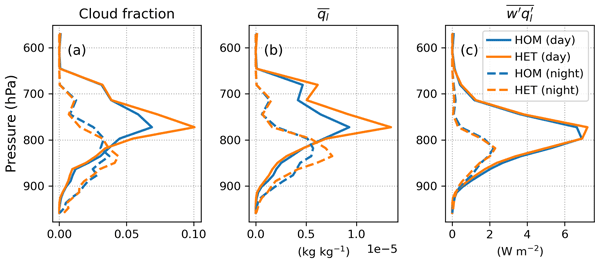
The land surface in one grid cell may be diverse in character. This study uses an explicit way to account for that subgrid diversity in a state-of-the-art Earth system model (ESM) and explores its implications for the overlying atmosphere. We find that the shallow clouds are increased significantly with the land surface diversity. Our work highlights the importance of accurately representing the land surface and its interaction with the atmosphere in next-generation ESMs.
Nathaniel W. Chaney, Laura Torres-Rojas, Noemi Vergopolan, and Colby K. Fisher
Geosci. Model Dev., 14, 6813–6832, https://doi.org/10.5194/gmd-14-6813-2021, https://doi.org/10.5194/gmd-14-6813-2021, 2021
Short summary
Short summary
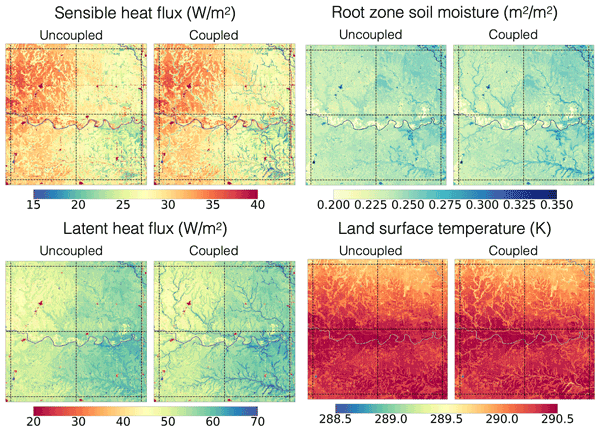
Although there have been significant advances in river routing and sub-grid heterogeneity (i.e., tiling) schemes in Earth system models over the past decades, there has yet to be a concerted effort to couple these two concepts. This paper aims to bridge this gap through the development of a two-way coupling between tiling schemes and river networks in the HydroBlocks land surface model. The scheme is implemented and tested over a 1 arc degree domain in Oklahoma, United States.
Cited articles
Arrouays, D., McKenzie, N., Hempel, J., de Forges, A. R., and McBratney, A. B.: GlobalSoilMap: Basis of the global spatial soil information system, CRC Press, 496 pp., https://doi.org/10.1201/b16500, 2014.
Baroni, G., Zink, M., Kumar, R., Samaniego, L., and Attinger, S.: Effects of uncertainty in soil properties on simulated hydrological states and fluxes at different spatio-temporal scales, Hydrol. Earth Syst. Sci., 21, 2301–2320, https://doi.org/10.5194/hess-21-2301-2017, 2017.
Batjes, N. H., Calisto, L., and de Sousa, L. M.: Providing quality-assessed and standardised soil data to support global mapping and modelling (WoSIS snapshot 2023), Earth Syst. Sci. Data, 16, 4735–4765, https://doi.org/10.5194/essd-16-4735-2024, 2024.
Chaney, N. W., Herman, J. D., Reed, P. M., and Wood, E. F.: Flood and drought hydrologic monitoring: the role of model parameter uncertainty, Hydrol. Earth Syst. Sci., 19, 3239–3251, https://doi.org/10.5194/hess-19-3239-2015, 2015.
Chaney, N. W., Wood, E. F., McBratney, A. B., Hempel, J. W., Nauman, T. W., Brungard, C. W., and Odgers, N. P.: POLARIS: A 30 m probabilistic soil series map of the contiguous United States, Geoderma, https://doi.org/10.1016/j.geoderma.2016.03.025, 2016.
Chaney, N. W., Minasny, B., Herman, J. D., Nauman, T. W., Brungard, C. W., Morgan, C. L. S., McBratney, A. B., Wood, E. F., and Yimam, Y.: POLARIS Soil Properties: 30 m Probabilistic Maps of Soil Properties Over the Contiguous United States, Water Resour. Res., https://doi.org/10.1029/2018WR022797, 2019.
Chen, C., Liaw, A., and Breiman, L.: Using random forest to learn imbalanced data, University of California, Berkeley, 110, 24, https://statistics.berkeley.edu/sites/default/files/tech-reports/666.pdf (last access: 9 May 2026), 2004.
Chilès, J.-P. and Delfiner, P.: Geostatistics: modeling spatial uncertainty, in: Geostatistics: modeling spatial uncertainty, John Wiley & Sons, Ltd, 147–237, https://doi.org/10.1002/9781118136188.ch3, 2012.
Corwin, D. L. and Scudiero, E.: Field-scale apparent soil electrical conductivity, Soil Sci. Soc. Am. J., 84, 1405–1441, https://doi.org/10.1002/saj2.20153, 2020.
Grunwald, S., Thompson, J. A., and Boettinger, J. L.: Digital Soil Mapping and Modeling at Continental Scales: Finding Solutions for Global Issues, Soil Sci. Soc. Am. J., 75, 1201–1213, https://doi.org/10.2136/SSSAJ2011.0025, 2011.
Haghverdi, A., Najarchi, M., Öztürk, H. S., and Durner, W.: Studying unimodal, bimodal, PDI and bimodal-PDI variants of multiple soil water retention models: I. Direct model fit using the extended evaporation and dewpoint methods, Water-Sui, 12, https://doi.org/10.3390/w12030900, 2020.
Hartemink, A. E., Hempel, J., Lagacherie, P., McBratney, A., McKenzie, N., MacMillan, R. A., Minasny, B., Montanarella, L., de Mendonça Santos, M. L., Sanchez, P., Walsh, M., and Zhang, G.-L.: GlobalSoilMap.net – A New Digital Soil Map of the World, in: Digital Soil Mapping: Bridging Research, Environmental Application, and Operation, edited by: Boettinger, J. L., Howell, D. W., Moore, A. C., Hartemink, A. E., and Kienast-Brown, S., Springer Netherlands, Dordrecht, 423–428, https://doi.org/10.1007/978-90-481-8863-5_33, 2010.
Hengl, T., Heuvelink, G. B., and Stein, A.: A generic framework for spatial prediction of soil variables based on regression-kriging, Geoderma, 120, 75–93, 2004.
Hengl, T., De Jesus, J. M., Heuvelink, G. B. M., Gonzalez, M. R., Kilibarda, M., Blagotić, A., Shangguan, W., Wright, M. N., Geng, X., Bauer-Marschallinger, B., Guevara, M. A., Vargas, R., MacMillan, R. A., Batjes, N. H., Leenaars, J. G. B., Ribeiro, E., Wheeler, I., Mantel, S., and Kempen, B.: SoilGrids250m: Global gridded soil information based on machine learning, PLoS ONE, https://doi.org/10.1371/journal.pone.0169748, 2017.
Jiang, Q., Fu, Q., and Wang, Z.: Delineating site-specific irrigation management zones, Irrig. Drain., 60, 464–472, https://doi.org/10.1002/ird.588, 2011.
Lesch, S. M., Rhoades, J. D., and Corwin, D. L.: The ESAP-95 version 2.01R user manual and tutorial guide (Research Report No. 146), USDA-ARS, George E. Brown Jr., Salinity Laboratory, https://www.ars.usda.gov/arsuserfiles/20360500/pdf_pubs/P1702.pdf (last access: 9 May 2026), 2000.
Lesch, S. M.: Sensor-directed response surface sampling designs for characterizing spatial variation in soil properties, Comput. Electron. Agr., 46, 153–179, https://doi.org/10.1016/j.compag.2004.11.004, 2005.
Li, N., Zhao, X., Wang, J., Sefton, M., and Triantafilis, J.: Digital soil mapping based site-specific nutrient management in a sugarcane field in Burdekin, Geoderma, 340, 38–48, https://doi.org/10.1016/j.geoderma.2018.12.033, 2019.
McBratney, A. B., Mendonça Santos, M. L., and Minasny, B.: On digital soil mapping, Geoderma, 117, 3–52, https://doi.org/10.1016/S0016-7061(03)00223-4, 2003.
Minasny, B. and McBratney, A. B.: A conditioned Latin hypercube method for sampling in the presence of ancillary information, Comput. Geosci., 32, 1378–1388, 2006.
Minasny, B. and McBratney, A. B.: Digital soil mapping: A brief history and some lessons, Geoderma, 264, 301–311, https://doi.org/10.1016/j.geoderma.2015.07.017, 2016.
Mueller, T. G., Pierce, F. J., Schabenberger, O., and Warncke, D. D.: Map Quality for Site-Specific Fertility Management, Soil Sci. Soc. Am. J., 65, 1547–1558, https://doi.org/10.2136/sssaj2001.6551547x, 2001.
National Cooperative Soil Survey: NCSS Soil Characterization Database (Lab Data Mart), https://ncsslabdatamart.sc.egov.usda.gov/ (last access: 1 March 2026), 2018.
Nauman, T. W., Kienast-Brown, S., Roecker, S. M., Brungard, C., White, D., Philippe, J., and Thompson, J. A.: Soil landscapes of the United States (SOLUS): Developing predictive soil property maps of the conterminous United States using hybrid training sets, Soil Sci. Soc. Am. J., 88, 2046–2065, https://doi.org/10.1002/saj2.20769, 2024.
Nussbaum, M., Zimmermann, S., Walthert, L., and Baltensweiler, A.: Benefits of hierarchical predictions for digital soil mapping – An approach to map bimodal soil pH, Geoderma, 437, 116579, https://doi.org/10.1016/j.geoderma.2023.116579, 2023.
Odgers, N. P., McBratney, A. B., and Minasny, B.: Digital soil property mapping and uncertainty estimation using soil class probability rasters, Geoderma, 237, https://doi.org/10.1016/j.geoderma.2014.09.009, 2015.
Oliver, M. A. and Webster, R.: A tutorial guide to geostatistics: Computing and modelling variograms and kriging, CATENA, 113, 56–69, https://doi.org/10.1016/j.catena.2013.09.006, 2014.
Ortuani, B., Chiaradia, E. A., Priori, S., L'Abate, G., Canone, D., Comunian, A., Giudici, M., Mele, M., and Facchi, A.: Mapping Soil Water Capacity Through EMI Survey to Delineate Site-Specific Management Units Within an Irrigated Field, Soil Sci., 181, 252, https://doi.org/10.1097/SS.0000000000000159, 2016.
Poggio, L., de Sousa, L. M., Batjes, N. H., Heuvelink, G. B. M., Kempen, B., Ribeiro, E., and Rossiter, D.: SoilGrids 2.0: producing soil information for the globe with quantified spatial uncertainty, SOIL, 7, 217–240, https://doi.org/10.5194/soil-7-217-2021, 2021.
Powers, J. S., Corre, M. D., Twine, T. E., and Veldkamp, E.: Geographic bias of field observations of soil carbon stocks with tropical land-use changes precludes spatial extrapolation, P. Natl. Acad. Sci. USA, 108, 6318–6322, https://doi.org/10.1073/pnas.1016774108, 2011.
Ramcharan, A., Hengl, T., Nauman, T., Brungard, C., Waltman, S., Wills, S., and Thompson, J.: Soil Property and Class Maps of the Conterminous United States at 100-Meter Spatial Resolution, Soil Sci. Soc. Am. J., 82, 186–201, https://doi.org/10.2136/sssaj2017.04.0122, 2018.
Rossiter, D. G., Poggio, L., Beaudette, D., and Libohova, Z.: How well does digital soil mapping represent soil geography? An investigation from the USA, SOIL, 8, 559–586, https://doi.org/10.5194/soil-8-559-2022, 2022.
Schmidinger, J. and Heuvelink, G. B. M.: Validation of uncertainty predictions in digital soil mapping, Geoderma, 437, 116585, https://doi.org/10.1016/j.geoderma.2023.116585, 2023.
Scudiero, E., Corwin, D. L., Markley, P. T., Pourreza, A., Rounsaville, T., Bughici, T., and Skaggs, T. H.: A system for concurrent on-the-go soil apparent electrical conductivity and gamma-ray sensing in micro-irrigated orchards, Soil Till. Res., 235, 105899, https://doi.org/10.1016/j.still.2023.105899, 2024.
Sharififar, A., Sarmadian, F., Malone, B. P., and Minasny, B.: Addressing the issue of digital mapping of soil classes with imbalanced class observations, Geoderma, 350, 84–92, https://doi.org/10.1016/j.geoderma.2019.05.016, 2019.
Shi, G., Sun, W., Shangguan, W., Wei, Z., Yuan, H., Li, L., Sun, X., Zhang, Y., Liang, H., Li, D., Huang, F., Li, Q., and Dai, Y.: A China dataset of soil properties for land surface modelling (version 2, CSDLv2), Earth Syst. Sci. Data, 17, 517–543, https://doi.org/10.5194/essd-17-517-2025, 2025.
Soil Survey Staff: Kellogg Soil Survey Laboratory methods manual, U. S. Department of Agriculture, Natural Resources Conservation Service, Lincoln, Nebraska, https://www.nrcs.usda.gov/sites/default/files/2023-01/SSIR42.pdf (last access: 9 May 2026), 2014.
Soil Survey Staff: Gridded National Soil Survey Geographic (gNATSGO) Database for the Conterminous United States, https://nrcs.app.box.com/v/gateway/folder/233395259341 (last access: 9 May 2026), 2023.
Soil Survey Staff: Gridded Soil Survey Geographic (gSSURGO) Database for the Conterminous United States, https://www.nrcs.usda.gov/resources/data-and-reports/gridded-soil-survey-geographic-gssurgo-database (last access: 1 March 2025), 2025.
Soil Survey Staff, Natural Resources Conservation Service, and United States Department of Agriculture: Soil Survey Geographic (SSURGO) Database for the CONUS, https://www.nrcs.usda.gov/resources/data-and-reports/soil-survey-geographic-database-ssurgo (last access: 1 March 2025), 2023.
Sylvain, J.-D., Anctil, F., and Thiffault, É.: Using bias correction and ensemble modelling for predictive mapping and related uncertainty: A case study in digital soil mapping, Geoderma, 403, 115153, https://doi.org/10.1016/j.geoderma.2021.115153, 2021.
Takoutsing, B., Heuvelink, G. B. M., Stoorvogel, J. J., Shepherd, K. D., and Aynekulu, E.: Accounting for analytical and proximal soil sensing errors in digital soil mapping, Eur. J. Soil Sci., 73, e13226, https://doi.org/10.1111/ejss.13226, 2022.
Vereecken, H., Schnepf, A., Hopmans, J. W., Javaux, M., Or, D., Roose, T., Vanderborght, J., Young, M. H., Amelung, W., Aitkenhead, M., Allison, S. D., Assouline, S., Baveye, P., Berli, M., Brüggemann, N., Finke, P., Flury, M., Gaiser, T., Govers, G., Ghezzehei, T., Hallett, P., Hendricks Franssen, H. J., Heppell, J., Horn, R., Huisman, J. A., Jacques, D., Jonard, F., Kollet, S., Lafolie, F., Lamorski, K., Leitner, D., McBratney, A., Minasny, B., Montzka, C., Nowak, W., Pachepsky, Y., Padarian, J., Romano, N., Roth, K., Rothfuss, Y., Rowe, E. C., Schwen, A., Šimůnek, J., Tiktak, A., Van Dam, J., van der Zee, S. E. A. T. M., Vogel, H. J., Vrugt, J. A., Wöhling, T., and Young, I. M.: Modeling Soil Processes: Review, Key Challenges, and New Perspectives, Vadose Zone J., 15, vzj2015.09.0131, https://doi.org/10.2136/vzj2015.09.0131, 2016.
Vereecken, H., Amelung, W., Bauke, S. L., Bogena, H., Brüggemann, N., Montzka, C., Vanderborght, J., Bechtold, M., Blöschl, G., Carminati, A., Javaux, M., Konings, A. G., Kusche, J., Neuweiler, I., Or, D., Steele-Dunne, S., Verhoef, A., Young, M., and Zhang, Y.: Soil hydrology in the Earth system, Nat. Rev. Earth Environ., 3, 573–587, https://doi.org/10.1038/s43017-022-00324-6, 2022.
Wu, Y., Huang, Y., Chen, Z., Yao, Z., Fu, Y., Liu, K., Luo, X., and Wang, D.: Iterative Feature Space Optimization through Incremental Adaptive Evaluation, arXiv [preprint], https://doi.org/10.48550/arXiv.2501.14889, 24 January 2025.
Xu, C., Torres-Rojas, L., Vergopolan, N., and Chaney, N. W.: The Benefits of Using State-Of-The-Art Digital Soil Properties Maps to Improve the Modeling of Soil Moisture in Land Surface Models, Water Resour. Res., 59, e2022WR032336, https://doi.org/10.1029/2022WR032336, 2023.
Xu, C., Huang, J., Hartemink, A. E., and Chaney, N. W.: Pruned hierarchical Random Forest framework for digital soil mapping: Evaluation using NEON soil properties, Geoderma, 459, 117392, https://doi.org/10.1016/j.geoderma.2025.117392, 2025.
Zhang, G. and Lu, Y.: Bias-corrected random forests in regression, J. Appl. Stat., 39, 151–160, https://doi.org/10.1080/02664763.2011.578621, 2012.
Short summary
Accurate soil information is vital. This study developed a method to improve existing probabilistic soil maps, spatially continuous maps providing prior estimates, by correcting their probability distributions as new soil data emerges. By iteratively adjusting previous predictions, the method increases both accuracy and certainty of soil maps. Its application in California enhanced predictions for several soil properties. This method can be further used for more soil properties and regions.
Accurate soil information is vital. This study developed a method to improve existing...


