
the Creative Commons Attribution 4.0 License.
the Creative Commons Attribution 4.0 License.
 | 16 Mar 2026
On soil health and the pivotal role of sensing
Yang Hu
Adam Cross
Zefang Shen
Johan Bouma
Raphael A. Viscarra Rossel
Soil underpins the functioning of all terrestrial ecosystems and human societies, yet its accelerating degradation demands urgent action. Sustainable soil management is essential to prevent further degradation and achieve sustainable land use. Many countries and supranational organisations have embraced the concept of soil health and integrated it into policy, but critical gaps persist in how soil health is assessed and implemented in practice. Clear operational procedures are needed to consistently evaluate soil health, communicate transparently with policymakers and stakeholders, and ensure that management decisions respect both the ecological functioning of soils and the services they provide to society. Soil health is often framed either from an ecological perspective, emphasising soil processes and functions, or from a socio-economic perspective, emphasising ecosystem services and productivity. Treating these perspectives in isolation has led to policies and agronomic practices that prioritise short-term outputs while neglecting the ecological principles that sustain soil systems, especially in managed landscapes. Here, soil health is instead approached as a property of the soil system that is central to both natural and socio-cultural domains: assessments consistently apply ecological understanding of soil processes and functions, whether soils are in natural ecosystems or in intensively managed agroecosystems. Conventional soil analysis alone cannot provide the continuous, spatially explicit information needed for timely and effective soil health evaluation because it is slow, costly, and spatially limited. Modern technologies such as soil and remote sensing, statistical modelling, machine learning (ML), and artificial intelligence (AI) are therefore not merely valuable additions but the only feasible means of generating rapid, affordable, precise, and scalable soil information across diverse ecosystems. Here, we review the conceptualisation of soil health, criteria for selecting indicators, current assessment frameworks, and the use of modern technologies to overcome operational constraints. Most published studies on soil health focus on agriculture, yet current environmental challenges demand a broader perspective that includes other ecosystems and land uses. We propose an integrative framework that explicitly links two complementary perspectives on the soil system: (1) its ecological integrity, captured by the physical, chemical and biological processes and functions that sustain it, and (2) the ecosystem services and societal benefits that arise when these functions operate within natural and managed landscapes. The framework integrates soil and remote sensing with advanced analytical approaches, such as statistical modelling, ML, and AI, enabling objective, quantitative, reliable, rapid, cost-effective, and scalable soil health assessments. By consistently applying ecological principles to soils in both natural and socio-cultural contexts, and then interpreting the resulting assessments in terms of ecosystem services and societal goals, this sensing-enabled framework supports soil management and policy that advance both environmental stewardship and the UN Sustainable Development Goals (SDGs).
- Article
(3897 KB) - Full-text XML
- BibTeX
- EndNote


Soil is essential for ecosystem functioning and human society. Healthy soil improves water quality by enhancing infiltration, reducing erosion, and mitigating pollution (Zimnicki et al., 2020; Keesstra et al., 2021). It contributes to climate change mitigation by sequestering carbon, buffering soil biota from rapid environmental changes, and regulating greenhouse gas emissions (CO2, CH4, N2O) (Lal, 2016).
Soil also serves as a foundation for human communities and societal functioning, by providing nutrients through food production, offering medicinal resources, and supporting immune system development through exposure to beneficial environmental microbiomes (Pepper, 2013; Brevik et al., 2020). Conversely, when soils are degraded or contaminated, they can threaten human health through reduced food quality, nutrient deficiencies, or exposure to toxins and pathogens (Brevik et al., 2020; Oliver and Brevik, 2024).
The United Nations' Sustainable Development Goals (SDGs), adopted in 2015, recognised the global importance of soil. Amongst others, the SDGs address food insecurity (SDG1/2), water scarcity (SDG6), climate change (SDG13), biodiversity (SDG15), and health (SDG3) (Bouma, 2014; Keesstra et al., 2016). SDG 15.3 explicitly aims to halt and reverse soil degradation by 2030. The concept of soil health is central to assessing soil degradation, as its indicators reflect the severity of degradation. Global frameworks, such as the United Nations Convention to Combat Desertification (UNCCD) and United Nations Framework Convention on Climate Change (UNFCCC), also emphasise sustainable soil management and the role of soil in carbon sequestration (Lehmann et al., 2020).
Despite this recognition, soil health continues to decline globally through widespread degradation (FAO and ITPS, 2015) that diminishes ecosystem capacity to provide essential goods and services (Food and Agriculture Organization of the United Nations, 2025; Kraamwinkel et al., 2021). Soil is a non-renewable resource formed over millennia; its degradation threatens biodiversity, climate stability, human well-being, and planetary sustainability (Alexander, 1988; Doran, 1996; Lehmann et al., 2020). Agricultural expansion and deforestation exacerbate soil degradation (Dickson et al., 2021; Burrell et al., 2020), with approximately 80 % of global arable land affected by desertification, erosion, salinisation, or carbon loss (Prăvălie et al., 2021). Intensifying climate change and growing global demand for food, water, energy, and raw materials further compound these pressures (Keesstra et al., 2016). Sustainable development, as defined in the Brundtland Report, involves meeting current needs without compromising those of future generations (WCED, 1987). Sustainable soil management is urgently needed.
Many nations have enacted policies to protect their soil. The EU's Soil Strategy for 2030 highlights soil contributions to ecosystem services and includes initiatives like “Living Labs and Lighthouses” to develop region-specific soil health practices (European Commission, 2021; Bouma, 2022b). In the US, programs such as the Conservation Stewardship Program and the 2018 Farm Bill incentivise practices like crop rotation, cover cropping, and rotational grazing. Australia's National Soil Strategy outlines a 20-year plan to improve soil health nationally, extending beyond state-specific initiatives (DAWE, 2021). Most current policies focus primarily on specific soil functions, particularly carbon sequestration and water-quality improvement in agricultural systems. However, they often overlook the broader ecological functions of soil, such as supporting biodiversity, facilitating nutrient cycling, regulating pest populations, and providing habitats across ecosystems.
Despite these efforts, significant challenges remain, particularly in defining, measuring, and implementing soil health assessments. Policies often prioritise management practices without addressing broader ecosystem services (Baveye, 2021; Bouma, 2021; Bouma and Scrope, 2024). The debate on soil health frequently emphasises agricultural perspectives, neglecting the intrinsic ecological functions that enable the self-regulation and resilience of ecosystems independent of human-centric goals. Societal and cultural values, while vital, complicate definitions and hinder objective, quantitative measurements (Lehmann et al., 2020; Janzen et al., 2021; Friedrichsen et al., 2021). Ecosystems have intrinsic needs that must guide research, as highlighted in SDG 15, “Life on Land”. Broader societal values, including cultural and aesthetic dimensions, as well as human well-being (e.g., self-determination and connectedness), are relevant but complicate definitions and measurement (Lehmann et al., 2020; Janzen et al., 2021; Friedrichsen et al., 2021). A pragmatic focus that restricts soil health assessments to environmental ecosystem functions allows objective, quantitative evaluations of soil health, while still recognising its broader socioeconomic relevance (Baveye, 2021).
To be a practical scientific approach, soil health must be clearly defined and objectively measured. Reliable indicators should reflect the underlying ecological mechanisms and guide effective soil management decisions. As soil degradation accelerates in many regions, there is an urgent need for assessment methods that are scientifically robust and operationally efficient. Current methods are often outdated, costly, and limited in scope, frequently lacking quantitative links between measured indicators and real-world outcomes (Wood and Blankinship, 2022). To address the scale and urgency of contemporary soil challenges, advances in information technology, sensors, machine learning, and artificial intelligence (AI) offer promising avenues for rapid, precise, and cost-effective soil health assessments at the appropriate spatial and temporal scales (Viscarra Rossel et al., 2011; Shen et al., 2022; Baumann et al., 2022; Reijneveld et al., 2024). These innovations can potentially transform soil health monitoring and deepen our understanding of soil functions and ecosystem sustainability (Viscarra Rossel and Bouma, 2016).
Thus, our objectives are to:
-
Evaluate contemporary perspectives on soil health and explore current assessment methods, while pinpointing significant limitations and gaps within these approaches.
-
Propose a new framework for assessing soil health that integrates ecological principles with socio-cultural considerations, leveraging soil sensing and balancing environmental sustainability and community needs.
-
Describe how soil sensing and other innovative technologies can support the proposed framework, enhance soil health assessments and their practical implementation.
-
Critically evaluate the current challenges and future research needed to operationalise these new technologies.
Conceptual framework and manuscript structure
Here, we treat soil health as the ecological condition of a soil relative to its soil-specific potential, that is, the range of states that the soil can attain under minimally disturbed conditions. Within this value-neutral perspective, soil health assessment first focuses on intrinsic soil functions within natural ecosystems and only then on how those functions give rise to ecosystem services and socio-cultural benefits or trade-offs. This separation enables consistent assessment of soil ecological state across soils and ecosystems while supporting diverse management and policy objectives.
Our central premise is that sensing provides a pivotal enabling technology for operationalising such an ecologically grounded soil health assessment framework at relevant spatial and temporal scales. Proximal, laboratory and remote sensing can together deliver rapid, cost-effective and standardised measurements of key soil properties and processes, capturing spatial heterogeneity and temporal dynamics more efficiently than conventional laboratory methods alone. In the proposed framework, sensing is therefore the measurement infrastructure that supports indicator selection, monitoring and interpretation.
The manuscript is organised into two main parts. Section 2 reviews soil health concepts and current assessment practice, including definitions, existing frameworks, indicator selection, measurement, interpretation, indices, and thresholds, and identifies key conceptual and operational limitations. Section 3 then presents the integrative, ecologically grounded soil health framework and shows how sensing-enabled approaches can implement it in practice, including a workflow for assessment. Section 4 provides a synthesis of sensing technologies relevant to soil health indicators (Fig. 1). Finally, we conclude by synthesising implications for soil management, monitoring, and policy, and outlining priorities for future research.
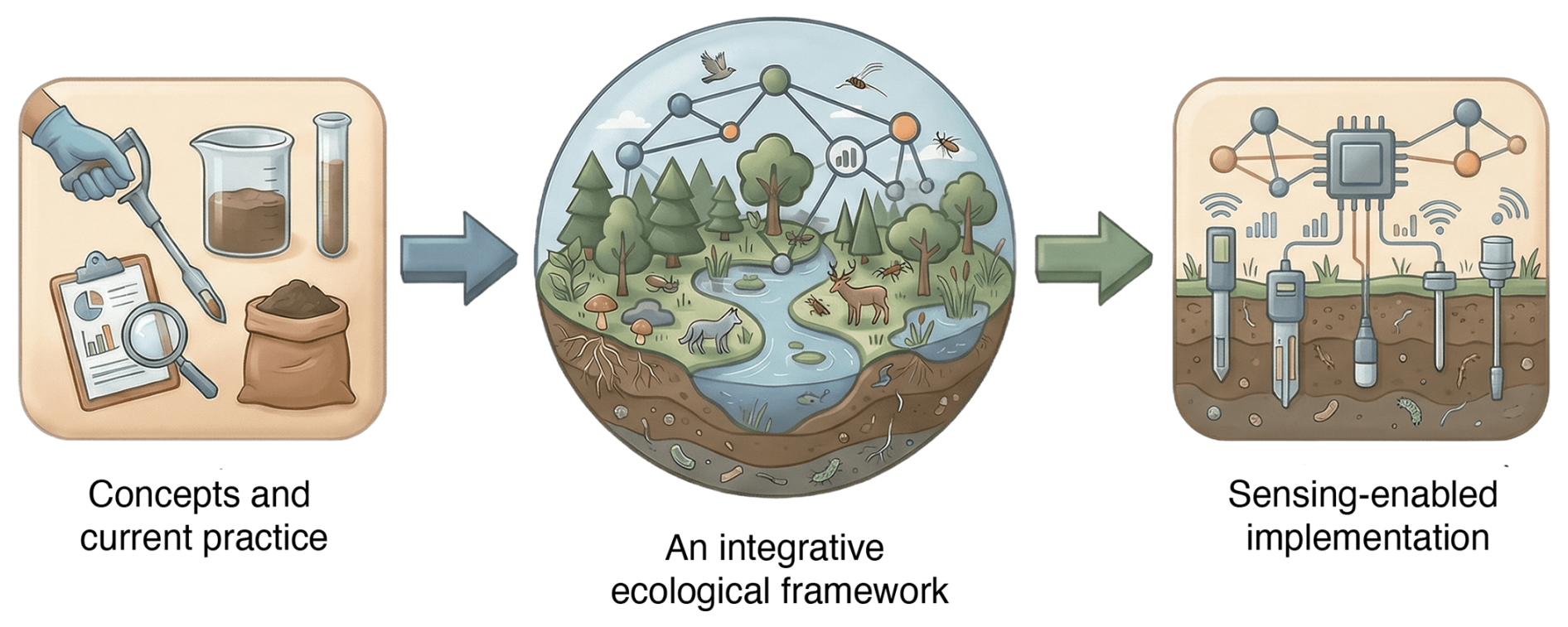
Figure 1Manuscript structure and conceptual development of an ecologically-grounded soil health assessment framework that is enabled by soil sensing.
2.1 Defining soil health
The evolution from “soil fertility” to “soil quality” and, ultimately, to “soil health” (Bünemann et al., 2018; Lehmann et al., 2020) reflects growing scientific awareness of soil's broader functions beyond crop production. Early assessments focused on soil fertility, defined as the soil's capacity to support crop production (Patzel et al., 2000; Bünemann et al., 2018). Over time, this expanded to encompass the soil's roles in water and air quality and its contributions to plant and animal health, leading to the concept of soil quality (Mausel, 1971; Bünemann et al., 2018). Wallace first used the term “soil health” in 1910, initially referring to soil fertility (Wallace, 1910; Brevik, 2018). By the 1990s, as understanding of soil biology and its environmental and human health roles grew, the contemporary concept of soil health emerged, encompassing soil's multifunctionality in ecosystem functions and services (Brevik, 2018; Lehmann et al., 2020; Janzen et al., 2021; Friedrichsen et al., 2021).
The terms “soil health” and “soil quality” are often used interchangeably but differ conceptually. Soil health refers to the current condition of a specific soil, akin to a patient's health status, while soil quality describes the expected range of health values for a given soil type, comparable to health standards for demographic groups (Bonfante et al., 2020). The analogy with human health makes “soil health” a compelling term for engaging stakeholders. Soil fertility, though narrower in scope, remains relevant in agronomic contexts as one function of soil health (Kuzyakov et al., 2020).
Figure 2 illustrates the progression and broadening scope of the soil health concept over time. Early definitions of soil health, such as “the continued capacity of a living soil to function within ecosystem boundaries to sustain biological productivity, maintain environmental quality, and promote plant, animal, and human health” (Doran and Parkin, 1994; Doran, 1996; Doran and Safley, 1997), remain widely applicable. Modern refinements link soil health to ecosystem services and international policy frameworks, such as the United Nations SDGs, where soil's contributions to ecosystem services align with global sustainability goals (European Commission, 2021).
More recent soil health definitions emphasise soil organisms. This focus addresses the historical neglect of soil biology compared to chemical and physical properties (Pankhurst et al., 1997). It underscores that only living organisms exhibit health (Harris et al., 2022), a statement challenged by Bouma (2022a), who emphasises that physical and chemical conditions are also crucial for soil organisms and that an integrated approach, certainly including biological indicators, is needed. Some authors therefore describe soil health as “the biological integrity of the soil community, that is, the balance among organisms within the soil and between soil organisms and their physical and chemical environment” (Brady and Weil, 2017). Soil biology is a critical indicator of soil health, and several new methods are available for its characterisation (Reijneveld et al., 2024).
Many authors adopt a broader, holistic view of soil health, highlighting its role in ecosystem services such as food provision, climate regulation, nutrient cycling, pest and disease control, and habitat support for soil fauna and microbiota (Lehmann et al., 2020; Janzen et al., 2021; Friedrichsen et al., 2021). Expanding on this, soil health contributes to human health, well-being, and societal values and is directly linked to the SDGs (Veerman et al., 2020). These broader definitions also integrate stakeholder values, underscoring the need for clear, accessible descriptions and cost-effective methodologies. The soil health concept functions as a “boundary object”, bridging knowledge and management to foster collaboration and actionable outcomes (Wood and Blankinship, 2022). However, soil health should focus on measurable indicators rather than management practices, as the latter aim to improve soil health and evolve with experimental findings, such as those from “living labs” (Bouma, 2022b; Bouma and Scrope, 2024).
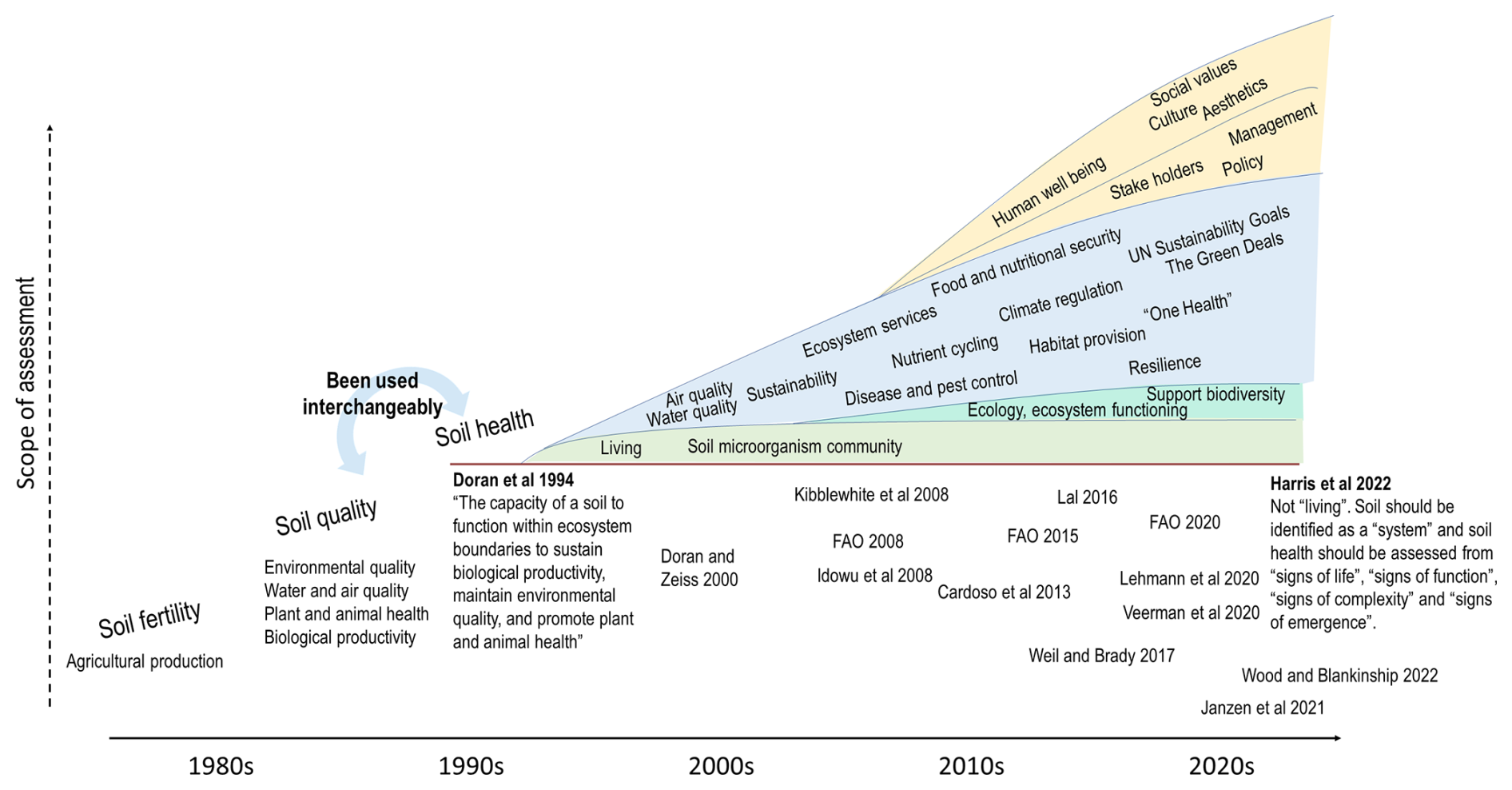
Figure 2The evolution of soil assessment from soil fertility to soil quality to soil health, reflecting an expanding scope. Keywords and elements from key papers on soil health are arranged chronologically.
2.2 Limitations of Current Definition
Efforts to make soil health a holistic concept have led to definitions that encompass diverse elements, including ecosystem services, the SDGs, societal values, management practices, and stakeholder perspectives. This breadth makes soil health difficult to measure, as “Anything that is infinitely defined is, ultimately, undefined and undefinable” (Sojka and Upchurch, 1999). Identifying and quantifying specific indicators to capture this broad scope remains a significant challenge (Baveye, 2021; Wood and Blankinship, 2022), leading to criticisms of the concept's vagueness (Janzen et al., 2021). While some authors embrace this vagueness as an opportunity for new ideas (Janzen et al., 2021) or as a principle in itself (Lehmann et al., 2020), others argue that soil health serves better as a communication tool than a scientific framework (Powlson, 2020).
Harris et al. (2022) challenged the popular notion of soil as a “living” entity, advocating for a holistic view that considers all soil constituents, interactions, and feedback mechanisms, rather than continually broadening the concept. Although their proposal lacks a concrete implementation strategy, it underscores the importance of grounding the concept of soil health in scientific understanding before setting expectations for what healthy soil can achieve.
Current definitions often prioritise a soil's ability to provide human-desired ecosystem services over its intrinsic properties (Kibblewhite et al., 2008; FAO and ITPS, 2015; Fine et al., 2017; Bonfante et al., 2020; Lehmann et al., 2020). However, equating soil health solely with its capacity to deliver services is inadequate, much like assessing human health purely by economic output or productivity. A more effective approach is to focus on the soil ecosystem's inherent state and its ecological functions within the natural boundaries of the specific soil type and ecosystem. Ecosystem functions – representing the processes and structures within an ecosystem – provide an objective, value-neutral framework for assessing soil health, distinct from ecosystem services (De Groot et al., 2010; Manning et al., 2018).
Some argue that the soil health concept is unnecessary, suggesting that soil scientists can address issues such as soil functioning, degradation, and carbon sequestration without it (Baveye, 2021). However, the concept remains valuable. It has advanced scientific understanding of soil biology (Lehman et al., 2015), highlighted its connections to human health (Brevik et al., 2020), and proved an effective tool for science communication. The term “soil health” resonates with the public, fostering awareness of soil science, agroecology, and conservation (Wander et al., 2019; National Resources Conservation Services of the US Dept. of Agriculture, 2019), and supporting citizen science initiatives that enhance soil knowledge (Pino et al., 2022). To fully realise the potential of the soil health concept, a more precise, objective definition of soil health, aligned with scientific principles, is essential. Central to this is improving the quantitative, robust measurement of soil health. As Lord Kelvin aptly noted, “When you cannot measure it, when you cannot express it in numbers… you have scarcely, in your thoughts, advanced to the stage of science” (Baveye, 2021).
2.3 Current Soil Health Assessment Frameworks
Numerous frameworks exist for assessing soil health (Table 1). These typically involve selecting indicators, developing sampling guidelines, collecting and preparing soil samples, conducting laboratory analyses, interpreting results, setting thresholds, and, if desired, integrating findings into an index (Rinot et al., 2019). Prominent frameworks include the Soil Management Assessment Framework (SMAF) (Andrews et al., 2004), the Comprehensive Assessment of Soil Health (CASH) (Idowu et al., 2008), and the Soil Quality Index (SQI) (Andrews and Carroll, 2001). Initially developed for soil quality evaluation, they were later adapted to assess soil health as the concept evolved (Table 1).
(FAO, 2008)(O'Neill, 2005; Amacher et al., 2007)(Andrews and Carroll, 2001)(Andrews et al., 2004)(Idowu et al., 2008; Moebius-Clune, 2016; Fine et al., 2017)(Thoumazeau et al., 2019)Rinot et al. (2019)(Haney et al., 2018)(Woods End Laboratories, 2021)(Debeljak et al., 2019)Creamer et al. (2022)(Zwetsloot et al., 2022)Bonfante et al. (2020)Su et al. (2018)Wade et al. (2022)Maaz et al. (2023)(Deel et al., 2024)(Maharjan et al., 2020)Table 1Current soil health assessment frameworks and approaches.
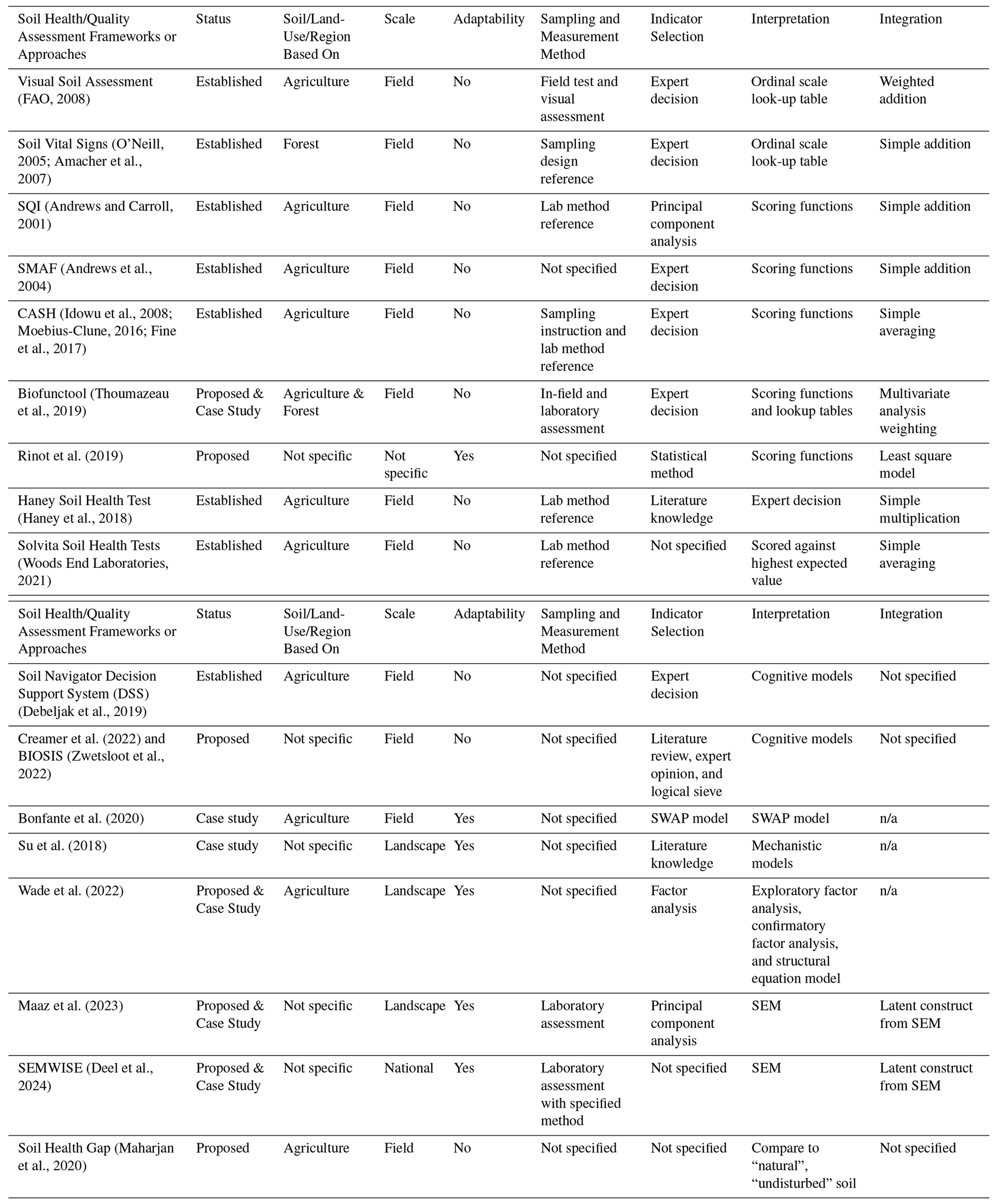
Note: The abbreviations used are: CASH – Comprehensive Assessment of Soil Health, SEM – Structural Equation Modelling, SEMWISE – Structural Equation Model for Well-Informed Soil Evaluation, SMAF – Soil Management Assessment Framework, SQI – Soil Quality Index, SWAP – Soil-Water-Atmosphere-Plant ecosystem model, n/a – not applicable.
While the soil health concept is relevant to all terrestrial ecosystems and even aquatic and marine soils (Walden et al., 2024), most assessment frameworks focus on agriculture, aiming to identify productivity constraints and guide land managers toward sustainable practices (Andrews and Carroll, 2001; Andrews et al., 2004; FAO, 2008). Frameworks such as SMAF and CASH were developed primarily using data from North American farms (Wade et al., 2022), thereby limiting their applicability to other regions or ecosystems. Recent efforts to expand the scope include frameworks addressing broader soil functions, such as carbon sequestration, biodiversity, and water regulation (Debeljak et al., 2019; Bonfante et al., 2020; Reijneveld et al., 2024). However, these remain largely agronomic, which is fine if that is the intended use, but further research is needed to broaden their applicability to other land uses (Wood and Blankinship, 2022).
Soil health assessments in non-agricultural systems, such as natural ecosystems, lag significantly, often lacking appropriate thresholds that currently apply only to agriculture and forestry. Indicators may be the same, but thresholds would differ.
Another limitation is scale. Most frameworks operate at the pedon or field scale, neglecting landscape-level processes such as nutrient runoff, soil redistribution, and climate change impacts (Magdoff and Van Es, 2021; Vereecken et al., 2016). While frameworks like Su et al. (2018) address larger scales, such approaches remain rare.
Despite advancements, there is no universally accepted framework or standardised procedure for soil health assessment, particularly outside agriculture (Deel et al., 2024; Wood and Blankinship, 2022). This lack of consensus hampers the societal acceptance of soil health and its integration into ecological restoration and other disciplines (Gann et al., 2019).
2.4 Soil Health Indicators
Soil health is a multi-faceted concept that necessitates measurable indicators for assessment. These indicators – encompassing physical, chemical, and biological properties – are closely related to ecosystem services, which are fundamentally interdisciplinary Bünemann et al. (2018) reviewed soil health assessments and identified over 100 indicators grouped into 50 categories, with 27 frequently used across studies. This diversity complicates the selection of appropriate indicators for practical soil health evaluations. Table 2 highlights these indicators.
The selection of indicators is guided by several widely accepted criteria (Bünemann et al., 2018):
-
Relevance to soil functions and ecosystem services.
-
Sensitivity to spatial and temporal variations from perturbations and management practices.
-
Practicality, affordability, and rapid measurability.
-
Reliability and reproducibility of measurements.
-
Ability to provide actionable management insights.
Despite these criteria, no standardised method exists for selecting scientifically robust and practical indicators across different land uses, ecosystems, and scales. Indicator selection often relies on expert judgement, which introduces subjectivity and limits methodological transparency (Rinot et al., 2019) (Table 1). Subjectivity is further influenced by specific management goals and the investigator's familiarity with the indicators (Wade et al., 2022). Frameworks such as SQI and CASH (Table 1) aim to mitigate subjectivity by employing statistical techniques, such as principal component analysis (PCA), to identify indicators that explain variability among land-use and management treatments (Chang et al., 2022). However, this may prioritise indicators responsive to management changes while overlooking those that provide unique insights into soil health (Rinot et al., 2019; Wood and Blankinship, 2022).
Methods that evaluate indicators based on specific criteria (Niemeijer and De Groot, 2008) or site-specific performance (Griffiths et al., 2016; Thoumazeau et al., 2019) are valuable but often neglect interrelationships among indicators (Niemeijer and De Groot, 2008). Improved approaches consider mechanistic interactions between indicators and the soil functions they represent (Creamer et al., 2022). For instance, the Soil Navigator decision support system (DSS) employs a hierarchical multi-criteria model to link soil functions to sub-functions, informed by the literature and expert insights into causal relationships among soil properties, environmental data, land use, and management (Debeljak et al., 2019). Although primarily designed for croplands and grasslands, this DSS informs field-scale applications (Debeljak et al., 2019). Similarly, Creamer et al. (2022) and BIOSIS (Zwetsloot et al., 2022) (Table 1) have developed hierarchical cognitive models to elucidate the relationships between soil biota and soil processes that contribute to specific functions. These models employ a logical sieve framework to score indicators, though they currently emphasise biological indicators and require further development to integrate physical and chemical properties (Creamer et al., 2022).
Reijneveld et al. (2024) used a relatively simple procedure for practical application, employing four physical, two chemical, and one biological indicators, with carbon in the central position. They did not define an “average” soil health value; instead, they focused on individual values, allowing research to concentrate on indicators that did not meet their threshold. Their work emphasises interdisciplinarity and ecosystem services, aligning with several SDGs, including SDG15 (Life on Land), SDG2 (Zero Hunger), SDG3 (Good Health and Well-being), SDG6 (Water Quality), SDG13 (Climate Action), and SDG15 (Biodiversity).
Climate change is increasingly integrated into soil health assessments, requiring indicators that address its impacts on soil ecosystems and functions. Allen et al. (2011) identified 11 indicators for evaluating climate change effects, primarily biological, but only four are used frequently in soil health assessments.
2.5 Measuring Soil Health Indicators
Many soil health assessment frameworks provide only rudimentary soil sampling guidelines. For example, CASH (Table 1) recommends combining samples from five to ten locations along a zig-zag transect (Moebius-Clune, 2016). Other frameworks propose general strategies, such as random sampling, W-shaped walks, or circular transects (Stott, 2019), but these approaches often fail to accurately capture soil variability. In practice, a robust sampling strategy tailored to the assessment's purpose should consider the heterogeneity of the soil health indicators being measured. Different indicators, locations, and assessment objectives require different sampling strategies to achieve the desired accuracy and precision, particularly for digital soil mapping (Brus and De Gruijter, 1997; Lawrence et al., 2020). Frameworks such as the one proposed by Lawrence et al. (2020) offer structured guidance on selecting between design-based and model-based soil sampling, defining management goals, and determining appropriate sampling densities and layouts to improve soil sampling in soil health assessments.
While some frameworks recommend visual field assessments (FAO, 2008), most rely on laboratory analyses requiring significant sample processing, such as drying, crushing, sieving, and homogenisation. Laboratory methods depend on specific analytical equipment and standardised procedures but are often time-consuming, expensive, and procedurally complex (Viscarra Rossel and Bouma, 2016; Hurisso et al., 2018; Haney et al., 2018). Moreover, these methods may not accurately reflect actual soil conditions. For instance, plant-available nutrients are typically extracted using chemical reagents that are absent from natural soils (Haney et al., 2018), and sample preparation can disrupt soil structure, thereby affecting assessment accuracy (Inselsbacher et al., 2011). Variations in nutrient availability arising from plant strategies and environmental factors further complicate interpretation (Lambers et al., 2008). Additionally, the delay between sampling and analysis can compromise results, particularly for rapidly changing indicators like plant-available nutrients (Chen and Xu, 2008).
Laboratory testing is subject to variability both between and within laboratories (Viscarra Rossel and Bouma, 2016; van Leeuwen et al., 2022). Significant inconsistencies exist for routine indicators and new ones, such as permanganate oxidisable carbon (POXC), analysed by accredited laboratories or using standard methods (Hurisso et al., 2018; Wade et al., 2020). Such variability can amplify marginal errors, leading to deviations in soil health assessments and management recommendations (Viscarra Rossel and Bouma, 2016).
Logistical challenges of laboratory analyses include slow turnaround times, high costs, and environmental impact (Viscarra Rossel et al., 2011). These factors become more pronounced with increasing numbers of indicators and sample sizes (Bünemann et al., 2018; Lawrence et al., 2020). The growing demand for fine-resolution soil data across spatial and temporal scales highlights the limitations of current laboratory methods.
The assessment of soil health by Reijneveld et al. (2024) could only be realised by applying innovative methods, including modern analytical and sensing-based approaches (discussed further in Sect. 4), to quantify heavy metals, biocides, and microbial conditions in a rapid, precise, cost-effective and scalable manner. Without these methods, a meaningful assessment would not have been possible.
2.6 Interpreting Soil Health Indicators
Conventional soil health assessment frameworks often interpret indicators using scoring curves or ordinal-scale look-up tables to generate an index value (Table 1). While ordinal-scale tables provide semi-quantitative assessments, they can introduce between-assessor bias. Scoring curves transform numerical indicators into unit-less continuous values (typically 0 to 1, with 1 indicating healthy) (Wymore, 2018; Karlen and Stott, 1994). These curves are based on assumptions about the relationship between indicators and soil health outcomes, such as “more is better”, “less is better”, or “optimal” scenarios, which may oversimplify and misrepresent complex soil dynamics (Wood and Blankinship, 2022; Maaz et al., 2023).
An alternative approach involves comparing indicator values with those from undisturbed, natural, or healthy reference sites (Maharjan et al., 2020), but defining and applying reference conditions across diverse land uses remains challenging (Kennedy et al., 2019; Janzen et al., 2021). Conventional methods help identify differences in management practices (Stewart et al., 2018), but they often fail to establish whether these practices improve soil health or whether the indicators are sensitive enough to differentiate soil conditions (Wood and Blankinship, 2022). These gaps reveal our limited understanding of how indicators connect to overall soil health (Creamer et al., 2022).
To address these limitations, the Soil Navigator DSS (Debeljak et al., 2019) introduced a framework that decomposes complex soil functions into subfunctions based on soil, environmental, and management interactions, derived from expert knowledge and the literature (Creamer et al., 2022) (Table 1). Initially developed for croplands and grasslands, this approach was later expanded to include biological indicators, with ongoing development for physical and chemical aspects (Creamer et al., 2022). More recent data-driven methods improve interpretation by analysing the covariation between indicators and latent variables describing soil health while accounting for measurement errors (Borsboom et al., 2003; Wade et al., 2022; Deel et al., 2024). These methods simultaneously interpret indicators, focusing on structural relationships rather than predefined assumptions (Maaz et al., 2023).
Some researchers have also integrated soil health interpretation with soil-water-atmosphere-plant ecosystem models (Table 1). For example, the InVEST model assesses freshwater yield as a soil ecosystem service at the landscape scale (Su et al., 2018), whereas the SWAP model evaluates soil health under varying climate change scenarios (Bonfante et al., 2020). These models enable systematic assessments of soil functions at broader scales through simulation (Su et al., 2018). However, understanding the complex mechanisms underlying soil health remains a significant challenge due to the intricate interactions of soil processes and functions (Vereecken et al., 2016; Vogel et al., 2023). Furthermore, large-scale applications of soil-water-atmosphere-plant ecosystem models are challenging due to system complexity, scarce high-resolution field data, poorly constrained parameters from limited measurements, and insufficient empirical observations for calibration (Vereecken et al., 2016; Pongratz et al., 2018).
Threshold and target values for soil health indicators are critical for connecting indicator interpretation with management and policy (Bouma and Reijneveld, 2024). Target values represent achievable management goals, whereas thresholds identify critical declines in soil function that necessitate intervention. Scientific understanding must inform indicator thresholds (Matson et al., 2024; European Environment Agency, 2023). Reijneveld et al. (2024) emphasises the importance of separating indicators and defining threshold values to distinguish between “good” and “not yet good enough”, allowing research to focus on indicators that fall short. Developing robust, broadly applicable thresholds, however, requires rapid, cost-effective methods for assessing soil health indicators, particularly where large, representative datasets are needed across diverse soils and land uses.
The European Environment Agency has already defined threshold values for key indicators (European Environment Agency, 2023). A recent review summarised four methods for establishing threshold or target values: (1) using fixed values based on existing research or practical experience, (2) using values from reference sites, (3) situating indicator values within the distributions for similar soils (stratified by soil type, land use, and climate), and (4) assessing relative changes in indicators over time (Matson et al., 2024). The relative change method, identified as the most promising, relies on representative chronosequence data, which substantially increases sampling requirements. Quantitative research is limited, particularly for indicators linked to multiple soil functions, such as soil organic carbon storage, and for those with complex interactions. Importantly, the complexity of the setting is emphasised by EEA, as threshold-setting is inherently context-dependent, varying with soil function, land-use type, climate, and management objectives, and therefore requires substantial contextual data to be established reliably (Matson et al., 2024). Generating the breadth of data needed to support robust threshold development, thus, depends on more efficient, scalable measurement approaches.
2.7 Soil health indices and thresholds
Many soil health assessment frameworks (Table 1) integrate indicators into a composite soil health index to simplify communication with stakeholders. However, achieving a scientifically robust yet uncomplicated integration method remains challenging. Current approaches – such as addition (Andrews and Carroll, 2001), averaging (Moebius-Clune, 2016), multiplication (Haney et al., 2018), or weighted combinations assume linear, independent contributions of indicators to soil health, failing to account for ecosystem-specific context dependencies (Wood and Blankinship, 2022). In weighted approaches, the challenge lies in determining appropriate weights. Data-driven methods, such as principal component analysis, for assigning weights (Yu et al., 2018), provide one solution but may bias results toward indicators sensitive to management or disturbance, thereby overlooking those more directly linked to soil functions (Rinot et al., 2019). Emerging frameworks seek to address these limitations by employing multi-criteria decision models (Debeljak et al., 2019), cognitive models (Creamer et al., 2022), and structural equation models (Maaz et al., 2023; Deel et al., 2024) (Table 1).
A single soil health index or score is often insufficient to guide management decisions. Individual indicators, such as soil carbon or structure, provide actionable insights, e.g., adding manure to increase carbon or adjusting tillage to improve structure, while a composite index lacks this specificity (Baveye, 2021; Powlson, 2020). Reijneveld et al. (2024) decided, therefore, not to define a single soil health index. Demonstrating that specific indicators do not meet their thresholds enables a focused research effort on those indicators. Regardless of the approach, ensuring that indices remain accessible to stakeholders while retaining scientific validity is therefore critical. Simplified outputs facilitate communication and adoption, but we must maintain the methodological rigour that underpins them to safeguard credibility and prevent misguidance. One possible future approach is a multi-tiered framework in which individual actionable indicators complement composite indices. For example, the Global Agro-Ecological Zones (GAEZ) integrates data using structured, multi-tiered models that layer agro-climatic, edaphic, and management-specific constraints to generate spatially explicit cropping suitability and yield advice (Fischer et al., 2000). Such approaches would balance simplicity with scientific rigour, summarising complex interactions among indicators while also providing spatially explicit quantitative information on individual soil properties, processes, and functions to support targeted management actions (Hussain et al., 2022).
Soil health assessments often exhibit bias, focusing primarily on ecosystem services tied to human values, agriculture, and societal goals, including the SDGs (Fig. 2, Table 1) (Kibblewhite et al., 2008; FAO and ITPS, 2015; Fine et al., 2017; Bonfante et al., 2020; Lehmann et al., 2020). While this focus has ensured policy relevance, it has also reinforced ambiguity and competing definitions, leaving the concept of soil health vague and subjective (Powlson, 2020; Baveye, 2021; Janzen et al., 2021). For instance, in a southern Alberta grassland, Janzen et al. (2021) found that agronomic criteria deemed the soil “unhealthy” due to low organic matter content, alkaline pH, and thin topsoil, whereas an aesthetic landscape evaluation rated it as “healthy”. Both perspectives used similar indicators but interpreted them through different, use-specific lenses, implying soil health is defined from a perspective to serve a particular human desired purpose, assessing soil for the suitability or capacity of soil to achieve specific management objectives, rather than the soil's condition relative to its own potential to support the ecological functioning of the native ecosystem. This human-centric framing leads to the conflation of soil health with use-specific definitions and interpretive frameworks, thereby obscuring the objective assessment of its ecological value. What is needed is an objective, ecologically grounded definition of soil health, distinct from suitability for particular land uses, to establish consistent, operational procedures for assessing soil condition. Without standardised procedures, soil health remains contested and marginalised in regulation (Baveye, 2021), often replaced by generic management measures assumed, rather than demonstrated, to promote sustainability (Bouma and Scrope, 2024). The scientific community cannot, therefore, afford to delay further the development of operational procedures for assessing and evaluating soil health.
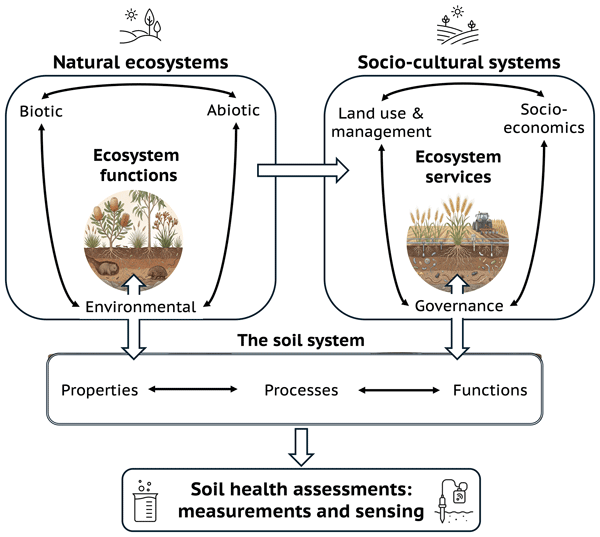
We propose an integrative framework that reorients soil health assessment towards ecological foundations while maintaining relevance to human needs. The framework positions soil health within two interrelated but distinct contexts: natural ecosystems and socio-cultural domains Fig. 3. By grounding soil health in its intrinsic ecological functions, the framework counters the ecosystem-services bias and shows how societal benefits flow from these foundational processes. In the proposed framework, soil health assessments interpret indicator values relative to the expected range of conditions for the soil being evaluated, that is, its soil-specific potential. This means that the ecological condition of a soil is judged against what is inherently achievable for that soil, rather than against an agronomic optimum. In the southern Alberta grassland example, the same indicators that classify the soil as “unhealthy” for intensive agriculture can indicate a relatively healthy soil when interpreted against the soil-specific potential of that grassland, as demonstrated by its capacity to support native vegetation and associated ecosystem functions.
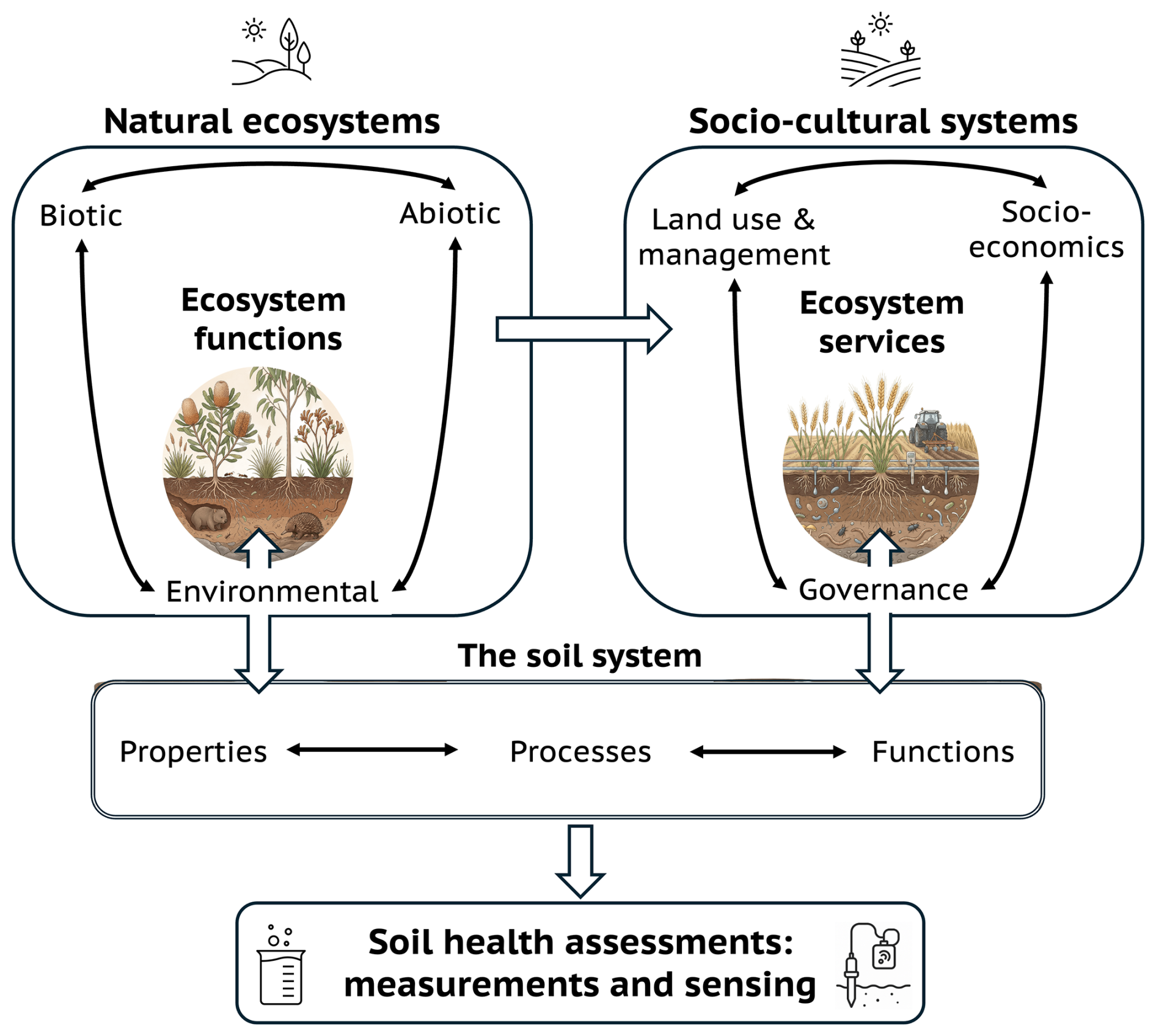
Figure 3A conceptual framework showing the soil system between natural ecosystem and socio-cultural domains, reflecting soil's central role in sustaining ecological functions and supporting human needs. Soil health assessment is grounded in ecological understanding of soil properties, processes and functions, and its outcomes are interpreted within environmental and socio-cultural contexts.
In this framing, soil health arises from the interplay among its physical, chemical, and biological processes shaped by biotic and abiotic properties and environmental drivers. These processes sustain essential functions, including nutrient cycling, carbon storage, water regulation, and resilience (Hoffland et al., 2020; Gerke, 2022). For example, soil organic matter interacts with mineral surfaces and microbial communities to regulate mineralisation, aggregation, and microbial growth (Hoffland et al., 2020; Vereecken et al., 2016), thereby linking structure and function. From such dynamics emerge the ecosystem services that underpin both ecological and socio-cultural systems (Fig. 3).
Humans occupy a dual role within the framework: they are beneficiaries of soil-derived ecosystem services and active participants in shaping soil health through management practices, land-use decisions, and cultural values (Fig. 3). Recognising this bidirectional relationship ensures that the socio-cultural considerations are integrated without compromising ecological objectivity. Soil health assessments thus move beyond narrow service-based framing and instead reflect the soil's intrinsic properties, processes, and functions, enhancing evidence-based understanding of soil systems, informing ecosystem services, and supporting human interests through targeted, evidence-driven management decisions (Neßhöver et al., 2012; Elmqvist et al., 2012). This ecological assessment of soil health is distinct from interpretive management frameworks, such as land capability classifications or crop suitability assessments, which evaluate how a given soil state constrains or enables specific uses. In the southern Alberta grassland, for example, the soil may never be capable of supporting high-yield potato production, yet it can still be assessed as relatively healthy considering its soil-specific potential and its ability to sustain a productive native grassland ecosystem. Separating assessments of soil identity from those of its suitability for particular human purposes enables the same ecologically grounded soil health evaluation to support diverse management and policy decisions.
Operationalising this framework requires measurement methods that capture the dynamic and heterogeneous nature of soil systems. While different methodological pathways are possible, the practical challenge lies in developing and using tools that can integrate across physical, chemical, and biological domains and scale from field plots to landscapes cost-effectively and efficiently (Fig. 3). Meeting this requirement necessitates sensing and data-driven approaches that enable spatially explicit, temporally dynamic, and system-level assessment of soil health (Viscarra Rossel and Bouma, 2016; Viscarra Rossel et al., 2011; Adamchuk and Viscarra Rossel, 2010). This ecological, value-neutral framework therefore provides universal applicability across ecosystems and land uses, offering a consistent foundation for both scientific inquiry and policy action. In the following section, we show how the sensor-based methods provide the measurement capabilities required to operationalise this framework. The example of mine-site rehabilitation (Sect. 3.3) demonstrates how each step of the sensing-enabled assessment can be implemented in practice.
3.1 A Sensor-enabled framework
Building on the framework outlined above, sensing provides the unique measurement capabilities essential for assessing soil health. Quantitative and objective soil health assessments require indicators that accurately capture soil variability, function across diverse ecosystems, and link to ecosystem processes. Proximal and laboratory-based soil sensing meet these criteria by offering rapid, practical and cost-effective measurements (Viscarra Rossel et al., 2011; Viscarra Rossel and Bouma, 2016; Silvero et al., 2023). Combined with remote sensing, these approaches extend assessments to the landscape and regional scales, embedding soil health within broader environmental contexts (Grunwald et al., 2015).
Sensor data often provide precise, high-resolution, continuous, multi-property representations of soil conditions, offering greater temporal and spatial ecological relevance than infrequent, few measurements from conventional laboratory procedures (Viscarra Rossel and Bouma, 2016; van Leeuwen et al., 2022; Haney et al., 2018). Spectroscopy, for example, captures molecular-level information about soil organic matter, minerals and water, while other sensor systems measure elemental, electrochemical, structural, or biological properties with much less disturbance (Viscarra Rossel and Walter, 2004; Lobsey et al., 2010; Hossain et al., 2024; Shen et al., 2022; Karlen et al., 2021). Advances in data analysis, machine learning, AI, and chemometrics further enhance interpretation, enabling the extraction of meaningful ecological indicators from complex multi-sensor datasets (Viscarra Rossel et al., 2024; Teng et al., 2018; Deng et al., 2013).
Sensing is well-suited to the socio-ecological framework (Fig. 3) because it can quantify mechanistic pathways that connect soil to ecosystem processes. Unlike conventional soil analysis that relies on disruptive methods and delayed results, sensors enable in situ and ex situ (near-) real-time measurements. Proximal soil sensors deployed directly in the soil can capture physical, chemical and biological signals under natural conditions, thereby capturing dynamics from rapid fluxes to seasonal cycles and linking measurements directly to ecosystem functions. Sensing in the laboratory, by contrast, can serve a complementary purpose. For example, under controlled conditions, it enables high-throughput, standardised analysis, supports calibration and validation, and allows systematic exploration of soil properties across large sample sets and at different scales (e.g. Viscarra Rossel et al., 2016, 2014). Together, these two modes of sensing, proximal and laboratory, in combination with conventional analysis and remote sensing (Fig. 4), offer synergistic pathways for enhanced understanding of soil processes. In situ deployments reveal context-specific variability and emergent dynamics. Laboratory sensing provides comprehensive testing and, when combined with conventional laboratory analyses, yields reproducible reference data for calibration and validation.
Therefore, meaningful soil indicators can be extracted from sensor data, positioning sensing as a transformative tool for a next-generation of soil health assessment and monitoring (Buters et al., 2019; Viscarra Rossel and Bouma, 2016; Reijneveld et al., 2024).
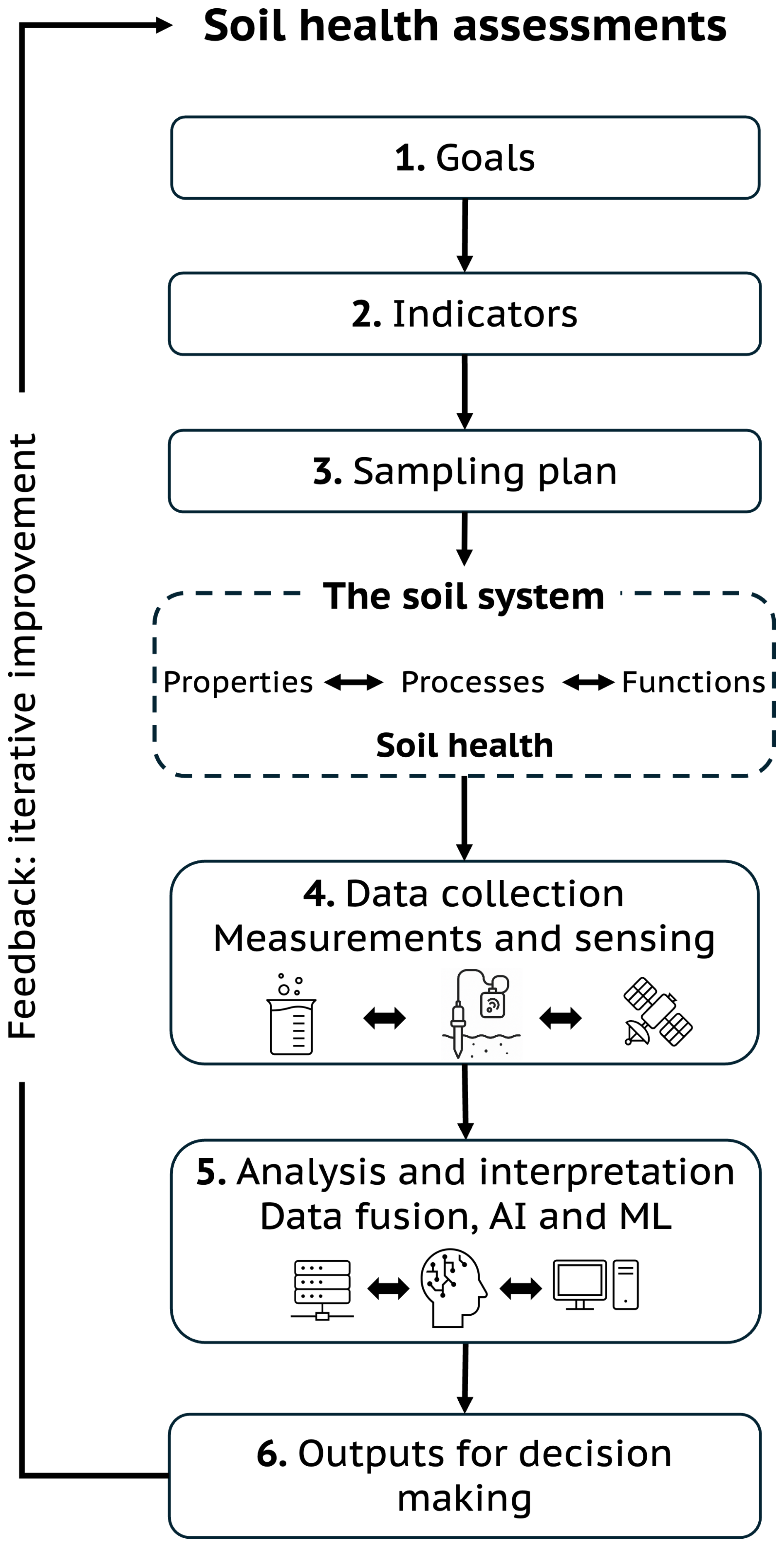
Figure 4Sensing-enabled soil health assessments. The mine-site rehabilitation example in Sect. 3.3 illustrates each step in the sensing-enabled soil health assessment for a specific application.
3.2 Implementing the sensor-based framework
The assessment framework in Fig. 4 connects ecological objectives with sensor-enabled measurements, establishing a standardised yet adaptable pathway for soil health assessment across ecosystems. The implementation begins by defining goals and identifying the key ecosystem functions (e.g. carbon storage, biodiversity support, nutrient cycling) that balance ecological integrity with societal needs (Fig. 4 Step 1). Indicators are selected using, e.g. multi-criteria methods (e.g. Debeljak et al., 2019) that prioritise ecological relevance, sensitivity to environmental change, and compatibility with cost-effective sensor technologies (Fig. 4 Step 2), while also identifying complementary laboratory analysis, calibration, and validation needs (Fig. 4).
Then, a sampling strategy is designed to align with ecosystem-relevant spatial and temporal scales, leveraging the sensors' capabilities to enable more measurements and continuous monitoring (Fig. 4 Step 3). Measurements are made through a combined sensor-laboratory approach to provide unique ecological insights and assessments (Fig. 4 Step 4). In this framework, data collection must also adhere to rigorous, standardised protocols for measurement, calibration, and quality assurance, while accounting for the need to quantify and propagate uncertainties.
Once collected, the multi-sensor data is analysed and interpreted (Fig. 4 Step 5) using methods such as sensor-data fusion, machine learning, AI or chemometrics (Fig. 4), which transform the sensor signals into the indicators, which, for example, might be benchmarked against reference sites, distribution-based thresholds, or temporal trends. Soil sensing offers advantages for implementing these approaches; for example, spectroscopy can efficiently characterise mineral-organic baseline conditions across diverse undisturbed sites at a lower cost than conventional analytical measurements; distribution-based thresholds can be established from large-scale sensor datasets that capture the natural variability of soil properties across soil types, climate zones, and land uses, and rapid, cost-effective repeated measurements enable temporal trend analysis at frequencies that reveal seasonal dynamics and long-term changes. The outcomes are then used with decision-support frameworks to deliver actionable guidance for land management while enabling iterative refinement of assessment protocols based on ecological responses and management outcomes (Fig. 4 Step 6).
This approach (Fig. 4) highlights why sensing technologies are enabling: unlike conventional laboratory methods, sensing provides more practical and cost-effective measurements (Li et al., 2022), more adequately captures spatial heterogeneity and temporal dynamics, and can scale from fields to farms and regions. The strength of sensing aligns with our proposed framework (Fig. 3), emphasising system-level properties, dynamic processes, and spatial-temporal complexity. By operationalising this framework, sensor-based approaches make soil health assessment more rigorous, ecologically grounded, and scalable, bridging the gap between conceptual models of soil function and actionable tools for management and policy.
3.3 Application example–mine site rehabilitation
In this example, implementing the framework (Figs. 3, 4) begins with defining the rehabilitation objectives: restoring structural stability for plant establishment, nutrient cycling, chemical amelioration of contaminants, restoring the microbiome and hydrological function for water conservation and erosion control (Young et al., 2022) (Fig. 4 Step 1). Indicator selection emphasises restoration-relevant soil properties, including organic carbon, microbial activity, pH, and electrical conductivity, to assess chemical constraints, aggregate stability, available nitrogen and phosphorus for plant establishment, and heavy metal contamination to determine possible levels of toxicity (Fig. 4 Step 2). A multi-criteria evaluation prioritises indicators sensitive to rehabilitation progress and measurable with sensor technologies (Debeljak et al., 2019). A sampling plan is prepared to address soil and landscape heterogeneity using a stratified design that covers disturbance gradients, such as waste and rock dumps, tailings areas, topsoil stockpiles, and reference undisturbed sites (Young et al., 2022) (Fig. 4 Step 3). The design accommodates the higher density of measurement sites enabled by sensing, which is not possible with conventional methods. The measurement methods combine proximal and remote sensing with laboratory analysis (Fig. 4) to capture the multiple dimensions of soil and landscape rehabilitation (Fig. 4 Step 4). A portable proximal vis–NIR spectrometer provides in situ rapid semi-quantitative assessments of soil clay and iron oxide mineralogy, and organic matter (Viscarra Rossel et al., 2009; Shen et al., 2022), while electrochemical sensors measure field condition pH, EC, nitrate-N, sodium and phosphorus (Viscarra Rossel and Walter, 2004; Lobsey et al., 2010). A portable respirometer is used to measure CO2 flux as an indicator of biological activity (Bekku et al., 1995; Chimner, 2004; Gyawali et al., 2020). To assess contamination risk, a handheld pXRF sensor detects major elements and heavy metals (Carr et al., 2008). Soil samples are collected for laboratory mid-IR spectroscopy to obtain quantitative estimates of organic and inorganic carbon, clay, sand, and silt content, and cation exchange capacity, using local calibrations and validated against conventional reference analyses (Soriano-Disla et al., 2014). Across the rehabilitation site, hyperspectral imaging of vegetation and soil-surface properties is complemented by satellite imagery to track long-term trajectories (Buma et al., 2024). This integrated approach balances spatial coverage, temporal resolutions, and analytical accuracy in monitoring soil health and rehabilitation progress. Data processing integrates multi-sensor data through sensor fusion and machine learning models calibrated against laboratory analyses, generating integrated rehabilitation indices that combine chemical, physical, and biological recovery indicators (Fig. 4 Step 5). Threshold interpretation applies multiple benchmarks, regulatory compliance values for heavy metals, functional thresholds for plant establishment, and reference ecosystem targets. The analysis identifies areas showing positive health and rehabilitation trajectories versus those requiring intervention (Fig. 4 Step 5). Decision support provides integrated assessments, including risk maps that highlight soil health and intervention areas, compliance reporting that demonstrates regulatory target achievement, and adaptive management recommendations based on rehabilitation progress (Fig. 4 Step 6). The sensor-enabled approach (Fig. 4) significantly reduces assessment costs while providing higher spatial resolution than conventional methods, enabling precise tracking of soil health and restoration success.
Sensing is an enabling tool for assessing and monitoring soil health. Their capabilities, including relevance to soil functions, sensitivity to spatial and temporal variation, rapidity, cost-effectiveness, reliability, and the provision of actionable insights, make sensing effectively meet the criteria for soil health indicator selection (see Sect. 5). Various sensor technologies are available for measuring soil properties (Kuang et al., 2012; Viscarra Rossel et al., 2011; Silvero et al., 2023; Adamchuk and Viscarra Rossel, 2010). These technologies include laboratory bench-top instruments and portable proximal sensors. Viscarra Rossel et al. (2011) offers a thorough review and classification of soil sensors. Here, we focus on soil sensors relevant to soil health assessments, emphasising those that meet the accepted criteria for indicator selection. Table 2 lists these sensors, along with their capabilities to measure commonly used soil health indicators, directly or indirectly. “Direct measurement” refers to measuring a soil health indicator through its direct physical or chemical interaction with the sensor, while “Indirect measurement” refers to an estimate of a soil health indicator from its relationship with other soil properties that the sensor can directly measure. Although these sensors are currently used in soil science research and some other specific applications (Viscarra Rossel et al., 2011; Silvero et al., 2023), standardised protocols for their use in soil health assessments are underdeveloped.
Diffuse reflectance spectroscopy is the most mature and widely used soil sensing technology (Viscarra Rossel et al., 2022) (Table 2), directly measuring organic and mineral compositions through molecular interactions with visible, near-infrared (vis–NIR), and mid-infrared (MIR) wavelengths (Stenberg et al., 2010; Soriano-Disla et al., 2014). Spectroscopy provides results quickly, requires moderate to no sample preparation, and can be applied in both laboratory and field settings. Portable, affordable versions are now available (Ji et al., 2016; Shen et al., 2022). The spectra enable direct or indirect estimation of various chemical, physical, and biological soil health indicators simultaneously (Table 2, sensors 1 and 2) and provide a cost-effective alternative to traditional laboratory analyses (e.g. Li et al., 2022). Portable or hand-held elemental analysers, such as laser-induced breakdown spectroscopy (LIBS) and X-ray fluorescence spectroscopy (XRF), offer rapid, quantitative, and direct, simultaneous measurements of soil elemental composition as well as indirectly measure many soil health indicators that has strong relationship with soil elemental content (Kalnicky and Singhvi, 2001; Bricklemyer et al., 2018; John et al., 2021; Ferreira et al., 2015; Villas-Boas et al., 2016; Senesi et al., 2021; Silva et al., 2020; Jenkins et al., 2025) (Table 2, sensors 3 and 4).
Table 2Available sensors for soil health assessment and their capabilities. The soil health indicators shown are the most frequently used, as identified by Bünemann et al. (2018). vis–NIR: Visible and near-infrared spectroscopy; mid-IR: Mid-infrared spectroscopy; LIBS: Laser-induced breakdown spectroscopy; XRF: X-ray fluorescence spectroscopy; AγA: Active gamma-ray attenuation, ER: electrical resistivity sensor; EMI: electromagnetic induction; TOM/TOC: total organic matter or total organic carbon; Blue dot: direct measurement; Pink dot: indirect measurement based on correlation with directly measurable properties; “∼” indicates partial satisfaction to the criteria. Key references for sensor type 1: Viscarra Rossel et al. (2022), Stenberg et al. (2010), Soriano-Disla et al. (2014), Viscarra Rossel and Hicks (2015), Ji et al. (2016), Shen et al. (2022), Li et al. (2022), Yang et al. (2019, 2022), Huerta et al. (2013); 2: Viscarra Rossel et al. (2022), Soriano-Disla et al. (2014), Li et al. (2022), Shi et al. (2023), Walden et al. (2025); 3: Senesi et al. (2009), Bricklemyer et al. (2018), Ferreira et al. (2015), Villas-Boas et al. (2016), Senesi et al. (2021); 4: Kalnicky and Singhvi (2001), Carr et al. (2008), John et al. (2021), Silva et al. (2020), Jenkins et al. (2025); 5: Pires et al. (2009), Lobsey and Viscarra Rossel (2016), England and Viscarra Rossel (2018), Reinhardt and Herrmann (2019), Pepers et al. (2024); 6: Herrick and Jones (2002), Wijewardane et al. (2020), Veum et al. (2017); 7: Sudduth et al. (2003), Joschko et al. (2010); 8: Doolittle and Brevik (2014), Lardo et al. (2012); 9: Sucre et al. (2011), Liu et al. (2016); 10: Flynn et al. (2020), Fajardo and McBratney (2023), Wengler et al. (2024), Nouri et al. (2021); 11: Bekku et al. (1995), Chimner (2004), Gyawali et al. (2020); 12: Pucetaite et al. (2021), Whitesides (2006), Zhu et al. (2022).
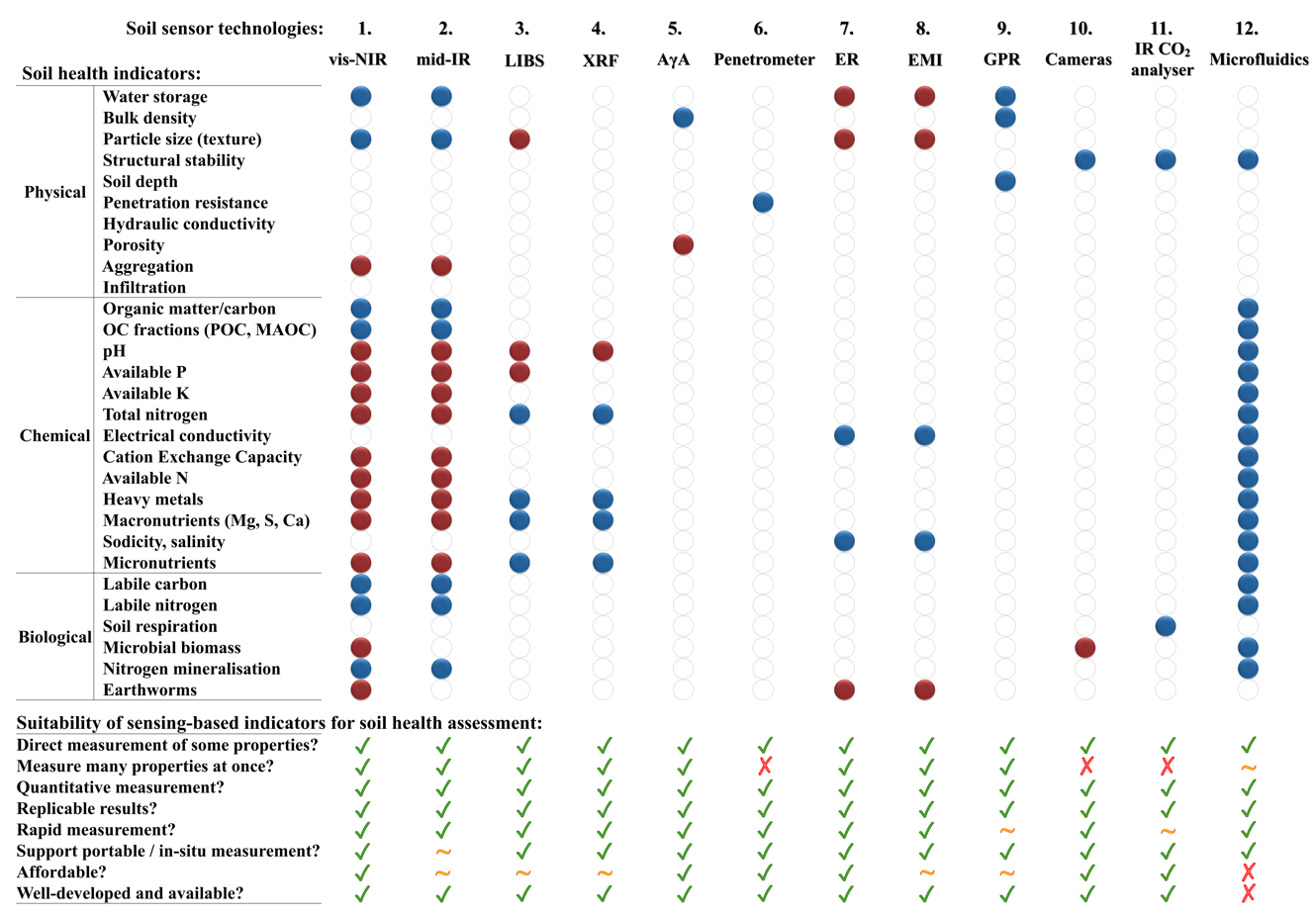
While spectroscopy and elemental sensors measure many properties simultaneously, some critical physical, chemical, and biological properties require more specialised methods. For instance, soil bulk density, essential for assessing compaction and estimating organic carbon stocks, can be measured using active gamma-ray attenuation (AγA) indirectly via the influence of soil density on the amount of gamma radiation attenuated while passing through soil (Lobsey and Viscarra Rossel, 2016; England and Viscarra Rossel, 2018; Pepers et al., 2024) (Table 2, sensor 5). It can also be indirectly estimated using penetrometers (Herrick and Jones, 2002), and electrical resistivity sensors (ER) (Sudduth et al., 2003; Viscarra Rossel et al., 2011). ER and electromagnetic induction (EMI) can directly measure soil apparent electrical conductivity (ECa), as well as sodicity and salinity that directly influence ECa (Doolittle and Brevik, 2014). Ground-penetrating radar measures soil depth, a critical physical indicator linked to root development, water infiltration, and nutrient availability, by measuring the travel time of electromagnetic waves sent into the ground and reflected from bedrock (Sucre et al., 2011; Liu et al., 2016) (Table 2, sensor 9). Soil aggregate stability, vital for preventing erosion and supporting root growth, can be assessed using digital imaging techniques such as Moulder (Flynn et al., 2020; Fajardo and McBratney, 2023) or Aggregate STability Assessment using VIdeo Tests (ASTAVIT) (Wengler et al., 2024) (Table 2, sensor 10).
Biological soil health indicators can also be measured by sensing. Portable respirometers with infrared CO2 analysers measure soil respiration, reflecting microbial activity and organic matter decomposition (Bekku et al., 1995; Chimner, 2004; Gyawali et al., 2020) (Table 2, sensor 11). Microbial biomass and fungal-to-bacterial ratios can be measured using a smartphone-based microBIOMETER (Nouri et al., 2021). While progress has been made in sensing biological properties, further advancements are needed. Biological soil properties are inherently complex and variable; sensors may not be sensitive or selective enough to detect low concentrations of specific biological markers or differentiate between biologically active and inactive organic matter, as well as interference from soil physical, chemical properties and environmental variables like temperature and moisture (Table 3). Studies using vis–NIR spectra combined with machine learning have related soil spectra to microbial biomass, respiration, with excellent accuracy with a correlation coefficient above 0.90 (Chodak, 2011), and bacterial and fungal abundance and diversity, with up to 73 % of the variability explained by vis–NIR spectra (Yang et al., 2019, 2022). Portable sequencers now facilitate efficient soil organism profiling through eDNA (Kestel et al., 2022; Hellekås et al., 2021), and nanobiosensors show promise for measuring enzymatic activity (Mandal et al., 2020). Some studies have found that sensing signals can be used as surrogates for earthworm presence and abundance (e.g. Huerta et al., 2013; Joschko et al., 2010; Lardo et al., 2012), but overall, there remains a lack of robust, generalisable sensor-based measurements of soil fauna.
Emerging technologies like microfluidics (Whitesides, 2006; Zhu et al., 2022) offer potential for analysing a wide range of soil health indicators (Table 2, sensor 12). These “soil-on-a-chip” systems manipulate fluids in micrometre-scale channels to emulate soil environments, enabling real-time, in-situ monitoring of soil processes (Zhu et al., 2022). Combined with spectroscopy techniques, microfluidics can study interactions between soil microorganisms, the soil matrix, and plant roots, potentially advancing the development of novel, interpretable soil health indicators (Pucetaite et al., 2021). Despite their promise, these technologies remain in early stages of development. Some soil properties remain difficult to measure using sensing techniques, such as infiltration and hydraulic conductivity, and further research and development are needed.
4.1 Multi-sensor data fusion for soil health assessments
No single sensor can capture all attributes relevant to soil health (Table 2). Combining data from multiple sensors is a natural strategy to expand the coverage needed for soil health assessments. Fusing signals from various sensors (including remote sensing and laboratory analyses) broadens the range of soil properties measured, yielding more comprehensive datasets than any single sensor. Some overlap in sensor measurements is inevitable, but a limited degree of redundancy can enhance the robustness and reliability of the fused data. In practice, integrating complementarity sensors has been shown to improve prediction accuracy for soil properties (Wang et al., 2015; Bricklemyer et al., 2018; Omer et al., 2020; Gozukara et al., 2022). Multi-sensor data fusion provides a broader and often a more precise view of soil condition, and overall health (Song et al., 2024; Veum et al., 2017).
However, combining data from multiple sensors is not without challenges. Noise, interference, and inconsistencies can be introduced when fusing heterogeneous data streams (Azcarate et al., 2021). Effective sensor fusion depends on evaluating the independence of sensor information, balancing cost-effectiveness with prediction accuracy, and applying appropriate statistical methods (Azcarate et al., 2021). Furthermore, studies have found that adding data from more sensors may yield diminishing returns in model improvement, underscoring the need for judicious sensor selection (Schmidinger et al., 2024).
4.2 Integrative sensing for soil health assessments
Spectroscopic sensors such as diffuse reflectance spectrometers, LIBS, and XRF (Table 2, sensors 1 to 4) enable simultaneous measurement of various soil constituents, including molecules, functional groups, and elements, as well as their interactions. These measurements generate an integrative “fingerprint” that reflects a wide range of soil information at once and can itself serve as a composite indicator of soil health (Cohen et al., 2005; Viscarra Rossel et al., 2006; Stenberg et al., 2010; Viscarra Rossel et al., 2022) (Table 3).
This integrative approach offers significant advantages for soil health assessment compared with conventional methods that rely on selecting and measuring a limited, predefined set of indicators. Instead of choosing individual indicators (e.g., one measure for pH, another for organic carbon, etc), the rich sensor signals inherently contain quantitative soil information on many facets of the soil, thereby minimising bias in the selection of indicators (Maynard and Johnson, 2018) Table 3. As a composite indicator, integrative sensing provides a more objective, holistic view of soil health, making it applicable across diverse soils and management conditions. This is particularly valuable in our socio-ecological soil health assessment framework (Fig. 3) where we aim to determine the functional status of the soil system.
Integrative sensing can directly predict soil processes, functions, and health by capturing extensive soil information in a single measurement. While promising, this capability requires further research and validation. Spectroscopic methods, particularly vis–NIR and MIR spectroscopy, have proven effective in various applications. For example, researchers have used vis–NIR spectra to predict soil C and N mineralisation (Fystro, 2002; Russell et al., 2002) and litter decomposition (Bouchard et al., 2003). Both vis–NIR and MIR spectra have been used to classify soil health, categorising soils into “healthy”, “moderately degraded”, or “degraded”, as well as to estimate soil health indices in the CASH and SMAF frameworks (Cohen et al., 2006; Elliott et al., 2007; Maynard and Johnson, 2018; Kinoshita et al., 2012; Veum et al., 2015, 2017). Spectra have also been used to classify soil types (Viscarra Rossel and Webster, 2011; Teng et al., 2018) and predict functions such as organic carbon storage, nutrient supply, and biological activity under various conditions, including those affected by wildfire disturbances (Cécillon et al., 2009). In agriculture, spectra have been used to assess soil fertility and evaluate carbon sequestration potential (Vågen et al., 2006; Viscarra Rossel et al., 2010; Deiss et al., 2023; Baldock et al., 2019; Karunaratne et al., 2024). These applications demonstrate the versatility of spectroscopic sensing in providing comprehensive, scalable solutions for assessing soil health and functionality, while addressing challenges in agriculture and environmental management.
4.3 Advantages and limitations of soil sensing for soil health assessments
Sensing provides essential advantages for assessing soil health. It enables rapid, non-destructive, and increasingly cost-effective measurements of a wide range of indicators, often delivered in real time and at higher spatial and temporal resolutions than conventional laboratory methods (Viscarra Rossel and Bouma, 2016). These capabilities are especially valuable for supporting data-driven decision-making in situations where traditional approaches may be logistically challenging or economically restrictive. Nevertheless, like any technology, sensing has current limitations (Table 3) that can be addressed as the field continues to advance.
Table 3Advantages, limitations, and possible solutions for sensor-based soil health assessment.
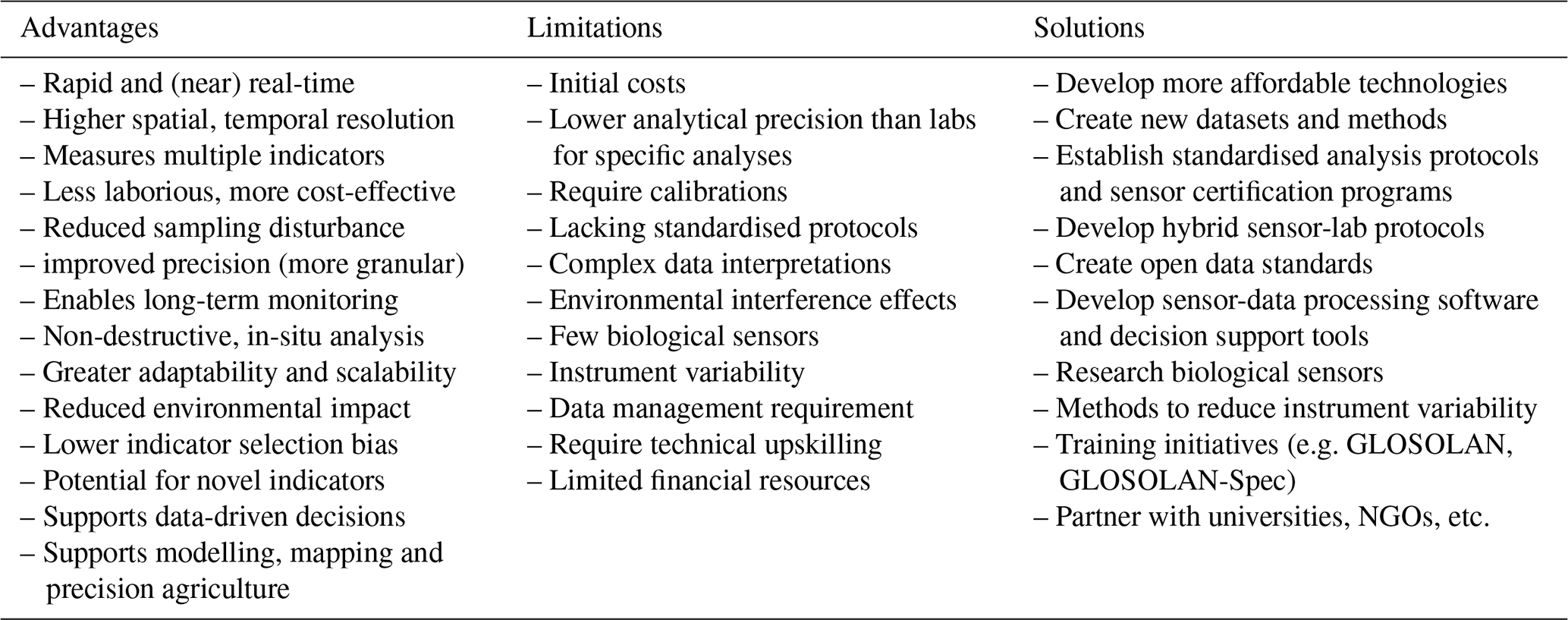
Most soil sensors require careful calibration, which can involve two aspects: instrument calibration, where the raw sensor signal is standardised against known references (for example, pH or nutrient sensors calibrated with buffer solutions of known concentrations, or wavelength standards in spectrometers), and analytical calibration, where sensor outputs are related indirectly to soil properties through empirical models. The latter applies to spectrometers and other sensors that estimate soil health indicators by comparison with conventional analytical methods (Table 2). The reliability of these calibrations depends directly on the quality of the laboratory reference measurements; if the reference values are inaccurate, the sensor estimates will also be flawed (Viscarra Rossel et al., 2022). It is therefore essential that calibration samples are analysed in accredited laboratories that adhere to strict quality control and regular standardisation procedures. Otherwise, the principle of “garbage in, garbage out” applies, where poor-quality reference data inevitably results in poor-quality sensor estimates.
An additional consideration is that, while soil-sensing measurements may be less precise per sample than conventional methods, they offer a distinct advantage by enabling substantially higher sampling densities across locations and times. This capacity generates datasets that are not only richer but also more representative of soil conditions and their spatial and temporal variability (Viscarra Rossel et al., 2022). The costs and practical challenges posed by sensor calibration can be mitigated by developing global soil-sensing data libraries and employing transfer learning (Viscarra Rossel et al., 2024). These approaches can significantly reduce the number of local calibration samples needed, making large-scale sensing applications increasingly feasible and efficient.
Other challenges include variability across instruments and the performance gap that often exists between field-deployable and benchtop instruments (Table 3). Ongoing research into instrument calibration transfer is addressing these compatibility issues, both across devices (Liu et al., 2024) and between field- and laboratory-based instruments (Silva et al., 2025) (Table 3). Sensor measurements are also affected by environmental interference, including soil moisture, temperature, electrical conductivity, and surface conditions (Adamchuk and Viscarra Rossel, 2010; Fan et al., 2022), which needs to be accounted for through experimental design or compensation algorithms (Ji et al., 2015). Biological indicators of soil health also remain a limitation, as they require further advances in sensing technologies and data analytical methods to capture their complexity more effectively.
In addition to these technical challenges, several practical barriers can limit adoption. All technologies, whether conventional laboratory instruments or newer sensing devices, require considerable upfront investment. However, a key advantage of new sensing technologies is that costs are declining rapidly. For example, portable spectrometers that once cost upwards of USD 75 000 can now be acquired in miniaturised versions for less than USD 10 000. This growing affordability makes sensing increasingly accessible compared with conventional laboratory analyses, which are often tied to centralised infrastructure and large commercial fertiliser companies. Furthermore, implementing a sensing approach for soil monitoring requires robust data processing and storage, reliable connectivity, and sufficient computational power to handle and process large datasets (Fan et al., 2022). As a result, sensing technologies hold promise for transforming soil health management in economically developing countries by enabling a more distributed, bottom-up approach driven by local farmers and communities rather than top-down commercial services (Viscarra Rossel and Bouma, 2016).
The development of standardised protocols for sensor operation, calibration, validation, and reporting is essential to ensure data quality, comparability, and broader uptake. International initiatives such as the Food and Agriculture Organisation of the United Nations (FAO)'s Global Soil Partnership and Global Soil Laboratory Network (GLOSOLAN) are already working towards this goal by harmonising soil analytical methods worldwide, and its dedicated GLOSOLAN-Spec initiative (https://www.fao.org/global-soil-partnership/glosolan-old/soil-analysis/dry-chemistry-spectroscopy/en/, last access: 28 January 2026) is specifically focused on spectroscopy and soil sensing (Table 3). These initiatives are not only developing guidelines for method standardisation but also building global capacity by training laboratories and practitioners. Such efforts ensure that data from different regions and technologies can be compared and integrated confidently. Building on these developments, pilot projects that test integrated sensing frameworks across diverse ecosystems and land uses could offer valuable opportunities to validate, refine, and demonstrate at scale.
Our socio-ecological soil health assessment framework (Fig. 3) requires modern technologies and institutional and procedural conditions to facilitate its adoption. Within the framework, standardisation is crucial because it underpins every step (Fig. 4), from defining the goals and selecting the indicators to ensuring that sensor measurements are precise and comparable across ecosystems, laboratories, and instruments. Harmonised protocols for sensor operation, calibration, validation, and reporting will enable more effective data processing and modelling for decision-making. Furthermore, sensor certification programs should be developed to verify instrument performance and measurement precision against standardised protocols, analogous to accreditation systems for conventional laboratories. Such standardisation will aid the framework's scalability.
Pilot projects provide the link between concept and practice. By trialling integrated sensing frameworks across different ecosystems and land uses, pilots enable method validation and adaptation to socio-ecological contexts and land management practices. Living Labs exemplify this approach by situating sensing within a participatory environment in which farmers, foresters, and other land users co-create knowledge with researchers. Reijneveld et al. (2024) showed that modern sensing of heavy metals, biocides, and microbiological indicators was essential to obtain realistic results in a Living Lab context. Extending this model to non-agricultural Living Labs, forests, rangelands, wetlands, and urban green spaces broadens the framework's reach by embedding soil sensing into the assessment of ecosystem services beyond agriculture. Initiatives such as the EU Mission “A Soil Deal for Europe”, which is establishing a network of 100 Living Labs and Lighthouses by 2030, demonstrate the scalability of this approach and provide a ready pathway to embed our sensing-based framework in decision-making contexts.
At the data level of the framework (Fig. 4), global spectral libraries provide the backbone for connecting sensing to interpretation and outputs. Large, curated datasets (e.g., the USDA NRCS National Soil Survey Centre, Kellogg Soil Survey Laboratory MIR library), and the FAO's GLOSOLAN-Spec initiative are enabling the development of robust, transferable models and ensuring comparability across regions. These libraries align with the socio-ecological framework by reducing the data burden on individual communities and ensuring that local assessments can be connected to global knowledge bases. Recent advances in mitigating instrument dissimilarity further enhance model portability, making it more realistic to deploy sensing across diverse socio-ecological settings. Realising the full potential of these libraries requires establishing interoperability protocols that enable seamless integration of sensor data from different instruments, soil types and geographical regions.
Equally important, however, is the development of new spectral and soil sensor databases (or libraries) built from soil samples analysed in accredited laboratories under standardised reference methods. Because many sensor calibrations depend directly on the quality of the underlying laboratory measurements, inconsistencies or inaccuracies in reference data will propagate into the models. Inaccurate soil analyses in legacy datasets often lead to imprecise sensor predictions, illustrating the well-known dictum of “garbage in, garbage out”. Establishing sensor-specific libraries underpinned by high-quality, traceable, and standardised laboratory analyses is therefore crucial. To maximise the value of both approaches, we should also develop and test hybrid sensor-laboratory protocols that leverage sensing for high-density spatiotemporal coverage with complementary targeted conventional laboratory analyses for calibration and validation as needed.
A key barrier to adopting our framework is that general (often referred to as “global”) models do not always transfer well to local contexts (Viscarra Rossel et al., 2024). For instance, soil spectroscopic models trained on large, diverse libraries often lose accuracy when applied to local regions, using different instruments or under specific management systems. For communities or agencies with limited resources, collecting sufficient local soil samples to train models from scratch is often not feasible. This “data gap” might limit the accessibility and scalability of sensing-based soil health assessments. Transfer learning (TL) provides a practical solution (Viscarra Rossel et al., 2024). In our framework (Fig. 3), TL could link global resources to local implementation. Models of soil health indicators pre-trained on global sensor-specific databases could be fine-tuned with small, targeted local datasets to deliver accurate, cost-effective context-specific predictions. This approach would substantially reduce the need for extensive new sampling and laboratory analysis, thereby making soil health assessments feasible even in resource-constrained settings, such as developing countries.
Finally, capacity building will ensure that the framework is adopted and sustained. The limitations identified in Table 3 should be viewed as opportunities to strengthen the framework's socio-ecological dimension. Expanded training programs (e.g., through GLOSOLAN), accessible webinars, open standard operating procedures, and cross-sectoral partnerships with universities, NGOs, and agencies to reduce entry costs and disseminate standard operating procedures can democratise access to sensing technologies. Simultaneously, innovations that reduce device costs, enhance robustness, and integrate outputs into user-friendly platforms lower barriers to entry for diverse stakeholders. We also need the development of decision support tools that translate complex multi-sensor data into intuitive visualisations, interpretative guidance, and management recommendations tailored to stakeholders' specific contexts and objectives. In this way, capacity building becomes part of the framework's social infrastructure. These efforts, combined with ongoing work to further reduce device costs and improve sensing and modelling capabilities, will enable broader implementation.
-
Soil health extends beyond the realm of agriculture. Current frameworks remain narrowly focused on agricultural contexts, limiting their ability to capture the full ecological dimensions of soil function across diverse ecosystems and land uses.
-
An ecological perspective is needed. Recognising soils as dynamic components of all ecosystems enables us to assess their capacity to sustain ecological balance and deliver essential ecosystem services, regardless of land use.
-
Traditional soil health assessment methods that rely on only conventional laboratory analyses are insufficient. Indicator measurements based on conventional field and laboratory approaches are costly, labour-intensive, and often do not reflect real-world conditions. These limitations hinder the development of comprehensive and scalable soil health assessments.
-
Sensing technologies provide a transformative opportunity. Integrating laboratory, proximal, and remote sensing with AI and machine learning now enables cost-effective, scalable, and precise assessments of soil health and its role in ecosystem services.
-
A “universal” framework is still lacking. Despite technological advances, soil science has not yet developed an accepted, operational framework for ecological soil health. Without such a framework, policy and management risk are based on incomplete or fragmented evidence.
-
Our proposed socio-ecological framework offers a way forward. By grounding soil health assessment in an ecological perspective and operationalising it through modern sensing and data-driven technologies, we provide a pathway toward consistent, scalable, and policy-relevant evaluations of soil function. This framework can bridge scientific advances with decision-making, ensuring that soils are recognised and managed as vital to sustaining both ecosystems and human well-being. Time is running out; the scientific community must pay urgent attention.
No data sets were used in this article.
YH conducted the literature review and, with RAVR, wrote the manuscript. AC, ZS, and JB provided critical revisions to enhance the manuscript. RAVR conceptualised the review, edited the manuscript, and secured project funding.
At least one of the (co-)authors is a member of the editorial board of SOIL. The peer-review process was guided by an independent editor, and the authors also have no other competing interests to declare.
Publisher's note: Copernicus Publications remains neutral with regard to jurisdictional claims made in the text, published maps, institutional affiliations, or any other geographical representation in this paper. The authors bear the ultimate responsibility for providing appropriate place names. Views expressed in the text are those of the authors and do not necessarily reflect the views of the publisher.
We thank Dr. Johanna Wetterlind for discussion on an earlier draft of the manuscript.
This research has been supported by the Australian Government (grant no. ACSRIV000077) and the Australian Research Council (grant no. DP210100420).
This paper was edited by Jonathan Maynard and reviewed by two anonymous referees.
Adamchuk, V. and Viscarra Rossel, R.: Development of on-the-go proximal soil sensor systems, Proximal Soil Sensing, 15–28, https://doi.org/10.1007/978-90-481-8859-8_2, 2010. a, b, c
Alexander, E. B.: Rates of soil formation: implications for soil-loss tolerance, Soil Science, 145, 37–45, 1988. a
Allen, D. E., Singh, B. P., and Dalal, R. C.: Soil health indicators under climate change: a review of current knowledge, Soil Health and Climate Change, 25–45, https://doi.org/10.1007/978-3-642-20256-8_2, 2011. a
Amacher, M. C., O'Neil, K. P., and Perry, C. H.: Soil vital signs: a new soil quality index (SQI) for assessing forest soil health, Res. Pap. RMRS-RP-65, Fort Collins, CO, US Department of Agriculture, Forest Service, Rocky Mountain Research Station, 12 pp., 65, https://doi.org/10.2737/RMRS-RP-65, 2007. a
Andrews, S. S. and Carroll, C. R.: Designing a soil quality assessment tool for sustainable agroecosystem management, Ecological Applications, 11, 1573–1585, 2001. a, b, c, d
Andrews, S. S., Karlen, D. L., and Cambardella, C. A.: The soil management assessment framework: A quantitative soil quality evaluation method, Soil Science Society of America Journal, 68, 1945–1962, 2004. a, b, c
Azcarate, S. M., Ríos-Reina, R., Amigo, J. M., and Goicoechea, H. C.: Data handling in data fusion: Methodologies and applications, TrAC Trends in Analytical Chemistry, 143, 116355, https://doi.org/10.1016/j.trac.2021.116355, 2021. a, b
Baldock, J., McNally, S., Beare, M., Curtin, D., and Hawke, B.: Predicting soil carbon saturation deficit and related properties of New Zealand soils using infrared spectroscopy, Soil Research, 57, 835–844, 2019. a
Baumann, P., Lee, J., Behrens, T., Biswas, A., Six, J., McLachlan, G., and Viscarra Rossel, R. A.: Modelling soil water retention and water-holding capacity with visible–near-infrared spectra and machine learning, European Journal of Soil Science, 73, e13220, https://doi.org/10.1111/ejss.13220, 2022. a
Baveye, P. C.: Soil health at a crossroad, Soil Use and Management, 37, 215–219, 2021. a, b, c, d, e, f, g, h
Bekku, Y., Koizumi, H., Nakadai, T., and Iwaki, H.: Measurement of soil respiration using closed chamber method: An IRGA technique, Tech. rep., Wiley Online Library, https://doi.org/10.1007/BF02347863, 1995. a, b, c
Bonfante, A., Basile, A., and Bouma, J.: Targeting the soil quality and soil health concepts when aiming for the United Nations Sustainable Development Goals and the EU Green Deal, SOIL, 6, 453–466, https://doi.org/10.5194/soil-6-453-2020, 2020. a, b, c, d, e, f
Borsboom, D., Mellenbergh, G. J., and Van Heerden, J.: The theoretical status of latent variables, Psychological Review, 110, 203, https://doi.org/10.1037/0033-295X.110.2.203, 2003. a
Bouchard, V., Gillon, D., Joffre, R., and Lefeuvre, J.-C.: Actual litter decomposition rates in salt marshes measured using near-infrared reflectance spectroscopy, Journal of Experimental Marine Biology and Ecology, 290, 149–163, 2003. a
Bouma, J.: Soil science contributions towards sustainable development goals and their implementation: linking soil functions with ecosystem services, Journal of Plant Nutrition and Soil Science, 177, 111–120, 2014. a
Bouma, J.: Soil challenges beyond publication issues, European Journal of Soil Science, 72, 29–30, 2021. a
Bouma, J.: Feeding existing expertise into a possibly “new” theory for soil health?, European Journal of Soil Science, 73, e13312, https://doi.org/10.1111/ejss.13312, 2022a. a
Bouma, J.: Transforming living labs into lighthouses: a promising policy to achieve land-related sustainable development, SOIL, 8, 751–759, https://doi.org/10.5194/soil-8-751-2022, 2022b. a, b
Bouma, J. and Reijneveld, J. A.: How meeting the ten pedometrics challenges can deliver healthy-soil contributions to SDG-related ecosystem services, European Journal of Soil Science, 75, e13550, https://doi.org/10.1111/ejss.13550, 2024. a
Bouma, J. and Scrope, T.: How to focus soil research when contributing to environmental agricultural regulations aimed at sustainable development, European Journal of Soil Science, 75, e13581, https://doi.org/10.1111/ejss.13581, 2024. a, b, c
Brady, N. C. and Weil, R. R.: The nature and properties of soils, Harlow, England, Pearson, 15th edition, ISBN 9780132279383, 2017. a
Brevik, E. C.: A brief history of the soil health concept, Soil Science Society of America, Madison, WI, USA, https://www.researchgate.net/profile/Eric-Brevik-2/publication/360608649_A_Brief_History_of_the_Soil_Health_Concept/links/628082933a23744a72817cf1/A-Brief-History-of-the-Soil-Health-Concept.pdf (last access: 26 January 2026), 2018. a, b
Brevik, E. C., Slaughter, L., Singh, B. R., Steffan, J. J., Collier, D., Barnhart, P., and Pereira, P.: Soil and human health: current status and future needs, Air, Soil and Water Research, 13, 1178622120934441, https://doi.org/10.1177/1178622120934441, 2020. a, b, c
Bricklemyer, R. S., Brown, D. J., Turk, P. J., and Clegg, S.: Comparing vis–NIRS, LIBS, and combined vis–NIRS-LIBS for intact soil core soil carbon measurement, Soil Science Society of America Journal, 82, 1482–1496, 2018. a, b, c
Brus, D. and De Gruijter, J.: Random sampling or geostatistical modelling? Choosing between design-based and model-based sampling strategies for soil (with discussion), Geoderma, 80, 1–44, 1997. a
Buma, W., Abelev, A., and Merrick, T.: Vegetation spectra as an integrated measure to explain underlying soil characteristics: a review of recent advances, Frontiers in Environmental Science, 12, 1430818, https://doi.org/10.3389/fenvs.2024.1430818, 2024. a
Bünemann, E. K., Bongiorno, G., Bai, Z., Creamer, R. E., De Deyn, G., de Goede, R., Fleskens, L., Geissen, V., Kuyper, T. W., Mäder, P., and Pulleman, M.: Soil quality – A critical review, Soil Biology and Biochemistry, 120, 105–125, 2018. a, b, c, d, e, f, g
Burrell, A., Evans, J., and De Kauwe, M.: Anthropogenic climate change has driven over 5 million km2 of drylands towards desertification, Nature Communications, 11, 3853, https://doi.org/10.1038/s41467-020-17710-7, 2020. a
Buters, T. M., Bateman, P. W., Robinson, T., Belton, D., Dixon, K. W., and Cross, A. T.: Methodological ambiguity and inconsistency constrain unmanned aerial vehicles as a silver bullet for monitoring ecological restoration, Remote Sensing, 11, 1180, https://doi.org/10.3390/rs11101180, 2019. a
Carr, R., Zhang, C., Moles, N., and Harder, M.: Identification and mapping of heavy metal pollution in soils of a sports ground in Galway City, Ireland, using a portable XRF analyser and GIS, Environmental Geochemistry and Health, 30, 45–52, 2008. a, b
Cécillon, L., Cassagne, N., Czarnes, S., Gros, R., Vennetier, M., and Brun, J.-J.: Predicting soil quality indices with near infrared analysis in a wildfire chronosequence, Science of the Total Environment, 407, 1200–1205, 2009. a
Chang, T., Feng, G., Paul, V., Adeli, A., and Brooks, J. P.: Soil health assessment methods: Progress, applications and comparison, Advances in Agronomy, 129–210, https://doi.org/10.1016/bs.agron.2021.10.002, 2022. a
Chen, C. R. and Xu, Z. H.: Analysis and behavior of soluble organic nitrogen in forest soils, Journal of Soils and Sediments, 8, 363–378, 2008. a
Chimner, R. A.: Soil respiration rates of tropical peatlands in Micronesia and Hawaii, Wetlands, 24, 51–56, 2004. a, b, c
Chodak, M.: Near-infrared spectroscopy for rapid estimation of microbial properties in reclaimed mine soils, Journal of Plant Nutrition and Soil Science, 174, 702–709, 2011. a
Cohen, M., Dabral, S., Graham, W. D., Prenger, J., and Debusk, W.: Evaluating ecological condition using soil biogeochemical parameters and near infrared reflectance spectra, Environmental Monitoring and Assessment, 116, 427–457, 2006. a
Cohen, M. J., Prenger, J. P., and DeBusk, W. F.: Visible-near infrared reflectance spectroscopy for rapid, nondestructive assessment of wetland soil quality, Journal of Environmental Quality, 34, 1422–1434, 2005. a
Creamer, R., Barel, J., Bongiorno, G., and Zwetsloot, M. J.: The life of soils: Integrating the who and how of multifunctionality, Soil Biology and Biochemistry, 166, 108561, https://doi.org/10.1016/j.soilbio.2022.108561, 2022. a, b, c, d, e, f, g, h
DAWE: National Soil Strategy, Department of Agriculture, Water and the Environment (Australia), ISBN 978-1-76003-395-8, 2021. a
Debeljak, M., Trajanov, A., Kuzmanovski, V., Schröder, J., Sandén, T., Spiegel, H., Wall, D. P., Van de Broek, M., Rutgers, M., Bampa, F., and Creamer, R. E.: A field-scale decision support system for assessment and management of soil functions, Frontiers in Environmental Science, 7, 115, https://doi.org/10.3389/fenvs.2019.00115, 2019. a, b, c, d, e, f, g, h
Deel, H. L., Moore, J. M., and Manter, D. K.: SEMWISE: A national soil health scoring framework for agricultural systems, Applied Soil Ecology, 195, 105273, https://doi.org/10.1016/j.apsoil.2024.105273, 2024. a, b, c, d
De Groot, R. S., Fisher, B., Christie, M., Aronson, J., Braat, L., Haines-Young, R., Gowdy, J., Maltby, E., Neuville, A., Polasky, S., and Portela, R.: Integrating the ecological and economic dimensions in biodiversity and ecosystem service valuation, in: The economics of ecosystems and biodiversity (TEEB): ecological and economic foundations, 9–40, Earthscan, Routledge, https://doi.org/10.4324/9781849775489, 2010. a
Deiss, L., Demyan, M. S., Fulford, A., Hurisso, T., and Culman, S. W.: High-throughput soil health assessment to predict corn agronomic performance, Field Crops Research, 297, 108930, https://doi.org/10.1016/j.fcr.2023.108930, 2023. a
Deng, F., Minasny, B., Knadel, M., McBratney, A., Heckrath, G., and Greve, M. H.: Using vis-NIR spectroscopy for monitoring temporal changes in soil organic carbon, Soil Science, 178, 389–399, 2013. a
Dickson, B., Miles, L., Thornton, H., and O'Connell, E.: Becoming #GenerationRestoration: Ecosystem restoration for people, nature and climate, United Nations Environment Programme (UNEP),UN Environment Programme World Conservation Monitoring Centre (UNEP-WCMC), ISBN 978-92-807-3864-3, 2021. a
Doolittle, J. A. and Brevik, E. C.: The use of electromagnetic induction techniques in soils studies, Geoderma, 223, 33–45, 2014. a, b
Doran, J. W.: Soil health and sustainability, Advances in Agronomy, 56, 1–54, 1996. a, b
Doran, J. W. and Parkin, T. B.: Defining and assessing soil quality, Defining soil quality for a sustainable environment, 35, 1–21, Soil Science Society of America, https://doi.org/10.2136/sssaspecpub35.c1, 1994. a
Doran, J. W. and Safley, M.: Defining and assessing soil health and sustainable productivity, Biological indicators of soil health, 1–28, edited by: Pankhurst, C., Doube, B. M., and Gupta, V. V. S. R., CAB International, Wallingford, ISBN 978-0-85199-158-0, 1997. a
Elliott, G. N., Worgan, H., Broadhurst, D., Draper, J., and Scullion, J.: Soil differentiation using fingerprint Fourier transform infrared spectroscopy, chemometrics and genetic algorithm-based feature selection, Soil Biology and Biochemistry, 39, 2888–2896, 2007. a
Elmqvist, T., Maltby, E., Barker, T., Mortimer, M., Perrings, C., Aronson, J., De Groot, R., Fitter, A., Mace, G., Norberg, J., and Pinto, I. S.: Biodiversity, ecosystems and ecosystem services, in: The Economics of Ecosystems and Biodiversity: Ecological and economic foundations, 41–111, Routledge, https://doi.org/10.4324/9781849775489, 2012. a
England, J. R. and Viscarra Rossel, R. A.: Proximal sensing for soil carbon accounting, SOIL, 4, 101–122, https://doi.org/10.5194/soil-4-101-2018, 2018. a, b
European Commission: Communication from the Commission to the European Parliament, the Council, the European Economic and Social Committee and the Committee of the Regions. EU Soil Strategy for 2030: Reaping the benefits of healthy soils for people, food, nature and climate, https://eur-lex.europa.eu/legal-content/EN/TXT/PDF/?uri=CELEX:52021DC0699 (last access: 26 January 2026), 2021. a, b
European Environment Agency (EEA): Soil monitoring in Europe – Indicators and thresholds for soil quality assessments, https://www.eea.europa.eu/en/analysis/publications/soil-monitoring-in-europe (last access: 26t January 2026), 2023. a, b
Fajardo, M. and McBratney, A.: Moulder: A Soil Aggregate Stability Smart-phone App [mobile application software], The University of Sydney, Australia, https://play.google.com/store/apps/details?id=slaker.sydneyuni.au.com.slaker&hl=en (last access: 26 January 2026), 2023. a, b
Fan, Y., Wang, X., Funk, T., Rashid, I., Herman, B., Bompoti, N., Mahmud, M. S., Chrysochoou, M., Yang, M., Vadas, T. M., and Lei, Y.: A critical review for real-time continuous soil monitoring: Advantages, challenges, and perspectives, Environmental Science & Technology, 56, 13546–13564, 2022. a, b
FAO: Visual soil assessment: field guides, FAO, ISBN 978-92-5-105941-8, 2008. a, b, c
FAO and ITPS: Status of the World's Soil Resources (SWSR) – Main Report, FAO, ISBN 978-92-5-109004-6, 2015. a, b, c
Ferreira, E. C., Neto, J. A. G., Milori, D. M. B. P., Ferreira, E. J., and Anzano, J. M.: Laser-induced breakdown spectroscopy: Extending its application to soil pH measurements, Spectrochimica Acta Part B: Atomic Spectroscopy, 110, 96–99, 2015. a, b
Fine, A. K., van Es, H. M., and Schindelbeck, R. R.: Statistics, scoring functions, and regional analysis of a comprehensive soil health database, Soil Science Society of America Journal, 81, 589–601, 2017. a, b, c
Fischer, G., van Velthuizen, H. T., and Nachtergaele, F. O.: Global agro-ecological zones assessment: methodology and results, International Institute for Applied Systems Analysis (IIASA), Laxenburg, Austria, https://pure.iiasa.ac.at/6182 (last access: 26 January 2026), 2000. a
Flynn, K. D., Bagnall, D. K., and Morgan, C. L.: Evaluation of SLAKES, a smartphone application for quantifying aggregate stability, in high-clay soils, Soil Science Society of America Journal, 84, 345–353, 2020. a, b
Food and Agriculture Organization of the United Nations: All Definitions, https://www.fao.org/soils-portal/about/all-definitions/en/ (last access: 16 June 2025), 2025. a
Friedrichsen, C. N., Hagen-Zakarison, S., Friesen, M. L., McFarland, C. R., Tao, H., and Wulfhorst, J.: Soil health and well-being: redefining soil health based upon a plurality of values, Soil Security, 2, 100004, https://doi.org/10.1016/j.soisec.2021.100004, 2021. a, b, c, d
Fystro, G.: The prediction of C and N content and their potential mineralisation in heterogeneous soil samples using Vis–NIR spectroscopy and comparative methods, Plant and Soil, 246, 139–149, 2002. a
Gann, G. D., McDonald, T., Walder, B., Aronson, J., Nelson, C. R., Jonson, J., Hallett, J. G., Eisenberg, C., Guariguata, M. R., Liu, J., and Hua, F.: International principles and standards for the practice of ecological restoration, Restoration Ecology, 27, S1–S46, 2019. a
Gerke, J.: The central role of soil organic matter in soil fertility and carbon storage, Soil Systems, 6, 33, https://doi.org/10.3390/soilsystems6020033, 2022. a
Gozukara, G., Acar, M., Ozlu, E., Dengiz, O., Hartemink, A. E., and Zhang, Y.: A soil quality index using Vis-NIR and pXRF spectra of a soil profile, Catena, 211, 105954, https://doi.org/10.1016/j.catena.2021.105954, 2022. a
Griffiths, B. S., Römbke, J., Schmelz, R. M., Scheffczyk, A., Faber, J. H., Bloem, J., Pérès, G., Cluzeau, D., Chabbi, A., Suhadolc, M., and Sousa, J. P.: Selecting cost effective and policy-relevant biological indicators for European monitoring of soil biodiversity and ecosystem function, Ecological Indicators, 69, 213–223, 2016. a
Grunwald, S., Vasques, G. M., and Rivero, R. G.: Fusion of soil and remote sensing data to model soil properties, Advances in Agronomy, 131, 1–109, 2015. a
Gyawali, A. J., Lester, B. J., and Stewart, R. D.: Talking SMAAC: a new tool to measure soil respiration and microbial activity, Frontiers in Earth Science, 7, 138, https://doi.org/10.3389/feart.2019.00138, 2020. a, b, c
Haney, R. L., Haney, E. B., Smith, D. R., Harmel, R. D., and White, M. J.: The soil health tool – Theory and initial broad-scale application, Applied Soil Ecology, 125, 162–168, 2018. a, b, c, d, e
Harris, J., Evans, D., and Mooney, S.: A new theory for soil health, European Journal of Soil Science, e13292, https://doi.org/10.1111/ejss.13292, 2022. a, b
Hellekås, J., Sæbø, M., and Sønstebø, J. H.: Next-generation sequencing of soil samples. Illumina MiSeq vs. Oxford Nanopore MinION, Master's thesis, University of South-Eastern Norway, 2021. a
Herrick, J. E. and Jones, T. L.: A dynamic cone penetrometer for measuring soil penetration resistance, Soil Science Society of America Journal, 66, 1320–1324, 2002. a, b
Hoffland, E., Kuyper, T. W., Comans, R. N., and Creamer, R. E.: Eco-functionality of organic matter in soils, Plant and Soil, 455, 1–22, 2020. a, b
Hossain, M., Khaleque, M., Ali, M., Bacchu, M., Hossain, M., Shahed, S., Aly, M. A. S., and Khan, M. Z.: Development of electrochemical sensors for quick detection of environmental (soil and water) NPK ions, RSC Advances, 14, 9137–9158, 2024. a
Huerta, E., Brunet, D., Velazquez, E., and Lavelle, P.: Identifying earthworm's organic matter signatures by near infrared spectroscopy in different land-use systems in Tabasco, Mexico, Applied Soil Ecology, 69, 49–55, 2013. a, b
Hurisso, T. T., Culman, S. W., and Zhao, K.: Repeatability and spatiotemporal variability of emerging soil health indicators relative to routine soil nutrient tests, Soil Science Society of America Journal, 82, 939–948, 2018. a, b
Hussain, Z., Deng, L., Wang, X., Cui, R., and Liu, G.: A review of farmland soil health assessment methods: Current status and a novel approach, Sustainability, 14, 9300, https://doi.org/10.3390/su14159300, 2022. a
Idowu, O. J., Van Es, H. M., Abawi, G. S., Wolfe, D. W., Ball, J. I., Gugino, B. K., Moebius, B. N., Schindelbeck, R. R., and Bilgili, A. V.: Farmer-oriented assessment of soil quality using field, laboratory, and VNIR spectroscopy methods, Plant and Soil, 307, 243–253, 2008. a, b
Inselsbacher, E., Öhlund, J., Jämtgård, S., Huss-Danell, K., and Näsholm, T.: The potential of microdialysis to monitor organic and inorganic nitrogen compounds in soil, Soil Biology and Biochemistry, 43, 1321–1332, 2011. a
Janzen, H. H., Janzen, D. W., and Gregorich, E. G.: The “soil health” metaphor: Illuminating or illusory?, Soil Biology and Biochemistry, 159, 108167, https://doi.org/10.1016/j.soilbio.2021.108167, 2021. a, b, c, d, e, f, g, h, i
Jenkins, E. M., Galbraith, J., and Paltseva, A. A.: Portable X-ray fluorescence as a tool for urban soil contamination analysis: accuracy, precision, and practicality, SOIL, 11, 565–582, https://doi.org/10.5194/soil-11-565-2025, 2025. a, b
Ji, W., Viscarra Rossel, R., and Shi, Z.: Accounting for the effects of water and the environment on proximally sensed vis–NIR soil spectra and their calibrations, European Journal of Soil Science, 66, 555–565, 2015. a
Ji, W., Adamchuk, V. I., Biswas, A., Dhawale, N. M., Sudarsan, B., Zhang, Y., Viscarra Rossel, R. A., and Shi, Z.: Assessment of soil properties in situ using a prototype portable MIR spectrometer in two agricultural fields, Biosystems Engineering, 152, 14–27, 2016. a, b
John, K., Kebonye, N. M., Agyeman, P. C., and Ahado, S. K.: Comparison of Cubist models for soil organic carbon prediction via portable XRF measured data, Environmental Monitoring and Assessment, 193, 1–15, 2021. a, b
Joschko, M., Gebbers, R., Barkusky, D., and Timmer, J.: The apparent electrical conductivity as a surrogate variable for predicting earthworm abundances in tilled soils, Journal of Plant Nutrition and Soil Science, 173, 584–590, 2010. a, b
Kalnicky, D. J. and Singhvi, R.: Field portable XRF analysis of environmental samples, Journal of Hazardous Materials, 83, 93–122, 2001. a, b
Karlen, D. L. and Stott, D. E.: A framework for evaluating physical and chemical indicators of soil quality, Defining soil quality for a sustainable environment, Soil Science Society of America, 35, 53–72, https://doi.org/10.2136/sssaspecpub35.c4, 1994. a
Karlen, D. L., Stott, D. E., and Mikha, M. M. (Eds.): Approaches to soil health analysis, vol. 1 of ASA, CSSA, and SSSA Books, Wiley, 1st edn., ISBN 978-0-89118-984-8, https://doi.org/10.1002/9780891189817.fmatter, 2021. a
Karunaratne, S., Asanopoulos, C., Jin, H., Baldock, J., Searle, R., Macdonald, B., and Macdonald, L. M.: Estimating the attainable soil organic carbon deficit in the soil fine fraction to inform feasible storage targets and de-risk carbon farming decisions, Soil Research, 62, https://doi.org/10.1071/SR23096, 2024. a
Keesstra, S., Sannigrahi, S., López-Vicente, M., Pulido, M., Novara, A., Visser, S., and Kalantari, Z.: The role of soils in regulation and provision of blue and green water, Philosophical Transactions of the Royal Society B, 376, 20200175, https://doi.org/10.1098/rstb.2020.0175, 2021. a
Keesstra, S. D., Bouma, J., Wallinga, J., Tittonell, P., Smith, P., Cerdà, A., Montanarella, L., Quinton, J. N., Pachepsky, Y., van der Putten, W. H., Bardgett, R. D., Moolenaar, S., Mol, G., Jansen, B., and Fresco, L. O.: The significance of soils and soil science towards realization of the United Nations Sustainable Development Goals, SOIL, 2, 111–128, https://doi.org/10.5194/soil-2-111-2016, 2016. a, b
Kennedy, C. M., Oakleaf, J. R., Theobald, D. M., Baruch-Mordo, S., and Kiesecker, J.: Managing the middle: A shift in conservation priorities based on the global human modification gradient, Global Change Biology, 25, 811–826, 2019. a
Kestel, J. H., Field, D. L., Bateman, P. W., White, N. E., Allentoft, M. E., Hopkins, A., Gibberd, M., and Nevill, P.: Applications of environmental DNA (eDNA) in agricultural systems: Current uses, limitations and future prospects, Science of The Total Environment, 847, 157556, https://doi.org/10.1016/j.scitotenv.2022.157556, 2022. a
Kibblewhite, M., Ritz, K., and Swift, M.: Soil health in agricultural systems, Philosophical Transactions of the Royal Society B: Biological Sciences, 363, 685–701, 2008. a, b
Kinoshita, R., Moebius-Clune, B. N., van Es, H. M., Hively, W. D., and Bilgilis, A. V.: Strategies for soil quality assessment using visible and near-infrared reflectance spectroscopy in a Western Kenya chronosequence, Soil Science Society of America Journal, 76, 1776–1788, 2012. a
Kraamwinkel, C. T., Beaulieu, A., Dias, T., and Howison, R. A.: Planetary limits to soil degradation, Communications Earth & Environment, 2, 249, https://doi.org/10.1038/s43247-021-00323-3, 2021. a
Kuang, B., Mahmood, H., Quraishi, M., Hoogmoed, W., Mouazen, A., and van Henten, E.: Chapter four-sensing soil properties in the laboratory, in situ, and on-line: a review, Advances in Agronomy, 114, 155–223, 2012. a
Kuzyakov, Y., Gunina, A., Zamanian, K., Tian, J., Luo, Y., Xu, X., Yudina, A., Aponte, H., Alharbi, H., Ovsepyan, L., and Kurganova, I.: New approaches for evaluation of soil health, sensitivity and resistance to degradation, Frontiers of Agricultural Science and Engineering, 7, 282–288, 2020. a
Lal, R.: Soil health and carbon management, Food and Energy Security, 5, 212–222, 2016. a
Lambers, H., Raven, J. A., Shaver, G. R., and Smith, S. E.: Plant nutrient-acquisition strategies change with soil age, Trends in Ecology & Evolution, 23, 95–103, 2008. a
Lardo, E., Coll, P., Le Cadre, E., Palese, A. M., Villenave, C., Xiloyannis, C., and Celano, G.: Electromagnetic induction (EMI) measurements as a proxy of earthworm presence in Southern French vineyards, Applied Soil Ecology, 61, 76–84, 2012. a, b
Lawrence, P. G., Roper, W., Morris, T. F., and Guillard, K.: Guiding soil sampling strategies using classical and spatial statistics: A review, Agronomy Journal, 112, 493–510, 2020. a, b, c
Lehman, R. M., Cambardella, C. A., Stott, D. E., Acosta-Martinez, V., Manter, D. K., Buyer, J. S., Maul, J. E., Smith, J. L., Collins, H. P., Halvorson, J. J., and Kremer, R. J.: Understanding and enhancing soil biological health: the solution for reversing soil degradation, Sustainability, 7, 988–1027, 2015. a
Lehmann, J., Bossio, D. A., Kögel-Knabner, I., and Rillig, M. C.: The concept and future prospects of soil health, Nature Reviews Earth & Environment, 1, 544–553, 2020. a, b, c, d, e, f, g, h, i, j
Li, S., Viscarra Rossel, R. A., and Webster, R.: The cost-effectiveness of reflectance spectroscopy for estimating soil organic carbon, European Journal of Soil Science, 73, e13202, https://doi.org/10.1111/ejss.13202, 2022. a, b, c, d
Liu, N., Liu, C., Chen, L., Yu, J., Sun, X., Zhang, S., and Wu, J.: Research on model transfer strategies based on the fusion of NIR-MIR spectral data, Infrared Physics & Technology, 142, 105545, https://doi.org/10.1016/j.infrared.2024.105545, 2024. a
Liu, X., Dong, X., and Leskovar, D. I.: Ground penetrating radar for underground sensing in agriculture: a review, International Agrophysics, 30, https://doi.org/10.1515/intag-2016-0010, 2016. a, b
Lobsey, C. and Viscarra Rossel, R. A.: Sensing of soil bulk density for more accurate carbon accounting, European Journal of Soil Science, 67, 504–513, 2016. a, b
Lobsey, C. R., Viscarra Rossel, R., and Mcbratney, A. B.: Proximal soil nutrient sensing using electrochemical sensors, Proximal soil sensing, Progress in Soil Science, Springer, Dordrecht, https://doi.org/10.1007/978-90-481-8859-8_6, 77–88, 2010. a, b
Maaz, T. M., Heck, R. H., Glazer, C. T., Loo, M. K., Zayas, J. R., Krenz, A., Beckstrom, T., Crow, S. E., and Deenik, J. L.: Measuring the immeasurable: A structural equation modeling approach to assessing soil health, Science of The Total Environment, 870, 161900, https://doi.org/10.1016/j.scitotenv.2023.161900, 2023. a, b, c, d
Magdoff, F. and Van Es, H.: Building Soils for Better Crops: Ecological Management for Healthy Soils, Sustainable Agriculture Network handbook series, Sustainable Agriculture Research and Education Program (SARE), Sustainable Agriculture Network (SAN), Beltsville, Maryland, USA, ISBN 9781888626193, https://books.google.com.au/books?id=GnJpzgEACAAJ (last access: 26 January 2026), 2021. a
Maharjan, B., Das, S., and Acharya, B. S.: Soil Health Gap: A concept to establish a benchmark for soil health management, Global Ecology and Conservation, 23, e01116, https://doi.org/10.1016/j.gecco.2020.e01116, 2020. a, b
Mandal, N., Adhikary, S., and Rakshit, R.: Nanobiosensors: Recent developments in soil health assessment, Soil Analysis: Recent Trends and Applications, Springer, Singapore, 285–304, https://doi.org/10.1007/978-981-15-2039-6_15, 2020. a
Manning, P., Van Der Plas, F., Soliveres, S., Allan, E., Maestre, F. T., Mace, G., Whittingham, M. J., and Fischer, M.: Redefining ecosystem multifunctionality, Nature Ecology & Evolution, 2, 427–436, 2018. a
Matson, A., Fantappiè, M., Campbell, G. A., Miranda-Vélez, J. F., Faber, J. H., Gomes, L. C., Hessel, R., Lana, M., Mocali, S., Smith, P., and Robinson, D. A.: Four approaches to setting soil health targets and thresholds in agricultural soils, Journal of Environmental Management, 371, 123141, https://doi.org/10.1016/j.jenvman.2024.123141, 2024. a, b, c
Mausel, P. W.: Soil quality in Illinois – an example of a soils geography resource analysis, The Professional Geographer, 23, 127–136, 1971. a
Maynard, J. J. and Johnson, M. G.: Applying fingerprint Fourier transformed infrared spectroscopy and chemometrics to assess soil ecosystem disturbance and recovery, Journal of Soil and Water Conservation, 73, 443–451, 2018. a, b
Moebius-Clune, B. N.: Comprehensive assessment of soil health: The Cornell framework manual, Cornell University, ISBN 0-967-6507-6-3, 2016. a, b, c
National Resources Conservation Services of the US Dept. of Agriculture: Soil Health, https://www.nrcs.usda.gov/conservation-basics/natural-resource-concerns/soil/soil-health (last access: 26 January 2026), 2019. a
Neßhöver, C., Aronson, J., Blignaut, J., Eppink, F., Vakrou, A., Wittmer, H., and Shine, C.: Investing in ecological infrastructure, in: The economics of ecosystems and biodiversity in national and international policy making, 401–448, Routledge, ISBN 978-1-84971-250-7, 2012. a
Niemeijer, D. and De Groot, R. S.: A conceptual framework for selecting environmental indicator sets, Ecological Indicators, 8, 14–25, 2008. a, b
Nouri, A., Yoder, D. C., Raji, M., Ceylan, S., Jagadamma, S., Lee, J., Walker, F. R., Yin, X., Fitzpatrick, J., Trexler, B., and Arelli, P.: Conservation agriculture increases the soil resilience and cotton yield stability in climate extremes of the southeast US, Communications Earth & Environment, 2, 1–12, 2021. a, b
Oliver, M. A. and Brevik, E. C.: Chapter One – The history of soil and human health, Advances in Agronomy, 1–100, https://doi.org/10.1016/bs.agron.2024.07.001, 2024. a
Omer, M., Idowu, O. J., Brungard, C. W., Ulery, A. L., Adedokun, B., and McMillan, N.: Visible near-infrared reflectance and laser-induced breakdown spectroscopy for estimating soil quality in arid and semiarid agroecosystems, Soil Systems, 4, 42, https://doi.org/10.3390/soilsystems4030042, 2020. a
O'Neill, K. P.: Soils as an indicator of forest health: a guide to the collection, analysis, and interpretation of soil indicator data in the Forest Inventory and Analysis program, Vol. 258, USDA Forest Service, North Central Research Station, https://doi.org/10.2737/NC-GTR-258, 2005. a
Pankhurst, C., Doube, B. M., and Gupta, V.: Biological indicators of soil health, Cab International Wallingford, ISBN 0 85199 158 0, 1997. a
Patzel, N., Sticher, H., and Karlen, D. L.: Soil fertility–phenomenon and concept, Journal of Plant Nutrition and Soil Science, 163, 129–142, 2000. a
Pepers, K. H., van Egmond, F., Koomans, R., Teuling, K., Staats, G., and van Os, G.: Validation of a new gamma ray soil bulk density sensor, European Journal of Soil Science, 75, e13542, https://doi.org/10.1111/ejss.13542, 2024. a, b
Pepper, I. L.: The soil health-human health nexus, Critical Reviews in Environmental Science and Technology, 43, 2617–2652, 2013. a
Pino, V., McBratney, A., O'Brien, E., Singh, K., and Pozza, L.: Citizen science & soil connectivity: Where are we?, Soil Security, 9, 100073, https://doi.org/10.1080/10643389.2012.694330, 2022. a
Pires, L. F., Rosa, J. A., Pereira, A., Arthur, R. C. J., and Bacchi, O. O. S.: Gamma-ray attenuation method as an efficient tool to investigate soil bulk density spatial variability, Annals of Nuclear Energy, 36, 1734–1739, 2009. a
Pongratz, J., Dolman, H., Don, A., Erb, K.-H., Fuchs, R., Herold, M., Jones, C., Kuemmerle, T., Luyssaert, S., Meyfroidt, P., and Naudts, K.: Models meet data: Challenges and opportunities in implementing land management in Earth system models, Global Change Biology, 24, 1470–1487, 2018. a
Powlson, D. S.: Soil health – useful terminology for communication or meaningless concept? Or both?, Frontiers of Agricultural Science and Engineering-FASE, https://doi.org/10.15302/J-FASE-2020326, 2020. a, b, c
Prăvălie, R., Patriche, C., Borrelli, P., Panagos, P., Roşca, B., Dumitraşcu, M., Nita, I.-A., Săvulescu, I., Birsan, M.-V., and Bandoc, G.: Arable lands under the pressure of multiple land degradation processes. A global perspective, Environmental Research, 194, 110697, https://doi.org/10.1016/j.envres.2020.110697, 2021. a
Pucetaite, M., Ohlsson, P., Persson, P., and Hammer, E.: Shining new light into soil systems: spectroscopy in microfluidic soil chips reveals microbial biogeochemistry, Soil Biology and Biochemistry, 153, 108078, https://doi.org/10.1016/j.soilbio.2020.108078, 2021. a, b
Reijneveld, J. A., Geling, M., Geling, E., and Bouma, J.: Transforming agricultural living labs into lighthouses contributing to sustainable development as defined by the UN-SDGs, Soil Systems, 8, 79, https://doi.org/10.3390/soilsystems8030079, 2024. a, b, c, d, e, f, g, h, i
Reinhardt, N. and Herrmann, L.: Gamma-ray spectrometry as versatile tool in soil science: A critical review, Journal of Plant Nutrition and Soil Science, 182, 9–27, 2019. a
Rinot, O., Levy, G. J., Steinberger, Y., Svoray, T., and Eshel, G.: Soil health assessment: A critical review of current methodologies and a proposed new approach, Science of the Total Environment, 648, 1484–1491, 2019. a, b, c, d, e
Russell, C., Angus, J., Batten, G., Dunn, B., and Williams, R.: The potential of NIR spectroscopy to predict nitrogen mineralization in rice soils, Plant and Soil, 247, 243–252, 2002. a
Schmidinger, J., Barkov, V., Tavakoli, H., Correa, J. E., Ostermann, M., Atzmueller, M., Gebbers, R., and Vogel, S.: Which and How Many Soil Sensors are Ideal to Predict Key Soil Properties: A Case Study with Seven Sensors, Geoderma, 450, 117017, https://doi.org/10.1016/j.geoderma.2024.117017, 2024. a
Senesi, G., Dell'Aglio, M., Gaudiuso, R., De Giacomo, A., Zaccone, C., De Pascale, O., Miano, T., and Capitelli, M.: Heavy metal concentrations in soils as determined by laser-induced breakdown spectroscopy (LIBS), with special emphasis on chromium, Environmental Research, 109, 413–420, 2009. a
Senesi, G. S., Harmon, R. S., and Hark, R. R.: Field-portable and handheld laser-induced breakdown spectroscopy: Historical review, current status and future prospects, Spectrochimica Acta Part B: Atomic Spectroscopy, 175, 106013, https://doi.org/10.1016/j.sab.2020.106013, 2021. a, b
Shen, Z., D'Agui, H., Walden, L., Zhang, M., Yiu, T. M., Dixon, K., Nevill, P., Cross, A., Matangulu, M., Hu, Y., and Viscarra Rossel, R. A.: Miniaturised visible and near-infrared spectrometers for assessing soil health indicators in mine site rehabilitation, SOIL, 8, 467–486, https://doi.org/10.5194/soil-8-467-2022, 2022. a, b, c, d, e
Shi, L., O'Rourke, S., de Santana, F. B., and Daly, K.: Prediction of soil bulk density in agricultural soils using mid-infrared spectroscopy, Geoderma, 434, 116487, https://doi.org/10.1016/j.geoderma.2023.116487, 2023. a
Silva, F., Wijewardane, N. K., Cox, M. S., and Zhang, X.: Assessment of different VisNIR and MIR spectroscopic techniques and the potential of calibration transfer between MIR laboratory and portable instruments to estimate soil properties, Soil and Tillage Research, 251, 106555, https://doi.org/10.1016/j.still.2025.106555, 2025. a
Silva, S. H. G., Weindorf, D. C., Pinto, L. C., Faria, W. M., Junior, F. W. A., Gomide, L. R., de Mello, J. M., de Pádua Junior, A. L., de Souza, I. A., dos Santos Teixeira, A. F., and Guilherme, L. R. G.: Soil texture prediction in tropical soils: A portable X-ray fluorescence spectrometry approach, Geoderma, 362, 114136, https://doi.org/10.1016/j.geoderma.2019.114136, 2020. a, b
Silvero, N. E. Q., Demattê, J. A. M., Minasny, B., Rosin, N. A., Nascimento, J. G., Albarracín, H. S. R., Bellinaso, H., and Gómez, A. M. R.: Sensing technologies for characterizing and monitoring soil functions: A review, Advances in Agronomy, 177, 125, https://doi.org/10.1016/bs.agron.2022.08.002, 2023. a, b, c
Sojka, R. and Upchurch, D.: Reservations regarding the soil quality concept, Soil Science Society of America Journal, 63, 1039–1054, 1999. a
Song, J., Shi, X., Wang, H., Lv, X., Zhang, W., Wang, J., Li, T., and Li, W.: Improving Soil Quality Index Prediction by Fusion of Vis-NIR and pXRF spectral data, Geoderma, 447, 116938, https://doi.org/10.1016/j.geoderma.2024.116938, 2024. a
Soriano-Disla, J. M., Janik, L. J., Viscarra Rossel, R. A., Macdonald, L. M., and McLaughlin, M. J.: The performance of visible, near-, and mid-infrared reflectance spectroscopy for prediction of soil physical, chemical, and biological properties, Applied Spectroscopy Reviews, 49, 139–186, 2014. a, b, c, d
Stenberg, B., Viscarra Rossel, R. A., Mouazen, A. M., and Wetterlind, J.: Visible and near infrared spectroscopy in soil science, Advances in Agronomy, 107, 163–215, 2010. a, b, c
Stewart, R. D., Jian, J., Gyawali, A. J., Thomason, W. E., Badgley, B. D., Reiter, M. S., and Strickland, M. S.: What we talk about when we talk about soil health, Agricultural & Environmental Letters, 3, 180033, https://doi.org/10.2134/ael2018.06.0033, 2018. a
Stott, D.: Recommended soil health indicators and associated laboratory procedures, U.S. Department of Agriculture, Natural Resources Conservation Service, Soil Health Technical Note No. 450-03, https://efotg.sc.egov.usda.gov/references/public/CO/Tech_Note_450_06_Recommended_Soil_Health_Indicators_and_Lab_procedures.pdf (last access: 27 January 2026), 2019. a
Su, C., Liu, H., and Wang, S.: A process-based framework for soil ecosystem services study and management, Science of the Total Environment, 627, 282–289, 2018. a, b, c, d
Sucre, E. B., Tuttle, J. W., and Fox, T. R.: The use of ground-penetrating radar to accurately estimate soil depth in rocky forest soils, Forest Science, 57, 59–66, 2011. a, b
Sudduth, K. A., Kitchen, N. R., Bollero, G. A., Bullock, D. G., and Wiebold, W. J.: Comparison of electromagnetic induction and direct sensing of soil electrical conductivity, Agronomy Journal, 95, 472–482, 2003. a, b
Teng, H., Viscarra Rossel, R. A., Shi, Z., and Behrens, T.: Updating a national soil classification with spectroscopic predictions and digital soil mapping, Catena, 164, 125–134, 2018. a, b
Thoumazeau, A., Bessou, C., Renevier, M.-S., Trap, J., Marichal, R., Mareschal, L., Decaëns, T., Bottinelli, N., Jaillard, B., Chevallier, T., and Suvannang, N.: Biofunctool®: a new framework to assess the impact of land management on soil quality. Part A: concept and validation of the set of indicators, Ecological Indicators, 97, 100–110, 2019. a, b
Vågen, T.-G., Shepherd, K. D., and Walsh, M. G.: Sensing landscape level change in soil fertility following deforestation and conversion in the highlands of Madagascar using Vis-NIR spectroscopy, Geoderma, 133, 281–294, 2006. a
van Leeuwen, C. C., Mulder, V. L., Batjes, N. H., and Heuvelink, G. B.: Statistical modelling of measurement error in wet chemistry soil data, European Journal of Soil Science, 73, e13137, https://doi.org/10.1111/ejss.13137, 2022. a, b
Veerman, C., Correia, T. P., Bastioli, C., Biro, B., Bouma, J., Cienciala, E., Emmett, B., Frison, E. A., Grand, A., Filchev, L. H., and Kriauciuniene, Z.: Caring for soil is caring for life – Ensure 75 % of soils are healthy by 2030 for food, people, nature and climate – Report of the Mission board for Soil health and food, Publications Office of European Union, https://doi.org/10.2777/821504, 2020. a
Vereecken, H., Schnepf, A., Hopmans, J. W., Javaux, M., Or, D., Roose, T., Vanderborght, J., Young, M. H., Amelung, W., Aitkenhead, M., and Allison, S. D.: Modeling soil processes: Review, key challenges, and new perspectives, Vadose Zone Journal, 15, https://doi.org/10.2136/vzj2015.09.0131, 2016. a, b, c, d
Veum, K. S., Sudduth, K. A., Kremer, R. J., and Kitchen, N. R.: Estimating a soil quality index with VNIR reflectance spectroscopy, Soil Science Society of America Journal, 79, 637–649, 2015. a
Veum, K. S., Sudduth, K. A., Kremer, R. J., and Kitchen, N. R.: Sensor data fusion for soil health assessment, Geoderma, 305, 53–61, 2017. a, b, c
Villas-Boas, P. R., Romano, R. A., de Menezes Franco, M. A., Ferreira, E. C., Ferreira, E. J., Crestana, S., and Milori, D. M. B. P.: Laser-induced breakdown spectroscopy to determine soil texture: A fast analytical technique, Geoderma, 263, 195–202, 2016. a, b
Viscarra Rossel, R. A. and Bouma, J.: Soil sensing: A new paradigm for agriculture, Agricultural Systems, 148, 71–74, 2016. a, b, c, d, e, f, g, h, i, j
Viscarra Rossel, R. A. and Hicks, W.: Soil organic carbon and its fractions estimated by visible–near infrared transfer functions, European Journal of Soil Science, 66, 438–450, 2015. a
Viscarra Rossel, R. A. and Walter, C.: Rapid, quantitative and spatial field measurements of soil pH using an ion sensitive field effect transistor, Geoderma, 119, 9–20, 2004. a, b
Viscarra Rossel, R. A. and Webster, R.: Discrimination of Australian soil horizons and classes from their visible–near infrared spectra, European Journal of Soil Science, 62, 637–647, 2011. a
Viscarra Rossel, R. A., Walvoort, D., McBratney, A., Janik, L. J., and Skjemstad, J.: Visible, near infrared, mid infrared or combined diffuse reflectance spectroscopy for simultaneous assessment of various soil properties, Geoderma, 131, 59–75, 2006. a
Viscarra Rossel, R. A., Cattle, S. R., Ortega, A., and Fouad, Y.: In situ measurements of soil colour, mineral composition and clay content by vis–NIR spectroscopy, Geoderma, 150, 253–266, 2009. a
Viscarra Rossel, R. A., Rizzo, R., Demattê, J. A. M., and Behrens, T.: Spatial Modeling of a Soil Fertility Index using Visible–Near-Infrared Spectra and Terrain Attributes, Soil Science Society of America Journal, 74, 1293–1300, 2010. a
Viscarra Rossel, R. A., Adamchuk, V., Sudduth, K., McKenzie, N., and Lobsey, C.: Proximal soil sensing: An effective approach for soil measurements in space and time, Advances in Agronomy, 113, 243–291, 2011. a, b, c, d, e, f, g, h
Viscarra Rossel, R. A., Webster, R., Bui, E. N., and Baldock, J. A.: Baseline map of organic carbon in Australian soil to support national carbon accounting and monitoring under climate change, Global Change Biology, 20, 2953–2970, 2014. a
Viscarra Rossel, R. A., Brus, D., Lobsey, C., Shi, Z., and McLachlan, G.: Baseline estimates of soil organic carbon by proximal sensing: Comparing design-based, model-assisted and model-based inference, Geoderma, 265, 152–163, 2016. a
Viscarra Rossel, R. A., Behrens, T., Ben-Dor, E., Chabrillat, S., Demattê, J. A. M., Ge, Y., Gomez, C., Guerrero, C., Peng, Y., Ramirez-Lopez, L., and Shi, Z.: Diffuse reflectance spectroscopy for estimating soil properties: A technology for the 21st century, European Journal of Soil Science, 73, e13271, https://doi.org/10.1111/ejss.13271, 2022. a, b, c, d, e, f
Viscarra Rossel, R. A., Shen, Z., Lopez, L. R., Behrens, T., Shi, Z., Wetterlind, J., Sudduth, K. A., Stenberg, B., Guerrero, C., Gholizadeh, A., and Ben-Dor, E.: An imperative for soil spectroscopic modelling is to think global but fit local with transfer learning, Earth-Science Reviews, 104797, https://doi.org/10.1016/j.earscirev.2024.104797, 2024. a, b, c, d
Vogel, H.-J., Betancur-Corredor, B., Franke, L., König, S., Lang, B., Lucas, M., Rabot, E., Stößel, B., Weller, U., Wiesmeier, M., and Wollschläger, U.: The soil knowledge library (KLIB) – a structured literature database on soil process research, SOIL, 9, 533–543, https://doi.org/10.5194/soil-9-533-2023, 2023. a
Wade, J., Maltais-Landry, G., Lucas, D. E., Bongiorno, G., Bowles, T. M., Calderón, F. J., Culman, S. W., Daughtridge, R., Ernakovich, J. G., Fonte, S. J., and Giang, D.: Assessing the sensitivity and repeatability of permanganate oxidizable carbon as a soil health metric: An interlab comparison across soils, Geoderma, 366, 114235, https://doi.org/10.1016/j.geoderma.2020.114235, 2020. a
Wade, J., Culman, S. W., Gasch, C. K., Lazcano, C., Maltais-Landry, G., Margenot, A. J., Martin, T. K., Potter, T. S., Roper, W. R., Ruark, M. D., and Sprunger, C. D.: Rigorous, empirical, and quantitative: a proposed pipeline for soil health assessments, Soil Biology and Biochemistry, 108710, https://doi.org/10.1016/j.soilbio.2022.108710, 2022. a, b, c, d
Walden, L., Serrano, O., Shen, Z., Zhang, M., Lavery, P., Luo, Z., Gao, L., and Viscarra Rossel, R. A.: Mid-infrared spectroscopy determines the provenance of coastal marine soils and their organic and inorganic carbon content, Science of The Total Environment, 949, 174871, https://doi.org/10.1016/j.scitotenv.2024.174871, 2024. a
Walden, L., Sepanta, F., and Viscarra Rossel, R.: FT-MIR Spectroscopic Analysis of the Organic Carbon Fractions in Australian Mineral Soils, European Journal of Soil Science, 76, e70084, https://doi.org/10.1111/ejss.70084, 2025. a
Wallace, H.: Relation between live stock farming and the fertility of the land, Iowa State University, Ames, IA, https://doi.org/10.31274/rtd-180813-7404, 1910. a
Wander, M. M., Cihacek, L. J., Coyne, M., Drijber, R. A., Grossman, J. M., Gutknecht, J. L. M., Horwath, W. R., Jagadamma, S., Olk, D. C., Ruark, M., and Snapp, S. S.: Developments in agricultural soil quality and health: Reflections by the research committee on soil organic matter management, Frontiers in Environmental Science, 7, 109, https://doi.org/10.3389/fenvs.2019.00109, 2019. a
Wang, D., Chakraborty, S., Weindorf, D. C., Li, B., Sharma, A., Paul, S., and Ali, M. N.: Synthesized use of VisNIR DRS and PXRF for soil characterization: Total carbon and total nitrogen, Geoderma, 243, 157–167, 2015. a
WCED: Our common future: The Brundtland report, United Nations, https://digitallibrary.un.org/record/139811?ln=en&v=pdf (last access: 27 January 2026), 1987. a
Wengler, J., Cottenot, L., Darboux, F., Saby, N., and Lacoste, M.: Description of ASTAVIT, a rapid assessment method of soil structural stability based on image recognition, Soil and Tillage Research, 244, 106222, https://doi.org/10.1016/j.still.2024.106222, 2024. a, b
Whitesides, G. M.: The origins and the future of microfluidics, Nature, 442, 368–373, 2006. a, b
Wijewardane, N. K., Hetrick, S., Ackerson, J., Morgan, C. L., and Ge, Y.: VisNIR integrated multi-sensing penetrometer for in situ high-resolution vertical soil sensing, Soil and Tillage Research, 199, 104604, https://doi.org/10.1016/j.still.2020.104604, 2020. a
Wood, S. A. and Blankinship, J. C.: Making soil health science practical: Guiding research for agronomic and environmental benefits, Soil Biology and Biochemistry, 108776, https://doi.org/10.1016/j.soilbio.2022.108776, 2022. a, b, c, d, e, f, g, h, i
Woods End Laboratories: Soil Health and Nutrient Test Quick Guide, https://www.woodsend.com/wp-content/uploads/2021/05/Soil-Health-Quick-Guide-Vers-4.4.pdf (last access: 26 January 2026), 2021. a
Wymore, A. W.: Model-based systems engineering, CRC press, https://doi.org/10.1201/9780203746936, 2018. a
Yang, Y., Viscarra Rossel, R. A., Li, S., Bissett, A., Lee, J., Shi, Z., Behrens, T., and Court, L.: Soil bacterial abundance and diversity better explained and predicted with spectro-transfer functions, Soil Biology and Biochemistry, 129, 29–38, 2019. a, b
Yang, Y., Shen, Z., Bissett, A., and Viscarra Rossel, R. A.: Estimating soil fungal abundance and diversity at a macroecological scale with deep learning spectrotransfer functions, SOIL, 8, 223–235, https://doi.org/10.5194/soil-8-223-2022, 2022. a, b
Young, R. E., Gann, G. D., Walder, B., Liu, J., Cui, W., Newton, V., Nelson, C. R., Tashe, N., Jasper, D., Silveira, F. A., and Carrick, P.: International principles and standards for the ecological restoration and recovery of mine sites, Restoration Ecology, 30, e13771, https://doi.org/10.1111/rec.13771, 2022. a, b
Yu, P., Liu, S., Zhang, L., Li, Q., and Zhou, D.: Selecting the minimum data set and quantitative soil quality indexing of alkaline soils under different land uses in northeastern China, Science of the Total Environment, 616, 564–571, 2018. a
Zhu, X., Wang, K., Yan, H., Liu, C., Zhu, X., and Chen, B.: Microfluidics as an emerging platform for exploring soil environmental processes: a critical review, Environmental Science & Technology, 56, 711–731, 2022. a, b, c
Zimnicki, T., Boring, T., Evenson, G., Kalcic, M., Karlen, D. L., Wilson, R. S., Zhang, Y., and Blesh, J.: On quantifying water quality benefits of healthy soils, BioScience, 70, 343–352, 2020. a
Zwetsloot, M. J., Bongiorno, G., Barel, J. M., di Lonardo, D. P., and Creamer, R. E.: A flexible selection tool for the inclusion of soil biology methods in the assessment of soil multifunctionality, Soil Biology and Biochemistry, 166, 108514, https://doi.org/10.1016/j.soilbio.2021.108514, 2022. a, b
- Abstract
- Introduction
- Soil health concepts and current assessment practice
- An integrative framework for soil health assessments
- Sensing for characterising soil health
- Recommendations, research needs
- Conclusions
- Data availability
- Author contributions
- Competing interests
- Declaration of generative AI and AI-assisted technologies
- Disclaimer
- Acknowledgements
- Financial support
- Review statement
- References
- Abstract
- Introduction
- Soil health concepts and current assessment practice
- An integrative framework for soil health assessments
- Sensing for characterising soil health
- Recommendations, research needs
- Conclusions
- Data availability
- Author contributions
- Competing interests
- Declaration of generative AI and AI-assisted technologies
- Disclaimer
- Acknowledgements
- Financial support
- Review statement
- References