
the Creative Commons Attribution 4.0 License.
the Creative Commons Attribution 4.0 License.
 | 16 Nov 2026
Fresh and degraded maize shoot and root residues temporarily change hydraulic properties of a loamy soil
Frederic Leuther

Alina Langanki
Eva Lehndorff
Efstathios Diamantopoulos
Mulching and incorporation of crop residues (CR) into soils are common strategies to sustain soil carbon stocks, return nutrients, and regulate water losses through bare soil evaporation. To date, implementing the effects of mulching strategies into soil-plant-atmosphere models remains a challenge as there is limited information on how this layer of CR changes with time and how it thereby influences processes such as evaporation, water infiltration or the transport of pollutants. An important, hitherto unknown key property of a mulch layer and the incorporation of plant residues is their influence on soil hydraulic properties (SHP) as well as on the persistence of these effects over time. We hypothesized that increasing amounts of incorporated maize CR increases water retention and reduces unsaturated hydraulic conductivity, and that the quality of the CR would determine the persistence of the effects, i.e., that mulching with relatively fast decaying shoot residues would be less persistent than incorporating root residues.
In a laboratory study, we quantified the effect of maize CR in various concentrations (0 wt %, 2 wt %, and 5 wt %) on the SHP of a loam soil and additionally measured the SHP of a mulch layer (100 wt % CR) from saturation to oven dryness. We differentiated between shoot and root CR to quantify the effect of biomass quality and adapted the simplified evaporation method to measure the hydraulic properties of 100 % CR layer. The experiments were run in triplicate in a climate constant room (20 °C, 65 % RH) and repeated after three weeks of incubation under optimal conditions for biological activity (30 °C, 90 % RH) to simulate organic matter degradation after harvest. CR decay was monitored by carbon and nitrogen composition of fresh material, after the first measurement of SHP (pre-incubation) and at the end of the experiment (post-incubation, incubation plus second measurement of SHP). Comparing the SHP with different CR mixtures provided direct information on how CR concentration modifies water retention and conductivity, comparing pre- and post-incubation measurements provided information about the temporal dynamics of CR effects on SHP.
Compared to the control, water retention increased systematically by 2 vol % to 5 vol % across the CR-soil mixtures from saturation to field capacity while the unsaturated hydraulic conductivity was slightly reduced. However, biodegradation of CR started immediately after harvest especially for shoot residues, simultaneously altering residue carbon and nitrogen concentrations. During the experimental time of 31 d for CR-soil mixtures and of 48 d for 100 % CR layers, carbon mass exponentially decreased about 46 %–50 % in 100 % CR layers, 7 %–15 % in root-soil mixtures and 21 %–27 % in shoot–soil mixtures. Despite this degradation, a positive effect on the soil water retention curve persisted, with water content increasing on average by 1.5 vol % per gram of carbon in a kilogram of soil at saturation and by 1.3 vol % at field capacity. In contrast, the slight decrease in conductivity at field capacity diminished after three weeks of incubation.
Overall, the study demonstrates that the beneficial effects of CR incorporation on the SHP of a loam soil increase with CR amount and persist for at least one month after harvest. In agroecosystems, this post-harvest period and the mulching process are crucial for defining the initial soil conditions for the subsequent crop. Furthermore, the relatively low unsaturated hydraulic conductivity of the 100 % CR layer at field capacity confirms field observations that mulch layers can effectively reduce water losses through bare soil evaporation.
- Article
(2889 KB) - Full-text XML
-
Supplement
(854 KB) - BibTeX
- EndNote


The ability of soils to store and conduct water controls many soil functions, from plant productivity and nutrient cycling to groundwater recharge. The relationship between matric potential and water content, the soil water retention curve (SWRC), and the relationship between matric potential and hydraulic conductivity, the soil hydraulic conductivity curve (SHCC), define the hydraulic properties of soils (SHP) and are fundamental for most soil-plant-atmosphere models to describe water flow and transport in unsaturated soils (Holbak et al., 2026). However, both curves are known to have certain constraints such as in describing drying-wetting processes, hysteresis, spatial heterogeneities or temporal dynamics (Assouline and Or, 2013). For the latter, it is well known that SHP in agricultural soils are not static over time (Strudley et al., 2008), but seasonal dynamics are often neglected because experimental data are missing. In agricultural systems, two typical management operations where we expect significant time dependent dynamics on SHP are the incorporation of crop residues (CR) into soils by tillage practices and the creation of a shallow organic matter layer on the soil surface by mulching straw, sawdust, or leaves (Green et al., 2003; Klopp and Blanco-Canqui, 2022; Vuaille et al., 2024). Both are common approaches to return nutrients, improve soil structural stability, increase soil organic carbon (SOC) contents, and herewith improving SHP (Turmel et al., 2015).
Minasny and McBratney (2018) showed in a meta-analysis the limited effect of SOC on soil available water capacity which was especially true for fine textured soils. The authors summarised that 1 % mass increase in SOC on average, increases the water content at saturation, field capacity, wilting point, and plant available water capacity by: 2.95, 1.61, 0.17, and 1.16 mm H2O 100 mm soil−1, respectively. However, it should be noted that when quantifying the effect of C on SHP in a meta-analysis, C contents are routinely determined for sieved soils <2 mm where larger plant residues are consequently removed and, thus, the effect of CR might be underestimated. A comparable meta study on unsaturated SHC is, so far, not available. A review paper by Klopp and Blanco-Canqui (2022) investigated the effect of CR on physical soil properties at the field scale and it was summarised that for fields without CR incorporation the saturated hydraulic conductivity of the top 20 cm soil layer was reduced on average from 129 to 62 cm d−1 and the unsaturated hydraulic conductivity at −0.015 kPa from 1.7 to 1.0 cm d−1. It is noted that the results on unsaturated hydraulic conductivity were based on three field studies and no data were given for dryer conditions. It can be assumed that changes in bulk density (Hohenbrink et al., 2023), reduced wettability and bioclogging (Diamantopoulos et al., 2013; Leuther et al., 2019; Volk et al., 2016), aggregation or a shift in pore size distribution (Rasse et al., 2000; Sindelar et al., 2019) will affect unsaturated hydraulic conductivity, if positively or negatively depends on soil texture. This was also true for water retention at the investigated field sites, where mixed effects (positive, neutral, and negative) of CR removal on the top 10 cm were determined. On average, it reduced the volumetric water content at field capacity from 0.38 to 0.26 cm3 cm−3 and at permanent wilting point from 0.23 to 0.17 cm3 cm−3 which significantly reduced the plant available water capacity by around 0.05 cm3 cm−3 (Klopp and Blanco-Canqui, 2022). The removal of CR in agricultural fields does only result in reduced C concentrations but also in a reduction in the abundance of soil macrofauna and other soil engineers (Blanco-Canqui and Lal, 2007; Bottinelli et al., 2015) which will cause feedback to SHP. Thus, it is still unclear to what extent the positive effect on SHP is after incorporation of fresh CR and, further, how long the benefit in SHP lasts in a soil environment with high biological activity. The authors highlight that the effect of CR might change during the season when fresh residues are decomposed over time but that studies are needed to quantify the temporal effect of CR on soil physical properties.
One major reason for the expected temporal dynamics in SHP is that fresh CR in agricultural soils undergo degradation, which alters the physico-chemical properties of soil organic matter. As a valuable source of carbon and nutrients, CR stimulate soil food-web activity and promote microbial processes within the first weeks after harvest, largely independent of soil type or microbial community composition (Birge et al., 2015). The quality of CR and soil organic matter can cause soil water repellency and hydrophobicity (Miller et al., 2019). Changes in litter quality during decomposition can further regulate decomposition rates and, consequently, the long-term effects on SHP (Córdova et al., 2018). In addition, litter morphology such as tissue density and the formation of pores during decomposition were shown to significantly determine water storage properties of the CR itself (Iqbal et al., 2013). As a result, it was shown that water retention of maize stem residues can also increase with degree of decomposition. Again, while studies on the water retention properties of CR exist, studies on the combined effect of CR incorporation and their biodegradation on both SWRC and SHCC are rare.
In this study we aimed to (i) quantify the extent to which different CR concentration and CR qualities incorporated into a loam soil affect SWRC and SHCC, (ii) to measure the hydraulic properties of pure CR to provide hydraulic properties of a mulching layer, and (iii) to quantify the effect of biological degradation of CR on SWRC and SHCC. In a lab study under constant climatic conditions, the SHP were measured for repacked soil samples with varying maize residue concentrations (0 wt %, 2 wt %, and 5 wt %) of two different OC qualities (shoot and roots) from saturation to oven dryness. The experiments were repeated after an incubation time of three weeks to investigate the effect of biodegradation of CR on SHP and thus temporal dynamics we could expect in tilled soil layers. In addition, we measured for the first time both water retention and unsaturated hydraulic conductivity of maize CR to provide experimental data to simulate SHP of a mulching layer and root residues in soil-plant-atmosphere models. Changes in CR quality during the experiments were determined by total organic C and total N analysis.
We hypothesized that (i) higher CR concentration in loam soil increases soil water retention and decreases unsaturated conductivity compared to soil without crop residue; (ii) microbial degradation processes under controlled climate conditions will diminish the effect of higher concentrations of CR on water retention and hydraulic conductivity within three weeks due to the decay and physico-chemical transformation of the plant material that entails changes in the pore space and wettability; (iii) decomposition rates differ between CR quality, with shoot residues decaying much faster than root residues and thus reducing the effect on SHP after a similar incubation period.
2.1 Soil samples and plant cultivation
The soil texture used in this study is classified as loam (World Reference Base) with 33 g 100 g−1 sand, 48 g 100 g−1 silt, and 19 g 100 g−1 clay and which originates from the top 50 cm of a haplic Phaeozem, which was excavated and thoroughly homogenised (Vetterlein et al., 2021). The soil has a pH (CaCL2) of 6.21, and nutrient concentrations of <0.1 g 100 g−1 carbonate, 0.084 g 100 g−1 total nitrogen (N), and 0.84 g 100 g−1 total organic carbon (C). For the experiments, the soil was air-dried and sieved to <5 mm.
Maize seeds (Zea mays, Perley, Limagrain GmbH) were first germinated in Petri dishes filled with cotton fibres and tab water. After germination, 30 seedlings were transplanted and cultivated in a fertilized potting compost until flowering (70–79 d). Irrigation occurred regularly with fertilized tap water (NPK ). After flowering, the plants were harvested and divided into shoot (leaves and stem) and root CR. To remove the plants from the potting compost without destroying the root system, the entire plant-root zone including the surrounding potting compost was lifted from the containers using a small hand shovel and aggregates were carefully removed by hand, shaking, and brushing. The plants were cut in two pieces to separate shoot biomass (leaves and stem) from root biomass. Roots were washed in a 2 mm sieve to clean of any remaining soil particles and stored in a water bath to prevent drying. Both fresh CR (roots and shoot) were cut into pieces of 0.5 cm length and width.
Triplicates of two different treatments of CR (root and shoot) with four different concentrations (0 wt %, 2 wt %, 5 wt %, 100 wt %) were prepared (Fig. 1). Of each treatment and concentration, 5 g subsamples were stored immediately in a freezer at −20 °C for total organic C and total N analysis. All cylinders were packed according to the same protocol. For the soil-CR mixtures, steel cylinders (250 cm3, 5 cm in height, 8 cm in diameter) were closed at the bottom with a filter paper and a perforated lid. For each soil-CR mixture replicate, fresh plant residues were mixed with 360 g sieved soil in a container before packing. In intervals, the cylinders were packed with 50 g soil and slightly compacted until a final bulk density of 1.39–1.40 g cm−3 (Table 1) was reached.

Figure 1Workflow for the conducted experiments, including the climatic conditions during the measurements and incubation, the days for each processing step, as well as the additional measurements made for each treatment.
For the 100 % CR replicates, a custom-made cylinder was used which had the same outer dimensions as the standard 250 cm3 cylinder but a smaller volume for the sample. The sample container is made of a PVC block and has an elongated cut-out of 30 cm3 in the centre. The bottom is closed but has two holes (6 mm in diameter) for the tensiometers and one hole (1.5 mm in diameter) for the temperature sensor. This container enables to use the standard settings of device to measure SHP for a small amount of CR. Once a cylinder was packed, the top was closed using another porous lid and a filter paper.
Table 1Sample overview of all tested treatments pre and post incubation. The number of replicates for 100 % crop residue samples decreased from pre to post incubation because of biomass losses and space limitations in the incubation chamber.

2.2 Soil hydraulic properties
SWRC and SHCC were measured for all samples using the simplified evaporation method as implemented in the HYPROP device (METER Group, USA). The measurements of the SHP were performed under controlled climatic condition (20 °C, 63 %–67 % relative humidity, Fig. S1 in the Supplement) in a climate constant room since soil organic matter degradation was expected to occur during the measurement phase. Before the start of the experiments, the samples were saturated with tab water by capillary rise over night and fully covered for 2 h to gain near saturated initial conditions but avoiding long periods of anoxic conditions. HYPROP sensor units were prepared following the protocol using degassed water. The HYPROP experiments of the CR-soil mixtures were conducted for 9 d until both tensiometer experienced cavitation, and the residual water content was about 20 vol %. For each treatment, a dummy sample was run in parallel to take three subsamples at the end of the first round and measure water potential at low water contents via the dewpoint potentiometer WP4C (Meter Group, USA). This is a destructive approach to determine representative water contents and potential, therefore WP4C could not be measured for the same samples that were planned for incubation. After initial saturation, the 100 % CR samples contained up to 90 % of water and thus measurements were run for 15 d to capture a wide range in water contents. We stopped the experiments before cavitation because degradation of CR already occurred during the experimental time and some tensiometers loosed hydraulic contact to the CR. Due to biological degradation we measured the water retention characteristics for the first round of HYPROP at dry conditions with WP4C for freshly cut material used to prepare the samples. After the incubation time, the second measurement of SHP followed the protocol of the first round except that after cavitation, three sub samples per CR-soil mixture replicate were taken from the top, centre, and bottom to measure water potential at low water contents via WP4C. Due to the low mass of the 100 % CR samples, the entire sample was placed in a WP4C container. All subsamples were measured at various water contents. At the end, all samples and subsamples were dried at 105 °C to gain the dry solid mass.
The measured SHP were characterised by fitting the unimodal van Genuchten model (van Genuchten, 1980; Mualem, 1976) as implemented in the Labros SoilView software Version 5.4.0.0 for the soil-CR mixtures and the SoilHyP R package (Dettmann, 2018) for the 100 % CR samples. The model combines the measurements of the SWRC and SHCC and enables to describe the SHP from saturation to oven dryness:
where α [L−1] and n [–] are shape parameter, h is the matric potential [L], and Se(h) is the effective saturation (Eq. 2),
θs [L3 L−3] and θr [L3 L−3] are saturated and residual water contents, respectively. The hydraulic conductivity function was fitted using the Mualem-van Genuchten function which related the conductivity to the water retention curve (Eq. 3):
where K(Se) [L T−1] is the unsaturated hydraulic conductivity, Ks [L T−1] is the saturated hydraulic conductivity, and τ is a dimensionless fitting parameter.
Parameter uncertainty for CR-soil mixtures and 100 % CR samples was estimated by using a non-parametric bootstrap procedure with 2000 resamples as implemented in boots R package (Canty et al., 2025). For each bootstrap replicate, observations were sampled with replacement from the original dataset, the Mualem-van Genuchten model was refitted, and the model parameters were stored. Parameter uncertainty and uncertainty of the fitted soil water retention and hydraulic conductivity curves were quantified using a non-parametric bootstrap approach (2000 resamples with replacement), with 95 % confidence intervals obtained from the 2.5th and 97.5th percentiles of the bootstrap parameter estimates and model predictions. The frequency distribution of pore sizes was derived from the fitted SWRC using Young-Laplace equation under the assumption of the capillary tube model and perfect wettability of pore surfaces.
2.3 Incubation experiments, organic carbon and nitrogen analysis
After the first round of SHP measurements, the samples were covered with a filter paper and a perforated lid, rewetted via capillary rise for 30 min, and the sensor units were carefully removed. The sample bottom was then covered with a perforated lid as well but without a filter paper to promote oxygen supply during the incubation. A climate constant chamber was used for incubation with a constant temperature of 30 °C and 10 % ventilation leading to a relative humidity of about 90 %. Every sample experienced in total 3 weeks of incubation time, while every two to three days the sample was weight and rewetted via capillary rise for 30 min to prevent dry spells inside the soil samples but enable oxygen to diffuse.
Total C and N concentrations of each 5 g subsample taken after sample preparation, after first round of SHP measurements (pre-incubation), and after incubation plus second round of HYPROP (post-incubation) were measured after thawing, air drying, and milling using a Vario Max Analyzer (Elementar Analysensysteme GmbH, Germany) according to DIN EN ISO 10694. Total C represented organic C as soil did not contain carbonates. In contrast to standard protocols for soil samples, the subsamples were not sieved and thus contained all remaining CR.
Carbon dynamics were described using a first-order exponential decay model. First-order decay kinetics were fitted using cumulative degree-days (DD) as the time variable. Degree-days were calculated from the inoculation and incubation temperature regime (6 d at 20 °C, 21 d at 30 °C, and 5 d at 20 °C), yielding a total thermal time of 850 DD for CR-soil mixtures.
The measured C mass [g] at DD=0 d was used as a fixed initial condition (C0), and decomposition rate constant (k, DD−1) were estimated from:
where CDD is the carbon mass [g] at degree-days DD [°C d], Cstable is the stable background carbon pool [g] determined from the control treatment, C0 is the initial carbon mass [g], and k is the decay constant. To estimate k, the model was linearized and fitted by ordinary least squares regression:
The fitted models were used to estimate the time required for decomposition of 95 % of the labile C pool (DD95). The decay model was also used to describe changes in carbon content of the 100 % CR samples assuming a relative higher stable C pool of 15 % for shoot and 22 % of roots (Clemente et al., 2013; Rummel et al., 2020)
2.4 Statistics and data management
Data management, data analysis and figures were all carried out using the open-source packages tidyverse (Wickham et al., 2019) and ggplot2 (Wickham, 2016) in R Version 4.1.2 (R Core Team, 2020). Due to the experimental design, the assumptions required for statistical testing of the effects of inoculation and incubation time on C and N concentration were not met. Therefore, values are presented descriptively without significance testing. Regressions and correlation coefficients, R2 and p value, were determined for water content at different pF values as a function of C mass using the ggpubr package (Kassambara, 2020).
3.1 Crop residue-soil mixtures
The effects of CR incorporation on both SWRC (Fig. 2a) and SHCC (Fig. 2b) were observed across the entire pF range, from saturation to oven dryness. Increasing shoot concentration from 2 % to 5 % resulted in higher water content at each pF value compared to the control. The effect was mostly pronounced in the wet range of the soil water retention curve (pF 0–2). Similarly, the increasing root concentration from 2 % to 5 % also resulted systematically in higher water content. With increasing tension, the differences between CR concentration and quality (root and shoot) disappeared. The incorporation of CR reduced the unsaturated hydraulic conductivity around pF 2.5 where the effect on the water retention curve was low. It should be noted that the measurement range of the HYPROP device only covers a part of the conductivity curve.

Figure 2Soil water retention curve (a) and unsaturated hydraulic conductivity curve (b) for crop residues-soil mixtures of different concentrations (control (0 % CR addition), 2 wt % CR, and 5 wt % CR) of shoot and root residues before the incubation. The results of the control are presented as the fitted vanGenuchten model for better comparision.
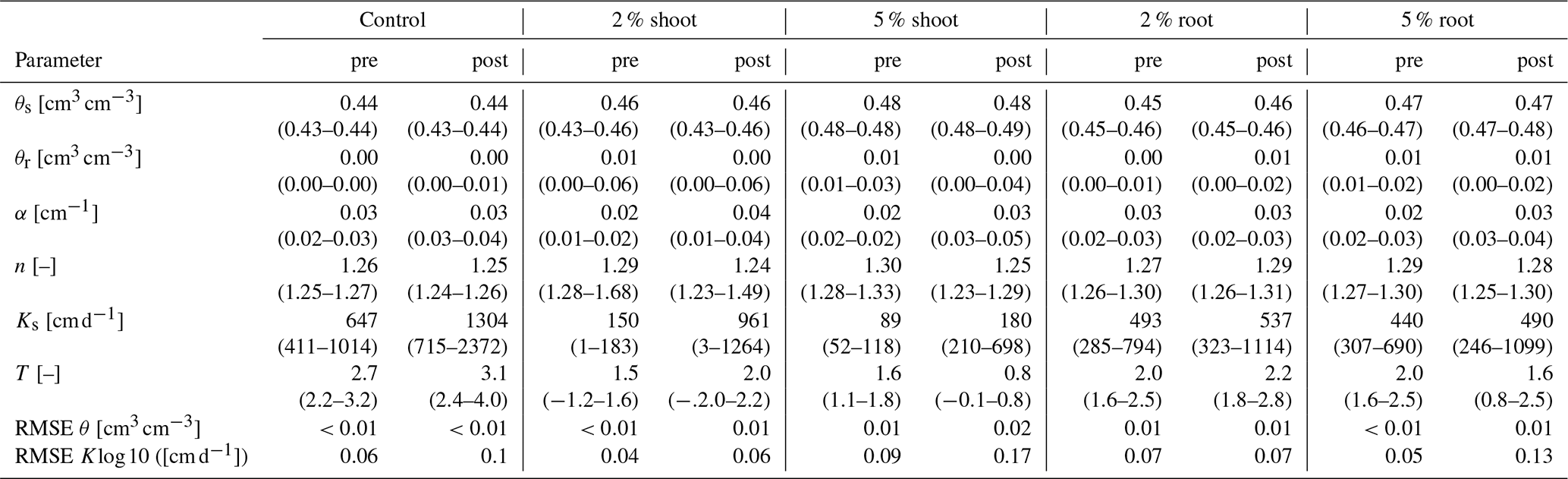
The described observations of the measured SHP caused corresponding alterations in the fitting parameters of the unimodal van Genuchten model of the samples pre-incubation (Table 2). The saturated water content (θs) increased proportionally with CR concentration by +0.02 cm3 cm−3 (2 % shoot and 2 % root), by +0.03 cm3 cm−3 (5 % root), and by +0.04 cm3 cm−3 (5 % shoot), which was also true for the residual water content (θr) but to a minor extent. The shape parameter α, which is related to the air entry value of the soil, was decreasing with increasing shoot concentration but was not affected by the root concentration. The shape parameter n, which controls the steepness of the water retention curve and where higher values indicate a more abrupt transition from saturated to unsaturated conditions, was increasing with CR concentration for both, shoot and root CR. Both fitting parameters of the SHCC, Ks and τ, have a high uncertainty since measurement points are limited to a certain part of the curve and thus will not be used for interpretation.
Table 2Fitting parameters of the unimodal van Genuchten model pre-incubation and post-incubation. The fitting for each crop residue-soil mixtures is based on all measured replicates. Values in parentheses display the 95 % confidence interval of each fitting parameter gained by bootstrapping.
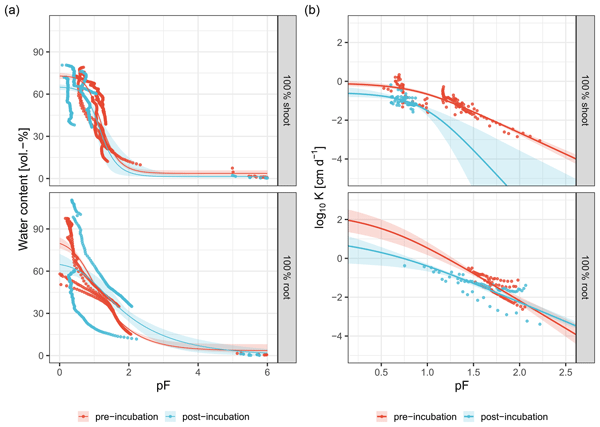
Both the SWRC (Fig. 3a) and the SHCC (Fig. 3b) of the control and thus also the fitting parameters were very similar before and after incubation (Fig. S2 in the Supplement). This was not the case for the CR-soil mixtures. Here, incubation generally reduced the effect of both water retention and, to a minor extent, hydraulic conductivity. Especially the shoot CR-soil samples changed the shape and herewith the shape parameters of the SWRC getting closer to the curve of the control. The effect of incubation on the SHP of root CR-soil mixture samples was comparably low. For all CR-soil mixtures the saturated water content was the same before and after incubation and the reduction in water retention mainly occurred in the pF range from pF 1 to 3. Deriving the pore size distribution from SWRCs for all samples pre- and post-incubation enabled the classification of the effects of CR incorporation on different pore size classes (Fig. S3 in the Supplement). In comparison to the control, root residues primarily increased the volume of equivalent pores in the 10–50 µm size range (2 % root: +0.9 vol %, 5 % root: +1.5 vol %) whereas the effect of shoot residues was more pronounced in the equivalent pore size range of 0.2–10 µm (2 % shoot: +2.2 vol %, 5 % shoot: +3.1 vol %). The shifts in the shape parameters and the reduction in water content around field capacity observed after incubation affected the equivalent pore size distribution, causing a shift from equivalent meso- and micropores (0.2–10 µm) toward a greater proportion of equivalent macropores (>50 µm) in all samples.

Figure 3Soil water retention curve (a) and unsaturated hydraulic conductivity curve (b) for crop residue-soil mixtures of different concentrations (control (0 % CR), 2 wt %, and 5 wt %) of shoot and root residues before (red) and after (blue) incubation.
3.2 Mulching layer and root residues
Measuring the SWRC and SHCC for 100 wt % CR with HYPROP provided data mainly from close to saturation (pF 0) to pF 2, while WP4C measurements were done for very dry conditions from pF 5 to 6 (Fig. 4). The saturated water content of shoot CR was on average 72 vol % and of root CR 77 vol % but both showed a high variability compared to the CR-soil mixtures independent of the CR quality. Which is presented by the uncertainty ranges of the individual model parameters and the 95-confidence interval of the fit gained by bootstrapping as shown in Fig. 4a and b. At pF 1.5, the shoot water retention sharply dropped to 34 vol % and thus lost around 38 vol % of water while root CR lost even around 43 vol %. Including both measurements tools, it was possible to describe the data with a unimodal van Genuchten model and fill the gap in data points from pF 2.5 to 5. For both CR qualities, the model indicates a significant drop in water retention close to saturation, i.e. water which is drained fast at a low hydraulic head. Differences between the shape parameter α of shoot and root CR pre-incubation indicates that both CR had a low ability to retain water while the shape parameter n, indicates a higher steepness of the SWRC for shoot CR compared to root CR. After drainage of the big pores, the models indicate that shoot residues already reached the residual water content at pF 2, while root residues retained water from pF 2–4 before reaching residual water content at very dry conditions. Due to the substantial loss of water in the investigated pF range and a low gradient between the tensiometers, measurement points of the SHCC curve were limited to a certain pF range. At pF 2, tensiometers lost contact to the CR and furthermore, the material started to degrade and samples were transferred to the incubation experiment. After incubation, it was observed that the material changed the consistency towards a more biofilm-like substance. However, the degradation of the CR didn't change the SHP very much as shown in Fig. 4a and b, as well as by the fitting parameters presented in Table 3. For the shoot residues, note that the reduced number of data points for the SHCC>pF 1 created a high sensitivity of the τ value causing a sharp drop in conductivity which is not supported by data.
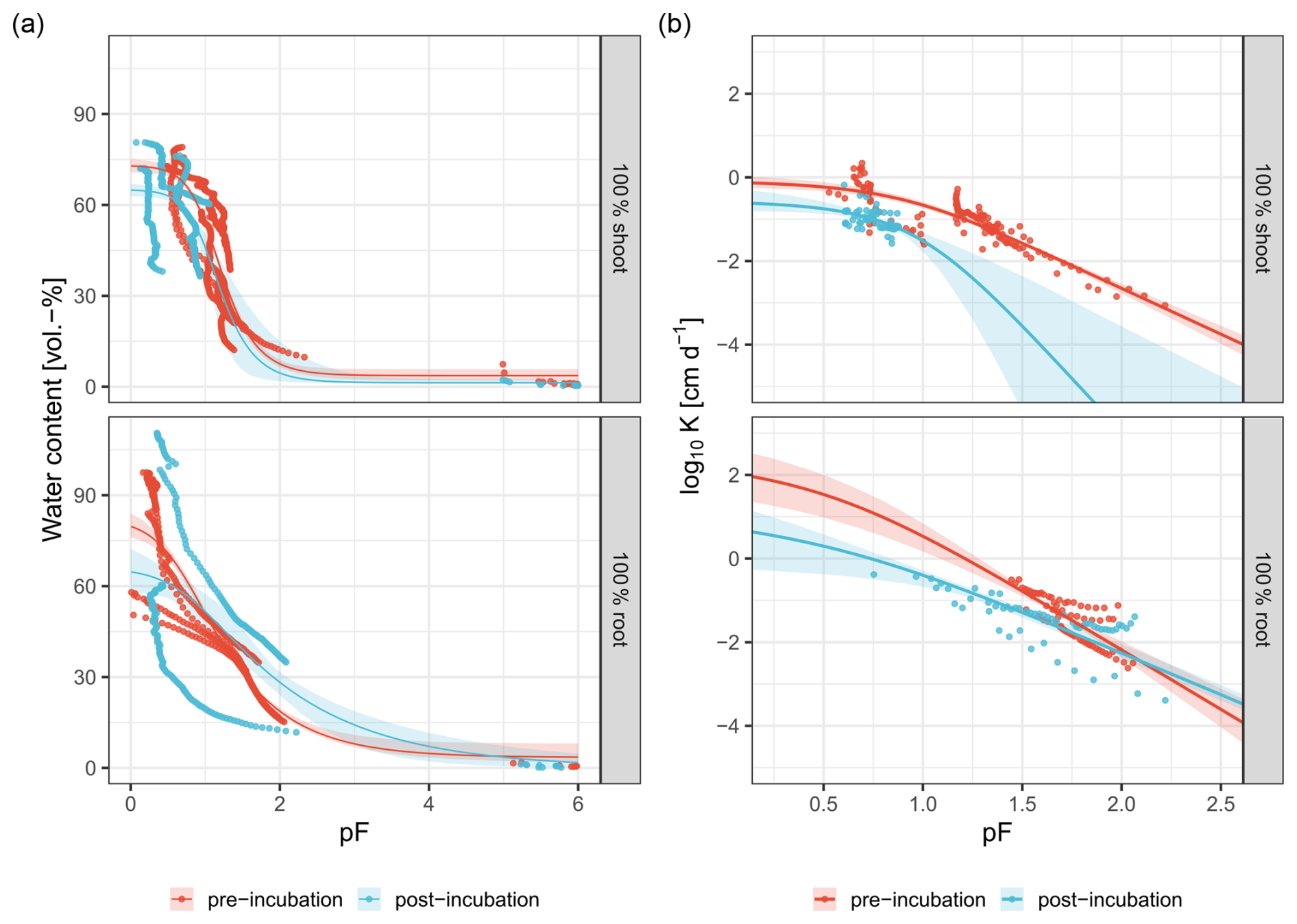
Figure 4Soil water retention curve (a) and unsaturated hydraulic conductivity curve (b) for 100 % crop residue layers of shoot and root residues before (red) and after (blue) incubation. Dots mark the HYPROP and WP4C measurements, the solid lines depict the fitting of the unimodal van Genuchten model. The shaded area marks the 95 % confidence interval of the fit gained by bootstrapping.
Table 3Fitting parameters of the unimodal van Genuchten model after the first round of HYPROP (pre-incubation) and after the second round of HYPROP (post-incubation) measurements for the 100 % CR samples. The fitting for each treatment is based on all measured replicates, the parameter range displays the 95 % confidence interval of the fit gained by bootstrapping. ∗ marks values were fitting parameters reached model constraints (min/max values).

3.3 Mass losses, organic carbon to nitrogen ratios as indicators for biodegradation
The total dry mass of fresh shoot (2.5 g) and root residues (1.7 g) decreased during the entire experimental time about 50 % and 27 % (Table 4), respectively, and herewith also changed the dry mass C concentration (fresh shoot 399 g kg−1, fresh root 432 g kg−1, Fig. 5a), i.e. after the first round of HYPROP (pre-incubation; shoot: 390 g kg−1, root: 376 g kg−1) and after the incubation time and the second round of HYPROP (post-incubation, shoot: 401 g kg−1, root: 350 g kg−1). Consequently, both treatments lost about 50 % of total C. Note that the fresh biomass and fresh CR-soil mixture was subsampled from one batch and that mass loss of root and shoot CR during the experiments was so severe that for single C and N measurements mass was only sufficient for one measurement without replicates, thus a statistical test was not possible. In contrast to C concentrations, for both CR an increase in N concentrations were observed between fresh and pre-incubation (Fig. 5b), for shoot CR from 12.3 to 24.5 g kg−1 and for roots from 7.1 to 17.9 g kg−1 (Fig. 5a). Post-incubation, the N concentration for the shoot CR was decreasing again to 20.0 g kg−1 while N concentration for the root CR was about the same 20.6 g kg−1. The initial ratios indicate that shoot CR with ratio of 32.4 were more nitrogen-rich relative to carbon compared to root residues which had a ratio of 61.1 (Fig. 5c). The ratios of both CR decreased mainly at the beginning of the experiment, i.e. shoot CR pre-incubation decreased to a ratio of 15.9 and for root residues to a ratio of 21.0, indicating a biodegradation of CR starting during the first measurement of SHP. Further changes of CR ratio during incubation were comparingly low, which is shown by the post-incubation measurements of shoot ratio of 20.1 and root ratio of 15.7. The change in ratio for shoot CR pre-incubation was also driven by an increase in N concentration.
Table 4Total dry mass, carbon and nitrogen concentrations and carbon and nitrogen mass per treatment. Note that the dry mass estimated for pre-incubated samples is based on one dummy sample per treatment.

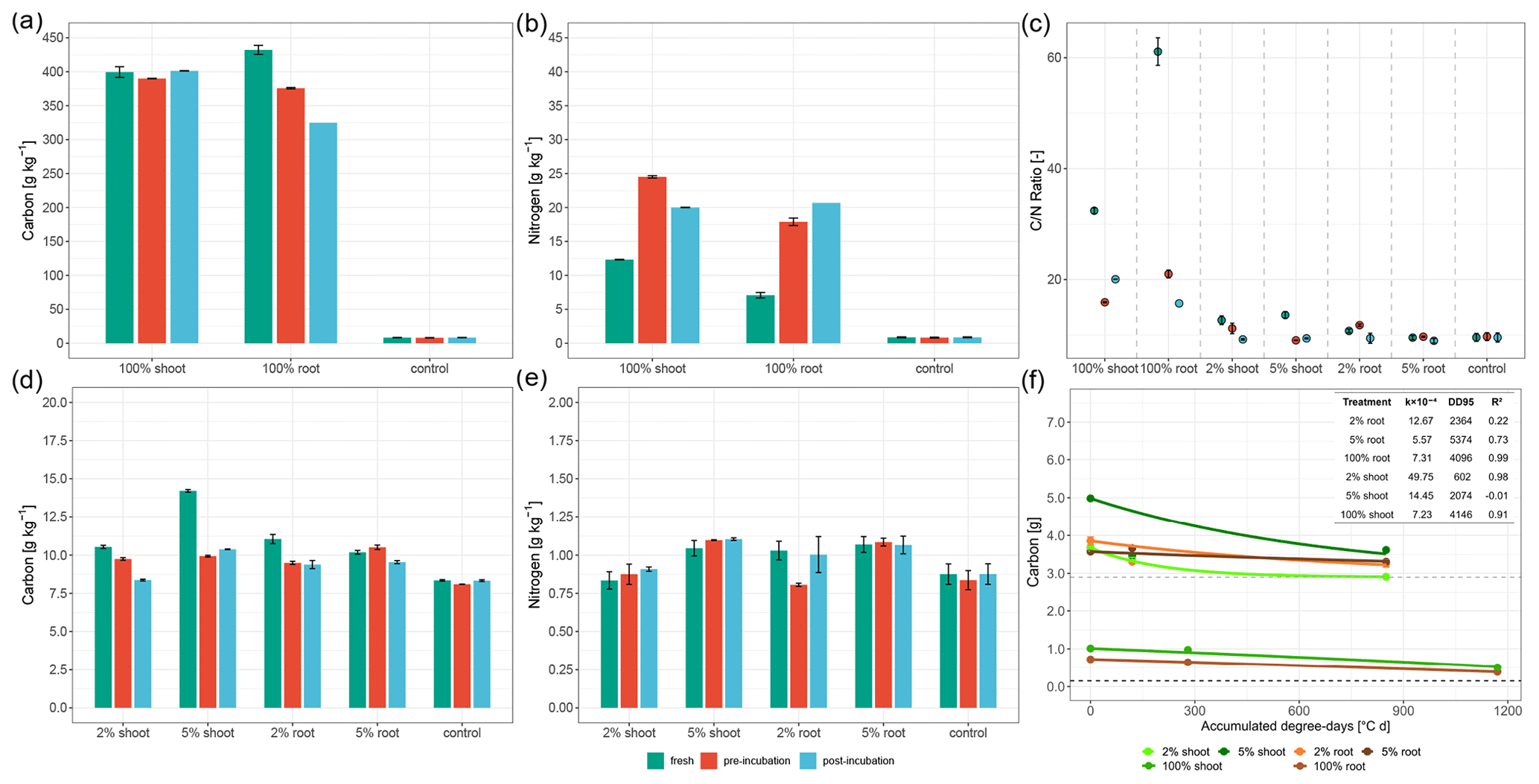
Figure 5Carbon concentration (a, d), nitrogen concentration (b, e), and carbon/nitrogen ratio (c) of the 100 % crop residues and crop residue-soil mixtures. The error bars show the standard deviation of two technical replicates for the 100 % crop residues and three technical replicates for the crop residue-soil mixtures. (f) The model for carbon mass decomposition, as well as the fitted decomposition rate constant k and the time required for the decay of 95 % of the labile carbon pool (DD95), are shown inside the figure. The dashed grey line indicates the stable carbon pool in soil (control), the black dashed line a stable carbon pool of 15 % in shoots and 22 % in roots.
The incorporation of CR into soil increased the C concentration of all tested CR-soil mixtures when compared to the control (C 8.3 g kg−1, N 0.8 g kg−1, ratio of 9.6) as well as the N concentration, expect for 2 % shoot CR-soil mixture (Fig. 5d and e, respectively). Compared to the 100 % CR samples, the initial C and N concentrations in fresh CR-soil mixtures were by factor 30–36 and 7–16 smaller, respectively, and the observed dynamics in concentrations during the experiment differed significantly. The C concentration of shoot and root CR-soil mixtures were decreasing from fresh (2 % shoot: 10.5 g kg−1, 5 % shoot: 14.2 g kg−1, 2 % root: 11.1 g kg−1, 5 % root: 10.2 g kg−1) to pre-incubation (2 % shoot: 9.7 g kg−1, 5 % shoot: 9.9 g kg−1, 2 % root: 9.5 g kg−1, 5 % root: 10.5 g kg−1) and further to post-incubation (2 % shoot: 8.4 g kg−1, 5 % shoot: 10.3 g kg−1, 2 % root: 9.4 g kg−1, 5 % root: 9.5 g kg−1). The N concentration, however, did not change for all treatments, and thus, the decrease in ratio was mainly driven by a decrease in C concentration. As a result at the end of the experiments, i.e. post-incubation, all CR-soil mixtures had a ratio similar to the control ( ratio of 9.5). Again, changes in C and N concentrations mainly occurred due to the loss of C (Table 4), which was most pronounced in the shoot treatment were the C mass decreased by 21 % for 2 % shoot CR-soil mixtures and by 27 % for 5 % shoot CR-soil mixtures. For roots CR-soil mixture the decrease was about 7 % and 15 % for 5 % root and 2 % root, respectively. Except for 5 % root, in all treatments CR degradation occurred already during the pre-incubation measurement. The C-decay function described the CR degradation of most samples with an R2 greater than 0.70 (Fig. 5f), except for 2 % root (R2=0.22) and 5 % shoot (R2=0) CR-soil mixtures, where high C losses were observed already during the first HYPROP measurement, i.e. before the incubation started. The derived decomposition rate constant (k) per degree days was, overall, higher for shoot residues ( DD, DD, DD) than for root residues ( DD, DD, DD) resulting in significantly faster turnover times for shoot CR.
When correlating the vol % water content at most common basepoint of the water retention curve, i.e. close to saturation (pF 0), at field capacity (pF 1.8), and at permanent wilting point (pF 4.2), to the samples C concentration [g kg−1], it becomes obvious that the positive effect of CR incorporation on water retention is most pronounced in the wet range at pF 0 and 1.8 (Fig. 6). The correlations at pre-incubation state were moderate (R2=0.6 at pF 0) to weak (R2=0.4 at pF 1.8 and 4.2) and not statistically significant. However, this was mainly due to the exceptionally high impact of 5 % shoot CR on soil water retention compared to the other treatments. After incubation, there was a strong positive correlation between the water content at pF 0 and 1.8 and the C concentration in the soil, which was mainly due to the decrease in the positive effect of 5 % shoot CR. For both basepoints at pre-incubation, the estimated correlation implies an increase of 1.5 vol % water content per 1 g C per kg soil. This did not change after incubation for water content at pF 0 and only slightly dropped for water content at pF 1.8. At pF 4.2, the correlation after incubation remained weak, indicating that C concentration had less influence on water retention under high tension (drier conditions). There was no significant correlation between unsaturated hydraulic conductivity and C concentration in the investigated tension range (Fig. S4 in the Supplement).
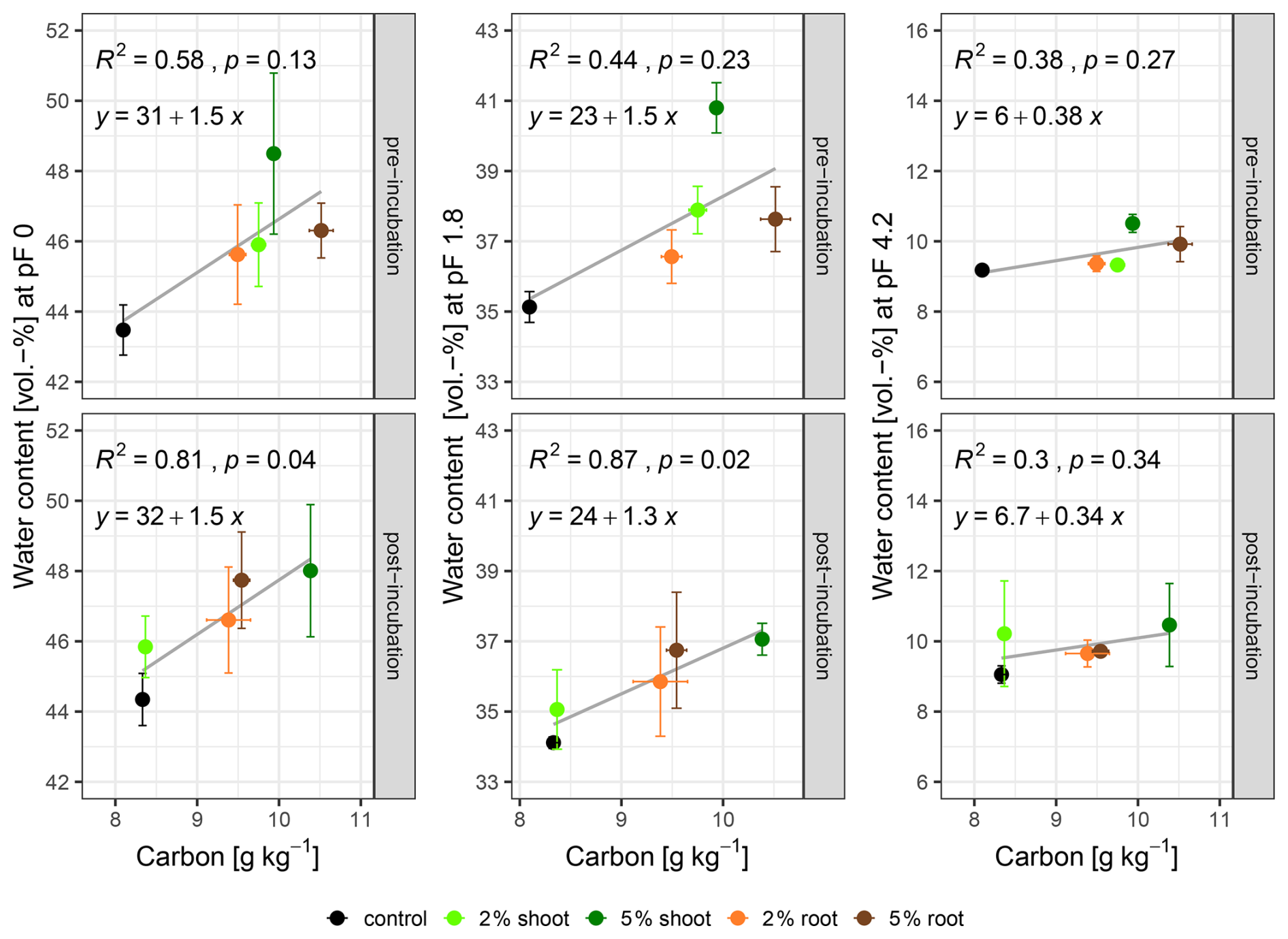
Figure 6Water content as function of carbon concentration for most common basepoints of the water retention curve: close to saturation (pF 0), at field capacity (pF 1.8), and at permanent wilting point (pF 4.2) investigated for samples measured pre-incubation (top) and post-incubation (bottom).
Maize CR have a high surface area and a low tissue density and thus have their own porosity and pore distribution of macro- and mesopores which enables retaining a high amount of water (Iqbal et al., 2013). They are composed of hydrophilic compounds, such as cellulose and hemicellulose, and hydrophobic compounds, such as lignin. During the degradation of crop residues, the ratio typically decreases due to preferential microbial consumption of labile carbon fractions (Iqbal et al., 2013). As a result, the relative proportion of recalcitrant, hydrophobic compounds (e.g., lignin-derived aromatics, waxes, and cuticular materials) increases. Consequently, hydrophobicity is expected to increase in parallel with the decline in ratio. At the µm to mm scale, the incorporation of CR can create voids between CR and soil matrix (Leuther et al., 2025). Biological degradation is expected to alter the morphological and chemical characteristics not only of the CR itself but also of the vicinity by stimulating biological growth and nutrient turnover as often observed in the detritusphere (Sanaullah et al., 2011; Védère et al., 2020). These characteristics differ to mineral soil constituents and may therefore contribute to changes in the integrated SHP of the CR itself and of CR-soil mixtures. Based on the results of different CR concentration, CR qualities, and biological degradation of CR on SHP of a loam soil it can be summarised that:
- i.
Incorporating 2 % and 5 % CR into loam soil significantly increased water retention, particularly in the wet range (pF 0–2) around 2 vol % to 5 vol %, and slightly decreased unsaturated hydraulic conductivity around pF 2.5 of about log 10(−0.05) cm d−1 for 5 % shoot CR.
- ii.
After three weeks of incubation under controlled climatic conditions, the effects of CR on water retention were similarly high near saturation, but were reduced in the pF range from pF 1 to 2.5, and the effect on SHCC was no longer measurable.
- iii.
The chemical composition of CR significantly changed during the experiment indicating biological degradation of the material. ratios dropped sharply during pre-incubation due to a high C loss for shoot CR and both N increase and C decrease for root CR. The CR-soil mixtures approach control values (∼9.5) post-incubation.
- iv.
Shoot CR decomposed faster than root CR, leading to a more pronounced reduction in soil hydraulic properties post-incubation. Root CR retained its effect on water retention, indicating slower degradation.
These changes in SHP and CR qualities address the hypotheses tested in the study which is discussed in the following.
4.1 The effect of CR concentration on soil hydraulic properties
For fresh CR-soil mixtures, we observed that the saturated water content (θs) increased proportionally with CR concentration, while residual water content (θr) also rose slightly. The shape parameter α decreased with shoot CR, which may indicate that CR filled large pores which shifted the air-entry value to higher suctions. The parameter n increased with both shoot and root CR, reflecting a steeper transition from saturated to unsaturated conditions and thus a pore size distribution which is more narrow compared to the control. In CR-soil mixtures, the change in SWRC suggested an apparent increase in mesopores and micropores in the range of 0.2 to 10 µm for shoot-soil mixtures and in the range of 10 to 50 µm for roots. Both the SWRC and the SHCC of the control and thus also the fitting parameters were highly similar before and after the incubation experiment showing that the experimental setup caused only minimal hysteresis effects. Various studies have demonstrated the positive effect of soil organic matter on water capacity (Feifel et al., 2024; Rawls et al., 2003). The controlled laboratory conditions of our studies enabled us to attribute the changes in SHP to the hydraulic properties of CR and its transformation during biodegradation. It is important to note that the reference volume and the mass of soil remained constant across all CR-soil mixture experiments, while we additionally added the CR mass. As a result, we have a greater total mass of solid material in the same volume and thus a decrease in overall porosity, yet a positive effect on the SWRC was measured from saturation to pF 2. The SWRC of the 100 wt % CR samples showed that this was the range in which fresh CR can hold up to 95 vol % of water. Water retention of shoot CR sharply dropped at pF 2 to 4 vol %, which is equivalent to pore sizes with a radius of 15 µm, i.e. it can be assumed that the majority of shoot CR pore sizes are larger than 15 µm. In contrast, the decline in water retention for root CR was less steep, suggesting that root residues also contain a considerable proportion of pores with radii larger than 1 µm. This interpretation is further supported by the pore size distribution of the CR-soil mixtures, which showed a distinct peak at an equivalent pore size of approximately 10 µm. In contrast, this peak was far less pronounced in the control treatment and became increasingly prominent with increasing CR concentration in both the root and shoot treatments (Fig. S3). Overall, the data show that CR can store substantial amounts of water but are only able to retain it against comparatively low matric potentials. These results are consistent with previous findings that reported similar saturated water contents and retention characteristics for maize CR of various sizes (Iqbal et al., 2013). While the authors measured high residual water contents for fresh CR, a decline was observed due to degradation within 49 d and thus an increase in the pore class radius >29 µm. This is consistent with our observations from the SWRC-derived pore size distributions of shoot-CR soil mixtures in which we quantified a decrease in pore size from 0.2 to 10 µm, but an increase in pores larger than 50 µm. However, the pore size distribution in the control group also showed a slight increase in pores larger than 50 µm, which is why the pore size classes derived from the SWRC should be interpreted with caution. Similar to Findeling et al. (2007) for rape and rye CR, the 100 wt % CR samples slightly increased water retention as decomposition proceeded, which the authors attributed to an increase in porosity due to the degradation of the cell walls. Interestingly, fresh CR mixed with soil increased the water absorption capacity of the mineral soil, as they systematically increased the water content at saturation indicating an improved wettability of the soil. However, the increase in saturated water content was again reduced after incubation.
Previous review article reported that for medium textured soils, 10 g kg−1 increase in SOC on average, increases the volumetric water content at saturation, field capacity, and wilting point by 3.6, 2.1, and 0.7 mm H2O 100 mm soil−1, respectively (Minasny and McBratney, 2018). This was similar to the presented results where CR mainly affected the SWRC from saturation to field capacity (here defined at pF 1.8 in the review article at pF 2 and 2.5) and only slightly affecting water content at permanent wilting point. Due to the different CR concentrations and CR qualities we covered a range of C contents in soil and estimated that 10 g kg−1 increase in soil organic carbon on average, increases the volumetric water content at saturation, field capacity, and wilting point by 1.5, 1.5, and 0.4 mm H2O 100 mm soil−1 for fresh CR, respectively, and by 1.5, 1.3, and 0.3 mm H2O 100 mm soil−1 after three weeks of incubation. The positive effect of mulching and CR incorporation on water retention of loamy soils were reported in field studies (Blanco-Canqui and Lal, 2007; Ramos et al., 2024) and were mostly attributed to the increase in SOC and biological activity. Under field conditions, however, the described positive effect of CR incorporation on water retention might be limited when water contents are fluctuating between field capacity and wilting point.
Falling the described impact of CR on SWRC, the interpretation of the impact on SHCC is much less straight forward, since the measured data from 100 % CR (pF 1–2) and soil-CR mixtures (pF 2–3) do not consistently overlap. Based on the fitted van Genuchten model, it was shown that the hydraulic conductivity of the soil-CR mixtures close to saturation was by order of magnitude higher as the CR conductivity. This is also true for unsaturated hydraulic conductivity at pF 2 where shoot and root CR had a log 10k value of around −2.5 cm d−1 while CR-soil mixture and the control was around −0.5 cm d−1. However, both fitting parameters and the confidence intervals of 100 % CR show high uncertainty for k at saturation and close to saturation which makes interpretation highly speculative. Based on the more robust interpretation of the SWRC and pore size distribution, we can assume that both root and shoot CR were mainly drained at pF 2 while pores of the repacked soil are still conducting. As a result, air-filled CR might act as physical barriers and thus reduce conductivity of soil-CR mixtures compared to the control which have been observed for shoot CR at pF 1.8 and 2.2 (Fig. S4). At pF 3.0, the effect diminished with further drying and the more dominant film and corner flow of the soil matrix. In the scientific literature, there are only a few research studies on the effect of CR on unsaturated conductivity that are based on field experiments, and the existing studies do not provide a clear picture. Previous field studies reported that the removal of CR reduced the saturated and unsaturated hydraulic conductivity under no-till farming over a broad pF range from pF 0 to 4.2 (Blanco-Canqui and Lal, 2007) and had mixed effects on both for various farming systems (Klopp and Blanco-Canqui, 2022). After incubation, the effect of shoot CR on SHCC in the measured pF range was significantly reduced. Interestingly, in contrast to the SWRC an effect of root CR on unsaturated hydraulic conductivity was not detected, neither pre- nor post-incubation. The measurements of 100 % CR post-incubation provided an even higher uncertainty due to the low number of replicates as a result of the degradation of crop residues and thus can only provide an estimate on the temporal changes in SHCC, which was for both treatments lower compared to pre-incubation measurements. Again, to the best of our knowledge there are no comparable lab studies investigating the effect of CR and its biological degradation on unsaturated hydraulic conductivity.
4.2 Biological degradation of crop residues significantly reduces the effect on SHP in short time
Plant residues contain populations of bacteria and fungi which are known to colonize the crop and tissues before and after harvest. These microorganisms are able to decompose readily available substrates and change herewith the chemistry of CR and morphology of cell walls (Machinet et al., 2009). The decomposition of maize CR is highly time-dependent and occurs more rapidly in the early stages of decomposition. Depending on the litter quality, often classified by the ratio, both tested maize CR root and shoot can be considered as CR of lower quality compared to other CR (Córdova et al., 2018; Elias et al., 2024), with fresh shoot CR ( ratio of 32.4) being more nitrogen-rich relative to carbon compared to root residues ( ratio of 61.1). Incubation studies have shown that after 46 d of incubation most of the litter-C remained as residual litter (Córdova et al., 2018), which was especially true for low-quality litter from maize (79 %–85 %), with high carbon/nitrogen ()-ratios and high lignin contents, but also for high-quality litter such as oats (61 %–69 %) or alfalfa (67 %–72 %). In another incubation study, Elias et al. (2024) showed that more high-quality litter-C was respired relative to low-quality litter across different mineral compositions and that more litter-C was found as particulate organic matter and as stabilised, mineral-associated organic matter from low quality OM. In mixtures with minerals, 25 % of litter-derived C can be respired within days and after that respiration rates slow down (Elias et al., 2024), which was similar to the C losses we determined for shoot CR-soil mixtures (21 %–27 %). The C loss from root-CR was comparably lower (7 %–15 %). In soil mixtures under comparable conditions (25 °C), maize stem residues decreased their C content from 464 to 452 g kg−1 dry mass while increasing the N content from 2.9 to 7.4 g kg−1 dry mass within 49 d of incubation, reducing the ratio from 160 to 61 (Iqbal et al., 2013). Interestingly, the authors measured a reduction in soluble C fractions, little changes in hemicellulose and cellulose content while the content in lignin increased, i.e. the relative content of hydrophobic substances increased. This might be one reason for the observed changes in unsaturated hydraulic conductivity and why carbon-rich amendments improved the soil's ability to retain water at low to moderate tensions but not at high tensions when hydrophobicity can become a dominant factor. It also confirms our observations, that biological degradation of CR already occurred during the first measurements of SHP and continued during incubation, which was especially true for the 5 % shoot samples where degradation in the first 6 d was much faster than the predicted exponential decay function. The effect of biological degradation during the incubation period on SHP was still significant and thus might have even been bigger when conducting the post-incubation HYPROP experiments under less ideal conditions. The decision of conducting the SHP measurements at 20 °C was made up on two (i) simulating more realistic conditions comparable to a topsoil after harvest in July–September, and (ii) the technical fact that the measurement time of SHP would have been much longer at cold temperature at reduced respiration rates which might have had resulted in similar biodegradation.
4.3 Study limitations and extrapolation to field conditions
In this study, we present the hydraulic properties of crop residues in soil before and after an incubation period. These data could be of great value for modelling water flow in 3D structures at both the pore and sample scales (e.g., Leuther and Diamantopoulos, 2024) and for assessing the effects of mulch layers composed of plant residues of various origins at the field scale. For the latter application, the temporal dynamics of hydraulic properties resulting from crop residue degradation represent a well-known limitation in modelling approaches because data describing these dynamics remain scarce (Bristow and Horton, 1996; Pavlů et al., 2021). Mulch layer thickness, bulk density, residue distribution, the hydraulic connection between soil and mulch layer, and environmental conditions all influence water exchange between the atmosphere and the soil, but these factors were not explicitly simulated in this study. Furthermore, the experiments were conducted under constant temperature and humidity conditions and therefore did not account for field-relevant processes such as wetting-drying cycles, rainfall events, plant root growth, fluctuating microbial activity, and soil fauna interactions. These processes may considerably alter both crop residue degradation and the associated hydraulic properties over time. In addition, cropping system and soil management, preferential flow pathways, aggregate turnover, spatial heterogeneity in CR quality and quantity as well as soil characteristics, and temporal climatic variability may modify the hydraulic effects of CR under field conditions (Klopp and Blanco-Canqui, 2022), potentially leading to responses that differ from those observed under the controlled laboratory conditions employed here. Nevertheless, defining the hydraulic properties of mulch layers, quantifying degradation-induced changes that contribute to seasonal structural dynamics, and accounting for these temporal dynamics when evaluating the effects of crop residues on soil hydraulic properties constitute important steps forward. This is particularly relevant for the development of new models that consider structural dynamics and the impact on soil hydraulic properties (Jarvis et al., 2024; Jha et al., 2023). Within such frameworks, external drivers that dominate water flow under field conditions can be considered, allowing the effects of mulching and crop residue incorporation to be evaluated more systematically.
The water retention characteristics of 100 % CR were consistent with previous findings reported by Iqbal et al. (2013), as were the degradation rates discussed above. However, the results presented here also demonstrate the need for additional hydraulic conductivity measurements close to saturation for both soils and CR. This is a well-known limitation of the simplified evaporation method and could be overcome by using Multi-Step-Flux measurements or tension disk infiltrometers (Nielsen et al., 2026). Such measurements would substantially reduce parameter uncertainty and better capture the observed changes in pore-size distribution, not only for the SWRC but also for the SHCC. However, any additional measurements should take into account that they would extend the overall measurement period and, consequently, influence the observed decay process during the measurements themselves.
The effect of biodegradation on hydraulic property measurements was most pronounced in the post-incubation measurements of the 100 % CR samples. This resulted in a substantial reduction in the number of samples that could be measured and increased the uncertainty of the fitted hydraulic parameters. To monitor the biological transformation of crop residues more directly, X-ray Computed tomography measurements of fresh, pre-incubation, and post-incubation samples could be used to quantify structural and morphological changes occurring during the experimental period. Such analyses would provide valuable information on pore network evolution and would allow the structural mechanisms inferred in the present study to be tested directly rather than indirectly through hydraulic measurements. This is particularly true within the macropore and large mesopore size ranges, which appear to be most strongly affected by biological degradation (Leuther et al., 2022).
In this study, we investigated the effects of fresh and degraded crop residues on the soil hydraulic properties of a repacked loam soil. The magnitude of these effects may differ in soils with contrasting textures or in undisturbed field soils, where roots preferentially follow existing biopores and where microbial community composition may differ substantially. However, many of the processes observed and discussed occurred within a pF range that is primarily governed by structural pores rather than by texture-dependent pore domains. Consequently, while the quantitative effects may vary across soil types and management systems, our results suggest that some of the mechanisms discussed here may also operate in other soils. However, their relative importance and magnitude remain to be verified experimentally across a broader range of soil textures and field conditions.
In this study we investigated the effect of fresh and degraded root and shoot maize CR on SHP of a loamy soil. Based on the conditions investigated, it can be concluded that (i) increasing CR concentration in the studied soil increased soil water retention and decreased unsaturated conductivity compared to soil without crop residues; (ii) under unsaturated conditions and controlled climatic conditions, the microbial degradation processes diminished the effect of higher concentrations of CR on water retention and hydraulic conductivity within three weeks due to the decay of the plant material and the associated changes in pore space; (iii) decomposition rates differed between CR quality, with shoot residues decaying much faster than root residues, thereby reducing their effect on SHP after a similar incubation period; and (iv) for both CR, C loss and changes in ratios indicated an increasing relative proportion of recalcitrant, hydrophobic compounds.
These findings improve our understanding of temporal changes in SHP that are often observed in topsoils after harvest, simulated here by the root decay, or after CR incorporation by tillage, simulated by root and shoot decay. Furthermore, the study provides a set of SHP which can be used to simulate water flow associated with root and litter residues from the pore to the sample scale and may support the representation of fresh and degraded mulch layers in soil-plant-atmosphere models for similar conditions. However, because this study was restricted to a single loamy soil, the extent to which these findings apply to other soil textures remains uncertain and requires experimental verification. Since the effect of CR on SHP could not only be explained by chemical changes but may also reflect morphological characteristics, future studies combining SHP measurements with monitoring of structural changes by X-ray computed tomography could provide further insides to the effect of fresh and degraded maize shoot and root residues on soil hydraulic properties.
The source data underlying Figs. 1–5 and Tables 1–4 are provided in this paper. In addition, the data set is archived and provided by the University of Bayreuth's Institutional Repository for Digital Research Data https://doi.org/10.57880/rdspace-ubt-52 (Leuther, 2026).
The supplement related to this article is available online at https://doi.org/10.5194/soil-12-1195-2026-supplement.
Frederic Leuther: Writing – original draft, Visualization, Validation, Methodology, Investigation, Formal analysis, Data curation, Conceptualization. Alina Langanki: Visualization, Investigation, Formal analysis, Data curation. Eva Lehndorff: Writing – review and editing, Supervision, Conceptualization. Efstathios Diamantopoulos: Writing – review and editing, Supervision, Project administration, Methodology, Funding acquisition, Conceptualization.
The contact author has declared that none of the authors has any competing interests.
Publisher's note: Copernicus Publications remains neutral with regard to jurisdictional claims made in the text, published maps, institutional affiliations, or any other geographical representation in this paper. The authors bear the ultimate responsibility for providing appropriate place names. Views expressed in the text are those of the authors and do not necessarily reflect the views of the publisher.
We would like to thank Andreas Kolb, Lara Ketterer, and Karin Söllner for technical support.
This paper was funded by the Open Access Publishing Fund of the University of Bayreuth and the European Union – Horizon 2020, Path4Med (No. 101156867).
This paper was edited by Jose Alfonso Gomez and reviewed by three anonymous referees.
Assouline, S. and Or, D.: Conceptual and Parametric Representation of Soil Hydraulic Properties: A Review, Vadose Zone J., 12, vzj2013.07.0121, https://doi.org/10.2136/vzj2013.07.0121, 2013.
Birge, H. E., Conant, R. T., Follett, R. F., Haddix, M. L., Morris, S. J., Snapp, S. S., Wallenstein, M. D., and Paul, E. A.: Soil respiration is not limited by reductions in microbial biomass during long-term soil incubations, Soil Biol. Biochem., 81, 304–310, https://doi.org/10.1016/j.soilbio.2014.11.028, 2015.
Blanco-Canqui, H. and Lal, R.: Impacts of Long-Term Wheat Straw Management on Soil Hydraulic Properties under No-Tillage, Soil Sci. Soc. Am. J., 71, 1166–1173, https://doi.org/10.2136/sssaj2006.0411, 2007.
Bottinelli, N., Jouquet, P., Capowiez, Y., Podwojewski, P., Grimaldi, M., and Peng, X.: Why is the influence of soil macrofauna on soil structure only considered by soil ecologists?, Soil Till. Res., 146, 118–124, https://doi.org/10.1016/j.still.2014.01.007, 2015.
Bristow, K. L. and Horton, R.: Modeling the impact of partial surface mulch on soil heat and water flow, Theor. Appl. Climatol., 54, 85–98, https://doi.org/10.1007/BF00863561, 1996.
Canty, A., Ripley, B., and Brazzale, A. R.: `Boot”: Bootstrap Functions, https://doi.org/10.32614/CRAN.package.boot, 2025.
Clemente, J. S., Simpson, M. J., Simpson, A. J., Yanni, S. F., and Whalen, J. K.: Comparison of soil organic matter composition after incubation with maize leaves, roots, and stems, Geoderma, 192, 86–96, https://doi.org/10.1016/j.geoderma.2012.08.007, 2013.
Córdova, S. C., Olk, D. C., Dietzel, R. N., Mueller, K. E., Archontouilis, S. V., and Castellano, M. J.: Plant litter quality affects the accumulation rate, composition, and stability of mineral-associated soil organic matter, Soil Biol. Biochem., 125, 115–124, https://doi.org/10.1016/j.soilbio.2018.07.010, 2018.
Dettmann, U.: SoilHyP: Soil Hydraulic Properties, R package version 0.1.1, https://doi.org/10.32614/CRAN.package.SoilHyP, 2018.
Diamantopoulos, E., Durner, W., Reszkowska, A., and Bachmann, J.: Effect of soil water repellency on soil hydraulic properties estimated under dynamic conditions, J. Hydrol., 486, 175–186, https://doi.org/10.1016/j.jhydrol.2013.01.020, 2013.
Elias, D. M. O., Mason, K. E., Goodall, T., Taylor, A., Zhao, P., Otero-Fariña, A., Chen, H., Peacock, C. L., Ostle, N. J., Griffiths, R., Chapman, P. J., Holden, J., Banwart, S., McNamara, N. P., and Whitaker, J.: Microbial and mineral interactions decouple litter quality from soil organic matter formation, Nat. Commun., 15, 10063, https://doi.org/10.1038/s41467-024-54446-0, 2024.
Feifel, M., Durner, W., Hohenbrink, T. L., and Peters, A.: Effects of improved water retention by increased soil organic matter on the water balance of arable soils: A numerical analysis, Vadose Zone J., 23, e20302, https://doi.org/10.1002/vzj2.20302, 2024.
Findeling, A., Garnier, P., Coppens, F., Lafolie, F., and Recous, S.: Modelling water, carbon and nitrogen dynamics in soil covered with decomposing mulch, Eur. J. Soil Sci., 58, 196–206, https://doi.org/10.1111/j.1365-2389.2006.00826.x, 2007.
Green, T. R., Ahuja, L. R., and Benjamin, J. G.: Advances and challenges in predicting agricultural management effects on soil hydraulic properties, Geoderma, 116, 3–27, https://doi.org/10.1016/S0016-7061(03)00091-0, 2003.
Hohenbrink, T. L., Jackisch, C., Durner, W., Germer, K., Iden, S. C., Kreiselmeier, J., Leuther, F., Metzger, J. C., Naseri, M., and Peters, A.: Soil water retention and hydraulic conductivity measured in a wide saturation range, Earth Syst. Sci. Data, 15, 4417–4432, https://doi.org/10.5194/essd-15-4417-2023, 2023.
Holbak, M., Abrahamsen, P., Grønning, C. R., Klöffel, T., Schwartzkopff, M. V., Styczen, M. E., Svane, S. F., and Diamantopoulos, E.: The Daisy model: A tool for simulating agricultural systems – Recent (2012–2025) developments, calibrations and validations, Agr. Syst., 238, 104846, https://doi.org/10.1016/j.agsy.2026.104846, 2026.
Iqbal, A., Beaugrand, J., Garnier, P., and Recous, S.: Tissue density determines the water storage characteristics of crop residues, Plant Soil, 367, 285–299, https://doi.org/10.1007/s11104-012-1460-8, 2013.
Jarvis, N., Coucheney, E., Lewan, E., Klöffel, T., Meurer, K. H. E., Keller, T., and Larsbo, M.: Interactions between soil structure dynamics, hydrological processes, and organic matter cycling: A new soil-crop model, Eur. J. Soil Sci., 75, e13455, https://doi.org/10.1111/ejss.13455, 2024.
Jha, A., Bonetti, S., Smith, A. P., Souza, R., and Calabrese, S.: Linking Soil Structure, Hydraulic Properties, and Organic Carbon Dynamics: A Holistic Framework to Study the Impact of Climate Change and Land Management, J. Geophys. Res.-Biogeo., 128, e2023JG007389, https://doi.org/10.1029/2023JG007389, 2023.
Kassambara, A.: rstatix: pipe-friendly framework for basic statistical tests, https://doi.org/10.32614/CRAN.package.rstatix, 2020.
Klopp, H. W. and Blanco-Canqui, H.: Implications of crop residue removal on soil physical properties: A review, Soil Sci. Soc. Am. J., 86, 979–1001, https://doi.org/10.1002/saj2.20418, 2022.
Leuther, F.: Data for “Fresh and degraded maize shoot and root residues temporarily change soil hydraulic properties”, UBT [data set], https://doi.org/10.57880/rdspace-ubt-52, 2026.
Leuther, F. and Diamantopoulos, E.: Simulating bare soil evaporation for undisturbed soil cores – Using HYDRUS 3D simulation on X-ray μCT determined soil macrostructures, Vadose Zone J., 23, e20339, https://doi.org/10.1002/vzj2.20339, 2024.
Leuther, F., Schlüter, S., Wallach, R., and Vogel, H.-J.: Structure and hydraulic properties in soils under long-term irrigation with treated wastewater, Geoderma, 333, 90–98, https://doi.org/10.1016/j.geoderma.2018.07.015, 2019.
Leuther, F., Wolff, M., Kaiser, K., Schumann, L., Merbach, I., Mikutta, R., and Schlüter, S.: Response of subsoil organic matter contents and physical properties to long-term, high-rate farmyard manure application, Eur. J. Soil Sci., 73, e13233, https://doi.org/10.1111/ejss.13233, 2022.
Leuther, F., Fischer, D., Nunan, N., Meurer, K. H., and Herrmann, A. M.: Soil structural indicators as predictors of biological activity under various soil management practices, Geoderma, 457, 117290, https://doi.org/10.1016/j.geoderma.2025.117290, 2025.
Machinet, G. E., Bertrand, I., Chabbert, B., Watteau, F., Villemin, G., and Recous, S.: Soil biodegradation of maize root residues: Interaction between chemical characteristics and the presence of colonizing micro-organisms, Soil Biol. Biochem., 41, 1253–1261, https://doi.org/10.1016/j.soilbio.2009.03.009, 2009.
Miller, J. J., Owen, M. L., Yang, X. M., Drury, C. F., Chanasyk, D. S., and Willms, W. D.: Water Repellency and Hydrophobicity of Some Major Agricultural Crop Residues, Agron. J., 111, 3008–3019, https://doi.org/10.2134/agronj2019.02.0067, 2019.
Minasny, B. and McBratney, A. B.: Limited effect of organic matter on soil available water capacity, Eur. J. Soil Sci., 69, 39–47, 2018.
Mualem, Y.: A new model for predicting the hydraulic conductivity of unsaturated porous media, Water Res., 12, 513–522, https://doi.org/10.1029/WR012i003p00513, 1976.
Nielsen, M. B. S., Leuther, F., and Diamantopoulos, E.: Integrating Muli-Step-Flux-Method for full range soil hydraulic characterisation: From saturation to oven-dryness, EGUsphere [preprint], https://doi.org/10.5194/egusphere-2026-1405, 2026.
Pavlů, L., Kodešová, R., Fér, M., Nikodem, A., Němec, F., and Prokeš, R.: The impact of various mulch types on soil properties controlling water regime of the Haplic Fluvisol, Soil Till. Res., 205, 104748, https://doi.org/10.1016/j.still.2020.104748, 2021.
R Core Team: R: A language and environment for statistical computing, R Foundation for Statistical Computing, Vienna, Austria, https://doi.org/10.32614/R.manuals, 2020.
Ramos, T. B., Darouich, H., and Pereira, L. S.: Mulching effects on soil evaporation, crop evapotranspiration and crop coefficients: a review aimed at improved irrigation management, Irrigation Sci., 42, 525–539, https://doi.org/10.1007/s00271-024-00924-8, 2024.
Rasse, D. P., Smucker, A. J. M., and Santos, D.: Alfalfa Root and Shoot Mulching Effects on Soil Hydraulic Properties and Aggregation, Soil Sci. Soc. Am. J., 64, 725–731, https://doi.org/10.2136/sssaj2000.642725x, 2000.
Rawls, W. J., Pachepsky, Y. A., Ritchie, J. C., Sobecki, T. M., and Bloodworth, H.: Effect of soil organic carbon on soil water retention, Geoderma, 116, 61–76, https://doi.org/10.1016/S0016-7061(03)00094-6, 2003.
Rummel, P. S., Pfeiffer, B., Pausch, J., Well, R., Schneider, D., and Dittert, K.: Maize root and shoot litter quality controls short-term CO2 and N2O emissions and bacterial community structure of arable soil, Biogeosciences, 17, 1181–1198, https://doi.org/10.5194/bg-17-1181-2020, 2020.
Sanaullah, M., Chabbi, A., Leifeld, J., Bardoux, G., Billou, D., and Rumpel, C.: Decomposition and stabilization of root litter in top- and subsoil horizons: what is the difference?, Plant Soil, 338, 127–141, https://doi.org/10.1007/s11104-010-0554-4, 2011.
Sindelar, M., Blanco-Canqui, H., Jin, V. L., and Ferguson, R.: Cover Crops and Corn Residue Removal: Impacts on Soil Hydraulic Properties and Their Relationships with Carbon, Soil Sci. Soc. Am. J., 83, 221–231, https://doi.org/10.2136/sssaj2018.06.0225, 2019.
Strudley, M. W., Green, T. R., and Ascough, J. C.: Tillage effects on soil hydraulic properties in space and time: State of the science, Soil Till. Res., 99, 4–48, https://doi.org/10.1016/j.still.2008.01.007, 2008.
Turmel, M.-S., Speratti, A., Baudron, F., Verhulst, N., and Govaerts, B.: Crop residue management and soil health: A systems analysis, Agr. Syst., 134, 6–16, https://doi.org/10.1016/j.agsy.2014.05.009, 2015.
van Genuchten, M. T.: A Closed-form Equation for Predicting the Hydraulic Conductivity of Unsaturated Soils, Soil Sci. Soc. Am. J., 44, 892–898, https://doi.org/10.2136/sssaj1980.03615995004400050002x, 1980.
Védère, C., Vieublé Gonod, L., Pouteau, V., Girardin, C., and Chenu, C.: Spatial and temporal evolution of detritusphere hotspots at different soil moistures, Soil Biol. Biochem., 150, 107975, https://doi.org/10.1016/j.soilbio.2020.107975, 2020.
Vetterlein, D., Lippold, E., Schreiter, S., Phalempin, M., Fahrenkampf, T., Hochholdinger, F., Marcon, C., Tarkka, M., Oburger, E., Ahmed, M., Javaux, M., and Schlüter, S.: Experimental platforms for the investigation of spatiotemporal patterns in the rhizosphere – Laboratory and field scale, J. Plant Nutr. Soil Sc., 184, 35–50, https://doi.org/10.1002/jpln.202000079, 2021.
Volk, E., Iden, S. C., Furman, A., Durner, W., and Rosenzweig, R.: Biofilm effect on soil hydraulic properties: Experimental investigation using soil-grown real biofilm, Water Res., 52, 5813–5828, https://doi.org/10.1002/2016WR018866, 2016.
Vuaille, J., Abrahamsen, P., Jensen, S. M., Diamantopoulos, E., Wacker, T. S., and Petersen, C. T.: Modelling pesticide degradation and leaching in conservation agriculture: Effect of no-till and mulching, Sci. Total Environ., 929, 172559, https://doi.org/10.1016/j.scitotenv.2024.172559, 2024.
Wickham, H.: ggplot2: elegant graphics for data analysis, 2nd edn., Springer Cham, https://doi.org/10.1007/978-3-319-24277-4, 2016.
Wickham, H., Averick, M., Bryan, J., Chang, W., McGowan, L. D., François, R., Grolemund, G., Hayes, A., Henry, L., and Hester, J.: Welcome to the Tidyverse, J. Open Source Softw., 4, 1686, https://doi.org/10.21105/joss.01686, 2019.