
Articles | Volume 12, issue 2
https://doi.org/10.5194/soil-12-1195-2026
© Author(s) 2026. This work is distributed under
the Creative Commons Attribution 4.0 License.
the Creative Commons Attribution 4.0 License.
https://doi.org/10.5194/soil-12-1195-2026
© Author(s) 2026. This work is distributed under
the Creative Commons Attribution 4.0 License.
the Creative Commons Attribution 4.0 License.
Original research article
| 
16 Nov 2026
Original research article |
| 16 Nov 2026
| 16 Nov 2026
Fresh and degraded maize shoot and root residues temporarily change hydraulic properties of a loamy soil
Frederic Leuther
CORRESPONDING AUTHOR

Professorship of Soil Physics, Bayreuth Center of Ecology and Environmental Research (BayCEER), University of Bayreuth, Bayreuth, 95447, Germany
Alina Langanki
Professorship of Soil Physics, Bayreuth Center of Ecology and Environmental Research (BayCEER), University of Bayreuth, Bayreuth, 95447, Germany
Eva Lehndorff
Chair of Soil Ecology, Bayreuth Center of Ecology and Environmental Research (BayCEER), University of Bayreuth, Bayreuth, 95447, Germany
Efstathios Diamantopoulos
Professorship of Soil Physics, Bayreuth Center of Ecology and Environmental Research (BayCEER), University of Bayreuth, Bayreuth, 95447, Germany
Related authors
Mathilde Blume Sommer Nielsen, Frederic Leuther, and Efstathios Diamantopoulos
EGUsphere, https://doi.org/10.5194/egusphere-2026-1405, https://doi.org/10.5194/egusphere-2026-1405, 2026
Short summary
Short summary
Soils store and conduct water, which is important for plants, farming, and the environment. Measuring how water flows through soil is difficult, especially in the moisture range where soil structure strongly influences flow. To address this gap, we developed a laboratory method that combines several measurements on the same soil sample. Tests on repacked sand and undisturbed soils show that the method captures how soil structure affects water flow and can improve future soil modelling studies.
Tobias L. Hohenbrink, Conrad Jackisch, Wolfgang Durner, Kai Germer, Sascha C. Iden, Janis Kreiselmeier, Frederic Leuther, Johanna C. Metzger, Mahyar Naseri, and Andre Peters
Earth Syst. Sci. Data, 15, 4417–4432, https://doi.org/10.5194/essd-15-4417-2023, https://doi.org/10.5194/essd-15-4417-2023, 2023
Short summary
Short summary
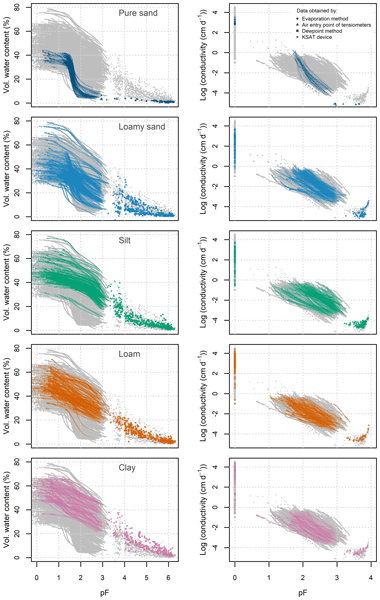
The article describes a collection of 572 data sets of soil water retention and unsaturated hydraulic conductivity data measured with state-of-the-art laboratory methods. Furthermore, the data collection contains basic soil properties such as soil texture and organic carbon content. We expect that the data will be useful for various important purposes, for example, the development of soil hydraulic property models and related pedotransfer functions.
Efstathios Diamantopoulos and Sascha Christian Iden
EGUsphere, https://doi.org/10.5194/egusphere-2026-1738, https://doi.org/10.5194/egusphere-2026-1738, 2026
Short summary
Short summary
This mini-review shows that Richards' equation fails under dynamic flow conditions because it assumes equilibrium between water content and pressure head. Evidence from six experiments demonstrates persistent non-equilibrium effects under both fast and slow flow. A simple Dual-NE model, allowing partial decoupling, successfully reproduces all observations.
Mathilde Blume Sommer Nielsen, Frederic Leuther, and Efstathios Diamantopoulos
EGUsphere, https://doi.org/10.5194/egusphere-2026-1405, https://doi.org/10.5194/egusphere-2026-1405, 2026
Short summary
Short summary
Soils store and conduct water, which is important for plants, farming, and the environment. Measuring how water flows through soil is difficult, especially in the moisture range where soil structure strongly influences flow. To address this gap, we developed a laboratory method that combines several measurements on the same soil sample. Tests on repacked sand and undisturbed soils show that the method captures how soil structure affects water flow and can improve future soil modelling studies.
Maximilian Rötzer, Henri Braunmiller, Eva Lehndorff, Nadja Ray, Andrea Scheibe, and Alexander Prechtel
SOIL, 12, 205–226, https://doi.org/10.5194/soil-12-205-2026, https://doi.org/10.5194/soil-12-205-2026, 2026
Short summary
Short summary
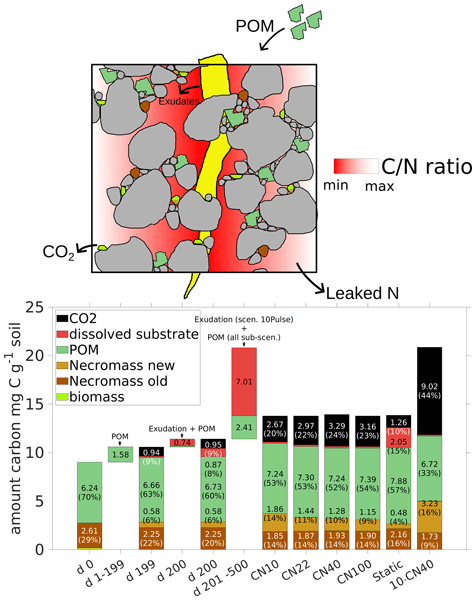
In soil, many factors influence how much carbon is stored: the structure of soil particles, microbial activity, and the balance of carbon and nitrogen. Using small-scale simulations, we can quantify and study their interplay. Nitrogen availability limits the microbial efficiency, and dead microbes contribute to long-term carbon storage by becoming occluded in aggregated soil particles. Our study offers new insights into how soils hold carbon, which is crucial for understanding climate change.
Tobias Karl David Weber, Lutz Weihermüller, Attila Nemes, Michel Bechtold, Aurore Degré, Efstathios Diamantopoulos, Simone Fatichi, Vilim Filipović, Surya Gupta, Tobias L. Hohenbrink, Daniel R. Hirmas, Conrad Jackisch, Quirijn de Jong van Lier, John Koestel, Peter Lehmann, Toby R. Marthews, Budiman Minasny, Holger Pagel, Martine van der Ploeg, Shahab Aldin Shojaeezadeh, Simon Fiil Svane, Brigitta Szabó, Harry Vereecken, Anne Verhoef, Michael Young, Yijian Zeng, Yonggen Zhang, and Sara Bonetti
Hydrol. Earth Syst. Sci., 28, 3391–3433, https://doi.org/10.5194/hess-28-3391-2024, https://doi.org/10.5194/hess-28-3391-2024, 2024
Short summary
Short summary
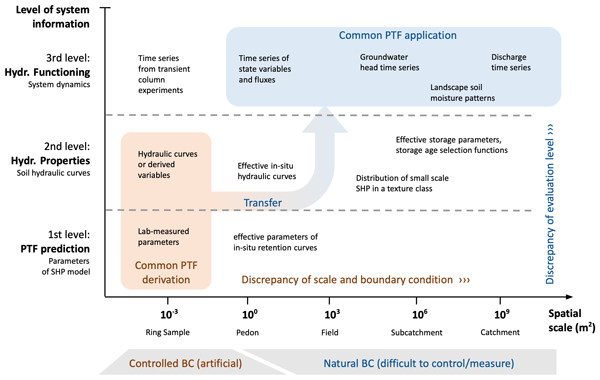
Pedotransfer functions (PTFs) are used to predict parameters of models describing the hydraulic properties of soils. The appropriateness of these predictions critically relies on the nature of the datasets for training the PTFs and the physical comprehensiveness of the models. This roadmap paper is addressed to PTF developers and users and critically reflects the utility and future of PTFs. To this end, we present a manifesto aiming at a paradigm shift in PTF research.
Tobias L. Hohenbrink, Conrad Jackisch, Wolfgang Durner, Kai Germer, Sascha C. Iden, Janis Kreiselmeier, Frederic Leuther, Johanna C. Metzger, Mahyar Naseri, and Andre Peters
Earth Syst. Sci. Data, 15, 4417–4432, https://doi.org/10.5194/essd-15-4417-2023, https://doi.org/10.5194/essd-15-4417-2023, 2023
Short summary
Short summary
The article describes a collection of 572 data sets of soil water retention and unsaturated hydraulic conductivity data measured with state-of-the-art laboratory methods. Furthermore, the data collection contains basic soil properties such as soil texture and organic carbon content. We expect that the data will be useful for various important purposes, for example, the development of soil hydraulic property models and related pedotransfer functions.
Cited articles
Assouline, S. and Or, D.: Conceptual and Parametric Representation of Soil Hydraulic Properties: A Review, Vadose Zone J., 12, vzj2013.07.0121, https://doi.org/10.2136/vzj2013.07.0121, 2013.
Birge, H. E., Conant, R. T., Follett, R. F., Haddix, M. L., Morris, S. J., Snapp, S. S., Wallenstein, M. D., and Paul, E. A.: Soil respiration is not limited by reductions in microbial biomass during long-term soil incubations, Soil Biol. Biochem., 81, 304–310, https://doi.org/10.1016/j.soilbio.2014.11.028, 2015.
Blanco-Canqui, H. and Lal, R.: Impacts of Long-Term Wheat Straw Management on Soil Hydraulic Properties under No-Tillage, Soil Sci. Soc. Am. J., 71, 1166–1173, https://doi.org/10.2136/sssaj2006.0411, 2007.
Bottinelli, N., Jouquet, P., Capowiez, Y., Podwojewski, P., Grimaldi, M., and Peng, X.: Why is the influence of soil macrofauna on soil structure only considered by soil ecologists?, Soil Till. Res., 146, 118–124, https://doi.org/10.1016/j.still.2014.01.007, 2015.
Bristow, K. L. and Horton, R.: Modeling the impact of partial surface mulch on soil heat and water flow, Theor. Appl. Climatol., 54, 85–98, https://doi.org/10.1007/BF00863561, 1996.
Canty, A., Ripley, B., and Brazzale, A. R.: `Boot”: Bootstrap Functions, https://doi.org/10.32614/CRAN.package.boot, 2025.
Clemente, J. S., Simpson, M. J., Simpson, A. J., Yanni, S. F., and Whalen, J. K.: Comparison of soil organic matter composition after incubation with maize leaves, roots, and stems, Geoderma, 192, 86–96, https://doi.org/10.1016/j.geoderma.2012.08.007, 2013.
Córdova, S. C., Olk, D. C., Dietzel, R. N., Mueller, K. E., Archontouilis, S. V., and Castellano, M. J.: Plant litter quality affects the accumulation rate, composition, and stability of mineral-associated soil organic matter, Soil Biol. Biochem., 125, 115–124, https://doi.org/10.1016/j.soilbio.2018.07.010, 2018.
Dettmann, U.: SoilHyP: Soil Hydraulic Properties, R package version 0.1.1, https://doi.org/10.32614/CRAN.package.SoilHyP, 2018.
Diamantopoulos, E., Durner, W., Reszkowska, A., and Bachmann, J.: Effect of soil water repellency on soil hydraulic properties estimated under dynamic conditions, J. Hydrol., 486, 175–186, https://doi.org/10.1016/j.jhydrol.2013.01.020, 2013.
Elias, D. M. O., Mason, K. E., Goodall, T., Taylor, A., Zhao, P., Otero-Fariña, A., Chen, H., Peacock, C. L., Ostle, N. J., Griffiths, R., Chapman, P. J., Holden, J., Banwart, S., McNamara, N. P., and Whitaker, J.: Microbial and mineral interactions decouple litter quality from soil organic matter formation, Nat. Commun., 15, 10063, https://doi.org/10.1038/s41467-024-54446-0, 2024.
Feifel, M., Durner, W., Hohenbrink, T. L., and Peters, A.: Effects of improved water retention by increased soil organic matter on the water balance of arable soils: A numerical analysis, Vadose Zone J., 23, e20302, https://doi.org/10.1002/vzj2.20302, 2024.
Findeling, A., Garnier, P., Coppens, F., Lafolie, F., and Recous, S.: Modelling water, carbon and nitrogen dynamics in soil covered with decomposing mulch, Eur. J. Soil Sci., 58, 196–206, https://doi.org/10.1111/j.1365-2389.2006.00826.x, 2007.
Green, T. R., Ahuja, L. R., and Benjamin, J. G.: Advances and challenges in predicting agricultural management effects on soil hydraulic properties, Geoderma, 116, 3–27, https://doi.org/10.1016/S0016-7061(03)00091-0, 2003.
Hohenbrink, T. L., Jackisch, C., Durner, W., Germer, K., Iden, S. C., Kreiselmeier, J., Leuther, F., Metzger, J. C., Naseri, M., and Peters, A.: Soil water retention and hydraulic conductivity measured in a wide saturation range, Earth Syst. Sci. Data, 15, 4417–4432, https://doi.org/10.5194/essd-15-4417-2023, 2023.
Holbak, M., Abrahamsen, P., Grønning, C. R., Klöffel, T., Schwartzkopff, M. V., Styczen, M. E., Svane, S. F., and Diamantopoulos, E.: The Daisy model: A tool for simulating agricultural systems – Recent (2012–2025) developments, calibrations and validations, Agr. Syst., 238, 104846, https://doi.org/10.1016/j.agsy.2026.104846, 2026.
Iqbal, A., Beaugrand, J., Garnier, P., and Recous, S.: Tissue density determines the water storage characteristics of crop residues, Plant Soil, 367, 285–299, https://doi.org/10.1007/s11104-012-1460-8, 2013.
Jarvis, N., Coucheney, E., Lewan, E., Klöffel, T., Meurer, K. H. E., Keller, T., and Larsbo, M.: Interactions between soil structure dynamics, hydrological processes, and organic matter cycling: A new soil-crop model, Eur. J. Soil Sci., 75, e13455, https://doi.org/10.1111/ejss.13455, 2024.
Jha, A., Bonetti, S., Smith, A. P., Souza, R., and Calabrese, S.: Linking Soil Structure, Hydraulic Properties, and Organic Carbon Dynamics: A Holistic Framework to Study the Impact of Climate Change and Land Management, J. Geophys. Res.-Biogeo., 128, e2023JG007389, https://doi.org/10.1029/2023JG007389, 2023.
Kassambara, A.: rstatix: pipe-friendly framework for basic statistical tests, https://doi.org/10.32614/CRAN.package.rstatix, 2020.
Klopp, H. W. and Blanco-Canqui, H.: Implications of crop residue removal on soil physical properties: A review, Soil Sci. Soc. Am. J., 86, 979–1001, https://doi.org/10.1002/saj2.20418, 2022.
Leuther, F.: Data for “Fresh and degraded maize shoot and root residues temporarily change soil hydraulic properties”, UBT [data set], https://doi.org/10.57880/rdspace-ubt-52, 2026.
Leuther, F. and Diamantopoulos, E.: Simulating bare soil evaporation for undisturbed soil cores – Using HYDRUS 3D simulation on X-ray μCT determined soil macrostructures, Vadose Zone J., 23, e20339, https://doi.org/10.1002/vzj2.20339, 2024.
Leuther, F., Schlüter, S., Wallach, R., and Vogel, H.-J.: Structure and hydraulic properties in soils under long-term irrigation with treated wastewater, Geoderma, 333, 90–98, https://doi.org/10.1016/j.geoderma.2018.07.015, 2019.
Leuther, F., Wolff, M., Kaiser, K., Schumann, L., Merbach, I., Mikutta, R., and Schlüter, S.: Response of subsoil organic matter contents and physical properties to long-term, high-rate farmyard manure application, Eur. J. Soil Sci., 73, e13233, https://doi.org/10.1111/ejss.13233, 2022.
Leuther, F., Fischer, D., Nunan, N., Meurer, K. H., and Herrmann, A. M.: Soil structural indicators as predictors of biological activity under various soil management practices, Geoderma, 457, 117290, https://doi.org/10.1016/j.geoderma.2025.117290, 2025.
Machinet, G. E., Bertrand, I., Chabbert, B., Watteau, F., Villemin, G., and Recous, S.: Soil biodegradation of maize root residues: Interaction between chemical characteristics and the presence of colonizing micro-organisms, Soil Biol. Biochem., 41, 1253–1261, https://doi.org/10.1016/j.soilbio.2009.03.009, 2009.
Miller, J. J., Owen, M. L., Yang, X. M., Drury, C. F., Chanasyk, D. S., and Willms, W. D.: Water Repellency and Hydrophobicity of Some Major Agricultural Crop Residues, Agron. J., 111, 3008–3019, https://doi.org/10.2134/agronj2019.02.0067, 2019.
Minasny, B. and McBratney, A. B.: Limited effect of organic matter on soil available water capacity, Eur. J. Soil Sci., 69, 39–47, 2018.
Mualem, Y.: A new model for predicting the hydraulic conductivity of unsaturated porous media, Water Res., 12, 513–522, https://doi.org/10.1029/WR012i003p00513, 1976.
Nielsen, M. B. S., Leuther, F., and Diamantopoulos, E.: Integrating Muli-Step-Flux-Method for full range soil hydraulic characterisation: From saturation to oven-dryness, EGUsphere [preprint], https://doi.org/10.5194/egusphere-2026-1405, 2026.
Pavlů, L., Kodešová, R., Fér, M., Nikodem, A., Němec, F., and Prokeš, R.: The impact of various mulch types on soil properties controlling water regime of the Haplic Fluvisol, Soil Till. Res., 205, 104748, https://doi.org/10.1016/j.still.2020.104748, 2021.
R Core Team: R: A language and environment for statistical computing, R Foundation for Statistical Computing, Vienna, Austria, https://doi.org/10.32614/R.manuals, 2020.
Ramos, T. B., Darouich, H., and Pereira, L. S.: Mulching effects on soil evaporation, crop evapotranspiration and crop coefficients: a review aimed at improved irrigation management, Irrigation Sci., 42, 525–539, https://doi.org/10.1007/s00271-024-00924-8, 2024.
Rasse, D. P., Smucker, A. J. M., and Santos, D.: Alfalfa Root and Shoot Mulching Effects on Soil Hydraulic Properties and Aggregation, Soil Sci. Soc. Am. J., 64, 725–731, https://doi.org/10.2136/sssaj2000.642725x, 2000.
Rawls, W. J., Pachepsky, Y. A., Ritchie, J. C., Sobecki, T. M., and Bloodworth, H.: Effect of soil organic carbon on soil water retention, Geoderma, 116, 61–76, https://doi.org/10.1016/S0016-7061(03)00094-6, 2003.
Rummel, P. S., Pfeiffer, B., Pausch, J., Well, R., Schneider, D., and Dittert, K.: Maize root and shoot litter quality controls short-term CO2 and N2O emissions and bacterial community structure of arable soil, Biogeosciences, 17, 1181–1198, https://doi.org/10.5194/bg-17-1181-2020, 2020.
Sanaullah, M., Chabbi, A., Leifeld, J., Bardoux, G., Billou, D., and Rumpel, C.: Decomposition and stabilization of root litter in top- and subsoil horizons: what is the difference?, Plant Soil, 338, 127–141, https://doi.org/10.1007/s11104-010-0554-4, 2011.
Sindelar, M., Blanco-Canqui, H., Jin, V. L., and Ferguson, R.: Cover Crops and Corn Residue Removal: Impacts on Soil Hydraulic Properties and Their Relationships with Carbon, Soil Sci. Soc. Am. J., 83, 221–231, https://doi.org/10.2136/sssaj2018.06.0225, 2019.
Strudley, M. W., Green, T. R., and Ascough, J. C.: Tillage effects on soil hydraulic properties in space and time: State of the science, Soil Till. Res., 99, 4–48, https://doi.org/10.1016/j.still.2008.01.007, 2008.
Turmel, M.-S., Speratti, A., Baudron, F., Verhulst, N., and Govaerts, B.: Crop residue management and soil health: A systems analysis, Agr. Syst., 134, 6–16, https://doi.org/10.1016/j.agsy.2014.05.009, 2015.
van Genuchten, M. T.: A Closed-form Equation for Predicting the Hydraulic Conductivity of Unsaturated Soils, Soil Sci. Soc. Am. J., 44, 892–898, https://doi.org/10.2136/sssaj1980.03615995004400050002x, 1980.
Védère, C., Vieublé Gonod, L., Pouteau, V., Girardin, C., and Chenu, C.: Spatial and temporal evolution of detritusphere hotspots at different soil moistures, Soil Biol. Biochem., 150, 107975, https://doi.org/10.1016/j.soilbio.2020.107975, 2020.
Vetterlein, D., Lippold, E., Schreiter, S., Phalempin, M., Fahrenkampf, T., Hochholdinger, F., Marcon, C., Tarkka, M., Oburger, E., Ahmed, M., Javaux, M., and Schlüter, S.: Experimental platforms for the investigation of spatiotemporal patterns in the rhizosphere – Laboratory and field scale, J. Plant Nutr. Soil Sc., 184, 35–50, https://doi.org/10.1002/jpln.202000079, 2021.
Volk, E., Iden, S. C., Furman, A., Durner, W., and Rosenzweig, R.: Biofilm effect on soil hydraulic properties: Experimental investigation using soil-grown real biofilm, Water Res., 52, 5813–5828, https://doi.org/10.1002/2016WR018866, 2016.
Vuaille, J., Abrahamsen, P., Jensen, S. M., Diamantopoulos, E., Wacker, T. S., and Petersen, C. T.: Modelling pesticide degradation and leaching in conservation agriculture: Effect of no-till and mulching, Sci. Total Environ., 929, 172559, https://doi.org/10.1016/j.scitotenv.2024.172559, 2024.
Wickham, H.: ggplot2: elegant graphics for data analysis, 2nd edn., Springer Cham, https://doi.org/10.1007/978-3-319-24277-4, 2016.
Wickham, H., Averick, M., Bryan, J., Chang, W., McGowan, L. D., François, R., Grolemund, G., Hayes, A., Henry, L., and Hester, J.: Welcome to the Tidyverse, J. Open Source Softw., 4, 1686, https://doi.org/10.21105/joss.01686, 2019.
Short summary
Improving soil hydraulic properties by incorporating and mulching crop residues is a widely used management strategy. In this study, we show that the benefits in water retention were stronger with higher residue amounts but faded as the residues decomposed, especially for the fast‑decaying shoots. Taking into account the temporal dynamics of biodegradation and crop residue quality is particularly important for water simulations in soil-crop-atmosphere models.
Improving soil hydraulic properties by incorporating and mulching crop residues is a widely used...


Altmetrics
Final-revised paper
Preprint