
Articles | Volume 11, issue 2
https://doi.org/10.5194/soil-11-991-2025
© Author(s) 2025. This work is distributed under
the Creative Commons Attribution 4.0 License.
the Creative Commons Attribution 4.0 License.
https://doi.org/10.5194/soil-11-991-2025
© Author(s) 2025. This work is distributed under
the Creative Commons Attribution 4.0 License.
the Creative Commons Attribution 4.0 License.
Original research article
| 
28 Nov 2025
Original research article |
| 28 Nov 2025
| 28 Nov 2025
Availability of labile carbon controls the temperature-dependent response of soil organic matter decomposition in alpine soils
Dario Püntener
CORRESPONDING AUTHOR
Department of Geography, University of Zurich, Winterthurerstrasse 190, 8057 Zurich, Switzerland
Tatjana C. Speckert
Department of Geography, University of Zurich, Winterthurerstrasse 190, 8057 Zurich, Switzerland
Yves-Alain Brügger
Department of Geography, University of Zurich, Winterthurerstrasse 190, 8057 Zurich, Switzerland
Guido L. B. Wiesenberg
Department of Geography, University of Zurich, Winterthurerstrasse 190, 8057 Zurich, Switzerland
Related authors
Dario Püntener, Philipp Zürcher, Tatjana C. Speckert, Carrie L. Thomas, and Guido L. B. Wiesenberg
SOIL, 12, 599–618, https://doi.org/10.5194/soil-12-599-2026, https://doi.org/10.5194/soil-12-599-2026, 2026
Short summary
Short summary
We studied how warmer temperatures affect carbon stored in mountain soils. In a year-long experiment with forest and pasture soils, we found that even moderate warming sped up the breakdown of plant material and soil carbon. Microorganisms became less efficient at higher temperatures. This means that rising temperatures could cause mountain soils to release more carbon, reinforcing climate change.
Binyan Sun, Guido L. B. Wiesenberg, Elaine Pegoraro, Margaret S. Torn, Michael W. I. Schmidt, and Mike C. Rowley
SOIL, 12, 757–771, https://doi.org/10.5194/soil-12-757-2026, https://doi.org/10.5194/soil-12-757-2026, 2026
Short summary
Short summary
Soil is the largest terrestrial carbon pool but vulnerable to loss under warming. Using a +4 °C whole-soil warming experiment at Blodgett Forest Research Station to 1 m depth, we investigated density fractions across depths. Below 50 cm, carbon quantity and composition shifted, mainly from losses of unprotected soil organic carbon. Soil carbon protected by minerals stayed largely stable, indicating organo-mineral protection buffers subsoil carbon loss.
Dario Püntener, Philipp Zürcher, Tatjana C. Speckert, Carrie L. Thomas, and Guido L. B. Wiesenberg
SOIL, 12, 599–618, https://doi.org/10.5194/soil-12-599-2026, https://doi.org/10.5194/soil-12-599-2026, 2026
Short summary
Short summary
We studied how warmer temperatures affect carbon stored in mountain soils. In a year-long experiment with forest and pasture soils, we found that even moderate warming sped up the breakdown of plant material and soil carbon. Microorganisms became less efficient at higher temperatures. This means that rising temperatures could cause mountain soils to release more carbon, reinforcing climate change.
Binyan Sun, Cyrill Zosso, Guido L. B. Wiesenberg, Elaine Pegoraro, Margaret S. Torn, and Michael W. I. Schmidt
SOIL, 11, 1077–1093, https://doi.org/10.5194/soil-11-1077-2025, https://doi.org/10.5194/soil-11-1077-2025, 2025
Short summary
Short summary
To understand how warming will change the dynamics of roots across soil profile, we took usage of a long-term field warming experiment and incubated 13C-labelled roots at three different depths. After 3 years of incubation, at compound class level, the effects of warming on decomposition of root-derived hydrolysable lipids were compound class specific. At monomer level, warming effects on suberin-derived monomer decomposition were depth-dependent and their resistance increased with chain length.
Mike C. Rowley, Jasquelin Pena, Matthew A. Marcus, Rachel Porras, Elaine Pegoraro, Cyrill Zosso, Nicholas O. E. Ofiti, Guido L. B. Wiesenberg, Michael W. I. Schmidt, Margaret S. Torn, and Peter S. Nico
SOIL, 11, 381–388, https://doi.org/10.5194/soil-11-381-2025, https://doi.org/10.5194/soil-11-381-2025, 2025
Short summary
Short summary
This study shows that calcium (Ca) preserves soil organic carbon (SOC) in acidic soils, challenging beliefs that their interactions were limited to near-neutral or alkaline soils. Using spectromicroscopy, we found that Ca was co-located with a specific fraction of carbon, rich in aromatic and phenolic groups. This association was disrupted when Ca was removed but was reformed during decomposition with added Ca. Overall, this suggests that Ca amendments could enhance SOC stability.
Tatjana Carina Speckert, Arnaud Huguet, and Guido Lars Bruno Wiesenberg
EGUsphere, https://doi.org/10.5194/egusphere-2024-870, https://doi.org/10.5194/egusphere-2024-870, 2024
Preprint archived
Short summary
Short summary
Afforestation on former pasture and its potential implication on the soil microbial community structure remains still an open question, particularly in mountainous regions. We investigate the effect of afforestation on a subalpine pasture on the soil microbial community structure by combining the analysis of PLFA and GDGTs. We found differences in the microbial community structure with evidence of increasing decomposition of soil organic matter due to the alteration in substrate quality.
Carrie L. Thomas, Boris Jansen, Sambor Czerwiński, Mariusz Gałka, Klaus-Holger Knorr, E. Emiel van Loon, Markus Egli, and Guido L. B. Wiesenberg
Biogeosciences, 20, 4893–4914, https://doi.org/10.5194/bg-20-4893-2023, https://doi.org/10.5194/bg-20-4893-2023, 2023
Short summary
Short summary
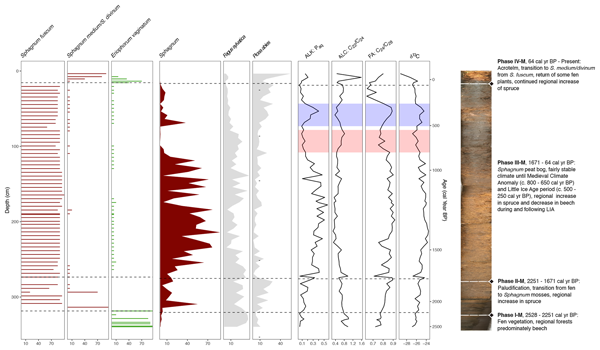
Peatlands are vital terrestrial ecosystems that can serve as archives, preserving records of past vegetation and climate. We reconstructed the vegetation history over the last 2600 years of the Beerberg peatland and surrounding area in the Thuringian Forest in Germany using multiple analyses. We found that, although the forest composition transitioned and human influence increased, the peatland remained relatively stable until more recent times, when drainage and dust deposition had an impact.
Tatjana C. Speckert, Jeannine Suremann, Konstantin Gavazov, Maria J. Santos, Frank Hagedorn, and Guido L. B. Wiesenberg
SOIL, 9, 609–621, https://doi.org/10.5194/soil-9-609-2023, https://doi.org/10.5194/soil-9-609-2023, 2023
Short summary
Short summary
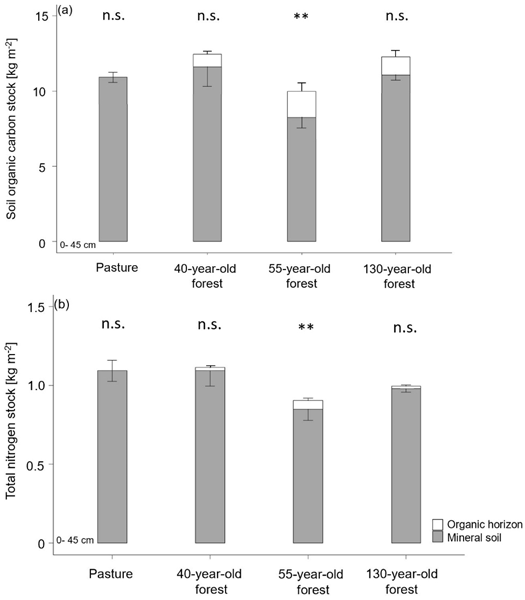
Soil organic carbon (SOC) is key player in the global carbon cycle. Afforestation on pastures potentially alters organic matter input and SOC sequestration. We investigated the effects of a Picea abies L. afforestation sequence (0 to 130 years) on a former subalpine pasture on SOC stocks and dynamics. We found no difference in the SOC stock after 130 years of afforestation and thus no additional SOC sequestration. SOC composition was altered due to a modified SOC input following afforestation.
Carrie L. Thomas, Boris Jansen, E. Emiel van Loon, and Guido L. B. Wiesenberg
SOIL, 7, 785–809, https://doi.org/10.5194/soil-7-785-2021, https://doi.org/10.5194/soil-7-785-2021, 2021
Short summary
Short summary
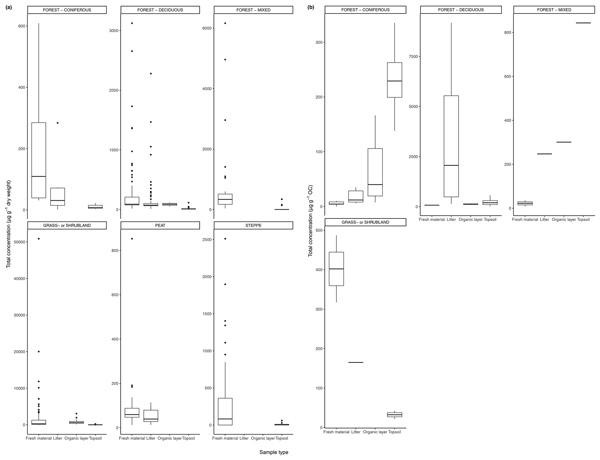
Plant organs, such as leaves, contain a variety of chemicals that are eventually deposited into soil and can be useful for studying organic carbon cycling. We performed a systematic review of available data of one type of plant-derived chemical, n-alkanes, to determine patterns of degradation or preservation from the source plant to the soil. We found that while there was degradation in the amount of n-alkanes from plant to soil, some aspects of the chemical signature were preserved.
Cyrill U. Zosso, Nicholas O. E. Ofiti, Jennifer L. Soong, Emily F. Solly, Margaret S. Torn, Arnaud Huguet, Guido L. B. Wiesenberg, and Michael W. I. Schmidt
SOIL, 7, 477–494, https://doi.org/10.5194/soil-7-477-2021, https://doi.org/10.5194/soil-7-477-2021, 2021
Short summary
Short summary
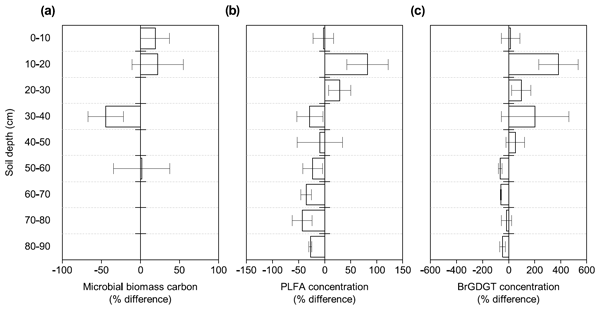
How subsoil microorganisms respond to warming is largely unknown, despite their crucial role in the soil organic carbon cycle. We observed that the subsoil microbial community composition was more responsive to warming compared to the topsoil community composition. Decreased microbial abundance in subsoils, as observed in this study, might reduce the magnitude of the respiration response over time, and a shift in the microbial community will likely affect the cycling of soil organic carbon.
Cited articles
Abiven, S. and Andreoli, R.: Charcoal does not change the decomposition rate of mixed litters in a mineral cambisol: a controlled conditions study, Biology and Fertility of Soils, 47, 111–114, https://doi.org/10.1007/s00374-010-0489-1, 2011. a
Albrich, K., Seidl, R., Rammer, W., and Thom, D.: From sink to source: changing climate and disturbance regimes could tip the 21st century carbon balance of an unmanaged mountain forest landscape, Forestry, 96, 399–409, https://doi.org/10.1093/forestry/cpac022, 2023. a
Allison, S. D., Wallenstein, M. D., and Bradford, M. A.: Soil-carbon response to warming dependent on microbial physiology, Nature Geoscience, 3, 336–340, https://doi.org/10.1038/ngeo846, 2010. a
Bahri, H., Rasse, D., Rumpel, C., Dignac, M.-F., Bardoux, G., and Mariotti, A.: Lignin degradation during a laboratory incubation followed by 13C isotope analysis, Soil Biology and Biochemistry, 40, 1916–1922, https://doi.org/10.1016/j.soilbio.2008.04.002, 2008. a
Balesdent, J., Mariotti, A., and Guillet, B.: Natural 13C abundance as a tracer for studies of soil organic matter dynamics, Soil Biology and Biochemistry, 19, 25–30, https://doi.org/10.1016/0038-0717(87)90120-9, 1987. a
Batjes, N.: Harmonized soil property values for broad-scale modelling (WISE30sec) with estimates of global soil carbon stocks, Geoderma, 269, 61–68, https://doi.org/10.1016/j.geoderma.2016.01.034, 2016. a
Baumann, K., Sanaullah, M., Chabbi, A., Dignac, M.-F., Bardoux, G., Steffens, M., Kögel-Knabner, I., and Rumpel, C.: Changes in litter chemistry and soil lignin signature during decomposition and stabilisation of 13C labelled wheat roots in three subsoil horizons, Soil Biology and Biochemistry, 67, 55–61, https://doi.org/10.1016/j.soilbio.2013.07.012, 2013. a, b
Beniston, M.: Climatic change in mountain regions: a review of possible impacts, Climatic Change, 59, 531, https://doi.org/10.1023/A:1024458411589, 2003. a
Blanco, J. A., Durán, M., Luquin, J., San Emeterio, L., Yeste, A., and Canals, R. M.: Soil C/N ratios cause opposing effects in forests compared to grasslands on decomposition rates and stabilization factors in southern European ecosystems, Science of The Total Environment, 888, 164118, https://doi.org/10.1016/j.scitotenv.2023.164118, 2023. a
Bonfanti, N., Clément, J. C., Münkemüller, T., Barré, P., Baudin, F., and Poulenard, J.: Prolonged warming leads to carbon depletion and increases nutrient availability in alpine soils, Applied Soil Ecology, 213, https://doi.org/10.1016/j.apsoil.2025.106239, 2025. a
Bradford, M. A., Veen, G. F., Bonis, A., Bradford, E. M., Classen, A. T., Cornelissen, J. H. C., Crowther, T. W., De Long, J. R., Freschet, G. T., Kardol, P., Manrubia-Freixa, M., Maynard, D. S., Newman, G. S., Logtestijn, R. S. P., Viketoft, M., Wardle, D. A., Wieder, W. R., Wood, S. A., and van der Putten, W. H.: A test of the hierarchical model of litter decomposition, Nature Ecology & Evolution, 1, 1836–1845, https://doi.org/10.1038/s41559-017-0367-4, 2017. a
Breidenbach, A., Schleuss, P. M., Liu, S., Schneider, D., Dippold, M. A., de la Haye, T., Miehe, G., Heitkamp, F., Seeber, E., Mason-Jones, K., Xu, X., Huanming, Y., Xu, J., Dorji, T., Gube, M., Norf, H., Meier, J., Guggenberger, G., Kuzyakov, Y., and Spielvogel, S.: Microbial functional changes mark irreversible course of Tibetan grassland degradation, Nature Communications, 13, https://doi.org/10.1038/s41467-022-30047-7, 2022. a, b
Bright, K., Dienes, B., Keiluweit, M., Rixen, C., and Aeppli, M.: Climate change impacts on organic carbon cycling in European alpine soils, Soil Biology and Biochemistry, 210, 109891, https://doi.org/10.1016/j.soilbio.2025.109891, 2025. a
Canedoli, C., Ferrè, C., Abu El Khair, D., Comolli, R., Liga, C., Mazzucchelli, F., Proietto, A., Rota, N., Colombo, G., Bassano, B., Viterbi, R., and Padoa-Schioppa, E.: Evaluation of ecosystem services in a protected mountain area: Soil organic carbon stock and biodiversity in alpine forests and grasslands, Ecosystem Services, 44, 101135, https://doi.org/10.1016/j.ecoser.2020.101135, 2020. a
Chen, Y., Qin, W., Zhang, Q., Wang, X., Feng, J., Han, M., Hou, Y., Zhao, H., Zhang, Z., He, J. S., Torn, M. S., and Zhu, B.: Whole-soil warming leads to substantial soil carbon emission in an alpine grassland, Nature Communications, 15, https://doi.org/10.1038/s41467-024-48736-w, 2024. a, b
Conant, R. T., Ryan, M. G., Agren, G. I., Birge, H. E., Davidson, E. A., Eliasson, P. E., Evans, S. E., Frey, S. D., Giardina, C. P., Hopkins, F. M., Hyvönen, R., Kirschbaum, M. U., Lavallee, J. M., Leifeld, J., Parton, W. J., Megan Steinweg, J., Wallenstein, M. D., Martin Wetterstedt, J. A., and Bradford, M. A.: Temperature and soil organic matter decomposition rates – synthesis of current knowledge and a way forward, Global Change Biology, 17, 3392–3404, https://doi.org/10.1111/j.1365-2486.2011.02496.x, 2011. a, b, c, d, e
Craine, J. M., Fierer, N., and McLauchlan, K. K.: Widespread coupling between the rate and temperature sensitivity of organic matter decay, Nature Geoscience, 3, 854–857, https://doi.org/10.1038/ngeo1009, 2010. a
Crowther, T. W., Todd-Brown, K. E. O., Rowe, C. W., Wieder, W. R., Carey, J. C., Machmuller, M. B., Snoek, B. L., Fang, S., Zhou, G., Allison, S. D., Blair, J. M., Bridgham, S. D., Burton, A. J., Carrillo, Y., Reich, P. B., Clark, J. S., Classen, A. T., Dijkstra, F. A., Elberling, B., Emmett, B. A., Estiarte, M., Frey, S. D., Guo, J., Harte, J., Jiang, L., Johnson, B. R., Kröel-Dulay, G., Larsen, K. S., Laudon, H., Lavallee, J. M., Luo, Y., Lupascu, M., Ma, L. N., Marhan, S., Michelsen, A., Mohan, J., Niu, S., Pendall, E., Peñuelas, J., Pfeifer-Meister, L., Poll, C., Reinsch, S., Reynolds, L. L., Schmidt, I. K., Sistla, S., Sokol, N. W., Templer, P. H., Treseder, K. K., Welker, J. M., and Bradford, M. A.: Quantifying global soil carbon losses in response to warming, Nature, 540, 104–108, https://doi.org/10.1038/nature20150, 2016. a, b
D'Alò, F., Odriozola, I., Baldrian, P., Zucconi, L., Ripa, C., Cannone, N., Malfasi, F., Brancaleoni, L., and Onofri, S.: Microbial activity in alpine soils under climate change, Science of the Total Environment, 783, https://doi.org/10.1016/j.scitotenv.2021.147012, 2021. a
Davidson, E. A. and Janssens, I. A.: Temperature sensitivity of soil carbon decomposition and feedbacks to climate change, Nature, 440, 165–173, https://doi.org/10.1038/nature04514, 2006. a, b, c, d
Dignac, M. F., Bahri, H., Rumpel, C., Rasse, D. P., Bardoux, G., Balesdent, J., Girardin, C., Chenu, C., and Mariotti, A.: Carbon-13 natural abundance as a tool to study the dynamics of lignin monomers in soil: An appraisal at the Closeaux experimental field (France), Geoderma, 128, 3–17, https://doi.org/10.1016/j.geoderma.2004.12.022, 2005. a
Dijkstra, P., Ishizu, A., Doucett, R., Hart, S. C., Schwartz, E., Menyailo, O. V., and Hungate, B. A.: 13C and 15N natural abundance of the soil microbial biomass, Soil Biology and Biochemistry, 38, 3257–3266, https://doi.org/10.1016/j.soilbio.2006.04.005, 2006. a
Dirnböck, T., Dullinger, S., and Grabherr, G.: A regional impact assessment of climate and land‐use change on alpine vegetation, Journal of Biogeography, 30, 401–417, https://doi.org/10.1046/j.1365-2699.2003.00839.x, 2003. a
Djukic, I., Zehetner, F., Tatzber, M., and Gerzabek, M. H.: Soil organic‐matter stocks and characteristics along an Alpine elevation gradient, Journal of Plant Nutrition and Soil Science, 173, 30–38, https://doi.org/10.1002/jpln.200900027, 2010. a, b
Don, A., Schumacher, J., Scherer-Lorenzen, M., Scholten, T., and Schulze, E.-D.: Spatial and vertical variation of soil carbon at two grassland sites – Implications for measuring soil carbon stocks, Geoderma, 141, 272–282, https://doi.org/10.1016/j.geoderma.2007.06.003, 2007. a
Eberwein, J., Oikawa, P., Allsman, L., and Jenerette, G.: Carbon availability regulates soil respiration response to nitrogen and temperature, Soil Biology and Biochemistry, 88, 158–164, https://doi.org/10.1016/j.soilbio.2015.05.014, 2015. a
Ernakovich, J. G., Hopping, K. A., Berdanier, A. B., Simpson, R. T., Kachergis, E. J., Steltzer, H., and Wallenstein, M. D.: Predicted responses of arctic and alpine ecosystems to altered seasonality under climate change, Global Change Biology, 20, 3256–3269, https://doi.org/10.1111/gcb.12568, 2014. a
Feng, X. and Simpson, M. J.: Temperature responses of individual soil organic matter components, Journal of Geophysical Research: Biogeosciences, 113, 1–14, https://doi.org/10.1029/2008JG000743, 2008. a
Fissore, C., Giardina, C. P., and Kolka, R. K.: Reduced substrate supply limits the temperature response of soil organic carbon decomposition, Soil Biology and Biochemistry, 67, 306–311, https://doi.org/10.1016/j.soilbio.2013.09.007, 2013. a, b
Fontaine, S., Barot, S., Barré, P., Bdioui, N., Mary, B., and Rumpel, C.: Stability of organic carbon in deep soil layers controlled by fresh carbon supply, Nature, 450, 277–280, https://doi.org/10.1038/nature06275, 2007. a
Gehrig‐Fasel, J., Guisan, A., and Zimmermann, N. E.: Tree line shifts in the Swiss Alps: Climate change or land abandonment?, Journal of Vegetation Science, 18, 571–582, https://doi.org/10.1111/j.1654-1103.2007.tb02571.x, 2007. a
Goñi, M. A. and Montgomery, S.: Alkaline CuO oxidation with a microwave digestion system: lignin analyses of geochemical samples, Analytical Chemistry, 72, 3116–3121, https://doi.org/10.1021/ac991316w, 2000. a
Grabherr, G., Gottfried, M., and Pauli, H.: Climate Change Impacts in Alpine Environments, Geography Compass, 4, 1133–1153, https://doi.org/10.1111/j.1749-8198.2010.00356.x, 2010. a
Guo, M., Zhao, B., Wen, Y., Hu, J., Dou, A., Zhang, Z., Rui, J., Li, W., Wang, Q., and Zhu, J.: Elevational pattern of soil organic carbon release in a Tibetan alpine grassland: Consequence of quality but not quantity of initial soil organic carbon, Geoderma, 428, 116148, https://doi.org/10.1016/j.geoderma.2022.116148, 2022. a
Hagedorn, F., Gavazov, K., and Alexander, J. M.: Above- and belowground linkages shape responses of mountain vegetation to climate change, Science, 365, 1119–1123, https://doi.org/10.1126/science.aax4737, 2019. a, b
Hall, S. J., Huang, W., Timokhin, V. I., and Hammel, K. E.: Lignin lags, leads, or limits the decomposition of litter and soil organic carbon, in: Ecology, 101, 1–7, Ecological Society of America, ISSN 19399170, https://doi.org/10.1002/ecy.3113, 2020. a
Hedges, J. I. and Ertel, J. R.: Characterization of lignin by gas capillary chromatography of cupric oxide oxidation products, Analytical Chemistry, 54, 174–178, https://doi.org/10.1021/ac00239a007, 1982. a
Heim, A. and Schmidt, M. W.: Lignin turnover in arable soil and grassland analysed with two different labelling approaches, European Journal of Soil Science, 58, 599–608, https://doi.org/10.1111/j.1365-2389.2006.00848.x, 2007. a, b
Hicks Pries, C. E., Castanha, C., Porras, R. C., and Torn, M. S.: The whole-soil carbon flux in response to warming, Science, 355, 1420–1423, https://doi.org/10.1126/science.aal1319, 2017. a
Hiltbrunner, D., Schulze, S., Hagedorn, F., Schmidt, M. W., and Zimmmermann, S.: Cattle trampling alters soil properties and changes soil microbial communities in a Swiss sub-alpine pasture, Geoderma, 170, 369–377, https://doi.org/10.1016/j.geoderma.2011.11.026, 2012. a
Hock, R., Rasul, G., Adler, C., Cáceres, B., Gruber, S., Hirabayashi, Y., Jackson, M., Kääb, A., Kang, S., Kutuzov, S., Milner, A., Molau, U., Morin, S., Orlove, B., and Steltzer, H.: High mountain areas, in: The ocean and cryosphere in a changing climate, Cambridge University Press, 131–202, https://doi.org/10.1017/9781009157964.004, 2019. a, b, c
Hoffmann, U., Hoffmann, T., Jurasinski, G., Glatzel, S., and Kuhn, N.: Assessing the spatial variability of soil organic carbon stocks in an alpine setting (Grindelwald, Swiss Alps), Geoderma, 232-234, 270–283, https://doi.org/10.1016/j.geoderma.2014.04.038, 2014. a
Ibanez, S., Brun, C., Millery, A., Piton, G., Bernard, L., Avrillier, J.-N., Gallet, C., Foulquier, A., and Clément, J.-C.: Litter and soil characteristics mediate the buffering effect of snow cover on litter decomposition, Plant and Soil, 460, 511–525, https://doi.org/10.1007/s11104-020-04803-x, 2021. a
IUSS Working Group WRB: World Reference Base for Soil Resources 2014, update 2015, International soil classification system for naming soils and creating legends for soil maps, Tech. rep., FAO, Rome, ISBN 978-92-5-108369-7, 2015. a
Jackson, R. B., Lajtha, K., Crow, S. E., Hugelius, G., Kramer, M. G., and Piñeiro, G.: The ecology of soil carbon: pools, vulnerabilities, and biotic and abiotic controls, Annual Review of Ecology, Evolution, and Systematics, 48, 419–445, https://doi.org/10.1146/annurev-ecolsys-112414-054234, 2017. a
Klein, G., Vitasse, Y., Rixen, C., Marty, C., and Rebetez, M.: Shorter snow cover duration since 1970 in the swiss alps due to earlier snowmelt more than to later snow onset, Climatic Change, 139, 637–649, https://doi.org/10.1007/s10584-016-1806-y, 2016. a
Kögel-Knabner, I.: The macromolecular organic composition of plant and microbial residues as inputs to soil organic matter, Soil Biology and Biochemistry, 34, 139–162, https://doi.org/10.1016/S0038-0717(01)00158-4, 2002. a, b
Kuzyakov, Y., Friedel, J., and Stahr, K.: Review of mechanisms and quantification of priming effects, Soil Biology and Biochemistry, 32, 1485–1498, https://doi.org/10.1016/S0038-0717(00)00084-5, 2000. a
Lehmann, J. and Kleber, M.: The contentious nature of soil organic matter, Nature, 528, 60–68, https://doi.org/10.1038/nature16069, 2015. a
Li, J. H., Li, F., Li, W. J., Chen, S., Abbott, L., and Knops, J. M. H.: Nitrogen Additions Promote Decomposition of Soil Organic Carbon in a Tibetan Alpine Meadow, Soil Science Society of America Journal, 82, 614–621, https://doi.org/10.2136/sssaj2017.12.0417, 2018. a
Magnani, A., Viglietti, D., Godone, D., Williams, M. W., Balestrini, R., and Freppaz, M.: Interannual variability of soil N and C forms in response to snow-cover duration and pedoclimatic conditions in alpine tundra, Northwest Italy, Arctic, Antarctic, and Alpine Research, 49, 227–242, https://doi.org/10.1657/AAAR0016-037, 2017. a
Manzoni, S.: Flexible Carbon-Use Efficiency across Litter Types and during Decomposition Partly Compensates Nutrient Imbalances – Results from Analytical Stoichiometric Models, Frontiers in Microbiology, 8, 1–15, https://doi.org/10.3389/fmicb.2017.00661, 2017. a
Manzoni, S., Jackson, R. B., Trofymow, J. A., and Porporato, A.: The global stoichiometry of litter nitrogen mineralization, Science, 321, 684–686, https://doi.org/10.1126/science.1159792, 2008. a
Marschner, B., Brodowski, S., Dreves, A., Gleixner, G., Gude, A., Grootes, P. M., Hamer, U., Heim, A., Jandl, G., Ji, R., Kaiser, K., Kalbitz, K., Kramer, C., Leinweber, P., Rethemeyer, J., Schäffer, A., Schmidt, M. W. I., Schwark, L., and Wiesenberg, G. L. B.: How relevant is recalcitrance for the stabilization of organic matter in soils?, Journal of Plant Nutrition and Soil Science, 171, 91–110, https://doi.org/10.1002/jpln.200700049, 2008. a
Melillo, J. M., Aber, J. D., and Muratore, J. F.: Nitrogen and lignin control of hardwood leaf litter decomposition dynamics, Ecology, 63, 621–626, https://doi.org/10.2307/1936780, 1982. a
Melillo, J. M., Frey, S. D., DeAngelis, K. M., Werner, W. J., Bernard, M. J., Bowles, F. P., Pold, G., Knorr, M. A., and Grandy, A. S.: Long-term pattern and magnitude of soil carbon feedback to the climate system in a warming world, Science, 358, 101–105, https://doi.org/10.1126/science.aan2874, 2017. a
Möhl, P., von Büren, R. S., and Hiltbrunner, E.: Growth of alpine grassland will start and stop earlier under climate warming, Nature Communications, 13, https://doi.org/10.1038/s41467-022-35194-5, 2022. a
Mooshammer, M., Wanek, W., Hämmerle, I., Fuchslueger, L., Hofhansl, F., Knoltsch, A., Schnecker, J., Takriti, M., Watzka, M., Wild, B., Keiblinger, K. M., Zechmeister-Boltenstern, S., and Richter, A.: Adjustment of microbial nitrogen use efficiency to carbon:nitrogen imbalances regulates soil nitrogen cycling, Nature Communications, 5, 3694, https://doi.org/10.1038/ncomms4694, 2014. a
Nottingham, A. T., Meir, P., Velasquez, E., and Turner, B. L.: Soil carbon loss by experimental warming in a tropical forest, Nature, 584, 234–237, https://doi.org/10.1038/s41586-020-2566-4, 2020. a, b
Ofiti, N. O. E., Schmidt, M. W. I., Abiven, S., Hanson, P. J., Iversen, C. M., Wilson, R. M., Kostka, J. E., Wiesenberg, G. L. B., and Malhotra, A.: Climate warming and elevated CO2 alter peatland soil carbon sources and stability, Nature Communications, 14, 7533, https://doi.org/10.1038/s41467-023-43410-z, 2023. a
Ortiz, C., Vázquez, E., Rubio, A., Benito, M., Schindlbacher, A., Jandl, R., Butterbach-Bahl, K., and Díaz-Pinés, E.: Soil organic matter dynamics after afforestation of mountain grasslands in both a Mediterranean and a temperate climate, Biogeochemistry, 131, 267–280, https://doi.org/10.1007/s10533-016-0278-5, 2016. a
Pausas, J. G.: Litter fall and litter decomposition in Pinus sylvestris forests of the eastern Pyrenees, Journal of Vegetation Science, 8, 643–650, https://doi.org/10.2307/3237368, 1997. a
Prescott, C. E.: Litter decomposition: what controls it and how can we alter it to sequester more carbon in forest soils?, Biogeochemistry, 101, 133–149, https://doi.org/10.1007/s10533-010-9439-0, 2010. a
Prescott, C. E. and Vesterdal, L.: Decomposition and transformations along the continuum from litter to soil organic matter in forest soils, Forest Ecology and Management, 498, 119522, https://doi.org/10.1016/j.foreco.2021.119522, 2021. a, b
Prietzel, J., Zimmermann, L., Schubert, A., and Christophel, D.: Organic matter losses in German Alps forest soils since the 1970s most likely caused by warming, Nature Geoscience, 9, 543–548, https://doi.org/10.1038/ngeo2732, 2016. a
Püntener, D., Speckert, T. C., Brügger, Y.-A., and Wiesenberg, G.: Dataset to Manuscript: Availability of labile carbon controls the temperature-dependent response of soil organic matter decomposition in alpine soils, Zenodo [data set], https://doi.org/10.5281/zenodo.17697617, 2025. a
Qin, S., Chen, L., Fang, K., Zhang, Q., Wang, J., Liu, F., Yu, J., and Yang, Y.: Temperature sensitivity of SOM decomposition governed by aggregate protection and microbial communities, Science Advances, 5, https://doi.org/10.1126/sciadv.aau1218, 2019. a
R Core Team: R: A Language and Environment for Statistical Computing, https://www.R-project.org/ (last access: 30 March 2025), 2024. a
Rogora, M., Frate, L., Carranza, M. L., Freppaz, M., Stanisci, A., Bertani, I., Bottarin, R., Brambilla, A., Canullo, R., Carbognani, M., Cerrato, C., Chelli, S., Cremonese, E., Cutini, M., Di Musciano, M., Erschbamer, B., Godone, D., Iocchi, M., Isabellon, M., Magnani, A., Mazzola, L., Morra di Cella, U., Pauli, H., Petey, M., Petriccione, B., Porro, F., Psenner, R., Rossetti, G., Scotti, A., Sommaruga, R., Tappeiner, U., Theurillat, J. P., Tomaselli, M., Viglietti, D., Viterbi, R., Vittoz, P., Winkler, M., and Matteucci, G.: Assessment of climate change effects on mountain ecosystems through a cross-site analysis in the Alps and Apennines, Science of the Total Environment, 624, 1429–1442, https://doi.org/10.1016/j.scitotenv.2017.12.155, 2018. a, b, c
Rumpel, C.: Grassland Productivity and Ecosystem Services, in: Grassland productivity and ecosystem services, edited by: Lemaire, G., Hodgson, J., and Chabbi, A., cabi edn., 65–72, ISBN 978-1-84593-809-3, 2011. a
Rustad, L. E., Campbell, J. L., Marion, G. M., Norby, R. J., Mitchell, M. J., Hartley, A. E., Cornelissen, J. H., Gurevitch, J., Alward, R., Beier, C., Burke, I., Canadell, J., Callaghan, T., Christensen, T. R., Fahnestock, J., Fernandez, I., Harte, J., Hollister, R., John, H., Ineson, P., Johnson, M. G., Jonasson, S., John, L., Linder, S., Lukewille, A., Masters, G., Melillo, J., Mickelsen, A., Neill, C., Olszyk, D. M., Press, M., Pregitzer, K., Robinson, C., Rygiewiez, P. T., Sala, O., Schmidt, I. K., Shaver, G., Thompson, K., Tingey, D. T., Verburg, P., Wall, D., Welker, J., and Wright, R.: A meta-analysis of the response of soil respiration, net nitrogen mineralization, and aboveground plant growth to experimental ecosystem warming, Oecologia, 126, 543–562, https://doi.org/10.1007/s004420000544, 2001. a
San Román, A. X., Srikanthan, N., Hamid, A. A., Muratore, T. J., Knorr, M. A., Frey, S. D., and Simpson, M. J.: Long-term warming in a temperate forest accelerates soil organic matter decomposition despite increased plant-derived inputs, Biogeochemistry, 167, 1159–1174, https://doi.org/10.1007/s10533-024-01165-9, 2024. a
Schimel, J. P. and Bennett, J.: Nitrogen mineralization: Challenges of a changing paradigm, Ecology, 85, 591–602, https://doi.org/10.1890/03-8002, 2004. a
Schmidt, M. W., Torn, M. S., Abiven, S., Dittmar, T., Guggenberger, G., Janssens, I. A., Kleber, M., Kögel-Knabner, I., Lehmann, J., Manning, D. A., Nannipieri, P., Rasse, D. P., Weiner, S., and Trumbore, S. E.: Persistence of soil organic matter as an ecosystem property, Nature, 478, 49–56, 2011. a, b, c
Slater, C., Preston, T., and Weaver, L. T.: Stable isotopes and the international system of units, Rapid Communications in Mass Spectrometry, 15, 1270–1273, https://doi.org/10.1002/rcm.328, 2001. a
Soong, J. L., Castanha, C., Hicks Pries, C. E., Ofiti, N., Porras, R. C., Riley, W. J., Schmidt, M. W., and Torn, M. S.: Five years of whole-soil warming led to loss of subsoil carbon stocks and increased CO2 efflux, Science Advances, 7, 1–8, https://doi.org/10.1126/sciadv.abd1343, 2021. a, b
Speckert, T. C., Huguet, A., and Wiesenberg, G. L. B.: Afforestation induced shift in the microbial community explains enhanced decomposition of subsoil organic matter, EGUsphere, https://doi.org/10.5194/egusphere-2024-870, 2024. a
Studer, M. S., Künzli, R., Maier, R., Schmidt, M. W. I., Siegwolf, R. T. W., Woodhatch, I., and Abiven, S.: The MICE facility – a new tool to study plant–soil C cycling with a holistic approach, Isotopes in Environmental and Health Studies, 53, 286–297, https://doi.org/10.1080/10256016.2016.1254209, 2017. a
Tao, X., Feng, J., Yang, Y., Wang, G., Tian, R., Fan, F., Ning, D., Bates, C. T., Hale, L., Yuan, M. M., Wu, L., Gao, Q., Lei, J., Schuur, E. A., Yu, J., Bracho, R., Luo, Y., Konstantinidis, K. T., Johnston, E. R., Cole, J. R., Penton, C. R., Tiedje, J. M., and Zhou, J.: Winter warming in Alaska accelerates lignin decomposition contributed by Proteobacteria, Microbiome, 8, 1–12, https://doi.org/10.1186/s40168-020-00838-5, 2020. a
Thevenot, M., Dignac, M. F., and Rumpel, C.: Fate of lignins in soils: A review, Soil Biology and Biochemistry, 42, 1200–1211, https://doi.org/10.1016/j.soilbio.2010.03.017, 2010. a, b
Tian, Q., He, H., Cheng, W., Bai, Z., Wang, Y., and Zhang, X.: Factors controlling soil organic carbon stability along a temperate forest altitudinal gradient, Scientific Reports, 6, 18783, https://doi.org/10.1038/srep18783, 2016. a
vandenEnden, L., Anthony, M. A., Frey, S. D., and Simpson, M. J.: Biogeochemical evolution of soil organic matter composition after a decade of warming and nitrogen addition, Biogeochemistry, 156, 161–175, https://doi.org/10.1007/s10533-021-00837-0, 2021. a
Vanhala, P., Karhu, K., Tuomi, M., Björklöf, K., Fritze, H., and Liski, J.: Temperature sensitivity of soil organic matter decomposition in southern and northern areas of the boreal forest zone, Soil Biology and Biochemistry, 40, 1758–1764, https://doi.org/10.1016/j.soilbio.2008.02.021, 2008. a
Volk, M., Bassin, S., Lehmann, M. F., Johnson, M. G., and Andersen, C. P.: 13C isotopic signature and C concentration of soil density fractions illustrate reduced C allocation to subalpine grassland soil under high atmospheric N deposition, Soil Biology and Biochemistry, 125, 178–184, https://doi.org/10.1016/j.soilbio.2018.07.014, 2018. a
Walker, T. W. N., Kaiser, C., Strasser, F., Herbold, C. W., Leblans, N. I. W., Woebken, D., Janssens, I. A., Sigurdsson, B. D., and Richter, A.: Microbial temperature sensitivity and biomass change explain soil carbon loss with warming, Nature Climate Change, 8, 885–889, https://doi.org/10.1038/s41558-018-0259-x, 2018. a
Wang, Y., Xiao, J., Ma, Y., Ding, J., Chen, X., Ding, Z., and Luo, Y.: Persistent and enhanced carbon sequestration capacity of alpine grasslands on Earth’s Third Pole, Science Advances, 9, 1–15, https://doi.org/10.1126/sciadv.ade6875, 2023. a
WSL-SLF: IMIS Weather Station Fochsen-Jaun, Tech. rep., WSL, Davos, Switzerland, https://grafana.wsl.ch/public-dashboards/e4ca4984b6a34e2d8819c79cc56e4aac (last access: 1 April 2025), 2021. a
Yao, H., Bowman, D., and Shi, W.: Seasonal variations of soil microbial biomass and activity in warm- and cool-season turfgrass systems, Soil Biology and Biochemistry, 43, 1536–1543, https://doi.org/10.1016/j.soilbio.2011.03.031, 2011. a
Zhang, Y., Zou, J., Meng, D., Dang, S., Zhou, J., Osborne, B., Ren, Y., Liang, T., and Yu, K.: Effect of soil microorganisms and labile C availability on soil respiration in response to litter inputs in forest ecosystems: A meta‐analysis, Ecology and Evolution, 10, 13602–13612, https://doi.org/10.1002/ece3.6965, 2020. a
Zierl, B. and Bugmann, H.: Sensitivity of carbon cycling in the European Alps to changes of climate and land cover, Climatic Change, 85, 195–212, https://doi.org/10.1007/s10584-006-9201-8, 2007. a
Žifčáková, L., Větrovský, T., Howe, A., and Baldrian, P.: Microbial activity in forest soil reflects the changes in ecosystem properties between summer and winter, Environmental Microbiology, 18, 288–301, https://doi.org/10.1111/1462-2920.13026, 2016. a
Zosso, C. U., Ofiti, N. O., Torn, M. S., Wiesenberg, G. L., and Schmidt, M. W.: Rapid loss of complex polymers and pyrogenic carbon in subsoils under whole-soil warming, Nature Geoscience, 16, 344–348, https://doi.org/10.1038/s41561-023-01142-1, 2023. a, b
Short summary
Alpine soils store much carbon but warming and changes in vegetation could reverse this by turning them into carbon sources. In a one-year laboratory study, we examined alpine forest and pasture soils and added fresh grass litter marked with a carbon tracer to track decomposition under different temperatures. Our findings reveal that fresh plant material drives soil breakdown more than temperature alone, offering new insights into how climate change may affect carbon storage in mountain regions.
Alpine soils store much carbon but warming and changes in vegetation could reverse this by...


