
the Creative Commons Attribution 4.0 License.
the Creative Commons Attribution 4.0 License.
 | 19 Oct 2026
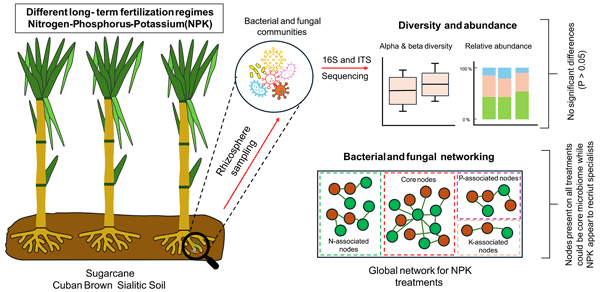
Fertilizer regimes reshape microbial interaction networks without altering sugarcane rhizosphere diversity
Leonardo Zamora-Leiva
Jorge Soto
Ignacio Ramos-Tapia

Sugarcane (Saccharum spp.), an economically important crop in the food and bioenergy industries, has historically played a central role in the Cuban economy, shaping its agricultural landscape and international relations. Although production has declined in recent decades, sugarcane remains a strategic crop, with its byproducts contributing to national energy and industrial outputs. However, how long-term fertilization shapes soil microbial communities across varying edaphoclimatic conditions remains largely unknown. Here, we investigated a traditional sugarcane plantation to evaluate how distinct fertilizer formulations varying in nitrogen, phosphorus, and potassium affect the soil and rhizosphere microbiota. Using high-throughput sequencing of 16S rRNA (bacterial) and internal transcribed spacer (fungal) genes, we identified 421 bacterial and 471 fungal genera from 5741 amplicon sequence variants across different fertilization regimes. While microbial composition and diversity did not differ significantly between treatments, a global co-occurrence network revealed a highly modular and stable trans-domain architecture. Furthermore, taxonomic overlap analysis highlighted a nutrient-specific recruitment of accessory taxa, suggesting that fertilization regimes may influence rhizosphere functioning by modulating specialized ecological niches rather than through broad taxonomic turnover. The findings provide a detailed characterization of the rhizosphere microbiome of Saccharum spp. in brown sialitic soils (inceptisol), offering ecological insights into its bacterial–fungal associations. This highlights the importance of understanding how long-term fertilization regimes influence rhizosphere microbial dynamics, which is key to designing more sustainable soil management and fertilization practices in sugarcane production systems.
- Article
(2732 KB) - Full-text XML
-
Supplement
(1323 KB) - BibTeX
- EndNote


Cultivated across tropical and subtropical regions for sugar and bioethanol production, sugarcane (Saccharum officinarum L.) is one of the most important industrial crops worldwide (Cherubin et al., 2018; Otto et al., 2022). Sugarcane is predominantly cultivated as a monoculture under intensive management systems that rely on long-term fertilization practices (Cherubin et al., 2018; Dinesh Babu et al., 2022; Khan et al., 2023) due to its high biomass productivity and nutrient demand. This results in cultivation that requires substantial inputs of nitrogen, phosphorus, and potassium (NPK) fertilizers (Cherubin et al., 2019). Sugarcane is primarily produced in Brazil, accounting for 38 % of global production, followed by India (23 %) and China (5 %) (Ritchie et al., 2023). Farmers worldwide have indiscriminately applied nitrogen fertilizers to ensure high crop yields, thereby emitting nitrous oxide into the environment (Tian et al., 2020). To increase nutrient availability, accumulation, and use efficiency in the current sugarcane crop system, new fertilization management strategies are needed. In several production systems, fertilizer application is one of the highest economic and environmental costs of sugarcane farming. This has strong implications for greenhouse gas emissions, soil acidification, and nutrient leaching (Wang et al., 2024). Therefore, assessing the interactions between fertilizer regimes and soil microbial communities in sugarcane agroecosystems has become a key priority (Liu et al., 2024). In Cuba, sugarcane cultivation has historically relied on fixed-dose fertilization schemes, primarily involving NPK (FAO, 2003). Even when these schemes account for soil heterogeneity and plant nutrient demands, sugarcane productivity in Cuba has declined due to inadequate attention to the crop, shortages of fuel and herbicides, reduced water availability, and other limitations (FAO, 2003, 2025). Fertilization regimes often do not consider microbial interactions, which can influence ecosystem functioning (Guo et al., 2020). Nutrient over- or under-application may occur, leading to reduced yields or environmental problems. This can include soil contamination through nutrient leaching and a loss of ecosystem services due to reduced microbial diversity (Berger et al., 2024; Du et al., 2025).
Closely related to fertilization systems, soil microbial communities are central regulators of terrestrial ecosystem functioning. They play essential roles in nutrient cycling, organic matter turnover, soil structure, and plant health (Du et al., 2025). Different ecosystems, including tropical agroecosystems, can host highly diverse microbial communities adapted to specific edaphoclimatic environments (Guo and Chen, 2022; Jiménez-Venegas et al., 2024; Ramos-Tapia et al., 2023; Tripathi et al., 2016; Zamora-Leiva et al., 2025). These microbial consortia are particularly relevant because they directly influence nutrient availability, plant productivity, and resilience to environmental stress (Antoszewski et al., 2022; Kumar et al., 2023; Núñez Salazar et al., 2020; Ramos-Tapia et al., 2022; Souza et al., 2025). Agricultural practices, including tillage, crop rotation, irrigation, and fertilization regimes, can have strong selective pressures on soil microbiomes. This can lead to shifts in microbial community composition and functionality (Liu et al., 2021b; Orrù et al., 2021; Sui et al., 2023). Climatic conditions, such as high rainfall and intense weathering, which are common in tropical ecosystems, often produce nutrient-poor, acidic, and highly leached soils with low cation-exchange capacity (Oishy et al., 2025). Therefore, understanding how soil microbial communities respond to different fertilization strategies is crucial to optimizing sustainable crop management and maintaining soil health.
Although continuous monocropping, combined with sustained fertilizer inputs, can strongly influence soil health and microbial community structure, the effects are not easily predictable. Long-term fertilization can produce contrasting outcomes, ranging from enhanced nutrient cycling to reduced microbial diversity and ecosystem resilience (Akter et al., 2025; Chen et al., 2023; Kracmarova et al., 2022; Pan et al., 2014). Nitrogen fertilization has been associated with decreases in microbial alpha diversity, community shifts toward copiotrophic taxa, and reductions in nitrogen-fixing microorganisms (Sui et al., 2023). Phosphorus and potassium amendments affect fungal communities, particularly arbuscular mycorrhizal fungi, which are highly responsive to changes in nutrient availability (Semenov et al., 2022; Yang et al., 2025). This indicates that fertilizer regimes can shape soil microbial assemblages in ways that alter nutrient cycling processes, soil–plant interactions, and ecosystem sustainability (de Castro et al., 2022; Mitter et al., 2021). However, soil microbial community responses to fertilization vary across ecosystems and are highly context-dependent (Kracmarova et al., 2022; Moneda et al., 2022). This response is influenced by several factors, including soil type (Huang et al., 2025), climate (Du et al., 2025), cropping history (Pan et al., 2014), and management intensity (Suman et al., 2022). In certain cases, microbial communities show considerable resilience, maintaining similar diversity and composition across a wide range of fertilization treatments (Philippot et al., 2021). This variability complicates extrapolating results across agroecosystems and underscores the need for site-specific studies (Souza et al., 2025).
Microbial communities are commonly studied through high-throughput sequencing techniques (Lahlali et al., 2021). These technologies have substantially expanded our ability to explore the structure and function of microbial communities in environmental samples, describing the taxonomic composition and relative abundance of microbial taxa across diverse ecosystems (Lahlali et al., 2021). However, while attention has been traditionally focused on how community composition and diversity shift under different environmental or management conditions, an equally important aspect lies in the relationships among microbial taxa (Zamkovaya et al., 2021). These interactions, whether cooperative, competitive, or neutral, shape the functional stability and resilience of microbial ecosystems (Freilich et al., 2011). Network-based approaches are powerful tools to explore these relationships, allowing the identification of co-occurrence patterns, ecological clusters, and potential keystone taxa that play central roles in ecosystem functioning (Shaw et al., 2020). Integrating network analysis with community profiling can provide a deeper understanding of how microbial communities respond to environmental factors, such as fertilization regimes (Gao et al., 2022).
In the context of Cuban agriculture, sugarcane is largely cultivated on brown sialitic soils, which are mineral-rich soils with relatively underexplored microbiological dynamics. Understanding how fertilization interacts with local edaphoclimatic conditions is essential for improving sustainable management strategies and maintaining soil function in tropical agroecosystems. However, traditional fertilization recommendations in Cuba, such as those from SERFE (Servicio de Recomendaciones de Fertilizantes), primarily focus on crop nutritional requirements and do not explicitly account for soil microbial processes. Notably, available yield records from the long-term fertilization trial, established in 1998 at the Sugar Cane Research Institute in Santiago de Cuba, indicate that while fertilized plots consistently outperform non-fertilized controls, sugarcane yield tends to plateau across a wide range of NPK fertilization regimes, with limited differences among moderate and high input treatments (Table S1 in the Supplement (Tamayo-Isaac et al., 2024)). This apparent decoupling between fertilizer dose and yield response suggests that factors other than nutrient availability alone may regulate system functioning under long-term management. We therefore hypothesized that sustained fertilization under tropical conditions leads to physicochemical homogenization of these soils, generating changes in microbial community composition and promoting nutrient-specific reorganization of microbial interactions within the rhizosphere. To test this hypothesis, we leveraged the long-term fertilization trial established in 1998 at the Sugar Cane Research Institute in Santiago de Cuba, which provides a rare opportunity to assess the legacy effects of sustained fertilization on soil microbial network structure. Using high-throughput sequencing of bacterial (16S rRNA gene) and fungal (internal transcribed spacer; ITS region) markers, we evaluated how gradients of NPK inputs shape both microbial composition and co-occurrence networks in rhizosphere and bulk soil samples.
2.1 Experimental design and sample collection
2.1.1 Profile of the experimental site
The long-term experiment, encompassing different mineral fertilization rates of NPK, was established in 1998 on sialitic brown soil at the Estación Territorial de Investigaciones de la Caña de Azúcar (ETICA) Oriente Sur, and has maintained the same fertilization regime across the years. Crucially, fertilization regimes assigned to each plot have been strictly and continuously maintained without interruption since the trial began. The study reproduced the traditional sugarcane cultivation system used in Cuba, featuring manual planting and an annual harvesting scheme. Crop management followed consistent 5-year cycles, consisting of one initial plant cane harvest followed by four ratoon harvests, before the plots were entirely replanted. The station is located in the municipality of Palma Soriano in the province of Santiago de Cuba (Sieiro and Pablos, 2021). Sialitic brown soils have moderate organic matter content, high clay fraction, and a dominance of exchangeable Ca2+ and Mg2+. These properties contribute to a relatively stable pH and high cation exchange capacity. The area is characterized by a humid tropical climate, with an average annual rainfall of 1375 mm, and two well-defined periods: rainy (May–October) and dry (November–April). For the current study, sampling was conducted in March 2022, during the second ratoon crop on the ongoing cycle (which was planted in spring 2020 with cultivar C86-12). Because there were no gaps in management between 1998 and 2022, the soil properties and microbial communities evaluated herein reflect the robust, cumulative 24-year legacy of these continuous, treatment-specific fertilization practices.
2.1.2 Experimental design
The completely randomized block experiment included 11 treatments, with different co-concentrations of NPK, all expressed in kg ha−1 (Table 1): (i) N0 (N0P25K50), no nitrogen application; (ii) N1 (N50P25K50), as a basal application of nitrogen, phosphorus and potassium; (iii) N2 (N100P25K50), medium nitrogen application; (iv) N3 (N150P25K50), high nitrogen application; (v) N4 (N200P25K50), very high nitrogen application; (vi) N5 (N50P0K0), only nitrogen application; (vii) P1 (N50P75K50), medium phosphorus application; (viii) P2 (N50P100K50), high phosphorus application; (ix) K1 (N50P25K100), medium potassium application; (x) K3 (N50P25K200), high potassium application; and (xi) K4 (N50P25K300), very high potassium application.
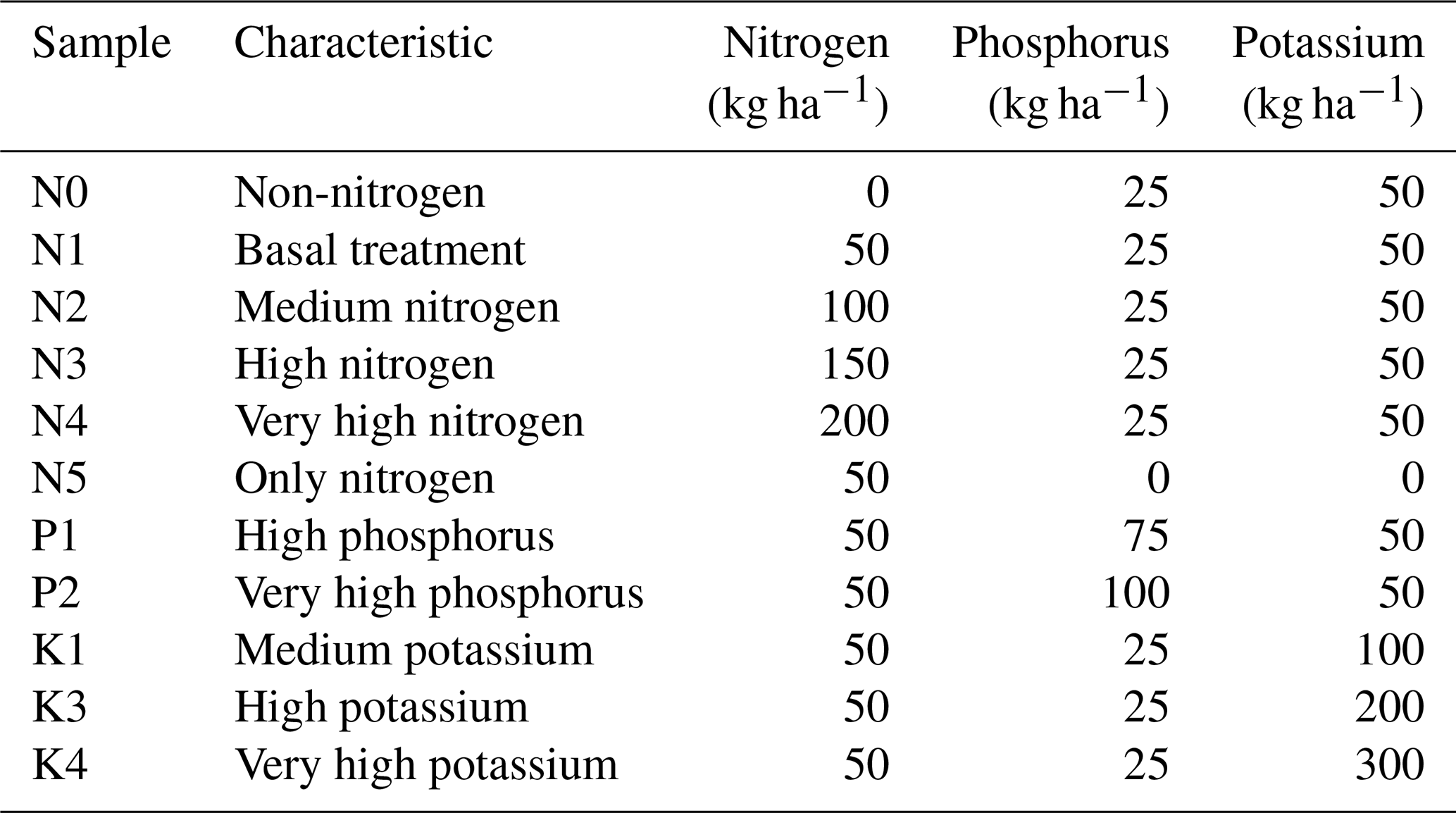
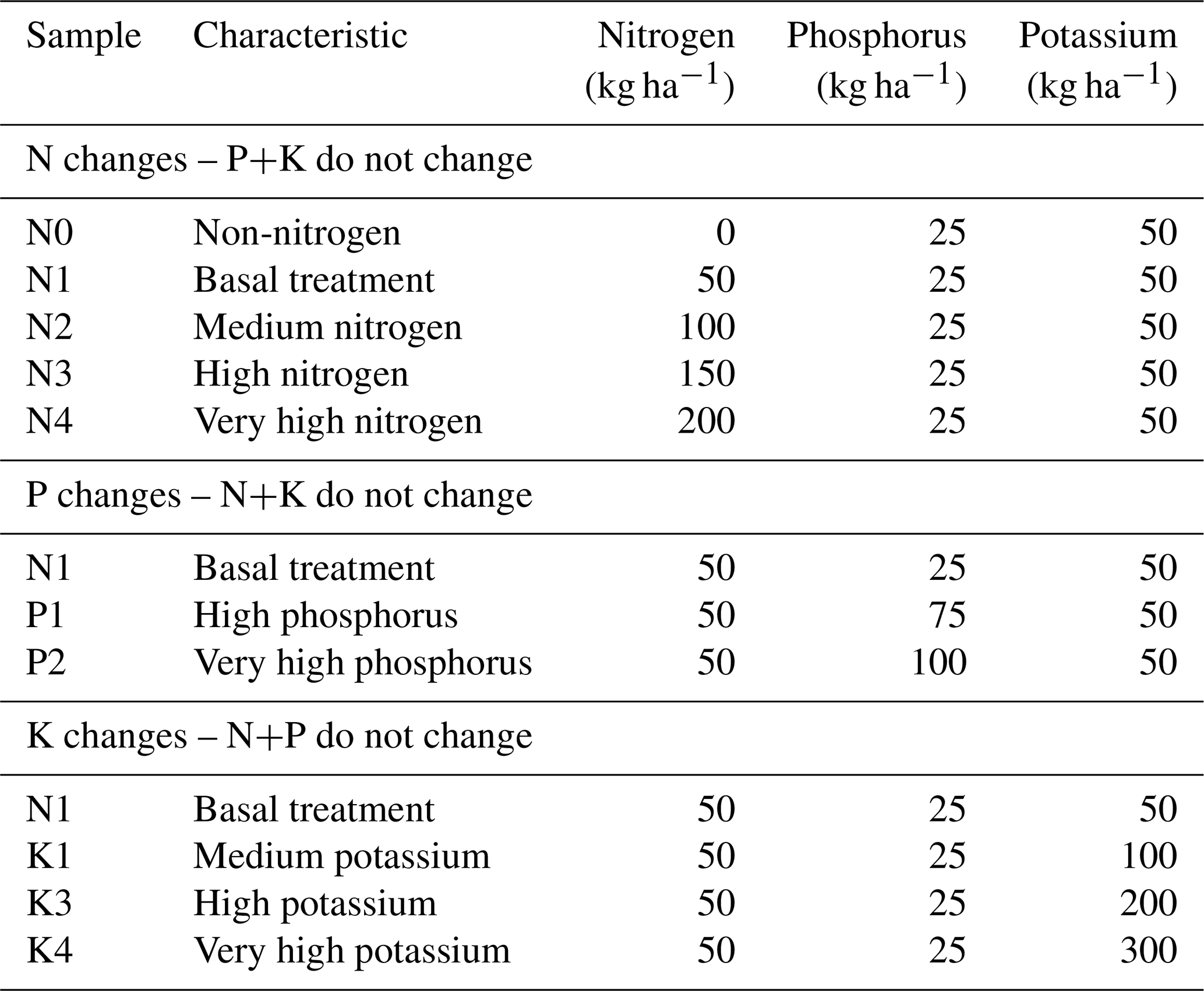
Derived from the experimental design, three comparison groups were generated to evaluate different parameters (Table 2): (i) effect of the increase in nitrogen, (ii) effect of the increase in phosphorus, and (iii) effect of the increase in potassium.
Two controls were considered: bulk soil without planting (blank) and rhizosphere without fertilization (control). Each treatment was repeated three times, and each replicate was 48 m2. The chemical fertilizers applied were urea (46 % N), calcium superphosphate (12 % P2O5), and potassium chloride (60 % K2O). All fertilizers were applied at the bottom of the furrow before planting and 20 d post-harvest, manually and without fractioning doses (INICA, 1990). The evaluated plot had received three fertilizer applications by the sampling date, with planting in spring 2020 and sampling in March 2022, corresponding to the initial application plus those made after each cutting/ratoon.
2.1.3 Soil sampling
Sugarcane root systems were extracted at a depth of 10 cm and gently shaken to remove the loosely bound bulk soil. The soil that remained firmly adhered to the roots was considered the rhizosphere. These root-adhering soil samples were then carefully collected into 50 mL Falcon™ tubes (Thermo Fisher Scientific, Waltham, MA, USA) until the volume was filled with roots. The tubes were immediately sealed to avoid environmental contamination, labeled, and stored at 4 °C during the laboratory transport (Ramos-Tapia et al., 2022). Plants were vortexed to dislodge soil particles adhering to the roots, and this soil was subsequently used for DNA extraction. Simultaneously, the soil removed from around the roots (within 3 cm) was collected as a composite soil sample for physicochemical analysis. The composite soil (control and blank) samples comprised five subsamples of approximately 200 g, which were combined and mixed to better capture the natural heterogeneity of the sampled area. Subsequently, these composite soil samples from each experimental plot were used for chemical analysis and soil respiration, developed by ETICA (Tamayo-Isaac et al., 2023, 2024). Sampling was conducted in March, one of the driest months of the year (Centella et al., 2007; Durán, 2012). For physicochemical parameters, pH in water and KCl was measured with potentiometric method (soil:solution ratio 1:2.5); organic matter with Walkley–Black colorimetric method, digestion with H2SO4, K2Cr2O7 1 N (ox.) and FeSO4 x7 H2O 0.5 N (red.), using Vam Bemmen's factor (1.724) to convert carbon into organic matter; assimilable phosphorus as P2O5 mg per 100 g with Oniani method, extraction with 0.1 N H2SO4, soil:solution ratio 1:2.5, determination by colorimetry; assimilable potassium as K2O mg per 100 g with Oniani method, extraction with 0.1 N H2SO4, soil:solution ratio 1:2.5, by flame photometry; and exchangeable bases (K+, Ca2+, Mg2+, and Na+) as cmol(+) kg−1 with extraction with 1N NH4OAc at pH 7, determining calcium and magnesium by EDTA titration, sodium and potassium by flame photometry (INICA, 1990; Tamayo-Isaac et al., 2024). Soil physicochemical properties were analyzed using a one-way ANOVA (p<0.05) followed by Tukey's HSD post-hoc test.
2.1.4 DNA extraction, PCR, and sequencing
Microbial DNA was successfully extracted from 39 samples, comprising 33 fertilized rhizosphere samples (11 treatments with three replicates each), three non-fertilized rhizosphere controls, and three bulk-soil (blank) controls. For each sample, genomic DNA was extracted from 0.5 g of fresh soil using the DNeasy Powersoil DNA isolation kit (Qiagen, Hilden, Germany), according to the manufacturer's instructions. DNA concentration and purity were checked using a Qubit dsDNA HS Assay kit and Qubit 4.0 fluorometer (Thermo Fisher Scientific). The V3-V4 hypervariable regions of the 16S rRNA gene were amplified with the primers 5′-CCTACGGGGGNGGCWGCAG-3′ and 5′-GACTACHVGGGTATCTAATCC-3′ (Klindworth et al., 2013). Meanwhile, for the fungal ITS1 and ITS2 regions, the primers 5′-CTTGGTCATTTAGAGGAAGTAA-3′ and 5′-GCTGCGTTCTTCATCGATGC-3′ were used (Orgiazzi et al., 2012). Amplification and bulk sequencing were performed with Illumina MiSeq technology by Austral-Omics (Universidad Austral de Chile). The sequencing process was performed with the Miseq Reagent v3 600-cycle kit (2 × 250 pair-end). The sequences were imported as FASTQ files with forward and reverse for each sample.
2.1.5 Bioinformatic analysis
The FASTQ files were processed using QIIME 2 v2025.7 (Caporaso et al., 2010). Read quality was evaluated using FastQC v0.11.9 (Andrews, 2010). Based on this evaluation, adapters were removed, and the forward and reverse sequences were trimmed to 260 and 205 bp for bacteria and to 250 and 220 bp for fungi, respectively, using the DADA2 denoise-paired plugin (Callahan et al., 2016). Quality was maintained using PHRED 20 (Callahan et al., 2016). Taxonomic assignment was performed using the classify-sklearn plugin in the SILVA database version 138.2 (Quast et al., 2013) and UNITE database version 10.0 (Abarenkov et al., 2024), for bacterial and fungal classification, respectively, both preprocessed with RESCRIPt (Robeson et al., 2021). New unified Amplicon Sequence Variant (ASVs) with 99 % identity were aligned using MAFFT (Katoh and Standley, 2013). The maximum likelihood was inferred using FastTree v2.2.0 (Price et al., 2009). The abundance, taxonomy, phylogeny, and metadata of the ASVs were integrated into a Microeco object for subsequent analyses using the Microeco v1.15.0 R package (Liu et al., 2021a), in R v4.3.2 (R Core Team, 2023). ASVs assigned to archaea, mitochondria, chloroplasts, metagenomes, and ambiguous taxa were deleted, as well as fungal ASVs in bacterial analysis, and bacterial ASVs for fungal analysis. Samples with < 1000 reads were excluded; however, all samples met the criteria. ASVs that did not occur more than twice in at least 10 % of the samples were also excluded (Callahan et al., 2017). To minimize potential bias, unclassified ASVs were strictly retained in all analyses but excluded from taxonomic visualizations to ensure that the discussion focused on identifiable biological entities. The Microeco object was used to calculate alpha and beta diversities and for constructing relative abundance plots (Liu et al., 2021a). Alpha diversity was calculated using observed features – species richness on samples, Shannon – entropic information on abundance of observed ASVs, and Simpson (1-dominance) indices. Alpha diversity metrics were assessed using the Kruskal-Wallis test, and beta diversity differences were evaluated using Permutational Multivariate Analysis of Variance (PERMANOVA).
To determine beta diversity, all samples were compared across sampling points using the Bray–Curtis, Canberra, Jaccard, Robust Aitchison, Unifrac, and weighted Unifrac matrices. Significant differences were evaluated using Kruskal–Wallis tests and PERMANOVA. ASVs were transformed into proportions, and relative abundance was used to measure the composition of microbial communities at the phylum, class, order, family, and genus levels. All samples were rarefied according to the minimum sample size of 11 248 and 18 829 for bacteria and fungi, respectively. Differential taxon abundance was analyzed by implementing Linear Discriminant Analysis Effect Size (LEfSe, linear discriminant analysis [LDA] value > 2, α = 0.05), supported with an Analysis of Compositions of microbiomes with Bias Correction 2 (ANCOM-BC2) analysis.
For the co-occurrence network and overlapping community analyses, the bacterial and fungal datasets were merged at the ASV level. To account for differences in sequencing depth, the complete dataset was rarefied to a uniform depth of 11 248 reads per sample, using the trans_rarefy function from the Microeco R package. To evaluate microbial interactions, a single, unified global trans-domain network incorporating all 39 samples was constructed using the cal_network function in the Microeco R package (which implements igraph v2.1.4). Pairwise correlations between ASVs were computed using Spearman's rank with Benjamini-Hochberg false discovery rate (FDR) correction (Looney and Hagan, 2011), retaining only robust and significant connections (Spearman rho > 0.6, adjusted p < 0.01). Network modularity was defined as the extent to which a network is organized into cohesive subgroups of nodes (modules), with higher within-module connectivity than between modules. Modules were detected using the cluster_fast_greedy algorithm, and modularity values were computed with the modularity function in the igraph R package. Network hubs were identified based on within-module connectivity (Zi) and among-module connectivity (Pi) using the get_node_table function from the Microeco R package. The network was constructed with co-occurrences between ASVs and visualized using Gephi v0.10.1 (Bastian et al., 2009). Finally, to evaluate the specific influence of each macronutrient on microbial recruitment, we performed a sequential overlap analysis based on presence/absence matrices with the trans_venn function. Unclassified ASVs and Incertae sedis were filtered out before analysis to ensure that all overlapping communities corresponded to identifiable biological entities. Initially, a universal core microbiome was identified by intersecting all experimental conditions (N, P, and K gradients). Nutrient-specific accessory microbiomes were then filtered by excluding ASVs present under the basal condition (N1) or associated with multiple fertilization treatments. We identified nutrient-specific specialists by calculating the intersection of ASVs present exclusively in the modified treatments (e.g., nitrogen gradient) while simultaneously excluding those detected in the basal soil or across parallel treatments (e.g., phosphorus or potassium gradients for nitrogen analysis). The resulting intersection patterns and microbial recruitment dynamics were visualized as UpSet plots using the UpSetR package v1.4.1.
3.1 Physicochemical characterization of brown sialitic soils under different fertilization regimes
The physicochemical properties of soils across fertilization treatments are summarized in Table 3. The data showed minimal variation among treatments, suggesting strong homogenization of soil conditions across the experimental site. Soil pH values remained nearly constant, ranging from 6.4 to 6.5 (HCl) and 7.7 to 7.9 (H2O). This indicates a slightly acidic-to-neutral reaction, typical of sialitic soils. This stability is consistent with the buffering capacity conferred by high levels of exchangeable calcium (58–69 cmol(+) kg−1) and magnesium (0.4–11 cmol(+) kg−1). While statistical differences were detected among plots (one-way ANOVA, p<0.05, Table S1), the sum of exchangeable calcium and magnesium remained consistently high across the entire experimental site, strictly constrained within a highly saturated range (60.7–72.2 cmol(+) kg−1). This persistently high reservoir of basic cations reinforces the notion of a chemically buffered soil matrix that can resist dramatic acidification despite long-term fertilization. Organic matter (OM) content ranged from 2.9 % to 3.9 %, with no clear trends associated with fertilization. Similarly, available phosphorus (P2O5) and potassium (K2O) concentrations exhibited broad ranges (P2O5: 63–139 mg per 100 g; K2O: 25–88 mg per 100 g). Despite statistical differences among plots (one-way ANOVA, p<0.01; Table S1), these variations did not translate into distinct patterns of nutrient enrichment in response to applied fertilizers. This lack of correlation suggests that rapid nutrient turnover or leaching, potentially driven by intense rainfall and the clay-rich matrix of sialitic soils, may diminish the effect of fertilization inputs.
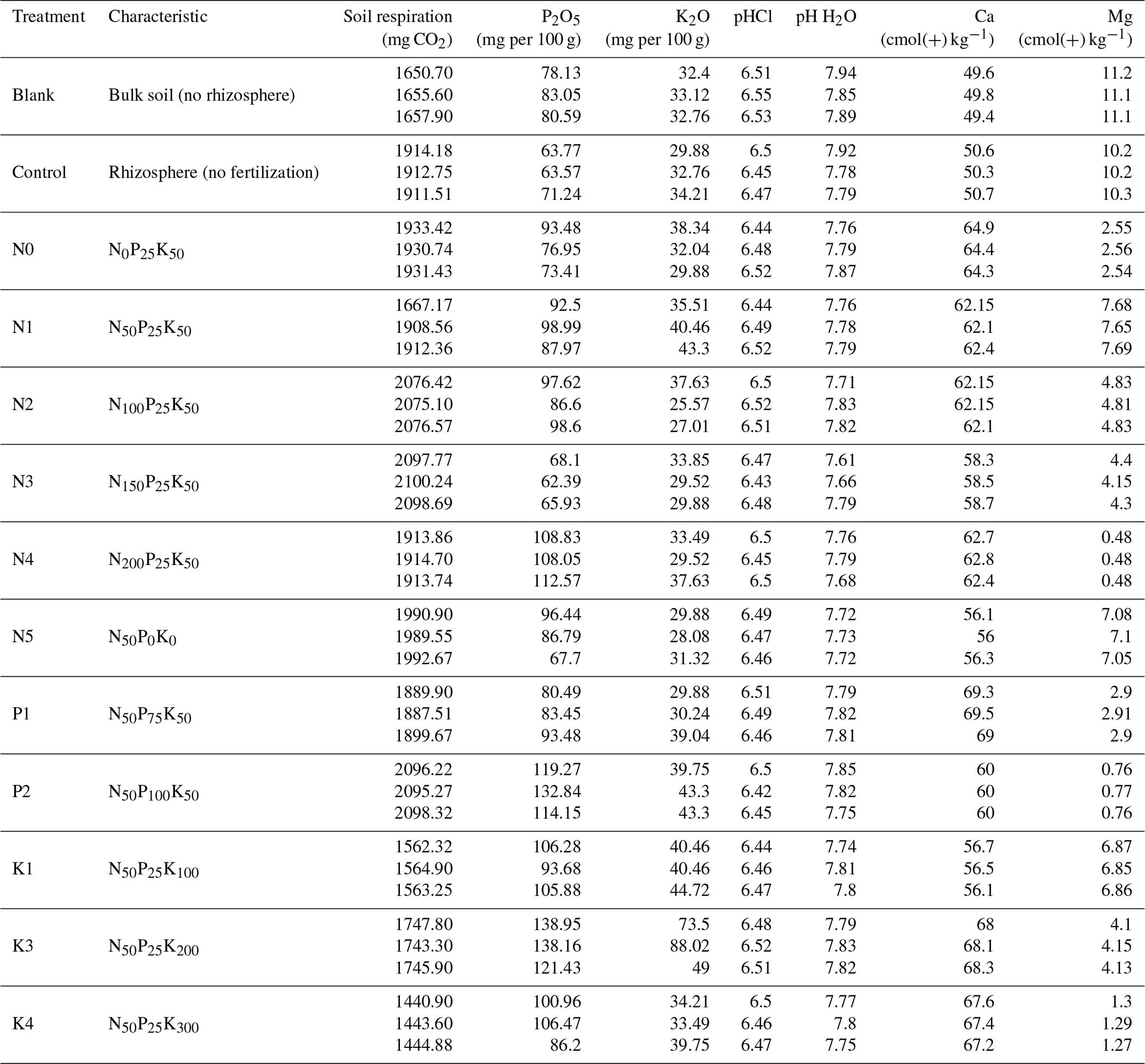
Soil respiration, i.e., microbial CO2 release after 9 d of incubation, ranged between 1440 and 2100 mg CO2, with significant differences among treatments (one-way ANOVA, p<0.05, Table S1). However, soil respiration exhibited erratic spatial variations, with the unplanted bulk soil (blank) showing higher respiration rates than several fertilized rhizosphere plots. This lack of logical correlation strongly suggests that historical field heterogeneity, rapid nutrient turnover, and severe leaching, driven by the intense rainfall characteristic of the tropical climate and the clay-rich matrix of sialitic soils, have overridden the immediate effects of the fertilizer inputs. Although microbial activity was slightly higher in plots with intermediate and high nitrogen and medium phosphorus fertilization (> 2000 mg CO2 in each case), the inconsistent pattern prevents establishing a direct link between fertilizer dose and microbial respiration. Crop yield also showed minor fluctuations, ranging from 87.7 to 99.8 t ha−1. It appeared to be negatively affected by high nitrogen fertilizer levels, with the high (N150) and very high (N200) treatments yielding the lowest among the fertilized plants (Table S1). Despite the application of nutrient gradients, soil and plant responses remained broadly decoupled from the theoretical fertilizer inputs.
3.2 Characterization of bacterial and fungal communities
Microbial DNA was successfully extracted from a total of 39 samples, comprising 33 rhizosphere samples (11 treatments with three replicates each), three non-fertilized rhizosphere samples (control), and three bulk soil (non-rhizosphere) samples (blank). For the bacterial and fungal analyses, we obtained 3034 and 2707 ASVs identified post-quality filters among all the samples, with a median of 16 883 and 48 883 reads per sample, respectively. Taxonomic assignments were made at the phylum (98.26 % and 91.28 %), class (96.94 % and 85.52 %), order (89.46 % and 84.97 %), family (68.98 % and 73.59 %), and genus (34.46 % and 66.89 %) levels, in bacteria and fungi, respectively. The percentage of classified ASVs diminished substantially for the bacterial sequences. Meanwhile, nearly twice as many fungal ASV sequences were classified at the genus level.
Across all fertilization treatments, bacterial communities associated with the rhizosphere of Saccharum spp. were dominated by a few major phyla. This reflected a relatively stable community structure. The most abundant bacterial phyla were Actinomycetota, Pseudomonadota, and Acidobacteriota, which together accounted for approximately 60.4 % of the total relative abundance. Subdominant groups included Bacillota and Planctomycetota, each representing less than 16.6 % of the total sequences (Fig. 1A). Within these major lineages, members of Bacilli (Bacillota), Alphaproteobacteria (Pseudomonadota), Vicinamibacteria (Acidobacteriota), and Thermoleophilia (Actinomycetota) were present across all treatments at relative abundance exceeding 11 %. This suggests that the fertilization regime did not substantially alter the core microbiota composition (Fig. 1B). Minor variations were observed in the relative abundance of Actinomycetota, which increased in soils receiving higher nitrogen inputs. However, these differences were not statistically significant (Kruskal–Wallis, P>0.05). Although Actinomycetota was the dominant phylum, Bacillota comprised the most represented taxa from class to genus levels, demonstrating that most ASVs in this phylum were successfully classified. At the order level, the number of incertae sedis and unclassified taxa increases, representing the fifth and sixth in relative abundance, respectively, with 7.4 % and 3.1 % of the total relative abundance (Fig. 1C). Relative abundances at the genus level are detailed in Fig. S1 in the Supplement.
Among fungal communities, the phylum Ascomycota was dominant across all treatments, with a relative abundance exceeding 69 %. This was followed by Basidiomycota and Chytridiomycota, which together represented almost 18 % of relative abundance (Fig. 2A). Six minor groups, such as Kickxellomycota, Glomeromycota, Calcarisporiellomycota, Mucoromycota, Neocallimastigomycota, and Zoopagomycota, were present in lower abundances (< 1 %) and did not show significant treatment-related variation (Fig. 2A). At the class level, even when several taxa appeared to be involved in the ecosystem, only three classes represent more than 65.4 % (Sordariomycetes, Eurotiomycetes, and Leotiomycetes), which belong to the Ascomycota phylum (Fig. 2B). This behavior repeats at the order level, where six taxa (Eurotiales, Helotiales, Hypocreales, Sordariales, Chaetothyriales, and Pleosporales) that belong to the phylum Ascomycota represent more than 54 % of the total (Fig. 2C). This result underscores the importance and prevalence of a few representatives of the phylum Ascomycota in sugarcane communities. Relative abundances at the genus level are detailed in Fig. S2.
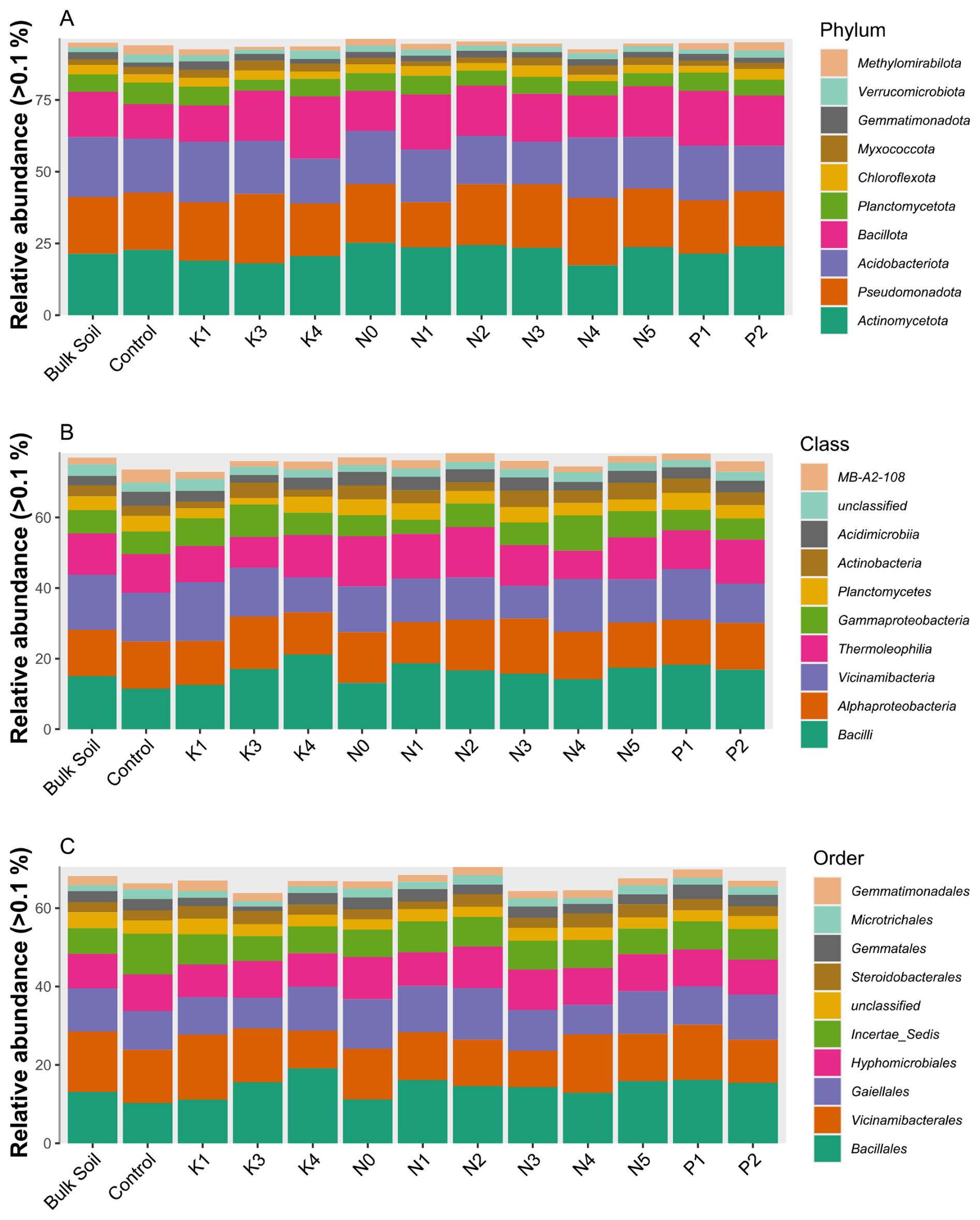
Figure 1Bacterial relative abundance at three different taxonomic levels. (A) 10 most abundant bacteria per sample at the phylum level, (B) 10 most abundant bacteria per sample at the class level, and (C) 10 most abundant bacteria per sample at the order level. Sample abbreviations: K1, medium potassium application; K3, high potassium application; K4, very high potassium application; N0, no nitrogen application; N1, low nitrogen application; N2, medium nitrogen application; N3, high nitrogen application; N4, very high N application; N5, only nitrogen application; P1, medium phosphorus application; P2, high phosphorus application.
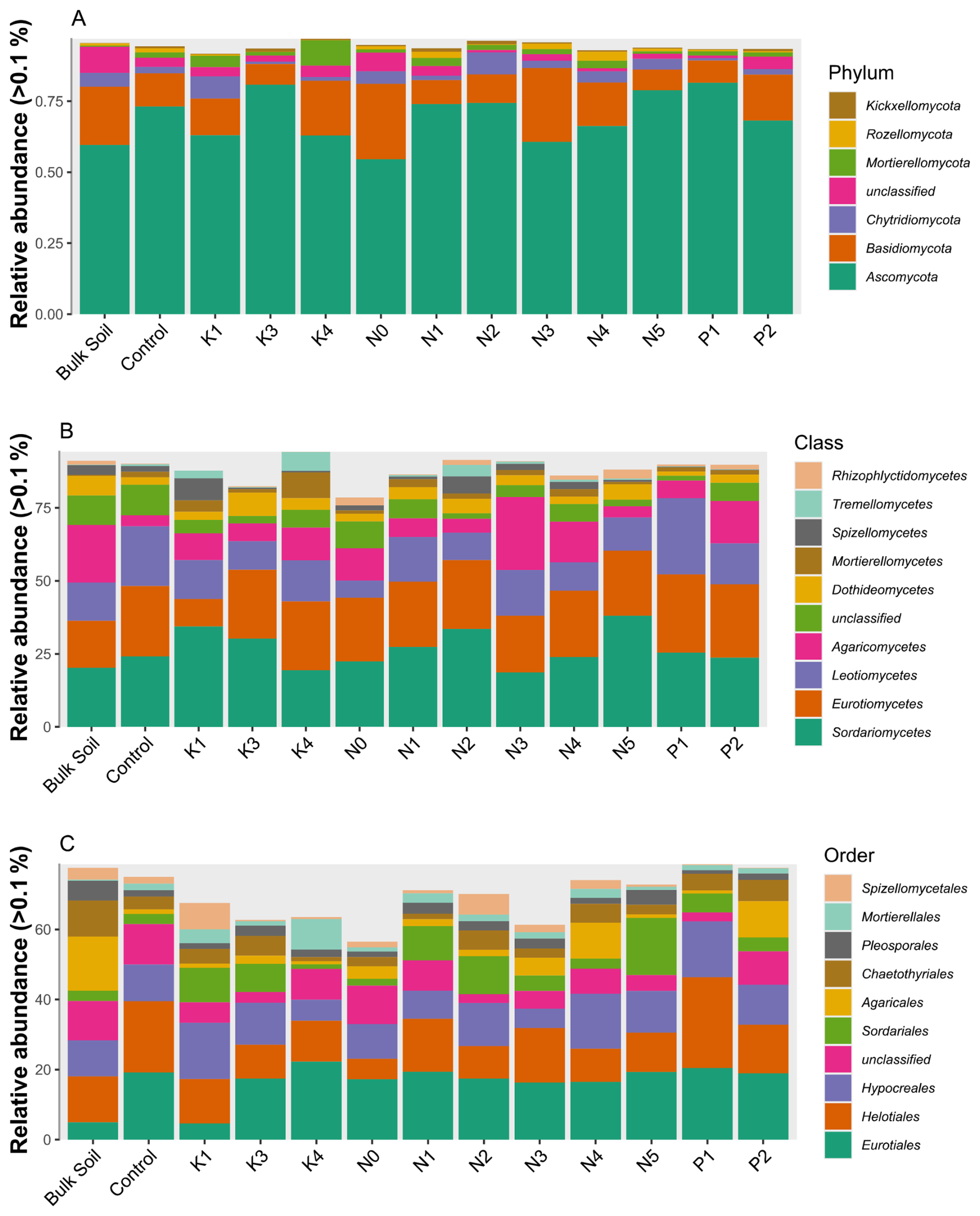
Figure 2Fungal relative abundance at three different taxonomic levels. (A) 10 most abundant fungi per sample at the phylum level, (B) 10 most abundant fungi per sample at the class level, and (C) 10 most abundant fungi per sample at the order level. Sample abbreviations: K1, medium potassium application; K3, high potassium application; K4, very high potassium application; N0, no nitrogen application; N1, low nitrogen application; N2, medium nitrogen application; N3, high nitrogen application; N4, very high N application; N5, only nitrogen application; P1, medium phosphorus application; P2, high phosphorus application.
3.3 Alpha and beta diversity analysis
Alpha diversity indices (Observed, Shannon, and Simpson) showed no significant differences among fertilization treatments for either bacterial or fungal communities (Kruskal–Wallis, P>0.05, Figs. S3 and S4, respectively). This pattern indicates that nutrient fertilization did not significantly affect within-sample diversity. Microbial communities remained compositionally stable despite long-term exposure to different NPK regimes (Fig. 3). Even so, bacterial communities exhibited relatively high species richness and evenness, with average Shannon indices ranging from 4.9 to 5.9. Meanwhile, fungal diversity indices were lower, ranging from 2.9 to 4.3, suggesting a more specialized community structure in the rhizosphere.
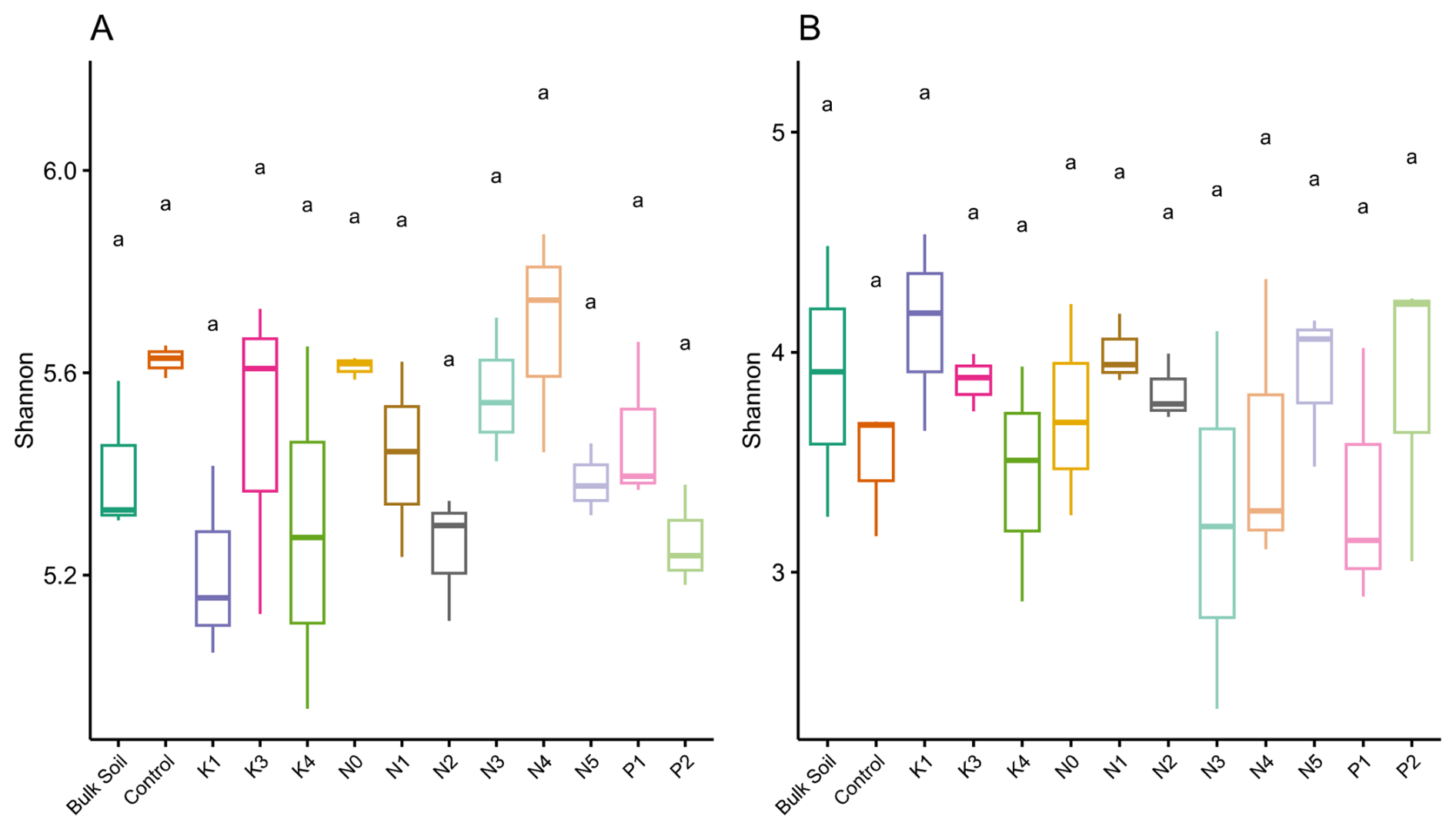
Figure 3Alpha diversity for rhizosphere and soil samples based on the Shannon index. (A) Bacterial and (B) Fungal. Dunn's Kruskal–Wallis test, non-significant. Sample abbreviations: K1, medium potassium application; K3, high potassium application; K4, very high potassium application; N0, no nitrogen application; N1, low nitrogen application; N2, medium nitrogen application; N3, high nitrogen application; N4, very high N application; N5, only nitrogen application; P1, medium phosphorus application; P2, high phosphorus application.
Based on six indices (Bray–Curtis, Canberra, Jaccard, Robust Aitchison, Unifrac, and weighted Unifrac matrices), beta diversity analysis showed no clear clustering of samples according to fertilization treatment (PERMANOVA, P>0.05; Fig. 4 shows the Bray–Curtis matrix as a representative). This implies that other environmental factors, such as soil texture, OM, or rainfall regime, may have a stronger influence on microbial assemblages than the applied fertilization treatments. Principal Coordinate Analysis does not reveal clustering among samples across different fertilization treatments. The microbial communities associated with Saccharum spp. in brown sialitic soils are compositionally rich, yet functionally stable, showing limited responsiveness to changes in nutrient fertilization.
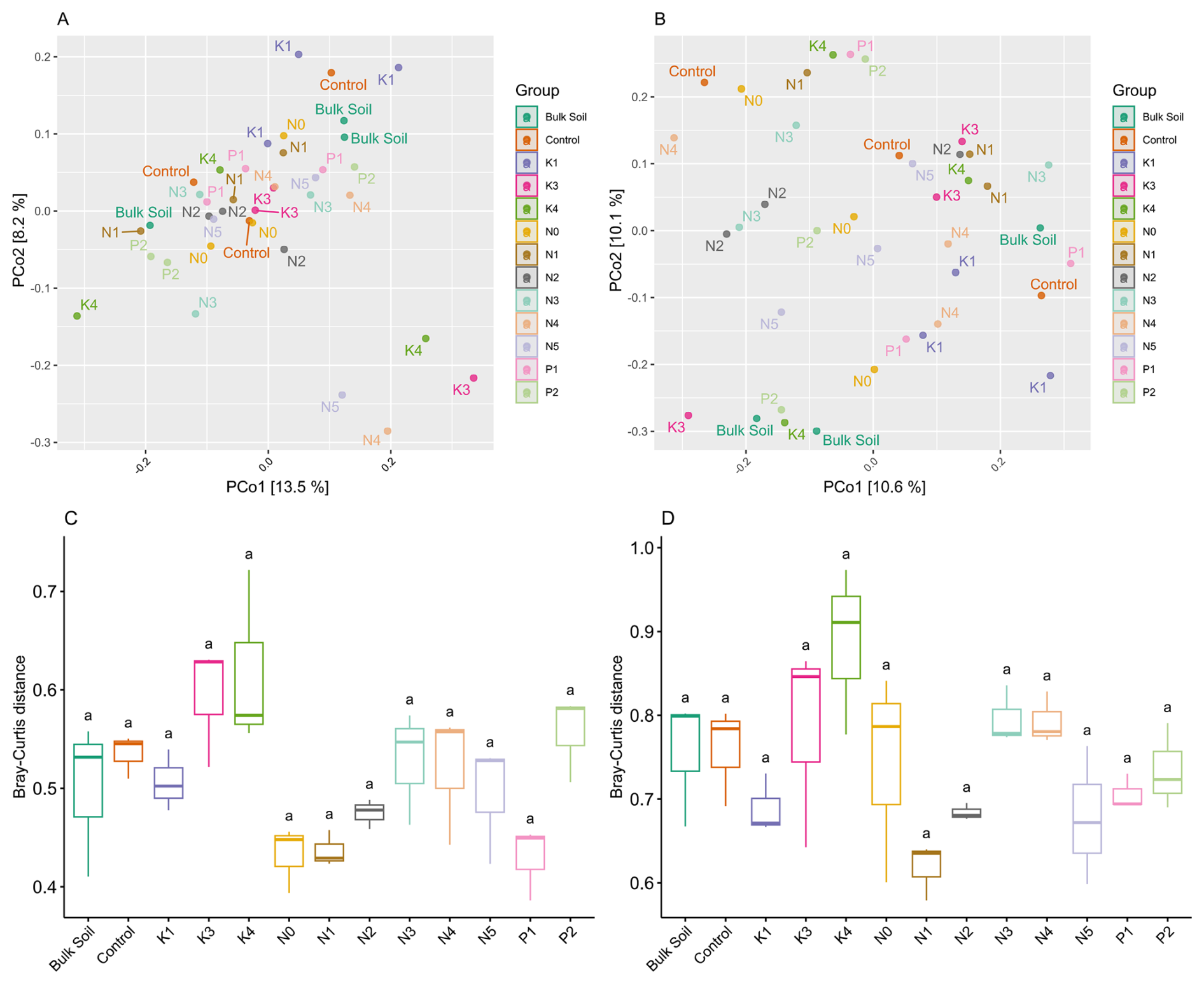
Figure 4Beta diversity for rhizosphere and soil samples. Principal coordinate analysis determined by using the Bray–Curtis method test for (A) Bacterial and (B) Fungal communities; and group distances calculated with Dunn's Kruskal–Wallis test for (C) Bacterial and (D) Fungal communities, with non-significant differences.
To further investigate potential treatment-driven shifts at specific taxonomic levels, differential abundance analyses were conducted using LEfSe and ANCOM-BC2. Notably, neither approach identified any taxa with statistically significant differential abundance among the evaluated fertilization regimes (LDA score < 2.0; adjusted p>0.05). This lack of significant biomarkers further corroborates the overall compositional stability of the sugarcane rhizosphere microbiome across treatments.
3.4 Co-occurrence between bacterial and fungal taxa
The global cross-domain co-occurrence network integrating the bacterial and fungal datasets indicated a complex and heterogeneous microbial structure, encompassing 371 nodes and 747 edges (Fig. 5). Taxonomic annotations demonstrated a clear numerical predominance of fungal taxa within the network topology (218 fungal nodes vs 153 bacterial nodes). The phylum Ascomycota was the most heavily represented in the network, followed closely by Basidiomycota. Among the bacterial domain, the network was primarily supported by members of Pseudomonadota, Bacillota, Actinomycetota, and Planctomycetota. This topological distribution suggests that fungi may play a central structural role within the rhizosphere-associated microbiome in sugarcane cultivated in brown sialitic soils, while diverse bacterial taxa appear to integrate into this framework, potentially providing extensive functional connections. Notably, while the phylum Methylomirabilota exhibited a notable relative abundance (1.8 %), its representation in the network was limited, highlighting the distinction between raw abundance and ecological interaction roles.
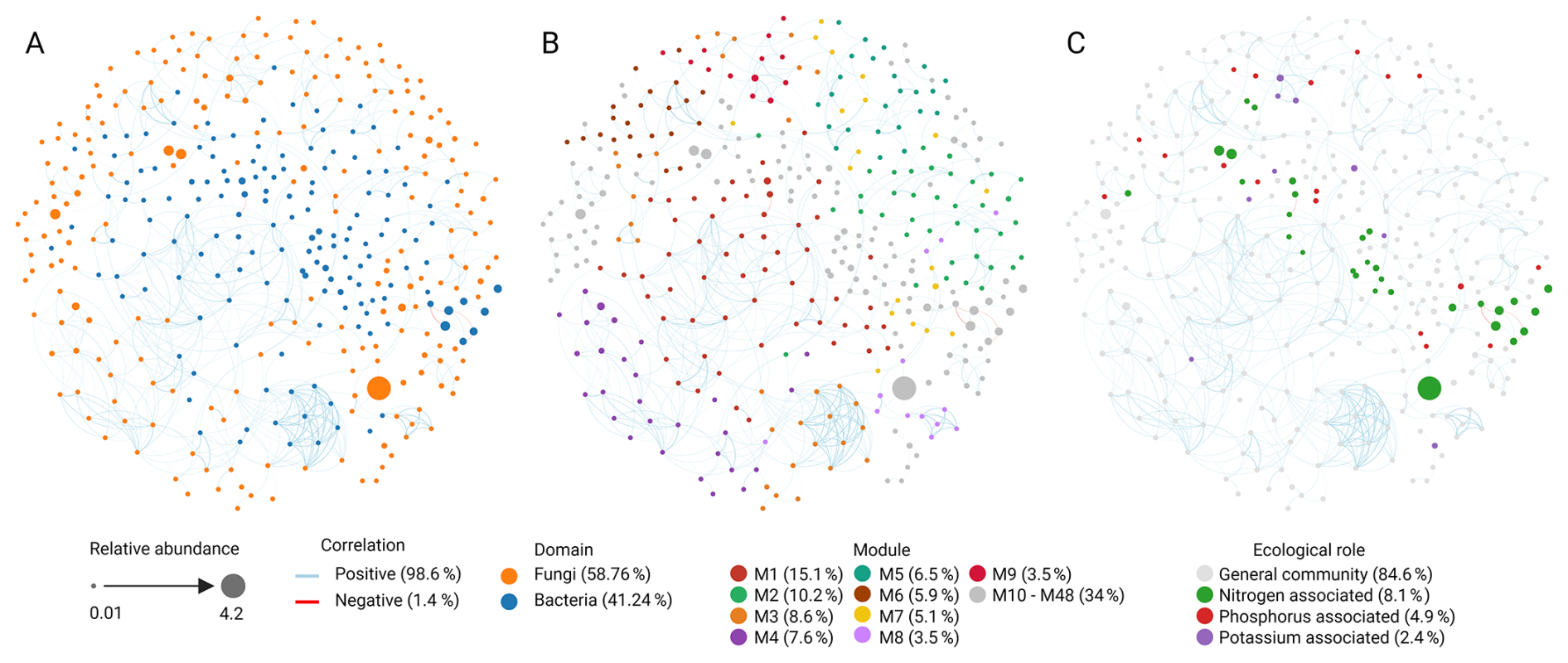
Figure 5Microbial interaction network. Bacterial and fungal ASVs are graphed as nodes. The relative abundance is displayed as the size of the nodes, while the relationship between nodes is displayed as edges (positive relations, lightblue line; negative correlations, red). The networks show: (A) Fungi (orange) and Bacteria (blue); (B) modules; and (C) Ecological role related to general community (grey), nitrogen associated (green), phosphorus associated (red), and potassium associated (purple) ASVS. Significant positive Spearman correlations are graphed as edges (ρ > 0.6, false discovery rate adjusted P < 0.01, two-sided).
The global network was organized into 48 distinct structural modules (Fig. 5B), indicating that independent trans-domain clusters of microorganisms coexist within the rhizosphere. However, the community architecture was heavily dominated by five major modules (M1–M5), which accounted for 48.2 % of the total network nodes. According to the Zi-Pi topological analysis, the vast majority of ASVs (95 %) acted as peripheral nodes, while a small but highly connected subset served as connectors and module hubs, potentially serving as stabilizers of the overall architecture (Fig. S5). Notably, fungi generally exhibited higher connectivity (degree) than bacteria, suggesting that they may serve as key structural components of the network. Among these, one ASV was classified as a potential hub or keystone taxon; both belonged to the phylum Pseudomonadota but with no classified genus (Fig. S5). Among the bacteria, highly connected taxa included members of Pseudomonadota, such as Pseudomonas and Steroidobacter, and Actinomycetota (Gaiella and Streptomyces). Meanwhile, fungi showed greater connectivity than bacteria, with higher degrees within the network. Even though the largest number of nodes belonged to Ascomycota and Basidiomycota, Mortierellomycota also showed higher connectivity than bacteria with higher node numbers. The interactions between bacteria and fungi appear to be even (Fig. S6).
A substantial portion of the network nodes corresponded to unclassified taxa from both fungal and bacterial groups. This indicates that a substantial portion of the interacting “microbial dark matter” in these soils remains taxonomically unresolved but may represent a consistent and relevant structural component of the community. Furthermore, the network topology was overwhelmingly dominated by positive correlations (99.8 %), with only five negative correlations, all between Pseudomonadota and Bacillota ASVs. This result reflects potential mutualistic, commensal, or shared environmental responses among microorganisms rather than competitive exclusion. This strong predominance of positive associations may contribute to the observed ecological resilience of these soils, as community composition remained largely unchanged across fertilization regimes.
3.5 Taxonomic breakdown of shared and exclusive microbial groups across fertilization regimes
To identify shared and exclusive ASVs across different fertilization strategies without the statistical limitations of small-sample networks, trans-domain overlap analysis was generated directly from the standardized abundance matrices (Figs. 6 and S7). To identify nutrient-specific ASVs, we compared the basal condition (N1) with each subsequent nutrient addition and identified ASVs detected exclusively following the addition of that nutrient. From here, we identified microorganisms associated with the presence of NPK (described in Supplementary Table “Shared ASs”). The Universal Resiliency Core: By crossing the conserved taxa across all experimental gradients (NPK), we identified a highly conserved, trans-domain universal core of 76 ASVs (Fig. 6A and Supplement Table “Shared ASVs”). This basal core likely represents a foundational component of the sugarcane rhizosphere in these soils, relying heavily on a dual-domain alliance between robust bacterial phyla, such as Bacillota (17 ASVs) and Pseudomonadota (13 ASVs), while most ASVs belong to the fungal Ascomycota (26 ASVs, including genera like Fusarium and Cladophialophora). The preservation of this core suggests that long-term sugarcane cultivation establishes a stable basal microbiome that resists profound nutritional fluctuations. Nutrient-specific specialists and General Oportunists: Beyond the universal core, we investigated the accessory microbiomes triggered by nutrient addition compared to the basal condition (Fig. 6B–D and Supplement Table “Shared ASVs”). To ensure strict nutrient-specificity, we filtered out overlapping ASVs that responded indiscriminately to multiple fertilizers. When isolating strictly specific specialists, macronutrients acted as profound environmental filters: Nitrogen variation (N2, N3, and N4) specifically recruited a highly specialized group of 18 unique ASVs, predominantly composed of fungal taxa, with Ascomycota predominating (Fig. 6B and E). In contrast, the application of secondary nutrients generated a targeted recruitment response. Specifically, phosphorus fertilization (P1 and P2) recruited 40 unique ASVs that were completely absent in the basal nitrogen plots (Fig. 6C and E). Crucially, this P-driven accessory microbiome was dominated by fungi (27 fungal ASVs vs. 13 bacterial ASVs), primarily by Ascomycota (e.g., genus Talaromyces) and Basidiomycota. On the other hand, potassium gradients (K1, K3, and K4) exhibited the most restricted specific recruitment, with an accessory cohort of only six unique ASVs (Fig. 6D and E). These taxonomic breakdowns align with the topological network findings, suggesting that although bacteria are highly diverse in the soil, nutrient variations – particularly phosphorus – may act as a potent environmental filter that promotes the emergence and recruitment of specialized trans-domain fungal niches rather than fragmenting the overall community structure.
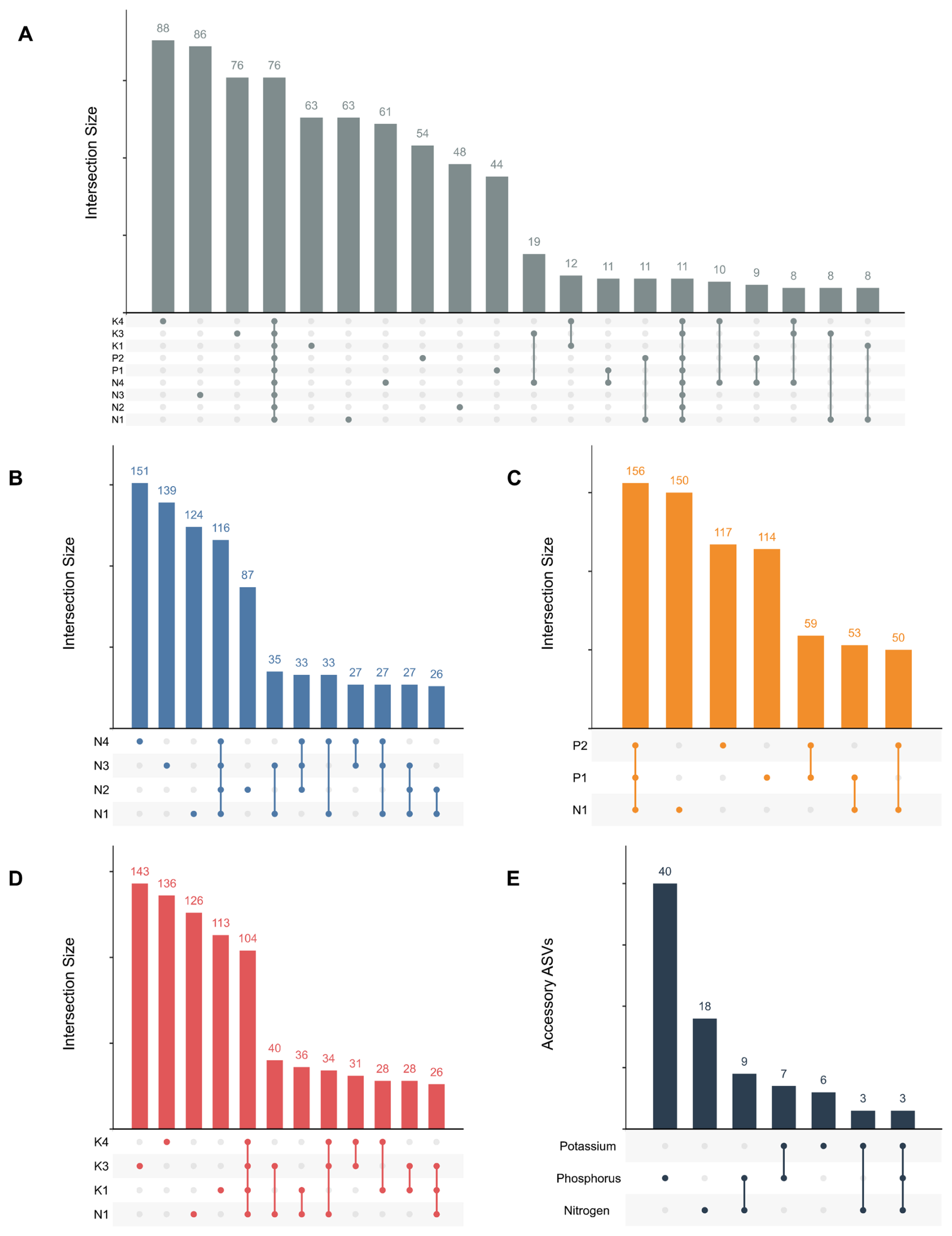
Figure 6UpSet plots depicting the core and accessory microbiome assemblies across fertilization regimes. Vertical bars indicate the number of shared and unique ASVs for each intersection, derived directly from standardized abundance matrices. Connected dots below the x-axis specify which fertilization treatments are included in each intersection. (A) Global trans-domain overlap analysis across all nine experimental conditions, highlighting the highly conserved Universal Resiliency Core of 76 ASVs shared across all treatments. (B–D) Intersections of the complete microbial communities within individual nutrient variations compared to the basal soil condition (N1): Nitrogen gradient (B), Phosphorus addition (C), and Potassium gradient (D). (E) Accessory microbiome isolating the ASVs strictly recruited by specific nutrient additions. This panel explicitly differentiates strict nutrient-specific specialists (single dots, e.g., 40 ASVs exclusive to Phosphorus) from general opportunistic taxa shared across multiple fertilization strategies (connected dots).
4.1 Soil buffering capacity and leaching override dose-dependent physicochemical gradients
As Cuba is one of the few countries that uses a nationally developed soil classification system (Hernández-Jiménez et al., 2019), brown sialitic soils are rarely referenced in the literature. Therefore, in this study, we have provided one of the first integrative characterizations of rhizosphere-associated microbial communities of Saccharum spp. cultivated on this soil type. However, the Cuban classification can be linked to international systems. Brown sialitic soils have historically been classified as inceptisols in United States Department of Agriculture (USDA) Soil Taxonomy and Cambisols in the World Reference Base (WRB) and as Food and Agriculture Organization of the United Nations (FAO) classification system (Sanchez, 2019). Inceptisols are young soils with weak horizon development, widely distributed across diverse landscapes (Soil Survey Staff, 2015). They typically have low natural fertility (Syamsiyah et al., 2018), characterized by limited availability of nitrogen, phosphorus, and potassium; low OM content and slightly acidic pH (Sofyan et al., 2024). These conditions contribute to nutrient leaching, with most N losses in inceptisols occurring within the first week after fertilization (Sofyan et al., 2024). When nutrient uptake by plants during that time is insufficient, crops may experience long-term nutrient limitation (Rashid et al., 2024). Slow-release fertilizers are an effective strategy to mitigate nutrient leaching in inceptisols (Hakim et al., 2022). Therefore, this may be relevant for improving fertilizer efficiency in Cuban sugarcane production systems. Our physicochemical analysis revealed significant spatial heterogeneity across the experimental site; however, these variations were broadly decoupled from the theoretical fertilizer doses applied. Rather than forming distinct chemical gradients, the inputs appear to have been rapidly redistributed. This lack of dose-dependency strongly suggests that intense rainfall and the inherent leaching potential of sialitic clay matrices override the immediate local effects of fertilization (Oishy et al., 2025), as well as intrinsic soil properties, agricultural practices, such as tilling of sugarcane, and external climatic influences (McDonald et al., 2024; Peng et al., 2024; Skidmore et al., 2023). Brown sialitic soils have mid-to-high nutrient loss rates (Hernández et al., 2015; Kaur et al., 2024), and under long-term cultivation and repeated fertilizer inputs, nutrient redistribution via rainfall and leaching can lead to chemical homogenization within the soil matrix. Furthermore, the robust stability of soil pH across all plots reflects the massive buffering capacity conferred by the consistently high reservoir of exchangeable basic cations (Ca + Mg). Consequently, microorganisms in this long-term agroecosystem are exposed to a highly buffered, yet spatially erratic, nutritional environment. This phenomenon highlights the importance of soil microhabitats, particularly physically protected aggregates formed by roots, fungal hyphae, and bacterial polymers (Liao et al., 2020; Wilpiszeski et al., 2019), which can maintain biological organization even when bulk soil chemistry is homogenized or heavily leached by tropical environmental processes. This is especially relevant under long-term fertilization, as organic and inorganic fertilizer addition can increase organic and inorganic carbon contents and enhance cation-exchange capacity of soil macroaggregates (Meena et al., 2022; Niu et al., 2022). These aggregates form physically protected microhabitats, and the rhizosphere promotes their formation (Li et al., 2020). Here, plant roots, fungal hyphae, and bacterial extracellular polymers bind particles together and create localized niches with steep gradients of oxygen, carbon availability, moisture, and nutrients (Wilpiszeski et al., 2019; Zhong et al., 2017). The distribution and relative abundance of micro- and macroaggregates also influence the bulk properties of soil, including organic carbon content, water content, and niche availability. The interiors of aggregates can exhibit properties distinct from the surrounding matrix (Wilpiszeski et al., 2019). This is consistent with the results of the present study, in which microbial communities showed nutrient-dependent restructuring despite the absence of substantial changes in community composition.
4.2 Long-term fertilization maintains overall community composition and diversity
Despite variation in synthetic fertilizer application, alpha- and beta-diversity analyses demonstrated that the overall microbial community composition remained remarkably stable (Figs. S3 and S4). This taxonomic resilience was further confirmed by differential abundance analyses (LEfSe and ANCOM-BC2), which detected no significant biological markers associated with any specific treatment. This reflects the adaptation of microbial communities to persistent, long-term management regimes, reaching a resilient equilibrium where taxonomic structure is maintained despite environmental fluctuations, a pattern consistent with other intensively cultivated soils (Kostin et al., 2021; Lori et al., 2023). In such systems, microbial assemblages reach a resilient equilibrium, maintaining taxonomic structure despite environmental or nutritional variations. Similar results have been reported in long-term agricultural trials (Lori et al., 2023; Luo et al., 2023). Furthermore, the results showed no difference relative to non-fertilized soil or bulk soil, suggesting that the microbial consortia associated with sugarcane in brown sialitic soils are resilient to variations in nitrogen, phosphorus, and potassium availability. Such resilience may be linked to the soil physicochemical properties and climatic conditions in eastern Cuba, characterized by high rainfall and seasonal variability (Centella et al., 2007). These conditions could homogenize nutrient availability and microbial niches across treatments. Another possible explanation is that natural conditions, including heavy rain, could mobilize nutrients through leaching and translocation (lateral movement), thereby homogenizing soil physicochemical properties and microbial communities (Stover and Henry, 2018).
When the bacterial and fungal communities were analyzed at the genus level, a considerable fraction of the identified ASVs remained taxonomically unresolved (65 % of bacteria and 33 % of fungi). The unclassified ASVs at the genus level spanned multiple bacterial and fungal phyla, with representation from Actinomycetota, Acidobacteriota, and Bacillota among bacteria, and Ascomycota, Basidiomycota, and Chytridiomycota among fungi. These groups are typically associated with key ecological processes in soil systems, including carbon decomposition (Actinomycetota, Ascomycota, and Basidiomycota) (Singavarapu et al., 2023), nutrient cycling under oligotrophic conditions (Acidobacteriota) (Gonçalves et al., 2024), stress tolerance and sporulation (Bacillota) (Filippidou et al., 2016), lignin decay and soil aggregate formation (Basidiomycota) (Datta et al., 2017), and the degradation of complex biopolymers (Chytridiomycota) (Zeghal et al., 2021). The presence of numerous unclassified taxa within these ecologically important groups suggests that brown sialitic soils may harbor poorly described or potentially novel microbial lineages that contribute to the unique functioning of these tropical, nutrient-leached systems. This taxonomic ambiguity is likely related to two major factors: (i) the limited representation of tropical and Caribbean soil microorganisms in public reference databases, such as SILVA and UNITE, and (ii) the physicochemical characteristics of sialitic soils, which may select for endemic or highly specialized microbial taxa, such as Stretpomyces (Andam et al., 2016; Martiny, 2016). Despite the classification limitations, these unassigned ASVs are an important component of the microbial diversity in this agroecosystem. These findings highlight the need to expand genomic reference databases to better represent tropical soil microbiomes.
Despite the large proportion of poorly classified microorganisms, both bacterial and fungal community structures remained taxonomically stable across the fertilization gradient, suggesting resilience to moderate variations in nutrient inputs. Interestingly, bacteria have a lower percentage of unclassified taxa at the phylum level than fungi at 1.7 % and 8.8 %, respectively. However, at lower taxonomic levels, bacteria could be classified to a lesser extent than fungi (65.5 % and 33.1 %, respectively). This further emphasizes the limited reference coverage for bacterial taxa from tropical soils.
4.3 Trans-domain co-occurrence networks and taxonomic overlap suggest a stable architecture with nutrient-specific recruitment
Although long-term fertilization did not substantially alter overall community diversity, our global topological analysis revealed a highly connected and stable microbial architecture across the evaluated soils. While diversity metrics were relatively stable, the global co-occurrence network analysis indicated a robust web of potential microbial interactions that persists under long-term management. These findings highlight that the soil microbiome maintains a conserved taxonomic composition and a cohesive connectivity. This is consistent with nutrient enrichment, which homogenizes bulk soil conditions over time through leaching, repeated inputs, and microbial convergence. Meanwhile, the rhizosphere remains structured, likely by plant-driven microenvironments. Root exudates and microbial extracellular polymers promote soil aggregation (Liao et al., 2020; Wilpiszeski et al., 2019), generating microsites with distinct nutrient, carbon, and oxygen dynamics. These can harbor highly structured and functionally specialized microbial associations (Wilpiszeski et al., 2019). Such soil aggregates act as ecological refuges that stabilize microbial communities and promote network-level interactions, even when taxonomic profiles remain similar (Akter et al., 2025; Li et al., 2020; Meena et al., 2022; Wilpiszeski et al., 2019). Therefore, the observed bacterial–fungal co-occurrence network may reflect a conserved functional organization within rhizosphere microhabitats rather than profound structural disruptions triggered by fertilization.
The global architecture was highly modular and dominated by positive correlations (99.8 %), reflecting prevalent mutualistic, commensal, or shared environmental responses rather than competitive exclusion (Cheng et al., 2024). Fungal taxa, particularly Ascomycota and Basidiomycota, exhibited higher connectivity than bacterial nodes, suggesting their role as a potential structural backbone of the network. Although co-occurrence network analysis represents the presence of ASVs on the same sample at some point, these findings suggest that bacterial-fungal functional interdependence is critical for nutrient turnover and the maintenance of soil structure within rhizosphere microhabitats (Fabian et al., 2017). Notably, similar patterns have been reported across diverse ecosystems, where functional conservation is often stronger than taxonomic conservation, and ecosystem processes are maintained by different taxa performing equivalent ecological roles (Hou et al., 2021). In this context, microbial taxa with unique or specialized functions may exert an important influence on ecosystem functioning, sustaining the observed microbial interactions and network organization even in the absence of major taxonomic changes (Tang et al., 2023). This functional redundancy and specialization likely underpins the stable microbial network observed across these soils.
Rather than fragmenting the community, our overlapping taxonomic analysis revealed a core-and-satellite assembly strategy in response to fertilization (Yan et al., 2021). We identified a Universal Resiliency Core of 76 trans-domain ASVs shared across all treatments (N, P, and K). This basal core, heavily reliant on alliances between bacterial (Bacillota and Pseudomonadota) and fungal (Ascomycota and Basidiomycota) taxa, represents the stable structural foundation of the sugarcane rhizosphere, capable of withstanding profound nutritional fluctuations.
Interestingly, while the universal core remains structurally stable, each macronutrient actively recruited its own distinct satellite community. By excluding opportunistic taxa that responded generally to any nutrient addition (22 ASVs), we identified the strict specialists for each fertilization strategy. Nitrogen variations stimulated the emergence of 18 exclusive microbial specialists, indicating a highly specific, fungus-driven response to N enrichment. Conversely, secondary macronutrients acted as much stronger environmental filters for accessory recruitment. The application of phosphorus recruited a massive, specialized accessory microbiome of 40 unique ASVs, heavily dominated by fungi (Talaromyces and various Basidiomycota). Potassium variations exhibited a highly restricted recruitment pattern (six strict ASVs). These findings suggest a threshold-dependent ecological response: while the universal core microbiome is highly resilient, variations in specific nutrients dictate the selective recruitment of specialized, trans-domain accessory niches to exploit available resources (Mu et al., 2024).
4.4 Ecological and agronomic implications
The observed resilience in diversity, coupled with the nutrient-specific recruitment of accessory taxa, indicates that microbial ecosystems in brown sialitic soils maintain a stable core architecture while dynamically exploiting available resources under changing fertilization regimes. In natural systems, fungal–bacterial networks emerge from trophic exchanges, metabolite fluxes, and the physical architecture of hyphae, biofilms, and soil aggregates. Their structure and functioning vary with environmental factors, such as pH, soil moisture, aggregate type and size, and management practices (Gao et al., 2024; Jiménez-Venegas et al., 2024, 2026; Matazimov et al., 2025). These networks can coordinate biogeochemical cycling, influence plant nutrition, and contribute to soil structure and system-level resilience. Within biogeochemical cycles, these microbial frameworks regulate nitrogen and phosphorus mobilization, thereby influencing nutrient retention or leaching (Tedersoo and Bahram, 2019). Their enhancement can increase functional enzyme activity, enabling a 25 %–50 % substitution of synthetic nitrogen with organic nitrogen, while also supporting carbon, nitrogen, and phosphorus cycling (Gao et al., 2024). Likewise, biocrusts formed by fungal–bacterial associations improve the connectivity of carbon pools, stimulating or suppressing carbon uptake depending on the dominant guild, and modulating soil organic carbon gains (Naylor et al., 2020; Tedersoo and Bahram, 2019). Common mycorrhizal networks connect plant roots and facilitate the movement of key nutrients, such as carbon and nitrogen (Matazimov et al., 2025). Fungal hyphae bind soil particles, while bacterial extracellular polymeric substances contribute to aggregate stabilization, influencing pore connectivity and water retention. Furthermore, established fungal–bacterial consortia can help suppress pathogens in the rhizosphere through antibiosis, resource competition, and the induction of plant defenses, enhancing system resilience (Matazimov et al., 2025).
From an agronomic perspective, these findings suggest that further intensification of nitrogen and phosphorus fertilization may not significantly alter overall microbial diversity but drives the targeted recruitment of specialized accessory microbes. Understanding how these distinct ecological niches are occupied without disrupting the overarching stable community framework is crucial for functional stability and soil health. Therefore, sustainable fertilization strategies should aim to support these foundational microbial architectures while optimizing nutrient inputs to avoid potential imbalances in the rhizosphere.
This study demonstrates that long-term fertilization in brown sialitic soils does not completely restructure the overall rhizosphere community; rather, specific nutrient applications (such as Phosphorus) act as targeted drivers that recruit and organize specialized trans-domain accessory microbiomes within a highly stable core network. Contrary to our initial expectation that fertilization would primarily alter community structure by shifting taxon abundances, our results support that microbial ecosystems adapt through the selective recruitment of specialized accessory taxa, revealing ecological responses not captured by conventional diversity-based approaches.
Using a unified global trans-domain network, we uncovered a robust and modular rhizosphere architecture predominantly driven by cooperative interactions. Within this framework, a stable Nitrogen-Resiliency Core, supported by alliances between bacterial and fungal phyla, persists across varying nitrogen gradients and may represent a structural foundation of the soil microbiome. Conversely, variations in secondary macronutrients triggered distinct ecological responses. Phosphorus, in particular, acted as a potent environmental filter, awakening and recruiting a specialized, fungal-dominated accessory microbiome to exploit available resources without fragmenting the overall basal community.
Importantly, the observed spatial heterogeneity in soil nutrient availability, largely uncoupled from the theoretical fertilization doses, highlights the intense leaching dynamics and rapid nutrient turnover characteristic of tropical sialitic soils. Nevertheless, the massive buffering capacity conferred by exchangeable basic cations (Ca + Mg) provided a stable edaphic baseline. In these highly weathered environments, physically protected rhizosphere microhabitats provide ecological refuges, allowing microbial interaction networks to maintain ecosystem functioning and resilience despite the chemically erratic bulk soil matrix.
Overall, our findings emphasize that trans-domain interaction networks provide crucial insights into soil ecosystem responses to long-term fertilization that are not evident from diversity or abundance data alone. Incorporating network-based perspectives is essential to a deep understanding of the ecological consequences of fertilization practices and for designing more sustainable nutrient management strategies in tropical agroecosystems.
All raw sequences have been deposited in the National Center for Biotechnology Information (NCBI) database (Bethesda, MD, USA) under BioProject accession code PRJNA1380633.
The supplement related to this article is available online at https://doi.org/10.5194/soil-12-999-2026-supplement.
I.R.-T., J.S., and M.P.: conceptualization, methodology, investigation, and formal analysis; L.Z.: formal análisis, writing – original draft and visualization; J.S., I.R.-T., and M.P.: writing – review and editing, M.P. resources and supervision.
The contact author has declared that none of the authors has any competing interests.
Publisher's note: Copernicus Publications remains neutral with regard to jurisdictional claims made in the text, published maps, institutional affiliations, or any other geographical representation in this paper. The authors bear the ultimate responsibility for providing appropriate place names. Views expressed in the text are those of the authors and do not necessarily reflect the views of the publisher.
We extend our gratitude to the researchers from the Instituto de Investigaciones de la Caña de Azúcar in Santiago de Cuba, Cuba – Dolores del Rosario Piñón-Gómez, Mónica Tamayo-Isaac, Pablo D. Pablos-Reyes, and René Barbosa-García – for generously providing physical soil samples, which made our soil metagenomic studies possible.
Declaration of generative AI in scientific writing. The authors declare that they did not use generative artificial intelligence (AI) or AI-assisted technologies in the writing process.
This work was funded by Bionostra Chile Research Foundation and Agroenergía Ingeniería Genética S.A.
This paper was edited by Katerina Georgiou and reviewed by two anonymous referees.
Abarenkov, K., Nilsson, R. H., Larsson, K. H., Taylor, A. F. S., May, T. W., Frøslev, T. G., Pawlowska, J., Lindahl, B., Põldmaa, K., Truong, C., Vu, D., Hosoya, T., Niskanen, T., Piirmann, T., Ivanov, F., Zirk, A., Peterson, M., Cheeke, T. E., Ishigami, Y., Jansson, A. T., Jeppesen, T. S., Kristiansson, E., Mikryukov, V., Miller, J. T., Oono, R., Ossandon, F. J., Paupério, J., Saar, I., Schigel, D., Suija, A., Tedersoo, L., and Kõljalg, U.: The UNITE database for molecular identification and taxonomic communication of fungi and other eukaryotes: Sequences, taxa and classifications reconsidered, Nucleic Acids Res., 52, D791–D797, https://doi.org/10.1093/nar/gkad1039, 2024.
Akter, S., Mahmud, U., Shoumik, B. A. A., and Khan, M. Z.: Although invisible, fungi are recognized as the engines of a microbial powerhouse that drives soil ecosystem services, Arch. Microbiol., 207, 79, https://doi.org/10.1007/s00203-025-04285-4, 2025.
Andam, C. P., Doroghazi, J. R., Campbell, A. N., Kelly, P. J., Choudoir, M. J., and Buckley, D. H.: A latitudinal diversity gradient in terrestrial bacteria of the genus Streptomyces, mBio, 7, e02200-15, https://doi.org/10.1128/mbio.02200-15, 2016.
Andrews, S.: FastQC: A quality control tool for high-throughput sequence data, Babraham Bioinformatics, http://www.bioinformatics.babraham.ac.uk/projects/fastqc/ (last access: September 2024), 2010.
Antoszewski, M., Mierek-Adamska, A., and Dąbrowska, G. B.: The importance of microorganisms for sustainable agriculture: A review, Metabolites, 12, 1100, https://doi.org/10.3390/metabo12111100, 2022.
Bastian, M., Heymann, S., and Jacomy, M.: Gephi: An open source software for exploring and manipulating networks, Proc. Int. AAAI Conf. Web Soc. Media, 3, 361–362, https://doi.org/10.1609/icwsm.v3i1.13937, 2009.
Berger, A., Gatt Harari, M., Gross, A., and Erez, A.: Diversity loss in microbial ecosystems undergoing gradual environmental changes, Cell Rep. Sustain., 1, 100242, https://doi.org/10.1016/j.crsus.2024.100242, 2024.
Callahan, B. J., McMurdie, P. J., and Holmes, S. P.: Exact sequence variants should replace operational taxonomic units in marker-gene data analysis, ISME J., 11, 2639–2643, https://doi.org/10.1038/ismej.2017.119, 2017.
Callahan, B. J., McMurdie, P. J., Rosen, M. J., Han, A. W., Johnson, A. J. A., and Holmes, S. P.: DADA2: High-resolution sample inference from Illumina amplicon data, Nat. Methods, 13, 581–583, https://doi.org/10.1038/nmeth.3869, 2016.
Caporaso, J. G., Kuczynski, J., Stombaugh, J., Bittinger, K., Bushman, F. D., Costello, E. K., Fierer, N., Peña, A. G., Goodrich, J. K., Gordon, J. I., Huttley, G. A., Kelley, S. T., Knights, D., Koenig, J. E., Ley, R. E., Lozupone, C. A., McDonald, D., Muegge, B. D., Pirrung, M., Reeder, J., Sevinsky, J. R., Turnbaugh, P. J., Walters, W. A., Widmann, J., Yatsunenko, T., Zaneveld, J., and Knight, R.: QIIME allows analysis of high-throughput community sequencing data, Nat. Methods, 7, 335–336, https://doi.org/10.1038/nmeth.f.303, 2010.
Centella, A., Lapinel, B., Solano, O., Vázquez, R., Fonseca, C., Cutié, V., Baéz, R., González, S., Sille, J., Rosario, P., and Duarte, L.: La sequía meteorológica y agrícola en la República de Cuba y la República Dominicana [Meteorological and agricultural drought in the Republic of Cuba and the Dominican Republic], Proyecto PNUD/ACDI Desarrollo y Adaptación al Cambio Climático, 172 pp., https://www.undp.org/es/cuba/publicaciones/la-sequia-meteorologica-y-agricola-tomos-i-y-ii (last access: September 2024), 2007.
Chen, S., Gao, J., Chen, H., Zhang, Z., Huang, J., Lv, L., Tan, J., and Jiang, X.: The role of long-term mineral and manure fertilization on P species accumulation and phosphate-solubilizing microorganisms in paddy red soils, SOIL, 9, 101–116, https://doi.org/10.5194/soil-9-101-2023, 2023.
Cheng, C., Li, G., Yang, X., Zhao, J., Liu, J., Zheng, A., and Zhang, Z.: High diversity, close genetic relatedness, and favorable living conditions benefit species co-occurrence of gut microbiota in Brandt's vole, Front. Microbiol., 15, 1337402, https://doi.org/10.3389/fmicb.2024.1337402, 2024.
Cherubin, M. R., Oliveira, D. M. S., Feigl, B. J., Pimentel, L. G., Lisboa, I. P., Gmach, M. R., Varanda, L. L., Morais, M. C., Satiro, L. S., Popin, G. V., Paiva, S. R., Klebson, A. K. B., Vasconcelos, A. L. S., Melo, P. L. A., Cerri, C. E. P., Cerri, C. C., Cerri, E. P., and Cerri, C. C.: Crop residue harvest for bioenergy production and its implications on soil functioning and plant growth: A review, Sci. Agric., 75, 255–272, https://doi.org/10.1590/1678-992x-2016-0459, 2018.
Cherubin, M. R., Lisboa, I. P., Silva, A. G. B., Varanda, L. L., Bordonal, R. O., Carvalho, J. L. N., Otto, R., Pavinato, P. S., Soltangheisi, A., and Cerri, C. E. P.: Sugarcane Straw Removal: Implications to Soil Fertility and Fertilizer Demand in Brazil, Sugar, 12, 888–900, https://doi.org/10.1007/s12155-019-10021-w, 2019.
Datta, R., Kelkar, A., Baraniya, D., Molaei, A., Moulick, A., Meena, R. S., and Formanek, P.: Enzymatic degradation of lignin in soil: A review, Sustainability, 9, 1163, https://doi.org/10.3390/su9071163, 2017.
de Castro, S. G. Q., Magalhães, P. S. G., de Castro, S. A. Q., Kölln, O. T., and Franco, H. C. J.: Optimizing nitrogen fertilizer rates at distinct in-season application moments in sugarcane, Int. J. Plant Prod., 16, 137–152, https://doi.org/10.1007/s42106-021-00175-z, 2022.
Dinesh Babu, K. S., Janakiraman, V., Palaniswamy, H., Kasirajan, L., Gomathi, R., and Ramkumar, T. R.: A short review on sugarcane: Its domestication, molecular manipulations and future perspectives, Genet. Resour. Crop Evol., 69, 2623–2643, https://doi.org/10.1007/s10722-022-01430-6, 2022.
Du, J., Gao, Q., Sun, F., Liu, B., Jiao, Y., and Liu, Q.: Agricultural soil microbiomes at the climate frontier: Nutrient-mediated adaptation strategies for sustainable farming, Ecotoxicol. Environ. Saf., 295, 118161, https://doi.org/10.1016/j.ecoenv.2025.118161, 2025.
Durán, I.: Comportamiento de la precipitación en estaciones meteorológicas seleccionadas de Cuba [Precipitation behavior at selected meteorological stations in Cuba], Ph.D. Thesis, Universidad de La Habana, https://www.researchgate.net/publication/322235859_Comportamiento_de_la_Precipitacion_en_Estaciones_Meteorologicas_Seleccionadas_de_Cuba (last access: September 2024), 2012.
FAO [Food and Agriculture Organization of the United Nations]: Fertilizer use by crop in Cuba, Land and Plant Nutrition Management Service and Land and Water Development Division, FAO, Rome, 39 pp., https://openknowledge.fao.org/handle/20.500.14283/y4801e (last access: September 2024), 2003.
FAO [Food and Agriculture Organization of the United Nations]: Sugar cane production, Our World in Data, https://archive.ourworldindata.org/20251014-161652/grapher/sugar-cane-production.html (last access: September 2024), 2025.
Fabian, J., Zlatanovic, S., Mutz, M., and Premke, K.: Fungal–bacterial dynamics and their contribution to terrigenous carbon turnover in relation to organic matter quality, ISME J., 11, 415–425, https://doi.org/10.1038/ismej.2016.131, 2017.
Filippidou, S., Wunderlin, T., Junier, T., Jeanneret, N., Dorador, C., Molina, V., Johnson, D. R., and Junier, P.: A combination of extreme environmental conditions favor the prevalence of endospore-forming Firmicutes, Front. Microbiol., 7, 1707, https://doi.org/10.3389/fmicb.2016.01707, 2016.
Freilich, S., Zarecki, R., Eilam, O., Segal, E. S., Henry, C. S., Kupiec, M., Gophna, U., Sharan, R., and Ruppin, E.: Competitive and cooperative metabolic interactions in bacterial communities, Nat. Commun., 2, 589, https://doi.org/10.1038/ncomms1597, 2011.
Gao, C., Xu, L., Montoya, L., Madera, M., Hollingsworth, J., Chen, L., Purdom, E., Singan, V., Vogel, J., Hutmacher, R. B., Dahlberg, J. A., Coleman-Derr, D., Lemaux, P. G., and Taylor, J. W.: Co-occurrence networks reveal more complexity than community composition in resistance and resilience of microbial communities, Nat. Commun., 13, 3867, https://doi.org/10.1038/s41467-022-31343-y, 2022.
Gao, C., Bezemer, T. M., de Vries, F. T., and van Bodegom, P. M.: Trade-offs in soil microbial functions and soil health in agroecosystems, Trends Ecol. Evol., 39, 895–903, https://doi.org/10.1016/j.tree.2024.05.013, 2024.
Gonçalves, O. S., Fernandes, A. S., Tupy, S. M., Ferreira, T. G., Almeida, L. N., Creevey, C. J., and Santana, M. F.: Insights into plant interactions and the biogeochemical role of the globally widespread Acidobacteriota phylum, Soil Biol. Biochem., 192, 109369, https://doi.org/10.1016/j.soilbio.2024.109369, 2024.
Guo, J. and Chen, J.: The impact of heavy rainfall variability on fertilizer application rates: Evidence from maize farmers in China, Int. J. Environ. Res. Publ. Hth., 19, 15906, https://doi.org/10.3390/ijerph192315906, 2022.
Guo, Z., Wan, S., Hua, K., Yin, Y., Chu, H., Wang, D., and Guo, X.: Fertilization regime has a greater effect on soil microbial community structure than crop rotation and growth stage in an agroecosystem, Appl. Soil Ecol., 149, 103510, https://doi.org/10.1016/j.apsoil.2020.103510, 2020.
Hakim, F. K., Sofyan, E. T., Sudirja, R., Joy, B., Yuniarti, A., and Herdiyantoro, D.: The application of slow release NPK fertilizer on inceptisols to changes of soil chemical properties and growth of sweet corn (Zea mays L. saccharata), Int. J. Environ., Agric. Biotechnol., 7, 18–24, https://doi.org/10.22161/ijeab.73.3, 2022.
Hernández, A., Pérez, J., Bosch, D., and Castro, N.: Clasificación de los suelos de Cuba 2015 [Classification of Cuban soils 2015], Mayabeque, Cuba, Ediciones INCA, 93 pp., SBN 978-959-7023-77-7, 2015.
Hernández-Jiménez, A., Pérez-Jiménez, J., Bosch-Infante, D., and Castro, N.: La clasificación de suelos de Cuba: Énfasis en la versión de 2015 [The soil classification of Cuba: emphasis in the 2015 version], Cult. Trop., 40, 31, ISSN 0258-5936, 2019.
Hou, Z., Lv, G., and Jiang, L.: Functional diversity can predict ecosystem functions better than dominant species: The case of desert plants in the Ebinur Lake Basin, Sustainability, 13, 2858, https://doi.org/10.3390/su13052858, 2021.
Huang, R., Li, W., Qiu, S., Long, Y., Zeng, Z., Tang, J., and Huang, Q.: Impact of land use types on soil microbial community structure and functional structure in Baihualing Village, China, Glob. Ecol. Conserv., 57, e03379, https://doi.org/10.1016/j.gecco.2024.e03379, 2025.
INICA [Instituto Nacional de Investigaciones de la Caña de Azúcar]: Normas metodológicas del departamento de suelos y agroquímica [Methodological standards of the Department of Soils and Agrochemistry], INICA-MINAZ, Tomo 1, La Habana, Cuba, 100 pp., 1990.
Jiménez-Venegas, J., Zamora-Leiva, L., Univaso, L., Soto, J., Tapia, Y., and Paneque, M.: Profile of Bacterial Communities in Copper Mine Tailings Revealed through High-Throughput Sequencing, Microorganisms, 12, 1820, https://doi.org/10.3390/microorganisms12091820, 2024.
Jiménez-Venegas, J., Zamora-Leiva, L., Román-Figueroa, C., Tapia, Y., and Paneque, M.: Metals and Extremophilic Bacteria in Mining Environments: A Systematic Review, Microorganisms, 14, 1312, https://doi.org/10.3390/microorganisms14061312, 2026.
Katoh, K. and Standley, D. M.: MAFFT multiple sequence alignment software version 7: Improvements in performance and usability, Mol. Biol. Evol., 30, 772–780, https://doi.org/10.1093/molbev/mst010, 2013.
Kaur, S., Bedi, M., Singh, S., Kour, N., Bhatti, S. S., Bhatia, A., Kumar, M., and Kumar, R.: Monoculture of crops: A challenge in attaining food security, in: Environmental Challenges in Attaining Food Security, Advances in Food Security and Sustainability, 9, edited by: Sharma, A., Kumar, M., and Sharma, P., Elsevier, 197–213, https://doi.org/10.1016/bs.af2s.2024.07.008, 2024.
Khan, A., Wei, Y., Adnan, M., Ali, I., and Zhang, M.: Dynamics of rhizosphere bacterial communities and soil physiochemical properties in response to consecutive ratooning of sugarcane, Front. Microbiol., 14, 1197246, https://doi.org/10.3389/fmicb.2023.1197246, 2023.
Klindworth, A., Pruesse, E., Schweer, T., Peplies, J., Quast, C., Horn, M., and Glöckner, F. O.: Evaluation of general 16S ribosomal RNA gene PCR primers for classical and next-generation sequencing-based diversity studies, Nucleic Acids Res., 41, e1–e1, https://doi.org/10.1093/nar/gks808, 2013.
Kostin, J. E., Cesarz, S., Lochner, A., Schädler, M., Macdonald, C. A., and Eisenhauer, N.: Land-use drives the temporal stability and magnitude of soil microbial functions and modulates climate effects, Ecol. Appl., 31, e02325, https://doi.org/10.1002/eap.2325, 2021.
Kracmarova, M., Uhlik, O., Strejcek, M., Szakova, J., Cerny, J., Balik, J., Tlustos, P., Kohout, P., Demnerova, K., and Stiborova, H.: Soil microbial communities following 20 years of fertilization and crop rotation practices in the Czech Republic, Environ. Microbiome, 17, 13, https://doi.org/10.1186/s40793-022-00406-4, 2022.
Kumar, V., Raghuvanshi, N., Pandey, A. K., Kumar, A., Thoday-Kennedy, E., and Kant, S.: Role of halotolerant plant growth-promoting rhizobacteria in mitigating salinity stress: Recent advances and possibilities, Agriculture, 13, 168, https://doi.org/10.3390/agriculture13010168, 2023.
Lahlali, R., Ibrahim, D. S. S., Belabess, Z., Kadir Roni, M. Z., Radouane, N., Vicente, C. S. L., Menéndez, E., Mokrini, F., Barka, E. A., Galvão de Melo E Mota, M., and Peng, G.: High-throughput molecular technologies for unraveling the mystery of soil microbial community: Challenges and future prospects, Heliyon, 7, e08142, https://doi.org/10.1016/j.heliyon.2021.e08142, 2021.
Li, J., Yuan, X., Ge, L., Li, Q., Li, Z., Wang, L., and Liu, Y.: Rhizosphere effects promote soil aggregate stability and associated organic carbon sequestration in rocky areas of desertification, Agric., Ecosyst. Environ., 304, 107126, https://doi.org/10.1016/j.agee.2020.107126, 2020.
Liao, H., Zhang, Y., Wang, K., Hao, X., Chen, W., and Huang, Q.: Complexity of bacterial and fungal network increases with soil aggregate size in an agricultural inceptisol, Appl. Soil Ecol., 154, 103640, https://doi.org/10.1016/j.apsoil.2020.103640, 2020.
Liu, C., Cui, Y., Li, X., and Yao, M.: Microeco: An R package for data mining in microbial community ecology, FEMS Microbiol. Ecol., 97, fiaa255, https://doi.org/10.1093/femsec/fiaa255, 2021a.
Liu, Q., Zhao, X., Liu, Y., Xie, S., Xing, Y., Dao, J., Wei, B., Peng, Y., Duan, W., and Wang, Z.: Response of sugarcane rhizosphere bacterial community to drought stress, Front. Microbiol., 12, 716196, https://doi.org/10.3389/fmicb.2021.716196, 2021b.
Liu, Y., Liang, D., Xing, J., Xue, Z., and Zhang, Z.: Interactions between sugarcane leaf return and fertilizer reduction in soil bacterial network in Southern China red soil, Microorganisms, 12, 1788, https://doi.org/10.3390/microorganisms12091788, 2024.
Looney, S. W. and Hagan, J. L.: Statistical methods for assessing biomarkers and analyzing biomarker data, in: Handbook of Statistics, 27, edited by: Rao, C. R., Miller, J. P., and Rao, D. C., Elsevier, 27–65, https://doi.org/10.1016/B978-0-444-53737-9.50005-0, 2011.
Lori, M., Hartmann, M., Kundel, D., Mayer, J., Mueller, R. C., Mäder, P., and Krause, H. M.: Soil microbial communities are sensitive to differences in fertilization intensity in organic and conventional farming systems, FEMS Microbiol. Ecol., 99, fiad046, https://doi.org/10.1093/femsec/fiad046, 2023.
Luo, J., Liao, G., Banerjee, S., Gu, S., Liang, J., Guo, X., Zhao, H., Liang, Y., and Li, T.: Long-term organic fertilization promotes the resilience of soil multifunctionality driven by bacterial communities, Soil Biol. Biochem., 177, 108922, https://doi.org/10.1016/j.soilbio.2022.108922, 2023.
Martiny, J. B. H.: History leaves its mark on soil bacterial diversity, mBio, 7, e00784-16, https://doi.org/10.1128/mBio.00784-16, 2016.
Matazimov, M. T., Sidametova, Z. E., Olimov, N. K., Abdullaeva, M. U., Rakhimova, D. O., Rustamov, I. X., and Umurzakova, N. S.: Ecological roles of fungal networks: Integrating nutrient cycling, soil health, and climate resilience – A systematic review, Microb. Bioact., 8, 1–8, https://doi.org/10.25163/microbbioacts.8110420, 2025.
McDonald, M. D., Lewis, K. L., Blazier, J. C., and Gentry, T. J.: Semi-arid soil bacterial communities are refined by altered plant selection pressure under conservation management practices, Appl. Soil Ecol., 194, 105191, https://doi.org/10.1016/j.apsoil.2023.105191, 2024.
Meena, S. K., Dwivedi, B. S., Meena, M. C., Datta, S. P., Singh, V. K., Mishra, R. P., Chakraborty, D., Dey, A., and Meena, V. S.: Impact of long-term nutrient supply options on soil aggregate stability after nineteen years of rice–wheat cropping system, Land, 11, 1465, https://doi.org/10.3390/land11091465, 2022.
Mitter, E. K., Tosi, M., Obregón, D., Dunfield, K. E., and Germida, J. J.: Rethinking crop nutrition in times of modern microbiology: Innovative biofertilizer technologies, Front. Sustain. Food Syst., 5, 606815, https://doi.org/10.3389/fsufs.2021.606815, 2021.
Moneda, A. P. C., de Carvalho, L. A. L., Teheran-Sierra, L. G., Funnicelli, M. I. G., and Pinheiro, D. G.: Sugarcane cultivation practices modulate rhizosphere microbial community composition and structure, Sci. Rep., 12, 19174, https://doi.org/10.1038/s41598-022-23562-6, 2022.
Mu, P., Ding, G., Zhang, Y., Jin, Q., Liu, Z., Guan, Y., Zhang, L., Liang, C., Zhou, F., and Liu, N.: Interactions between arbuscular mycorrhizal fungi and phosphate-soluble bacteria affect ginsenoside compositions by modulating the C:N:P stoichiometry in Panax ginseng, Front. Microbiol., 15, 1426440, https://doi.org/10.3389/fmicb.2024.1426440, 2024.
Naylor, D., Sadler, N., Bhattacharjee, A., Graham, E. B., Anderton, C. R., McClure, R., Lipton, M., Hofmockel, K. S., and Jansson, J. K.: Soil microbiomes under climate change and implications for carbon cycling, Annu. Rev. Environ. Resour., 45, 29–59, https://doi.org/10.1146/annurev-environ-012320-082720, 2020.
Niu, Z., An, F., Su, Y., Liu, T., Yang, R., Du, Z., and Chen, S.: Effect of long-term fertilization on aggregate size distribution and nutrient accumulation in aeolian sandy soil, Plants, 11, 909, https://doi.org/10.3390/plants11070909, 2022.
Núñez Salazar, R., Aguirre, C., Soto, J., Salinas, P., Salinas, C., Prieto, H., and Paneque, M.: Physicochemical parameters affecting the distribution and diversity of the water column microbial community in the high-altitude Andean lake system of la Brava and la Punta, Microorganisms, 8, 1181, https://doi.org/10.3390/microorganisms8081181, 2020.
Oishy, M. N., Shemonty, N. A., Fatema, S. I., Mahbub, S., Mim, E. L., Hasan Raisa, M. B., and Anik, A. H.: Unravelling the effects of climate change on the soil-plant-atmosphere interactions: A critical review, Soil Environ. Health, 3, 100130, https://doi.org/10.1016/j.seh.2025.100130, 2025.
Orgiazzi, A., Lumini, E., Nilsson, R. H., Girlanda, M., Vizzini, A., Bonfante, P., and Bianciotto, V.: Unravelling soil fungal communities from different Mediterranean land-use backgrounds, PLoS One, 7, e34847, https://doi.org/10.1371/journal.pone.0034847, 2012.
Orrù, L., Canfora, L., Trinchera, A., Migliore, M., Pennelli, B., Marcucci, A., Farina, R., and Pinzari, F.: How tillage and crop rotation change the distribution pattern of fungi, Front. Microbiol., 12, 634325, https://doi.org/10.3389/fmicb.2021.634325, 2021.
Otto, R., Ferraz-Almeida, R., Sanches, G. M., Lisboa, I. P., and Cherubin, M. R.: Nitrogen fertilizer consumption and nitrous oxide emissions associated with ethanol production – A national-scale comparison between Brazilian sugarcane and corn in the United States, J. Clean. Prod., 350, 131482, https://doi.org/10.1016/j.jclepro.2022.131482, 2022.
Pan, Y., Cassman, N., de Hollander, M., Mendes, L. W., Korevaar, H., Geerts, R. H. E. M., van Veen, J. A., and Kuramae, E. E.: Impact of long-term N, P, K, and NPK fertilization on the composition and potential functions of the bacterial community in grassland soil, FEMS Microbiol. Ecol., 90, 195–205, https://doi.org/10.1111/1574-6941.12384, 2014.
Peng, Z., Qian, X., Liu, Y., Li, X., Gao, H., An, Y., Qi, J., Jiang, L., Zhang, Y., Chen, S., Pan, H., Chen, B., Liang, C., van der Heijden, M. G. A., Wei, G., and Jiao, S.: Land conversion to agriculture induces taxonomic homogenization of soil microbial communities globally, Nat. Commun., 15, 3624, https://doi.org/10.1038/s41467-024-47348-8, 2024.
Philippot, L., Griffiths, B. S., and Langenheder, S.: Microbial community resilience across ecosystems and multiple disturbances, Microbiol. Mol. Biol. Rev., 85, e00026-20, https://doi.org/10.1128/mmbr.00026-20, 2021.
Price, M. N., Dehal, P. S., and Arkin, A. P.: FastTree: Computing large minimum evolution trees with profiles instead of a distance matrix, Mol. Biol. Evol., 26, 1641–1650, https://doi.org/10.1093/molbev/msp077, 2009.
Quast, C., Pruesse, E., Yilmaz, P., Gerken, J., Schweer, T., Yarza, P., Peplies, J., and Glöckner, F. O.: The SILVA ribosomal RNA gene database project: Improved data processing and web-based tools, Nucleic Acids Res., 41, D590–D596, https://doi.org/10.1093/nar/gks1219, 2013.
Ramos-Tapia, I., Nuñez, R., Salinas, C., Salinas, P., Soto, J., and Paneque, M.: Study of wetland soils of the Salar de Atacama with different azonal vegetative formations reveals changes in the microbiota associated with hygrophile plant type on the soil surface, Microbiol. Spectr., 10, e0053322, https://doi.org/10.1128/spectrum.00533-22, 2022.
Ramos-Tapia, I., Salinas, P., Nuñez, R., Cortez, D., Soto, J., and Paneque, M.: Compositional changes in sediment microbiota are associated with seasonal variation of the water column in high-altitude hyperarid Andean lake systems, Microbiol. Spectr., 11, e0520022, https://doi.org/10.1128/spectrum.05200-22, 2023.
Rashid, H., Sun, X., Wu, F., and Ni, X.: Nutrient leaching after subtropical forest conversions and its implications for soil fertility, Forest Ecol. Manage., 566, 122044, https://doi.org/10.1016/j.foreco.2024.122044, 2024.
R Core Team: R: A Language and Environment for Statistical Computing (Version 4.3.2), R Foundation for Statistical Computing, Vienna, Austria, https://www.R-project.org/ (last access: September 2024), 2023.
Ritchie, H., Rosado, P., and Roser, M.: Agricultural production, Our World in Data, https://ourworldindata.org/agricultural-production (last access: September 2024), 2023.
Robeson, M. S., O'Rourke, D. R., Kaehler, B. D., Ziemski, M., Dillon, M. R., Foster, J. T., and Bokulich, N. A.: RESCRIPt: Reproducible sequence taxonomy reference database management, PLoS Comput. Biol., 17, e1009581, https://doi.org/10.1371/journal.pcbi.1009581, 2021.
Sanchez, P. A.: Soils of the tropics, in: Properties and management of soils in the tropics, Cambridge University Press, 82–119, https://doi.org/10.1017/9781316809785.006, 2019.
Semenov, M. V., Krasnov, G. S., Semenov, V. M., and van Bruggen, A.: Mineral and organic fertilizers distinctly affect fungal communities in the crop rhizosphere, J. Fungi, 8, 251, https://doi.org/10.3390/jof8030251, 2022.
Shaw, G. T.-W., Liu, A.-C., Weng, C.-Y., Chen, Y.-C., Chen, C.-Y., Weng, F. C.-H., Wang, D., and Chou, C.-Y.: A network-based approach to deciphering a dynamic microbiome's response to a subtle perturbation, Sci. Rep., 10, 19530, https://doi.org/10.1038/s41598-020-73920-5, 2020.
Sieiro, G. L. and Pablos, P.: Índice de calidad para un suelo Pardo Sialítico monocultivado con Saccharum officinarum L. [Quality index for a Sialitic Brown soil monocultured with Saccharum officinarum L.], Rev. Agric. Trop., 7, 1–11, 2021.
Singavarapu, B., Du, J., Beugnon, R., Cesarz, S., Eisenhauer, N., Xue, K., Wang, Y., Bruelheide, H., and Wubet, T.: Functional potential of soil microbial communities and their subcommunities varies with tree mycorrhizal type and tree diversity, Microbiol. Spectr., 11, e0457822, https://doi.org/10.1128/spectrum.04578-22, 2023.
Skidmore, M., Andarge, T., and Foltz, J.: The impact of extreme precipitation on nutrient runoff, J. Agric. Appl. Econ. Assoc., 2, 769–785, https://doi.org/10.1002/jaa2.90, 2023.
Sofyan, E. T., Yuniarti, A., and Alparidzy, M.: Effect of liquid and single compound NPK fertilizer on soil and plant nitrogen content and yield of sweet corn (Zea mays L. saccharata) in inceptisols of Jatinangor, Asian J. Soil Sci. Plant Nutr., 10, 407–414, https://doi.org/10.9734/ajsspn/2024/v10i3352, 2024.
Soil Survey Staff [United States Department of Agriculture]: Illustrated guide to soil taxonomy, version 2, U.S. Department of Agriculture, Natural Resources Conservation Service, National Soil Survey Center, Lincoln, Nebraska, https://www.nrcs.usda.gov/sites/default/files/2022-06/Illustrated_Guide_to_Soil_Taxonomy.pdf (last access: September 2024), 2015.
Souza, V. S., Canisares, L. P., Schiebelbein, B. E., de Castro Santos, D., Menillo, R. B., Pinheiro Junior, C. R., and Cherubin, M. R.: Cover crops enhance soil health, crop yield and resilience of tropical agroecosystem, Field Crops Res., 322, 109755, https://doi.org/10.1016/j.fcr.2025.109755, 2025.
Stover, H. J. and Henry, H. A. L.: Soil homogenization and microedges: Perspectives on soil-based drivers of plant diversity and ecosystem processes, Ecosphere, 9, 6, https://doi.org/10.1002/ecs2.2289, 2018.
Sui, B., Wang, L., Wang, H., Zhao, X., Jin, F., Wang, H., Guo, J., and Xu, Q.: Deep tillage inhibits microbial species interactions and exhibits contrasting roles in bacterial and fungal assembly, Agric. Ecosyst. Environ., 357, 108679, https://doi.org/10.1016/j.agee.2023.108679, 2023.
Suman, J., Rakshit, A., Ogireddy, S. D., Singh, S., Gupta, C., and Chandrakala, J.: Microbiome as a key player in sustainable agriculture and human health, Front. Soil Sci., 2, 1–13, https://doi.org/10.3389/fsoil.2022.821589, 2022.
Syamsiyah, J., Sumarno, S., Suryono, S., Sari, W., and Anwar, M.: Chemical properties of inceptisol and rice yields applied with mixed source fertilizer (MSF), J. Trop. Soils, 23, 1–9, https://doi.org/10.5400/jts.2018.v23i1.1-9, 2018.
Tamayo-Isaac, M., Piñón-Gómez, D. R., Ramos-Tapia, I., Soto-Winckler, J., Reynosa-Rodríguez, G., and Paneque, M.: Diversidad microbiana en estudios de fertilización mineral de larga duración en caña de azúcar [Microbial diversity in long-term mineral fertilization studies in sugarcane], Rev. U.D.C.A Actual. Divulg. Cient., 26, 2, https://doi.org/10.31910/rudca.v26.n2.2023.2511, 2023.
Tamayo-Isaac, M., Piñón-Gómez, D., Puchades-Izaguirre, Y., Pablos-Reyes, P., and Pérez-Silva, R.: Biological activity of the microbial population associated with the rhizosphere of Saccharum officinarum L., Rev. Cub. Quím., 36, 1–12, 2024.
Tang, R., Li, S., Lang, X., Huang, X., and Su, J.: Rare species contribute greater to ecosystem multifunctionality in a subtropical forest than common species due to their functional diversity, Forest Ecol. Manage., 538, 120981, https://doi.org/10.1016/j.foreco.2023.120981, 2023.
Tedersoo, L. and Bahram, M.: Mycorrhizal types differ in ecophysiology and alter plant nutrition and soil processes, Biol. Rev. Camb. Philos. Soc., 94, 1857–1880, https://doi.org/10.1111/brv.12538, 2019.
Tian, H., Xu, R., Canadell, J. G., Thompson, R. L., Winiwarter, W., Suntharalingam, P., Davidson, E. A., Ciais, P., Jackson, R. B., Janssens-Maenhout, G., Prather, M. J., Regnier, P., Pan, N., Pan, S., Peters, G. P., Shi, H., Tubiello, F. N., Zaehle, S., Zhou, F., Arneth, A., Battaglia, G., Berthet, S., Bopp, L., Bouwman, A. F., Buitenhuis, E. T., Chang, J., Chipperfield, M. P., Dangal, S. R. S., Dlugokencky, E., Elkins, J. W., Eyre, B. D., Fu, B., Hall, B., Ito, A., Joos, F., Krummel, P. B., Landolfi, A., Laruelle, G. G., Lauerwald, R., Li, W., Lienert, S., Maavara, T., MacLeod, M., Millet, D. B., Olin, S., Patra, P. K., Prinn, R. G., Raymond, P. A., Ruiz, D. J., van der Werf, G. R., Vuichard, N., Wang, J., Weiss, R. F., Wells, K. C., Wilson, C., Yang, J., and Yao, Y.: A comprehensive quantification of global nitrous oxide sources and sinks, Nature, 586, 248–256, https://doi.org/10.1038/s41586-020-2780-0, 2020.
Tripathi, B. M., Song, W., Slik, J. W. F., Sukri, R. S., Jaafar, S., Dong, K., and Adams, J. M.: Distinctive tropical forest variants have unique soil microbial communities, but not always low microbial diversity, Front. Microbiol., 7, 376, https://doi.org/10.3389/fmicb.2016.00376, 2016.
Wang, C., Miao, Q., Wei, Z., Guo, Y., Li, J., Fan, Z., Hu, Y., Zhang, H., Sun, J., and Cui, Z.: Nutrient runoff and leaching under various fertilizer treatments and pedogeographic conditions: A case study in tobacco (Nicotiana tabacum L.) fields of the Erhai Lake basin, China, Eur. J. Agron., 156, 127170, https://doi.org/10.1016/j.eja.2024.127170, 2024.
Wilpiszeski, R. L., Aufrecht, J. A., Retterer, S. T., Sullivan, M. B., Graham, D. E., Pierce, E. M., Zablocki, O. D., Palumbo, A. V., and Elias, D. A.: Soil aggregate microbial communities: Towards understanding microbiome interactions at biologically relevant scales, Appl. Environ. Microbiol., 85, e00324-19, https://doi.org/10.1128/AEM.00324-19, 2019.
Yan, Q., Deng, J., Wang, F., Liu, Y., and Liu, K.: Community assembly and co-occurrence patterns underlying the core and satellite bacterial sub-communities in the Tibetan Lakes, Front. Microbiol., 12, 695465, https://doi.org/10.3389/fmicb.2021.695465, 2021.
Yang, H., Yang, Y., Zhu, H., Xiong, H., Zhang, Y., Liu, Y., Huang, X., Li, Y., and Jiang, T.: Short-term phosphorus fertilization alters soil fungal community in long-term phosphorus-deprived yellow soil paddy fields, Agriculture, 15, 280, https://doi.org/10.3390/agriculture15030280, 2025.
Zamkovaya, T., Foster, J. S., de Crécy-Lagard, V., and Conesa, A.: A network approach to elucidate and prioritize microbial dark matter in microbial communities, ISME J., 15, 228–244, https://doi.org/10.1038/s41396-020-00777-x, 2021.
Zamora-Leiva, L., Soto, J., Román-Figueroa, C., Peña, F., Univaso, L., and Paneque, M.: Characterization of bacterial diversity associated with a Salar de Atacama native plant Nitrophila atacamensis, Environ. Microbiome, 20, 100, https://doi.org/10.1186/s40793-025-00766-7, 2025.
Zeghal, E., Vaksmaa, A., Vielfaure, H., Boekhout, T., and Niemann, H.: The potential role of marine fungi in plastic degradation – A review, Front. Mar. Sci., 8, 738877, https://doi.org/10.3389/fmars.2021.738877, 2021.
Zhong, X., Li, J., Li, X., Ye, Y., Liu, S., Hallett, P. D., Ogden, M. R., and Naveed, M.: Physical protection by soil aggregates stabilizes soil organic carbon under simulated N deposition in a subtropical forest of China, Geoderma, 285, 323–332, https://doi.org/10.1016/j.geoderma.2016.09.026, 2017.