
the Creative Commons Attribution 4.0 License.
the Creative Commons Attribution 4.0 License.
 | 21 Aug 2026
Soil health-based business models: perspectives and policy implications
Erik Mathijs
Kato Van Ruymbeke
Soil health is foundational to ecological sustainability, economic productivity, and societal wellbeing. However, fragmented perspectives on what constitutes “healthy soil” hinder coherent policies and business models. This article addresses that gap by offering a value-based framework to guide soil-health initiatives. Building on the Total Economic Value framework, six complementary perspectives are identified: (1) productivist, (2) ecosystem services, (3) resilience, (4) non-use value, (5) intrinsic value, and (6) social innovation. These represent different motivations and beneficiaries – from private returns through public goods, to moral duties and collective empowerment. Each perspective implies specific opportunities and challenges for policy design. For instance, direct subsidies may be justified in cases where economic returns are delayed or insufficient, while ecosystem service payments require credible measurement and market mechanisms. Resilience investments often suffer from coordination failures, and intrinsic or social values lack clear economic incentives, requiring legal, educational, or institutional support instead. The article argues that no single policy instrument can serve all these perspectives effectively; rather, a differentiated, multi-perspective strategy is needed to align incentives, avoid over-subsidization, and ensure equitable access and accountability. This framework provides a foundation for designing inclusive and adaptive policies that foster sustainable soil stewardship across diverse stakeholders.
- Article
(362 KB) - Full-text XML
- BibTeX
- EndNote


Soils form the foundation of our economy, a fact most evident in how we use and manage land. Beyond their role in producing food, feed and fibre, soils increasingly contribute to ecosystem resilience, disaster mitigation, climate neutrality, human health, and cultural identity. As a result, different actors have different interests in advancing soil health (Kik et al., 2021). While policy and practice are advancing efforts to maintain soil health, the lack of a shared, holistic understanding of what exactly constitutes healthy soils, and why and for whom it matters, leads to fragmented approaches in achieving it. At best, this results in accidental synergies; at worst, it produces conflicting outcomes that undermine overall impact. Moreover, soil health lacks a universally agreed definition and is not always consistently measured or easily connected to spatial planning and national policy. We therefore understand field-scale soil health as corresponding primarily to the condition dimension of the broader soil security framework, which also includes capability, capital, connectivity and codification (McBratney et al., 2014; Evangelista et al., 2024; McBratney et al., 2026). Such a holistic understanding of soil health is particularly important in today's policy landscape, which increasingly focuses on creating new instruments aimed at incentivizing sustainable soil management. A key example is the EU's Mission “A Soil Deal for Europe”, which aims to foster new business models supporting soil health (European Commission, 2025). Given that business models are conceptual frameworks explaining how businesses create, deliver, and capture value (Osterwalder and Pigneur, 2013), it is important to understand the types of values created by investing in soil health. This understanding is crucial for effectively incentivizing land managers. This forum article provides a holistic framework laying out the different value propositions that may be linked to soil health and derives policy recommendations to support their realization. It is explicitly positioned as a policy relevant but non-neutral framework rooted in neolcassical economics. In doing so, it also contributes to the capital dimension of soil security by clarifying how soil as a stock can create different flows of value and can appreciate and depreciate through management.
To identify the various values linked to soil health, we build on the Total Economic Value (TEV) framework. Since its inception, many scholars have dissected, rearranged and expanded the TEV framework. Here, we do not aim to propose (yet another) variant of this framework, but instead build on the work of Bartkowski (2017), Davidson (2013), and Pascual et al. (2017) to map and contextualize its core value dimensions within the domain of soil health-based business models (SHBMs).
TEV originates in neoclassical environmental economics and uses market-compatible concepts, such as willingness to pay, that are influential in environmental finance and land stewardship policy. We use it as a structured policy vocabulary, not a s a neutral or exhaustive theory. Hence, it must be complemented where labour, rights, power and values that resist monetization are concerned.
The TEV framework is grounded in the distinction between output and insurance value. Output value captures the aggregated value of the ecosystem services (ESs) provided by a system in a given state, while insurance value concerns the system's capacity to maintain those services in the face of variability and disturbance (Bartkowski, 2017; TEEB, 2010). The framework can be broken down into benefits to humans and benefits to nature. Output values are typically divided into use and non-use values. Use values refer to private or quasi-private goods for which markets (usually) exist. This includes the option value (the importance of future availability of goods for personal use) and the actual value, in turn divided into direct-use of goods through consumptive (e.g., food, feed and fibre – provisioning ESs) or non-consumptive means (e.g., recreation, spiritual connection, cultural heritage – cultural ESs), and indirect use of goods derived from regulating and maintaining ESs. Non-use values remain anthropocentric: they concern the benefit derived from the knowledge that (part of) nature exists (existence value) or will continue to exist for use by other people and/or future generations (bequest value) (Davidson, 2013).
Insurance value is the value derived from maintaining soil's capacity to continue delivering ESs under conditions of uncertainty and change. In accordance with the initial classification proposed by the TEEB (2010), we consider insurance value to be a benefit to humans, but separate from current output values because it concerns future outputs not yet manifested. Next to the benefits to humans, we also consider benefits to nature, what is henceforth called the intrinsic value: value inherent in soil independently of human preferences. To the value propositions identified by TEEB we add a social perspective that relates to how value is created by and distributed among actors.
SHBMs may combine these different value propositions which in fact represent different perspectives on how to consider soil health in business operations. This gives rise to the following perspectives that are summarized in Table 1:
-
Productivist perspective: This perspective corresponds to the consumptive-use category in which soil is a form of capital. Investing in practices that increase soil health delivers returns through improved yields, reduced input costs, and increased land value (Dominati et al., 2010). The focus is on enhancing output productivity to increase income. Land managers are intrinsically motivated to adopt this perspective, though they may encounter barriers related to knowledge, access to credit, etc.
-
Ecosystem service perspective: This perspective corresponds to the non-consumptive use-category in which soil is a foundational component of natural systems whose health underpins multiple ecological functions that benefit society in the form of ESs. The focus is on increasing the productivity of these ESs which can be monetized through compensation mechanisms, thereby increasing income for land managers. This requires stakeholders willing to offer payments for ESs.
-
Resilience perspective: This perspective corresponds to the insurance value category as healthy soil contributes to system resilience by reducing the likelihood or severity of adverse outcomes for various stakeholders. This includes land managers facing lower income, capital providers facing lower repayment capacity, insurers facing higher pay-outs and food processors facing higher product prices. The emphasis is on safeguarding future productivity and ES delivery. Resilience is therefore primarily a temporal dimension of productivist and ES values rather than a wholly separate type of value. We nevertheless retain it as a separate perspective to make accounting, discounting and long-term stewardship visible as policy concerns. This requires stakeholders willing to pay resilience premiums to mitigate potential losses.
-
Non-use value perspective: This perspective corresponds to the non-use value category under which people value beyond their direct or indirect use of it. It emphasizes the existence and preservation of soil ecosystems and recognizes that current actions affecting soil can hold significant value for other people and future generations. This requires a commitment to valuing benefits that may not yet be visible or realized.
-
Intrinsic value perspective: This perspective corresponds to the benefits to nature, as soil possesses inherent value, independent of human preferences and utility. It therefore differs from non-use value, which remains based on people's preferences for existence or preservation. While it shares concerns with the ES perspective, such as maintaining ecological integrity, it diverges by emphasizing soil as a living entity of Earth's community of life. Rooted in ecocentric and value pluralism worldviews, this perspective emphasizes a moral and spiritual duty to protect soil for its own sake (Berry, 2003; Leopold, 1949).
-
Social perspective: Soil health is a socially co-constructed concept that enables innovation in how people, communities, and institutions interact with land and each other. Soil values are not simply a natural given but are co-produced through inherent soil properties, past and present human labour, management history and institutions. These relations are also shaped by power, including unequal ownership, enclosure, colonial dispossession and contemporary land approporiation. The perspective therefore emphasizes inclusive governance, community agency and fair access to soil-related benefits. Though not part of the original TEV framework, it is introduced to reflect soil health's broader societal relevance and the limits of what markets can price.
Table 1Value perspectives on soil-health based business models.
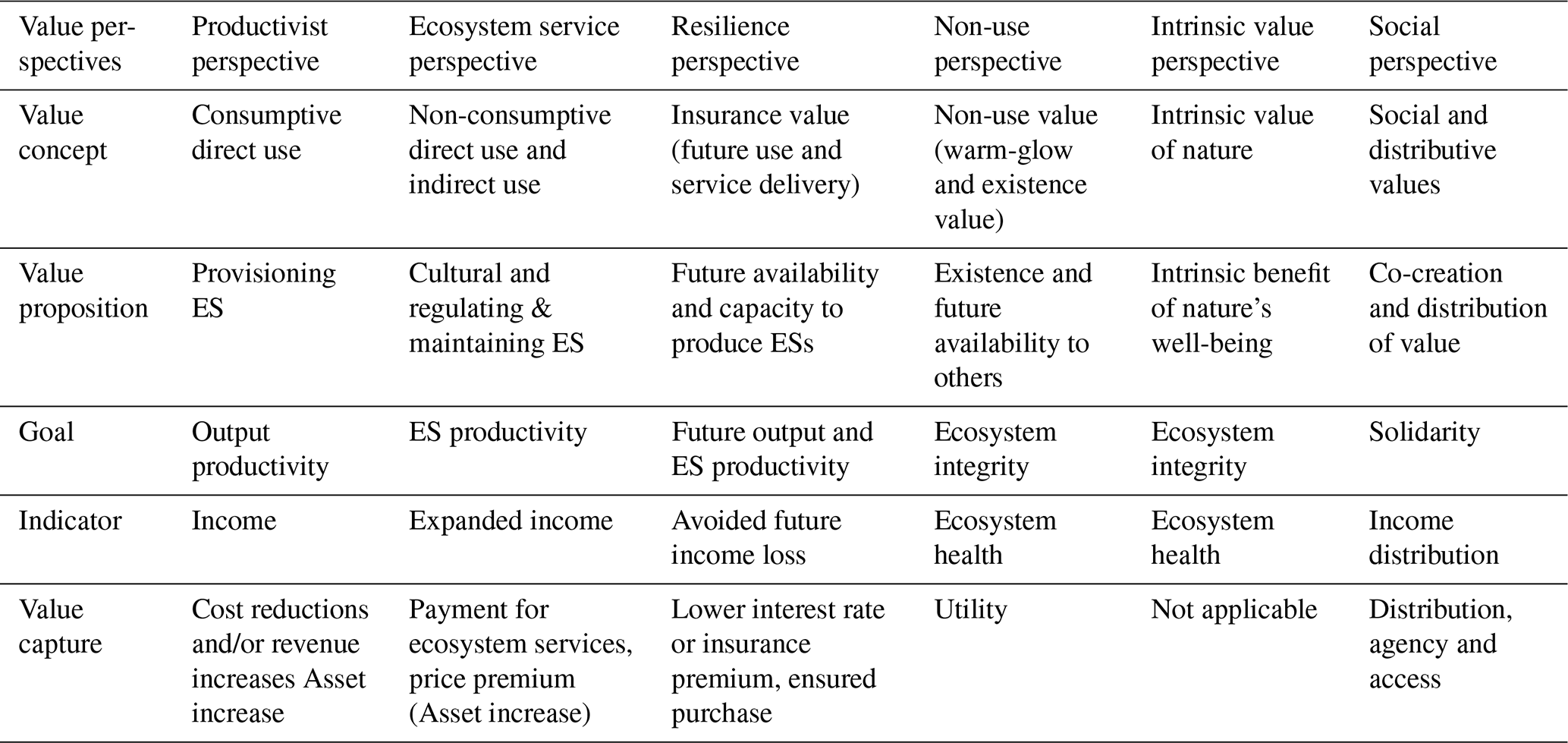
The six value perspectives provide complementary mechanisms for assessing and operationalising the capital dimension of soil security. Capital concerns the value attributed to soil as an asset or stock (McBratney et al., 2014; Evangelista et al., 2024). Its condition determines its capacity to perform soil functions and generate services, while management can cause it to appreciate or depreciate. The perspectives identify different components of soil capital and pathways for incorporating their value into investment decisions. The productivist perspective assesses contributions to agricultural production, input savings, avoided costs and land value. The ES perspective extends the assessment to regulating and cultural services benefiting actors beyond the land manager. The resilience perspective captures the capacity to continue providing services under disturbance and uncertainty, including avoided losses for farmers, lenders, insurers and value-chain actors. Together, these perspectives translate soil functions, services and threats into benefits, avoided costs and risk reductions that can underpin investment cases. The other perspectives identify components and conditions that conventional asset valuation cannot readily capture. The framework thus bridges the economic concept of soil capital with soil functions, services and threats observed in practice. It can help policymakers and financial institutions identify beneficiaries, credible investment cases and necessary safeguards. Soil health investments can consequently be understood as maintaining or appreciating a natural asset rather than merely increasing short-term productivity. This framing can support loans, guarantees, insurance arrangements, payments for ecosystem services and nature-positive investment without assuming that every component of soil value must be monetised or aggregated into a single figure.
The capital dimension can partly be operationalized through spatially explicit indicators. Francos et al. (2024) combined soil functions, services and threats to estimate soil management capital per hectare. Comparing a managed phenosoil with its least-modified genosoil reference can similarly indicate degradation or improvement over time (Dobarco et al., 2023). Measures such as pH-regulation costs, nutrient stocks and available water capacity can support targeting and investment decisions. However, these methods do not capture every value perspective and should complement rather than replace plural indicators and public deliberation.
Land managers but also other actors with a vested interest in soil health may combine different perspectives and value propositions in developing new SHBMs (Kik et al., 2021). However, to derive policy recommendations on how to effectively incentivize actors to adopt practices enhancing soil health, each perspective is discussed separately – nevertheless being mindful of interactions with other perspectives leading to possible synergies, trade-offs or overlaps.
The productivist perspective creates value for the land user through improving the asset base onto which output is produced, resulting in cost reductions, avoided costs or even increased revenues. In principle, incentives should not be needed if write-offs of the required investments can be paid by these income accruals. However, three problems may arise that leave room for policy interventions. First, the income accruals may not materialize immediately, which means there is a timing issue. This situation parallels the transition to organic farming, such that a subsidy may be justified. The challenge here is to determine the level and the duration of such a subsidy, as effects are likely to be context specific. Second, the income accruals may not be large enough to cover the investment, which means that there is no intrinsic motivation for the land manager to make the transition. In this case, additional income streams are necessary, but these need to be permanent. Investment subsidies may also provide a solution here. Alternatively, if sufficient levels of additional ESs are produced, payment for ES schemes may also apply. Third, land users may not have sufficient equity or access to credit to invest, which may be due to the characteristics of their business or because lenders perceive the investment as too risky. In this case, government guarantee may be an interesting instrument to lower the risk for the lender.
The ecosystem service perspective creates value for society at large, making the most straightforward incentive for land managers payments for ESs delivered. Regulations have been introduced that have incentivized businesses to take an active interest in enhancing ESs, thereby creating markets for certain ESs. A well-established example is the carbon credit market, such as the EU ETS (Emissions Trading System). Currently, the EU is working toward creating a similar market for biodiversity credits. Additionally, mandatory regulations like the Corporate Sustainability Reporting Directive (CSRD) and voluntary zero-carbon pledges require businesses to demonstrate progress in ES delivery. To meet these requirements, ESs must be valued in a standardized and verifiable way, producing credits that businesses can use to comply with CSRD or ETS obligations. This gives rise to three problems in which policy may intervene. First, land managers may invest in interventions that do not consistently yield the expected level of ESs. This can be addressed through hybrid schemes that combine payments for implementing practices with performance-based rewards for actual outcomes. Second, ESs are often co-produced, making it difficult to isolate individual contributions. While results-based approaches can separate outcomes, practice-based or hybrid approaches may generate multiple ESs. This creates synergies for land managers but complicates the design of appropriate interventions. Third, ES credits often fail to reflect the true opportunity costs. A carbon credit may provide a one-off payment for sequestered carbon, but land managers must continue investing to maintain soil carbon – a cost that may not be captured in the initial credit price. A crucial question here is whether land managers should be compensated only for additional ESs generated, or also for maintaining existing ES stocks. Moreover, the marginal gains in ESs tend to decline over time, making this an unstable income stream for land managers. Standardization should therefore not imply that carbon, biodiversity, water and social values are fully substitutable. Safeguards are also needed because market-based projects can restrict customary land uses or distribute benefits inequitably, as experience with carbon projects has shown (Dzingirai and Mangwanya, 2015).
The resilience perspective highlights the value of investing in practices that reduce the risk of ecosystem breakdown, benefiting all actors who rely on land use. ES delivery may be unstable (generally called leakage) due to factors outside the land manager's control, such as the weather. Investing in resilience reduces risk. Here, two issues may arise. First, since all actors benefit each may be willing to pay a premium, but without coordination this can lead to free-riders or over-subsidization but also to under-subsidization due to lack of action. Unlike ESs, it is impossible to decompose risk according to actors. Second, there may be a trade-off between income and resilience; investing in resilience-increasing practices may reduce income. A typical problem is crop diversification which involves including crops in rotations that may not be economically profitable. Buyers may offer broader contracts, but also here a coordination problem occurs, as buyers typically only purchase a single crop.
The non-use and intrinsic value perspectives do not depend on direct use or conventional market returns, which means that there will be no payments from economic actors as in the previous perspectives. Non-use values may justify public expenditure and intergenerational protection, whereas intrinsic value established moral duties and ecological limits independent of willingness to pay. Support therefore often comes through legal, cultural and educational avenues. Legal frameworks can establish minimum protection (e.g., the EU Soil Monitoring Law), while cultural programs that revitalize land-based knowledge, storytelling, and spiritual practices also help sustain an ethic of care. These perspectives challenge current paradigms and open space for more inclusive, resilient, and respectful relationships with the land.
The social perspective involves enhancing the capacity of local actors to shape the systems that affect them and also relates to how value is created by and distributed among actors. Such empowerment helps repoliticize soil health, turning it from a technical issue into a matter of social justice and ecological responsibility. An important challenge is scaling and sustaining social innovations beyond niche or pilot contexts. Without institutional support or funding, community-led efforts may struggle to persist. There is also a risk of tokenism or co-optation (Di Santo et al., 2023; Swyngedouw, 2005) – where soil-focused social initiatives are superficially adopted without empowering communities. Moreover, success depends on context: what works in one region may not transfer elsewhere. Incentives in this perspective are often relational and institutional rather than purely financial. These include platforms for peer exchange, recognition and visibilit, (e.g., EIP-Agri – European Innovation Partnership for Agricultural Productivity and Sustainability), institutional flexibility (e.g., adaptive policy frameworks), grants for community-based soil projects, open-access knowledge tools and funding for participatory research. Policies should additionally consider tenure security, bargaining power, transaction costs and benefit sharing, particularly where external investors or credit schemes may shift control away from local actors.
In summary, soil health is shaped by multiple, overlapping value perspectives that rarely occur in isolation. Different actors may hold diverse or simultaneous values, and policy must reflect this complexity. Rather than relying on a single instrument, a flexible, differentiated approach is needed–one that supports land managers with targeted, easily adoptable measures integrated into their SHBMs. At the same time, policy must avoid over-subsidization and free-riding, especially where benefits are non-excludable. Effective governance requires coordination, accountability, distributional safeguards and adaptive learning to ensure long-term resilience and fairness. The six perspectives can thus add economic content to the capital dimension of soil security, while the wider soil security framework prevents capital valuation from becoming the sole account of what soils are and why they matter.
No data sets were used in this article.
EM: conceptualization, funding acquisition, writing (original draft preparation), writing (review and editing).
KVR: conceptualization, writing (original draft preparation), writing (review and editing).
The contact author has declared that neither of the authors has any competing interests.
Views and opinions expressed are however those of the author(s) only and do not necessarily reflect those of the EU or the European Research Executive Agency (REA). Neither the EU nor the granting authority can be held responsible for them.
Publisher's note: Copernicus Publications remains neutral with regard to jurisdictional claims made in the text, published maps, institutional affiliations, or any other geographical representation in this paper. The authors bear the ultimate responsibility for providing appropriate place names. Views expressed in the text are those of the authors and do not necessarily reflect the views of the publisher.
This research has been supported by the European Commission, Research Executive Agency (grant no. 101091308).
This paper was edited by Awdenegest Moges and reviewed by R. Murray Lark and one anonymous referee.
Bartkowski, B.: Are diverse ecosystems more valuable? Economic value of biodiversity as result of uncertainty and spatial interactions in ecosystem service provision, Ecosyst. Serv., 24, 50–57, https://doi.org/10.1016/j.ecoser.2017.02.023, 2017.
Berry, W.: The Art of the Commonplace: The Agrarian Essays of Wendell Berry, Counterpoint, Washington, ISBN 978-1593760076, 2003.
Davidson, M. D.: On the relation between ecosystem services, intrinsic value, existence value and economic valuation, Ecol. Econ., 95, 171–177, https://doi.org/10.1016/j.ecolecon.2013.09.002, 2013.
Di Santo, N., Lopolito, A., and Sisto, R.: Tokenism in Territorial Development: Enabling Factors and Mitigation Measures, European Countryside, 15, 346–365, https://doi.org/10.2478/euco-2023-0019, 2023.
Dobarco, M. R., Campusano, J. P., McBratney, A. B., Malone, B., and Minasny, B.: Genosoil and phenosoil mapping in continental Australia is essential for soil security, Soil Security, 13, 100108, https://doi.org/10.1016/j.soisec.2023.100108, 2023.
Dominati, E., Patterson, M., and Mackay, A.: A framework for classifying and quantifying the natural capital and ecosystem services of soils, Ecol. Econ., 69, 1858–1868, https://doi.org/10.1016/j.ecolecon.2010.05.002, 2010.
Dzingirai, V. and Mangwanya, L.: Struggles over carbon in the Zambezi Valley: the case of Kariba REDD in Hurungwe, Zimbabwe, in: Carbon Conflicts and Forest Landscapes in Africa, edited by: Leach, M. and Scoones, I., Routledge, ISBN 9781315740416, 2015.
Evangelista, S. J., Field, D. J., McBratney, A. B., Minasny, B., Ng, W., Padarian, J., Dobarco, M. R., and Wadoux, A. M. C.: Soil security – Strategizing a sustainable future for soil, Adv. Agron., 183, 1–70, https://doi.org/10.1016/bs.agron.2023.10.001, 2024.
European Commission: EU Mission: A Soil Deal for Europe, European Commission [WWW Document], https://research-and-innovation.ec.europa.eu/funding/funding-opportunities/funding-programmes-and-open-calls/horizon-europe/eu-missions-horizon-europe/soil-deal-europe_en (last access: 18 August 2025), 2025.
Francos, N., McBratney, A. B., Field, D. J., Minasny, B., Pachon, J. C., Padarian, J., Hunakunti, A., Ng, W., Evangelista, S. J., and O'Donoghue, T.: Valuing and integrating soil roles in assessing the capital dimension of soil security: An Australian case study, Soil Security, 16, 100141, https://doi.org/10.1016/j.soisec.2024.100141, 2024.
Kik, M. C., Claassen, G. D. H., Meuwissen, M. P. M., Smit, A. B., and Saatkamp, H. W.: Actor analysis for sustainable soil management – A case study from the Netherlands, Land Use Policy, 107, 105491, https://doi.org/10.1016/j.landusepol.2021.105491, 2021.
Leopold, A.: The Land Ethic, in: A Sand County Almanac and Sketches Here and There, OUP, New York, ISBN 978-0195007770, 1949.
McBratney, A., Field, D. J., and Koch, A.: The dimensions of soil security, Geoderma, 213, 203–213, https://doi.org/10.1016/j.geoderma.2013.08.013, 2014.
McBratney, A., Evangelista, S., Francos, N., Hunakunti, A., Jang, H. J., Ng, W., O'Donoghue, T., Pachón Maldonado, J. C., Park, M., Sharififar, A., and Styc, Q.: Beyond Soil Health: Soil Security Underpinning a National Framework for Sustainable Australian Agriculture, Earth, 7, 62, https://doi.org/10.3390/earth7020062, 2026.
Osterwalder, A. and Pigneur, Y.: Business model generation: a handbook for visionaries, game changers, and challengers, Wiley & Sons, New York, ISBN 978-0470876411, 2013.
Pascual, U., Balvanera, P., Díaz, S., Pataki, G., Roth, E., Stenseke, M., Watson, R. T., Başak Dessane, E., Islar, M., Kelemen, E., Maris, V., Quaas, M., Subramanian, S. M., Wittmer, H., Adlan, A., Ahn, S., Al-Hafedh, Y. S., Amankwah, E., Asah, S. T., Berry, P., Bilgin, A., Breslow, S. J., Bullock, C., Cáceres, D., Daly-Hassen, H., Figueroa, E., Golden, C. D., Gómez-Baggethun, E., González-Jiménez, D., Houdet, J., Keune, H., Kumar, R., Ma, K., May, P. H., Mead, A., O'Farrell, P., Pandit, R., Pengue, W., Pichis-Madruga, R., Popa, F., Preston, S., Pacheco-Balanza, D., Saarikoski, H., Strassburg, B. B., Van Den Belt, M., Verma, M., Wickson, F., and Yagi, N.: Valuing nature's contributions to people: the IPBES approach, Curr. Opin. Env. Sust., 26–27, 7–16, https://doi.org/10.1016/j.cosust.2016.12.006, 2017.
Swyngedouw, E.: Governance Innovation and the Citizen: The Janus Face of Governance-beyond-the-State, Urban Stud., 42, 1991–2006, https://doi.org/10.1080/00420980500279869, 2005.
TEEB: The Economics of Ecosystems and Biodiversity: The Ecological and Economic Foundations, Earthscan, London and Washington DC, ISBN 978-0415501088, 2010.