
the Creative Commons Attribution 4.0 License.
the Creative Commons Attribution 4.0 License.
 | 03 Jun 2026
Operational POM increases are over-interpreted as SOM stabilization:quantifying untransformed straw and biochar residues via magnetic separation
Yuhan Xia
Sen Dou
Song Guan
Dilimulati Yalihong
Soil organic matter (SOM) is a complex mixture of organic compounds derived from the decomposition of plant and animal residues. SOM that has undergone microbial transformation and formed stable associations with minerals represents the stabilized fraction of soil organic carbon, which differs from the simple physical accumulation of external organic materials. Current understanding suggests that particulate organic matter (POM) includes both undecomposed and partially decomposed residues. Conventional analytical methods cannot clearly distinguish undecomposed exogenous organic residues from indigenous SOM. Consequently, increases in operationally defined POM are often misinterpreted as evidence of SOM stabilization or microbially transformed organic carbon formation. In this study, straw and biochar were magnetized through chemical coprecipitation and applied to the soil. Magnetic separation was performed at successive incubation times to isolate undegraded magnetic residues, thereby enabling more accurate tracking of SOM dynamics. Five treatments were established: blank control (CK), untreated straw (CS), untreated biochar with carbon input equivalent to straw (Bc), magnetized straw (MCS), and magnetized biochar (MBc). The recovery of magnetized straw residues declined continuously and reached 54.55 % after 360 d, whereas biochar residues remained highly persistent at 92.48 %. In the CS and Bc treatments, the organic carbon content of POM fractions and their proportion in total SOM were consistently higher than in CK, particularly during early incubation. However, after removing undegraded residues by magnetic separation, values were close to those of CK. This result indicates that the observed POM increases mainly originated from undecomposed external residues rather than microbially stabilized SOM. On day 30, the apparent increase in particulate organic carbon (POC) was 63.48 % in CS and 58.99 % in Bc. Over time, the apparent POC increase in CS declined to 15.34 % by day 360, whereas that in Bc remained high (53.71 %). These findings suggest that interpreting total POM as stabilized or microbially transformed SOM may lead to misleading conclusions about SOM stability, particularly in short-term incubations or agroecosystems receiving fresh organic amendments. This study provides a basis for a more accurate evaluation of soil organic matter transformation dynamics and content.
- Article
(2097 KB) - Full-text XML
-
Supplement
(339 KB) - BibTeX
- EndNote


Soil organic matter (SOM) is a complex assemblage of organic compounds formed through the accumulation, decomposition and transformation of plant and animal residues. The decomposed part exhibits a much stronger binding capacity to soil minerals than undecomposed or partially decomposed residues. This strong binding makes it one of the most stable organic fractions in soil and supports its long-term persistence (Angst et al., 2021; Cotrufo et al., 2013; Dou et al., 2020; Vendig et al., 2023). Notably, the core of SOM refers to its labile and functional organic components with dynamic transformation properties. These components supply nutrients to the soil, sustain microbial activity, and regulate soil structure (Arumugam et al., 2025; Feng et al., 2025; Xu et al., 2026). Therefore, SOM should not be regarded merely as the passive accumulation of carbon-containing substances. Distinct SOM components exhibit different turnover rates and stabilization mechanisms (Sokol et al., 2022; Von Lützow et al., 2007). Cambardella and Elliott (1992) established a widely used particle-size fractionation method to separate SOM into particulate organic matter (POM, 2 mm to 53 µm) and mineral-associated organic matter (MAOM, <53 µm). Based on these fractions, several conceptual models describing SOM formation and stabilization have been developed (Christensen, 1992; Cotrufo and Lavallee, 2022; Guo et al., 2022; Lavallee et al., 2020; Rocci et al., 2021; Witzgall et al., 2021).
In recent years, soil management and improvement measures have primarily aimed to increase organic material inputs and promote microbial utilization to form SOM (Castellano et al., 2015; Cotrufo et al., 2013). However, when application rates exceed microbial decomposition capacity, substantial amounts of undecomposed organic material can accumulate in POM over a certain period (Bhattacharyya et al., 2011; Brown et al., 2014; Stewart et al., 2012), leading to sharp short-term increases in POM organic carbon content (Hua et al., 2022; Liang et al., 2016; Mitchell et al., 2018). This increase is transient and non-stabilized, as POM remains susceptible to decomposition and transformation even under the physical protection of soil (Connell et al., 2025), and such short-term increases exhibit low persistence in soil (Janzen, 2015; Powlson et al., 2014). Currently, an accurate assessment of the proportion and duration of this transient and non-stabilized, residue-derived increase in POM mass and organic carbon content at various times following organic material application is still lacking.
In routine experiments, methods such as heavy liquid separation, sieving, and electrostatic attraction can isolate some undecomposed organic materials. However, they are less effective for highly fragmented materials such as biochar, limiting evaluation of SOM transformation processes. Therefore, new approaches for efficient separation of undecomposed residues are required. Magnetized materials (e.g., iron-based materials such as nano-zero-valent iron and iron sulfides) can be rapidly separated from soil under an external magnetic field, enabling the efficient recovery of target substances (Li et al., 2024; Rana et al., 2025; Zhang et al., 2025). Although biochar modified with magnetized materials has been widely studied, most research has focused on heavy metal or pollutant adsorption, with no application in SOM transformation. Among magnetized material preparation methods, the chemical coprecipitation method has been widely used because of its operational simplicity, high efficiency, and ease of impurity removal (Zhou et al., 2019). It offers excellent biocompatibility, stability, and recyclability (Baragaño et al., 2020; Duan et al., 2022), which facilitate the combined application of organic materials in soil. Iron particles form stable chemical bonds with organic materials, rather than simple physical adsorption. The surfaces of these materials contain abundant oxygen-containing functional groups such as hydroxyl, carboxyl, and carbonyl groups. During coprecipitation, these groups react with Fe2+ and Fe3+ to form coordinated and covalent bonds (Duan et al., 2022; Zhou et al., 2019). The resulting magnetic nanoparticles are uniformly embedded within the porous structure of the organic materials. This embedding prevents their detachment under non-biodegradation conditions, such as physical disturbance or soil hydration. When soil microorganisms decompose organic components, including cellulose, hemicellulose, and lignin, the functional groups that bind iron particles are disrupted. As a result, magnetic nanoparticles detach or disperse into non-magnetic fine particles smaller than 10 nm, which cannot be captured by magnetic fields. Consequently, decomposed residues completely lose their magnetism (Li et al., 2024).
In this study, a chemical coprecipitation method was used to turn straw (CS) and straw biochar (Bc) into magnetized materials. At different incubation stages, undecomposed magnetized organic residues were separated using an external magnetic field to eliminate their interference in SOM determina to quantify and characterize the incompletely decomposed residues at different times after organic material application; (ii) to determine the existence, proportion, and duration of residue-derived and non-stabilized accumulation in POM organic carbon; and (iii) to assess the proportion of organic residues ultimately transformed into stable SOM. The results provide critical support for precise evaluation of POM organic carbon content and elucidation of the mechanisms by which organic materials are transformed into stable SOM.
2.1 Experimental materials
The test soil was collected from the experimental station of Jilin Agricultural University, located in the semi-humid region of Northeast China (43°48′43.57′′ N, 125°23′38.50′′ E). The region has a temperate semi-humid climate, with an annual mean temperature of 4.6 °C and average annual precipitation ranging from 600 to 700 mm. The soil is classified as Black Soil under the suborder of semi-moist temperature semi-eluvial soil in the Chinese soil classification system, which is equivalent to Argiudolls in the USDA soil taxonomy. In September 2023, 100 soil samples were randomly collected from the 0–20 cm layer using a soil auger and combined to form a composite sample. After sampling, visible organic residues were manually removed. The field-moist soil was air-dried and sieved through a 2 mm mesh for subsequent incubation. The basic properties of the soil were determined prior to the formal experiment as part of the initial soil characterization, with specific measurement methods following standard protocols in soil science: soil organic matter was determined by the dichromate oxidation method, total nitrogen by the Kjeldahl method, available nitrogen by the alkaline hydrolysis-diffusion method, available phosphorus by the molybdenum-antimony colorimetric method, and available potassium by flame photometry. The specific values were as follows: soil organic matter, 22.76 g kg−1; total nitrogen, 1.28 g kg−1; available nitrogen, 132.21 mg kg−1; available phosphorus, 18.52 mg kg−1; and available potassium, 99.32 mg kg−1.
The corn stover (CS) used in the experiment was obtained from the Experimental Station of the Jilin Agricultural University, Jilin Province, China (Changchun, China). The entire CS was rinsed with deionized water to remove surface ash and soil, dried in an oven for 24 h, ground using a grinder, and sieved through a 20-mesh sieve for later use.
The sieved straw powder (passing 20 mesh) was placed in a tubular furnace and pyrolyzed at 500 °C for 2 h under a nitrogen atmosphere at a heating rate of 5 °C min−1. After cooling to room temperature, the resulting black solid was collected as straw biochar (Bc) for further use.
The magnetized straw (MCS) and magnetized biochar (MBc) were prepared using the chemical coprecipitation method (Zhou et al., 2019) as follows: 2.5 g of FeCl3 ⋅ 6 H2O and 1.5 g of FeSO4 ⋅ 7 H2O (Fe3+ : Fe2+ molar ratio of 2:1) were weighed into a beaker. Subsequently, 2.0 g of dried CS or Bc was introduced to 100 mL of ultrapure water. The mixture was thoroughly stirred at room temperature for 30 s using a magnetic stirrer. An excess of ammonia solution (NH3 ⋅ H2O) was subsequently added to adjust the pH to 10. After the reaction, the magnetic materials in the suspension were separated from the liquid phase using an external magnet. The magnetized samples were collected, dried in a vacuum oven at 60 °C, weighed, and designated as magnetized straw (MCS) and magnetized biochar (MBc).
2.2 Experimental design
Prior to the incubation experiment, the collected soil was pretreated by thorough mixing and sieving through a 2 mm mesh. Fine roots and other visible plant residues were carefully removed, and all iron-containing particles were extracted using a magnetic rod to minimize potential experimental interference. The study included five treatments: (1) control (CK): no organic amendment; (2) straw treatment (CS): non-magnetized straw; (3) biochar treatment (Bc): non-magnetized biochar with carbon content equivalent to CS; (4) magnetized straw treatment (MCS): magnetized straw at the same carbon input as CS; and (5) magnetized biochar treatment (MBc): magnetized biochar with carbon equivalent to CS.
For each treatment, the respective materials (CS, Bc, MCS, and MBc) were thoroughly mixed with soil. Specifically, 400 g of soil was placed in PVC containers, and amendments were applied based on a full straw return rate of 11 t ha−1. Accordingly, 1.95 g of straw was added to the CS treatment, while 1.16 g of biochar was applied to the Bc treatment to match the carbon input of straw. The amount of magnetized straw and magnetized biochar were adjusted according to their preparation yields, resulting in 2.67 and 1.63 g for the MCS and MBc treatments, respectively.
To ensure homogeneous mixing, a small portion of amendment and air-dried soil was first combined in a glass beaker using a plastic spoon. After thorough mixing, the remaining soil was gradually added and continuously mixed until a uniform soil amendment mixture was obtained (Shi et al., 2024). The K, CS, and Bc treatments each included three replicates. Each of the MCS and MBc treatments had six replicates divided into two subgroups: three without magnetic residue separation (MCS-O and MBc-O) and three with magnetic residue separation prior to soil and parameter analyses (MCS-D and MBc-D). During incubation, soil moisture was maintained at 25 % by frequent weighing and watering, and all samples were incubated at 30 °C in a constant-temperature incubator.
The incubation began in April 2024, with destructive sampling at 30, 60, 180, and 360 d after the start. The samples from each treatment were retrieved, air-dried, and sieved through a 2 mm mesh for subsequent analyses.
2.3 Fractionation of POM and MAOM
SOM was fractionated into particulate organic matter (POM) and mineral-associated organic matter (MAOM) following the wet sieving and particle-size fractionation methods described by Cambardella and Elliott (1992). Specifically, 20 g of air-dried soil was weighed and mixed with 60 mL of 5 g L−1 sodium hexametaphosphate solution. The mixture was shaken for 18 h at 25 °C and 180 rpm. The dispersed suspension was then passed through a 53 µm sieve and washed repeatedly with small volumes of deionized water until the filtrate became clear and colorless. The material retained on the sieve (>53 µm) was considered as sand particles and POM, while the fraction passing through the sieve (<53 µm) consisted of silt- and clay-sized particles along with MAOM.
The POM and MAOM fractions were collected separately in glass beakers. Within the soil-water suspension, a strong external magnetic iron rod was used to separate undecomposed magnetized straw and magnetized biochar residues from the POM and MAOM fractions in liquid form. These separated materials were designated as magnetized residue components within the POM and MAOM fractions, respectively. Both the soil fractions and magnetized residue fractions of POM and MAOM were dried at 60 °C, weighed, and ground through a 60-mesh sieve (Liu et al., 2024). After the complete removal of undecomposed magnetized organic residues, preliminary determination of the organic carbon content in the original soil was performed using the potassium dichromate oxidation method with external heating (Nelson and Sommers, 1982). For formal and consistent characterization across all sample types, the soil organic carbon (SOC) content of the original soil, organic residue samples, and soil fractions collected at different incubation stages was subsequently measured with an elemental analyzer (Vario EL III, Hanau, Germany). All organic carbon data reported in this study were obtained from elemental analysis and corrected to an ash-free and moisture-free basis (Ndzelu et al., 2021). To quantify the particulate organic carbon (POC) derived from amendment residues and its contribution to total soil organic carbon (SOC), the following equations were applied:
where MP denotes the relative mass proportion of the POM fraction (%, i.e., percentage by mass of POM in the soil sample), OCP represents the organic carbon content of the POM fraction (g kg−1), POC refers to the calculated particulate organic carbon content of the soil sample (g kg−1), SOC denotes the total soil organic carbon content of the undisturbed soil (g kg−1), and POM-C Contribution (%) represents the percentage contribution of particulate organic carbon to total soil organic carbon.
2.4 Calculation of organic residue retention rate
The cumulative retention rate of dry matter from straw (CS) and biochar (Bc) residues within the MCS and MBc fractions was calculated as follows:
where L is the mass retention rate of the organic residue (%), Md is the dry mass of the recovered magnetized material at different decomposition times (g), MFe is the dry mass of the Fe-related products in the applied magnetized material (g), and M1 is the dry mass of the unmagnetized straw or biochar applied in the CS and Bc treatments (g). For the magnetized treatments (MCS and MBc), the applied mass of magnetized materials was calculated based on the same M1 to ensure equal organic carbon input across all treatments.
2.5 Data analysis
All data were first organized using Microsoft Office Excel 2022, followed by statistical analysis with IBM SPSS Statistics 25 (IBM Corporation, Armonk, NY, USA). One-way analysis of variance (ANOVA) was performed to examine differences in the measured indices across all treatments and incubation time points, with post-hoc multiple comparisons conducted using the least significant difference (LSD) test at the 0.05 significance level. Additionally, two-way ANOVA was applied to evaluate the effects of treatment, incubation time, and their interaction on soil and fraction-specific organic carbon contents, and Duncan's multiple range test (integrated in SPSS) was used for post-hoc comparison of significant differences. Graphs were generated using Origin 2022.
3.1 Differences between magnetized and original organic materials
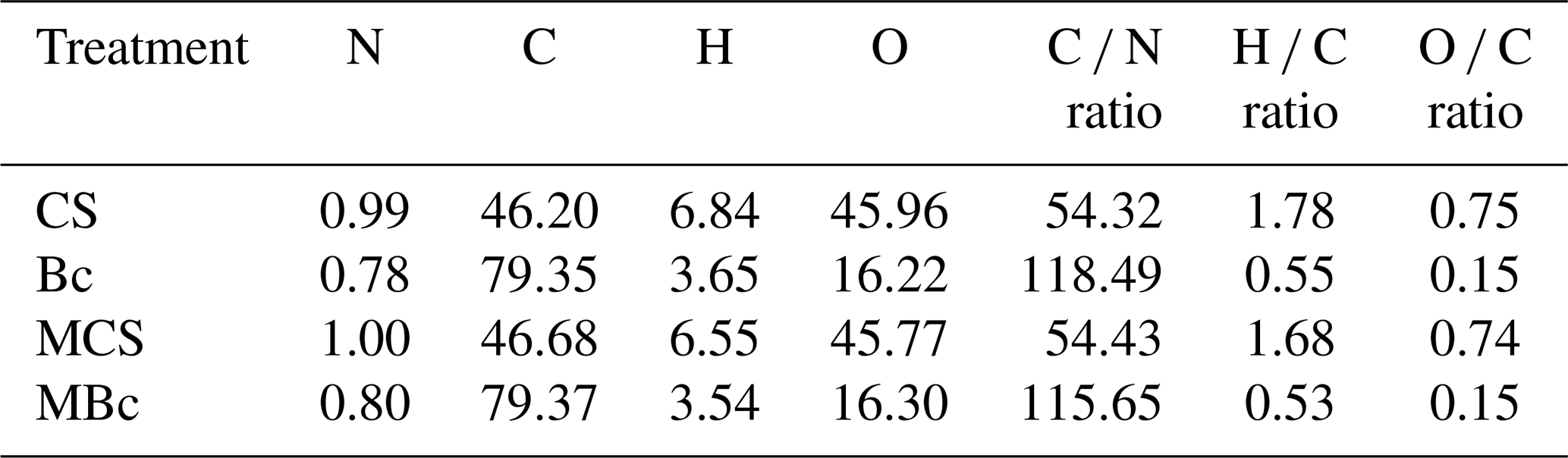
As shown in Table 1, no significant differences were observed in the molar ratios of carbon to nitrogen (C N), hydrogen to carbon (H C), or oxygen to carbon (O C) before and after magnetic modification of the organic materials. This result indicates that the magnetization process does not substantially alter the elemental composition of organic materials. The C N, H C, and O C ratios serve as key indicators of the chemical properties and structural characteristics of organic materials. Specifically, the C N ratio could be closely associated with the decomposition rate of organic substrates, the H C ratio reflects aromaticity, and the O C ratio represents the oxidation level (Ndzelu et al., 2021). The near-constant values of these ratios before and after magnetization suggest that the fundamental chemical attributes and structural features of the organic materials remained unchanged by magnetic treatment.
Table 1Comparison of elemental composition of organic materials before and after magnetization.
The metallic nanoparticles produced by coprecipitation were uniformly distributed on the surfaces of straw and biochar within a narrow size range. They formed a discontinuous and porous coating, rather than a dense and impermeable layer. This nanoscale coating does not block surface functional groups or internal pore structures, thereby preserving the natural accessibility of organic materials to soil microorganisms (Panda et al., 2026). As a result, the decomposition behavior of the magnetized materials remained consistent with that of the unmodified materials, supporting their reliability in tracking SOM transformation processes. Therefore, the magnetized organic materials exhibited high chemical and structural consistency with their non-magnetized counterparts, making them reliable representatives of original organic substrates. This conclusion could present a sound theoretical basis for using magnetized organic materials in subsequent experiments to investigate the behavior of undecomposed organic residues in soil. It also ensured the reliability and accuracy of results related to the assessment of residue-driven increases in soil organic matter through the separation of magnetized organic residues.
3.2 Temporal changes in magnetized organic residues in soil
As shown in Fig. 1, the retention rate of straw residues in MCS gradually decreased over the incubation period, with values of 85.98 %, 63.00 %, 58.99 %, and 54.55 % at 30, 60, 180, and 360 d, respectively. In contrast, the biochar fraction in MBc exhibited relatively minor changes, with retention rates of 98.92 %, 97.88 %, 94.80 %, and 92.48 % at the corresponding time points. These results show that the straw fraction in MCS decomposed gradually in soil over the incubation duration, and was gradually transformed into relatively recalcitrant organic matter. Conversely, the biochar fraction in MBc was significantly more resistant to microbial decomposition and more persistent than straw throughout the experiment, as evidenced by its consistently higher residue rate (92.48 % at 360 d) compared to straw (54.55 % at 360 d).
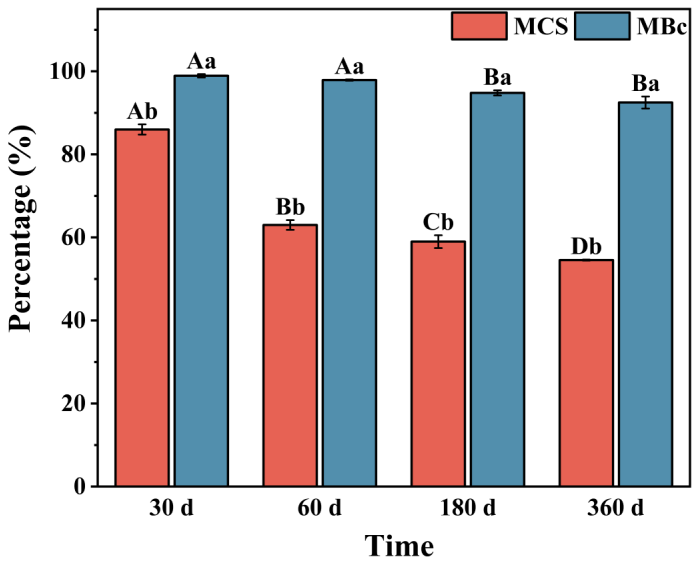
Figure 1Residual rates of undecomposed magnetized straw (MCS) and magnetized biochar (MBc) separated from soil at different incubation times. Note: MCS refers to magnetized straw; MBc refers to magnetized biochar. Different uppercase letters indicate significant differences among sampling times within the same organic residue (p<0.05), while different lowercase letters indicate significant differences between organic residues at the same sampling time (p<0.05).
The results in Fig. 2 further demonstrate that the two types of magnetized organic materials differed not only in their retention rates but also in the extent of mass changes after decomposition. Compared with the soil MAOM fraction, undecomposed MCS residues in the early incubation stage exhibited higher H C and C N ratios, closer to those of the soil POM fraction. As shown in Fig. 2a, the H C ratio of MCS residues decreased gradually over time, approaching that of MAOM by day 360, whereas the O C ratio exhibited a slow increase. In contrast, these trends were not evident in MBc residue samples. A decrease in the H C ratio indicates a reduced aliphatic character of the organic residues (Banach-Szott et al., 2014; Dou and Li, 2010), while an increase in the O C ratio could reflect increased oxidation (Mohammed et al., 2023). These findings indicate that with prolonged incubation, shifts in the H C and O C ratios of the organic residues (evident from the bulk elemental analysis presented in Fig. 2) are consistent with oxidative transformation and changes in aliphatic content and structural condensation of the organic material. Figure 2b further shows that the C N ratio and carbon concentration of MCS residues declined continuously, gradually approaching those of the soil MAOM fraction. This trend reflects the progressive decomposition and transformation of organic residues toward chemical characteristics similar to those of native soil mineral-associated organic matter, consistent with observations of organic matter stabilization in previous studies (Abakumov and Eskov, 2023). Notably, the C N ratio of MCS residues at 360 d approximated that of MAOM. Conversely, the changes in these parameters for MBc residues were relatively small, indicating that the organic components of MBc residues were more resistant to microbial decomposition and transformation than straw residues within the 360 d incubation period.
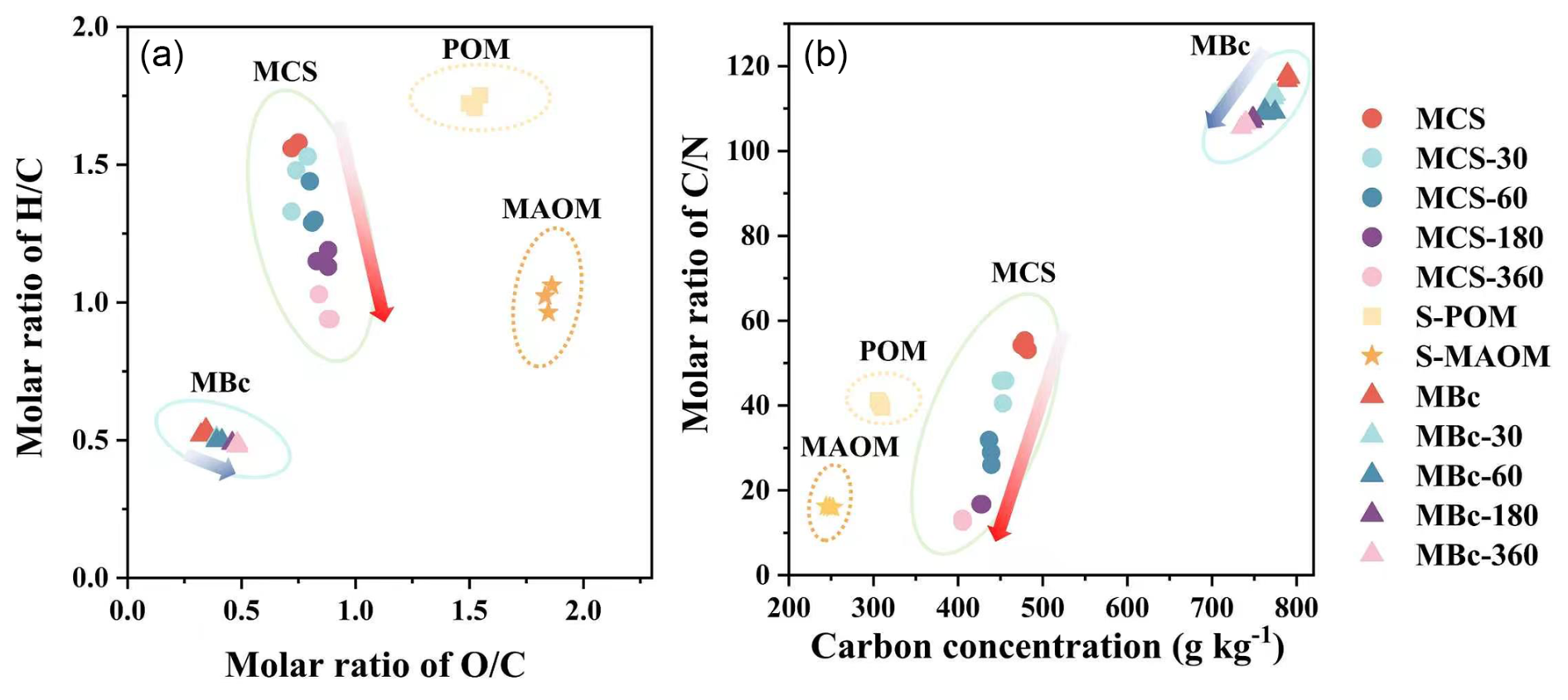
Figure 2Van Krevelen diagram of atomic H C and O C ratios (a), and comparison of C N ratio and carbon concentration (b) of magnetized organic residues, soil POM, and MAOM fractions at different incubation times. Note: MCS refers to magnetized straw; MBc refers to magnetized biochar. MCS-30, MCS-60, MCS-180, and MCS-360 represent undecomposed magnetized straw residues separated from soil at 30, 60, 180, and 360 d, respectively; MBc-30, MBc-60, MBc-180, and MBc-360 represent undecomposed magnetized biochar residues separated from soil at the same respective time points. S-POM and S-MAOM denote soil samples of particulate organic matter and mineral-associated organic matter fractions, respectively. All data are corrected on an ash-free and moisture-free basis.
3.3 Organic residues cause residue-derived increases in the mass proportion and organic carbon content of soil POM fraction
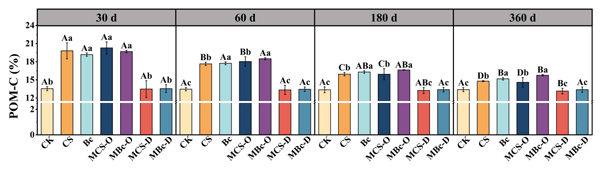
Figure 3 presents the relative mass proportions of the soil POM fraction at different incubation times across treatments. Clear differences among treatments were evident. Two-way ANOVA (Table S1 in the Supplement) revealed that the relative mass proportion of the POM fraction (MP) was significantly affected by treatment (p<0.001) and incubation time (p<0.01), with no significant interaction between treatment and time (p>0.05). Similarly, as shown in Fig. 3, the organic carbon content of the POM fraction (OCP) was significantly influenced by treatment (p<0.001), incubation time (p<0.001), and their interaction (p<0.001). Notably, no significant differences were observed between the MCS-O and MBc-O (magnetized treatments without removing magnetic organic residues at harvest) and the CS and Bc treatments at any sampling time, supporting the applicability of magnetized materials in soil applications.
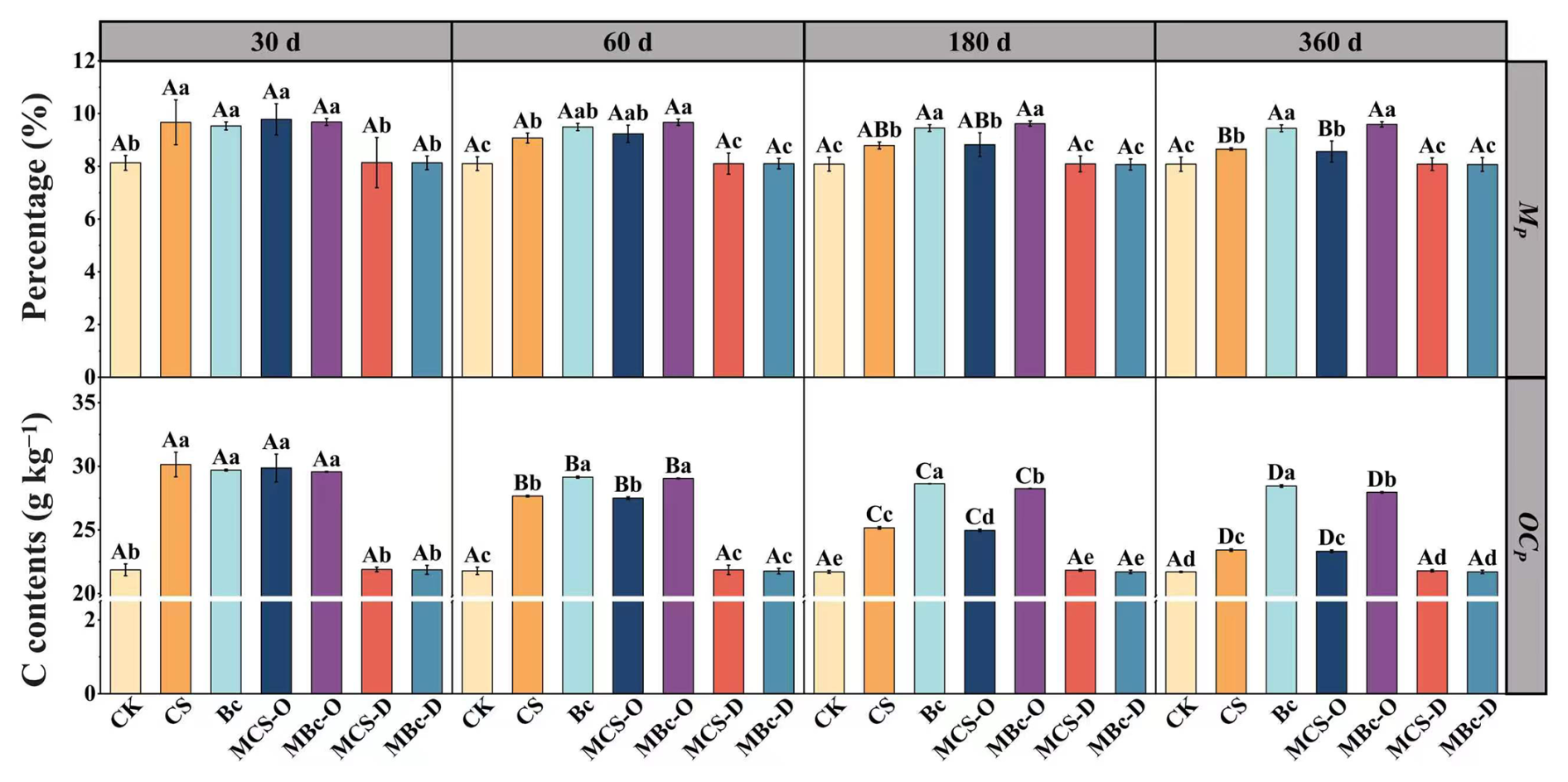
Figure 3Relative mass proportion (MP) and organic carbon content (OCP) of the soil POM fraction at different incubation times across treatments. Note: CK denotes the control treatment without organic amendments; CS denotes the treatment with normal straw application; Bc denotes the treatment with biochar applied at an equivalent carbon amount to straw; MCS denotes the treatment with magnetized straw applied at an equivalent carbon amount; and MBc denotes the treatment with magnetized biochar applied at an equivalent carbon amount. MCS-O and MBc-O refer to treatments in which magnetized organic materials were not removed at the end of incubation; MCS-D and MBc-D refer to treatments in which magnetized organic residues were separated from the soil before testing the remaining soil samples. Different uppercase letters indicate significant differences among sampling times within the same treatment, whereas different lowercase letters indicate significant differences among treatments at the same sampling time (p<0.05).
At 30, 60, 180, and 360 d of incubation, the mass proportion of the POM fraction (MP) in the CS treatment increased by 18.94 %, 11.97 %, 8.78 %, and 7.05 %, respectively, compared with CK. For the Bc treatment, the corresponding increases were 17.22 %, 17.16 %, 16.95 %, and 16.83 %, respectively. However, after the removal of magnetized organic residues from the soil, no significant changes in POM mass proportion were observed in the MCS-D and MBc-D (magnetized treatments with magnetic organic residues removed before analysis) treatments compared with CK. These results indicate that the increases in POM mass proportion observed in the CS and Bc treatments were residue-driven increases, arising from the retention of persistent amendment residues within the operationally defined >53 µm particulate fraction. Further analysis revealed that in the CS treatment, this residue-driven elevation decreased gradually over time, stabilizing at approximately day 180, whereas in the Bc treatment, it remained nearly constant throughout the incubation period.
Similarly, at different time points, the organic carbon content of the POM fraction (OCP) in the CS treatment increased by 37.87 %, 26.99 %, 15.94 %, and 7.92 %, respectively, compared with CK. For the Bc treatment, the increases were 35.86 %, 33.83 %, 31.93 %, and 31.10 %, respectively. At the same time points, the OCP in the CS treatment exceeded that in the MCS-D treatment by 37.68 %, 26.53 %, 15.25 %, and 7.48 %, respectively. Moreover, the OCP in the Bc treatment was higher than in the MBc-D treatment by 35.80 %, 33.96 %, 31.93 %, and 31.10 %. These results demonstrated that both the carbon content and mass proportion of the POM fraction exhibited residue-driven increases, resulting from the retention of persistent amendment residues within the operationally defined >53 µm particulate fraction. As no significant difference was identified between the MCS-D and CK treatments, the reduction in the residue-derived increase for the CS treatment was attributable not to an increase in organic carbon content in the MCS-D treatment but to the decomposition of organic residues within the fraction.
3.4 Organic residues cause residue-derived increases in POC and SOC contents
As shown in Fig. 4 and Table S2, two-way ANOVA indicated that the POC content was significantly affected by treatment (p<0.001), incubation time (p<0.001), and their interaction (P<0.001). Similarly, the SOC content was significantly influenced by treatment (p<0.001), incubation time (p<0.001), and their interaction (p<0.001). The POC contents in the MCS-O and MBc-O treatments were slightly lower than those in the CS and Bc treatments, although the differences were not statistically significant. Specifically, at 30, 60, 180, and 360 d of incubation, the POC contents in both the CS and Bc treatments were significantly higher than those in CK. The increase in POC content compared with CK in the CS treatment showed a clear decreasing trend, with increases of 63.48 %, 42.61 %, 26.29 %, and 16.00 %, respectively. In contrast, although the POC content in the Bc treatment also declined during incubation, the decrease was less pronounced, with increases of 58.99 %, 57.38 %, 54.86 %, and 53.71 % at the respective time points. No significant differences in POC content were observed between the MCS-D and MBc-D treatments, indicating that the elevated POC contents in the CS and Bc treatments originated from undecomposed organic residues. The POC contents in the CS treatment exceeded that in the MCS-D treatment by 63.48 %, 41.80 %, 24.86 %, and 15.34 % at the respective time points, whereas the POC contents in the Bc treatment were higher than that in the MBc-D treatment by 58.99 %, 42.61 %, 54.86 %, and 53.71 %, respectively.
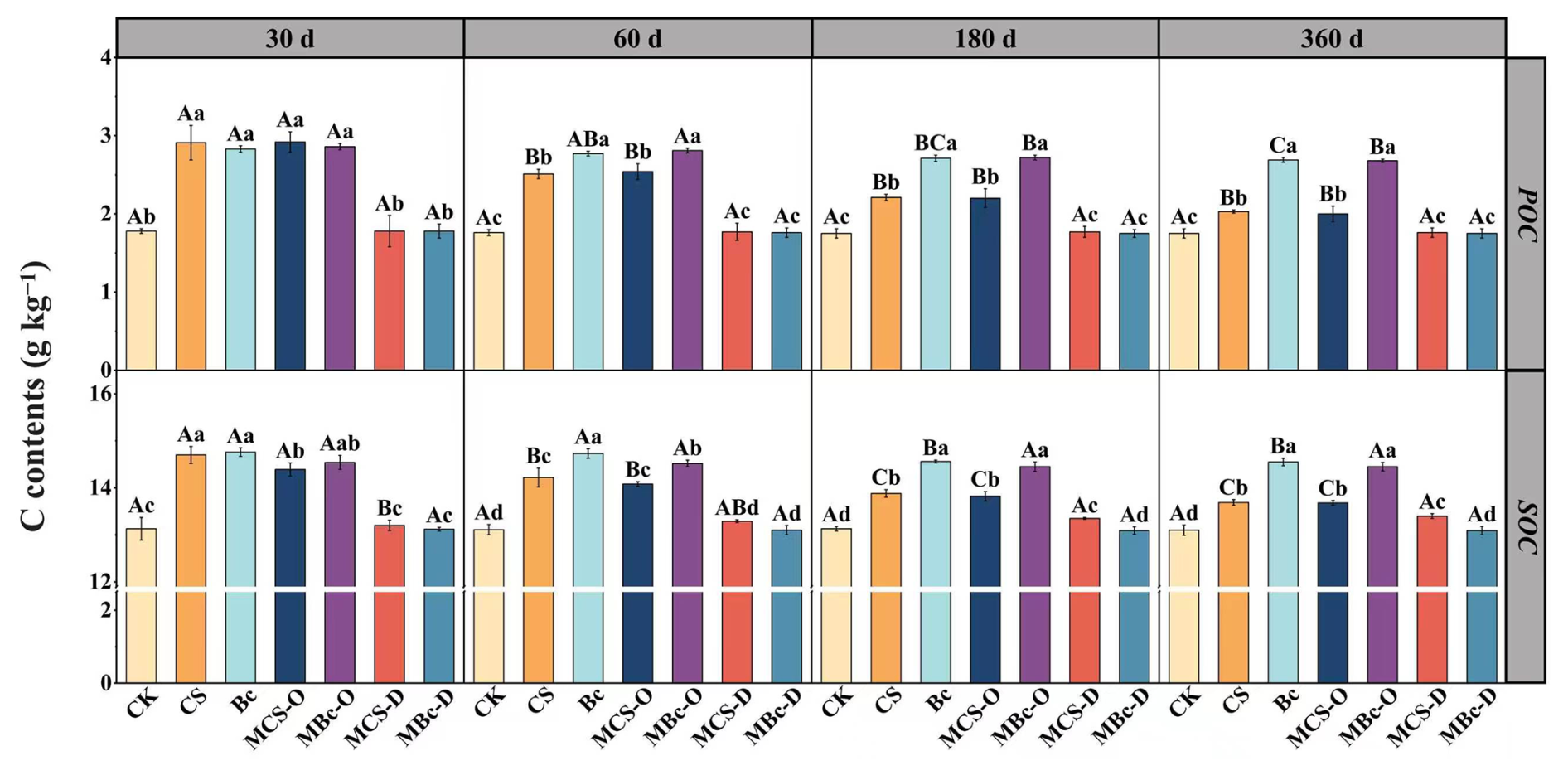
Figure 4POC and SOC contents of different treatments at various incubation times. Note: CK denotes the control treatment without organic amendments; CS denotes the treatment with normal straw application; Bc denotes the treatment with biochar applied at an equivalent carbon amount to straw; MCS denotes the treatment with magnetized straw applied at an equivalent carbon amount; and MBc denotes the treatment with magnetized biochar applied at an equivalent carbon amount. MCS-O and MBc-O refer to treatments in which magnetized organic materials were not removed at the end of incubation; MCS-D and MBc-D refer to treatments in which magnetized organic residues were separated from the soil before testing the remaining soil samples. Different uppercase letters indicate significant differences among sampling times within the same treatment, whereas different lowercase letters indicate significant differences among treatments at the same sampling time (p<0.05).
Across all incubation periods, the SOC contents in the MCS-O and MBc-O treatments were comparable to those in the CS and Bc treatments, indicating strong consistency between the magnetized organic materials and the original organic materials during incubation. Specifically, at 30, 60, 180, and 360 d, the SOC contents in the CS and Bc treatments were significantly higher than in CK. The SOC content in the CS treatment showed a decreasing trend, with increases of 11.95 %, 8.40 %, 5.71 %, and 4.50 %, respectively. In contrast, although the SOC content in the Bc treatment also declined over time, the decrease was less pronounced, with increases of 12.41 %, 12.35 %, 10.89 %, and 11.06 % at the respective time points. After 360 d of incubation, the SOC content in the MCS-D treatment showed an increasing trend, whereas the SOC content in the MBc-D treatment remained similar to that in CK without significant changes, maintaining a relatively stable level throughout the incubation period.
3.5 Organic residues cause residue-derived increases in the proportion of POM in total SOM
As shown in Fig. 5 and Table S3, two-way ANOVA revealed that the contribution of POC to total SOC (POM-C contribution, POC/SOC) was significantly affected by treatment (p<0.001), incubation time (p<0.001), and their interaction (p<0.001). POM-C in the CS and Bc treatments was significantly higher than that in CK. At different incubation times, the ratios in the CS treatment increased by 46.23 %, 31.05 %, 19.31 %, and 10.54 %, whereas those in the Bc treatment increased by 41.58 %, 39.60 %, 39.15 %, and 38.04 %, respectively. However, the residue-driven elevation of the POM proportion in SOM persisted. At different time points, the ratios in the CS treatment were 46.88 %, 32.23 %, 20.39 %, and 12.47 % higher than those in the MCS-D treatment, whereas in the Bc treatment, they were 41.47 %, 39.70 %, 38.94 %, and 38.04 % higher than those in the MBc-D treatment. Notably, the POM proportion in SOM in the MCS-D treatment was lower than that in CK, which was attributed to the greater conversion of straw residues into MAOM during decomposition, thereby increasing the MAOM proportion in SOM. In contrast, no significant changes were observed in biochar in the MBc-D treatment, and the proportion of POM in SOM was similar to that in CK.
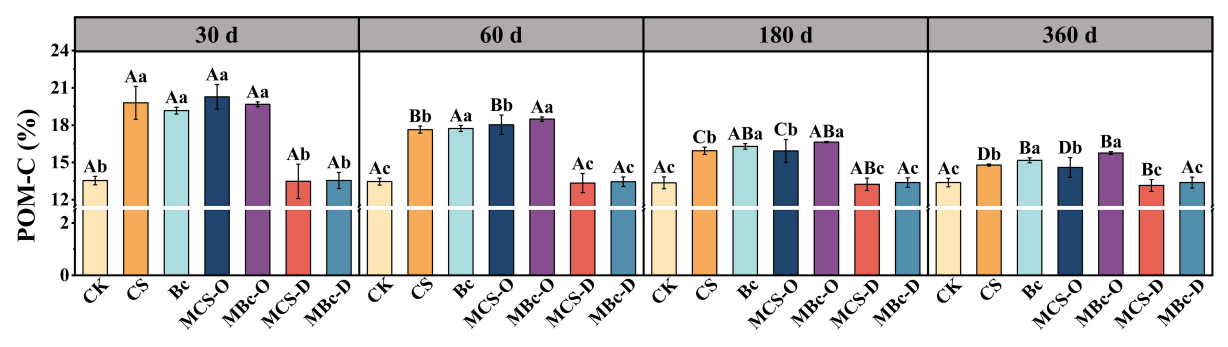
Figure 5Proportion of POM-C contribution (POC/SOC) for different treatments at various incubation times. Note: CK denotes the control treatment without organic amendments; CS denotes the treatment with normal straw application; Bc denotes the treatment with biochar applied at an equivalent carbon amount to straw; MCS denotes the treatment with magnetized straw applied at an equivalent carbon amount; and MBc denotes the treatment with magnetized biochar applied at an equivalent carbon amount. MCS-O and MBc-O refer to treatments in which magnetized organic materials were not removed at the end of incubation; MCS-D and MBc-D refer to treatments in which magnetized organic residues were separated from the soil before testing the remaining soil samples. Different uppercase letters indicate significant differences among sampling times within the same treatment, whereas different lowercase letters indicate significant differences among treatments at the same sampling time (p<0.05).
4.1 Differences in the transformation of organic materials with different qualities in soil
As shown in Fig. 1, the proportion of undecomposed straw residues significantly decreased over different incubation periods, with a residue rate of only 54.55 % after 360 d. In sharp contrast, biochar exhibited almost no decomposition, maintaining a high residue rate of 92.48 %. Based on the bulk elemental analysis in Fig. 2, the organic straw component within magnetic straw residues underwent progressive oxidative transformation and structural condensation with incubation time, as reflected by the gradual shifts in H C and O C ratios, indicating a gradual evolution toward more chemically stable characteristics. Meanwhile, the magnetic mineral phase remained preserved, resulting in the persistent magnetic properties of the residual materials. By contrast, MBc residues exhibited negligible changes in elemental composition throughout the incubation period.
The contrasting decomposition dynamics between straw and biochar are primarily driven by their inherent structural differences. Straw contains abundant labile components (e.g., carbohydrates, organic acids, and amino acids) that are readily utilized by soil microorganisms, leading to rapid mineralization within 0–60 d, followed by slower decomposition of recalcitrant aromatic and polymeric fractions during 60–180 d, which aligns with the present findings and previous reports (Chen et al., 2010; Ren et al., 2021). In contrast, biochar is produced via pyrolysis of biomass at 300–700 °C under anaerobic conditions (Dungait et al., 2012); during this process, labile cellulose-C in straw is converted into aromatic biochar-C with highly condensed structures, greatly enhancing its structural stability and resistance to microbial decomposition in soil (Yin et al., 2022), thus enabling biochar to remain largely as a residue (Bornø et al., 2019). Although straw has a lower C N ratio than biochar, this difference is a secondary feature accompanying their distinct chemical structures, rather than the dominant factor controlling their decomposition rates.
The high stability of biochar observed in this study confirms its unique advantages as a carbon-rich soil amendment for soil carbon sequestration and structural improvement, which is consistent with previous studies (Cao et al., 2022; Van et al., 2021; Wang et al., 2025; Zhang et al., 2024). Characterized by slow decomposition and a surface conducive to organic molecule aggregation, biochar can effectively reduce soil bulk density (Zhang et al., 2021), increase soil porosity (He et al., 2022), alleviate soil acidification (Shi et al., 2023), retain soil moisture (Khaledi et al., 2023), and enhance nutrient absorption efficiency and nutrient cycling coordination (Burgeon et al., 2022) when applied to soil. Therefore, despite its slow decomposition in soil, biochar plays a significant role in improving soil structure and function, which is further supported by its high persistence observed in the present one-year incubation experiment.
4.2 Residual undecomposed organic matter contributes to increases in the POM fraction
The analysis of the weight proportion and organic carbon content of soil fractions presented in Figs. 3 and 4 clearly demonstrated that under the CS and Bc treatments, both the relative mass and organic carbon content of the POM fraction were consistently higher than those in the CK treatment. This finding aligns with those reported by Xie et al. (2014). The POM fraction, a valid component of soil organic matter (SOM), mainly consists of partially decomposed, chemically recalcitrant polymeric structures, such as acid-insoluble fibers formed through fragmentation, which could primarily originate from exogenous organic materials. Owing to its rapid responsiveness to environmental changes, POM can be highly sensitive to agricultural management practices (Christensen, 1992; Cotrufo et al., 2022; Guo et al., 2022; Rocci et al., 2021; Witzgall et al., 2021). Xie et al. (2014) demonstrated that increasing the input of organic materials directly influenced both SOM content and its proportion within the POM fraction. They attributed this phenomenon to the continuous accumulation of organic residues in soil induced by organic amendments (Xie et al., 2014). However, it is critical to distinguish between POM derived directly from undecomposed amendment residues and MAOM formed through microbial transformation of organic materials. This distinction clarifies the dynamic nature of SOM accumulation. It does not imply that residue-derived POM is an invalid component of SOM.
In this experiment, the POM mass proportion and organic carbon content for the MCS-D and MBc-D treatments were obtained by first applying the magnetic materials to the soil for a period of incubation, then extracting the magnetic residues from the soil, and subsequently testing the soil samples after removal of the undecomposed materials. The results showed that after the magnetic materials were extracted, the POM mass proportion and organic carbon content in the MCS and MBc treatments did not exhibit significant increases compared with the CK treatment. This proved that the increases in POM mass proportion and organic carbon content observed under the CS and Bc treatments were largely attributable to the direct input of straw and biochar materials, with most undecomposed organic residues remaining within the POM fraction. Moreover, the residue-driven increases in both POM mass proportion and organic carbon content under the CS treatment decreased over the incubation period, whereas the corresponding values under the Bc treatment remained nearly constant. These findings suggest that the quantity, quality, and incubation duration of organic residues are key factors driving the increase in the POM mass proportion and organic carbon content. Additionally, the extent of increase in the POM fraction was closely related to the amount and source of organic material applied.
The results shown in Fig. 4 revealed a pronounced decreasing trend in the POM fraction organic carbon content (POC) under CS treatment. This confirmed that the effect of organic material addition in the short term was predominantly reflected in the POM fraction, whereas a gradual increase in the MAOM fraction was observed. This aligned with the conclusions of Bhattacharyya et al. (2011), Brown et al. (2014), and Stewart et al. (2012) who reported that organic amendments were primarily retained in the POM fraction, which could be more prone to mineralization, while gains in the MAOM fraction remained limited. The MAOM fraction in soil is widely regarded as being predominantly formed over decadal to centennial timescales through long-term weathering processes involving interactions between organic matter and secondary minerals. Notably, MAOM can also be produced via biotic processes (e.g., earthworm activities) over much shorter timescales. Due to this extremely slow formation process, MAOM accumulation can be difficult to achieve in the short term (Kleber et al., 2007; Slessarev et al., 2022). Moreover, because microorganisms struggle to utilize chemically recalcitrant components within plant residues, decomposition of these highly processed structural organic residues and POM components has been reported to cause MAOM formation (Cotrufo et al., 2015). This explains why the organic carbon data for the Bc treatment in this study (Figs. 3 and 4) indicated that most undecomposed organic residues remained preserved within the POM fraction. This also accounted for the consistently higher POM-C contribution observed in the CS and Bc treatments than in the MCS-D and MBc-D treatments.
Currently, some studies have suggested that abundant POM can be crucial for agroecosystem functioning and crop productivity, thereby advocating for greater research focusing on POM increments (Wood et al., 2016). However, the results of this study indicated that within the POM fraction, the dominant influencing factors were the quantity and quality of undecomposed organic residues, with temporal factors exerting a significant impact. Although the POM fraction plays an important role in nutrient supply, microbial activity promotion, and soil structure regulation, the indiscriminate addition of organic materials to soil primarily increases the amount of undecomposed organic residues, most of which reside in the POM fraction over short time periods. This practice directly increases the measured SOM content. Notably, the observed short-term increase in soil organic carbon was primarily derived from undecomposed exogenous organic residues retained in the particulate organic matter (POM) fraction, rather than the formation of microbially processed and mineral-associated stable organic matter pools. These findings highlight the need to distinguish between residue-derived POM and microbially transformed MAOM when interpreting SOM measurements, particularly in short-term incubation studies. Without this distinction, assessments of SOM dynamics may overestimate the short-term residue-driven increases in POM. This could lead to misinterpretation of SOM stabilization and biased evaluation of stable soil carbon pools in systems receiving recent organic amendments.
Based on the comprehensive results of this study, magnetic treatment exerted minimal influence on the elemental composition of organic materials, indicating that magnetized organic materials can serve as valid representatives of normal organic materials and that the related experimental outcomes are reliable. The straw component in MCS decomposed readily in soil, with its residue rate markedly decreasing during the incubation period. The H C ratio of the residues decreased, the O C ratio increased, and both the C N ratio and carbon concentration decreased continuously, indicating reduced aliphaticity, enhanced oxidation, and a molecular structural shift toward increased aromaticity and enhanced structural stability. Furthermore, the proportion of residues in the POM fraction sharply declined with incubation time, approaching the characteristics of MAOM after 360 d. In contrast, the biochar component in MBc exhibited high stability in soil, showing minor changes in the residue rate, elemental ratios, and a relatively gradual decline in the proportion of the POM fraction, reflecting greater resistance to decomposition. After organic material addition, the accumulation of the operationally defined POM fraction is frequently regarded as an indicator of enhanced soil organic carbon sequestration or microbially mediated organic matter transformation. However, as a labile organic pool, the elevated POM observed in this study was largely derived from recalcitrant and untransformed exogenous amendment residues, rather than the formation of chemically stable soil organic matter. In this study, the presence of unseparated residues in the CS and Bc treatments resulted in higher POM organic carbon content and a greater proportion of total SOM than in CK. This effect was most pronounced during the early incubation period. After residue separation, the MCS-D and MBc-D treatments displayed little difference from CK, confirming that the observed POM increases were attributable to incompletely decomposed residues. On day 30, the residue-driven increases in POC content reached 63.48 % and 58.99 % for the CS and Bc treatments, respectively. Over time, the residue-driven increase in CS gradually diminished, decreasing to 15.34 % after 360 d, whereas the residue-driven increase in Bc remained largely unchanged and stable, still reaching 53.71 % after 360 d. Owing to the greater conversion of straw residues into MAOM during decomposition, the POM fraction contribution in MCS-D was lower than that in CK. Concurrently, biochar in MBc-D exhibited no significant change, with a POM contribution comparable to that of CK. These results confirm the risk of overestimating stabilized soil organic carbon pools when residue-derived POM is included in the total SOM assessments. This risk is particularly evident in short-term incubation studies or agroecosystems receiving recent organic amendments, especially when incorporating pyrogenic carbon such as biochar. As a notable exception to the general lability of POM, such persistent recalcitrant materials can lead to an overestimation of soil organic matter stability, as their persistence arises from inherent chemical recalcitrance rather than microbially mediated stabilization processes. These findings provide a useful reference for the accurate evaluation of soil organic matter transformation processes and their content.
The datasets and code used in this study are available from the corresponding author upon reasonable request.
The supplement related to this article is available online at https://doi.org/10.5194/soil-12-689-2026-supplement.
The contact author has declared that none of the authors has any competing interests.
CRediT authorship contribution statement: YX: Writing – original draft, Visualization, Validation, Methodology, Investigation, Formal analysis, Data curation, Conceptualization. SD: Writing – review & editing, Supervision, Resources, Project administration, Methodology, Funding acquisition, Conceptualization. GS: Writing – review & editing, Supervision, Resources, Project administration, Methodology, Funding acquisition, Conceptualization. DY: Writing – review & editing, Methodology, Investigation.
Publisher's note: Copernicus Publications remains neutral with regard to jurisdictional claims made in the text, published maps, institutional affiliations, or any other geographical representation in this paper. The authors bear the ultimate responsibility for providing appropriate place names. Views expressed in the text are those of the authors and do not necessarily reflect the views of the publisher.
This study was financially supported by the National Natural Science Foundation of China (2024YFD1500502-04). We gratefully acknowledge the technical support provided by the Key Laboratory of Soil Resource Sustainable Utilization for Commodity Grain Bases of Jilin Province, Jilin Agricultural University. We also thank the editors and anonymous reviewers for their valuable comments and suggestions that greatly improved the quality of this manuscript.
This work was supported by the National Key Research and Development Program of China (grant no. 2024YFD1500502-04).
This paper was edited by Moritz Laub and reviewed by two anonymous referees.
Abakumov, E. and Eskov, A.: Organic Matter Structural Composition of Vascular Epiphytic Suspended Soils of South Vietnam, App. Sci., 13, 4473, https://doi.org/10.3390/app13074473, 2023.
Angst, G., Mueller, K. E., Nierop, K. G. J., and Simpson, M. J.: Plant- or microbial-derived? A review on the molecular composition of stabilized soil organic matter, Soil Biol. Biochem., 156, 108189, https://doi.org/10.1016/j.soilbio.2021.108189, 2021.
Arumugam, T., Kinattinkara, S., Vellingiri, K., Arumugam, M., Rajamani, J., and Jayaseelan, A.: Assessment of agricultural soil quality in macro and micronutrient analysis of Kasargod, Kerala, India, using GIS techniques, J. Hazard. Mater. Advances, 19, 100846, https://doi.org/10.1016/j.hazadv.2025.100846, 2025.
Banach-Szott, M., Debska, B., and Rosa, E.: Effect of soil pollution with polycyclic aromatic hydrocarbons on the properties of humic acids, J. Soils Sediments, 14, 1169–1178, https://doi.org/10.1007/s11368-014-0873-9, 2014.
Baragaño, D., Alonso, J., Gallego, J. R., Lobo, M. C., and Gil-Díaz, M.: Magnetite nanoparticles for the remediation of soils co-contaminated with As and PAHs, Chem. Eng. J., 399, 125809, https://doi.org/10.1016/j.cej.2020.125809, 2020.
Bhattacharyya, R., Kundu, S., Srivastva, A. K., Gupta, H. S., Prakash, V., and Bhatt, J. C.: Long term fertilization effects on soil organic carbon pools in a sandy loam soil of the Indian sub-Himalayas, Plant Soil, 341, 109–124, https://doi.org/10.1007/s11104-010-0627-4, 2011.
Bornø, M. L., Müller-Stöver, D. S., and Liu, F.: Biochar properties and soil type drive the uptake of macro- and micronutrients in maize (Zea mays L.), J. Plant Nutr. Soil Sci., 182, 149–158, https://doi.org/10.1002/jpln.201800228, 2019.
Brown, K. H., Bach, E. M., Drijber, R. A., Hofmockel, K. S., Jeske, E. S., Sawyer, J. E., and Castellano, M. J.: A long-term nitrogen fertilizer gradient has little effect on soil organic matter in a high-intensity maize production system, Global Change Biol., 20, 1339–1350, https://doi.org/10.1111/gcb.12519, 2014.
Burgeon, V., Fouché, J., Garré, S., Dehkordi, R. H., Colinet, G., and Cornelis, J.-T.: Young and century-old biochars strongly affect nutrient cycling in a temperate agroecosystem, Agr. Ecosyst. Environ., 328, 107847, https://doi.org/10.1016/j.agee.2021.107847, 2022.
Cambardella, C. A. and Elliott, E. T.: Particulate Soil Organic-Matter Changes across a Grassland Cultivation Sequence, Soil Sci. Soc. Am. J., 56, 777–783, https://doi.org/10.2136/sssaj1992.03615995005600030017x, 1992.
Cao, L., Zhang, X., Xu, Y., Xiang, W., Wang, R., Ding, F., Hong, P., and Gao, B.: Straw and wood based biochar for CO2 capture: Adsorption performance and governing mechanisms, Separat. Purific. Technol., 287, 120592, https://doi.org/10.1016/j.seppur.2022.120592, 2022.
Castellano, M. J., Mueller, K. E., Olk, D. C., Sawyer, J. E., and Six, J.: Integrating plant litter quality, soil organic matter stabilization, and the carbon saturation concept, Global Change Biol., 21, 3200–3209, https://doi.org/10.1111/gcb.12982, 2015.
Chen, H.-L., Zhou, J.-M., and Xiao, B.-H.: Characterization of dissolved organic matter derived from rice straw at different stages of decay, J. Soils Sediments, 10, 915–922, https://doi.org/10.1007/s11368-010-0210-x, 2010.
Christensen, B. T.: Physical Fractionation of Soil and Organic Matter in Primary Particle Size and Density Separates, in: Soil Restoration, vol. 17, edited by: Lal, R. and Stewart, B. A., Springer, New York, NY, 1–90, https://doi.org/10.1007/978-1-4612-2930-8_1, 1992.
Connell, R. K., James, T. Y., and Blesh, J.: A legume-grass cover crop builds mineral-associated organic matter across variable agricultural soils, Soil Biol. Biochem., 203, 109726, https://doi.org/10.1016/j.soilbio.2025.109726, 2025.
Cotrufo, M. F. and Lavallee, J. M.: Soil organic matter formation, persistence, and functioning: A synthesis of current understanding to inform its conservation and regeneration, in: Advances in Agronomy, vol. 172, Elsevier, 1–66, https://doi.org/10.1016/bs.agron.2021.11.002, 2022.
Cotrufo, M. F., Wallenstein, M. D., Boot, C. M., Denef, K., and Paul, E.: The Microbial Efficiency-Matrix Stabilization (MEMS) framework integrates plant litter decomposition with soil organic matter stabilization: do labile plant inputs form stable soil organic matter?, Global Change Biol., 19, 988–995, https://doi.org/10.1111/gcb.12113, 2013.
Cotrufo, M. F., Soong, J. L., Horton, A. J., Campbell, E. E., Haddix, M. L., Wall, D. H., and Parton, W. J.: Formation of soil organic matter via biochemical and physical pathways of litter mass loss, Nat. Geosci., 8, 776–779, https://doi.org/10.1038/ngeo2520, 2015.
Cotrufo, M. F., Haddix, M. L., Kroeger, M. E., and Stewart, C. E.: The role of plant input physical-chemical properties, and microbial and soil chemical diversity on the formation of particulate and mineral-associated organic matter, Soil Biol. Biochem., 168, 108648, https://doi.org/10.1016/j.soilbio.2022.108648, 2022.
Dou, S. and Li, K.: Effect of Organic Matter Application on CP-MAS-13C-NMR Spectra of Humic Acids from a Brown Soil, in: Molecular Environmental Soil Science at the Interfaces in the Earth's Critical Zone, edited by: Xu, J. and Huang, P. M., Springer, Berlin, Heidelberg, 29–31, https://doi.org/10.1007/978-3-642-05297-2_9, 2010.
Dou, S., Shan, J., Song, X., Cao, R., Wu, M., Li, C., and Guan, S.: Are humic substances soil microbial residues or unique synthesized compounds? A perspective on their distinctiveness, Pedosphere, 30, 159–167, https://doi.org/10.1016/S1002-0160(20)60001-7, 2020.
Duan, L., Wang, Q., Li, J., Wang, F., Yang, H., Guo, B., and Hashimoto, Y.: Zero valent iron or Fe3O4-loaded biochar for remediation of Pb contaminated sandy soil: Sequential extraction, magnetic separation, XAFS and ryegrass growth, Environ. Pollut., 308, 119702, https://doi.org/10.1016/j.envpol.2022.119702, 2022.
Dungait, J. A. J., Hopkins, D. W., Gregory, A. S., and Whitmore, A. P.: Soil organic matter turnover is governed by accessibility not recalcitrance, Global Change Biol., 18, 1781–1796, https://doi.org/10.1111/j.1365-2486.2012.02665.x, 2012.
Feng, H., Han, X., Biswas, A., Zhang, M., Zhu, Y., Ji, Y., Lu, X., Chen, X., Yan, J., and Zou, W.: Long-term organic material application enhances black soil productivity by improving aggregate stability and dissolved organic matter dynamics, Field Crops Res., 328, 109946, https://doi.org/10.1016/j.fcr.2025.109946, 2025.
Guo, X., Viscarra Rossel, R. A., Wang, G., Xiao, L., Wang, M., Zhang, S., and Luo, Z.: Particulate and mineral-associated organic carbon turnover revealed by modelling their long-term dynamics, Soil Biol. Biochem., 173, 108780, https://doi.org/10.1016/j.soilbio.2022.108780, 2022.
He, W., Wang, H., Ye, W., Tian, Y., Hu, G., Lou, Y., Pan, H., Yang, Q., and Zhuge, Y.: Distinct stabilization characteristics of organic carbon in coastal salt-affected soils with different salinity under straw return management, Land Degrad. Dev., 33, 2246–2257, https://doi.org/10.1002/ldr.4276, 2022.
Hua, F., Bruijnzeel, L. A., Meli, P., Martin, P. A., Zhang, J., Nakagawa, S., Miao, X., Wang, W., McEvoy, C., Peña-Arancibia, J. L., Brancalion, P. H. S., Smith, P., Edwards, D. P., and Balmford, A.: The biodiversity and ecosystem service contributions and trade-offs of forest restoration approaches, Science, 376, 839–844, https://doi.org/10.1126/science.abl4649, 2022.
Janzen, H. H.: Beyond carbon sequestration: soil as conduit of solar energy, Eur. J. Soil Sci., 66, 19–32, https://doi.org/10.1111/ejss.12194, 2015.
Khaledi, S., Delbari, M., Galavi, H., Bagheri, H., and Chari, M. M.: Effects of biochar particle size, biochar application rate, and moisture content on thermal properties of an unsaturated sandy loam soil, Soil Till. Res., 226, 105579, https://doi.org/10.1016/j.still.2022.105579, 2023.
Kleber, M., Sollins, P., and Sutton, R.: A conceptual model of organo-mineral interactions in soils: self-assembly of organic molecular fragments into zonal structures on mineral surfaces, Biogeochemistry, 85, 9–24, https://doi.org/10.1007/s10533-007-9103-5, 2007.
Lavallee, J. M., Soong, J. L., and Cotrufo, M. F.: Conceptualizing soil organic matter into particulate and mineral-associated forms to address global change in the 21st century, Global Change Biol., 26, 261–273, https://doi.org/10.1111/gcb.14859, 2020.
Li, X., Li, R., Zhan, M., Hou, Q., Zhang, H., Wu, G., Ding, L., Lv, X., and Xu, Y.: Combined magnetic biochar and ryegrass enhanced the remediation effect of soils contaminated with multiple heavy metals, Environ. Int., 185, 108498, https://doi.org/10.1016/j.envint.2024.108498, 2024.
Liang, J., Crowther, T. W., Picard, N., Wiser, S., Zhou, M., Alberti, G., Schulze, E.-D., McGuire, A. D., Bozzato, F., Pretzsch, H., de-Miguel, S., Paquette, A., Hérault, B., Scherer-Lorenzen, M., Barrett, C. B., Glick, H. B., Hengeveld, G. M., Nabuurs, G.-J., Pfautsch, S., Viana, H., Vibrans, A. C., Ammer, C., Schall, P., Verbyla, D., Tchebakova, N., Fischer, M., Watson, J. V., Chen, H. Y. H., Lei, X., Schelhaas, M.-J., Lu, H., Gianelle, D., Parfenova, E. I., Salas, C., Lee, E., Lee, B., Kim, H. S., Bruelheide, H., Coomes, D. A., Piotto, D., Sunderland, T., Schmid, B., Gourlet-Fleury, S., Sonké, B., Tavani, R., Zhu, J., Brandl, S., Vayreda, J., Kitahara, F., Searle, E. B., Neldner, V. J., Ngugi, M. R., Baraloto, C., Frizzera, L., Bałazy, R., Oleksyn, J., Zawiła-Niedźwiecki, T., Bouriaud, O., Bussotti, F., Finér, L., Jaroszewicz, B., Jucker, T., Valladares, F., Jagodzinski, A. M., Peri, P. L., Gonmadje, C., Marthy, W., O'Brien, T., Martin, E. H., Marshall, A. R., Rovero, F., Bitariho, R., Niklaus, P. A., Alvarez-Loayza, P., Chamuya, N., Valencia, R., Mortier, F., Wortel, V., Engone-Obiang, N. L., Ferreira, L. V., Odeke, D. E., Vasquez, R. M., Lewis, S. L., and Reich, P. B.: Positive biodiversity-productivity relationship predominant in global forests, Science, 354, aaf8957, https://doi.org/10.1126/science.aaf8957, 2016.
Liu, J., Sun, P., Chen, Y., Guo, J., Liu, L., Zhao, X., Xin, J., and Liu, X.: The regulation pathways of biochar and microorganism in soil-plant system by multiple statistical methods: The forms of carbon participation in coastal wetlands, Chemosphere, 362, 142918, https://doi.org/10.1016/j.chemosphere.2024.142918, 2024.
Mitchell, E., Scheer, C., Rowlings, D., Conant, R. T., Cotrufo, M. F., and Grace, P.: Amount and incorporation of plant residue inputs modify residue stabilisation dynamics in soil organic matter fractions, Agr. Ecosyst. Environ., 256, 82–91, https://doi.org/10.1016/j.agee.2017.12.006, 2018.
Mohammed, I., Kodaolu, B., Zhang, T., Wang, Y., Audette, Y., and Longstaffe, J.: Analysis of Molecular Structure Changes in Humic Acids from Manure-Amended Soils over 17 Years Using Elemental Analysis and Solid-State 13C Nuclear Magnetic Resonance Spectroscopy, Soil Syst., 7, 76, https://doi.org/10.3390/soilsystems7030076, 2023.
Ndzelu, B. S., Dou, S., Zhang, X., Zhang, Y., Ma, R., and Liu, X.: Tillage effects on humus composition and humic acid structural characteristics in soil aggregate-size fractions, Soil Till. Res., 213, 105090, https://doi.org/10.1016/j.still.2021.105090, 2021.
Nelson, D. W. and Sommers, L. E.: Total Carbon, Organic Carbon, and Organic Matter, in: Agronomy Monographs, vol. 9, edited by: Page, A. L., Wiley, 539–579, https://doi.org/10.2134/agronmonogr9.2.2ed.c29, 1982.
Panda, S., Devi, N. J., Maiti, P., Chatterjee, A., Hazra, P., Singh, V. K., Parmar, P., and Meikap, B. C.: Development of a novel FeCl3-activated magnetic biochar for adsorptive removal of paracetamol and environmental impact analysis, Powder Technol., 470, 122021, https://doi.org/10.1016/j.powtec.2025.122021, 2026.
Powlson, D. S., Stirling, C. M., Jat, M. L., Gerard, B. G., Palm, C. A., Sanchez, P. A., and Cassman, K. G.: Limited potential of no-till agriculture for climate change mitigation, Nat. Clim. Change, 4, 678–683, https://doi.org/10.1038/nclimate2292, 2014.
Rana, P., Soni, V., Sharma, S., Poonia, K., Patial, S., Singh, P., Selvasembian, R., Chaudhary, V., Hussain, C. M., and Raizada, P.: Harnessing nitrogen doped magnetic biochar for efficient antibiotic adsorption and degradation, J. Indust. Eng. Chem., S1226086X25000371, https://doi.org/10.1016/j.jiec.2025.01.025, 2025.
Ren, Z., Zhang, H., Wang, Y., Lu, L., Ren, D., and Wang, J.: Multiple roles of dissolved organic matter released from decomposing rice straw at different times in organic pollutant photodegradation, J. Hazard. Mater., 401, 123434, https://doi.org/10.1016/j.jhazmat.2020.123434, 2021.
Rocci, K. S., Lavallee, J. M., Stewart, C. E., and Cotrufo, M. F.: Soil organic carbon response to global environmental change depends on its distribution between mineral-associated and particulate organic matter: A meta-analysis, Sci. Total Environ., 793, 148569, https://doi.org/10.1016/j.scitotenv.2021.148569, 2021.
Shi, H., Liu, G., An, X., Zhao, Y., Zheng, F., Li, H., Zhang, X. (J.), Pan, X., Wu, B., and Wang, X.: Tracing soil erosion with Fe3O4 magnetic powder: Principle and application, Int. Soil Water Conserv. Res., 12, 419–431, https://doi.org/10.1016/j.iswcr.2023.08.002, 2024.
Shi, R.-Y., Ni, N., Wang, R.-H., Nkoh, J. N., Pan, X.-Y., Dong, G., Xu, R.-K., Cui, X.-M., and Li, J.-Y.: Dissolved biochar fractions and solid biochar particles inhibit soil acidification induced by nitrification through different mechanisms, Sci. Total Environ., 874, 162464, https://doi.org/10.1016/j.scitotenv.2023.162464, 2023.
Slessarev, E. W., Chadwick, O. A., Sokol, N. W., Nuccio, E. E., and Pett-Ridge, J.: Rock weathering controls the potential for soil carbon storage at a continental scale, Biogeochemistry, 157, 1–13, https://doi.org/10.1007/s10533-021-00859-8, 2022.
Sokol, N. W., Whalen, E. D., Jilling, A., Kallenbach, C., Pett-Ridge, J., and Georgiou, K.: Global distribution, formation and fate of mineral-associated soil organic matter under a changing climate: A trait-based perspective, Funct. Ecol., 36, 1411–1429, https://doi.org/10.1111/1365-2435.14040, 2022.
Stewart, C. E., Follett, R. F., Wallace, J., and Pruessner, E. G.: Impact of Biosolids and Tillage on Soil Organic Matter Fractions: Implications of Carbon Saturation for Conservation Management in the Virginia Coastal Plain, Soil Sci. Soc. Am. J., 76, 1257–1267, https://doi.org/10.2136/sssaj2011.0165, 2012.
Van, F. Y., Jaromir, K. J., and Tin, L. C.: Environmental Performance and Techno-Economic Feasibility of Different Biochar Applications: An Overview, Chem. Eng. Trans., 83, 469–474, https://doi.org/10.3303/CET2183079, 2021.
Vendig, I., Guzman, A., De La Cerda, G., Esquivel, K., Mayer, A. C., Ponisio, L., and Bowles, T. M.: Quantifying direct yield benefits of soil carbon increases from cover cropping, Nat. Sustain., 6, 1125–1134, https://doi.org/10.1038/s41893-023-01131-7, 2023.
Von Lützow, M., Kögel-Knabner, I., Ekschmitt, K., Flessa, H., Guggenberger, G., Matzner, E., and Marschner, B.: SOM fractionation methods: Relevance to functional pools and to stabilization mechanisms, Soil Biol. Biochem., 39, 2183–2207, https://doi.org/10.1016/j.soilbio.2007.03.007, 2007.
Wang, F., Zhou, F., Zhang, L., Liu, W., Su, Y., Zhang, Y., Hong, S., Zhan, M., Xie, B., and Zhou, Y.: Mechanisms of manganese-modified biochar and white-rot fungi in enhancing compost humification: Boosting polyphenol pathway by lignocellulose degradation, Chem. Eng. J., 507, 160637, https://doi.org/10.1016/j.cej.2025.160637, 2025.
Witzgall, K., Vidal, A., Schubert, D. I., Höschen, C., Schweizer, S. A., Buegger, F., Pouteau, V., Chenu, C., and Mueller, C. W.: Particulate organic matter as a functional soil component for persistent soil organic carbon, Nat. Commun., 12, 4115, https://doi.org/10.1038/s41467-021-24192-8, 2021.
Wood, S. A., Sokol, N., Bell, C. W., Bradford, M. A., Naeem, S., Wallenstein, M. D., and Palm, C. A.: Opposing effects of different soil organic matter fractions on crop yields, Ecol. Appl., 26, 2072–2085, https://doi.org/10.1890/16-0024.1, 2016.
Xie, H., Li, J., Zhu, P., Peng, C., Wang, J., He, H., and Zhang, X.: Long-term manure amendments enhance neutral sugar accumulation in bulk soil and particulate organic matter in a Mollisol, Soil Biol. Biochem., 78, 45–53, https://doi.org/10.1016/j.soilbio.2014.07.009, 2014.
Xu, S., Chen, Z., Zhang, N., Li, Y., Xu, Y., and Ding, W.: Soil carbon quality determined the responses of respiration components to nitrogen fertilization and straw return, Soil Till. Res., 259, 107072, https://doi.org/10.1016/j.still.2026.107072, 2026.
Yin, J., Zhao, L., Xu, X., Li, D., Qiu, H., and Cao, X.: Evaluation of long-term carbon sequestration of biochar in soil with biogeochemical field model, Sci. Total Environ., 822, 153576, https://doi.org/10.1016/j.scitotenv.2022.153576, 2022.
Zhang, B., Jin, Y., Qi, J., Chen, H., Chen, G., and Tang, S.: Porous carbon materials based on Physalis alkekengi L. husk and its application for removal of malachite green, Environ. Technol. Innov., 21, 101343, https://doi.org/10.1016/j.eti.2020.101343, 2021.
Zhang, B., Li, R., Zheng, Y., Chen, S., Su, Y., Zhou, W., Sui, Q., and Liang, D.: Biochar Composite with Enhanced Performance Prepared Through Microbial Modification for Water Pollutant Removal, Int. J. Molecu. Sci., 25, 11732, https://doi.org/10.3390/ijms252111732, 2024.
Zhang, G., Ren, R., Yan, X., Zhu, Y., Zhang, H., and Yan, G.: The key role of magnetic iron-to-biochar mass ratios in the dissipation of oxytetracycline and its resistance genes in soils with and without biodegradable microplastics, J. Environ. Manage., 377, 124658, https://doi.org/10.1016/j.jenvman.2025.124658, 2025.
Zhou, J., Liu, Y., Han, Y., Jing, F., and Chen, J.: Bone-derived biochar and magnetic biochar for effective removal of fluoride in groundwater: Effects of synthesis method and coexisting chromium, Water Environ. Res., 91, 588–597, https://doi.org/10.1002/wer.1068, 2019.