Articles | Volume 12, issue 1
https://doi.org/10.5194/soil-12-321-2026
© Author(s) 2026. This work is distributed under
the Creative Commons Attribution 4.0 License.
https://doi.org/10.5194/soil-12-321-2026
© Author(s) 2026. This work is distributed under
the Creative Commons Attribution 4.0 License.
Assessing the potential of complex artificial neural networks for modelling small-scale soil erosion by water
Nils Barthel
CORRESPONDING AUTHOR
Physical Geography and Landscape Ecology Section, Institute of Earth System Sciences, Leibniz University Hannover, Schneiderberg 50, 30167, Hannover, Germany
Simone Ott
Physical Geography and Landscape Ecology Section, Institute of Earth System Sciences, Leibniz University Hannover, Schneiderberg 50, 30167, Hannover, Germany
Benjamin Burkhard
Physical Geography and Landscape Ecology Section, Institute of Earth System Sciences, Leibniz University Hannover, Schneiderberg 50, 30167, Hannover, Germany
Bastian Steinhoff-Knopp
Coordination Unit Climate Soil Biodiversity, Thünen-Institute, Bundesallee 49, 38116, Braunschweig, Germany
Related authors
No articles found.
Alexander Störmer, Timo Kumpula, Miguel Villoslada, Pasi Korpelainen, Henning Schumacher, and Benjamin Burkhard
The Cryosphere, 19, 3949–3970, https://doi.org/10.5194/tc-19-3949-2025, https://doi.org/10.5194/tc-19-3949-2025, 2025
Short summary
Short summary
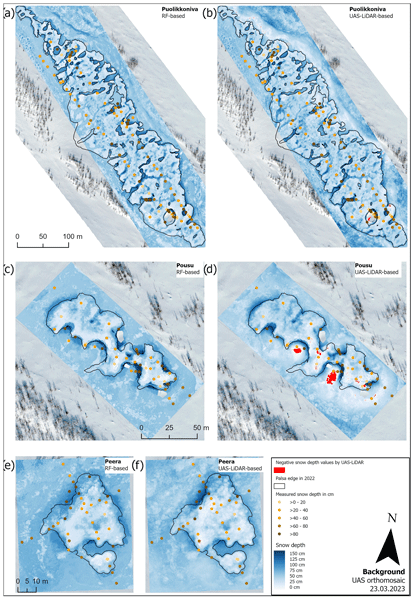
Snow has a major impact on palsa dynamics, yet our understanding of its distribution at the small scale remains limited. We used unoccupied aerial system (UAS) light detection and ranging (lidar) and ground truth data in combination with machine learning to model snow distribution at three palsa sites. We identified extremes in snow depth corresponding to palsa topography, providing insights into the influence of the distribution on their dynamics. The results demonstrate the usability of machine learning and UAS lidar for small-scale snow distribution mapping.
Mariana Verdonen, Alexander Störmer, Eliisa Lotsari, Pasi Korpelainen, Benjamin Burkhard, Alfred Colpaert, and Timo Kumpula
The Cryosphere, 17, 1803–1819, https://doi.org/10.5194/tc-17-1803-2023, https://doi.org/10.5194/tc-17-1803-2023, 2023
Short summary
Short summary
The study revealed a stable and even decreasing thickness of thaw depth in peat mounds with perennially frozen cores, despite overall rapid permafrost degradation within 14 years. This means that measuring the thickness of the thawed layer – a commonly used method – is alone insufficient to assess the permafrost conditions in subarctic peatlands. The study showed that climate change is the main driver of these permafrost features’ decay, but its effect depends on the peatland’s local conditions.
Cited articles
Abadi, M., Agarwal, A., Barham, P., Brevdo, E., Chen, Z., Citro, C., Corrado, G. S., Davis, A., Dean, J., Devin, M., Ghemawat, S., Goodfellow, I., Harp, A., Irving, G., Isard, M., Jia, Y., Jozefowicz, R., Kaiser, L., Kudlur, M., Levenberg, J., Mané, D., Monga, R., Moore, S., Murray, D., Olah, C., Schuster, M., Shlens, J., Steiner, B., Sutskever, I., Talwar, K., Tucker, P., Vanhoucke, V., Vasudevan, V., Viégas, F., Vinyals, O., Warden, P., Wattenberg, M., Wicke, M., Yu, Y., and Zheng, X.: TensorFlow: Large-Scale Machine Learning on Heterogeneous Systems, https://www.tensorflow.org/ (last access: 4 March 2026), 2015. a
Alewell, C., Borrelli, P., Meusburger, K., and Panagos, P.: Using the USLE: Chances, challenges and limitations of soil erosion modelling, International Soil and Water Conservation Research, 7, 203–225, https://doi.org/10.1016/j.iswcr.2019.05.004, 2019. a
Altmann, A., Toloşi, L., Sander, O., and Lengauer, T.: Permutation importance: a corrected feature importance measure, Bioinformatics, 26, 1340–1347, https://doi.org/10.1093/bioinformatics/btq134, 2010. a
Anache, J. A., Flanagan, D. C., Srivastava, A., and Wendland, E. C.: Land use and climate change impacts on runoff and soil erosion at the hillslope scale in the Brazilian Cerrado, Sci. Total Environ., 622, 140–151, https://doi.org/10.1016/j.scitotenv.2017.11.257, 2018. a
Avand, M., Mohammadi, M., Mirchooli, F., Kavian, A., and Tiefenbacher, J. P.: A new approach for smart soil erosion modeling: integration of empirical and machine-learning models, Environ. Model. Assess., 28, 145–160, https://doi.org/10.1007/s10666-022-09858-x, 2023. a, b, c
Barthel, N.: Soil erosion rate modelling with machine learning v2.2.0, Zenodo [code, data set], https://doi.org/10.5281/zenodo.16032628, 2026. a
Batista, P. V., Möller, M., Schmidt, K., Waldau, T., Seufferheld, K., Htitiou, A., Golla, B., Ebertseder, F., Auerswald, K., and Fiener, P.: Soil-erosion events on arable land are nowcast by machine learning, Catena, 256, 109080, https://doi.org/10.1016/j.catena.2025.109080, 2025. a
Bergstra, J., Bengio, Y.: Random search for hyper-parameter optimization, J. Mach. Learn. Res., 13, 281–305, http://jmlr.org/papers/v13/bergstra12a.html (last access: 19 March 2026), 2012. a
Böhner, J., Köthe, R., Conrad, O., Gross, J., Ringeler, A., and Selige, T.: Soil regionalisation by means of terrain analysis and process parameterisation, in: Soil Classification 2001, edited by: Micheli, E., Nachtergaele, F., and Montanarella, L., no. 7, European Soil Bureau Research Report, 213–222, Office for Official Publications of the European Communities, Luxembourg, eUR 20398 EN, https://esdac.jrc.ec.europa.eu/ESDB_Archive/eusoils_docs/esb_rr/n07_ESBResRep07/601Bohner.pdf (last access: 4 March 2026), 2002. a
Borrelli, P., Van Oost, K., Meusburger, K., Alewell, C., Lugato, E., and Panagos, P.: A step towards a holistic assessment of soil degradation in Europe: Coupling on-site erosion with sediment transfer and carbon fluxes, Environ. Res., 161, 291–298, https://doi.org/10.1016/j.envres.2017.11.009, 2018. a, b
Borrelli, P., Alewell, C., Alvarez, P., Anache, J. A. A., Baartman, J., Ballabio, C., Bezak, N., Biddoccu, M., Cerdà, A., Chalise, D., Chen, S., Chen, W., De Girolamo, A. M., Gessesse, G. D., Deumlich, D., Diodato, N., Efthimiou, N., Erpul, G., Fiener, P., Freppaz, M., Gentile, F., Gericke, A., Haregeweyn, N., Hu, B., Jeanneau, A., Kaffas, K., Kiani-Harchegani, M., Lizaga Villuendas, I., Li, C., Lombardo, L., López-Vicente, M., Lucas-Borja, M. E., Märker, M., Matthews, F., Miao, C., Mikoš, M., Modugno, S., Möller, M., Naipal, V., Nearing, M., Owusu, S., Panday, D., Patault, E., Patriche, C. V., Poggio, L., Portes, R., Quijano, L., Rahdari, M. R., Renima, M., Ricci, G. F., Rodrigo-Comino, J., Saia, S., Nazari Samani, A., Schillaci, C., Syrris, V., Kim, H. S., Spinola, D. N., Oliveira, P. T., Teng, H., Thapa, R., Vantas, K., Vieira, D., Yang, J. E., Yin, S., Zema, D. A., Zhao, G., and Panagos, P.: Soil erosion modelling: A global review and statistical analysis, Sci. Total Environ., 780, https://doi.org/10.1016/j.scitotenv.2021.146494, 2021. a, b, c
Botschek, J., Billen, N., Brandhuber, R., Bug, J., Deumlich, D., Duttmann, R., Elhaus, D., Mollenhauer, K., Prasuhn, V., Röder, C., Schäfer, W., Unterseher, E., Wurbs, D., and Thiermann, A.: Bodenerosion durch Wasser–Kartieranleitung zur Erfassung aktueller Erosionsformen, DWA-Regelwerk, Merkblatt DWA-M, 921, Deutsche Vereinigung für Wasserwirtschaft, Abwasser und Abfall e. V. (DWA), urn:nbn:de:101:1-2021042311222349076815, 2021. a
Breiman, L.: Random forests, Mach. Learn., 45, 5–32, https://doi.org/10.1023/A:1010933404324, 2001. a, b
Capelle, A.: Die erosionsgefährdete Landesfläche in Niedersachsen und Bremen, Z. Kult. Landentwickl., 31, 11–17, 1990. a
Capelle, A. and Lüders, R.: Die potentielle Erosionsgefährdung der Böden in Niedersachsen, Göttinger Bodenkundliche Berichte, 83, 107–127, 1985. a
Chinchor, N.: MUC-4 Evaluation Metrics, in: Fourth Message Understanding Conference (MUC-4), Proceedings of a Conference Held in McLean, Virginia, 16–18 June 1992, https://aclanthology.org/M92-1002/ (last access: 19 March 2026), 1992. a
Daoud, J. I.: Multicollinearity and regression analysis, J. Phys. Conf. Ser. 949, 012009, https://doi.org/10.1088/1742-6596/949/1/012009, 2017. a
De la Rosa, D., Mayol, F., Moreno, J., Bonsón, T., and Lozano, S.: An expert system/neural network model (ImpelERO) for evaluating agricultural soil erosion in Andalucia region, southern Spain, Agriculture, Ecosyst. Environ., 73, 211–226, https://doi.org/10.1016/S0167-8809(99)00050-X, 1999. a
Desmet, P. J. and Govers, G.: A GIS procedure for automatically calculating the USLE LS factor on topographically complex landscape units, J. Soil Water Conserv., 51, 427–433, https://doi.org/10.1080/00224561.1996.12457102, 1996. a
DIN (Deutsches Institut für Normung): Bodenbeschaffenheit – Ermittlung der Erosionsgefährdung von Böden durch Wasser mit Hilfe der ABAG, Tech. rep., Beuth Verlag GmbH, Berlin, DIN 19708:2005-02, 2005. a
DIN (Deutsches Institut für Normung): Bodenbeschaffenheit – Ermittlung der Erosionsgefährdung von Böden durch Wasser mit Hilfe der ABAG, Tech. rep., Beuth Verlag GmbH, Berlin, DIN 19708:2017-08, 2017. a
DVWK: Bodenerosion durch Wasser: DVWK-Merkblatt 239: Kartieranleitung zur Erfassung aktueller Erosionsformen, Wirtschafts- und Verl.-Ges. Gas und Wasser, Bonn, 1996. a
Ebrahimi-Khusfi, Z., Nafarzadegan, A. R., and Dargahian, F.: Predicting the number of dusty days around the desert wetlands in southeastern Iran using feature selection and machine learning techniques, Ecol. Indic., 125, 107499, https://doi.org/10.1016/j.ecolind.2021.107499, 2021. a
Fiener, P., Dostál, T., Krása, J., Schmaltz, E., Strauss, P., and Wilken, F.: Operational USLE-based modelling of soil erosion in Czech Republic, Austria, and Bavaria – Differences in model adaptation, parametrization, and data availability, Appl. Sci., 10, 3647, https://doi.org/10.3390/app10103647, 2020. a
Fischer, F., Winterrath, T., Junghänel, T., Walawender, E., and Auerswald, K.: Mean annual precipitation erosivity (R factor) based on RADKLIM Version 2017.002, Deutscher Wetterdienst (DWD), Offenbach/Main, Germany, https://doi.org/10.5676/DWD/RADKLIM_Rfct_V2017.002, 2019. a
Fu, B., Zhao, X., Li, Y., Wang, X., and Ren, Y.: A convolutional neural networks denoising approach for salt and pepper noise, Multimed. Tools Appl., 78, 30707–30721, https://doi.org/10.1007/s11042-018-6521-4, 2019. a
Garosi, Y., Sheklabadi, M., Conoscenti, C., Pourghasemi, H. R., and Van Oost, K.: Assessing the performance of GIS-based machine learning models with different accuracy measures for determining susceptibility to gully erosion, Sci. Total Environ., 664, 1117–1132, https://doi.org/10.1016/j.scitotenv.2019.02.093, 2019. a, b
Gholami, V., Sahour, H., and Amri, M. A. H.: Soil erosion modeling using erosion pins and artificial neural networks, Catena, 196, 104902, https://doi.org/10.1016/j.catena.2020.104902, 2021. a
Ghorbanzadeh, O., Shahabi, H., Mirchooli, F., Valizadeh Kamran, K., Lim, S., Aryal, J., Jarihani, B., and Blaschke, T.: Gully erosion susceptibility mapping (GESM) using machine learning methods optimized by the multi-collinearity analysis and K-fold cross-validation, Geomat. Nat. Haz. Risk, 11, 1653–1678, https://doi.org/10.1080/19475705.2020.1810138, 2020. a
Ghosh, A. and Maiti, R.: Soil erosion susceptibility assessment using logistic regression, decision tree and random forest: study on the Mayurakshi river basin of Eastern India, Environ. Earth Sci., 80, 328, https://doi.org/10.1007/s12665-021-09631-5, 2021. a, b
Golkarian, A., Khosravi, K., Panahi, M., and Clague, J. J.: Spatial variability of soil water erosion: Comparing empirical and intelligent techniques, Geosci. Front., 14, 101456, https://doi.org/10.1016/j.gsf.2022.101456, 2023. a
Guerra, C. A., Rosa, I. M., Valentini, E., Wolf, F., Filipponi, F., Karger, D. N., Nguyen Xuan, A., Mathieu, J., Lavelle, P., and Eisenhauer, N.: Global vulnerability of soil ecosystems to erosion, Landscape Ecol., 35, 823–842, https://doi.org/10.1007/s10980-020-00984-z, 2020. a
Guisan, A., Weiss, S. B., and Weiss, A. D.: GLM versus CCA spatial modeling of plant species distribution, Plant Ecol., 143, 107–122, https://doi.org/10.1023/A:1009841519580, 1999. a
Hilburn, K. A.: Understanding spatial context in convolutional neural networks using explainable methods: Application to interpretable GREMLIN, Artificial Intelligence for the Earth Systems, 2, 220093, https://doi.org/10.1175/AIES-D-22-0093.1, 2023. a
Hoerl, A. E. and Kennard, R. W.: Ridge regression: Biased estimation for nonorthogonal problems, Technometrics, 12, 55–67, 1970. a
Igwe, P. U., Onuigbo, A. A., Chinedu, O. C., Ezeaku, I. I., and Muoneke, M. M.: Soil erosion: A review of models and applications, International Journal of Advanced Engineering Research and Science, 4, 237341, https://doi.org/10.22161/ijaers.4.12.22, 2017. a
Issaka, S. and Ashraf, M. A.: Impact of soil erosion and degradation on water quality: a review, Geology, Ecology, and Landscapes, 1, 1–11, https://doi.org/10.1080/24749508.2017.1301053, 2017. a
Jaafari, A., Janizadeh, S., Abdo, H. G., Mafi-Gholami, D., and Adeli, B.: Understanding land degradation induced by gully erosion from the perspective of different geoenvironmental factors, J. Environ. Manage., 315, 115181, https://doi.org/10.1016/j.jenvman.2022.115181, 2022. a, b, c
Khosravi, K., Rezaie, F., Cooper, J. R., Kalantari, Z., Abolfathi, S., and Hatamiafkoueieh, J.: Soil water erosion susceptibility assessment using deep learning algorithms, J. Hydrol., 618, 129229, https://doi.org/10.1016/j.jhydrol.2023.129229, 2023. a
Kingma, D. P. and Ba, J.: Adam: A Method for Stochastic Optimization, arXiv [preprint], https://doi.org/10.48550/arxiv.1412.6980, 2014. a
Kingsford, C. and Salzberg, S. L.: What are decision trees?, Nat. Biotechnol., 26, 1011–1013, https://doi.org/10.1038/nbt0908-1011, 2008. a
Krizhevsky, A., Sutskever, I., and Hinton, G. E.: ImageNet classification with deep convolutional neural networks, Commun. ACM, 60, 84–90, https://doi.org/10.1145/3065386, 2017. a, b
Kumar, M., Sahu, A. P., Sahoo, N., Dash, S. S., Raul, S. K., and Panigrahi, B.: Global-scale application of the RUSLE model: a comprehensive review, Hydrolog. Sci. J., 67, 806–830, https://doi.org/10.1080/02626667.2021.2020277, 2022. a
LGLN: Digital Elevation Model (DEM1), Landesamt für Geoinformation und Landesvermessung Niedersachsen (LGLN), licensed under CC BY 4.0, https://arcg.is/aH4Cy (last access: 4 March 2026), 2024. a
Licznar, P. and Nearing, M.: Artificial neural networks of soil erosion and runoff prediction at the plot scale, Catena, 51, 89–114, https://doi.org/10.1016/S0341-8162(02)00147-9, 2003. a
Liu, C., Fan, H., and Wang, Y.: Gully erosion susceptibility assessment using three machine learning models in the black soil region of Northeast China, Catena, 245, 108275, https://doi.org/10.1016/j.catena.2024.108275, 2024. a
Moore, I. D. and Nieber, J. L.: Landscape assessment of soil erosion and nonpoint source pollution, Journal of the Minnesota Academy of Science, 55, 18–25, 1989. a
Morgan, R., Quinton, J., Smith, R., Govers, G., Poesen, J., Auerswald, K., Chisci, G., Torri, D., and Styczen, M.: The European Soil Erosion Model (EUROSEM): a dynamic approach for predicting sediment transport from fields and small catchments, Earth Surf. Proc. Land., 23, 527–544, https://doi.org/10.1002/(SICI)1096-9837(199806)23:6<527::AID-ESP868>3.0.CO;2-5, 1998. a
Nair, V. and Hinton, G. E.: Rectified linear units improve restricted boltzmann machines, Proceedings of the 27th international conference on machine learning (ICML-10), Omnipress, 807–814, https://www.cs.toronto.edu/~hinton/absps/reluICML.pdf (last access: 19 March 2026), 2010. a
Nearing, M. A., Foster, G. R., Lane, L., and Finkner, S.: A process-based soil erosion model for USDA-Water Erosion Prediction Project technology, T. ASAE, 32, 1587–1593, 1989. a
Ng, A. Y.: Feature selection, L1 vs. L2 regularization, and rotational invariance, Proceedings of the twenty-first international conference on Machine learning, ACM (Association for Computing Machinery), p. 78, https://doi.org/10.1145/1015330.1015435, 2004. a
Nielsen, M. A.: Neural networks and deep learning, Vol. 25, Determination press San Francisco, CA, USA, 2015. a
O'Brien, R. M.: A caution regarding rules of thumb for variance inflation factors, Qual. Quant., 41, 673–690, https://doi.org/10.1007/s11135-006-9018-6, 2007. a
Panagos, P., Ballabio, C., Himics, M., Scarpa, S., Matthews, F., Bogonos, M., Poesen, J., and Borrelli, P.: Projections of soil loss by water erosion in Europe by 2050, Environ. Sci. Policy, 124, 380–392, https://doi.org/10.1016/j.envsci.2021.07.012, 2021. a
Parsons, A. J.: How reliable are our methods for estimating soil erosion by water?, Sci. Total Environ., 676, 215–221, https://doi.org/10.1016/j.scitotenv.2019.04.307, 2019. a
Pedregosa, F., Varoquaux, G., Gramfort, A., Michel, V., Thirion, B., Grisel, O., Blondel, M., Prettenhofer, P., Weiss, R., Dubourg, V., Vanderplas, J., Passos, A., Cournapeau, D., Brucher, M., Perrot, M., and Duchesnay, E.: Scikit-learn: Machine Learning in Python, J. Mach. Learn. Res., 12, 2825–2830, 2011. a
Pieri, L., Bittelli, M., Wu, J. Q., Dun, S., Flanagan, D. C., Pisa, P. R., Ventura, F., and Salvatorelli, F.: Using the Water Erosion Prediction Project (WEPP) model to simulate field-observed runoff and erosion in the Apennines mountain range, Italy, J. Hydrol., 336, 84–97, https://doi.org/10.1016/j.jhydrol.2006.12.014, 2007. a
Plambeck, N. O.: Reassessment of the potential risk of soil erosion by water on agricultural land in Germany: Setting the stage for site-appropriate decision-making in soil and water resources management, Ecol. Indic., 118, 106732, https://doi.org/10.1016/j.ecolind.2020.106732, 2020. a
Renard, K. G., Foster, G. R., Weesies, G. A., McCool, D. K., and Yoder, D. C.: Predicting Soil Erosion by Water: A Guide to Conservation Planning with the Revised Universal Soil Loss Equation (RUSLE), U.S. Department of Agriculture, Agricultural Research Service, https://www.tucson.ars.ag.gov/unit/publications/PDFfiles/717.pdf (last access: 19 March 2026), 1997. a
Rohr, W., Mosimann, T., Bono, R., Rüttimann, M., and Prasuhn, V.: Kartieranleitung zur Aufnahme von Bodenerosionsformen und-schäden auf Ackerflächen, Legende, Erläuterungen zur Kartiertechnik, Schadensdokumentation und Fehlerabschätzung, Materialien zur Physiogeographie, 14, Geographisches Institut der Universität Basel, https://eth.swisscovery.slsp.ch/permalink/41SLSP_ETH/1puep7t/alma990005539670205503 (last access: 19 March 2026), 1990. a
Rumelhart, D. E., Hinton, G. E., and Williams, R. J.: Learning representations by back-propagating errors, Nature, 323, 533–536, https://doi.org/10.1038/323533a0, 1986. a
Saha, S., Sarkar, R., Thapa, G., and Roy, J.: Modeling gully erosion susceptibility in Phuentsholing, Bhutan using deep learning and basic machine learning algorithms, Environ. Earth Sci., 80, 295, https://doi.org/10.1007/s12665-021-09599-2, 2021. a
Sahour, H., Gholami, V., Vazifedan, M., and Saeedi, S.: Machine learning applications for water-induced soil erosion modeling and mapping, Soil Till. Res., 211, 105032, https://doi.org/10.1016/j.still.2021.105032, 2021. a
Sarkar, T. and Mishra, M.: Soil erosion susceptibility mapping with the application of logistic regression and artificial neural network, Journal of Geovisualization and Spatial Analysis, 2, 8, https://doi.org/10.1007/s41651-018-0015-9, 2018. a, b
Schmidt, J., Werner, M., and Michael, A.: Application of the EROSION 3D model to the CATSOP watershed, The Netherlands, Catena, 37, 449–456, https://doi.org/10.1016/S0341-8162(99)00032-6, 1999. a
Schober, P., Boer, C., and Schwarte, L. A.: Correlation coefficients: appropriate use and interpretation, Anesth. Analg., 126, 1763–1768, https://doi.org/10.1213/ANE.0000000000002864, 2018. a
Sharififar, A. and Sarmadian, F.: Coping with imbalanced data problem in digital mapping of soil classes, Eur. J. Soil Sci., 74, e13368, https://doi.org/10.1111/ejss.13368, 2023. a
Steinhoff, B., Bug, J., and Mosimann, T.: Einsatz eines mobilen GIS zur Kartierung von Bodenerosion durch Wasser, Neue Horizonte für Geodateninfrastrukturen – Open GeoData, Mobility D, 3, 27–32, 2013. a
Taha, A. A. and Hanbury, A.: Metrics for evaluating 3D medical image segmentation: analysis, selection, and tool, BMC Med. Imaging, 15, 1–28, https://doi.org/10.1186/s12880-015-0068-x, 2015. a
Winterrath, T., Brendel, C., Hafer, M., Junghänel, T., Klameth, A., Lengfeld, K., Walawender, E., Weigl, E., and Becker, A.: Radar-based gauge-adjusted one-hour precipitation sum climatology Version 2017.002: Gridded Precipitation Data for Germany (v2017.02), Deutscher Wetterdienst (DWD) [data set], https://doi.org/10.5676/DWD/RADKLIM_RW_V2017.002, 2018. a
Wischmeier, W. H. and Smith, D. D.: Predicting Rainfall Erosion Losses: A Guide to Conservation Planning, U.S. Department of Agriculture, Science and Education Administration, https://www.ars.usda.gov/ARSUserFiles/60600505/RUSLE/AH_537%20Predicting%20Rainfall%20Soil%20Losses.pdf (last access: 20 March 2026), 1978. a
Wythoff, B. J.: Backpropagation neural networks: a tutorial, Chemometr. Intell. Lab., 18, 115–155, https://doi.org/10.1016/0169-7439(93)80052-J, 1993. a
Yu, T. and Zhu, H.: Hyper-parameter optimization: A review of algorithms and applications, arXiv [preprint], https://doi.org/10.48550/arXiv.2003.05689, 2020. a
Zevenbergen, L. W. and Thorne, C. R.: Quantitative analysis of land surface topography, Earth Surf. Proc. Land., 12, 47–56, https://doi.org/10.1002/esp.3290120107, 1987. a
Short summary
This study compares neural networks and a random forest model for predicting soil erosion in agricultural cropland using long-term data from northern Germany. All models captured general erosion patterns, while more complex neural networks slightly improved the distinction between soil loss classes. A permutation importance analysis identified slope and machine direction vs. aspect as the most influential predictors across all models.
This study compares neural networks and a random forest model for predicting soil erosion in...