
Articles | Volume 12, issue 1
https://doi.org/10.5194/soil-12-253-2026
© Author(s) 2026. This work is distributed under
the Creative Commons Attribution 4.0 License.
the Creative Commons Attribution 4.0 License.
https://doi.org/10.5194/soil-12-253-2026
© Author(s) 2026. This work is distributed under
the Creative Commons Attribution 4.0 License.
the Creative Commons Attribution 4.0 License.
Short communication
| Highlight paper
| 
17 Mar 2026
Short communication | Highlight paper |
| 17 Mar 2026
| 17 Mar 2026
Mapping the fertosphere's phosphorus availability distribution in a field trial using a novel diffusive gradients in thin-films (fDGT) technique
Casey L. Doolette
CORRESPONDING AUTHOR
UniSA STEM, University of South Australia, Mawson Lakes, South Australia 5095, Australia
Euan Smith
Future Industries Institute, University of South Australia, Mawson Lakes, South Australia 5095, Australia
Ehsan Tavakkoli
School of Agriculture Food and Wine, University of Adelaide, Glen Osmond, South Australia 5064, Australia
Lukas van Zwieten
NSW Department of Primary Industries, Wollongbar Primary Industries Institute, Wollongbar, NSW, Australia
Brigid A. McKenna
The University of Queensland, School of Agriculture and Food Sustainability, St Lucia, Queensland 4072, Australia
Peter M. Kopittke
The University of Queensland, School of Agriculture and Food Sustainability, St Lucia, Queensland 4072, Australia
Enzo Lombi
Future Industries Institute, University of South Australia, Mawson Lakes, South Australia 5095, Australia
Related authors
Zhe H. Weng, Ram C. Dalal, Brian J. Reid, Yong-Guan Zhu, Timothy I. McLaren, Brigid A. McKenna, Meghan Barnard, Casey L. Doolette, Enzo Lombi, Johannes Friedl, and Peter M. Kopittke
EGUsphere, https://doi.org/10.5194/egusphere-2025-100, https://doi.org/10.5194/egusphere-2025-100, 2025
Preprint archived
Short summary
Short summary
Long-term cropping reduced total stocks of soil organic carbon (SOC). This study examined the microscale processes which regulates the preservation of SOC under long-term cropping, with an understanding of this being essential for predicting SOC persistence and to identify approaches to re-building SOC stocks in agroecosystems.
Zhe H. Weng, Ram C. Dalal, Brian J. Reid, Yong-Guan Zhu, Timothy I. McLaren, Brigid A. McKenna, Meghan Barnard, Casey L. Doolette, Enzo Lombi, Johannes Friedl, and Peter M. Kopittke
EGUsphere, https://doi.org/10.5194/egusphere-2025-100, https://doi.org/10.5194/egusphere-2025-100, 2025
Preprint archived
Short summary
Short summary
Long-term cropping reduced total stocks of soil organic carbon (SOC). This study examined the microscale processes which regulates the preservation of SOC under long-term cropping, with an understanding of this being essential for predicting SOC persistence and to identify approaches to re-building SOC stocks in agroecosystems.
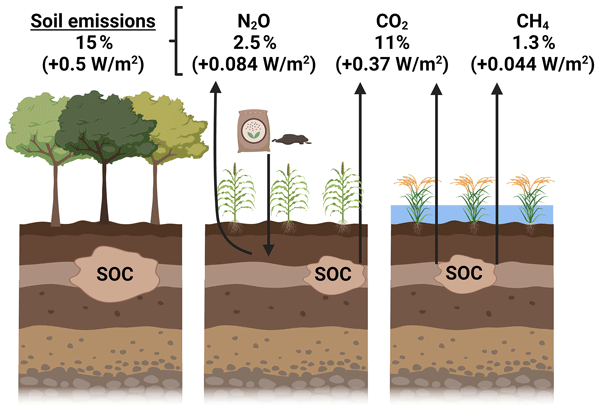
Peter M. Kopittke, Ram C. Dalal, Brigid A. McKenna, Pete Smith, Peng Wang, Zhe Weng, Frederik J. T. van der Bom, and Neal W. Menzies
SOIL, 10, 873–885, https://doi.org/10.5194/soil-10-873-2024, https://doi.org/10.5194/soil-10-873-2024, 2024
Short summary
Short summary
Soil produces 98.8 % of the calories consumed by humans, but the contribution that the anthropogenic use of soil makes to global warming is not clear. We show that soil has contributed 15 % of the total global warming caused by well-mixed greenhouse gases. Thus, our finding that soil is a substantial contributor to global anthropogenic greenhouse gas emissions represents a "wicked problem" – how do we continue to increase food production from soil whilst also decreasing emissions?
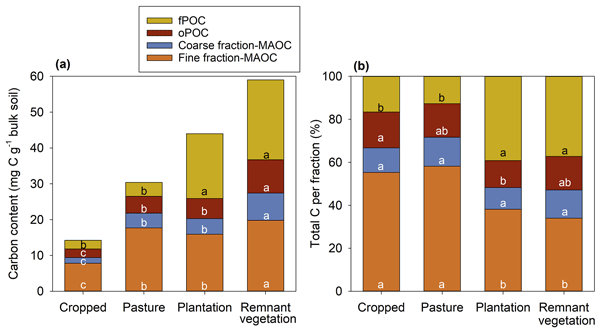
Laura Hondroudakis, Peter M. Kopittke, Ram C. Dalal, Meghan Barnard, and Zhe H. Weng
SOIL, 10, 451–465, https://doi.org/10.5194/soil-10-451-2024, https://doi.org/10.5194/soil-10-451-2024, 2024
Short summary
Short summary
Land use change to cropping is known to greatly reduced organic carbon and nitrogen concentrations, but much remains unknown about the mechanisms influencing their persistence in soil. In a soil from a subtropical Australian cropping system, we demonstrate that organic carbon is protected by mineral associations but not particulate forms. Importantly, we also show that reversion from cropping to pasture or plantation can partially restore this organic carbon.
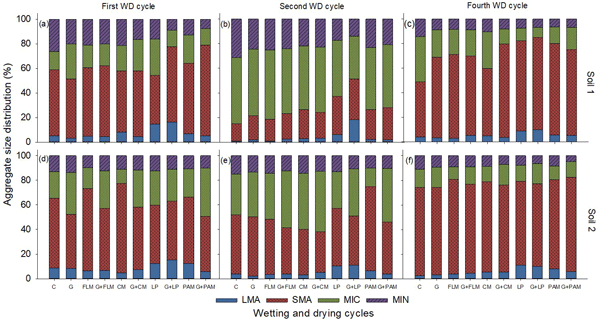
Sara Niaz, J. Bernhard Wehr, Ram C. Dalal, Peter M. Kopittke, and Neal W. Menzies
SOIL, 9, 141–154, https://doi.org/10.5194/soil-9-141-2023, https://doi.org/10.5194/soil-9-141-2023, 2023
Short summary
Short summary
Sodic soils affect ~580 Mha in semi-arid and arid regions of the world. These soils have a weak structure. This laboratory study evaluated treatments to overcome the weak aggregate structure in two sodic Vertisols by applying organic amendments, gypsum, and wetting–drying cycles. We conclude that sodic soils need to be treated with gypsum to flocculate clay and organic amendments (lucerne or chicken manure) to form aggregates, whereas drying cycles aid in small macroaggregates formation.
Cited articles
Arias, D. M., Teasdale, P. R., Doolette, C. L., Lombi, E., Farquhar, S., and Huang, J.: Development and evaluation of a new colorimetric DGT technique for the 2D visualisation of labile phosphate in soils, Chemosphere, 269, https://doi.org/10.1016/j.chemosphere.2020.128704, 2021.
Benbi, D. K. and Gilkes, R. J.: The movement into soil of P from superphosphate grains and its availability to plants, Fertilizer Research, 12, 21–36, https://doi.org/10.1007/BF01049418, 1987.
Colwell, J.: The estimation of the phosphorus fertilizer requirements of wheat in southern New South Wales by soil analysis, Aust. J. Exp. Agr., 3, 190–197, 1963.
Davison, W. and Zhang, H.: In situspeciation measurements of trace components in natural waters using thin-film gels, Nature, 367, 546–548, https://doi.org/10.1038/367546a0, 1994.
Doolette, C. L., Howard, D. L., Afshar, N., Kewish, C. M., Paterson, D. J., Huang, J., Wagner, S., Santner, J., Wenzel, W. W., Raimondo, T., De Vries Van Leeuwen, A. T., Hou, L., Van Der Bom, F., Weng, H., Kopittke, P. M., and Lombi, E.: Tandem Probe Analysis Mode for Synchrotron XFM: Doubling Throughput Capacity, Analytical Chemistry, 94, 4584–4593, https://doi.org/10.1021/acs.analchem.1c04255, 2022.
Fang, W., Williams, P. N., Fang, X., Amoah-Antwi, C., Yin, D., Li, G., Ma, L. Q., and Luo, J.: Field-Scale Heterogeneity and Geochemical Regulation of Arsenic, Iron, Lead, and Sulfur Bioavailability in Paddy Soil, Environmental Science and Technology, 52, 12098–12107, https://doi.org/10.1021/acs.est.8b01947, 2018.
Grant, C. A., Flaten, D. N., Tomasiewicz, D. J., and Sheppard, S. C.: The importance of early season phosphorus nutrition, Canadian Journal of Plant Science, 81, 211–224, https://doi.org/10.4141/P00-093, 2001.
Hedley, M. and McLaughlin, M.: Reactions of phosphate fertilizers and by-products in soils, in: Phosphorus: Agriculture and the Environment, 181–252, https://doi.org/10.2134/agronmonogr46.c7, 2005.
Hernandez-Mora, A., Duboc, O., Lombi, E., Bünemann, E. K., Ylivainio, K., Symanczik, S., Delgado, A., Abu Zahra, N., Nikama, J., Zuin, L., Doolette, C. L., Eigner, H., and Santner, J.: Fertilization efficiency of thirty marketed and experimental recycled phosphorus fertilizers, Journal of Cleaner Production, 467, 142957, https://doi.org/10.1016/j.jclepro.2024.142957, 2024.
Howard, D. L., Jonge, M. D., Afshar, N., Ryan, C. G., Kirkham, R., Reinhardt, J., Kewish, C. M., McKinlay, J., Walsh, A., Divitcos, J., Basten, N., Adamson, L., Fiala, T., Sammut, L., and Paterson, D. J.: The XFM beamline at the Australian Synchrotron, Journal of Synchrotron Radiation, 27, 1447–1458, https://doi.org/10.1107/S1600577520010152, 2020.
Huang, J., Bennett, W. W., Welsh, D. T., and Teasdale, P. R.: Determining time-weighted average concentrations of nitrate and ammonium in freshwaters using DGT with ion exchange membrane-based binding layers, Environmental Science: Processes & Impacts, 18, 1530–1539, https://doi.org/10.1039/C6EM00260A, 2016.
Hummel, C., Boitt, G., Santner, J., Lehto, N. J., Condron, L., and Wenzel, W. W.: Co-occurring increased phosphatase activity and labile P depletion in the rhizosphere of Lupinus angustifolius assessed with a novel, combined 2D-imaging approach, Soil Biology and Biochemistry, 153, https://doi.org/10.1016/j.soilbio.2020.107963, 2021.
Johnston, A. E. and Poulton, P. R.: Phosphorus in agriculture: A review of results from 175 years of research at Rothamsted, UK, Journal of Environmental Quality, 48, 1133–1144, https://doi.org/10.2134/jeq2019.02.0078, 2019.
Kar, G., Hundal, L. S., Schoenau, J. J., and Peak, D.: Direct chemical speciation of P in sequential chemical extraction residues using P K-edge X-ray absorption near-edge structure spectroscopy, Soil Science, 176, 589–595, https://doi.org/10.1097/SS.0b013e31823939a3, 2011.
Kopittke, P. M., Menzies, N. W., Dalal, R. C., McKenna, B. A., Husted, S., Wang, P., and Lombi, E.: The role of soil in defining planetary boundaries and the safe operating space for humanity, Environment International, 146, https://doi.org/10.1016/j.envint.2020.106245, 2021.
Lombi, E., McLaughlin, M. J., Johnston, C., Armstrong, R. D., and Holloway, R. E.: Mobility and lability of phosphorus from granular and fluid monoammonium phosphate differs in a calcareous soil, Soil Science Society of America Journal, 68, 682–689, https://doi.org/10.2136/sssaj2004.6820, 2004.
Lombi, E., McLaughlin, M. J., Johnston, C., Armstrong, R. D., and Holloway, R. E.: Mobility, solubility and lability of fluid and granular forms of P fertiliser in calcareous and non-calcareous soils under laboratory conditions, Plant and Soil, 25–34, https://doi.org/10.1007/s11104-004-0558-z, 2005.
Lombi, E., Scheckel, K. G., Armstrong, R. D., Forrester, S., Cutler, J. N., and Paterson, D.: Speciation and distribution of phosphorus in a fertilized soil: A synchrotron-based investigation, Soil Science Society of America Journal, 70, 2038–2048, https://doi.org/10.2136/sssaj2006.0051, 2006.
Lombi, E., Doolette, C. L., Coqui da Silva, R., McKenna, B. A., and Kopittke, P. A.: Unveiling chemical gradients in the fertosphere: A paradigm shift to enhance fertilizer efficiency and decrease the environmental impact of overfertilisation, Environmental Science and Technology, 59, 14853–14861, https://doi.org/10.1021/acs.est.5c04757, 2025.
Mason, S., Hamon, R., Zhang, H., and Anderson, J.: Investigating chemical constraints to the measurement of phosphorus in soils using diffusive gradients in thin films (DGT) and resin methods, Talanta, 74, 779–787, https://doi.org/10.1016/j.talanta.2007.07.005, 2008.
Mason, S., McNeill, A., McLaughlin, M. J., and Zhang, H.: Prediction of wheat response to an application of phosphorus under field conditions using diffusive gradients in thin-films (DGT) and extraction methods, Plant and Soil, 337, 243–258, https://doi.org/10.1007/s11104-010-0521-0, 2010.
McDowell, R. W., Pletnyakov, P., and Haygarth, P. M.: Phosphorus applications adjusted to optimal crop yields can help sustain global phosphorus reserves, Nature Food, 5, 332–339, https://doi.org/10.1038/s43016-024-00952-9, 2024.
Moens, C., Lombi, E., Howard, D. L., Wagner, S., Payne, J. L., Kopittke, P. M., and Doolette, C. L.: Mapping Phosphorus Availability in Soil at a Large Scale and High Resolution Using Novel Diffusive Gradients in Thin Films Designed for X-ray Fluorescence Microscopy, Environmental Science and Technology, 58, 440–448, https://doi.org/10.1021/acs.est.3c06237, 2024.
Pan, W. L., Madsen, I. J., Bolton, R. P., Graves, L., and Sistrunk, T.: Ammonia/Ammonium Toxicity Root Symptoms Induced by Inorganic and Organic Fertilizers and Placement, Agronomy Journal, 108, 2485–2492, https://doi.org/10.2134/agronj2016.02.0122, 2016.
Rayment, G. E. and Lyons, D. J.: Soil chemical methods: Australasia (Vol. 3), CSIRO, 2011.
Richardson, K., Steffen, W., Lucht, W., Bendtsen, J., Cornell, S. E., Donges, J. F., Drüke, M., Fetzer, I., Bala, G., von Bloh, W., Feulner, G., Fiedler, S., Gerten, D., Gleeson, T., Hofmann, M., Huiskamp, W., Kummu, M., Mohan, C., Nogués-Bravo, D., Petri, S., Porkka, M., Rahmstorf, S., Schaphoff, S., Thonicke, K., Tobian, A., Virkki, V., Wang-Erlandsson, L., Weber, L., and Rockström, J.: Earth beyond six of nine planetary boundaries, Science Advances, 9, https://doi.org/10.1126/sciadv.adh2458, 2023.
Ryan, C. G.: Quantitative trace element imaging using PIXE and the nuclear microprobe, International Journal of Imaging Systems and Technology, 11, 219–230, https://doi.org/10.1002/ima.1007, 2000.
Santner, J., Prohaska, T., Luo, J., and Zhang, H.: Ferrihydrite containing gel for chemical imaging of labile phosphate species in sediments and soils using diffusive gradients in thin films, Analytical Chemistry, 82, 7668–7674, https://doi.org/10.1021/ac101450j, 2010.
Sica, P., Sitzmann, T. J., Müller-Stöver, D., and Magid, J.: Strategic placement of mineral and biobased fertilizers for optimizing phosphorus use efficiency: A comprehensive review, Soil Use and Management, 41, e70039, https://doi.org/10.1111/sum.70039, 2025.
Sleight, D. M., Sander, D. H., and Peterson, G. A.: Effect of fertilizer phosphorus placement on the availability of phosphours, Soil Science Society of America Journal, 48, 336–340, 1984.
Speirs, S. D., Scott, B. J., Moody, P. W., and Mason, S. D.: Soil phosphorus tests II: A comparison of soil test–crop response relationships for different soil tests and wheat, Crop and Pasture Science, 64, 469–479, https://doi.org/10.1071/CP13111, 2013.
van der Bom, F. J. T., Kopittke, P. M., Raymond, N. S., Sekine, R., Lombi, E., Mueller, C. W., and Doolette, C. L.: Methods for assessing laterally-resolved distribution, speciation and bioavailability of phosphorus in soils, Reviews in Environmental Science and Biotechnology, 21, 53–74, https://doi.org/10.1007/s11157-021-09602-z, 2022.
Wang, Q. and Nielsen, U. G.: Applications of solid-state NMR spectroscopy in environmental science, Solid State Nuclear Magnetic Resonance, 110, https://doi.org/10.1016/j.ssnmr.2020.101698, 2020.
Xie, H., Dong, Y., Chen, J., Wang, X., and Fu, M.: Development and evaluation of a ceramic diffusive layer based DGT technique for measuring organic micropollutants in seawaters, Environment International, 156, 106653, https://doi.org/10.1016/j.envint.2021.106653, 2021.
Editorial statement
This paper has been selected as a Highlight Paper due to its high scientific quality, clear presentation, and significant contribution to the field. The manuscript successfully addressed all recommendations from the Topic Editor and was positively evaluated in the final review by the Editor in Chief.
This paper has been selected as a Highlight Paper due to its high scientific quality, clear...
Short summary
The first report of the field deployment of a new soil sampling device to investigate phosphorus (P) fertiliser strategies. The approach was combined with X-ray fluorescence microscopy to produce 2D spatially-resolved P availability maps to visualise distinct differences between new and conventional P fertilisers. This technique shows great potential for optimising P application and material sciences development; potentially leading to improved productivity and more sustainable P fertiliser use.
The first report of the field deployment of a new soil sampling device to investigate phosphorus...


