
the Creative Commons Attribution 4.0 License.
the Creative Commons Attribution 4.0 License.
 | 06 Nov 2026
Alpine wetland degradation reshapes the balance between hydrolytic and reductive soil nitrogen cycling enzyme potentials on the Qinghai–Tibetan Plateau
Wenhua Chang
Weiwei Ma

Jianfang Wang
Liangcui Song
Jianan Du
Wanpeng He
Guang Li
Alpine wetlands on the Qinghai-Tibet Plateau are increasingly degraded, with potentially important consequences for soil nitrogen (N) cycling and ecosystem functioning. However, how degradation restructures enzyme-mediated soil N cycling and its functional potential remains poorly understood. To address this gap, we conducted a three-year field investigation across 2019 to 2021 four degradation stages (i.e.non-degraded (ND), lightly degraded (LD), moderately degraded (MD), and heavily degraded (HD)) in the Gahai Wetland. We quantified four key soil N-cycling enzymes, including urease, protease, nitrate reductase, and nitrite reductase, and developed a nitrogen cycling functional potential (NCFP) index to characterize shifts in the relative balance between hydrolytic and reductive N-cycling functions potentials. Our results showing that degradation-induced drying and nutrient depletion reduced soil water content, soil organic carbon, total nitrogen, ammonium availability, and microbial biomass N, while increasing soil temperature and nitrate accumulation. Enzyme responses were strongly pathway specific: urease and nitrate reductase activities increased with degradation, whereas protease and nitrite reductase activities declined. Consequently, NCFP index shifting from slightly positive values in ND and LD to negative values in MD and HD, indicating a reorganization of N-cycling functional potential from a relative hydrolytic bias toward a relative reductive bias. Interannual hydroclimatic variability further modified this pattern; notably, exceptionally wet conditions in 2021 shifted NCFP index toward negative values across all degradation stages. Redundancy analysis and piecewise structural equation modeling showed that soil water content, and organic carbon were the primary regulators of NCFP index. Alpine wetland degradation reorganized the relative configuration of hydrolytic and reductive N-cycling potentials rather than uniformly suppressing N cycling, and this functional balance was jointly regulated by long-term degradation and short-term hydrological variability. Overall, the study provides new insight into mechanisms of soil N-cycling destabilization in degraded alpine wetlands and informs wetland restoration under a drier future climate.
- Article
(4757 KB) - Full-text XML
-
Supplement
(1187 KB) - BibTeX
- EndNote


Alpine wetlands are among the most important ecosystem types on the Qinghai-Tibet Plateau (QTP), and play indispensable roles in biodiversity conservation, regional climate regulation, water retention, and global carbon (C), nitrogen (N) and phosphorus (P) biogeochemical cycling (Li et al., 2021; Wei et al., 2015; Yin et al., 2022). Over recent decades, however, alpine wetlands in this region have undergone widespread degradation under the combined impacts of climate change, hydrological alteration, grazing pressure, and other anthropogenic disturbances, particularly overgrazing (Li et al., 2021, 2019; Yuan et al., 2025). The degradation typically manifests as vegetation succession, biodiversity loss, soil water depletion, and nutrient impoverishment (Alhassan et al., 2018; Du et al., 2024; Ma et al., 2020a; Zhao et al., 2025). Because N cycling is a central process regulating primary productivity, microbial activity, and ecosystem resilience in alpine wetland systems, degradation-induced shifts in soil N cycling are likely to have profound consequences for ecosystem functioning and restoration potential (Chen et al., 2022). Clarifying how soil N cycling responds to alpine wetland degradation is therefore essential for understanding and predicting ecosystem feedback to ongoing global change.
Soil enzymes, which are mainly produced by soil microorganisms and plant roots, mediate essential biogeochemical processes involved in C, N, and P-cycling (Allison and Vitousek, 2005; Ma et al., 2020b). Owing to their rapid responses to environmental perturbations, soil enzymes have been widely considered as sensitive biochemical indicators of soil functional status and nutrient transformation ability (Sinsabaugh et al., 2009; Sinsabaugh and Follstad Shah, 2012; Wang et al., 2022). In N-limited alpine wetland ecosystems, N-cycling enzymes regulate key steps of organic N depolymerization and inorganic N transformation, thereby influencing N mineralization, denitrification, and potential N loss pathways (Xiang et al., 2024; Zuccarini et al., 2023). In particular, hydrolytic enzymes, such as urease and protease increase the bioavailability of organic N, whereas reductive enzymes such as nitrate reductase and nitrite reductase regulate nitrate and nitrite reduction processes, thereby influencing whether inorganic N is retained within the soil system or further transformed and lost through denitrification-related pathways (Brzostek et al., 2012; Jin et al., 2023; Ma et al., 2021; Priemé et al., 2002; Rajsz et al., 2019; Tabatabai et al., 2010). Despite their central role in regulating soil N transformations, the responses of N-cycling enzymes to alpine wetland degradation remain insufficiently resolved.
The activities of soil N-cycling enzymes are jointly regulated by soil physicochemical properties, plant community composition, temperature, moisture, nutrient availability, and substrate concentration. Wetland degradation can substantially reshape these controls by altering vegetation composition, hydrological conditions, soil properties, and microbial habitat quality (Abulaizi et al., 2023; Du et al., 2024; Li et al., 2022). As degradation intensifies, the replacement of hygrophytic species by mesophytic or xerophytic plants generally reduces plant-derived C and nutrient inputs (Wu et al., 2017), leading to declines in soil organic carbon and total nitrogen pools (Liu et al., 2018). Meanwhile, hydrological drying and associated microclimatic shifts may constrain enzyme diffusion, suppress microbial activity, and reduce catalytic efficiency (Breidenbach et al., 2022; Song et al., 2024). However, the effects of degradation are not uniformly negative across all stages. Although many studies have reported reduced enzyme activity under degraded conditions, others have observed transient stimulation during early degradation, indicating strong context dependence associated with degradation intensity, and resource availability, (Ma et al., 2020a). Such complexity is especially relevant in the fragile alpine wetlands of the QTP, where degradation may irreversibly alter soil conditions and microbial functioning (Alhassan et al., 2018; Du et al., 2024).
This knowledge gap is further complicated by strong seasonal and interannual hydroclimatic variability in alpine wetlands. (Deng et al., 2025). On the QTP, short growing seasons, large fluctuations in soil moisture, and increasingly frequent drought events can substantially modify microbial activity (Sorensen et al., 2018), substrate diffusion, and redox conditions, thereby altering both the magnitude and direction of soil N-cycling processes (Asensio et al., 2024; Gao et al., 2021). Although seasonal variation in individual soil enzymes has been reported in alpine wetland ecosystems (Akinyemi et al., 2020; Bai et al., 2023; Brzostek et al., 2012), most studies have focused on single sampling periods, short-term observations, or isolated enzyme responses. Consequently, we still lack a process-based understanding of whether wetland degradation simply suppresses soil N cycling or instead reorganizes it by differentially affecting distinct enzymatic pathways under contrasting hydroclimatic conditions.
To address this knowledge gap, we conducted a three-year study from 2019 to 2021 in the Gahai Wetland on the northeastern QTP. Using a space-for-time substitution approach, we identified four alpine wetland degradation stages, non-degraded (ND), lightly degraded (LD), moderately degraded (MD), and heavily degraded (HD), under comparable climatic conditions and soil parent material. We measured four representative enzymes associated with hydrolytic and reductive N transformations, including urease, protease, nitrate reductase, and nitrite reductase. We further developed a nitrogen cycling functional potential (NCFP) index, expressed as the natural logarithm of the ratio between aggregated hydrolytic and reductive potential enzyme activities, to quantify shifts in their relative functional potential. Specifically, we asked: (1) whether alpine wetland degradation induces enzyme-specific rather than uniform changes in potential N-cycling functions; (2) how these responses are associated with changes in soil hydrological conditions, nutrient availability, and microbial N pools; and (3) whether interannual hydroclimatic variability modifies the magnitude of degradation responses among individual N-cycling pathways. By integrating degradation severity, environmental variation, individual enzyme responses, and their relative functional configuration, this study provides a process-oriented framework for understanding how alpine wetland degradation reorganizes belowground N-cycling potential.
2.1 Study area
This study was conducted in the Gahai–Zecha National Nature Reserve (102°26′ E, 34°16′ N; 3450 m a.s.l.), located in the northeastern QTP, China (Fig. 1). The region is characterized by a highland continental monsoon climate. The mean annual temperature of the Gahai wet meadow is 1.2 °C, with the lowest and highest monthly mean temperatures occurring in January (−9.1 °C) and July (10.5 °C), respectively (Du et al., 2025). The mean annual precipitation is approximately 782 mm, of which nearly 80 % occurs during the growing season from May to September (Fig. S1 in the Supplement). According to the World Reference Base for Soil Resources (WRB) classification system (Iuss Working Group Wrb, 2022), the soil type in the study area belongs to Histosols and Gleysols. The dominant plant species include Carex tibetikobresia, Carex meyeriana, Thalictrum aquilegifolium, Artemisia subulata, and Artemisia linearis (Chang et al., 2023).
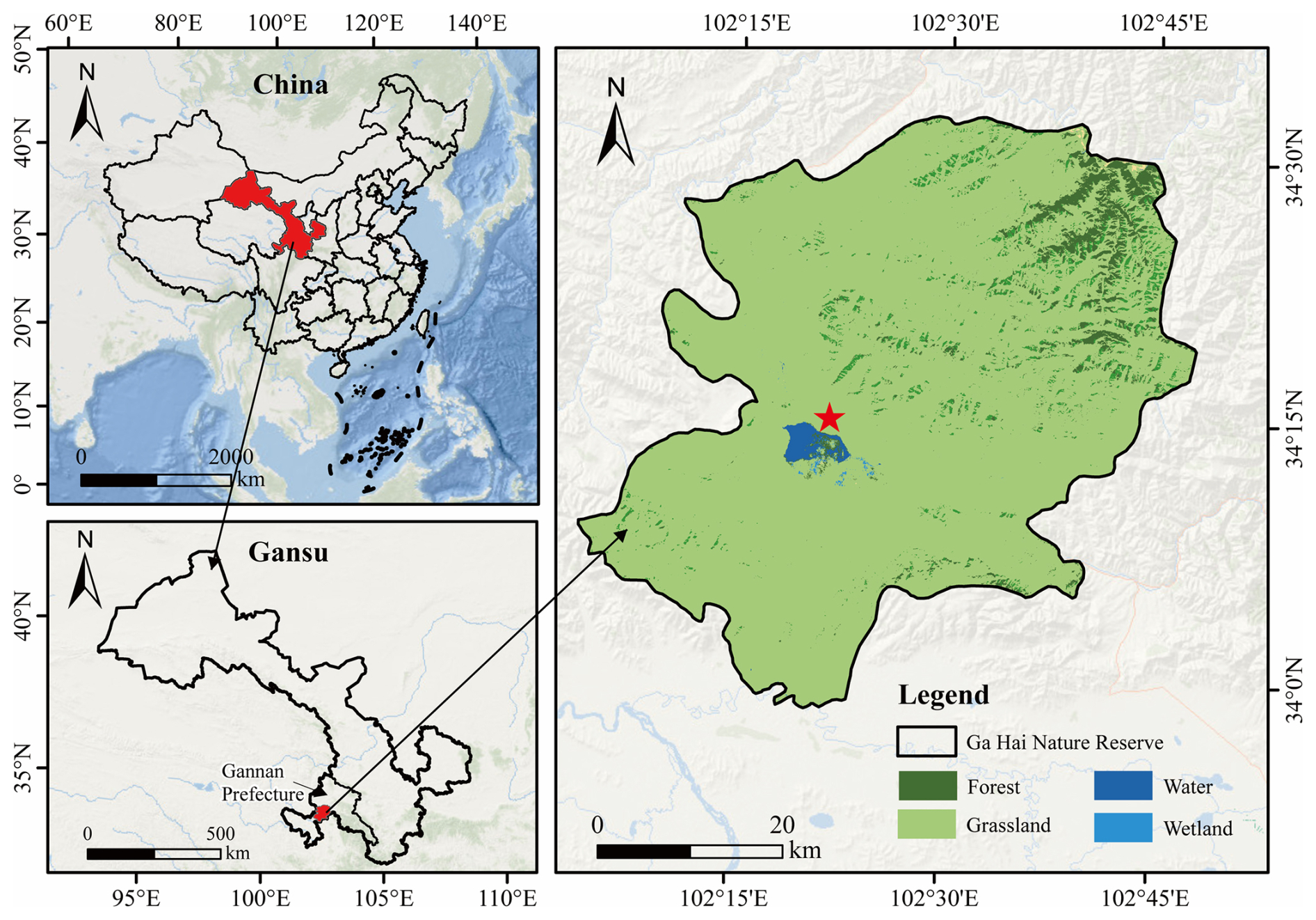
Figure 1The location of the study area.
Annual precipitation differed markedly among the three study years, with values of 816.4, 666.2, and 1216.4 mm in 2019, 2020, and 2021, respectively (Fig. S2). Relative to the long-term mean annual precipitation of 782 mm, the corresponding precipitation anomalies were 4.4 %, −14.8 %, and 55.6 %, respectively. Thus, 2020 represented a relatively dry year, whereas 2021 was exceptionally wet compared with the long-term climatic mean.
Over the past half-century, temperatures in this region have increased by 0.4 °C per decade, while precipitation has decreased by 2 mm per decade (Masson-Delmotte et al., 2021; Wang et al., 2024). This climatic shift has triggered progressive drying within the Gahai Wetland, significantly diminishing its water storage capacity. Concurrently, under pressure from population growth and socioeconomic activities, a substantial portion of the region's wetlands were drained for conversion to pastureland. From October to April, the Gahai wet meadows are routinely utilized as winter pasture for yaks, sheep, and goats. Long-term overgrazing coupled with inappropriate grazing management practices have greatly exacerbated wetland degradation (Du et al., 2025). Furthermore, high densities of Ochotona curzoniae are observed in this area. Consequently, this site presents an ideal setting for investigating the response of N-cycle enzyme activities to wet meadow degradation.
2.2 Experimental design
We referred to the classification criteria for alpine wetland degradation specified in the “Classification of degradation grade of alpine marshes” (DB63/T 1359–2015) and the “Ecosystem health assessment of Alpine Marsh wetland” (DB63/T 1544–2017) and further considered differences in vegetation characteristics and hydrological conditions within the study area (Liu et al., 2025). Using a space-for-time substitution approach, we established a belt transect extending outward from the relatively intact wetland surrounding Gahai Lake. According to the composition of dominant species, vegetation coverage, biomass and groundwater level and other characteristics (Table S1 in the Supplement). Sites with relatively flat topography and comparable elevations were selected and classified into four degradation stages: non-degraded (ND), lightly degraded (LD), moderately degraded (MD), and heavily degraded (HD). Within each degradation stage, three 10 × 10 m plots were randomly established, resulting in a total of 12 plots. All sampling sites are located within the same local wetland landscape. To minimize potential edge effects, a buffer distance of at least 10 m was maintained between adjacent plots. All experimental plots were fenced throughout the study period to exclude livestock grazing, including the local winter grazing season from October to the following May. Detailed information has been previously reported in our earlier studies (Chang et al., 2023; Du et al., 2024).
2.3 Soil samples and analysis
Soil samples were collected during the growing seasons from June to September in 2019, 2020, and 2021. Within each of the 12 established plots, composite soil samples were collected using a five-point sampling method. At each sampling point, soil cores with a diameter of 5 cm were collected from three depths: 0–10, 10–20, and 20–40 cm. Soil samples from the same depth within each plot were thoroughly homogenized to form one composite sample, yielding a total of 432 composite soil samples across the study period (4 × 3 × 12 × 3).
In addition, undisturbed soil cores were collected from each plot using stainless-steel cutting rings with a volume of 100 cm3 to determine soil bulk density. Visible roots, plant residues, and organic debris were carefully removed by hand. Fresh soil samples were then passed through a 2 mm mesh sieve to ensure sample homogeneity. Each sieved sample was divided into two subsamples. One subsample was air-dried at room temperature for the analysis of basic soil physicochemical properties, whereas the other was stored at 4 °C in a portable cooler and transported to the laboratory for the analysis of microbial biomass and related biochemical properties. These analyses were completed within two weeks of sample collection.
Soil pH was determined in a 1:2.5 soil-to-water suspension using a pH meter (Bao, 2000). Soil organic carbon (SOC) was measured using the potassium dichromate oxidation method. Total nitrogen (TN) was determined using the semi-micro Kjeldahl distillation–titration method (Lu, 2000). Total phosphorus (TP) was measured using the molybdenum–antimony colorimetric method after acid digestion. Soil ammonium nitrogen (NH-N) and nitrate nitrogen (NO-N) contents were determined by KCl extraction followed by distillation–titration (Min et al., 2011). Microbial biomass nitrogen (MBN) was measured using the chloroform fumigation–extraction method with K2SO4 as the extractant (Brookes et al., 2002). Soil water content (SWC) and soil temperature (TEM) were measured using soil moisture/temperature sensors (5TM and EC-TM sensors) connected to a data logger (Em50G, Decagon Devices, Pullman, WA, USA).
2.4 Determination of potential soil nitrogen cycle enzyme activity
The activities of four soil N-cycling enzymes, namely urease, protease, nitrate reductase, and nitrite reductase, were determined colorimetrically using urea, casein, nitrate, and nitrite as substrates, respectively (Ma et al., 2021; Ou et al., 2019; Pu et al., 2019). After a 24 h incubation at a constant temperature, the absorbance of each enzyme assay was measured using a spectrophotometer at the corresponding wavelength: 578 nm for urease, 560 nm for protease, and 520 nm for both nitrate reductase and nitrite reductase. Because these assays were conducted under standardized incubation conditions with defined substrates, the resulting activities are interpreted as potential enzyme activities. Detailed procedures for these enzyme assays have been described previously (Chang et al., 2023).
2.5 Soil nitrogen cycling functional potential (NCFP) index
To assess degradation induced shifts in the internal organization of soil N-cycling, a nitrogen cycling functional potential (NCFP) index was calculated as the difference between hydrolytic and reductive enzyme functions: NCFP = ln [(urease) + (protease)] − ln [(nitrate reductase) + (nitrite reductase)]. The higher NCFP index value indicates that hydrolysis dominates over reduction (> 0), whereas a lower NCFP index value indicates that reduction dominates over hydrolysis (< 0).
2.6 Statistical analyses
All statistical analyses were performed in R version 4.2.2 (R Core Team, 2022). Data normality was assessed using the Kolmogorov–Smirnov test and for homogeneity of variance with Levene's test. Variables that did not meet the assumption of normality were log-transformed before subsequent analyses. One-way analysis of variance (ANOVA) was used to test for differences in soil physicochemical properties and potential soil N-cycling enzyme activities among degradation stages, followed by Tukey's honestly significant difference (HSD) test for multiple comparisons.
Linear mixed-effects models were used to evaluate the effects of degradation stage and interannual variation on potential soil N-cycling enzyme activities and NCFP index (Bates et al., 2014). Degradation stage, year, and their interaction were included as fixed effects, whereas sampling month and plot identity were included as crossed random intercepts to account for temporal variation and repeated measurements within permanent plots, respectively. No random slopes were included. The model was specified as enzyme activity ∼ degradation × year + (1|month) + (1|plot). To evaluate the temporal sensitivity of degradation effects, enzyme responses in degraded wetlands relative to non-degraded wetlands were additionally expressed as logarithmic response ratios (Hedges et al., 1999). Because enzyme responses along the degradation gradient were not expected to be strictly linear, generalized additive mixed models (GAMMs) were fitted to test for potential nonlinear relationships between degradation intensity and each enzyme activity (Wood, 2011).
Redundancy analysis (RDA) was performed to examine the relationships between potential soil N-cycling enzyme activities and soil physicochemical and microbial variables (Oksanen et al., 2007). Prior to ordination, highly collinear explanatory variables were removed based on collinearity diagnostics. The significance and relative importance of the remaining explanatory variables were then evaluated using Monte Carlo permutation tests with 999 permutations. Because some potentially important variables were excluded during collinearity screening, Spearman correlation analysis combined with best-subset multiple regression was further used to quantify the relative contributions of key biotic and abiotic factors to variation in enzyme activities. Finally, based on the key environmental variables identified by the RDA and regression analyses, a piecewise structural equation model was constructed to evaluate the direct and indirect pathways through which wetland degradation regulated the NCFP index (Lefcheck, 2016). Statistical significance was assessed at P<0.05 unless otherwise stated.
3.1 Wetland degradation reshaped the soil hydrological and nutrient environment
Wetland degradation was accompanied by pronounced shifts in soil hydrological and biogeochemical conditions (Table 1). Across the degradation gradient, soil water content (SWC), pH, soil organic carbon (SOC), total nitrogen (TN), total phosphorus (TP), ammonium nitrogen (NH-N), and microbial biomass nitrogen (MBN) generally declined, whereas soil temperature (TEM) and nitrate nitrogen (NO-N) increased. Soil bulk density was also higher in degraded wetlands than in non-degraded wetlands, with the highest value observed under moderate degradation. Among these variables, the strongest degradation-related gradients were observed for SWC, MBN, and inorganic N forms. Non-degraded wetlands maintained substantially higher SWC, NH-N, and MBN, whereas degraded wetlands, particularly moderately degraded and heavily degraded wetlands, showed lower substrate and microbial N availability but higher NO-N. Overall, these patterns indicated that wetland degradation progressively transformed the soil environment from a wetter and C- and N-rich state toward a drier, warmer, and more nutrient-depleted condition. Principal component analysis (PCA) further demonstrated clear multivariate differentiation in soil physicochemical conditions across the degradation gradient (Fig. S3), with PC1 and PC2 explaining 63.2 % and 14.2 % of the total variation, respectively. The degradation stages showed an ordered ND, LD, MD and HD shift primarily along PC1, and PERMANOVA confirmed significant differences in overall soil physicochemical conditions among stages (P<0.001).
Table 1Basic physical and chemical properties of sample plots.
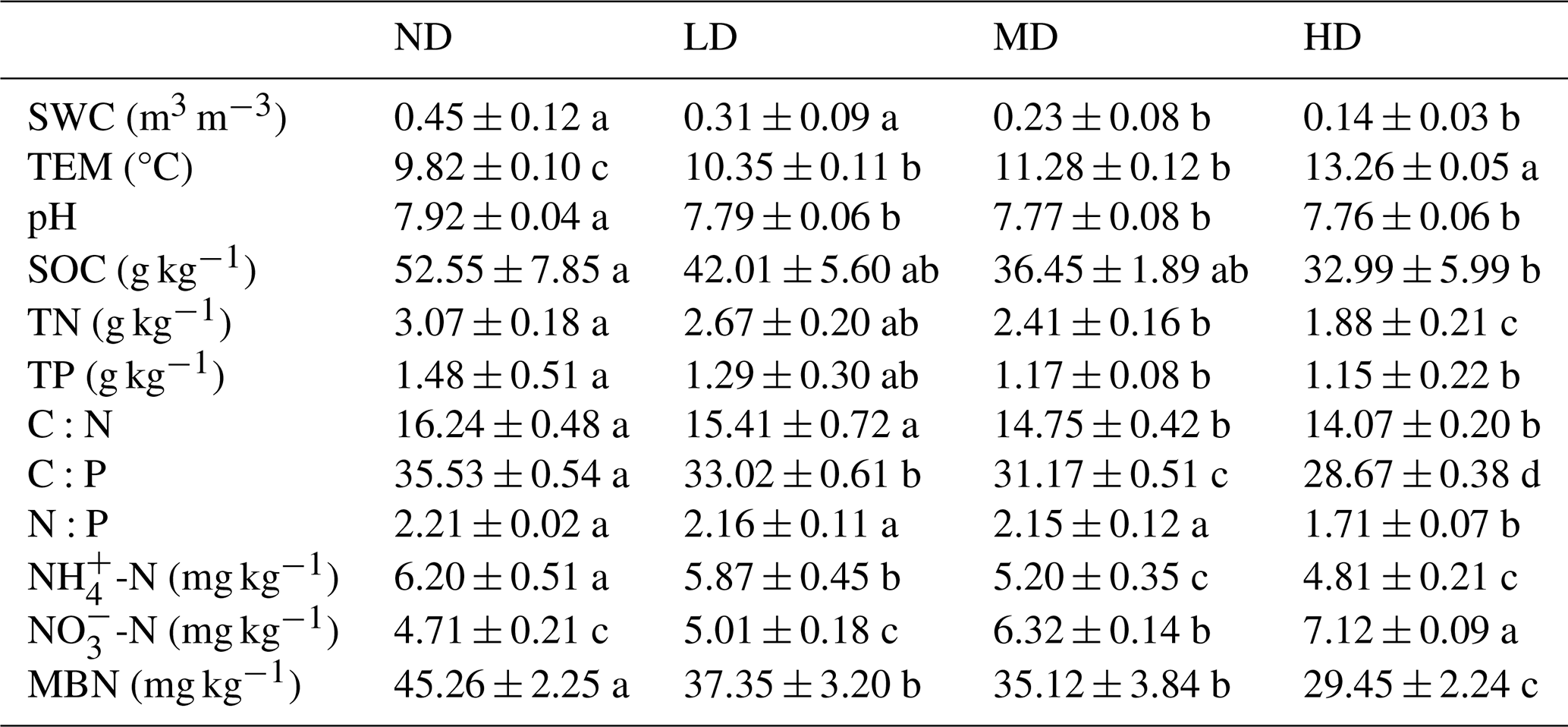
Note: Values are means ± standard error (n=3). SWC: soil water content, TEM: temperature. BD: bulk density, SOC: soil organic carbon, TN: total nitrogen, TP: total phosphorus, NH-N: ammonium nitrogen, NO-N: nitrate nitrogen, MBN, microbial biomass nitrogen. ND, non-degraded; LD, lightly degraded; MD, moderately degraded; HD, heavily degraded. Different lowercase letters in the same row indicate significant differences between different degrees of degradation (P<0.05). Values are Means ± Standard error (n=3).
3.2 Potential soil N-cycling enzymes responded divergently to degradation
Wetland degradation induced clear divergence among potential soil N-cycling enzymes pathways (Fig. 2). Urease and nitrate reductase activities generally increased along the degradation gradient, whereas protease and nitrite reductase activities declined. Although nitrate reductase activity did not differ significantly between non-degraded and lightly degraded wetlands, urease activity differed significantly between these two degradation stages (P<0.05). Soil protease activity decreased with increasing wetland degradation, but the maximum reduction, observed under heavy degradation, was only 13.00 % relative to non-degraded wetlands. Accordingly, no significant differences in protease activity were detected among the four degradation stages. In contrast, nitrite reductase activity showed a pronounced decreasing trend, with significant differences observed among degradation stages. Nitrite reductase activity decreased by 95.30 % from non-degraded to heavily degraded wetlands. Standardization further highlighted divergent responses among the four enzymes (Fig. S4). Along the degradation gradient, urease and nitrate reductase shifted progressively toward higher standardized activities, whereas protease and nitrite reductase shifted toward lower values. The strongest relative change was observed for nitrite reductase, which declined from strongly positive in ND to strongly negative in HD, while protease showed the weakest response.
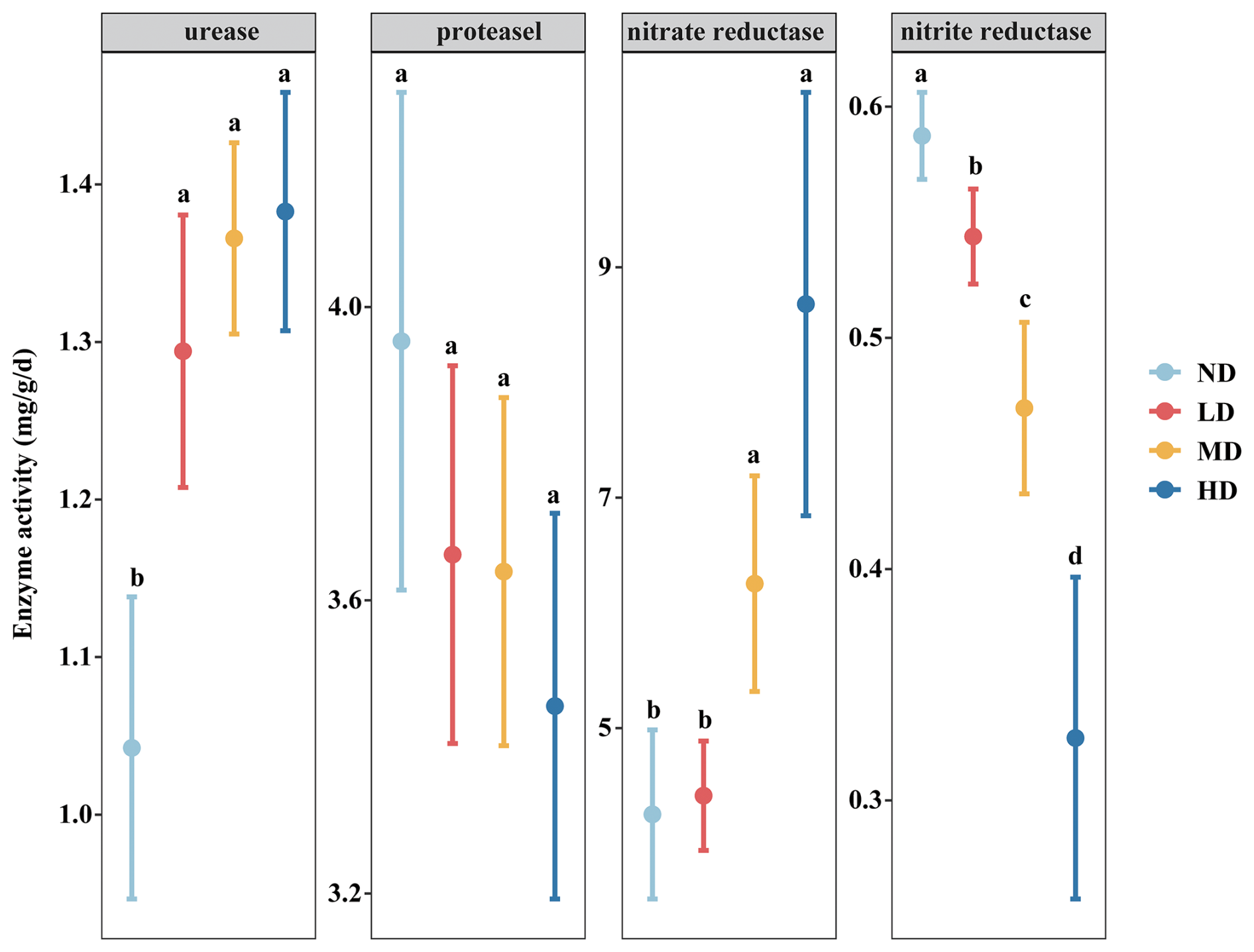
Figure 2Soil enzyme specific responses of four soil N-cycling enzymes across the alpine wetland degradation gradient. Activities of (a) urease, (b) protease, (c) nitrate reductase, and (d) nitrite reductase. ND, non-degraded; LD, lightly degraded; MD, moderately degraded; HD, heavily degraded. Different lowercase letters indicate significant differences among degradation stages at P<0.05.
3.3 Temporal variation modulated the strength of degradation effects
Potential soil N-cycling enzyme activities exhibited clear seasonal and interannual variation (Fig. 3). Urease activity generally increased from the early to the middle growing season and then declined toward September, whereas protease activity showed a similar seasonal trajectory but remained relatively low late in the growing season. Nitrate reductase activity was typically lowest in June and increased thereafter, whereas nitrite reductase activity displayed a more conserved seasonal pattern, with peak values generally occurring in August. Potential soil N-cycling enzyme activities also differed among years, coinciding with marked interannual variation in precipitation, particularly the exceptionally wet conditions in 2021 (Fig. S5). These patterns indicated that the timing of maximum activity differed among enzymatic pathways, suggesting different temporal controls on hydrolytic and reductive processes.
Linear mixed-effects models showed significant effects of degradation stage and sampling time on all four enzymes, whereas the effects were enzyme specific (Table 2). Significant degradation × year interactions occurred for urease, nitrate reductase, and nitrite reductase, but not for protease. Urease showed the strongest degradation differentiation in 2021, nitrate reductase differed significantly among degradation stages in 2019 and 2020 but not in 2021, and the decline in nitrite reductase was strongest in 2019. Generalized additive mixed models (GAMMs) indicated nonlinear and enzyme-specific responses along the degradation gradient (Fig. S6), the responses of soil N-cycling enzymes to degradation were enzyme-specific and were not uniformly linear along the alpine wetland degradation gradient. Urease and nitrate reductase activities showed stronger nonlinear increases with degradation, whereas protease and nitrite reductase activities declined more gradually or showed year-specific rates of decline. Overall, interannual variation modulated degradation effects differently among the four N-cycling enzymes.
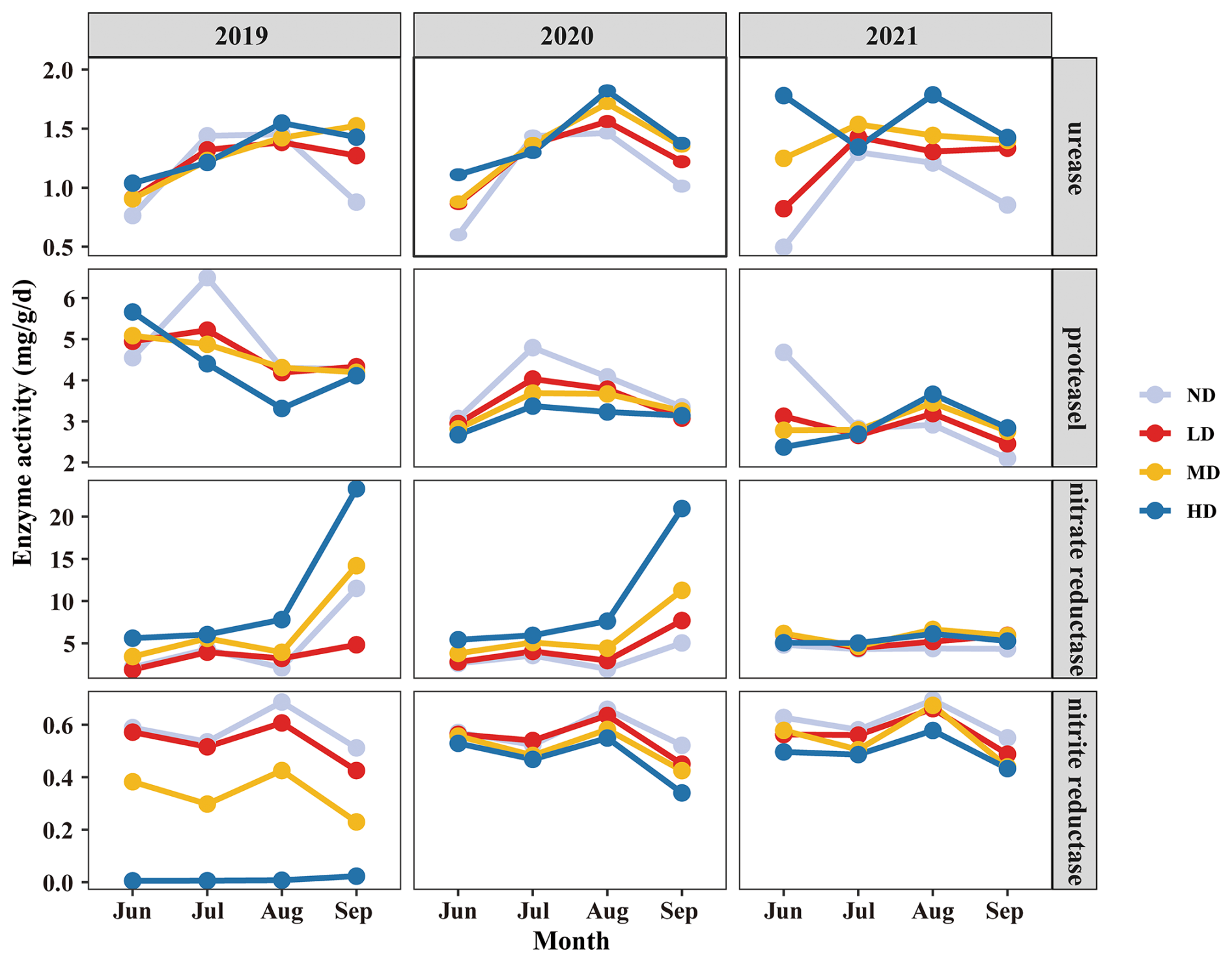
Figure 3Temporal changes in potential soil N-cycling enzyme activities across degradation levels during 2019, 2020, and 2021. Values are means of three independent replicate plots (n=3) for the integrated 0–40 cm soil layer. URE, urease; PRO, protease; NR, nitrate reductase; NIR, nitrite reductase. ND, non-degraded; LD, lightly degraded; MD, moderately degraded; HD, heavily degraded.
Table 2Fixed effects of degradation level, year, and their interaction on potential soil N-cycling enzyme activities based on linear mixed-effects models.

Note: Degradation level, year, and their interaction were included as fixed effects, whereas sampling month and plot identity were included as crossed random intercepts. F tests for fixed effects were evaluated using Satterthwaite-approximated denominator degrees of freedom. Values shown are F statistics; .01.
3.4 Wetland degradation shifted the hydrolytic to reductive N-cycling potential
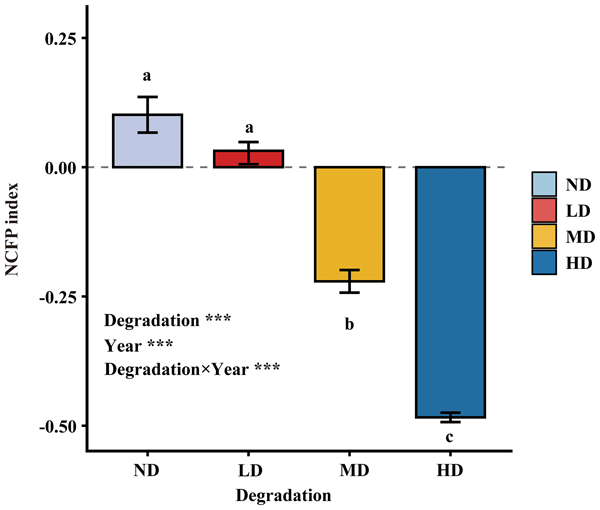
The nitrogen cycling functional potential (NCFP) index declined significantly along the wetland degradation gradient (Fig. 4). Relative to ND, NCFP decreased by approximately 0.052, 0.322, and 0.585 units in LD, MD, and HD, respectively. No significant difference was detected between ND and LD, whereas all other pairwise comparisons were significant (P<0.01). Degradation stage, year, and their interaction all had highly significant effects on NCFP. The relatively small difference between ND and LD, followed by pronounced declines under MD and HD. Changes in the relationship between hydrolytic and reductive functions further supported this functional reorganization (Fig. S7). ND, LD, and MD showed negative associations between hydrolytic and reductive functions, whereas HD showed a positive association. The strongest pattern occurred under light degradation, where the two functional groups were significantly negatively correlated (.534). The suggests an apparent transition in N-cycling functional potential once degradation progressed beyond the lightly degraded stage.
NCFP index also varied significantly among years (Fig. S8). In 2019, NCFP decreased by 0.728 units from ND to HD (P<0.001), whereas the corresponding decline reached 0.987 units in the relatively dry year of 2020 (P<0.001). In contrast, no significant differences among degradation stages were detected in the exceptionally wet year of 2021, when the ND to HD difference was only 0.04 units. These results indicate that the degradation response of NCFP was strongly modulated by interannual variation, with pronounced degradation gradients in 2019 and 2020 but little differentiation among degradation stages in 2021.
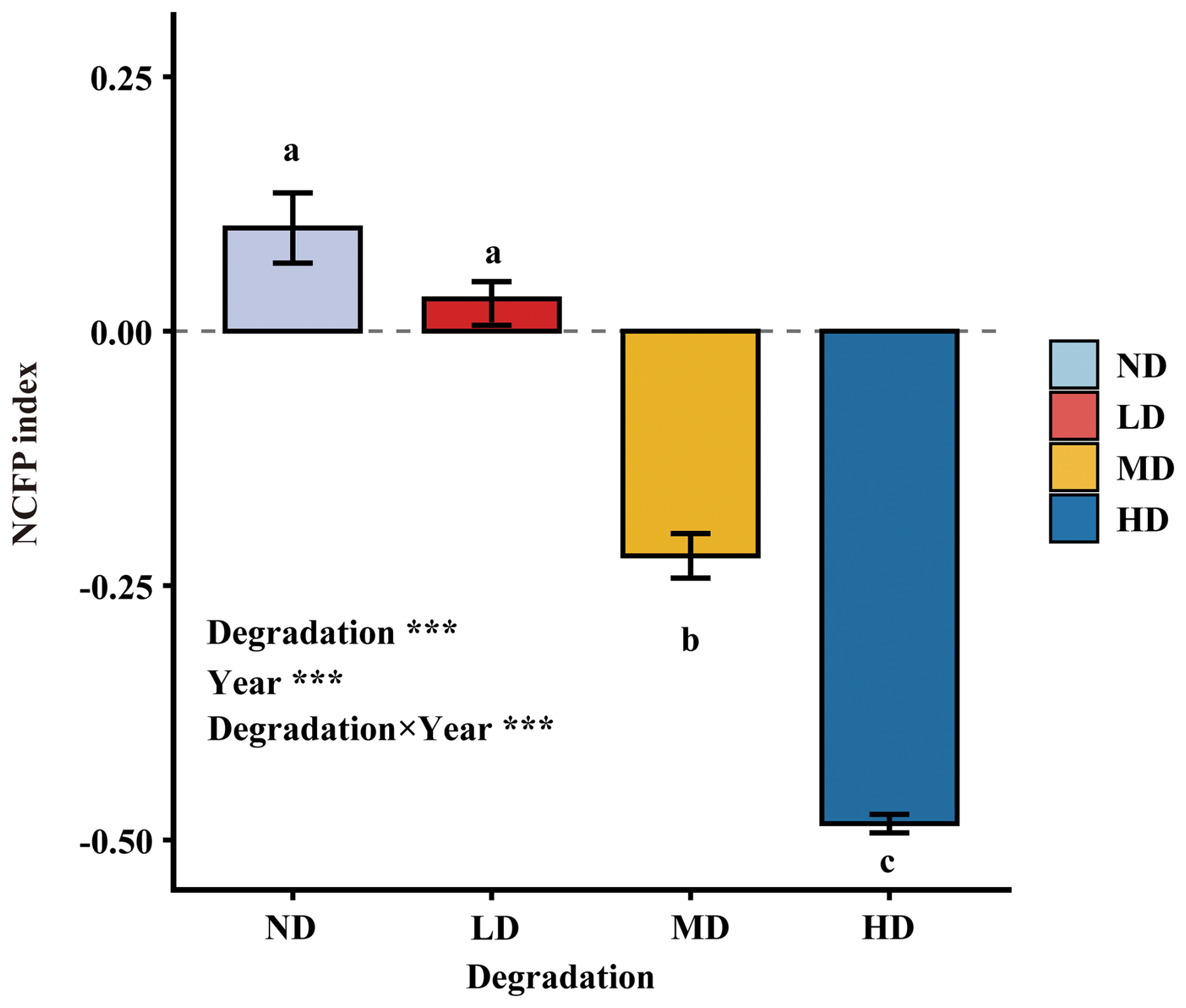
Figure 4Response of nitrogen cycling functional potential (NCFP) index to wetland degradation. ND, non-degraded; LD, lightly degraded; MD, moderately degraded; HD, heavily degraded.
3.5 Relationships between potential soil N-cycling enzyme activities and potential environmental drivers
Redundancy analysis (RDA) indicated that soil environmental factors strongly structured variation in potential soil N-cycling enzyme activities, with RDA1 and RDA2 explaining 66.20 % and 8.62 % of the total variation, respectively (Fig. 5). RDA1 represented the dominant environmental gradient, separating relatively wetter and more resource-rich conditions, characterized by higher SWC, SOC, TN, TP, MBN, and NH-N, from warmer and more nitrate-rich conditions, characterized by higher TEM and NO-N. In contrast, RDA2 represented a weaker secondary environmental gradient that was primarily associated with pH. Urease and protease activities were primarily associated with the resource-rich side of the ordination, whereas nitrate reductase activity was more closely aligned with higher TEM and NO-N. Nitrite reductase activity showed comparatively weaker associations with individual environmental variables. Permutation tests with 999 permutations identified NH-N as the most important independent explanatory variable, followed by TN, MBN, NO-N, and SOC. Correlation analysis combined with best-subset multiple regression further confirmed that TN, MBN, NO-N, and SOC were the major contributors to variation in enzyme activities, with greater explanatory power for urease and protease than for nitrate reductase and nitrite reductase.
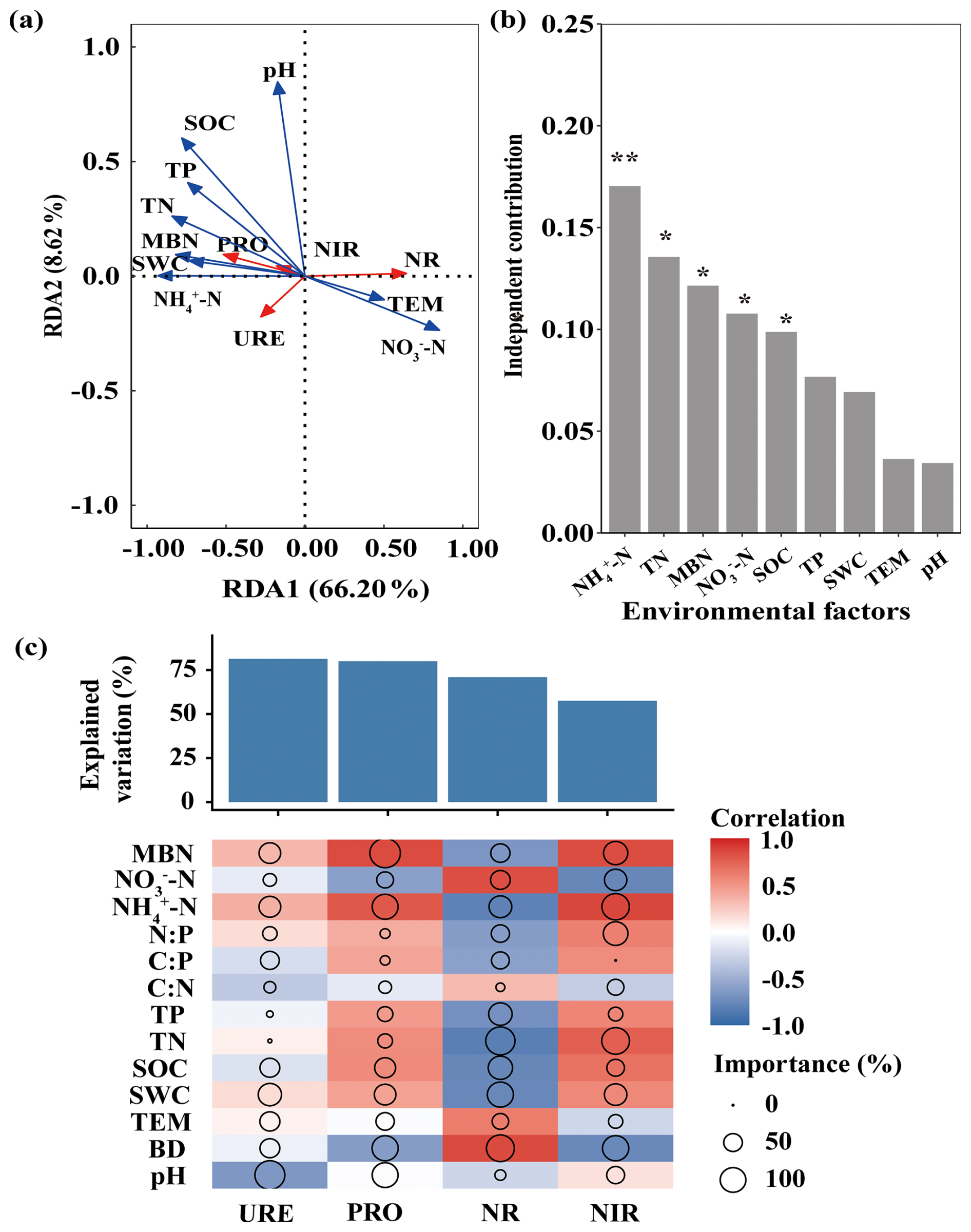
Figure 5Contributions of soil biotic and abiotic factors to potential soil N-cycling enzyme activities. (a) Redundancy analysis (RDA) ordination of enzyme activities and environmental variables. (b) Permutation-based ranking of the independent contributions of environmental factors identified by RDA. (c) Relative importance of soil variables for enzyme activities based on correlation analysis and optimal multiple regression modeling. Circle size represents the relative contribution/importance (%) estimated from the optimal regression model, and color indicates the Spearman correlation coefficient. URE, urease; PRO, protease; NR, nitrate reductase; NIR, nitrite reductase; BD, bulk density; TEM, temperature; SWC, soil water content; SOC: soil organic carbon; TN, total nitrogen; TP: total phosphorus; NH-N, ammonium nitrogen; NO-N, nitrate nitrogen; MBN, microbial biomass nitrogen.
Based on the key environmental factors identified by the RDA and regression analyses, we constructed a piecewise structural equation model (piecewise-SEM) to elucidate how wetland degradation affected the NCFP index through hydrological limitation, carbon resource status, soil N availability, and microbial biomass (Fig. 6). Wetland degradation had significant positive effects on SWC and SOC, and SWC showed positive pathways to TN, NH-N, and NO-N. NH-N exerted a significant positive effect on NCFP, suggesting that greater ammonium availability was associated with a relative predominance of hydrolytic over reductive N-cycling functions. In contrast, SOC had a direct positive effect on NCFP. Overall, the piecewise SEM analysis identified hydrological limitation as a dominant control on NCFP imbalance, with SWC exerting both direct and indirect effects through associated changes in soil N availability and microbial biomass.
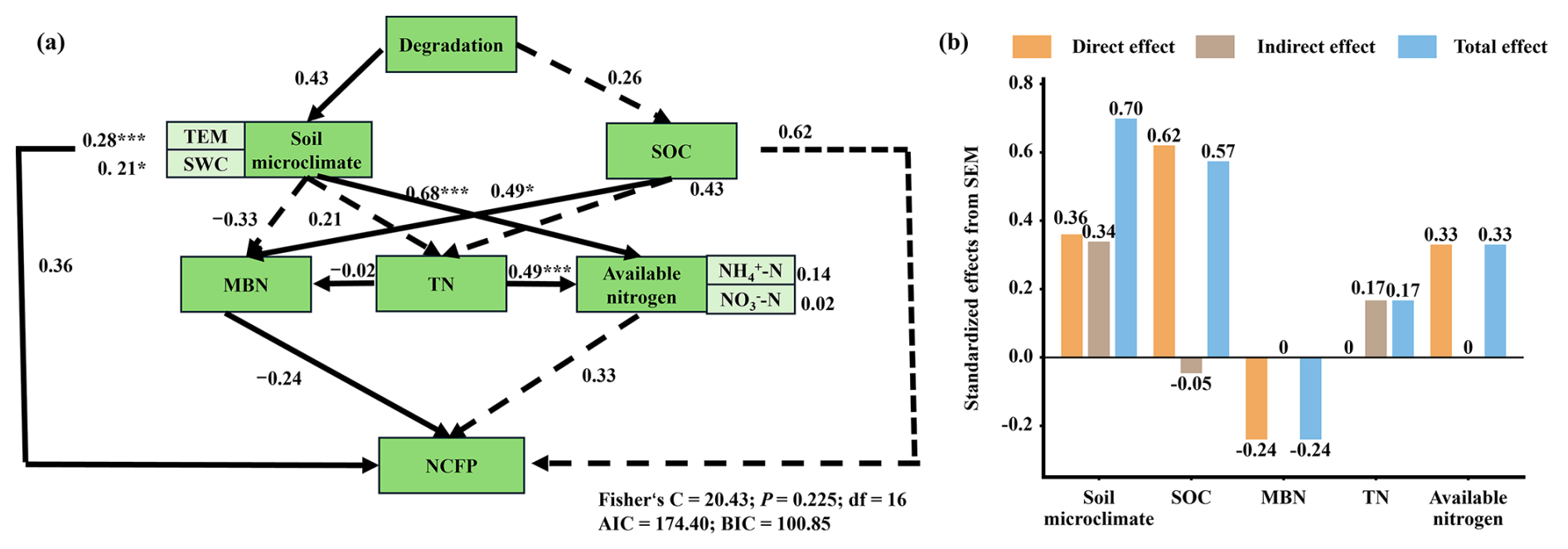
Figure 6Piecewise structural equation model showing how wetland degradation influences nitrogen-cycling functional imbalance through hydrological drying, substrate depletion, and microbial biomass constraints. (a) Structural equation modeling shows the influences of N cycling functional potential. (b) Direct effects, indirect effects and standardized total effect values of structural equation models. TN, total nitrogen; NH-N, ammonium nitrogen; NO-N, nitrate nitrogen; MBN, microbial biomass nitrogen; SWC, soil water content; TEM, temperature.
4.1 Wetland degradation redefines the hydrological and resource environment of soil N cycling
From a process-based perspective, hydrological drying appears to be the primary trigger linking vegetation degradation to belowground functional change. Soil water content declined by 69 % from ND to HD (Table 1), and water availability regulates oxygen diffusion, redox conditions, solute transport, and enzyme substrate contact. Progressive drying may therefore shift the soil environment from relatively water-saturated and diffusion-limited conditions toward greater aeration and a more oxic state, thereby altering the environmental constraints imposed on individual N-transformation pathways. This hydrological shift was accompanied by substantial changes in soil N availability and microbial N storage. Declines in SOC and NH-N indicated reductions in soil C resources and available N, whereas lower MBN indicated reduced microbial biomass and potentially weakened microbial N retention capacity (Cai et al., 2024; Li et al., 2024). Together, these changes created a more resource-limited and increasingly oxic soil environment, in which degradation progressively reduced substrate supply and biological N retention. Rather than uniformly suppressing microbial functioning, reduced water availability, contraction of the microbial N pool, altered substrate availability, and enhanced soil aeration created a fundamentally different physicochemical environment in which individual microbial pathways were subject to different constraints. RDA further revealed differential environmental regulation of potential N-cycling processes. Microorganisms may therefore reallocate enzymatic investment between N acquisition and N transformation in response to changing resource availability and redox conditions (Li et al., 2025). Thus, alpine wetland degradation primarily restructured the environmental context in which soil N-cycling operates, rather than uniformly weakening all microbial functions.
4.2 Differential responses of soil N-cycling enzymes to alpine wetland degradation
Against this altered environmental background, the four soil N-cycling enzymes did not respond synchronously. Instead, wetland degradation promoted a clear divergence among enzymatic pathways, indicating that soil N cycling was reorganized rather than uniformly suppressed (Fig. 2). Urease and nitrate reductase activities increased with degradation, whereas protease and nitrite reductase activities declined. The increase in urease activity can be interpreted as a shift toward faster access to relatively simple N compounds under resource-constrained conditions (Burns et al., 2013). As soil drying and nutrient depletion progress, microorganisms may rely more heavily on enzymatic routes that rapidly release inorganic N from accessible substrates, especially when the decomposition of complex organic matter becomes increasingly constrained (Geisseler et al., 2010). As the enzyme that directly catalyzes the hydrolysis of urea to ammonium (Krajewska, 2009), urease is closely linked to substrate turnover, pH conditions, and soil aeration (Pan et al., 2020; Wang et al., 2023). In contrast, the decline in protease activity indicates a reduced capacity to depolymerize more complex organic N pools, which is consistent with lower substrate supply, reduced microbial activity, and poorer diffusion conditions in degraded soils(Song et al., 2014; Vranova et al., 2013). At the same time, declines in SOC, TN, NH-N, and MBN suggest progressive depletion of both substrate resources and microbial metabolic capacity (Greenfield et al., 2021), thereby reducing microbial investment in the acquisition of complex organic N (Brockett et al., 2011; Chen et al., 2018; Ma et al., 2021; Vranova et al., 2013). This interpretation is consistent with findings from studies of alpine wetland degradation in Zoige (Huo et al., 2013). Thus, within the hydrolytic component of soil N cycling, degradation appears to shift function away from complex organic N acquisition and toward rapid-turnover pathways.
A similar internal divergence occurred within the reductive component of N cycling. Nitrate reductase activity increased, whereas nitrite reductase activity declined sharply with degradation (Fig. 2). This decoupling is consistent with a drying-induced shift in soil redox status: lower water tables and greater aeration can stimulate nitrification and nitrate accumulation (Szajdak and Gaca, 2010; Li et al., 2015), thereby supporting the initial step of nitrate reduction while simultaneously suppressing the anaerobic microsites required for sustained downstream nitrite reduction (Hefting et al., 2004). In other words, degradation appears to create a functional bottleneck in the N-reduction pathway, in which upstream substrate supply is maintained or enhanced (Ayiti and Babalola, 2022) whereas downstream oxygen-sensitive reduction is constrained (Jin et al., 2019) This interpretation is also supported by the observed increase in NO-N and by the stronger association of nitrate reductase activity with TEM and NO-N in the RDA results. Therefore, wetland degradation did not simply weaken soil N cycling overall but reorganized it by enhancing some rapid-turnover processes while suppressing enzymes associated with complex organic N depolymerization and oxygen-sensitive reduction steps.
It should be emphasized that the enzyme activities measured here represent potential enzymatic capacities rather than realized in situ N-transformation rates. Standard soil enzyme assays quantify activity under controlled substrate and incubation conditions, whereas field expression is additionally regulated by substrate availability, moisture, temperature, diffusion, and redox conditions (Burns, 2002; German et al., 2011; Wallenstein and Weintraub, 2008). Despite this distinction, potential enzyme activities are often related to realized N-transformation processes. Soil protease and other hydrolytic enzyme activities have been associated with organic-N solubilization and gross N mineralization rates (Darby et al., 2020), and coordinated changes in enzyme activities and net N mineralization and nitrification have also been reported in wetland soils (Jia et al., 2020). Conversely, studies of wetland denitrification enzyme activity emphasize that potential assays are most appropriately used to compare relative functional capacities among sites or treatments rather than as direct measurements of in-situ denitrification (Hartzog et al., 2017). Consistent with these observations, an independent three-year in situ incubation study conducted in the same Gahai wetland showed degradation-induced decreases in net ammonification and mineralization but an increase in net nitrification, and further identified N-cycling enzyme activities as important predictors of field N-transformation dynamics (Du et al., 2025). These findings indicate that potential enzyme activities can serve as informative indicators of the biochemical capacity for soil N transformations, although the strength and direction of enzyme–process relationships depend on environmental context and the specific N pathway considered.
4.3 Hydroclimatic variability modulated the magnitude of degradation-induced functional divergence
Our multi-year analysis from 2019 to 2021 revealed pronounced seasonal and interannual patterns in potential soil N-cycling enzyme activities (Fig. 3). At the seasonal scale, urease, protease, and nitrite reductase, reached peak activity during the middle of the growing season, particularly in July and August, whereas nitrate reductase activity showed a delayed peak in September. Such temporal separation likely reflects the combined effects of plant phenology, substrate availability, and seasonal hydrothermal conditions. The midsummer maxima were consistent with the period of relatively favourable environmental conditions on the QTP, when higher temperatures, adequate soil moisture, and intensified plant growth jointly stimulate microbial metabolism and enzyme production (Kivlin and Treseder, 2014). In particular, July and August correspond to the peak period of plant vegetative growth, during which enhanced root exudation supplies labile C to the rhizosphere (Brzostek et al., 2011), thereby stimulating microbial activity and promoting enzyme synthesis (Brzostek et al., 2011; Meier et al., 2017). The interpretation is also supported by independent field measurements from the same wetland, where net ammonification and net N mineralization generally reached their highest rates between July and August, broadly coinciding with the seasonal maxima in hydrolytic enzyme potential (Du et al., 2025). By contrast, the delayed peak in nitrate reductase activity in September likely reflected a seasonal shift in plant–microbe competition for N. As plant senescence progresses toward the end of the growing season, plant N uptake declines, allowing residual nitrate (NO) to accumulate in soil (Hefting et al., 2004; Keiluweit et al., 2017). The substrate accumulation, together with increased soil moisture and the formation of localized anaerobic microsites under cooler autumn conditions, may create a favourable microenvironment for nitrate reductase induction (Kotroczó et al., 2014). The later seasonal peak of nitrate reductase relative to nitrite reductase is particularly important because it indicates that even the reductive components of N-cycling were internally asynchronous rather than operating as a single coordinated pathway. Accordingly, the distinct seasonal maxima of these enzymes are better interpreted as evidence of seasonal functional partitioning among N-cycling pathways, jointly driven by vegetation phenology, substrate dynamics, and pathway-specific sensitivities to hydrothermal and redox conditions.
Interannual hydroclimatic variability significantly modulated the effects of wetland degradation on potential soil N-cycling enzyme activities, but this modulation was strongly enzyme-specific rather than indicative of a consistent drought-amplification effect. Significant degradation × year interactions for urease, nitrate reductase, and nitrite reductase demonstrated that the magnitude of degradation effects varied among years (Table 2). Although urease and nitrate reductase generally increased with degradation, whereas protease and nitrite reductase declined, their interannual responses were asynchronous. Degradation-related differentiation in urease was strongest in the exceptionally wet year of 2021; nitrate reductase increased significantly in heavily degraded wetlands in 2019 and in the relatively dry year of 2020, but this degradation gradient disappeared in 2021 (Fig. S5). In contrast, the decline in nitrite reductase was most pronounced in 2019, whereas the negative response of protease was strongest in 2020. These contrasting patterns suggest that changes in water availability may impose different constraints on individual N-transformation pathways by altering soil aeration, redox conditions, substrate diffusion, resource availability, and microbial N retention, rather than uniformly intensifying all degradation effects during dry years (Asensio et al., 2024; Steinweg et al., 2012). Accordingly, future climate change is more likely to influence alpine wetland N cycling through pathway-specific and potentially nonlinear interactions between degradation and hydroclimatic variability. In this context, maintaining wetland hydrological integrity may be critical for reducing functional instability in N cycling and sustaining the ecological resilience of alpine wetlands.
4.4 Effects of functional decoupling on soil N-cycling
The NCFP index revealed a clear reorganization of the relative balance between hydrolytic and reductive N-cycling enzyme potentials along the wetland degradation gradient (Fig. 4). NCFP progressively declined from ND to HD, shifting from slightly positive values in ND and LD to negative values in MD and HD. This pattern indicates a gradual shift in N-cycling enzyme function from a relative bias toward hydrolytic potential to a relative bias toward reductive potential, reflecting an adaptive reorganization of microbial resource allocation as habitat degradation progresses. Urease and protease mediate the hydrolysis and depolymerization of organic N substrates such as urea and proteins and therefore represent important components of organic N mineralization and microbial N acquisition (Marx et al., 2005). Accordingly, the relatively high NCFP values observed in ND and LD may reflect the greater availability of organic matter and microbial substrates in less-degraded wetlands, which could sustain a relatively strong potential for organic N hydrolysis. According to microbial resource allocation theory, extracellular enzyme production entails substantial energetic and nutrient costs (Sinsabaugh et al., 2009; Sinsabaugh and Moorhead, 1994), and microbial investment in enzyme synthesis is regulated by both substrate availability and cellular stoichiometric demand (Sinsabaugh and Follstad Shah, 2012). In contrast, the pronounced declines in soil moisture and nutrient availability associated with wetland degradation may alter substrate supply, microbial metabolic requirements, and the relative importance of different enzyme-mediated N transformations (Malik et al., 2019). The stage-dependent changes in the relationship between hydrolytic and reductive functions further support this interpretation (Fig. S7), suggesting that wetland degradation does not uniformly enhance or suppress all N-cycling processes (Fujita et al., 2018), but instead modifies the coupling among different functional components.
More importantly, strong interannual hydrological variability further modulated the expression of this degradation effect (Fig. S8). In the relatively dry year of 2020, ND and LD generally maintained higher NCFP values, whereas in the exceptionally wet year of 2021, NCFP became negative across all degradation stages. This pattern indicates that the hydrolytic-to-reductive functional balance is sensitive not only to degradation intensity but also to short-term hydrological variability. Soil moisture is a major regulator of microbial N transformations because it influences substrate diffusion, microbial activity, and soil aeration, whereas water saturation constrains O2 diffusion and promotes the development of anoxic or reducing microsites (Alldred and Baines, 2016). Notably, NCFP in ND also shifted from positive values in normal or relatively dry years to negative values in the wet year, indicating that degradation and interannual hydrological variability may influence the hydrolytic–reductive functional balance through different mechanisms. Long-term degradation likely restructures N-cycling functions through persistent changes in soil organic matter, inorganic N availability, microbial resources, and soil moisture, whereas anomalously high precipitation may rapidly modify soil O2 diffusion and redox conditions, thereby reconfiguring the relative expression of hydrolytic and reductive enzyme potentials. Thus, NCFP reflects a dynamic balance in soil N-cycling functional potential jointly shaped by long-term ecosystem degradation and short-term hydrological variability.
4.5 Limitations of the Study
Although this study provides valuable insights into the effects of alpine wetland degradation on soil N cycling, several limitations should be considered when interpreting our results. First, the enzyme activities measured in this study represent potential activities under standardized laboratory conditions rather than direct estimates of in situ transformation rates. All four enzymes were assayed under controlled incubation conditions with specific substrates, which facilitated comparisons among degradation stages but reduced the influence of field constraints such as substrate diffusion, temperature fluctuations, substrate limitation, oxygen availability, and soil redox conditions. This distinction is particularly important for nitrate reductase and nitrite reductase. Second, although we examined key soil physicochemical properties and plant nutrient characteristics, the role of microbial communities in mediating nutrient cycling was not directly assessed. Because soil microorganisms play central roles in C, N, and P transformations, their responses to alpine wetland degradation could further clarify the mechanisms underlying plant–soil interactions. Third, the lack of measurements of labile and biologically relevant carbon pools, such as dissolved organic carbon, particulate organic carbon, and microbial biomass carbon, limits our ability to determine how carbon availability regulates N-cycling functional potential. Addressing these limitations in future studies will improve our understanding of N cycling in degraded alpine wetlands and provide a stronger scientific basis for developing effective wetland restoration strategies.
Alpine wetland degradation did not uniformly suppress soil N-cycling but instead the relative balance between hydrolytic and reductive soil N-cycling enzyme potentials. With increasing degradation intensity, urease and nitrate reductase activities increased, whereas protease and nitrite reductase activities declined. Despite these enzyme-specific responses, the nitrogen cycling functional potential (NCFP) index showed an overall decreasing trend, indicating a progressive shift in the relative configuration of hydrolytic and reductive functions. This functional reorganization was primarily associated with degradation-induced hydrological drying and resource depletion, as declines in soil water availability and carbon resources altered the environmental context for microbial resource allocation. Interannual hydroclimatic variability further modified this pattern, with exceptionally wet conditions shifting NCFP toward negative values across all degradation stages, suggesting that the hydrolytic–reductive balance is jointly regulated by long-term ecosystem degradation and short-term hydrological fluctuations. Therefore, the ecological consequences of alpine wetland degradation extend beyond reductions in soil moisture and nutrient availability to include a restructuring of belowground N-cycling functional balance and its sensitivity to hydrological variability. Restoration of degraded alpine wetlands should thus the recovery of wetland hydrological conditions and soil resource availability to promote a more balanced configuration of N-cycling functions.
The data used in this paper can be accessed via the Zenodo: https://doi.org/10.5281/zenodo.20739760 (Chang, 2026).
The supplement related to this article is available online at https://doi.org/10.5194/soil-12-1121-2026-supplement.
Conceptualization, Methodology, Data curation, Software, Formal analysis, Writing – original draft: WC. Supervision, Project administration, Funding acquisition, Writing – review & editing: WM. Writing – review & editing: JW. Investigation: LS. Methodology: JD. Investigation: WH. Resources, Writing – review: GL.
The contact author has declared that none of the authors has any competing interests.
Publisher's note: Copernicus Publications remains neutral with regard to jurisdictional claims made in the text, published maps, institutional affiliations, or any other geographical representation in this paper. The authors bear the ultimate responsibility for providing appropriate place names. Views expressed in the text are those of the authors and do not necessarily reflect the views of the publisher.
We thank all the people involved in this work.
The study was supported by the Gansu Provincial Science and Technology Plan (Major Special Project) Grant in 2026 (grant no. 26ZDFG001); National Natural Science Foundation of China (grant no. 31860143); Innovation Star Project for Graduate Students in Universities in Gansu Province in 2026 (grant no. 2026CXZX-793); Priority Talent Project of Gansu Province in 2024: Research on Carbon Sequestration and Sink Enhancement Technology in Degraded Wetlands in the Upper Reaches of The Yellow River in Gannan and Talent Cultivation (grant no. 2024RCXM82); The Central Government Guide Local Science and Technology Development Funds In 2024 (grant no. 24ZYQA023); and Gansu Provincial Department of Education Industrial Support Program Project (grant no. 2021CYZC-15).
This paper was edited by Kairsty Topp and reviewed by Guang-Hui Yu and one anonymous referee.
Abulaizi, M., Chen, M., Yang, Z., Hu, Y., Zhu, X., and Jia, H.: Response of soil bacterial community to alpine wetland degradation in arid Central Asia, Front. Plant Sci., 13, 990597, https://doi.org/10.3389/fpls.2022.990597, 2023.
Akinyemi, D. S., Zhu, Y., Zhao, M., Zhang, P., Shen, H., and Fang, J.: Response of soil extracellular enzyme activity to experimental precipitation in a shrub-encroached grassland in Inner Mongolia, Global Ecology and Conservation, 23, e01175, https://doi.org/10.1016/j.gecco.2020.e01175, 2020.
Alhassan, A.-R. M., Ma, W., Li, G., Jiang, Z., Wu, J., and Chen, G.: Response of soil organic carbon to vegetation degradation along a moisture gradient in a wet meadow on the Qinghai-Tibet Plateau, Ecol. Evol., 8, 11999–12010, https://doi.org/10.1002/ece3.4656, 2018.
Alldred, M. and Baines, S. B.: Effects of wetland plants on denitrification rates: a meta-analysis, Ecol. Appl., 26, 676–685, https://doi.org/10.1890/14-1525, 2016.
Allison, S. D. and Vitousek, P. M.: Responses of extracellular enzymes to simple and complex nutrient inputs, Soil Biol. Biochem., 37, 937–944, https://doi.org/10.1016/j.soilbio.2004.09.014, 2005.
Asensio, D., Zuccarini, P., Sardans, J., Marañón-Jiménez, S., Mattana, S., Ogaya, R., Mu, Z., Llusià, J., and Peñuelas, J.: Soil biomass-related enzyme activity indicates minimal functional changes after 16 years of persistent drought treatment in a Mediterranean holm oak forest, Soil Biol. Biochem., 189, https://doi.org/10.1016/j.soilbio.2023.109281, 2024.
Ayiti, O. E. and Babalola, O. O.: Factors Influencing Soil Nitrification Process and the Effect on Environment and Health, Front. Sustain. Food Syst., 6, https://doi.org/10.3389/fsufs.2022.821994, 2022.
Bai, W., Wang, G., Shang, G., Xu, L., and Wang, Z.: Effects of experimental warming on soil enzyme activities in an alpine swamp meadow on the Qinghai-Tibetan Plateau, Pedobiologia, 101, 150910, https://doi.org/10.1016/j.pedobi.2023.150910, 2023.
Bao, S. D.: Soil and agricultural chemistry analysis, China Agriculture Science and Technique Press, Beijing, ISBN 978-7-109-06644-1, 2000.
Bates, D., Mächler, M., Bolker, B., and Walker, S.: Fitting Linear Mixed-Effects Models using lme4, arXiv [preprint], https://doi.org/10.48550/arXiv.1406.5823, 2014.
Breidenbach, A., Schleuss, P.-M., Liu, S., Schneider, D., Dippold, M. A., de la Haye, T., Miehe, G., Heitkamp, F., Seeber, E., Mason-Jones, K., Xu, X., Huanming, Y., Xu, J., Dorji, T., Gube, M., Norf, H., Meier, J., Guggenberger, G., Kuzyakov, Y., and Spielvogel, S.: Microbial functional changes mark irreversible course of Tibetan grassland degradation, Nat. Commun., 13, 1–10, https://doi.org/10.1038/s41467-022-30047-7, 2022.
Brockett, B. F. T., Prescott, C. E., and Grayston, S. J.: Soil moisture is the major factor influencing microbial community structure and enzyme activities across seven biogeoclimatic zones in western Canada, Soil Biol. Biochem., 44, 9–20, https://doi.org/10.1016/j.soilbio.2011.09.003, 2011.
Brookes, P. C., Landman, A., Pruden, G., and Jenkinson, D. S.: Chloroform fumigation and the release of soil nitrogen: A rapid direct extraction method to measure microbial biomass nitrogen in soil, Soil Biol. Biochem., 17, 837–842, https://doi.org/10.1016/0038-0717(85)90144-0, 2002.
Brzostek, E., Greco, A., Drake, J., and Finzi, A.: Root carbon inputs to the rhizosphere stimulate extracellular enzyme activity and increase nitrogen availability in temperate forest soils, Biogeochemistry, 115, https://doi.org/10.1007/s10533-012-9818-9, 2011.
Brzostek, E. R., Blair, J. M., Dukes, J. S., Frey, S. D., Hobbie, S. E., Melillo, J. M., Mitchell, R. J., Pendall, E., Reich, P. B., Shaver, G. R., Stefanski, A., Tjoelker, M. G., and Finzi, A. C.: The effect of experimental warming and precipitation change on proteolytic enzyme activity: positive feedbacks to nitrogen availability are not universal, Glob. Change Biol., 18, 2617–2625, https://doi.org/10.1111/j.1365-2486.2012.02685.x, 2012.
Burns, R. G.: Enzyme activity in soil: Location and a possible role in microbial ecology, Soil Biol. Biochem., 14, 423–427, https://doi.org/10.1016/0038-0717(82)90099-2, 2002.
Burns, R. G., DeForest, J. L., Marxsen, J., Sinsabaugh, R. L., Stromberger, M. E., Wallenstein, M. D., Weintraub, M. N., and Zoppini, A.: Soil enzymes in a changing environment: Current knowledge and future directions, Soil Biol. Biochem., 58, 216–234, https://doi.org/10.1016/j.soilbio.2012.11.009, 2013.
Cai, M., Zhang, Y., Zhao, G., Zhao, B., Cong, N., Zhu, J., Zheng, Z., Wu, W., and Duan, X.: Excessive climate warming exacerbates nitrogen limitation on microbial metabolism in an alpine meadow of the Tibetan Plateau: Evidence from soil ecoenzymatic stoichiometry, Sci. Total Environ., 930, 172731, https://doi.org/10.1016/j.scitotenv.2024.172731, 2024.
Chang, W.: Alpine wetland degradation shifts enzyme-mediated soil nitrogen cycling from functional coordination to imbalance-data, Zenodo [data set], https://doi.org/10.5281/zenodo.20739760, 2026.
Chang, W., Ma, W., Song, L., Tang, Y., Long, Y., Xu, G., and Yuan, J.: Responses of soil N-cycle enzyme activities to vegetation degradation in a wet meadow on the Qinghai-Tibet Plateau, Front. Ecol. Evol., 11, 1210643, https://doi.org/10.3389/fevo.2023.1210643, 2023.
Chen, H., Li, D., Zhao, J., Xiao, K., and Wang, K.: Effects of nitrogen addition on activities of soil nitrogen acquisition enzymes: A meta-analysis, Agric. Ecosyst. Environ., 252, 126–131, https://doi.org/10.1016/j.agee.2017.09.032, 2018.
Chen, H., Ju, P., Zhu, Q., Xu, X., Wu, N., Gao, Y., Feng, X., Tian, J., Niu, S., Zhang, Y., Peng, C., and Wang, Y.: Carbon and nitrogen cycling on the Qinghai–Tibetan Plateau, Nat. Rev. Earth Env., 3, 701–716, https://doi.org/10.1038/s43017-022-00344-2, 2022.
Darby, B. A., Goodale, C. L., Chin, N. A., Fuss, C. B., Lang, A. K., Ollinger, S. V., and Lovett, G. M.: Depth patterns and connections between gross nitrogen cycling and soil exoenzyme activities in three northern hardwood forests, Soil Biol. Biochem., 147, 107836, https://doi.org/10.1016/j.soilbio.2020.107836, 2020.
Deng, Y., Li, X., Yang, C., Shi, F., Zhao, S., Zhou, S., Miao, C., Ding, R., Fu, Y. H., Yang, X., and Wang, Z.: Rapid degradation of frozen soil environments in thermokarst-affected alpine grasslands on the Qinghai-Tibet Plateau under climate change, Catena, 254, 108936, https://doi.org/10.1016/j.catena.2025.108936, 2025.
Du, J., Ma, W., Li, G., Chang, W., and Chun, L.: Soil nitrogen-related functional genes undergo abundance changes during vegetation degradation in a Qinghai-Tibet Plateau wet meadow, Appl. Environ. Microbiol., 90, e00813-24, https://doi.org/10.1128/aem.00813-24, 2024.
Du, J., Ma, W., Li, G., Wu, J., and Chang, W.: Vegetation degradation and its progressive impact on soil nitrogen mineralization in the Qinghai-Tibet Plateau's alpine wetlands: Insights from a three-year study, J. Environ. Manage., 373, 123668, https://doi.org/10.1016/j.jenvman.2024.123668, 2025.
Fujita, K., Kunito, T., Matsushita, J., Nakamura, K., Moro, H., Yoshida, S., Toda, H., Otsuka, S., and Nagaoka, K.: Nitrogen supply rate regulates microbial resource allocation for synthesis of nitrogen-acquiring enzymes, PLOS One, 13, e0202086, https://doi.org/10.1371/journal.pone.0202086, 2018.
Gao, W., Reed, S. C., Munson, S. M., Rui, Y., Fan, W., Zheng, Z., Li, L., Che, R., Xue, K., Du, J., Cui, X., Wang, Y., and Hao, Y.: Responses of soil extracellular enzyme activities and bacterial community composition to seasonal stages of drought in a semiarid grassland, Geoderma, 401, 115327, https://doi.org/10.1016/j.geoderma.2021.115327, 2021.
Geisseler, D., Horwath, W. R., Joergensen, R. G., and Ludwig, B.: Pathways of nitrogen utilization by soil microorganisms – A review, Soil Biol. Biochem., 42, 2058–2067, https://doi.org/10.1016/j.soilbio.2010.08.021, 2010.
German, D. P., Weintraub, M. N., Grandy, A. S., Lauber, C. L., Rinkes, Z. L., and Allison, S. D.: Optimization of hydrolytic and oxidative enzyme methods for ecosystem studies, Soil Biol. Biochem., 43, 1387–1397, https://doi.org/10.1016/j.soilbio.2011.03.017, 2011.
Greenfield, L. M., Puissant, J., and Jones, D. L.: Synthesis of methods used to assess soil protease activity, Soil Biol. Biochem., 158, 108277, https://doi.org/10.1016/j.soilbio.2021.108277, 2021.
Hartzog, P. E., Sladek, M., Kelly, J. J., and Larkin, D. J.: Bottle effects alter taxonomic composition of wetland soil bacterial communities during the denitrification enzyme activity assay, Soil Biol. Biochem., 110, 87–94, https://doi.org/10.1016/j.soilbio.2017.03.006, 2017.
Hedges, L. V., Gurevitch, J., and Curtis, P. S.: The meta-analysis of response ratios in experimental ecology, Ecology, 80, 1150–1156, https://doi.org/10.1890/0012-9658(1999)080[1150:TMAORR]2.0.CO;2, 1999.
Hefting, M., Clément, J. C., Dowrick, D., Cosandey, A. C., Bernal, S., Cimpian, C., Tatur, A., Burt, T. P., and Pinay, G.: Water table elevation controls on soil nitrogen cycling in riparian wetlands along a European climatic gradient, Biogeochemistry, 67, 113–134, https://doi.org/10.1023/B:BIOG.0000015320.69868.33, 2004.
Huo, L., Chen, Z., Zou, Y., Lu, X., Guo, J., and Tang, X.: Effect of Ruoerge alpine wetland degradation on the density and fractions of soil organic carbon, Ecol. Eng., 51, 287–295, https://doi.org/10.1016/j.ecoleng.2012.12.020, 2013.
Iuss Working Group Wrb: World reference base for soil resources: international soil classification system for naming soils and creating legends for soil maps, 4th Edn., International Union of Soil Sciences (IUSS), Vienna, Austria, ISBN 979-8-9862451-1-9, 2022.
Jia, X., Zhong, Y., Liu, J., Zhu, G., Shangguan, Z., and Yan, W.: Effects of nitrogen enrichment on soil microbial characteristics: From biomass to enzyme activities, Geoderma, 366, 114256, https://doi.org/10.1016/j.geoderma.2020.114256, 2020.
Jin, P., Chen, Y., Yao, R., Zheng, Z., and Du, Q.: New insight into the nitrogen metabolism of simultaneous heterotrophic nitrification-aerobic denitrification bacterium in mRNA expression, J. Hazard. Mater., 371, 295–303, https://doi.org/10.1016/j.jhazmat.2019.03.023, 2019.
Jin, P., Liu, M., Xu, X., Sun, Y., Kuzyakov, Y., and Gunina, A.: Gross mineralization and nitrification in degraded alpine grassland soil, Rhizosphere, 27, 100778, https://doi.org/10.1016/j.rhisph.2023.100778, 2023.
Keiluweit, M., Wanzek, T., Kleber, M., Nico, P., and Fendorf, S.: Anaerobic microsites have an unaccounted role in soil carbon stabilization, Nat. Commun., 8, https://doi.org/10.1038/s41467-017-01406-6, 2017.
Kivlin, S. N. and Treseder, K. K.: Soil extracellular enzyme activities correspond with abiotic factors more than fungal community composition, Biogeochemistry, 117, 23–37, https://doi.org/10.1007/s10533-013-9852-2, 2014.
Kotroczó, Z., Veres, Z., Fekete, I., Krakomperger, Z., Tóth, J. A., Lajtha, K., and Tóthmérész, B.: Soil enzyme activity in response to long-term organic matter manipulation, Soil Biol. Biochem., 70, 237–243, https://doi.org/10.1016/j.soilbio.2013.12.028, 2014.
Krajewska, B.: Ureases I. Functional, catalytic and kinetic properties: A review, J. Mol. Catal. B: Enzym., 59, 9–21, https://doi.org/10.1016/j.molcatb.2009.01.003, 2009.
Lefcheck, J. S.: piecewiseSEM: Piecewise structural equation modelling in r for ecology, evolution, and systematics, Methods Ecol. Evol., 7, 573–579, https://doi.org/10.1111/2041-210X.12512, 2016.
Li, C. Y., Li, X. L., Su, X. X., Yang, Y. W., and Li, H. L.: Effects of Alpine Wetland Degradation on Soil Microbial Structure and Diversity on the Qinghai Tibet Plateau, Eurasian. Soil. Sci+., 54, S33–S41, https://doi.org/10.1134/S1064229322030097, 2022.
Li, H., Li, T., Sun, W., Zhang, W., Zhang, Q., Yu, L., Qin, Z., Guo, B., Liu, J., and Zha, X.: Degradation of wetlands on the Qinghai-Tibetan Plateau causing a loss in soil organic carbon in 1966–2016, Plant Soil, 467, 253–265, https://doi.org/10.1007/s11104-021-05086-6, 2021.
Li, X., Su, L., Jing, M., Wang, K., Song, C., and Song, Y.: Nitrogen addition restricts key soil ecological enzymes and nutrients by reducing microbial abundance and diversity, Sci. Rep., 15, 5560, https://doi.org/10.1038/s41598-025-87327-7, 2025.
Li, Y., Hodak, M., and Bernholc, J.: Enzymatic mechanism of copper-containing nitrite reductase, Biochemistry, 54, 1233–1242, https://doi.org/10.1021/bi5007767, 2015.
Li, Y., Jin, J., Li, S., Xia, S., and Wei, J.: A Study of the Effects of Wetland Degradation on Soil-Microbial-Extracellular Enzyme Carbon, Nitrogen, and Phosphorus and Their Ecological Stoichiometry, Agronomy, 14, 3008, https://doi.org/10.3390/agronomy14123008, 2024.
Li, Z., Gao, J., Wen, L., Zou, C., Feng, C., Li, D., and Xu, D.: Dynamics of soil respiration in alpine wetland meadows exposed to different levels of degradation in the Qinghai-Tibet Plateau, China, Sci. Rep., 9, 1–14, https://doi.org/10.1038/s41598-019-43904-1, 2019.
Liu, L., Chen, H., Jiang, L., Hu, J., Zhan, W., He, Y., Zhu, D., Zhong, Q., and Yang, G.: Water table drawdown reshapes soil physicochemical characteristics in Zoige peatlands, Catena, 170, 119–128, https://doi.org/10.1016/j.catena.2018.05.025, 2018.
Liu, M., Shi, J., and Zhang, X.: Responses of Ecological Stoichiometry of Plants and Soils to Degradation Levels in Alpine Wetlands of the Qinghai-Tibet Plateau, Environ. Manage., 75, 2258–2271, https://doi.org/10.1007/s00267-025-02152-y, 2025.
Lu, R. K.: Methods of soil agricultural chemical analysis, Chinese Agricultural Science and Technology Press, Beijing, ISBN 7-80119-925-1, 2000.
Ma, S., Wang, Z., Chen, Y., and Lu, X.: Effect of soil organic matter chemical compositions on soil protease and urease activity in alpine grassland soils in Northern Xizang, China, Chinese Journal of Plant Ecology, 45, 516–527, https://doi.org/10.17521/cjpe.2020.0169, 2021.
Ma, W., Li, G., Wu, J., Xu, G., and Wu, J.: Response of soil labile organic carbon fractions and carbon-cycle enzyme activities to vegetation degradation in a wet meadow on the Qinghai–Tibet Plateau, Geoderma, 377, 114565, https://doi.org/10.1016/j.geoderma.2020.114565, 2020a.
Ma, W., Li, J., Gao, Y., Xing, F., Sun, S., Zhang, T., Zhu, X., Chen, C., and Li, Z.: Responses of soil extracellular enzyme activities and microbial community properties to interaction between nitrogen addition and increased precipitation in a semi-arid grassland ecosystem, Sci. Total Environ., 703, 134691, https://doi.org/10.1016/j.scitotenv.2019.134691, 2020b.
Malik, A. A., Puissant, J., Goodall, T., Allison, S. D., and Griffiths, R. I.: Soil microbial communities with greater investment in resource acquisition have lower growth yield, Soil Biol. Biochem., 132, 36–39, https://doi.org/10.1016/j.soilbio.2019.01.025, 2019.
Marx, M.-C., Kandeler, E., Wood, M., Wermbter, N., and Jarvis, S. C.: Exploring the enzymatic landscape: distribution and kinetics of hydrolytic enzymes in soil particle-size fractions, Soil Biol. Biochem., 37, 35–48, https://doi.org/10.1016/j.soilbio.2004.05.024, 2005.
Masson-Delmotte, V., Zhai, P., Pirani, A., Connors, S. L., Péan, C., Chen, Y., Goldfarb, L., Gomis, M. I., Matthews, J. B. R., Berger, S., Huang, M., Yelekçi, O., Yu, R., Zhou, B., Lonnoy, E., Maycock, T. K., Waterfield, T., and Leitzell, K.: Working Group I Contribution to the Sixth Assessment Report of the Intergovernmental Panel on Climate Change, 16, https://doi.org/10.1017/9781009157896, 2021.
Meier, I. C., Finzi, A. C., and Phillips, R. P.: Root exudates increase N availability by stimulating microbial turnover of fast-cycling N pools, Soil Biol. Biochem., 106, 119–128, https://doi.org/10.1016/j.soilbio.2016.12.004, 2017.
Min, K., Kang, H., and Lee, D.: Effects of ammonium and nitrate additions on carbon mineralization in wetland soils, Soil Biol. Biochem., 43, 2461–2469, https://doi.org/10.1016/j.soilbio.2011.08.019, 2011.
Oksanen, J., Blanchet, F. G., Kindt, R., Legendre, P., Minchin, P. R., O'hara, R. B., Simpson, G. L., Solymos, P., Stevens, M. H. H., and Wagner, H.: The vegan package, Community ecology package, 10, 1–295, 2007.
Ou, Y., Rousseau, A. N., Wang, L., Yan, B., Gumiere, T., and Zhu, H.: Identification of the alteration of riparian wetland on soil properties, enzyme activities and microbial communities following extreme flooding, Geoderma, 337, 825–833, https://doi.org/10.1016/j.geoderma.2018.10.032, 2019.
Pan, T., Hou, S., Liu, Y., Tan, Q., Liu, Y., and Gao, X.: Influence of degradation on soil water availability in an alpine swamp meadow on the eastern edge of the Tibetan Plateau, Sci. Total Environ., 722, 137677, https://doi.org/10.1016/j.scitotenv.2020.137677, 2020.
Priemé, A., Braker, G., and Tiedje, J. M.: Diversity of Nitrite Reductase (nirK andnirS) Gene Fragments in Forested Upland and Wetland Soils, Appl. Environ. Microbiol., 68, 1893–1900, https://doi.org/10.1128/AEM.68.4.1893-1900.2002, 2002.
Pu, Y., Zhu, B., Dong, Z., Liu, Y., Wang, C., and Ye, C.: Soil N2O and NOx emissions are directly linked with N-cycling enzymatic activities, Appl. Soil Ecol., 139, 15–24, https://doi.org/10.1016/j.apsoil.2019.03.007, 2019.
Rajsz, A., Wojtuń, B., Mróz, L., Żołnierz, L., and Kempers, A. J.: Nitrate reductase activity in high-mountain plants: a test across species, growth form and habitat type, J. Plant Ecol., 12, 519–530, https://doi.org/10.1093/jpe/rty044, 2019.
R Core Team: R: A Language and Environment for Statistical Computing, R Foundation for Statistical Computing, Vienna, Austria, https://www.R-project.org/ (last access: 28 August 2026), 2022.
Sinsabaugh, R. L. and Follstad Shah, J. J.: Ecoenzymatic stoichiometry and ecological theory, Annu. Rev. Ecol. Evol. S., 43, 313–343, https://doi.org/10.1146/annurev-ecolsys-071112-124414, 2012.
Sinsabaugh, R. L. and Moorhead, D. L.: Resource allocation to extracellular enzyme production: A model for nitrogen and phosphorus control of litter decomposition, Soil Biol. Biochem., 26, 1305–1311, https://doi.org/10.1016/0038-0717(94)90211-9, 1994.
Sinsabaugh, R. L., Hill, B. H., and Follstad Shah, J. J.: Ecoenzymatic stoichiometry of microbial organic nutrient acquisition in soil and sediment, Nature, 462, 795–798, https://doi.org/10.1038/nature08632, 2009.
Song, Y., Song, C., Tao, B., Wang, J., Zhu, X., and Wang, X.: Short-term responses of soil enzyme activities and carbon mineralization to added nitrogen and litter in a freshwater marsh of Northeast China, Eur. J. Soil Biol., 61, 72–79, https://doi.org/10.1016/j.ejsobi.2014.02.001, 2014.
Song, Y., Song, T., An, Y., Shan, L., Su, X., and Yu, S.: Soil ecoenzyme activities coupled with soil properties and plant biomass strongly influence the variation in soil organic carbon components in semi-arid degraded wetlands, Sci. Total Environ., 922, 171361, https://doi.org/10.1016/j.scitotenv.2024.171361, 2024.
Sorensen, P. O., Finzi, A. C., Giasson, M.-A., Reinmann, A. B., Sanders-DeMott, R., and Templer, P. H.: Winter soil freeze-thaw cycles lead to reductions in soil microbial biomass and activity not compensated for by soil warming, Soil Biol. Biochem., 116, 39–47, https://doi.org/10.1016/j.soilbio.2017.09.026, 2018.
Steinweg, J. M., Dukes, J. S., and Wallenstein, M. D.: Modeling the effects of temperature and moisture on soil enzyme activity: Linking laboratory assays to continuous field data, Soil Biol. Biochem., 55, 85–92, https://doi.org/10.1016/j.soilbio.2012.06.015, 2012.
Szajdak, L. W. and Gaca, W.: Nitrate reductase activity in soil under shelterbelt and an adjoining cultivated field, Chem. Ecol., 26, 123–134, https://doi.org/10.1080/02757540.2010.501028, 2010.
Tabatabai, M. A., Ekenler, M., and Senwo, Z. N.: Significance of Enzyme Activities in Soil Nitrogen Mineralization, Commun. Soil Sci. Plan., 41, 595–605, https://doi.org/10.1080/00103620903531177, 2010.
Vranova, V., Rejsek, K., and Formanek, P.: Proteolytic activity in soil: A review, Appl. Soil Ecol., 70, 23–32, https://doi.org/10.1016/j.apsoil.2013.04.003, 2013.
Wallenstein, M. D. and Weintraub, M. N.: Emerging tools for measuring and modeling the in situ activity of soil extracellular enzymes, Soil Biol. Biochem., 40, 2098–2106, https://doi.org/10.1016/j.soilbio.2008.01.024, 2008.
Wang, G., Gao, Q., Yang, Y., Hobbie, S. E., Reich, P. B., and Zhou, J.: Soil enzymes as indicators of soil function: A step toward greater realism in microbial ecological modeling, Glob. Change Biol., 28, 1935–1950, https://doi.org/10.1111/gcb.16036, 2022.
Wang, H., Wu, J., Li, G., Yan, L., and Liu, S.: Effects of extreme rainfall frequency on soil organic carbon fractions and carbon pool in a wet meadow on the Qinghai-Tibet Plateau, Ecol. Indic., 146, 109853, https://doi.org/10.1016/j.ecolind.2022.109853, 2023.
Wang, P., Wang, J., Elberling, B., Ambus, P., Li, Y., Pan, J., Zhang, R., Guo, H., and Niu, S.: Regional emissions of soil greenhouse gases across Tibetan alpine grasslands, Geoderma, 443, 116843, https://doi.org/10.1016/j.geoderma.2024.116843, 2024.
Wei, D., Ri, X., Tarchen, T., Dai, D., Wang, Y., and Wang, Y.: Revisiting the role of CH4 emissions from alpine wetlands on the Tibetan Plateau: Evidence from two in situ measurements at 4758 and 4320 m above sea level, J. Geophys. Res.-Biogeo., 120, 1741–1750, https://doi.org/10.1002/2015JG002974, 2015.
Wood, S. N.: Fast Stable Restricted Maximum Likelihood and Marginal Likelihood Estimation of Semiparametric Generalized Linear Models, J. R. Stat. Soc. Ser. B. Stat. Methodol., 73, 3–36, https://doi.org/10.1111/j.1467-9868.2010.00749.x, 2011.
Wu, P., Zhang, H., Cui, L., Wickings, K., Fu, S., and Wang, C.: Impacts of alpine wetland degradation on the composition, diversity and trophic structure of soil nematodes on the Qinghai-Tibetan Plateau, Sci. Rep., 7, 837, https://doi.org/10.1038/s41598-017-00805-5, 2017.
Xiang, Y., Yao, B., Peñuelas, J., Sardans, J., Nizzetto, L., Li, R., Liu, Y., Luo, Y., Räty, M., Long, J., and Li, Y.: Microplastic effects on soil nitrogen cycling enzymes: A global meta-analysis of environmental and edaphic factors, J. Hazard. Mater., 484, 136677, https://doi.org/10.1016/j.jhazmat.2024.136677, 2024.
Yin, T., Feng, Y., Liang, S., Wang, G., Yuan, N., Yan, D., Wu, P., Kuang, X., and Wan, L.: A suitable method for alpine wetland delineation: An example for the headwater area of the yellow river, Tibetan Plateau, Front. Environ. Sci., 10, 1062954, https://doi.org/10.3389/fenvs.2022.1062954, 2022.
Yuan, M., Wang, X., Li, Y., Niu, Z., Li, J., Zhao, Y., Xia, J., Zhang, X., and Wang, F.: Alpine wetland degradation affects carbon cycle function genes but does not reduce soil microbial diversity, Catena, 249, 108637, https://doi.org/10.1016/j.catena.2024.108637, 2025.
Zhao, W., Yin, Y., Wang, Y., Zheng, W., Gao, H., Zhao, Y., and Li, S.: No-Tillage Reseeding Enhances the Restoration of Degraded Alpine Meadows by Regulating Plant Soil and Bacterial Communities, Land Degrad. Dev., ldr.70368, https://doi.org/10.1002/ldr.70368, 2025.
Zuccarini, P., Sardans, J., Asensio, L., and Peñuelas, J.: Altered activities of extracellular soil enzymes by the interacting global environmental changes, Glob. Change Biol., 29, 2067–2091, https://doi.org/10.1111/gcb.16604, 2023.