
the Creative Commons Attribution 4.0 License.
the Creative Commons Attribution 4.0 License.
 | 26 Oct 2026
Soil health management outweighs edaphic properties in explaining soil organic matter across working organic farms
Kenzo E. Esquivel

Hannah Waterhouse
Jennifer Thompson
Daniel S. Karp
Grace Santos
Yordi Gil-Santos
Patrick Baur
Alastair Iles
Timothy Bowles
Rebuilding soil organic carbon (SOC) on agricultural lands plays a pivotal role in mitigating climate change and improving soil function, yet its accumulation is constrained by both management practices and inherent soil properties. Scientists and farm advisors recommend that farmers plant cover crops, reduce tillage, and add organic amendments to increase SOC, yet the effectiveness of practices intended to improve soil health may be limited by underlying edaphic controls such as mineralogy, texture, and pH. Given that SOC consists of two distinct fractions – particulate organic matter (POM) and mineral-associated organic matter (MAOM) – which differ in their stability and response to management, a critical question emerges: How do soil health practices compare to edaphic factors in influencing carbon fractions and overall stocks? Despite extensive research in controlled field settings, real-world farming contexts remain less understood, limiting our ability to predict SOC gains across diverse soil conditions. Here, we evaluate how in-season and recent (< 5 years) implementation of soil health management systems on working farms relates to SOC fractions and stocks across 28 organic fields growing leafy greens in the Central Coast of California. Continuous living cover was associated with higher free particulate organic matter (fPOM; +3.16 Mg C ha−1 between representative high- and low-cover sites, 95 % CI: 0.82–5.92), with weaker, borderline associations with MAOM carbon concentration (p=0.07–0.11 depending on model specification) and total carbon stock (p=0.068). Reduced tillage showed a similar pattern, with a clear association with fPOM (+1.58 Mg C ha−1, 95 % CI: 0.39–2.93) and a weaker association with MAOM (p=0.07–0.09). Crop diversity was associated with higher occluded POM (+1.35 Mg C ha−1, 95 % CI: 0.11–2.53). We found no association between organic amendments and any measured carbon pool. On average, management variables explain 3.7 times more variance than edaphic variables across carbon fractions, while edaphic variables explained roughly 2.1 times more variance for total carbon stock. These findings suggest soil health management is most clearly linked to particulate carbon accumulation, with more tentative evidence for mineral-associated carbon and total stock, across a wide range of edaphic conditions on working organic farms.
We studied how soil-building practices like cover cropping, reduced tillage, and crop diversity affect soil carbon on farms in California. We find that maintaining living plants throughout the year and reducing tillage can boost multiple forms of soil carbon with distinct functions and longevity. While soil type matters, how the land is managed often had a greater effect. This suggests that improving farming practices can meaningfully increase carbon in the soil and draw down atmospheric carbon.
- Article
(1855 KB) - Full-text XML
-
Supplement
(3545 KB) - BibTeX
- EndNote


Rebuilding soil organic carbon (SOC) on agricultural lands has the potential to mitigate the negative impacts of climate change and create co-benefits like increased water and nutrient retention (Abbas et al., 2020; Desjardins et al., 2005; Kopittke et al., 2022; Lal, 2016; Lessmann et al., 2022; Lorenz and Lal, 2012; Marland et al., 2003). Soil health management practices promote SOC accrual through several principles: (1) continuous living roots (e.g., crop rotation, perennial vegetation, and cover crops); (2) minimizing soil disturbance (e.g., reducing the intensity, frequency, and depth of tillage); (3) biodiversity (e.g., crop rotation, pollinator plantings, cover crops), and (4) soil cover (e.g., mulching and crop residues) (NRCS, 2024). Organic amendments like compost, green manure, and organic fertilizers can also support healthy soils and SOC accrual (California Department of Food and Agriculture, 2021; Lal, 2016; Ryals and Silver, 2013). In this paper, soil health practices refers to this suite of management practices intended to build soil organic matter and more broadly improve soil health.
Soil organic carbon is composed of two distinct fractions, particulate and mineral-associated, which differ in their contribution to soil functions and in their responses to management and edaphic factors (Cotrufo and Lavallee, 2022; Lavallee et al., 2020). Particulate organic matter (POM) consists of partially decomposed plant material with high C:N ratios (Von Lützow et al., 2007; Bol et al., 2009), serving as a faster cycling nutrient and energy source for microbes and decomposers, and contributing to improved soil structure (e.g., aggregate formation and stability, soil porosity, water infiltration) (Angst et al., 2023; Bu et al., 2015; Drinkwater and Snapp, 2022). POM can be further classified into free POM (fPOM), which is unprotected, and occluded POM (oPOM), which is physically bound in soil aggregates and thus less accessible to microbial decay. Compared to mineral-associated organic matter (MAOM), POM tends to respond to management changes more rapidly. For example, increased plant biomass and incorporation of crop residue can increase POM. On the other hand, because it is physically and chemically more accessible to microbial decomposition, POM is also quite sensitive to disturbances that increase microbial activity, or that make oPOM physically accessible. (Drinkwater and Snapp, 2022; Prairie et al., 2023). Edaphic factors such as texture and mineralogy also govern POM stability, though not in a single consistent direction: finer-textured soils tend to retain more moisture, which can increase microbial activity and decomposition. while at the same time promoting aggregate formation, which physically protects POM from microbial decay (Haddix et al., 2020; Li et al., 2022; Plante et al., 2006). Given that these two pathways act in opposite directions, texture's net effect on POM stability likely depends on which mechanism dominates in a given soil.
Mineral associated organic matter (MAOM), in contrast, is composed of simpler carbon molecules that form chemical and physical associations with mineral surfaces. This protects MAOM from microbial decay, allowing it to persist on longer timescales than POM, in some cases centuries to millennia (Kleber et al., 2015; Lehmann et al., 2020), though a substantial portion of MAOM is now thought to cycle much faster, on seasonal to yearly timescales (Jilling et al., 2025). That said, the on-average slower cycling of MAOM makes it a potentially important pool for longer-term carbon sequestration, soil fertility, and nutrient provisioning (Liptzin and Silver, 2009; Spohn, 2024). MAOM is composed of relatively simple, low-molecular-weight carbon compounds, and generally has a lower C:N ratio than POM (Jilling et al., 2018). One key pathway to MAOM formation is therefore microbial decomposition: oxidative and hydrolytic extracellular enzymes break down structurally complex POM into the simpler compounds that can sorb to mineral surfaces and form MAOM (Jilling et al., 2020; Salonen et al., 2023; Samson et al., 2020; Yu et al., 2022; Zhang et al., 2022). While increases tend to be smaller than for POM, MAOM has also been shown to increase with cover cropping, crop diversification, fertilization, and tillage residue retention practices (Prairie et al., 2023; Romero et al., 2021). The ability for a soil to stabilize organic matter into MAOM is strongly influenced by its mineralogy, pH, texture, and the concentration of short-range order minerals and aluminum and iron oxides that provide reactive surfaces for carbon to sorb to. Edaphic factors are thought to strongly influence MAOM formation, stability, and the carbon sequestration capacity of a soil (Heckman et al., 2018; Rasmussen et al., 2018; Wagai et al., 2020), and may therefore shape MAOM's response to soil health practices (Bramble et al., 2024).
POM and MAOM have distinct agronomic and environmental benefits, with POM relating more to near-term soil fertility and MAOM serving as a longer-term carbon reservoir. However, how POM and MAOM pools are affected by specific soil management practices across different soil types is not well understood. Generating this understanding of how soil health management influences these distinct soil carbon fractions across heterogeneous edaphic contexts would support management decisions that could prioritize the different functions of POM and MAOM, depending on farmer goals and their soil conditions.
Much of the prior agricultural SOC research has used controlled field experiments to generate mechanistic insights and isolate effects of practices while controlling for edaphic context (Maat, 2011). While valuable, extrapolating these findings to real world farming contexts that vary considerably in the use and consistency of management practices and edaphic contexts can be challenging. On-farm research complements controlled experiments to provide an understanding of how diverse practices, soil types, and climate variables affect SOC dynamics (Karlen et al., 2017; Olimpi et al., 2024; Singh et al., 2024; Sprunger et al., 2021; Williams et al., 2020).
We conducted on-farm research across 28 fields on working farms growing leafy greens in the Central Coast region of California, spanning gradients of soil health management and key edaphic characteristics. We focused on organic farms because synthetic fertilizers and pesticides can independently influence soil microbial activity and carbon dynamics (Geisseler and Scow, 2014), and their variable use across farms could make it difficult to isolate the effects of the soil health practices under study; restricting our sample to organic farms holds this source of variation constant. Our work was guided by two inter-related questions:
-
What are the relative impacts of continuous living cover, reduced soil disturbance, crop diversity, and organic amendments, on POM, MAOM, and total carbon stocks? To what extent is MAOM associated with soil enzyme activity and microbial abundance?
-
How do soil health practices compare to edaphic factors in influencing carbon fractions and overall stocks?
Based on recent meta-analyses (Blanco-Canqui, 2022; Hu et al., 2023; Prairie et al., 2023; Vendig et al., 2023), we hypothesized that cover cropping, reduced tillage, organic amendments, and crop diversity would all increase SOC, with POM showing larger increases than MAOM. We also anticipated that increased enzyme activity would contribute to MAOM formation, while edaphic factors would primarily regulate SOC stocks via MAOM.
2.1 Study region and sampling
2.1.1 Study area and field sites
Our work focused on 28 organic farms in San Benito, Santa Cruz, and Monterey Counties along the northern end of the California Central Coast region (Fig. 1). This region is characterized by a temperate Mediterranean climate with warm, dry summers, and wet winters (Köppen-Geiger Zone Csb: Warm-summer Mediterranean climate). Agriculture in the region consists of small-scale diversified farms, larger wholesale growers, and grazing lands (Olimpi et al., 2024). This is one of the most productive and economically significant agricultural regions in California and the United States, particularly for fresh produce (CDFA, 2022a). Farms range in scale from ∼ 0.5 ha of production to 600+ ha.
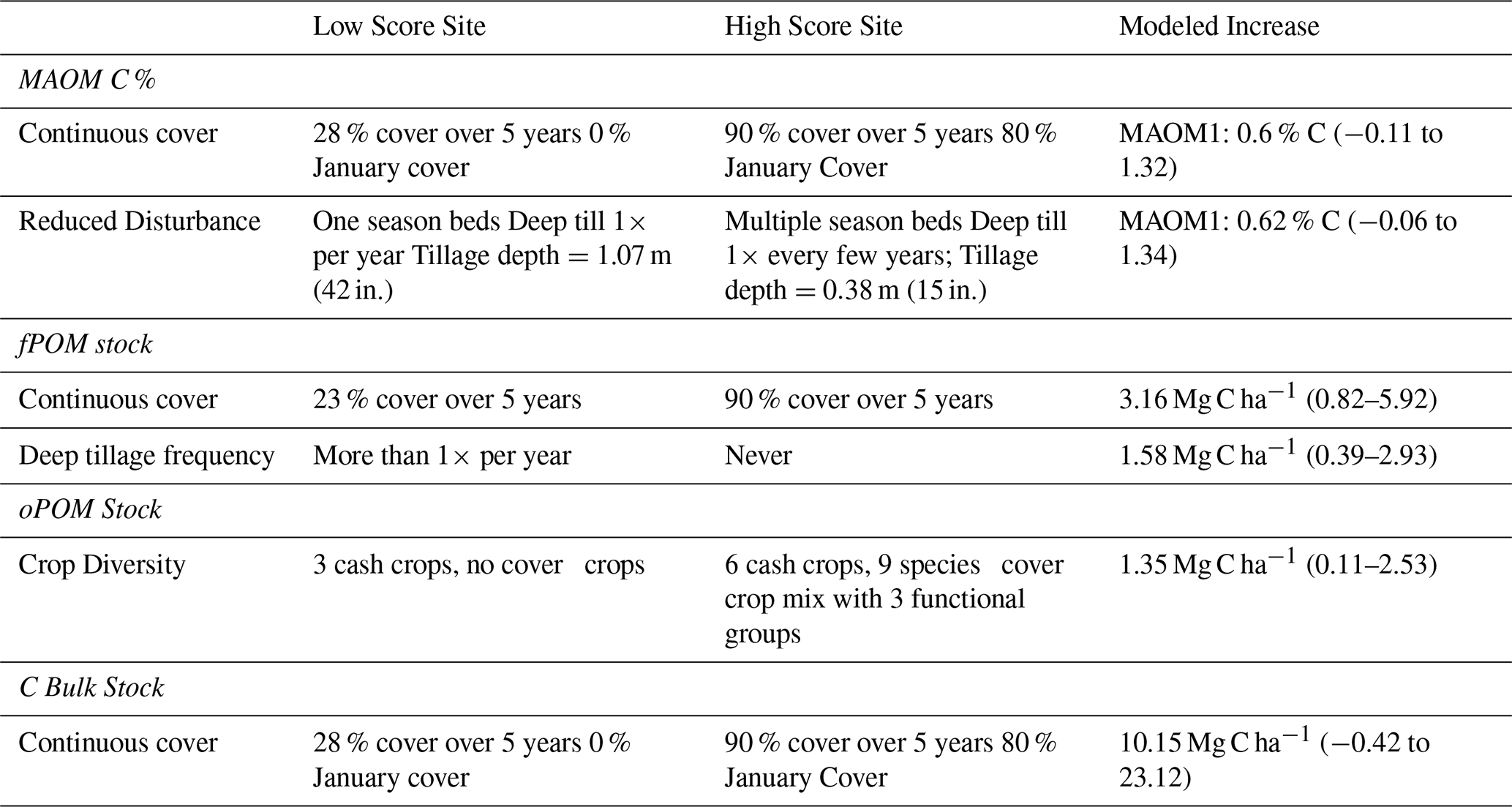
Participating farmers were identified using the USDA Organic Integrity Database and in consultation with local technical assistance providers. All selected farms grew organic lettuce, ranging from several rows to full fields dedicated to the crop. This crop was selected because of its economic importance, with lettuce and leafy greens representing the most valuable crops in the region (County of Monterey Agricultural Commissioner, 2021; San Benito County Agricultural Commissioner, 2021; Santa Cruz County Agricultural Commissioner, 2021). Given that many farmers across this region grow lettuce, using it as our focal crop allowed us to sample across a broad range of sub-regions and soil types, while explicitly selecting farms across a gradient of implemented soil health practices (Table 1). Lettuces have shallow root systems and low residue return, making carbon-building management practices vital for rebuilding soil organic matter in these systems.

Figure 1Map of soil sampling locations. 28 field sites span Santa Cruz, Monterey, and San Benito Counties. Sources: ESRI, Tigerline, Bowles Lab. | Powered by Esri.
2.1.2 Soil sampling
At all 28 field sites, five soil samples were collected across a 100 m transect, positioned in the middle of a given lettuce field and beginning at least 10 m in from field edges. Sampled lettuce fields varied in size, but the transect and edge buffer were applied consistently, regardless of field size. Each sample was a composite of five sub-samples, collected using an auger from the same depth, perpendicular to the transect across several rows of lettuce (within 5 m), and then thoroughly mixed to create one composite sample. Soils were kept cool in an iced cooler in the field and transferred to a fridge (∼ 4 °C) before analysis. Samples were collected during the 2020 growing season at three time points: transplant (unused for this analysis), mid-season to represent conditions at peak nutrient uptake and plant growth (approximately 3–6 weeks after transplant, depending on the lettuce variety, identified in consultation with farm partners rather than a standardized phenological measurement), and at harvest.
Soils were collected from 0–15 cm at all three time points, reflecting lettuce's shallow rooting depth, though cover crop rooting depths may go below this. Soil health management effects on carbon fractions (POM, MAOM) and basic soil characteristics were assessed using mid-season samples only (0–15 cm). At harvest, we additionally collected bulk (unfractionated) soil to a maximum depth of 60 cm, in three increments (0–15, 15–30, and 30–60 cm); this depth-resolved bulk carbon dataset is used in a supplementary analysis addressing carbon distribution below 15 cm (Sect. 4.1). Samples for microbial and enzyme assays were kept cold, while the other samples were air- or oven-dried for other analysis. 0–15 cm is hereafter referred to as surface soil.
Field sites were classified across four soil orders: Mollisols (20 sites), Alfisols (four sites), Entisols (three sites), and Vertisols (one site). Despite the constrained geographic area, California has a high level of soil heterogeneity as evidenced by the range of soil texture classification (Fig. S1 in the Supplement).
2.2 Lab analyses
2.2.1 Soil carbon and organic matter fractions
Bulk soil samples from harvest were collected at 0–15, 15–30, and 30–60, air dried and sieved to 2 mm, and then ball milled for elemental analysis. Total carbon (TC %) was analyzed by dry combustion on an Elementar varioEL Cube (Elementar, Ronkonkoma, NY) for each of the three depth increments (0–15, 15–30, 30–60 cm). The same samples were also analyzed by combustion with a temperature ramping procedure on an Elementar SoliTOC, which measures total inorganic carbon (TIC) in addition to TOC. TIC values were negligible (< 0.1 %), so we consider varioEL measurements as total organic carbon (TOC).
Mid-season, 0–15 cm soil samples were air-dried, sieved to 2 mm, and then fractionated by size and density into four functionally distinct pools: Dissolved organic matter (DOM), fPOM, oPOM, and MAOM. We performed a joint density and size fractionation following the protocol described by Haddix et al. (2020), which separates POM before and after aggregate dispersion into fPOM and oPOM. Thus, it may provide information on how management practices impact soil aggregates, which offer short-term protection of organic matter from microbial decay.
We first separated dissolved organic matter by shaking the air-dried, sieved samples with 40 mL of DI water for 15 min on a reciprocal shaker before centrifuging at 2520 g for 15 min. DOM was extracted as the resulting supernatant. fPOM was then fractionated by resuspending the remaining soil pellet using sodium polytungstate solution prepared at 1.85 g cm−3. The remaining oPOM and MAOM were fractionated by size (oPOM > 53 µm and MAOM < 53 µm), via wet sieving using a 53 µm sieve and milli-Q water. High-clay soils received an additional DI rinse and centrifugation, with ten additional drops of flocculants 0.25 M CaCl2 and 0.25 M MgCl2 to help clear excess sodium polytungstate solution.
Comparing initial soil mass with the sum of each fraction's mass, we ensured that fractions were recovered to ±5 % of the original sample weight. Fraction samples were then oven-dried at 60 °C and ball milled. Carbon in fPOM, oPOM, and MAOM fractions was measured by combustion analysis on a varioEL cube (Elementar, Ronkonkoma, NY).
2.2.2 Basic soil characteristics
Air-dried mid-season soil samples from 0–15 cm were sent to Soiltest Labs (Moses Lake, WA, USA) for analysis of texture, pH, and cation exchange capacity (CEC). pH was measured using a 1:1 soil-water slurry and a Skalar SP2000 Robotic Analyzer (Skalar, Breda, Netherlands). CEC was measured by ammonium replacement, and texture was measured by hydrometer, both following protocols by Miller et al. (2013).
Bulk density for surface soils (0–15 cm) was measured with 2–4 replicates per site, using a Hyprop cylindrical ring sampler with a sample volume of 250 mL (height = 12.34 cm, diameter = 5.08 cm) driven vertically into the soil to full depth and carefully excavated to preserve the intact soil core. Samples were dried at 105 °C for 3 d, and dry soil sample mass was divided by the known ring volume to calculate bulk density.
2.2.3 Extracellular enzyme potential activity
Within 48 h of soil sampling, potential extracellular enzyme activities were measured fluorometrically and photometrically using a microplate assay (Bach et al., 2013; German et al., 2011). Two grams of fresh, sieved soil were added to 100 mL of 50 mM sodium acetate buffer (pH =5.5) and blended for 30 s. For the fluorometric assays (hydrolytic enzymes), MUF (4-methylumbelliferone) and AMC (7-amino-4-methylcoumarin) labeled substrates were used. Specifically, the enzymes glucanase/1,4-β-cellobiosidase (CBH), β-glucosidase (BG), exochitinase (NAG), and phosphatase (PHO) used the substrates MUF-cellobioside, MUF-β-glucopyranoside, MUF-N-acetyl-β-D-glucosaminide, MUF-phosphate, respectively. For the enzyme leucine-amino-peptidase (LAP), the substrate L-leucine-7-amido-4methylcoumarin was used. Samples were incubated at room temperature (22 °C) in the dark and measured at 1.5 and 3 h (excitation: 365 nm, emission: 450 nm).
The oxidative enzymes peroxidase and phenoloxidase were analyzed from the same buffered soil solution. Briefly, 0.9 mL of 20 mM L-3,4-dihydroxyphenylalanine (DOPA) was added to 0.9 mL of soil suspension in triplicates for a final concentration of 10 mM DOPA, shaken on high speed for 10 min, and centrifuged for 10 min at 14 000 g. Once plated, peroxidase samples received an additional 10 µL of 0.3 % hydrogen peroxide. Absorption was measured at 450 nm at time 0 and after incubating microplates in the dark for 20 h. Mass-specific enzyme activities were calculated by normalizing activity levels to microbial biomass carbon measured using the chloroform direct extraction method (Setia et al., 2012).
2.2.4 Soil iron fractions
Soil iron fractions were isolated using pyrophosphate (iron complexed with organic matter), citrate-bicarbonate-dithionite (crystalline pedogenic iron), ammonium oxalate (poorly crystalline iron), and hydroxylamine hydrochloride (poorly crystalline microbially cycling iron) extractants. Pyrophosphate was extracted according to a method used by McKeague (1967). Oxalate and dithionite extractions followed protocols by Dominik and Kaupenjohann (2000), and hydroxylamine followed protocols by Lovley and Phillips (1987). The pyrophosphate, dithionite, and oxalate extractions were performed using 0.5 g of dry soil, while the hydroxylamine extraction used 1 g. In brief, extractants for each fraction were added to the soils, shaken, and centrifuged, and the supernatant was diluted and measured colorimetrically using a plate reader to determine total Fe concentration. Wet extractions are not perfect in isolating their target compounds, yet in combination, they can provide meaningful insight into the different forms of iron present (Rennert, 2018).
2.3 Soil Health Management
2.3.1 Management survey
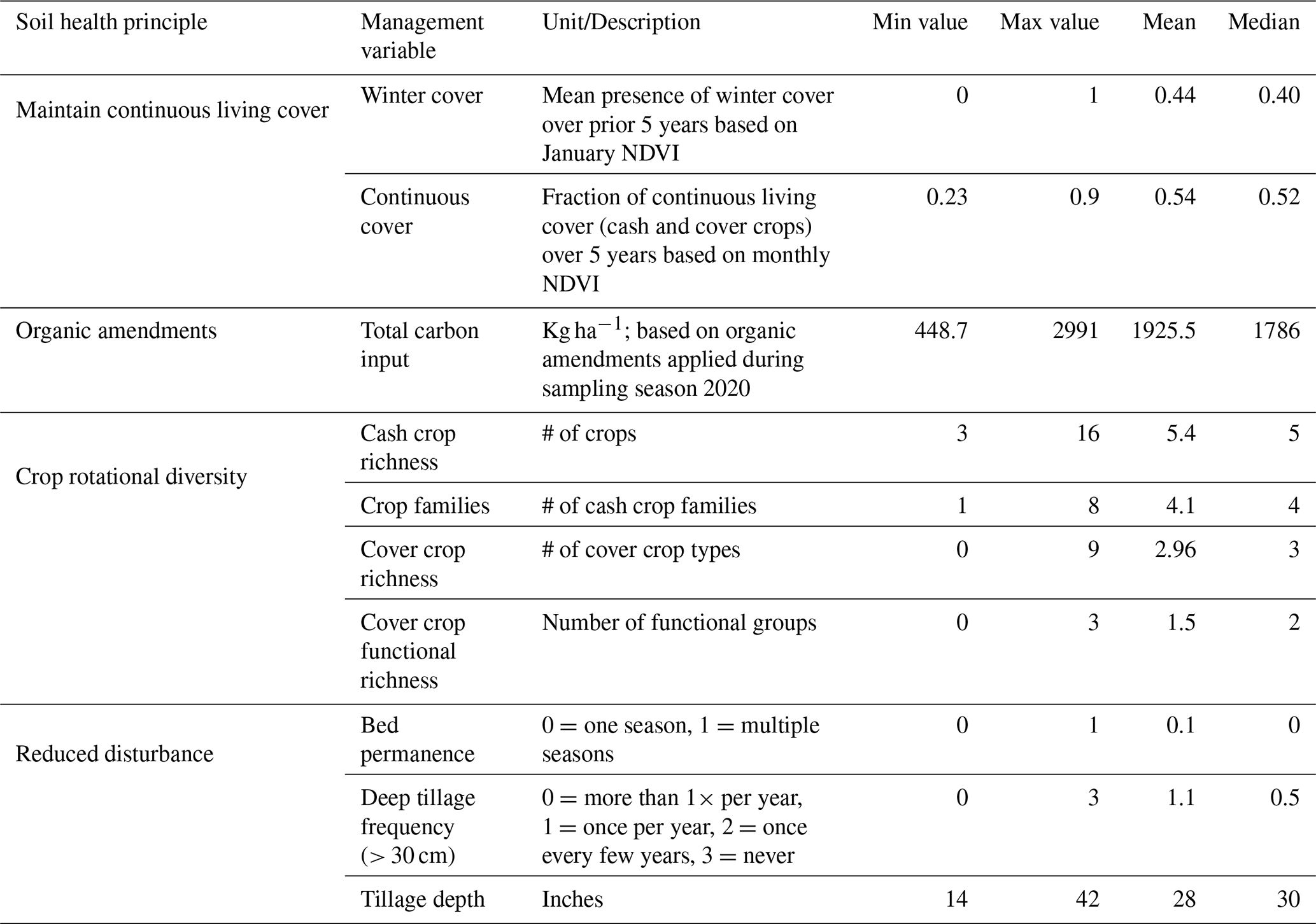
Soil health management data were collected for each of our 28 focal fields using an in-depth survey instrument created in Qualtrics. To ensure that questions and terms used by the survey were interpreted consistently by farmer participants, we conducted surveys in person or on the phone. This way, farmers could ask questions about our prompts, and the surveyor could provide additional context and definitions as needed. The farm management survey collected data on cover cropping, crop diversity and rotation practices, tillage, and organic inputs used by farmers over the prior five years. Questions about irrigation practices, barriers and incentives to soil health practices, and the impacts of COVID-19 were also conducted in the same survey but were not utilized in this study. Management practice information from the survey was then collated into numeric values (i.e., counting reported crops and cover crop varieties, conversion of fertilizer applied into C and N applied based on known values from composts and application amounts etc.) for analysis. Organic amendments included farm-produced composts, composted chicken manure, and commercial organic pellet fertilizers (often derived from chicken manure and bone meal). We also used variables such as “cover crop functional richness” based on the USDA-NRCS's six defined functional groups for cover crops – cool season grasses, cool season legumes, cool season broadleaves, warm season grasses, warm season legumes, and warm season broadleaves – which are associated with distinct seasonal niches; farmers who plant cover crop mixes spanning a broader range of these functional groups are thought to gain complementary soil health benefits relative to mixes drawn from a single group (NRCS, 2019).
Notably, our management survey is specific to our field of interest, where lettuce production was happening that season. Within our focal fields, some sites had polycultures with multiple crops at any given time and/or cover crop mixes with high diversity, which lead to wide variation in crop diversity metrics. That said, sampling always occurred where lettuce was growing. Additionally, a given field might experience up to three cash crops in a given year. Thus, over the 5-year period in question, focal fields could experience a wide range of species diversity.
2.3.2 Remote sensing continuous cover
To complement the management survey data about the historical use of cover cropping, we also used satellite imagery to assess continuous living cover at each farm field site via Google Earth Engine (Gorelick et al., 2017). While there was general alignment between farmer-reported cover data with the remotely sensed continuous cover data, for model analyses, we defaulted to using the remote sensing metrics of continuous cover for consistency. To do so, we created a polygon for each of the 28 field sites that represented our field sampling locations. We then computed the proportion of the year with vegetation cover from 2015 until 2019, based on an NDVI threshold approach using Landsat and Sentinel imagery. An NDVI threshold value of 0.3 was used to separate bare soil versus sparse vegetation (Sobrino et al., 2001). From 2015 through 2019, we classified the field as having or not having vegetative cover on a monthly basis, based on this threshold. For each year, we created a proportion of cover by taking the number of months where the mean monthly NDVI value was above or below our threshold and dividing this by 12. This continuous-cover measure intentionally captures both cash and cover crops, consistent with the “continuous living roots” soil health principle: living roots from any crop are expected to contribute the belowground inputs – rhizodeposition, biomass incorporation – associated with our hypothesized mechanism, regardless of whether a given crop was planted for cash or soil-building purposes. We also evaluated the presence of winter cover with NDVI values in January, though we could not distinguish winter cover versus cash crops using satellite imagery. Given that vegetation could be sparse in January, we increased the NDVI threshold to 0.5 for the “January Mean Cover” variable. This increased NDVI threshold ensured that we only indicated winter cover crop presence when significant biomass was present.
2.3.3 Farm management standardized scores
To create interpretable management variables, we first categorized all management questions into four practice types based on Natural Resources Conservation Service soil health principles – continuous living cover, crop diversity, reduced disturbance, and organic amendments (Table 1). We did not include soil cover (i.e. mulching) as a category because it is not used in our regional lettuce production system. We then scaled individual management variables by creating a new variable, where a value of 1 indicated the highest value of a practice within our dataset. For tillage variables, such as tillage depth and frequency, we subtracted the scaled variable from 1 so that higher values indicated reduced disturbance. We then created a composite score by averaging all practices within each management category. Finally, for each category, we calculated a z-score, with a mean of 0 and a standard deviation of 1 to compare different management practices on the same scale.
Organic amendment use was assessed for the 2020 sampling season only, unlike our continuous-cover, disturbance, and crop-diversity measures, which draw on up to five years of management history. We assume amendment practices are relatively stable year-over-year for a given farm, such that this single-season measure likely reflects typical annual input; however, because SOC accumulation reflects inputs over much longer timescales, even a representative annual rate may not capture the cumulative amendment history most relevant to detecting an SOC response.
2.4 Statistical analysis
Our primary goal was to assess the relationships between management practices, soil organic carbon (SOC) fractions, and total organic carbon stocks, while accounting for site-specific edaphic variability. To do this, we used mixed-effects models, treating “site” as a random intercept. Since our goal was to assess management practices associated with SOC fractions rather than make predictions, we focused on hypothesis testing rather than best-fit model selection, following recommendations for similar datasets (Bradford et al., 2021; Holland, 1986; Olimpi et al., 2024). In other words, our interest was in identifying robust parameter estimates rather than maximizing explained variance. Consequently, we did not rely solely on p-values < 0.05 to interpret results (Wasserstein et al., 2019; Wasserstein and Lazar, 2016). Non-significant variables were retained to control for potential confounding effects.
First, we used random forest variable importance analyses to assess whether individual management practices (i.e., tillage depth, cash crop richness, 5 year continuous cover; Table 1) might have a stronger impact when considered independently, rather than in a composite variable. For practices with high random forest importance, we tested substituting the corresponding individual practice variable for its composite z-score in an alternative model specification. We adopted an alternative specification over the full composite model only when both (a) the individual practice variable's estimated effect was directionally consistent with established mechanisms of soil carbon formation or prior literature (e.g., increased tillage frequency or depth associated with reduced POM), and (b) model fit (marginal R2) was equal to or improved relative to the composite-score specification. Where an individual practice variable met the random forest importance threshold, but its estimated effect was not directionally interpretable or did not improve model fit, we retained the composite-score model as primary. These analyses were performed using the “party” package in R (Hothorn et al., 2023).
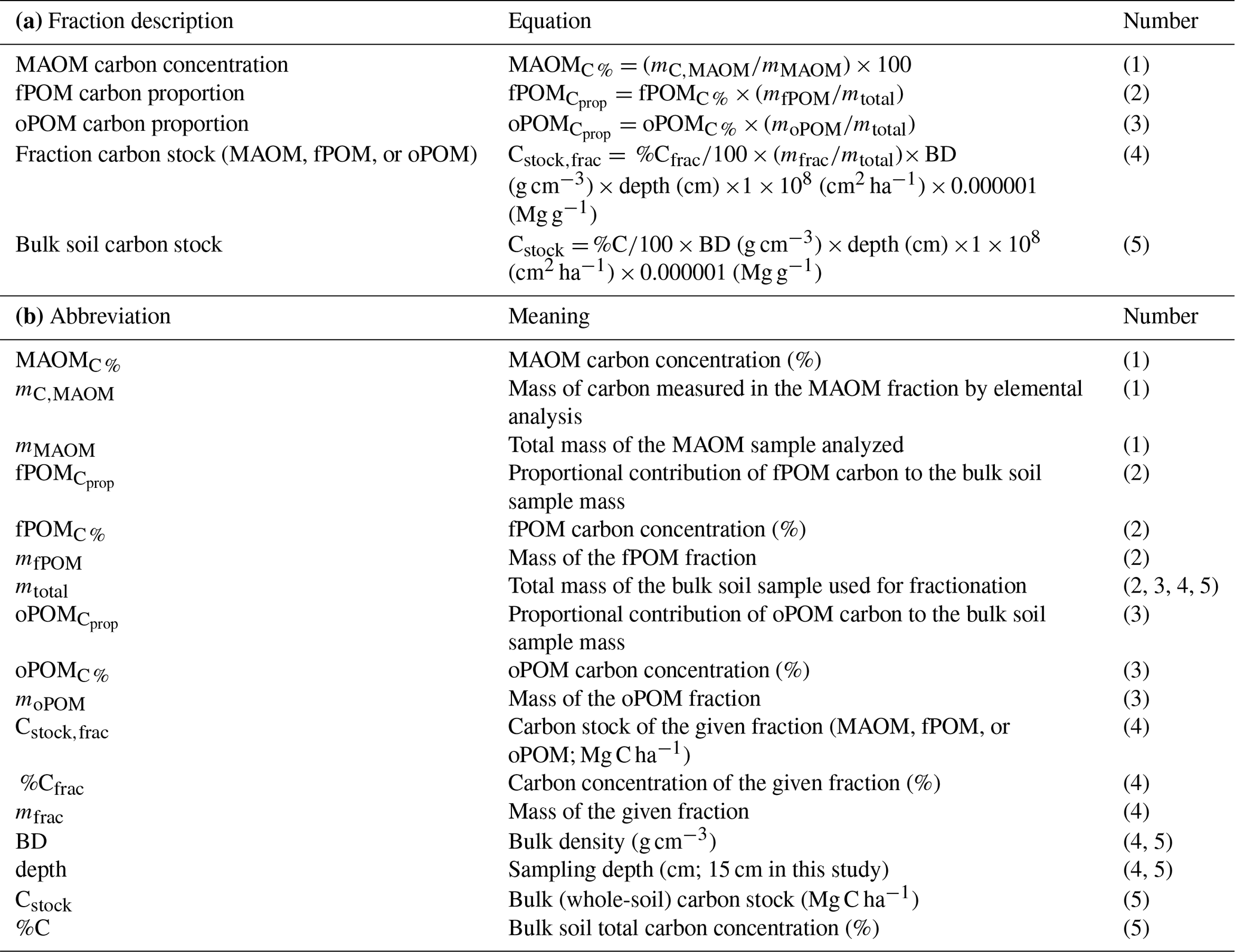
For model construction, we first needed to select carbon variables that could reasonably be altered by management. For mineral-associated organic matter, we analyzed the %C for the MAOM fraction (Table 2a, Eq. 1). This was chosen so that we could investigate how much carbon was adsorbed to mineral surfaces. While this is not equivalent to saturation, which accounts for texture and mineralogy, MAOM C % is the carbon concentration in the fine, high-density particles for a given soil (i.e., regardless of soil texture, how much carbon is present in this fraction?). This is in contrast to looking at, for example, total MAOM carbon stock, which we expect to be primarily driven by the percentage of silt and clay (though increasing MAOM C % would also increase stocks). Because we model MAOM as carbon concentration (MAOM C %) rather than total MAOM carbon stock, we use “MAOM C %” explicitly whenever referring to this measure throughout the Results and Discussion, to avoid conflating it with the smaller set of analyses that address total carbon stock directly.
For the free and occluded POM fractions, we calculated each fraction's carbon content relative to the total mass of the bulk sample used for fractionation, accounting for both the %C within a given POM fraction and the proportion, by mass, that fraction represents of the whole sample (Cprop; Table 2a, Eqs. 2–3). These Cprop values and the total POM stock are related; thus, we also ran models with stock values to compare model results. Since no meaningful differences were found (see Supplement), we focused on Cprop values for POM fractions.
MAOM C %, fPOM, and oPOM Cprop, were subsequently transformed using a logit function as follows:
Logit transformations are useful for proportion values falling between 0 and 1, making them appropriate here (Warton and Hui, 2011). Transformations also helped in improving subsequent model fit.
Fraction-level stocks for MAOM, fPOM, and oPOM were calculated assuming a depth of 15 cm (Table 2a, Eq. 4), and bulk soil carbon stocks for surface soils, were calculated following the same general approach (Table 2a, Eq. 5).
Reported mean fraction carbon concentrations (e.g., mean MAOM C %) are simple arithmetic means of %C across all samples (n=138). Fraction-level carbon stocks (MAOM, fPOM, oPOM; Eq. 4) were calculated for each individual sample and then averaged to the site level, rather than derived by applying the stock equation once to an already-averaged %C value.
As an internal check, we compared bulk soil carbon stock (Eq. 5; measured directly on harvest samples) to the sum of the three fraction-level stocks (measured on mid-season samples, Sect. 2.2.1). The two were broadly consistent: summed fraction stock averaged 25.54 Mg C ha−1 (range 13.57–73.25), compared to a bulk stock mean of 29.26 Mg C ha−1 (range 16.88–67.69) – a mean difference of ∼ 3.7 Mg C ha−1 (∼ 13 %). This modest gap likely reflects the different sampling timepoints, field-level heterogeneity, and the ± 5 % fractionation recovery tolerance described in Sect. 2.2.1, rather than a systematic discrepancy between methods.
Table 2(a) List of equations used for estimating different soil parameters. (b) List of abbreviations used in the equations.
2.4.1 Variable reduction
We used principal components analysis to reduce groups of related covariates for further analysis, including soil edaphic characteristics (sand content, clay content, cation exchange capacity, and dry bulk density), soil iron phases (pyrophosphate, oxalate, hydroxylamine, and dithionite extractions, described above), and extracellular enzyme activities (phosphatase, β-glucosidase, exochitinase, leucine-aminopeptidase, glucanase/1,4-β-cellobiosidase, peroxidase, and phenoloxidase). The first principal component axis, which captured 85.4 %, 62.1 % and 75.1 % of variation for physical, iron, and enzyme data, respectively, was used for further analysis. PCAs were performed using the “ade4” package in R (Dray et al., 2023). PCA figures and variable contributions to PC1 are reported in the Supplement.
2.4.2 Mixed models
We constructed mixed-effects models to analyze the relationship between soil carbon fractions and soil edaphic properties, soil enzymes (for MAOM), and soil health management. Site was included as a random intercept to account for site-level variability and to reflect our study design while avoiding pseudoreplication (Harrison et al., 2018; Zuur et al., 2009). Each field site contributed up to 5 composite sub-transect samples (Sect. 2.1.2) to each fraction-level model, yielding 138 observations across 28 sites (following exclusion of 2 samples identified as outliers). Site was included as a random intercept in all models specifically to account for this repeated-measures structure, such that the field, not the individual sample, is the effective unit of replication for inference. The 5 samples per site inform within-site precision but do not themselves constitute independent replicates. Intraclass correlation coefficients (ICC) – the proportion of total variance attributable to between-site differences – support this approach: ICCs ranged from 0.33 to 0.87 across models and were consistently high for MAOM and bulk carbon stock (ICC = 0.79–0.87), consistent with these pools being more strongly determined by site-level properties such as texture and mineralogy, and more moderate for the POM fractions (ICC = 0.33–0.55), consistent with their faster turnover and greater within-site variability. These values confirm that a substantial share of variation lies between rather than within sites, supporting the field as the appropriate unit of replication for inference throughout.
Models followed the general structure:
where subscript PC1 indicates the use of the first principal component axis, Z reflects the use of summarized practice z-scores, and u is the random intercept for site i.
We ran an additional MAOM model including soil extracellular enzymes PC1 (MAOM2), hypothesizing their role in processing POM into MAOM. While enzymes were positively associated with POM fractions (supplement), in this case, we believe that the increase in extracellular enzymes was a response to increased POM. However, it does not add explanatory power as a modeled variable (Fig. S2; Cenini et al., 2016).
The same model structure was used for fPOM and oPOM. An alternative fPOM model was also implemented that replaced two of the composite management z-scores with individual management practices identified via random forest analysis: continuous cover (5 years) and deep tillage frequency. Only one oPOM model was presented, as top variables from RF did not significantly alter model results.
Models were built using “lme4” in R (Bates et al., 2023), assuming Gaussian errors. Interactions were not modeled due to dataset limitations. Model fit was assessed via QQ plots qqnorm and multicollinearity was always found to be minimal (VIF < 3; James et al., 2023; see Supplement). Logit and box-cox transformations were used for fraction and bulk carbon values respectively. Missing values (e.g., negative lab results) were imputed using multiple imputation via classification and regression trees (CART) as implemented in the “mice” package (van Buuren and Groothuis-Oudshoorn, 2011), generating five imputed datasets over 20 iterations each, affecting 15 microbial biomass values and 40 enzyme activity data points.
To compare effect sizes across variables on different scales, we report standardized coefficients (Gelman, 2008). We evaluate contributions of management versus edaphic variables through variance partitioning, estimating marginal R2 values and confidence intervals via parametric bootstrapping (1000 iterations) using the “partR2” package in R (Stoffel et al., 2024). Sensitivity analysis involved iteratively removing variables to confirm result stability, with findings reported in the Supplement.
2.5 Estimated management outcomes
To facilitate interpretation of model coefficients on how management practices affect soil carbon fractions, we selected sites with contrasting use of management practices and calculated modeled changes in SOC fractions and stock. We chose these contrasting sites based on the practices that emerged as clear associated variables for a given model – in all cases, these are sites that are not necessarily the highest or lowest scorers, but rather sites that have relatively high and low scores. This was done rather than selecting fixed z-scores for each practice because z-scores are a composite function of multiple practices (meaning there could be multiple practice combinations that yield the same z-score). By choosing scores from distinct farm sites, the comparisons reflect real practices rather than an arbitrary score.
We first extracted the relevant parameter coefficients from our models and applied necessary back-transformations, and then used values from the relevant management variable to estimate modeled outcomes for contrasting management implementation. Lastly, we took the difference between the high and low implementation sites (Table 3). We calculate these changes for a single model and a single practice at a time. Thus, only one practice varies, and use of all other practices are assumed to be the same, cancelling out when the difference is taken.
Depth-resolved bulk carbon
To assess whether reduced tillage's association with surface carbon fractions reflects a net change in soil carbon or a redistribution within the profile, we modeled bulk (unfractionated) carbon stock separately at each measured depth increment (0–15, 15–30, 30–60 cm) and for the summed 0–60 cm profile, using the same mixed-effects model structure described above (Eq. 6), with log-transformed stock as the response and site as a random intercept. Modeled differences between representative high- and low-disturbance sites were estimated using the same simulation-based back-transformation approach described for other carbon pools (Sect. 2.4).
3.1 Site characteristics and bulk and fraction C %
The 28 field sites encompassed a diverse range of soil edaphic characteristics and soil health practices, with practice Z-scores generally ranging between −2 and 2 (Fig. S2). Soil texture ranged from clay to loamy sand, with mean sand, silt, and clay content of 42 %, 33 %, and 26 %, respectively (Table S2 in the Supplement). CEC values ranged fairly widely between 7.4 and 52.1 Meq per 100 g, with a mean of 20.3 (Table S2). The bulk density of surface soil (0–15 cm) ranged from 0.88 to 1.6 g cm−3, with a mean of 1.33 g cm−3 (Table S2). Surface soils (0–15 cm) had mean bulk soil organic carbon concentration of 1.50 %, ranging from 0.74 % to 3.95 % (Table S2). pH values were more constrained, with a range of 6.4 to 8.4 and a mean of 7.5 (Table S2); these values are generally representative of local soil conditions that tend to be slightly alkaline. Because sites shared a similar regional climate, climate is unlikely to confound the relationships we observe between soil properties, management practices, and SOM fractions; the wide variation across sites in soil physical properties and practice use can therefore be attributed to genuine differences in those variables, rather than to underlying climate differences.
3.2 Soil health management and edaphic impacts on MAOM C %
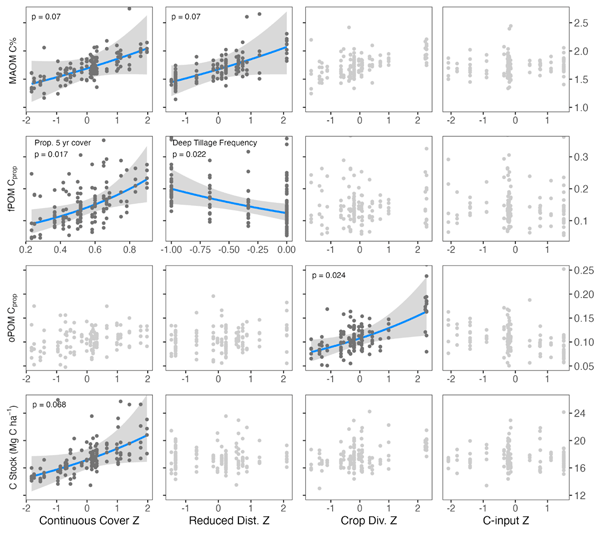
Mean MAOM C % was 1.73 %, with MAOM-C accounting for 77.2 % of the total estimated surface soil carbon stock (Fig. S3). This translates to ∼19.72 Mg C ha−1. Reduced tillage and continuous cover emerged as the two variables most consistently associated with higher MAOM C % across both MAOM mixed models. In MAOM model 1 (without extracellular enzymes), reduced disturbance (βstd=0.21; p=0.09) and continuous cover (βstd=0.20; p=0.105) were both positively associated with MAOM C %, falling at or just outside our p<0.1 threshold for interpreting effects in this observational dataset. The concentration of iron phases (IronPC1) and soil physical characteristics also were clearly associated with MAOM C %, with increasing amounts of poorly-crystalline (oxalate and hydroxylamine HCl-extracted) and organic complexed (pyrophosphate-extracted) iron (βstd=0.13; p=0.023), and increasing sand content (βstd=0.19; p=0.073), corresponding to higher MAOM C %. pH was negatively associated with MAOM C % (; p=0.064).
When extracellular enzyme activity was included in the model, continuous living cover and reduced disturbance remained the most the management practices most consistently associated with MAOM C % (βstd-cover=0.2, pcover=0.073; βstd-dist=0.21, pdist=0.068, respectively). In this model, the concentration of iron phases (IronPC1 primarily associated with poorly crystalline and organo-mineral fractions; see Supplement) remained a positively associated variable (βstd=0.1; p=0.068), while the effect of pH and physical characteristics became less clear (ppH=0.21; pphys=0.18). Meanwhile, the association with enzyme activity was clear (βstd=0.1; p=0.042), with higher enzyme activities corresponding to increased MAOM C %.
Reduced disturbance and continuous cover both showed weak, positive associations with MAOM C %. In the model excluding enzyme activity (MAOM1), reduced disturbance was associated with a ∼ 0.62 percentage-point increase in MAOM C % (95 % CI: −0.06 to 1.34; p=0.09), while continuous cover's association (+0.60 percentage points; 95 % CI: −0.11 to 1.32) fell just outside the p<0.1 threshold (p=0.106). Including enzyme activity as an additional covariate (MAOM2) modestly strengthened both associations (continuous cover: p=0.07; reduced disturbance: p=0.07; magnitudes nearly identical at ∼ 0.56 and ∼ 0.63 percentage points, respectively). We report both specifications rather than selecting the one that yields significance. The disturbance association is stable across both models, while the continuous-cover association is sensitive to whether enzyme activity is included.
MAOM1 and MAOM2 (enzyme) models' management variables explained approximately double the variance observed, relative to edaphic variables and enzyme activity (Fig. 3; Table S3). Edaphic variables explained less than 10 % of the variance observed in our data (6.0 % and 8.1 %, respectively), whereas management variables explained around 20 % (19 % and 20 %, respectively). Both MAOM models explained approximately the same amount of variance (total and 0.32 for models 1 and 2, respectively).
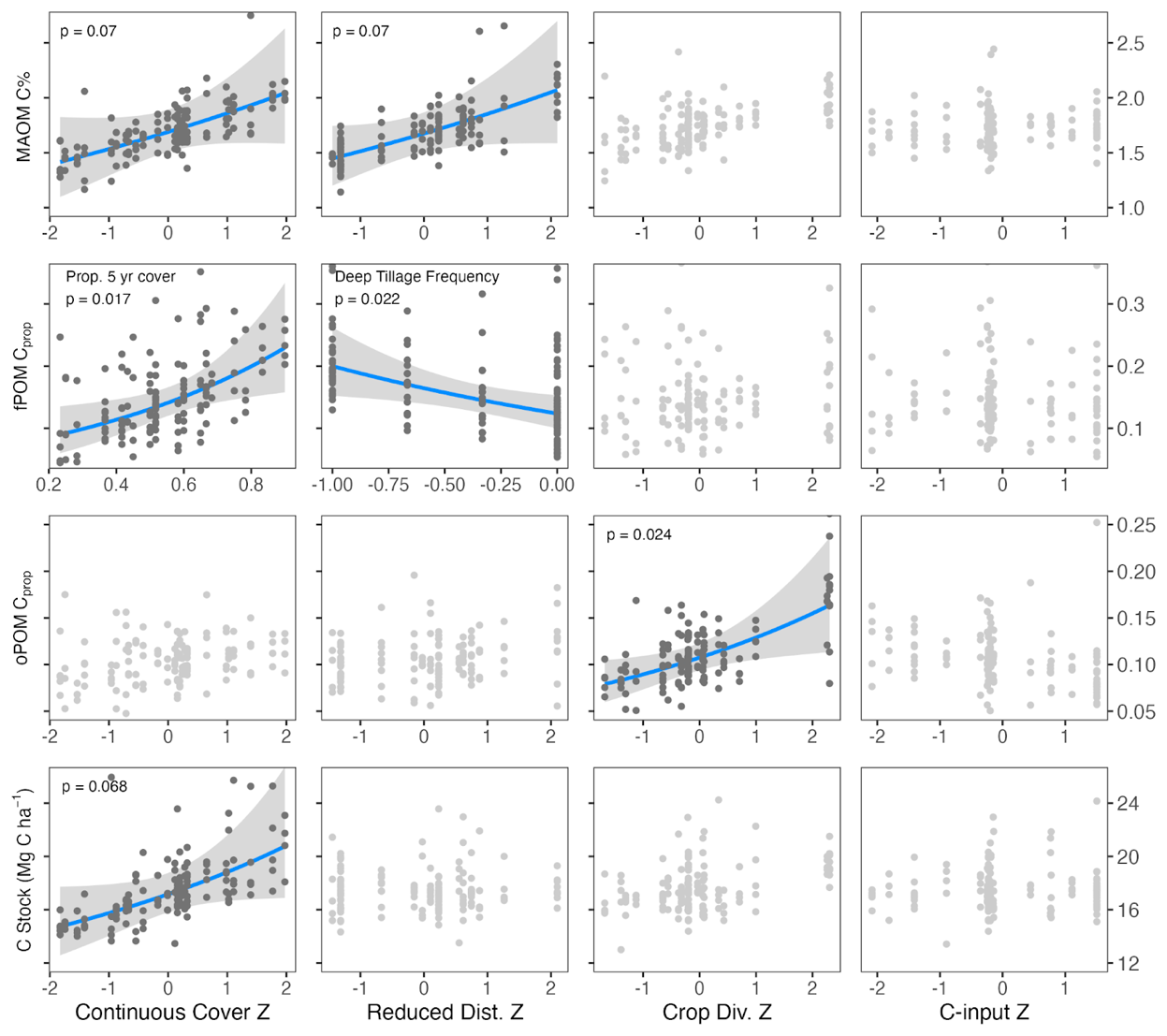
Figure 2Modeled regressions for carbon fraction and stock models. Models hold all other variables constant at mean values. Significant relationships are darker with p-values listed. Unless otherwise indicated, x-axis uses z-scores for each management category. MAOM results visualize MAOM 2 model.
Table 3Modeled management outcomes on various carbon fractions and stocks. Calculations are based on mixed-effects model coefficients, comparing high- and low-adoption sites. The sites selected are not the highest or lowest sites, but rather sites that are relatively high and low for each management category. Parentheticals report 95 % CI.
3.3 Soil health management and edaphic impacts on fPOM Cprop
Mean fPOM C % was 20.53 %, with fPOM carbon accounting for 8.93 % of the total estimated surface soil carbon stock. This translates to ∼ 3.54 Mg C ha−1.
In the fPOM 1 model, using the model structure with all four management category scores, crop diversity and IronPC1 were statistically clear associated variables of fPOM Cprop (βstd-crop div=0.34, pcrop div=0.083; βstd-iron=0.33; piron=0.045).
As a result of Random Forest (RF) variable importance analysis (see Supplement), we ran a second model (fPOM 2) replacing continuous cover and reduced disturbance z-scores with two individual management practices, the proportion of plant cover over the previous five years (hereafter Coverprop-5yr), and the frequency of deep tillage, respectively. In this model, these two variables both clearly associated with fPOM Cprop, with an increased proportion of cover and decreased deep tillage corresponding to increased fPOM Cprop(βstd-cover5yr= 0.46, pcover5yr=0.017; , pdeep till=0.022). Iron's relation was less clear in this model (p=0.13). Crop diversity drops out as a significant variable in this model (βstd-crop div=0.05, pcrop div=0.79).
Contrasting these individual management practices across high and low implementation sites, the model predicted that a shift from 23 % to 90 % cover increased fPOM carbon stocks by 3.16 Mg C ha−1 (CI: 0.82–5.92). Going from using deep tillage more than once per year to never deep tilling increased surface soil fPOM carbon stocks by ∼ 1.58 Mg C ha−1 (CI: 0.39–2.93).
The marginal R2 value for the full fPOM model 1 (0.18) was lower than that of fPOM model 2 (0.31). For the fPOM 1 model, management explained 12 % of the variance, while edaphic variables explained 3.9 %. When we substituted “Continuous Cover” and “Reduced Disturbance” management z-scores with individual practice variables, the management increased to 0.25, and edaphic variables decreased slightly to 0.03 (Fig. 3; Table S5).
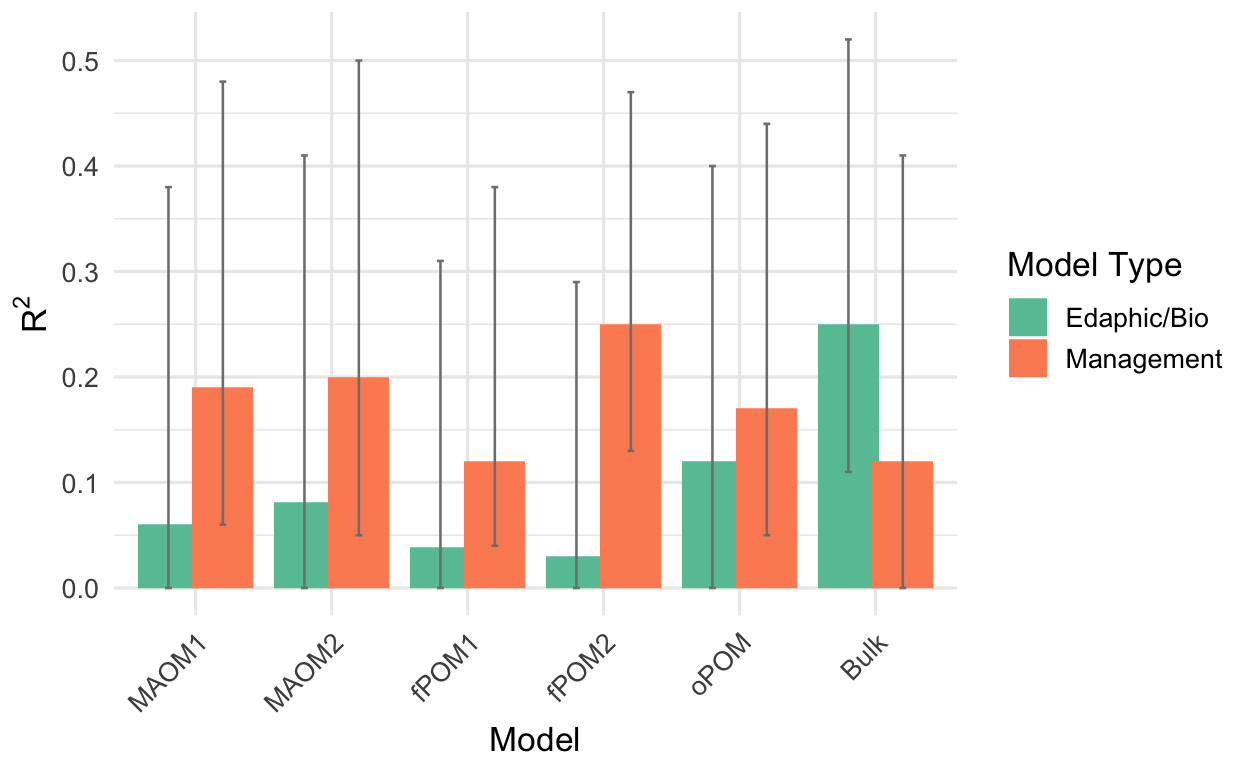
Figure 3Marginal R2 values for edaphic/biological variable groupings and management variables. 95 % confidence intervals derived from parametric bootstrapping (1000 iterations; “partR2” package in R). For all models, the edaphic/biological grouping includes soil physical PC1 (texture, CEC), soil iron PC1, and pH; for the MAOM2 model, this grouping additionally includes soil enzyme activity PC1. Management variables include continuous cover, reduced disturbance, C input, crop diversity Z scores.
3.4 Soil health management and edaphic impacts on oPOM Cprop
Mean oPOM C % was 0.87 %, with oPOM carbon accounting for 2.28 % of the total estimated surface soil carbon stock. This translated to ∼ 2.28 Mg C ha−1.
For oPOM Cprop, crop diversity and IronPC1 were the two statistically clearly associated variables (βstd-crop div = 0.36, pcrop div= 0.024; βstd-iron0.40, piron=0.001). Like fPOM, we used two individual practice variables that emerged from RF analysis (Coverprop-5yr and tillage depth), but this did not notably change model results (see Supplement).
Contrasting a low crop diversity field with 3 cash crops, to a high diversity site with 6 cash crops and 9 species of cover crops, the oPOM carbon stock had a modeled increase of 1.35 Mg C ha−1 (CI: 0.11–2.53).
Marginal R2 values showed the similar trend of management variables, explaining more variance than edaphic variables (, ), though the difference was not as pronounced as it was for MAOM or fPOM. The model as a whole, similar to other fractions, explained ∼ 29 % of the observed variance in our data.
3.5 C stock and management
Continuous cover and PC1Phys were both associated with bulk carbon stocks in the surface soil with a stronger association for PC1Phys (βstd-cover=0.015, pcover=0.068; , pphys=0.0074).
Contrasting sites with high and low implementation of continuous cover, increasing the cover proportion from 23 % to 90 % and winter cover from 0 % to 80 % increases carbon stock in the top 15 cm by ∼ 10.15 Mg C ha−1 (CI: −0.42 to 23.12), The marginal R2 value for carbon stocks is 0.25 for edaphic and 0.12 for management variables, and the total model R2 is 0.34 for the bulk carbon models.
3.6 Carbon distribution with depth
To evaluate whether reduced tillage's association with fPOM reflects redistribution rather than net carbon change, we compared bulk carbon stock across depth increments between representative high- and low-disturbance sites (Table 3). We found no evidence of a surface carbon deficit at the more-disturbed site: modeled differences at 0–15 and 15–30 cm did not clear a 95 % threshold (0–15 cm: −2.84 Mg C ha−1, 95 % CI: −11.02 to 5.55; 15–30 cm: +3.10 Mg C ha−1, 95 % CI: −4.32 to 10.65). At 30–60 cm, the less-disturbed site had significantly higher carbon (+19.09 Mg C ha−1, 95 % CI: 2.98–36.43). Summed across the full 0–60 cm profile, the less-disturbed site trended higher, but the difference did not clear a 95 % threshold (+22.57 Mg C ha−1, 95 % CI: −4.04 to 51.31).
Because this comparison used a single representative site pair, we additionally examined this pattern across the full disturbance gradient by dividing all 28 sites into terciles of Disturbance_Z (Tables S7–S8). Mean carbon stock at 30–60 cm was lower in the most-disturbed tercile (32.6 Mg C ha−1) than in the two less-disturbed terciles (49.2 and 41.2 Mg C ha−1), while stock at 0–15 and 15–30 cm did not differ systematically across terciles. The most disturbed tercile had comparatively favorable edaphic conditions for carbon stabilization (higher soil iron; Table S8).
4.1 Relative impacts of soil health management on POM, MAOM, and carbon stocks
Our findings indicated that soil health practices, ranging from continuous living cover to reduced disturbance were positively associated with multiple carbon fractions, with the strength of these associations varying by pool. These results point to land management strategies as a potential lever for carbon accumulation in POM, with more uncertain evidence for and MAOM and total carbon stocks, in agricultural soils.
Continuous living cover was associated with multiple carbon pools across most models, though the strength of this association differed by pool. Fields with higher levels of continuous living cover over the previous 5 years had higher fPOM (β=0.46, p=0.017; ∼ 3.16 Mg C ha−1, 95 % CI: 0.82–5.92), a weak association with MAOM C % (p=0.106 in the model without enzyme activity; p=0.07 with enzyme activity included; ∼ 0.56–0.60 percentage points, 95 % CI: −0.15 to 1.32), and a borderline association with bulk carbon stock (p=0.068; ∼ 10.15 Mg C ha−1, 95 % CI: −0.42 to 23.12). This may be mediated through increased aggregate stability, steady belowground carbon inputs via rhizodeposition, and above and belowground plant biomass that is incorporated into soils (Gentsch et al., 2024; White et al., 2020). These carbon inputs may support microbial activity and processing that is key for MAOM accumulation, and may also increase dissolved organic matter in soils, which can also sorb to minerals to form MAOM (Kallenbach et al., 2016; Liang et al., 2017; Sokol et al., 2019). Recent global meta-analyses similarly found that cover crops increased POM by nearly 14.5 %–15 % and MAOM carbon by 5.6 %–7 % relative to bare soil controls (Wooliver and Jagadamma, 2023; Hu et al., 2023). This increase in MAOM was accentuated in long-term experiments (> 10 years), suggesting that continuous cover over extended periods may be more consequential for MAOM accrual than the ≤ 5-year window captured in our data.
Reduced tillage showed a similar pattern: a clearer association with fPOM (0.40, p=0.022; 1.58 Mg C ha−1, 95 % CI: 0.39–2.93) alongside a weak association with MAOM C % (p=0.09 without enzyme activity, p=0.07 with it; 0.62–0.63 percentage points, 95 % CI: −0.08 to 1.38). Reducing tillage can help preserve soil structure and limit microbial degradation of physically protected POM and MAOM (Conceição et al., 2013; Grandy and Robertson, 2007). While the increase in fPOM might be expected with decreased tillage intensity, it was less expected to see MAOM associated with reduced tillage. Samson et al. (2020) similarly observed increased Fine Organic Matter (FOM) – analogous to MAOM – in reduced tillage systems. While Wooliver and Jagadamma (2023) found no direct tillage effect on MAOM in their meta-analysis, they suggest that overall, SOC declines under tillage result from increased microbial decomposition of the MAOM pool. Decreased fPOM under tillage may result from accelerated decomposition due to disturbance, but it is also possible that deep tillage moves fPOM from surface soils down the soil profile, thus reducing the fPOM observed in surface soils (Angers and Eriksen-Hamel, 2008; Martins et al., 2015). Fractionations of deeper soil samples would be needed to confirm this hypothesis.
As a partial check on this question, we compared bulk (unfractionated) carbon at depth across the disturbance gradient (Sect. 3.6). We found no evidence of a surface deficit at more-disturbed sites, arguing against a simple redistribution mechanism in which tillage moves a fixed carbon pool downward. If anything, less-disturbed sites showed higher carbon at 30–60 cm, a pattern not attributable to more favorable edaphic conditions at those sites. This analysis used bulk carbon rather than fraction-specific measurements and should be interpreted as suggestive; it is more consistent with reduced tillage supporting whole-profile carbon accumulation than with redistribution of a fixed pool, though fraction-level sampling at depth would be needed to confirm this directly.
Crop diversification was associated with oPOM (β=0.36, p=0.024; 1.35 Mg C ha−1, 95 % CI: 0.11–2.53). This is broadly consistent with a recent meta-analysis which found that, while POM generally increases with cropping system intensification (eliminating fallows, increasing number of crops grown per year, planting cover crops, inclusion of perennials), this trend is less clear for systems that incorporate multiple crops (Prairie et al., 2023). That said, they still found that bi- and polyculture systems as well as perennial intercropping show increases for POM (Prairie et al., 2023; Drinkwater et al., 2021). Importantly, diversified cropping systems contribute to the formation of stable macroaggregates, which are particularly important for oPOM (Gentsch et al., 2024; Li et al., 2024).
We found no apparent association between organic amendments and any measured carbon fractions or stocks. Coefficient values were negative for all pools except MAOM C %, though none reached even our p<0.10 threshold (all p>0.16; Table S3). This was unexpected given that controlled studies show increases in SOC following application of compost, manures, and other organic amendments (Aguilera et al., 2013; Bian et al., 2024; Bolinder et al., 2020; Samson et al., 2020; White et al., 2020). Consistent with the single-season scope of our amendment measure, even a representative annual input rate may understate the cumulative amendment history relevant to detecting an SOC response, particularly if meaningful accumulation requires sustained application over years to decades. A bivariate check found a negative correlation between carbon inputs and our POM fractions, consistent with a possible priming effect, wherein adding nutrient-rich amendments may increase microbial activity and accelerate POM decomposition. Organic amendments did correlate with yield in a related analysis (Esquivel et al., 2026), which is at least consistent with these inputs having some agronomic effect, though nitrogen variables did not emerge as associated with carbon outcomes when included in our mixed models (see Supplement). These null results may also not generalize to perennial or tree-crop systems, non-vegetable systems with different rooting depths and residue inputs, or non-organic systems with synthetic fertilizer and pesticide use.
Future work should account for interaction effects between practices, as has been done in other systems (e.g., Liu et al., 2025, in grassland restoration). While we included all practices simultaneously, simultaneous increases in tillage reduction and continuous cover, for instance, could plausibly have a compounding association with carbon fractions that our additive models cannot detect. More fundamentally, direct causal relationships and mechanisms between management and carbon outcomes are challenging to parse from this type of on-farm work; the associations reported here should be read as consistent with, rather than proof of, the mechanisms discussed above. Repeated sampling over longer timescales, paired with interactions between practices and local edaphic context, would help clarify whether soil health management can serve as a reliable climate mitigation strategy.
4.2 Management versus edaphic impact on soil carbon
While soil health management was associated with each of the focal carbon pools to varying degrees, edaphic characteristics – particularly soil iron – also emerged as an informative variable in most models.
Poorly crystalline iron (oxalate and hydroxylamine HCl extracted) and organo-mineral (pyrophosphate extracted) complexes are well known to provide sorption sites to stabilize MAOM, consistent with our MAOM C % models. Pyrophosphate-extracted iron fraction showed the strongest relationship with MAOM carbon concentration of the iron fractions measured (Fig. S4), consistent with organo-mineral stabilization processes in these Central Coast soils. These metal phases, though imperfectly isolated by wet extraction, provide valuable insights into soil carbon stabilization and turnover (Masiello et al., 2004; Rennert, 2018). Mineral-organic associations are thought to protect low-molecular-weight carbon inputs and contribute to long-term carbon storage (Rasmussen et al., 2018; Wagai et al., 2020; Wu et al., 2023). While total elemental iron is commonly measured as a micronutrient in routine soil health tests (Table S1), the iron mineralogy relevant to carbon stabilization is not: sequential selective extraction (Sect. 2.2.4) is far more labor-intensive than a standard elemental Fe test, and has limited direct bearing on crop nutrition, the primary purpose those routine panels serve. Soil iron fractions were also positively associated with fPOM and oPOM accumulation. Many of the soils in our study contain high-activity smectitic soils and amorphous minerals such as short-range order iron minerals, which can promote greater aggregate stability and physically protect both POM and MAOM (Six et al., 2004; Wu et al., 2023). Yu et al. (2022) similarly found oxalate-extractable Fe predictive of POM's contribution to total SOC across ecosystem types. In our dataset, iron mineralogy was positively associated with most fractions, most clearly for oPOM (p=0.001), consistent with soil iron being relevant for oPOM formation specifically (Ren et al., 2024; Silva et al., 2015; Wang et al., 2019).
One plausible mechanism linking management-driven root inputs to iron-associated carbon accumulation is root-driven mineral transformation: root activity and organic inputs have been shown to increase the availability of short-range-order Fe and Al phases, which can then act as nucleation sites for carbon retention and aggregate stabilization (Yu et al., 2017). This offers a candidate pathway by which continuous cover and crop diversity – both associated with greater root inputs – could interact with iron mineralogy to promote oPOM formation specifically, though we did not test this interaction directly.
Despite iron's consistent presence across models, management variables explained more of the variance than edaphic variables for MAOM, fPOM and oPOM models. This was somewhat unexpected for MAOM given the established role of soil pH and texture in sorption dynamics and SOC persistence (Rasmussen et al., 2018; Ye et al., 2022). While edaphic and climatic conditions are understood to govern POM decomposition broadly, our variance-partitioning results suggest that management-controlled POM may carry more explanatory weight than inherent soil characteristics in this dataset. A recent meta-analysis spanning pH 4 to 8 similarly found that cover cropping effects on POM and MAOM were not strongly moderated by soil texture and pH (Wooliver and Jagadamma, 2023). Altogether this suggests that on farm management practices may be associated with higher POM, and more tentatively higher MAOM, across a range of edaphic conditions (clay percentage ranges from 5 %–60 % and sand from 5 %–77 %; Table S2), though the individual-fraction associations for MAOM should be read with the caveats above.
Carbon stock was the only model where edaphic variables explained more variance than management, which is unsurprising given that as higher clay and silt content increases available surface area for carbon sorption (Georgiou et al., 2022; Wu et al., 2023). This is broadly consistent with other work finding that SOM is more closely tied to soil texture than management in agricultural soils (Williams et al., 2020). Iron concentration was not associated with bulk soil carbon stock (p>0.1), suggesting texture, more than mineralogy, may be the more relevant edaphic factor at the stock level specifically, even where iron matters for individual carbon fractions.
Relatedly, because bulk density can itself be affected by management, we examined whether measured surface bulk density varied systematically across the continuous-cover and disturbance gradients underlying our stock comparisons; we found no consistent directional trend across terciles of either gradient (Table S10), suggesting our fixed-depth stock comparisons are not substantially confounded by management-driven differences in bulk density. We therefore did not apply an equivalent soil mass correction.
It is worth noting that most agricultural soils remain highly undersaturated with respect to mineral-associated carbon – meaning substantial sorption capacity likely remains unused relative to uncultivated soils (Georgiou et al., 2022; Rasmussen et al., 2018). Thus, management-driven carbon inputs may still have room to accumulate even where our stock-level association was weak.
Finally, a model including enzyme activity as an additional covariate (MAOM2) showed a positive association between enzyme activity and MAOM C % (βstd=0.1, p=0.04), consistent with the breakdown of plant polymers and subsequent microbial contributions to MAOM formation (Whalen et al., 2022). Enzyme activity was also positively correlated with fPOM in our dataset (Fig. S2), but we treat the two associations differently, since the likely direction of causality differs. For fPOM, we interpret this correlation as more likely reflecting enzymes responding to greater substrate availability, rather than building POM directly – consistent with enzyme activity generally correlating more strongly with POM than MAOM in prior work (Cenini et al., 2016; Grandy et al., 2007). We therefore omit enzyme activity as a predictor in POM models. For MAOM, by contrast, enzymatic breakdown of POM into simpler compounds is a plausible pathway to MAOM formation (Sokol et al., 2019; Liang et al., 2023), including via fungal necromass and hyphal contributions (Klink et al., 2022; Wang et al., 2017) even though root exudates and enzymes can also destabilize MAOM in certain contexts (Jilling et al., 2021; Li et al., 2021). We therefore retain enzyme activity in the MAOM2 model, treating its positive association with MAOM C % as consistent with, rather than proof of, a net contribution to MAOM formation.
4.3 Implications for management and policy
Our findings suggest that increasing continuous living cover and reducing deep tillage on agricultural lands are associated with higher fPOM, and, more tentatively, with MAOM C % and total carbon stocks. According to data from the U.S. Census of Agriculture, the percent of available cropland planted with cover crops nationally is 5.6 %, and in California, 4.8 % (LaRose and Myers, 2019). In our focal region of the Central Coast of California, a recent remote sensing analysis revealed that only ∼ 6 % of farmland had winter cover crops, and ∼ 60 % of farmers left their fields fallow through the winter (Thompson et al., 2023). Similarly, based on our survey (Table 1) and local knowledge of production systems in California, the use of reduced tillage practices is quite rare (Mitchell et al., 2007). The low use of continuous cover and reduced tillage across California and the US indicates a significant opportunity for building cropland carbon levels. Policy and conservation incentive programs should focus on supporting farmers in adopting cover cropping practices, and other means of increasing living cover, while recognizing that the barriers that different groups of farmers face vary widely and that many barriers exist at structural levels beyond the farm requiring policies tailored to different farming contexts (Carlisle et al., 2022; Esquivel et al., 2021).
In California, the Healthy Soils Program (HSP), whose goal is explicitly tied to increasing SOC in agricultural lands, has allocated over of its grant funding towards carbon amendments and compost application, amounting to nearly USD 56 million in 2021 alone (Babin et al., 2025; CDFA, 2022b). Our finding of no association between organic amendments and any measured carbon pool suggests that the context and timescales on which compost and amendment application may be critical in detecting measurable SOC changes and highlights the need for further research into the conditions under which amendments are a reliable carbon sequestration strategy on agricultural lands.
4.4 Conclusion and future directions
Across 28 working organic farms, soil health management showed the clearest and most consistent associations with particulate carbon: continuous cover and reduced tillage were reliably linked to higher fPOM and crop diversity with higher oPOM. Management was also positively associated with MAOM C % and total carbon stock, though these associations were less statistically clear (p=0.07–0.11 for MAOM; p=0.068 for stock). This distinction matters practically – POM and MAOM serve different functions, with POM supporting near-term soil fertility and MAOM anchoring longer-term carbon storage – and suggests that, while the evidence is strongest for the faster-cycling pool, management may meaningfully influence longer-term carbon storage as well, even if this study cannot confirm that association with the same statistical confidence.
This on-farm study design, sampling across a continuous gradient of practice adoption rather than simple presence/absence, offers insights into real-world farming practices that is difficult to obtain from controlled field experiments alone: management explained more variance in carbon fractions than edaphic properties did, across a wide range of soil textures. That management effects held up despite this edaphic variability is itself informative for how these practices might generalize beyond our specific sites.
Continuous cover and reduced tillage remain rare in the region, making expanded adoption a tractable, near-term lever for building particulate soil carbon. Whether MAOM and total stock associations reported here strengthen over longer timescales or in regions with different edaphic baselines remains a key question for whether soil health management can meaningfully contribute to long-term carbon sequestration, not just near-term soil function.
The soil, management survey, and carbon fraction data underlying this study, along with the R code are not yet publicly available. Portions of this dataset are shared with companion manuscripts currently in preparation by co-authors, and we intend to archive the data and code together in a public repository (Zenodo) with a permanent DOI upon publication of those companion works. In the interim, the data and code are available to reviewers and editors upon request to the corresponding author.
The supplement related to this article is available online at https://doi.org/10.5194/soil-12-1035-2026-supplement.
KEE, TMB, JT, HW, DSK, PB, and AI contributed to shaping the overall research project. KEE led the study, conducted the formal analysis, produced the figures, and wrote the original draft, with writing assistance from TMB. JT and HW contributed substantially to field and laboratory data collection and made significant contributions to manuscript revisions; HW additionally contributed code for data imputation and cleaning, and JT led the organization of survey responses into management gradient metrics. GS and YGS primarily contributed to laboratory work and reviewed the manuscript. DSK and PB contributed to overall study planning and survey design and provided substantive feedback on manuscript drafts. AI, DSK, and TMB secured funding for the project. AI also provided feedback on the manuscript. TMB supervised the study.
The contact author has declared that none of the authors has any competing interests.
Publisher's note: Copernicus Publications remains neutral with regard to jurisdictional claims made in the text, published maps, institutional affiliations, or any other geographical representation in this paper. The authors bear the ultimate responsibility for providing appropriate place names. Views expressed in the text are those of the authors and do not necessarily reflect the views of the publisher.
Thank you to Kait Libby, Amiri Taylor, Melanie Rodriguez, Arely Ortiz, and Anna Barcellos for the mountain of lab work conducted over the last several years to make this work possible. A huge thank you to the interdisciplinary team of researchers who have supported this work. We appreciate Annie Taylor, who created the site map image. This work was supported by an NSF Coupled Natural Humans Systems (#1824871) and USDA-NIFA Grant (#2019-67019-29537) funding. We also want to thank UC Berkeley's Graduate Division, the William and Lisa Liu Fellowship, the Ford Foundation, and the Switzer Foundation for providing fellowship funding. Prepared by LLNL under Contract DE-AC52-07NA27344.
This research has been supported by the National Science Foundation: Coupled Natural Humans Systems Grant (grant no. 1824871) and the United States Department of Agriculture: Agriculture and Food Research Initiative (grant no. 2019-67019-29537).
This paper was edited by Ngonidzashe Chirinda and reviewed by two anonymous referees.
Abbas, F., Hammad, H. M., Ishaq, W., Farooque, A. A., Bakhat, H. F., Zia, Z., Fahad, S., Farhad, W., and Cerdà, A.: A review of soil carbon dynamics resulting from agricultural practices, J. Environ. Manage., 268, 110319, https://doi.org/10.1016/j.jenvman.2020.110319, 2020.
Aguilera, E., Lassaletta, L., Gattinger, A., and Gimeno, B. S.: Managing soil carbon for climate change mitigation and adaptation in Mediterranean cropping systems: A meta-analysis, Agr. Ecosyst. Environ., 168, 25–36, https://doi.org/10.1016/j.agee.2013.02.003, 2013.
Angers, D. A. and Eriksen-Hamel, N. S.: Full-Inversion Tillage and Organic Carbon Distribution in Soil Profiles: A Meta-Analysis, Soil Sci. Soc. Am. J., 72, 1370–1374, https://doi.org/10.2136/sssaj2007.0342, 2008.
Angst, G., Mueller, K. E., Castellano, M. J., Vogel, C., Wiesmeier, M., and Mueller, C. W.: Unlocking complex soil systems as carbon sinks: Multi-pool management as the key, Nat. Commun., 14, 2967, https://doi.org/10.1038/s41467-023-38700-5, 2023.
Babin, N., Tan, J., Church, S. P., and Radulski, B.: Systemic change or input substitution? The impact of the Healthy Soils Program on agroecological transitions within California food systems, Agroecol. Sustain. Food Syst., 49, 1785–1828, https://doi.org/10.1080/21683565.2025.2472770, 2025.
Bach, C. E., Warnock, D. D., Van Horn, D. J., Weintraub, M. N., Sinsabaugh, R. L., Allison, S. D., and German, D. P.: Measuring phenol oxidase and peroxidase activities with pyrogallol, l-DOPA, and ABTS: Effect of assay conditions and soil type, Soil Biol. Biochem., 67, 183–191, https://doi.org/10.1016/j.soilbio.2013.08.022, 2013.
Bates, D., Maechler, M., Bolker, B., Walker, S., Christensen, R. H. B., Singmann, H., Dai, B., Scheipl, F., Grothendieck, G., Green, P., Fox, J., Bauer, A., Krivitsky, P. N., and Tanaka, E.: lme4: Linear Mixed-Effects Models using “Eigen” and S4 (Version 1.1-35.1) [computer software], https://cran.r-project.org/web/packages/lme4/index.html (last access: 2 September 2024), 2023.
Bian, Q., Zhao, L., Cheng, K., Jiang, Y., Li, D., Xie, Z., Sun, B., and Wang, X.: Divergent accumulation of microbe- and plant-derived carbon in different soil organic matter fractions in paddy soils under long-term organic amendments, Agr. Ecosyst. Environ., 366, 108934, https://doi.org/10.1016/j.agee.2024.108934, 2024.
Blanco-Canqui, H.: Cover crops and carbon sequestration: Lessons from U.S. studies, Soil Sci. Soc. Am. J., 86, 501–519, https://doi.org/10.1002/saj2.20378, 2022.
Bol, R., Poirier, N., Balesdent, J., and Gleixner, G.: Molecular turnover time of soil organic matter in particle-size fractions of an arable soil, Rapid Commun. Mass Spectrom., 23, 2551–2558, https://doi.org/10.1002/rcm.4124, 2009.
Bolinder, M. A., Crotty, F., Elsen, A., Frac, M., Kismányoky, T., Lipiec, J., Tits, M., Tóth, Z., and Kätterer, T.: The effect of crop residues, cover crops, manures and nitrogen fertilization on soil organic carbon changes in agroecosystems: A synthesis of reviews, Mitig. Adapt. Strateg. Glob. Change, 25, 929–952, https://doi.org/10.1007/s11027-020-09916-3, 2020.
Bradford, M. A., Wood, S. A., Addicott, E. T., Fenichel, E. P., Fields, N., González-Rivero, J., Jevon, F. V., Maynard, D. S., Oldfield, E. E., Polussa, A., Ward, E. B., and Wieder, W. R.: Quantifying microbial control of soil organic matter dynamics at macrosystem scales, Biogeochemistry, 156, 19–40, https://doi.org/10.1007/s10533-021-00789-5, 2021.
Bramble, D. S. E., Ulrich, S., Schöning, I., Mikutta, R., Brandt, L., Poll, C., Kandeler, E., Mikutta, C., Konrad, A., Siemens, J., Yang, Y., Polle, A., Schall, P., Ammer, C., Kaiser, K., and Schrumpf, M.: Formation of mineral-associated organic matter in temperate soils is primarily controlled by mineral type and modified by land use and management intensity, Glob. Change Biol., 30, e17024, https://doi.org/10.1111/gcb.17024, 2024.
Bu, R., Lu, J., Ren, T., Liu, B., Li, X., and Cong, R.: Particulate Organic Matter Affects Soil Nitrogen Mineralization under Two Crop Rotation Systems, PLOS ONE, 10, e0143835, https://doi.org/10.1371/journal.pone.0143835, 2015.
California Department of Food and Agriculture: Healthy Soils Program, https://www.cdfa.ca.gov/oefi/healthysoils/ (last access: 15 March 2024), 2021.
California Department of Food and Agriculture (CDFA): California Agricultural Statistics Review, California Department of Food and Agriculture, https://www.cdfa.ca.gov/Statistics/PDFs/2022_Ag_Stats_Review.pdf (last access: 15 April 2024), 2022a.
California Department of Food and Agriculture (CDFA): 2021 Healthy Soils Program – Incentives Program: Applications Selected For Award, https://www.cdfa.ca.gov/oefi/healthysoils/docs/2021-HSPIncentive-SelectedProjects.pdf (last access: 15 April 2024), 2022b.
Carlisle, L., Esquivel, K., Baur, P., Ichikawa, N. F., Olimpi, E. M., Ory, J., Waterhouse, H., Iles, A., Karp, D. S., Kremen, C., and Bowles, T. M.: Organic farmers face persistent barriers to adopting diversification practices in California's Central Coast, Agroecol. Sustain. Food Syst., 46, 1145–1172, https://doi.org/10.1080/21683565.2022.2104420, 2022.
Cenini, V. L., Fornara, D. A., McMullan, G., Ternan, N., Carolan, R., Crawley, M. J., Clément, J.-C., and Lavorel, S.: Linkages between extracellular enzyme activities and the carbon and nitrogen content of grassland soils, Soil Biol. Biochem., 96, 198–206, https://doi.org/10.1016/j.soilbio.2016.02.015, 2016.
Conceição, P. C., Dieckow, J., and Bayer, C.: Combined role of no-tillage and cropping systems in soil carbon stocks and stabilization, Soil Till. Res., 129, 40–47, https://doi.org/10.1016/j.still.2013.01.006, 2013.
Cotrufo, M. F. and Lavallee, J. M.: Chapter One – Soil organic matter formation, persistence, and functioning: A synthesis of current understanding to inform its conservation and regeneration, in: Advances in Agronomy, vol. 172, edited by: Sparks, D. L., Academic Press, 1–66, https://doi.org/10.1016/bs.agron.2021.11.002, 2022.
County of Monterey Agricultural Commissioner: 2021 Monterey County Crop & Livestock Report, County of Monterey, California, https://www.countyofmonterey.gov/home/showpublisheddocument/113214/638797995070170000 (last access: 20 April 2024), 2022.
Desjardins, R. L., Smith, W., Grant, B., Campbell, C., and Riznek, R.: Management Strategies to Sequester Carbon in Agricultural Soils and to Mitigate Greenhouse Gas Emissions, in: Increasing Climate Variability and Change: Reducing the Vulnerability of Agriculture and Forestry, edited by: Salinger, J., Sivakumar, M. V. K., and Motha, R. P., Springer Netherlands, 283–297, https://doi.org/10.1007/1-4020-4166-7_14, 2005.
Dominik, P. and Kaupenjohann, M.: Simple spectrophotometric determination of Fe in oxalate and HCl soil extracts, Talanta, 51, 701–707, https://doi.org/10.1016/s0039-9140(99)00324-0, 2000.
Dray, S., Dufour, A.-B., Thioulouse, J., Jombart, T., Pavoine, S., Lobry, J. R., Ollier, S., Borcard, D., Legendre, P., Bougeard, S., Siberchicot, A., and Chessel, D.: ade4: Analysis of Ecological Data: Exploratory and Euclidean Methods in Environmental Sciences (Version 1.7-22) [computer software], https://cran.r-project.org/web/packages/ade4/index.html (last access: 23 October 2023), 2023.
Drinkwater, L. E. and Snapp, S. S.: Advancing the science and practice of ecological nutrient management for smallholder farmers, Front. Sustain. Food Syst., 6, 921216, https://doi.org/10.3389/fsufs.2022.921216, 2022.
Drinkwater, L. E., Midega, C. A. O., Awuor, R., Nyagol, D., and Khan, Z. R.: Perennial legume intercrops provide multiple belowground ecosystem services in smallholder farming systems, Agr. Ecosyst. Environ., 320, 107566, https://doi.org/10.1016/j.agee.2021.107566, 2021.
Esquivel, K., Carlisle, L., Ke, A., Olimpi, E., Baur, P., Ory, J., Waterhouse, H., Iles, A., Karp, D. S., Kremen, C., and Bowles, T. M.: The “sweet spot” in the middle: Why do mid-scale farms adopt diversification practices at higher rates?, Front. Sustain. Food Syst., 5, 734088, https://doi.org/10.3389/fsufs.2021.734088, 2021.
Esquivel, K., Thompson, J. B., Waterhouse, H., Gil-Santos, Y., Santos, G., Rutledge, J., Wang, T., Guzder-Williams, B., Carlisle, L., Baur, P., Iles, A., Kremen, C., Karp, D., and Bowles, T.: Continuous living cover outweighs other soil health practices and soil properties in predicting soil multifunctionality on working farms, SSRN [preprint], https://doi.org/10.2139/ssrn.7301425, 2026.
Geisseler, D. and Scow, K. M.: Long-term effects of mineral fertilizers on soil microorganisms – A review, Soil Biol. Biochem., 75, 54–63, https://doi.org/10.1016/j.soilbio.2014.03.023, 2014.
Gelman, A.: Scaling regression inputs by dividing by two standard deviations, Stat. Med., 27, 2865–2873, https://doi.org/10.1002/sim.3107, 2008.
Gentsch, N., Riechers, F. L., Boy, J., Schweneker, D., Feuerstein, U., Heuermann, D., and Guggenberger, G.: Cover crops improve soil structure and change organic carbon distribution in macroaggregate fractions, SOIL, 10, 139–150, https://doi.org/10.5194/soil-10-139-2024, 2024.
Georgiou, K., Jackson, R. B., Vindušková, O., Abramoff, R. Z., Ahlström, A., Feng, W., Harden, J. W., Pellegrini, A. F. A., Polley, H. W., Soong, J. L., Riley, W. J., and Torn, M. S.: Global stocks and capacity of mineral-associated soil organic carbon, Nat. Commun., 13, 3797, https://doi.org/10.1038/s41467-022-31540-9, 2022.
German, D. P., Weintraub, M. N., Grandy, A. S., Lauber, C. L., Rinkes, Z. L., and Allison, S. D.: Optimization of hydrolytic and oxidative enzyme methods for ecosystem studies, Soil Biol. Biochem., 43, 1387–1397, https://doi.org/10.1016/j.soilbio.2011.03.017, 2011.
Gorelick, N., Hancher, M., Dixon, M., Ilyushchenko, S., Thau, D., and Moore, R.: Google Earth Engine: Planetary-scale geospatial analysis for everyone, Remote Sens. Environ., 202, 18–27, https://doi.org/10.1016/j.rse.2017.06.031, 2017.
Grandy, A. S. and Robertson, G. P.: Land-Use Intensity Effects on Soil Organic Carbon Accumulation Rates and Mechanisms, Ecosystems, 10, 59–74, https://doi.org/10.1007/s10021-006-9010-y, 2007.
Grandy, A. S., Neff, J. C., and Weintraub, M. N.: Carbon structure and enzyme activities in alpine and forest ecosystems, Soil Biol. Biochem., 39, 2701–2711, https://doi.org/10.1016/j.soilbio.2007.05.009, 2007.
Haddix, M. L., Gregorich, E. G., Helgason, B. L., Janzen, H., Ellert, B. H., and Cotrufo, M. F.: Climate, carbon content, and soil texture control the independent formation and persistence of particulate and mineral-associated organic matter in soil, Geoderma, 363, 114160, https://doi.org/10.1016/j.geoderma.2019.114160, 2020.
Harrison, X. A., Donaldson, L., Correa-Cano, M. E., Evans, J., Fisher, D. N., Goodwin, C. E. D., Robinson, B. S., Hodgson, D. J., and Inger, R.: A brief introduction to mixed effects modelling and multi-model inference in ecology, PeerJ, 6, e4794, https://doi.org/10.7717/peerj.4794, 2018.
Heckman, K., Lawrence, C. R., and Harden, J. W.: A sequential selective dissolution method to quantify storage and stability of organic carbon associated with Al and Fe hydroxide phases, Geoderma, 312, 24–35, https://doi.org/10.1016/j.geoderma.2017.09.043, 2018.
Holland, P. W.: Statistics and Causal Inference, J. Am. Stat. Assoc., 81, 945–960, https://doi.org/10.1080/01621459.1986.10478354, 1986.
Hothorn, T., Hornik, K., Strobl, C., and Zeileis, A.: party: A Laboratory for Recursive Partytioning (Version 1.3-14) [computer software], https://cran.r-project.org/web/packages/party/index.html (last access: 25 March 2024), 2023.
Hu, Q., Thomas, B. W., Powlson, D., Hu, Y., Zhang, Y., Jun, X., Shi, X., and Zhang, Y.: Soil organic carbon fractions in response to soil, environmental and agronomic factors under cover cropping systems: A global meta-analysis, Agr. Ecosyst. Environ., 355, 108591, https://doi.org/10.1016/j.agee.2023.108591, 2023.
James, G., Witten, D., Hastie, T., Tibshirani, R., and Taylor, J.: An introduction to statistical learning: With applications in python, Springer Nature, https://doi.org/10.1007/978-3-031-38747-0, 2023.
Jilling, A., Keiluweit, M., Contosta, A. R., Frey, S., Schimel, J., Schnecker, J., Smith, R. G., Tiemann, L., and Grandy, A. S.: Minerals in the rhizosphere: overlooked mediators of soil nitrogen availability to plants and microbes, Biogeochemistry, 139, 103–122, https://doi.org/10.1007/s10533-018-0459-5, 2018.
Jilling, A., Kane, D., Williams, A., Yannarell, A. C., Davis, A., Jordan, N. R., Koide, R. T., Mortensen, D. A., Smith, R. G., Snapp, S. S., Spokas, K. A., and Grandy, A. S.: Rapid and distinct responses of particulate and mineral-associated organic nitrogen to conservation tillage and cover crops, Geoderma, 359, 114001, https://doi.org/10.1016/j.geoderma.2019.114001, 2020.
Jilling, A., Keiluweit, M., Gutknecht, J. L. M., and Grandy, A. S.: Priming mechanisms providing plants and microbes access to mineral-associated organic matter, Soil Biol. Biochem., 158, 108265, https://doi.org/10.1016/j.soilbio.2021.108265, 2021.
Jilling, A., Grandy, A. S., Daly, A. B., Hestrin, R., Possinger, A., Abramoff, R., Annis, M., Cates, A. M., Dynarski, K., Georgiou, K., Heckman, K., Keiluweit, M., Lang, A. K., Phillips, R. P., Rocci, K., Shabtai, I. A., Sokol, N. W., and Whalen, E. D.: Evidence for the existence and ecological relevance of fast-cycling mineral-associated organic matter, Commun. Earth Environ., 6, 690, https://doi.org/10.1038/s43247-025-02681-8, 2025.
Kallenbach, C. M., Frey, S. D., and Grandy, A. S.: Direct evidence for microbial-derived soil organic matter formation and its ecophysiological controls, Nat. Commun., 7, 13630, https://doi.org/10.1038/ncomms13630, 2016.
Karlen, D. L., Goeser, N. J., Veum, K. S., and Yost, M. A.: On-farm soil health evaluations: Challenges and opportunities, J. Soil Water Conserv., 72, 26A–31A, https://doi.org/10.2489/jswc.72.2.26A, 2017.
Kleber, M., Eusterhues, K., Keiluweit, M., Mikutta, C., Mikutta, R., and Nico, P. S.: Chapter One – Mineral–Organic Associations: Formation, Properties, and Relevance in Soil Environments, in: Advances in Agronomy, vol. 130, edited by: Sparks, D. L., Academic Press, 1–140, https://doi.org/10.1016/bs.agron.2014.10.005, 2015.
Klink, S., Keller, A. B., Wild, A. J., Baumert, V. L., Gube, M., Lehndorff, E., Meyer, N., Mueller, C. W., Phillips, R. P., and Pausch, J.: Stable isotopes reveal that fungal residues contribute more to mineral-associated organic matter pools than plant residues, Soil Biol. Biochem., 168, 108634, https://doi.org/10.1016/j.soilbio.2022.108634, 2022.
Kopittke, P. M., Berhe, A. A., Carrillo, Y., Cavagnaro, T. R., Chen, D., Chen, Q.-L., Román Dobarco, M., Dijkstra, F. A., Field, D. J., Grundy, M. J., He, J.-Z., Hoyle, F. C., Kögel-Knabner, I., Lam, S. K., Marschner, P., Martinez, C., McBratney, A. B., McDonald-Madden, E., Menzies, N. W., Mosley, L. M., Mueller, C. W., Murphy, D. V., Nielsen, U. N., O'Donnell, A. G., Pendall, E., Pett-Ridge, J., Rumpel, C., Young, I. M., and Minasny, B.: Ensuring planetary survival: The centrality of organic carbon in balancing the multifunctional nature of soils, Crit. Rev. Environ. Sci. Technol., 52, 4308–4324, https://doi.org/10.1080/10643389.2021.2024484, 2022.
Lal, R.: Soil health and carbon management, Food Energy Secur., 5, 212–222, https://doi.org/10.1002/fes3.96, 2016.
LaRose, J. and Myers, R.: Adoption of Soil Health Systems Based on Data from the 2017 U.S. Census of Agriculture, Soil Health Institute, https://soilhealthinstitute.org/app/uploads/2021/11/Soil-Health-Census-Report.pdf (last access: 15 February 2024), 2019.
Lavallee, J. M., Soong, J. L., and Cotrufo, M. F.: Conceptualizing soil organic matter into particulate and mineral-associated forms to address global change in the 21st century, Glob. Change Biol., 26, 261–273, https://doi.org/10.1111/gcb.14859, 2020.
Lehmann, J., Hansel, C. M., Kaiser, C., Kleber, M., Maher, K., Manzoni, S., Nunan, N., Reichstein, M., Schimel, J. P., Torn, M. S., Wieder, W. R., and Kögel-Knabner, I.: Persistence of soil organic carbon caused by functional complexity, Nat. Geosci., 13, 529–534, https://doi.org/10.1038/s41561-020-0612-3, 2020.
Lessmann, M., Ros, G. H., Young, M. D., and de Vries, W.: Global variation in soil carbon sequestration potential through improved cropland management, Glob. Change Biol., 28, 1162–1177, https://doi.org/10.1111/gcb.15954, 2022.
Li, G., Yu, C., Shen, P., Hou, Y., Ren, Z., Li, N., Liao, Y., Li, T., and Wen, X.: Crop diversification promotes soil aggregation and carbon accumulation in global agroecosystems: A meta-analysis, J. Environ. Manage., 350, 119661, https://doi.org/10.1016/j.jenvman.2023.119661, 2024.
Li, H., Bölscher, T., Winnick, M., Tfaily, M. M., Cardon, Z. G., and Keiluweit, M.: Simple Plant and Microbial Exudates Destabilize Mineral-Associated Organic Matter via Multiple Pathways, Environ. Sci. Technol., 55, 3389–3398, https://doi.org/10.1021/acs.est.0c04592, 2021.
Li, H., Van den Bulcke, J., Mendoza, O., Deroo, H., Haesaert, G., Dewitte, K., De Neve, S., and Sleutel, S.: Soil texture controls added organic matter mineralization by regulating soil moisture – Evidence from a field experiment in a maritime climate, Geoderma, 410, 115690, https://doi.org/10.1016/j.geoderma.2021.115690, 2022.
Liang, C., Schimel, J. P., and Jastrow, J. D.: The importance of anabolism in microbial control over soil carbon storage, Nat. Microbiol., 2, 1–6, https://doi.org/10.1038/nmicrobiol.2017.105, 2017.
Liang, G., Stark, J., and Waring, B. G.: Mineral reactivity determines root effects on soil organic carbon, Nat. Commun., 14, 4962, https://doi.org/10.1038/s41467-023-40768-y, 2023.
Liptzin, D. and Silver, W. L.: Effects of carbon additions on iron reduction and phosphorus availability in a humid tropical forest soil, Soil Biol. Biochem., 41, 1696–1702, https://doi.org/10.1016/j.soilbio.2009.05.013, 2009.
Liu, S., Ward, S. E., Wilby, A., Manning, P., Gong, M., Davies, J., Killick, R., Quinton, J. N., and Bardgett, R. D.: Multiple targeted grassland restoration interventions enhance ecosystem service multifunctionality, Nat. Commun., 16, 3971, https://doi.org/10.1038/s41467-025-59157-8, 2025.
Lorenz, K. and Lal, R.: Cropland Soil Carbon Dynamics, in: Recarbonization of the Biosphere: Ecosystems and the Global Carbon Cycle, edited by: Lal, R., Lorenz, K., Hüttl, R. F., Schneider, B. U., and von Braun, J., Springer Netherlands, 303–346, https://doi.org/10.1007/978-94-007-4159-1_14, 2012.
Lovley, D. R. and Phillips, E. J. P.: Rapid Assay for Microbially Reducible Ferric Iron in Aquatic Sediments, Appl. Environ. Microbiol., 53, 1536–1540, https://doi.org/10.1128/aem.53.7.1536-1540.1987, 1987.
Maat, H.: The history and future of agricultural experiments, NJAS-Wageningen J. Life Sci., 57, 187–195, https://doi.org/10.1016/j.njas.2010.11.001, 2011.
Marland, G., West, T. O., Schlamadinger, B., and Canella, L.: Managing soil organic carbon in agriculture: The net effect on greenhouse gas emissions, Tellus B, 55, 613–621, https://doi.org/10.3402/tellusb.v55i2.17042, 2003.
Martins, B. H., Cavigelli, M. A., Buyer, J. S., Maul, J. E., Reeves III, J. B., and Martin-Neto, L.: Chemical Evaluation of Soil Organic Matter Structure in Diverse Cropping Systems, in: Labile Organic Matter – Chemical Compositions, Function, and Significance in Soil and the Environment, John Wiley and Sons, Ltd, 195–217, https://doi.org/10.2136/sssaspecpub62.2014.0041, 2015.
Masiello, C. A., Chadwick, O. A., Southon, J., Torn, M. S., and Harden, J. W.: Weathering controls on mechanisms of carbon storage in grassland soils, Global Biogeochem. Cy., 18, https://doi.org/10.1029/2004GB002219, 2004.
McKeague, J. A.: An evaluation of 0.1 m pyrophosphate and pyrophosphate-dithionite in comparison with oxalate as extractants of the accumulation products in podzols and some other soils, Can. J. Soil Sci., 47, 95–99, https://doi.org/10.4141/cjss67-017, 1967.
Miller, R. O., Gavlak, R., and Horneck, D.: Soil, Plant and Water Reference Methods for the Western Region, 4th Edn., Western Coordinating Committee on Nutrient Management (WERA-103), https://www.naptprogram.org/files/napt/publications/method-papers/western-states-methods-manual-2013.pdf (last access: 24 January 2022), 2013.
Mitchell, J. P., Klonsky, K., Shrestha, A., Fry, R., DuSault, A., Beyer, J., and Harben, R.: Adoption of conservation tillage in California: Current status and future perspectives, Aust. J. Exp. Agric., 47, 1383–1388, https://doi.org/10.1071/EA07044, 2007.
Natural Resources Conservation Service (NRCS): Soil Health, https://www.nrcs.usda.gov/conservation-basics/natural-resource-concerns/soils/soil-health (last access: 15 October 2023), 2024.
Olimpi, E. M., Ke, A., Baur, P., Carlisle, L., Esquivel, K., Glaser, T., Snyder, W. E., Waterhouse, H., Bowles, T. M., Kremen, C., and Karp, D. S.: Ungrazed seminatural habitats around farms benefit bird conservation without enhancing food borne pathogen risks, Landsc. Ecol., https://doi.org/10.1007/s10980-024-01907-y, 2024.
Plante, A. F., Conant, R. T., Stewart, C. E., Paustian, K., and Six, J.: Impact of Soil Texture on the Distribution of Soil Organic Matter in Physical and Chemical Fractions, Soil Sci. Soc. Am. J., 70, 287–296, https://doi.org/10.2136/sssaj2004.0363, 2006.
Prairie, A. M., King, A. E., and Cotrufo, M. F.: Restoring particulate and mineral-associated organic carbon through regenerative agriculture, P. Natl. Acad. Sci. USA, 120, e2217481120, https://doi.org/10.1073/pnas.2217481120, 2023.
Rasmussen, C., Heckman, K., Wieder, W. R., Keiluweit, M., Lawrence, C. R., Berhe, A. A., Blankinship, J. C., Crow, S. E., Druhan, J. L., Hicks Pries, C. E., Marin-Spiotta, E., Plante, A. F., Schädel, C., Schimel, J. P., Sierra, C. A., Thompson, A., and Wagai, R.: Beyond clay: Towards an improved set of variables for predicting soil organic matter content, Biogeochemistry, 137, 297–306, https://doi.org/10.1007/s10533-018-0424-3, 2018.
Ren, L., Yang, H., Li, J., Zhang, N., Han, Y., Zou, H., and Zhang, Y.: Organic fertilizer enhances soil aggregate stability by altering greenhouse soil content of iron oxide and organic carbon, J. Integr. Agric., S209531192400217X, https://doi.org/10.1016/j.jia.2024.05.026, 2024.
Rennert, T.: Wet-chemical extractions to characterise pedogenic Al and Fe species – a critical review, Soil Res., 57, 1–16, https://doi.org/10.1071/SR18299, 2018.
Romero, C. M., Hao, X., Hazendonk, P., Schwinghamer, T., Chantigny, M., Fonteyne, S., and Verhulst, N.: Tillage-residues affect mineral-associated organic matter on Vertisols in northern Mexico, Geoderma Reg., 27, e00430, https://doi.org/10.1016/j.geodrs.2021.e00430, 2021.
Ryals, R. and Silver, W. L.: Effects of organic matter amendments on net primary productivity and greenhouse gas emissions in annual grasslands, Ecol. Appl., 23, 46–59, https://doi.org/10.1890/12-0620.1, 2013.
Salonen, A. R., Soinne, H., Creamer, R., Lemola, R., Ruoho, N., Uhlgren, O., de Goede, R., and Heinonsalo, J.: Assessing the effect of arable management practices on carbon storage and fractions after 24 years in boreal conditions of Finland, Geoderma Reg., 34, e00678, https://doi.org/10.1016/j.geodrs.2023.e00678, 2023.
Samson, M.-E., Chantigny, M. H., Vanasse, A., Menasseri-Aubry, S., Royer, I., and Angers, D. A.: Management practices differently affect particulate and mineral-associated organic matter and their precursors in arable soils, Soil Biol. Biochem., 148, 107867, https://doi.org/10.1016/j.soilbio.2020.107867, 2020.
San Benito County Agricultural Commissioner: 2020 Annual Livestock and Crop Report, San Benito County Department of Agriculture, Weights and Measures, Hollister, CA, USA, https://www.sanbenitocountyca.gov/home/showpublisheddocument/7385/637693078344330000 (last access: 21 January 2023), 2021.
Santa Cruz County Agricultural Commissioner: Santa Cruz County Agricultural Crop and Livestock Report, Watsonville, CA, USA, https://www.agdept.com/Portals/10/pdf/Final%20Online%20-%202021%20Crop%20Report.pdf?ver=l87OElCLz3q_RcQe8X6GZw%3d%3d (last access: 21 January 2023), 2021.
Setia, R., Verma, S. L., and Marschner, P.: Measuring microbial biomass carbon by direct extraction – Comparison with chloroform fumigation-extraction, Eur. J. Soil Biol., 53, 103–106, https://doi.org/10.1016/j.ejsobi.2012.09.005, 2012.
Silva, L. C. R., Doane, T. A., Corrêa, R. S., Valverde, V., Pereira, E. I. P., and Horwath, W. R.: Iron-mediated stabilization of soil carbon amplifies the benefits of ecological restoration in degraded lands, Ecol. Appl., 25, 1226–1234, https://doi.org/10.1890/14-2151.1, 2015.
Singh, P., Kawa, N. C., and Sprunger, C. D.: “More questions than answers”: Ohio farmers' perceptions of novel soil health data and their utility for on-farm management, Agroecol. Sustain. Food Syst., 48, 74–92, https://doi.org/10.1080/21683565.2023.2270928, 2024.
Six, J., Bossuyt, H., Degryze, S., and Denef, K.: A history of research on the link between (micro)aggregates, soil biota, and soil organic matter dynamics, Soil Till. Res., 79, 7–31, https://doi.org/10.1016/j.still.2004.03.008, 2004.
Sobrino, J. A., Raissouni, N., and Li, Z.-L.: A Comparative Study of Land Surface Emissivity Retrieval from NOAA Data, Remote Sens. Environ., 75, 256–266, https://doi.org/10.1016/S0034-4257(00)00171-1, 2001.
Sokol, N. W., Sanderman, J., and Bradford, M. A.: Pathways of mineral-associated soil organic matter formation: Integrating the role of plant carbon source, chemistry, and point of entry, Glob. Change Biol., 25, 12–24, https://doi.org/10.1111/gcb.14482, 2019.
Spohn, M.: Preferential adsorption of nitrogen- and phosphorus-containing organic compounds to minerals in soils: A review, Soil Biol. Biochem., 194, 109428, https://doi.org/10.1016/j.soilbio.2024.109428, 2024.
Sprunger, C. D., Culman, S. W., Deiss, L., Brock, C., and Jackson-Smith, D.: Which management practices influence soil health in Midwest organic corn systems?, Agron. J., 113, 4201–4219, https://doi.org/10.1002/agj2.20786, 2021.
Stoffel, M. A., Nakagawa, S., and Schielzeth, H.: partR2: Partitioning R2 in GLMMs (Version 0.9.2) [computer software], https://cran.r-project.org/web/packages/partR2/index.html (last access: 15 March 2024), 2024.
Thompson, J. B., Symonds, J., Carlisle, L., Iles, A., Karp, D. S., Ory, J., and Bowles, T. M.: Remote sensing of hedgerows, windbreaks, and winter cover crops in California's Central Coast reveals low adoption but hotspots of use, Front. Sustain. Food Syst., 7, 1052029, https://doi.org/10.3389/fsufs.2023.1052029, 2023.
van Buuren, S. and Groothuis-Oudshoorn, K.: mice: Multivariate Imputation by Chained Equations in R, J. Stat. Softw., 45, 1–67, https://doi.org/10.18637/jss.v045.i03, 2011.
Vendig, I., Guzman, A., De La Cerda, G., Esquivel, K., Mayer, A. C., Ponisio, L., and Bowles, T. M.: Quantifying direct yield benefits of soil carbon increases from cover cropping, Nat. Sustain., 6, 1125–1134, https://doi.org/10.1038/s41893-023-01131-7, 2023.
Von Lützow, M., Kögel-Knabner, I., Ekschmitt, K., Flessa, H., Guggenberger, G., Matzner, E., and Marschner, B.: SOM fractionation methods: Relevance to functional pools and to stabilization mechanisms, Soil Biol. Biochem., 39, 2183–2207, https://doi.org/10.1016/j.soilbio.2007.03.007, 2007.
Wagai, R., Kajiura, M., and Asano, M.: Iron and aluminum association with microbially processed organic matter via meso-density aggregate formation across soils: organo-metallic glue hypothesis, SOIL, 6, 597–627, https://doi.org/10.5194/soil-6-597-2020, 2020.
Wang, P., Wang, J., Zhang, H., Dong, Y., and Zhang, Y.: The role of iron oxides in the preservation of soil organic matter under long-term fertilization, J. Soils Sediments, 19, 588–598, https://doi.org/10.1007/s11368-018-2085-1, 2019.
Wang, T., Tian, Z., Bengtson, P., Tunlid, A., and Persson, P.: Mineral surface-reactive metabolites secreted during fungal decomposition contribute to the formation of soil organic matter, Environ. Microbiol., 19, 5117–5129, https://doi.org/10.1111/1462-2920.13990, 2017.
Warton, D. I. and Hui, F. K. C.: The arcsine is asinine: The analysis of proportions in ecology, Ecology, 92, 3–10, https://doi.org/10.1890/10-0340.1, 2011.
Wasserstein, R. L. and Lazar, N. A.: The ASA Statement on p-Values: Context, Process, and Purpose, Am. Stat., 70, 129–133, https://doi.org/10.1080/00031305.2016.1154108, 2016.
Wasserstein, R. L., Schirm, A. L., and Lazar, N. A.: Moving to a World Beyond “p < 0.05”, Am. Stat., 73, 1–19, https://doi.org/10.1080/00031305.2019.1583913, 2019.
Whalen, E. D., Grandy, A. S., Sokol, N. W., Keiluweit, M., Ernakovich, J., Smith, R. G., and Frey, S. D.: Clarifying the evidence for microbial- and plant-derived soil organic matter, and the path toward a more quantitative understanding, Glob. Change Biol., 28, 7167–7185, https://doi.org/10.1111/gcb.16413, 2022.
White, K. E., Brennan, E. B., Cavigelli, M. A., and Smith, R. F.: Winter cover crops increase readily decomposable soil carbon, but compost drives total soil carbon during eight years of intensive, organic vegetable production in California, PLOS ONE, 15, e0228677, https://doi.org/10.1371/journal.pone.0228677, 2020.
Williams, H., Colombi, T., and Keller, T.: The influence of soil management on soil health: An on-farm study in southern Sweden, Geoderma, 360, 114010, https://doi.org/10.1016/j.geoderma.2019.114010, 2020.
Wooliver, R. and Jagadamma, S.: Response of soil organic carbon fractions to cover cropping: A meta-analysis of agroecosystems, Agr. Ecosyst. Environ., 351, 108497, https://doi.org/10.1016/j.agee.2023.108497, 2023.
Wu, S., Konhauser, K. O., Chen, B., and Huang, L.: “Reactive Mineral Sink” drives soil organic matter dynamics and stabilization, npj Mater. Sustain., 1, 3, https://doi.org/10.1038/s44296-023-00003-7, 2023.
Ye, C., Huang, W., Hall, S. J., and Hu, S.: Association of Organic Carbon With Reactive Iron Oxides Driven by Soil pH at the Global Scale, Global Biogeochem. Cy., 36, e2021GB007128, https://doi.org/10.1029/2021GB007128, 2022.
Yu, G., Xiao, J., Hu, S., Polizzotto, M. L., Zhao, F., McGrath, S. P., Li, H., Ran, W., and Shen, Q.: Mineral availability as a key regulator of soil carbon storage, Environ. Sci. Technol., 51, 4960–4969, https://doi.org/10.1021/acs.est.7b00305, 2017.
Yu, W., Huang, W., Weintraub-Leff, S. R., and Hall, S. J.: Where and why do particulate organic matter (POM) and mineral-associated organic matter (MAOM) differ among diverse soils?, Soil Biol. Biochem., 172, 108756, https://doi.org/10.1016/j.soilbio.2022.108756, 2022.
Zhang, Z., Kaye, J. P., Bradley, B. A., Amsili, J. P., and Suseela, V.: Cover crop functional types differentially alter the content and composition of soil organic carbon in particulate and mineral-associated fractions, Glob. Change Biol., 28, 5831–5848, https://doi.org/10.1111/gcb.16296, 2022.
Zuur, A. F., Ieno, E. N., Walker, N. J., Saveliev, A. A., and Smith, G. M.: Mixed Effects Modelling for Nested Data, in: Mixed effects models and extensions in ecology with R, edited by: Zuur, A. F., Ieno, E. N., Walker, N., Saveliev, A. A., and Smith, G. M., Springer, 101–142, https://doi.org/10.1007/978-0-387-87458-6_5, 2009.
We studied how farming practices like cover cropping, reduced tillage, and crop diversity relate to soil carbon on 28 California organic farms. Fields with more continuous plant cover and less tillage tended to have more particulate organic carbon, with weaker but positive signals for slower-cycling mineral-associated carbon. Management explained trends in particulate and mineral-associated carbon more than soil properties, suggesting that farming practices could help build soil carbon.
We studied how farming practices like cover cropping, reduced tillage, and crop diversity relate...